
 How to Create a Social Media Marketing Strategy: Quick Guide
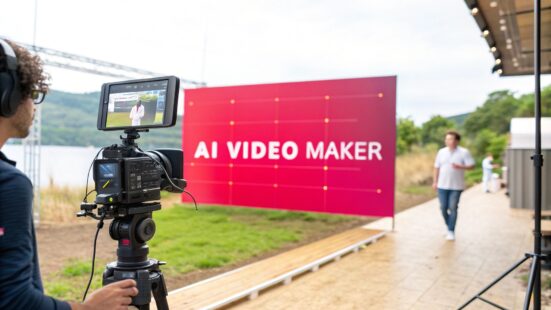
Ever feel like you need a whole film crew just to create a simple video? An AI video maker is like having that digital crew on standby, ready to turn your raw ideas into polished, ready-to-post videos in minutes.
You just feed it a simple text prompt, a link to a blog post, or a script, and the AI handles the heavy lifting—finding visuals, generating a voiceover, and even adding background music.
Table of Contents
What Exactly Is an AI Video Maker?
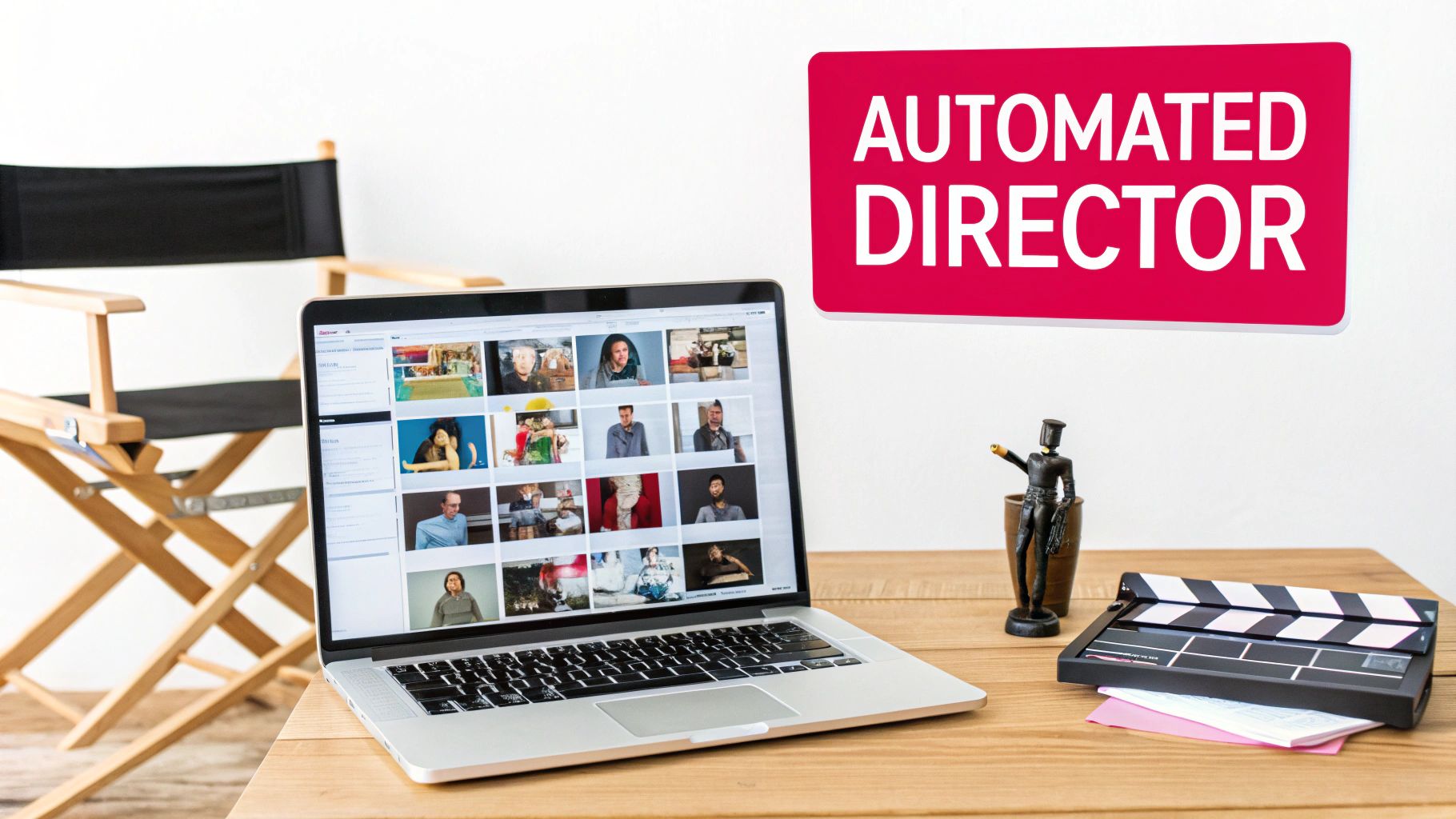
Think of an AI video maker as your automated director and production house rolled into one. Instead of juggling scriptwriters, camera operators, voice actors, and editors, you provide the core concept. The software then steps in to manage all the complex production tasks, piecing everything together into a professional final cut.
This isn't just about stitching random clips together. These platforms are smart enough to interpret your instructions and create a video that actually makes sense. The magic behind it all is generative AI, the same technology that powers popular AI image and text generators. This allows the tool to create brand-new visuals from scratch based on nothing more than a text description.
How the Technology Works
The whole process kicks off with your input. This could be a link to an article you've already written, a detailed script, or even just a single sentence describing the video you have in mind. From there, the AI gets to work.
First, it breaks down your text to understand the meaning, structure, and key points.
- Natural Language Processing (NLP): This is how the AI reads and understands your script. It identifies the main themes and keywords to figure out the narrative flow, deciding which scenes to create and in what order.
- Text-to-Speech (TTS): The platform then picks a synthetic voice from its library to generate a surprisingly human-like voiceover, syncing it perfectly with your script.
- Visual Generation and Selection: Based on its analysis, the AI either generates entirely new video clips or pulls the most relevant ones from a massive stock media library, making sure the visuals match what the narrator is saying.
This completely changes the game for video production. It makes creating high-quality video accessible to anyone, regardless of their budget or technical skills. You no longer need expensive gear or years of editing experience. By using AI for content creation, brands can finally scale their video output without needing to scale their resources.
The market is exploding for a reason. Valued at USD 614.8 million, the global AI video generator market is projected to skyrocket to USD 2,562.9 million by 2032. That's a compound annual growth rate of roughly 20.0%, showing just how quickly brands are jumping on board.
To give you a clearer picture, here's a quick rundown of what these platforms can do.
Core Capabilities of an AI Video Maker
This table summarizes the primary functions that define modern AI video creation platforms.
| Capability | Description | Example Use Case |
|---|---|---|
| Text-to-Video | Transforms written content (scripts, articles, prompts) into a complete video with visuals, voiceover, and music. | Turning a blog post about "Top 5 Skincare Tips" into a short, engaging social media video. |
| AI Voice Generation | Creates natural-sounding voiceovers from a script using text-to-speech (TTS) technology in various languages and accents. | Adding a clear, professional narration to a product demonstration video without hiring a voice actor. |
| Stock Media Integration | Automatically searches and selects relevant video clips, images, and music from huge royalty-free libraries. | Finding the perfect B-roll footage of a bustling city to match a scene in a travel brand's promo. |
| AI Avatars | Generates digital human presenters (avatars) that can speak your script on camera, adding a human touch. | Creating a series of training videos for new employees featuring a consistent, professional AI instructor. |
| Automated Editing | Handles tasks like scene transitions, text overlays, and synchronizing visuals with the audio track automatically. | Quickly adding animated captions and smooth cuts to a UGC testimonial to make it more dynamic. |
Essentially, these tools combine to create a seamless workflow, taking a simple idea and turning it into a finished video with minimal manual effort.
Exploring Key Features and Video Types
To really get how an AI video maker can reshape your content strategy, you have to look under the hood. These aren't just flashy tech novelties; they're practical tools built to solve the real-world headaches of video creation, from writing a script to making the final edits.
Each feature unlocks a new level of efficiency. Suddenly, brands can pump out a diverse range of video content at a scale that was unimaginable just a few years ago. Let's break down the most impactful features and see how they actually translate into assets for your business.
From Text to Video in Minutes
The absolute cornerstone of most AI video makers is text-to-video generation. This is the engine that turns your plain, written content into a fully produced video. Think of it as an automated production assistant that reads your script and immediately starts piecing together the visual story.
You just feed it text—a blog post, a product description, even a simple prompt—and the AI goes to town. It scans the content, picks out keywords, and pulls in relevant stock footage, images, and background music to match. In just a few minutes, that static document becomes a dynamic video, complete with text overlays and smooth transitions.
This is a game-changer for:
- Content Repurposing: Instantly turning your existing blog articles and whitepapers into snackable video summaries.
- Rapid Ad Creation: Pumping out multiple video ad variations from a single script to test what works best on different platforms.
- Internal Communications: Quickly creating informational videos from written company announcements or training manuals.
Lifelike AI Avatars and Presenters
What if you need someone on camera, but you're short on time, budget, or willing talent? This is where AI avatars step in. These are digitally created, photorealistic human presenters who can deliver your script straight to the camera.
You can pick from a library of diverse avatars, choose a voice, and the platform generates a video of them speaking your lines with surprisingly realistic lip-syncing and facial expressions. This feature adds a human touch to your videos without the logistical nightmare of setting up a real shoot.
The quality of AI avatars has gotten so good that for short-form content, many viewers can't even tell they aren't real people. This makes them a solid option for everything from corporate training videos to social media updates.
Automated Voiceovers and Narration
Hiring voice actors is expensive and slow, especially if you need content for different languages. AI video makers solve this with automated text-to-speech (TTS) technology. These platforms come loaded with hundreds of natural-sounding voices across dozens of languages and accents.
Just paste your script, pick a voice that fits your brand, and the AI spits out a crystal-clear audio track. This feature is a massive win for global brands, letting them localize video content for different markets with a single click and keeping the quality consistent across the board.
Intelligent Editing and Scene Selection
Manually digging through hours of footage to find the perfect clip is one of the biggest time-sucks in video editing. AI-assisted editing automates this by intelligently analyzing your script and suggesting the most relevant scenes.
The AI actually understands the context of your text and pulls clips that visually match the story you're telling. It also handles the tedious stuff like adding captions, applying transitions, and even detecting and snipping out awkward pauses in your audio. This smart assistance radically speeds up the post-production workflow, so you can focus on the creative side of things.
With these features, marketers can produce a wide variety of engaging video content. To get more ideas, explore different types of content for social media that can be created using these tools.
Weighing the Benefits and Limitations
Look, adopting any new piece of tech requires a clear-eyed view of what it can actually do for you. AI video makers offer some massive advantages, especially for brands that need to pump out content at scale. But it’s just as important to understand where the guardrails are right now.
Thinking this way helps you decide not if you should use these tools, but how and where they’ll make the biggest impact on your marketing. The upsides are seriously compelling, often completely changing workflows that used to be slow and expensive. For nimble e-commerce brands and busy marketing agencies, these benefits are a direct line to better business outcomes.
The Game-Changing Advantages
The first thing you'll notice is a huge drop in production time and cost. We all know the drill with traditional video: coordinating teams, booking locations, and then the endless post-production cycle. An AI video maker pretty much vaporizes that whole process, letting a single person spin up a finished video from a simple script in minutes.
This isn't just about saving a few bucks; it's about unlocking incredible speed and agility.
Imagine you need to A/B test ten different ad creatives for a new product launch. Traditionally, that would be a monumental task. With AI, you can generate ten unique video variations—each with a different hook, CTA, or visual style—in less than an hour. It’s a complete shift in what’s possible.
On top of that, AI is a stickler for brand consistency. Every single video can use your brand’s exact fonts, colors, and logo placements. The AI avatars and voiceovers also provide a perfectly uniform tone across all your communications, getting rid of the inconsistencies that pop up when working with different creators or actors.
The core value is simple: AI lets brands produce more video content, faster, and for a fraction of the cost, all while keeping a tight grip on the brand's look and feel. This turns video from a high-effort, high-cost headache into a routine marketing activity.
To really see the difference, let’s put the two workflows side-by-side.
Traditional vs AI Video Production Comparison
The table below breaks down the key differences in resources, time, and scalability when you compare old-school video creation with using an AI video maker.
| Aspect | Traditional Video Production | AI Video Maker |
|---|---|---|
| Timeline | Weeks or months | Minutes or hours |
| Cost | High (crew, gear, actors, locations) | Low (monthly subscription) |
| Scalability | Difficult and expensive | Effortless and affordable |
| Revisions | Time-consuming and costly | Instant and simple |
| Brand Control | Variable, depends on the team | Total, presets are locked in |
| Localization | Requires new shoots/voice actors | Simple, one-click language changes |
This comparison makes it pretty clear why so many teams are jumping on board. The efficiency gains are just too big to ignore.
Acknowledging the Current Limitations
As powerful as this all sounds, you have to be realistic about where the tech is today. While AI voices have gotten way better, they can sometimes miss the subtle emotional cues and inflections of a professional human voice actor. For certain types of content, they can still come off as a bit robotic.
Stylistic creativity can also be a hurdle. AI-generated videos often rely on stock footage libraries or follow pre-set templates. If you're not careful with customization, your content can end up with a generic, "cookie-cutter" feel. A human-led production still has the upper hand when it comes to creating truly unique, emotionally gripping, and artistically distinct content that really breaks the mold.
Finally, relying too much on automated tools without a solid creative strategy is a recipe for bland content. The risk is creating videos that look professional on the surface but fail to grab anyone's attention because they just blend in with everything else. The AI video maker space has exploded with vendors, and market research from firms like Gartner consistently points to key players like Synthesia, HeyGen, Pictory, and Runway. This gives brands plenty of specialized tools to choose from, but the core challenge of creating genuinely original content is still on you. You can explore the AI video generator market research to get a better sense of the growing options out there.
Weaving AI Video Into Your Marketing Workflow
Bringing a new tool into the mix is one thing, but actually making it a core part of your daily operations is another challenge entirely. An AI video maker isn't just a shiny new toy to play with—it's a production engine that can seriously amplify your whole content strategy. The trick is to stop thinking of it as a replacement for your creative team and start seeing it for what it is: a powerful assistant that takes the repetitive, time-sucking tasks off your plate.
By plugging AI into specific stages of your workflow, you can dramatically increase what your team can produce without needing to add headcount or make things more complicated. This lets you save your human creativity for where it really counts—on the strategy, the storytelling, and polishing the final product.
This simple flow chart breaks down how an AI tool compresses the whole production process from concept to launch.
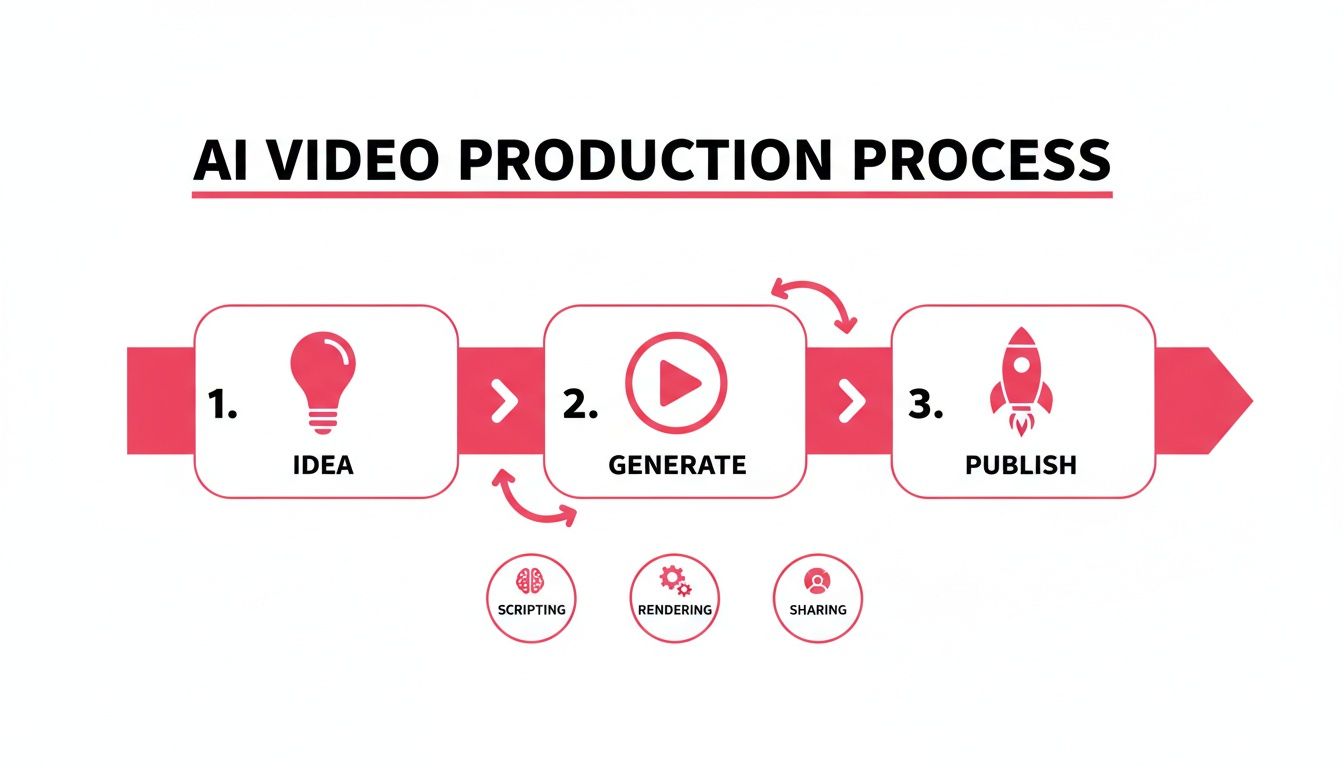
As you can see, AI basically squishes what used to be a long, drawn-out cycle into three straightforward, manageable stages.
A Practical Workflow for AI-Powered Video
You don't need to tear down and rebuild your entire marketing department to start using an AI video maker. It's much simpler than that. Just look for the friction points in your current process and see where AI can smooth things out. Here’s a step-by-step approach that high-performing teams are using to get the most out of these platforms.
1. Kick Things Off with Ideation and Concept Drafts
Instead of burning hours in brainstorming meetings, use the AI video maker as a rapid prototyping tool. Just feed it a simple prompt or a link to a competitor's blog post to generate a handful of "concept videos." These aren't supposed to be the final version; think of them as visual storyboards that help your team get on the same page about a creative direction in minutes, not days.
2. Repurpose Existing Content at Scale
Your blog posts, case studies, and customer reviews are absolute goldmines for video content that's just sitting there. The most efficient workflow is to make AI-driven repurposing a standard part of your publishing process. Every time you publish a new blog post, immediately pop it into a tool to generate a quick video summary for social media.
This "create once, distribute forever" mindset is how you build a massive content library without a massive budget. A single 2,000-word article can easily become a main explainer video, five short social clips, and a couple of ad variations.
3. Streamline Creator Collaborations and Briefs
Working with influencers or UGC creators can sometimes feel like a game of telephone, with endless back-and-forth to nail down the right tone and style. You can cut through that noise by creating an AI-generated "style guide" video to include with your creative brief. This gives creators a concrete visual example of the pacing, text overlays, and overall vibe you're after, which dramatically reduces misunderstandings and revision requests.
High-Impact Uses for E-commerce and Agencies
While you can use these tools for just about anything, a few applications deliver a seriously outsized return on investment. For e-commerce brands and marketing agencies, the real magic happens when you use AI for performance marketing and scaling your content output.
One of the most valuable workflows is creating dozens of ad variations for platforms like TikTok and Meta. You can take one core message and have the AI generate different versions by tweaking the:
- Hooks: Test out different opening lines to see what actually stops the scroll.
- Calls-to-Action (CTAs): Experiment with different offers or button text.
- Visuals: Swap background footage or product shots to appeal to different audience segments.
- Voiceovers: Use different AI voices or languages to localize your campaigns without any extra effort.
This kind of high-volume testing used to be a luxury reserved for brands with huge budgets. If you're looking to tighten up your ad campaigns, finding a platform that offers seamless integration with major advertising platforms like Google Ads is key to closing the loop between creating the ad and getting it live.
Refining and Approving AI-Generated Content
Last but not least, always remember that AI is your first drafter, not your final editor. The most successful teams put a clear review stage in place. The AI generates the initial video, and then it gets passed to a human editor or designer for a final polish. This human touch is what elevates a good AI video into a great one—adding unique brand elements, adjusting the timing for emotional impact, or just making sure everything feels right.
This is where having a structured approval process becomes essential. A clear system ensures that even though you're producing content quickly, it still meets your brand's standards for quality and messaging. To learn more about setting this up, check out our detailed guide on creating a content approval workflow that keeps your projects moving from draft to sign-off without a hitch.
How to Choose the Right AI Video Maker
Trying to pick an AI video tool can feel like wading through a sea of feature lists, with every platform promising the moon. It's easy to get analysis paralysis. To find the right tool for your brand, you have to cut through the marketing fluff and zero in on what actually impacts your content and your team's workflow.
This isn't about finding the tool with the most bells and whistles. It's about finding a partner that gets your brand, fits your marketing goals, and doesn't create legal headaches down the road. The perfect tool for a solo creator could be a total nightmare for a global e-commerce brand that needs tight security and deep customization.
Evaluate Avatar and Voice Realism
If your strategy involves using presenters for training, explainers, or marketing content, the quality of the AI avatars is everything. The whole point is to connect with your audience, and that’s impossible if your presenter sounds robotic or looks like it’s trapped in the uncanny valley.
As you check out different platforms, look for a deep bench of high-resolution, photorealistic avatars. But don't stop at the headshots. Pay attention to the tiny details in their performance.
- Lip-Sync Accuracy: Is the mouth movement perfectly in sync with the audio, or is there a distracting delay?
- Natural Expressions: Do the avatars have subtle facial cues, like a slight smile or raised eyebrow, that match the script's tone?
- Voice Inflection: Can the AI voice actually perform? Does it add emotional weight and vary its pitch, or does it drone on in a flat monotone?
Always, always use the free trial to run a few of your own scripts. A polished demo video can hide a multitude of sins. Hands-on testing is the only way you'll know for sure if an AI presenter is good enough to represent your brand.
Prioritize Brand Customization and Control
A video that looks like a generic template is worse than no video at all. The right AI video maker should feel like an extension of your brand kit, not a cookie-cutter solution that makes you look like everyone else. For brands, the ability to inject your unique identity into every single frame is non-negotiable.
Dig into the customization options. You need a tool that lets you upload and save your brand's core assets—logos, specific hex codes, and custom fonts. The best platforms allow you to create and save branded templates, which guarantees every video your team pumps out is automatically on-brand. That’s how you scale video production without watering down your identity.
A key differentiator is the ability to create reusable "scenes" or "brand kits." This feature saves immense time by letting you pre-design intros, outros, and call-to-action segments that can be dropped into any new project with a single click.
Scrutinize Security and Content Ownership
This is the part that trips up a lot of brands. The excitement over a cool new AI tool can quickly turn into a legal and security mess if you don’t read the fine print. Before you commit, you absolutely have to know who owns the content you create and how the platform is protecting your data.
It's time to put on your lawyer hat and dive into the terms of service and privacy policy. Look closely at these three areas:
- Commercial Rights: Does your subscription give you full, unrestricted commercial rights to use the videos wherever you want? You need a clear license to use your creations in paid ads, on your website, and across social media without any strings attached.
- Data Security: How are they handling your scripts, brand assets, and user info? Look for providers that are open about their security measures, like data encryption and compliance with standards like GDPR or SOC 2.
- Ownership of Underlying Assets: Here’s a key distinction: you'll own the final video, but you won't own the AI models, stock footage, or avatars the platform provides. Understanding this separation is crucial for avoiding copyright trouble later.
Choosing a platform with clear, creator-friendly terms is just as important as its features. A secure and transparent partner gives you the freedom to create without constantly looking over your shoulder, knowing your brand and your IP are safe.
So, What's the Verdict on AI Video?
Let's be clear: the rise of the AI video maker isn't putting your creative team out of a job. Think of it as the start of a whole new chapter. These tools aren’t here to replace human creativity; they’re here to collaborate with it.
They’re brilliant at handling the grunt work—the repetitive, time-sucking tasks that clog up the production pipeline. By automating that heavy lifting, your team is freed up to focus on what actually moves the needle: killer strategy, compelling storytelling, and forging a real emotional connection with your audience.
The core benefits are impossible to ignore. Being able to spin up video content in a fraction of the time and for a fraction of the cost throws the door wide open to possibilities that used to be out of reach for most brands.
The Path Forward Is Smart Adoption
This incredible efficiency means you can finally scale your video marketing, run high-volume A/B tests on ad creatives without breaking the bank, and lock in perfect brand consistency across every single video.
But—and this is a big but—it's critical to walk into this with your eyes open. The subtleties of human emotion, genuine artistic flair, and truly original ideas? That’s still where the human touch is absolutely essential.
The smartest way forward is to be strategic. An AI video maker is the perfect tool for scaling social media ads, churning out internal training videos, or quickly turning blog posts into snappy, engaging summaries.
Don't sit on the sidelines waiting for the tech to be "perfect." The time to start experimenting is now. Pinpoint a low-stakes, high-impact area in your current workflow and see how these platforms can amplify what you’re already doing.
If you embrace AI as a creative partner today, you’re not just positioning your brand to keep up with the future of marketing—you’re helping to build it.
Got Questions? We’ve Got Answers.
Jumping into the world of AI video can feel a bit like learning a new language. You know it's powerful, but there are a lot of questions that pop up when you start thinking about how to actually use it for your brand.
We get it. To make a smart decision, you need clear, straight answers. Let’s tackle some of the most common questions brands ask when looking at AI video makers.
Can These Tools Make Videos in Different Languages?
Absolutely, and this is where they really shine for brands with a global footprint. Most of the top-tier platforms come loaded with AI voices in dozens of languages, often complete with different regional accents. This means you can spin up localized video content for international markets in just a few minutes.
Forget the headache of sourcing and coordinating with a bunch of different voice actors. You can just pick a new language from a dropdown menu. Many of these tools even handle caption translations automatically, making it incredibly simple to scale your marketing campaigns across the world without blowing your budget or timeline.
Who Actually Owns the Copyright to an AI-Made Video?
This is a big one, and the answer is almost always found in the platform's terms of service. For the most part, reputable, commercial-grade AI video makers will grant you full ownership and commercial rights to any video you create under a paid subscription.
Here's the key distinction, though: you own the final video file you created, but you don’t own the building blocks. That means the AI models, the stock footage library, or the AI avatars themselves still belong to the platform.
Before you commit to any tool, read the licensing and copyright terms carefully. You're looking for language that explicitly gives you a royalty-free, perpetual license to use your videos for any commercial purpose, including paid ads.
How Real Do the AI Avatars and Voices Actually Look and Sound?
The quality has come a long way in the last couple of years, but it definitely varies from one tool to another. The best platforms now offer photo-realistic avatars with surprisingly natural facial expressions and lip-syncing that can be tough to spot as AI in short clips.
Likewise, the newest AI voices are worlds away from the monotone robots of the past. They can deliver a pretty convincing range of tones, whether you need a professional, authoritative voice or something more friendly and casual.
Even with these leaps forward, perfectly nailing subtle human emotion and inflection is still the final frontier.
- For corporate training or straightforward product demos, the quality is usually more than good enough. It delivers a polished, consistent presenter every time.
- For high-engagement social ads where you’re trying to build a deep emotional connection, a talented human creator might still have the edge.
Our best advice? Take advantage of the free trials. Upload your own scripts and see for yourself. Testing the avatars and voices with your own content is the only way to know for sure if the realism meets your brand’s standards.
Ready to scale your video content with authentic creators and powerful AI tools? JoinBrands connects you with over 250,000 creators to produce high-impact UGC, TikTok Shop videos, and social ads effortlessly. Start your campaign today!