



 Master Content Marketing Attribution for Better ROI
Picture a brand ambassador who can work around the clock, speak any language on the fly, and tailor their message to thousands of different customers all at once. That's the reality of Avatar AI. These aren't just digital puppets; they're sophisticated, data-driven personas built to create interactions that feel genuinely human.
Table of Contents
What Is Avatar AI and Why Does It Matter for E-Commerce?
At its heart, an avatar AI is a digital version of a person, powered by artificial intelligence to communicate and interact just like a real human would. But unlike a static picture or a pre-recorded video, these avatars can generate brand-new speech and expressions in real-time. They represent the next big leap in creator marketing, giving brands a way to produce massive amounts of high-quality, personalized video content at scale.

For direct-to-consumer (DTC) and e-commerce brands, this technology cracks a major code: how to churn out tons of tailored content without the logistical nightmare and high costs of traditional video shoots. An avatar can become the consistent face of your brand across every digital touchpoint, from social media ads to on-site customer support.
The Technology Behind the Persona
So, what’s the magic that makes these digital people so convincing? It’s not just one thing, but a powerful mix of several advanced technologies all working together to create a believable and engaging experience. Each piece of the puzzle plays a specific role in bringing the avatar to life, pushing it far beyond simple animation.
Let's break down the tech stack that powers these avatars. This table gives you a quick look at the core components and what they mean for your brand.
Key Components of Avatar AI Technology
| Component | What It Does | Benefit for E-commerce Brands |
|---|---|---|
| Generative AI | The creative engine. It generates the avatar's appearance, voice, and movements from scratch based on inputs like a text script. | Drastically cuts down content production time. A single script can become dozens of video variations for different platforms or audiences. |
| Natural Language Processing (NLP) | The brain for conversation. It allows the avatar to understand human language, process questions, and formulate relevant, natural-sounding responses. | Powers intelligent chatbots that can handle complex customer service queries, provide product recommendations, and guide users 24/7. |
| Machine Learning (ML) | The learning mechanism. It analyzes data from past interactions to continuously improve the avatar's performance, making it more accurate and personalized over time. | Interactions get smarter and more effective with every conversation, leading to higher customer satisfaction and better conversion rates. |
This combination is what allows an avatar AI to do more than just read a script. It can adapt its tone for a viral TikTok video, answer tricky product questions on your website, or even walk a customer through the checkout process.
The AI avatar market has absolutely taken off, recently valued at USD 2.5 billion in 2024 and projected to hit a staggering USD 63.5 billion by 2034. For DTC brands, this signals a massive shift. AI avatars are quickly becoming must-have tools for scaling creator campaigns, capable of cutting production costs by up to 70% compared to traditional shoots while delivering 30-50% higher conversion rates on personalized ads. You can explore more data on the AI avatar market growth and its impact.
The real value of Avatar AI lies in its ability to blend the scalability of automation with the personal touch of human interaction. It's a tool that lets brands be everywhere at once, without losing their voice.
By bringing these technologies together, brands can maintain a consistent, authentic persona that builds real engagement and works hand-in-hand with human influencers to drive results.
Exploring the Different Types of AI Avatars
Not all AI avatars are created equal. Just like you wouldn't use a sports car to haul furniture, the type of avatar you choose needs to match the job. The world of digital personas is surprisingly diverse, ranging from simple 2D characters all the way to hyper-realistic virtual influencers with massive followings.
Understanding these differences is the first step to picking the right tool for your brand's goals.
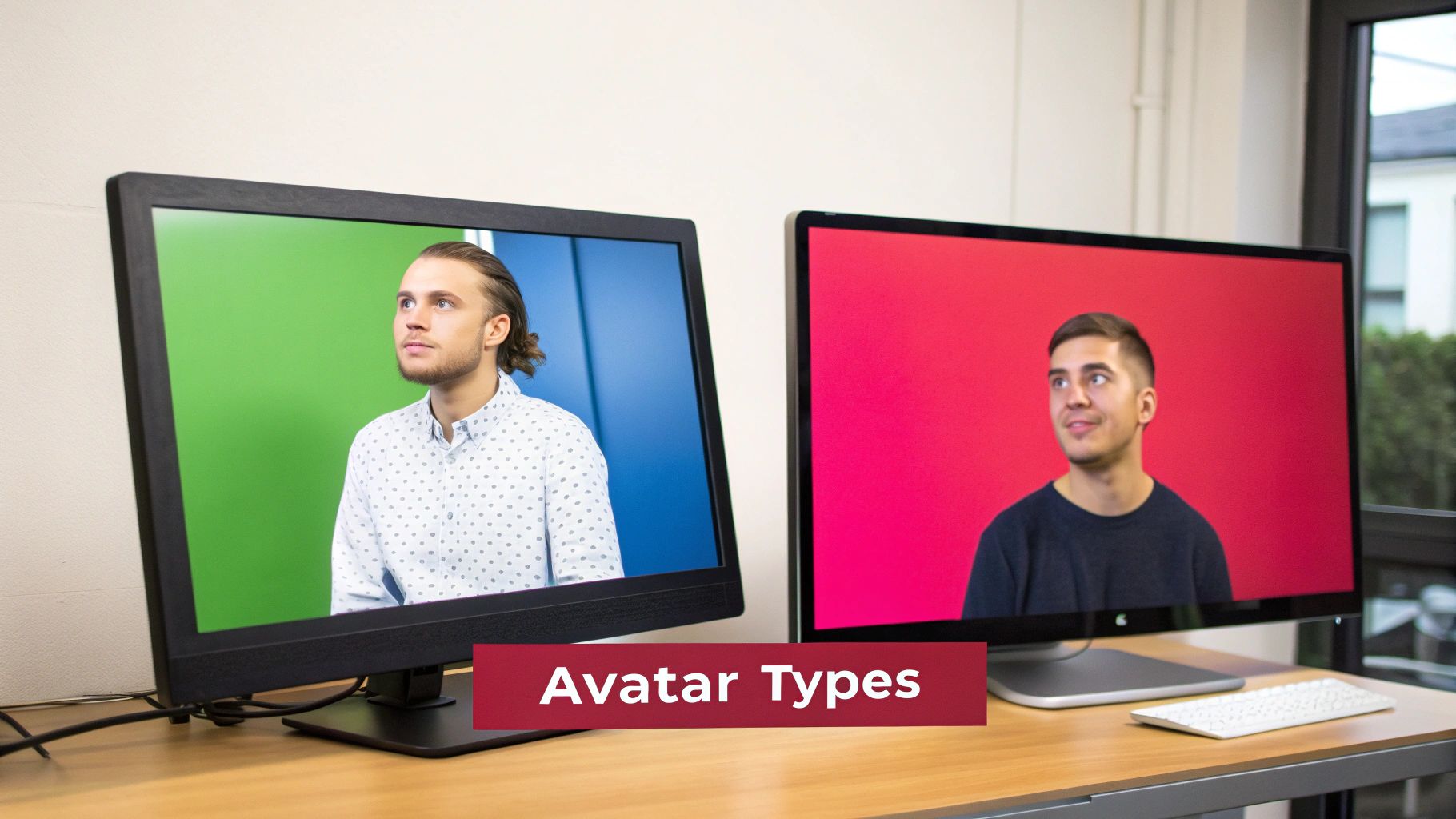
The avatar you use for a quick customer service chatbot is fundamentally different from one designed to host a virtual event in the metaverse. Each type is built on different tech and shines in different situations.
Let’s break down the main categories to help you find the perfect fit for your next campaign.
Photorealistic Avatars
Think of these as the "digital twins" of the avatar world. Created from high-res photos or videos of a real person, photorealistic avatars are designed to be almost indistinguishable from a human on screen.
They’re perfect when authenticity and authority are non-negotiable. A brand might use a photorealistic avatar of its CEO to deliver a company-wide announcement or create a digital version of a subject matter expert for training modules. The goal is pure realism and credibility.
Stylized and Animated Avatars
Moving away from pure realism, stylized avatars embrace a more creative and branded look. These can be anything from cartoonish 2D characters in an explainer video to complex 3D animated figures that embody a brand's personality.
Think of the animated characters you see in mobile games or a brand’s social media filter. These avatars give you a ton of design flexibility and are fantastic for:
- Brand Storytelling: Creating unique characters that become instant brand mascots.
- Customer Engagement: Using friendly, approachable figures for tutorials or website welcome messages.
- Gamification: Weaving fun, interactive elements into your marketing campaigns.
To get a sense of how realistic this tech can get, just look at the explosion of AI professional headshots, where AI generates convincing portraits from scratch for all kinds of uses.
When you go with a stylized approach, you can build a memorable persona that truly stands out. You aren't constrained by the need to perfectly replicate a real person, and that creative freedom is a powerful way to differentiate your brand.
3D and Metaverse Avatars
This is the cutting edge of avatar technology. We're talking about fully-rendered, three-dimensional models built for immersive spaces like virtual reality (VR), augmented reality (AR), and the metaverse. They are by far the most complex and interactive type.
The 3D & Metaverse avatar segment is the fastest-growing, rocketing ahead at a 37.4% CAGR. Big players like Synthesia and HeyGen are leading the charge. Right now, preset avatars hold 39.5% of the market share because they let brands deploy quickly, especially in retail where end-user growth is hitting 40% annually. This tech is also a game-changer for budgets, allowing marketing agencies to see up to 45% cost savings on video production.
These avatars can walk, talk, and interact within a virtual world. That makes them perfect for virtual product launches, immersive shopping experiences, or hosting digital events. As more people spend time in these digital worlds, these avatars will become essential for any brand wanting to build a real presence there.
Putting AI Avatars to Work for Your DTC Brand
Okay, understanding the tech behind AI avatars is one thing. But the real magic happens when you see how it can actually make a difference for your business. For DTC brands, this isn't just a cool gimmick; it's a serious tool for scaling up, getting personal with customers, and ultimately, boosting your bottom line. It's about turning that "what if" potential into real, measurable results.
Let's dig into the practical, high-impact ways you can put AI avatars to work. Think of these as solutions to the classic DTC headaches, from breaking through a crowded market to going global without needing a massive team.
Hyper-Personalize Your Video Ads at Scale
We’ve all seen it happen. You run the same video ad for a few weeks, and engagement just tanks. Ad fatigue is one of the biggest hurdles for any DTC brand. AI avatars offer a way out by enabling hyper-personalization at scale—something that would be a logistical nightmare and way too expensive with traditional video shoots.
Picture this: you have one killer script for a new product launch. Instead of shooting just one video, you use an avatar to spit out hundreds of unique variations in minutes.
- Audience Segmentation: Create different ad versions for different people. An avatar can switch up its tone, language, or even reference specific interests to connect with Gen Z on TikTok versus an older crowd on Facebook.
- A/B Testing: Want to test a dozen hooks, calls-to-action, or value props? Easy. An AI avatar can record 20 different opening lines for the same ad, letting you quickly find the winner without a single reshoot.
- Dynamic Content: You can even connect an avatar platform to your product feed to create ads featuring the exact items a user just browsed. The avatar can greet them by name and talk about the specific product they were just looking at.
This approach has a direct impact on your most important metrics. When you deliver content that feels like it was made just for them, you can seriously lower your customer acquisition costs (CAC) and see conversion rates climb.
The core advantage here is efficiency. You're not just making more ads; you're making smarter, more effective ads that resonate on an individual level, all from a single core asset.
Deploy a 24/7 Virtual Shopping Assistant
Your website is your digital storefront, but most of the time, it's missing a helpful guide. An AI avatar can step into that role, acting as a 24/7 virtual shopping assistant that makes the customer's journey better from the second they land on your site.
This is way more than your standard chatbot pop-up. A lifelike avatar can proactively greet visitors, answer tricky questions, and provide a guided shopping experience that builds trust and nudges them toward a sale.
Here's how it could work:
- Product Demonstrations: Pop an avatar on your product pages to give video demos on demand. It can walk through key features, show off different uses, and answer FAQs in a friendly, interactive way.
- Personalized Recommendations: By connecting to your customer data, the avatar can act like a personal stylist, offering tailored suggestions based on what a user has looked at or bought before.
- Checkout Assistance: Cut down on abandoned carts by having an avatar guide users through the checkout process. It can clear up shipping questions or handle any last-minute worries.
Expand Globally with Multilingual Avatars
Breaking into new international markets is a huge project. It usually means hiring local teams, translators, and creating culturally specific marketing campaigns from scratch. An AI avatar smashes that barrier to entry. With just a few clicks, your digital brand ambassador can speak dozens of languages fluently, complete with perfect lip-syncing.
This lets you roll out localized marketing campaigns for multiple countries at the same time, without the crazy costs of hiring native-speaking actors for each one. Your avatar can deliver a consistent brand message that feels completely natural to each audience, helping you build trust and recognition in new markets way faster and cheaper. It's a direct path to scaling your brand’s presence worldwide.
Integrating AI Avatars Into Your Marketing Workflow
Bringing new tech into the mix shouldn't mean blowing up your current processes. The good news is that weaving an AI avatar into your marketing campaigns is way more straightforward than you might think.
The key is to map the process onto a familiar, four-phase structure that probably looks a lot like how you already work with human creators. This makes the whole thing less mysterious and turns AI avatars into a scalable part of your strategy, not some disruptive headache. It keeps your brand’s voice, goals, and quality standards right where they belong—at the center of everything.
Phase 1: The Creative Brief
Just like any influencer or creator campaign, it all starts with a solid creative brief. This is ground zero. It's where you nail down the "who, what, and why" of your campaign to make sure the AI-generated content hits the mark. Think of your brief as the main instruction manual for the AI.
Your brief needs to clearly spell out:
- Persona and Tone: Is your avatar a super-energetic product expert? A calm, reassuring guide? Or maybe a quirky brand mascot? You've got to define their personality, the words they use, and their emotional vibe.
- Campaign Goals: What do you actually want people to do after watching? Are you chasing clicks, sign-ups, or just trying to get your name out there?
- Script and Key Messages: This is where you provide the exact script the avatar will say. Don't forget any must-have talking points, brand-specific phrases, or the all-important call-to-action.
- Visual Guidelines: Specify the background, any on-screen text, and brand assets like logos or specific color palettes that need to show up in the final video.
A detailed brief takes the guesswork out of the equation and paves the way for a smooth production run.
Phase 2: AI-Powered Production
Once the brief is locked in, it’s time for production. But instead of juggling a film crew and location scouting, you’re logging into an avatar AI platform. This is where your script and creative direction spring to life, turning your text into a finished video. The platform does all the heavy lifting—animation, voice synthesis, and getting the lip-sync just right.
Typically, this phase is as simple as uploading your script, picking your avatar (whether it's a pre-designed one or a custom creation), and setting up the visual extras like backgrounds and branding. Many of these tools can crank out the first version of a video in just a few minutes. That’s a job that could take days or even weeks with a traditional shoot, giving you the speed to A/B test different hooks or messages on the fly.
This workflow shows how these familiar marketing steps get a turbo-boost with an AI avatar.
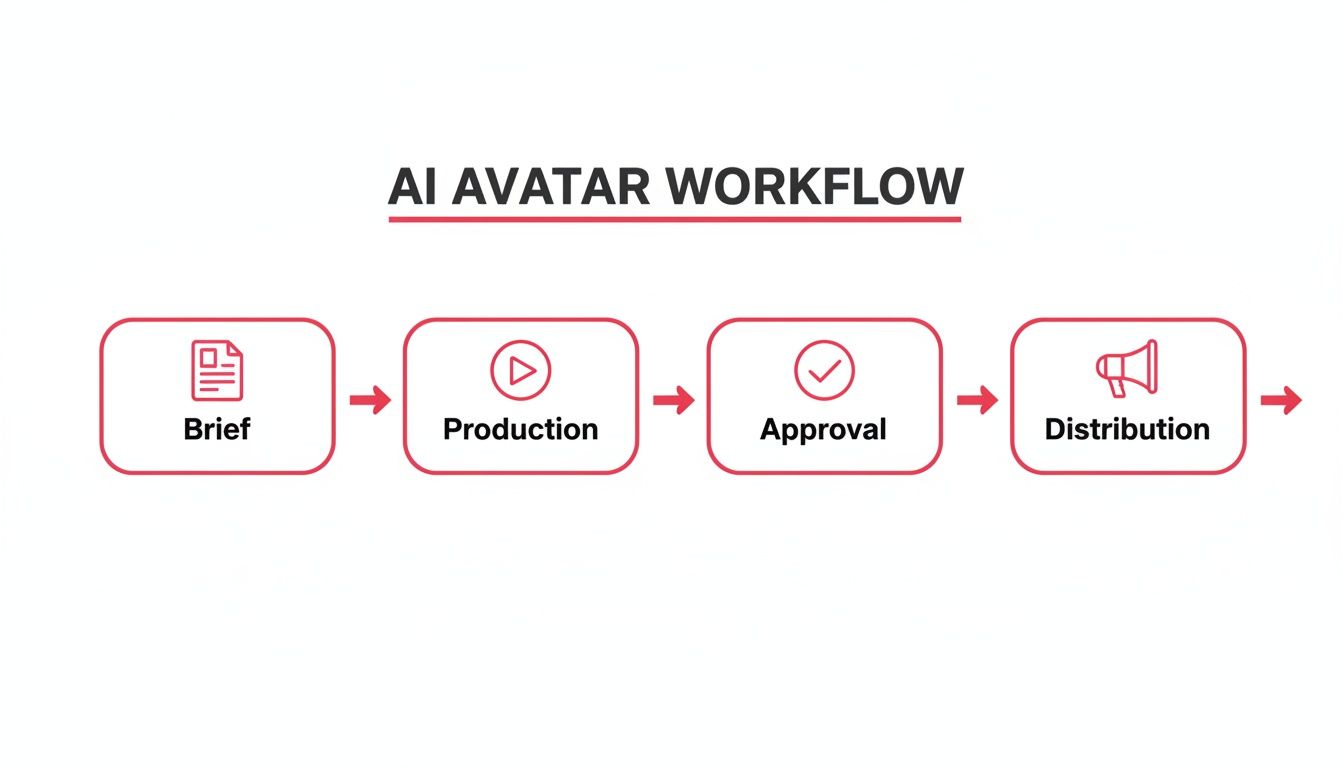
As you can see, you’re not reinventing the wheel. You’re just swapping out manual production headaches for automated efficiency.
Phase 3: Approval and Iteration
After the platform works its magic and generates the video, it's time for review and approval. This is pretty much the same as watching the first cut from a human creator. It's your chance to make sure everything lines up with the brief, from the avatar's delivery and pacing to the overall look and feel.
The real power of an AI workflow shines during iteration. If a word is mispronounced or the tone isn't quite right, you don’t need to schedule a reshoot. You simply edit the text script and regenerate the video in moments.
This feedback loop is incredibly fast and saves a ton of money. You can tweak tiny details—a single word, a pause, or even the whole script—without racking up more production costs. For a deeper dive on how this fits into a bigger plan, check out our guide on using AI for content creation.
Phase 4: Distribution and Activation
With the final video approved, you’re on to the last step: distribution. Honestly, this part is identical to any other marketing campaign you run. You take your shiny new AI-generated content and push it out across all your planned channels.
This could mean:
- Running it as a paid ad on TikTok, Instagram, or YouTube.
- Embedding it on a product page to serve as an interactive demo.
- Dropping it into an email marketing campaign to explain a new feature.
- Posting it organically to your social media feeds.
By sticking to this four-step workflow, you can plug AI avatars right into your marketing machine without skipping a beat. It becomes one more powerful tool in your belt for creating personalized, scalable video content that connects with your audience.
Measuring the ROI of Your AI Avatar Campaigns
So, you’re investing in new tech. That always feels like a bit of a calculated risk, doesn't it? But how do you actually prove your bet on avatar AI is paying off? To get the budget you need and scale up your efforts, you have to look past the easy vanity metrics like views and likes.
The real story, the one your leadership wants to hear, is told through the numbers that hit the bottom line. I’m talking about engagement rates, conversion rates, and the all-important cost-per-acquisition (CPA). By building a clear, data-driven framework, you can show the tangible value of AI avatars and make a solid case for making them a permanent part of your marketing mix. This isn't just about showing off cool tech; it's about proving it drives real growth for your brand.
Defining Your Key Performance Indicators
Before you can measure success, you have to define what success actually looks like for this specific campaign. Every campaign is different, so your KPIs need to line up perfectly with your original goals. Are you trying to drive sales, capture leads, or just get your name out there?
Here are some of the essential metrics you should be tracking for your avatar AI campaigns:
- Engagement Rate: This is your classic likes, comments, shares, and saves. High engagement is a great sign that your avatar's content is hitting the mark with your audience and grabbing their attention.
- Click-Through Rate (CTR): This one’s simple: how many people clicked the link in your post or ad? A strong CTR tells you that your avatar’s call-to-action is compelling enough to make people act.
- Conversion Rate: This is the big one. It's the percentage of users who actually did the thing you wanted them to do, like making a purchase or signing up for a newsletter. This metric is critical for proving a direct impact on revenue.
To really dial things in, you should also consider using various conversion rate optimization techniques to refine your strategy and squeeze the most value out of every interaction.
Calculating the Return on Investment
Figuring out the ROI of an avatar campaign comes down to a straightforward comparison: what did you spend, and what did you get back? The simplest way is to stack up the total investment in creating and running the campaign against the revenue or value it generated.
Start by adding up all your costs. This includes any subscription fees for the AI platform, custom design work for your avatar, and the time your team puts into the project. Then, track the revenue that came directly from the campaign. For a more sophisticated look, getting a handle on what is attribution modeling can help you accurately assign credit to your avatar's touchpoints, especially when the customer journey is complex.
The true financial power of an avatar AI becomes clear when you compare its cost-effectiveness against traditional content production. Consider the high fees for human influencers, location rentals, and video editing crews—costs that AI largely eliminates.
To illustrate this, let's break down the potential costs side-by-side.
Comparing Campaign Costs Traditional vs AI Avatar
Here’s a look at how the expenses for a typical social media video campaign might stack up when using a human creator versus an AI avatar.
| Cost Factor | Traditional Human Creator Campaign | AI Avatar Campaign |
|---|---|---|
| Creator / Talent Fees | $500 – $5,000+ per video | $0 – $500 (Platform subscription / one-time fee) |
| Production Crew | $1,000 – $10,000+ (Director, camera, sound) | $0 (Handled by AI platform) |
| Location / Studio Rental | $300 – $2,000+ per day | $0 (Virtual backgrounds included) |
| Equipment Rental | $200 – $1,500+ (Cameras, lighting, mics) | $0 (All digital) |
| Editing / Post-Production | $500 – $3,000+ | $0 – $100 (Included in platform or minimal edits) |
| Revisions & Reshoots | $500 – $5,000+ (Can be very costly) | $0 – $50 (Quick and cheap text-based edits) |
| TOTAL ESTIMATE | $2,500 – $26,500+ | $0 – $650+ |
As you can see, the savings can be substantial, allowing brands to reallocate that budget toward ad spend or producing even more content.
The digital avatar market is absolutely exploding. It was valued at USD 18.19 billion in 2023 and is projected to hit an incredible USD 270.61 billion by 2030. For brands, this growth translates into results you can measure: personalization from AI avatars can boost engagement by 40% over static ads, and some retailers have seen sales jump by 25% just by using avatar-led product demos. With agencies reporting 60% faster campaign launches, the ROI becomes undeniable. When you focus on these hard numbers, it’s clear that avatar AI isn’t just another expense—it's a strategic investment that drives efficiency and growth.
Getting Real About Authenticity and Ethics with AI Avatars
Using AI avatars the right way means using them responsibly. Simple as that. As this tech weaves itself into our daily lives, the line between human and digital gets blurrier, which puts a huge premium on trust. For any DTC brand, the end game is building a rock-solid, long-term relationship with customers, and that starts with being upfront about how you use technology.
It all boils down to one simple idea: transparency. Your audience should never, ever feel like you're trying to pull a fast one on them. If they're talking to an AI, they deserve to know.
Trust Is Built on Transparency
The biggest mistake you can make with an AI avatar is letting your audience think it's a real person. The second a customer figures out your friendly on-screen guide is a bot, any trust you've built can evaporate instantly. This isn't just about dodging a potential PR headache; it’s about basic respect for your customers.
Being clear is your best defense against skepticism. A simple, honest disclosure actually builds credibility and shows you're a brand that values honesty over trickery.
Here are a few practical ways to keep things transparent:
- Label It Clearly: Just add a small, easy-to-see disclaimer like "AI-powered assistant" or "Meet our digital ambassador" wherever your avatar appears.
- Introduce Your Bot: When a visitor first interacts with your AI avatar, use a quick pop-up or an initial chat message to introduce it as a digital helper.
- Keep Your Voice Consistent: Make sure your avatar's personality fits your brand. An AI that sounds completely out of step with the rest of your marketing is just confusing and feels fake. For a deeper dive, check out our guide on building authenticity in modern marketing to keep your entire message on point.
Sidestepping the Uncanny Valley
Ever seen a CGI character that's almost human but something is just… off? That's the "uncanny valley." It’s that weird, unsettling feeling you get from a digital creation that's trying too hard to be real and fails. An avatar that lands in this creepy space will turn customers away faster than you can say "buy now."
The goal isn't perfect realism; it's relatability.
An avatar doesn't need to look perfectly human to be effective. It just needs to feel genuine within its defined persona. A stylized, animated character is often more engaging than a hyper-realistic one that feels slightly "off."
Instead of chasing flawless human replication, focus on creating a persona that is likable and consistent with your brand. Give your avatar a personality that makes sense, making sure its expressions and tone feel natural for the role it's playing. This approach helps you build a genuine connection without making anyone uncomfortable. Think of your avatar as a believable brand representative, not an unnerving digital clone. Get this right, and your AI avatars will strengthen your brand, not weaken it.
Got Questions About Using Avatar AI?
Whenever a new tool this powerful comes along, it’s natural to have questions. We hear them all the time from marketers trying to figure out where this tech fits in. They're wondering about the learning curve, the impact on human creators, and if it's all just a little too weird for their audience.
Let's cut through the noise and tackle the real-world questions that pop up when you're seriously considering this new way of making content.
Do I Need to Be a Tech Expert to Use Avatar AI?
Not at all. This is probably the biggest myth out there—the idea you need a background in coding or AI to bring a digital persona to life. The truth is, modern avatar AI platforms are built for marketers, not developers. Most have super intuitive interfaces that are about as complicated as writing a script and clicking "generate."
Think of it like using your favorite social media scheduler or a drag-and-drop video editor. You bring the creative vision—the script, the brand voice, the campaign goals—and the platform does all the heavy lifting. It handles the animation, voice synthesis, and lip-syncing in the background. If you can put together a creative brief, you've got this.
Will AI Avatars Replace Human Creators and Influencers?
This is a big one, and it's a fair concern. But the reality is much more about collaboration than competition. AI avatars aren’t here to replace human influencers; they’re here to augment their efforts and fill specific gaps in your marketing plan. People are still the masters of building deep, authentic connections and bringing that spark of genuine creativity to a campaign—something AI just can't fake.
Instead, think of avatar AI as your new secret weapon for scale and efficiency.
- Handling the Repetitive Stuff: Use avatars for high-volume content, like cranking out personalized ad variations or multilingual product tutorials. This frees up your human creators for the strategic, high-impact work they do best.
- A/B Testing on Steroids: An avatar can spit out dozens of ad variations in minutes. That's a task that would be wildly time-consuming and expensive with a human creator.
- Filling Content Gaps: Avatars can work 24/7, keeping your social channels buzzing even when your human team is off the clock.
The smartest strategies will blend the best of both worlds. A human influencer might kick off a major campaign, and an AI avatar could handle the personalized follow-up ads that retarget interested viewers. It’s a partnership, not a replacement.
Can an AI Avatar Truly Feel Authentic?
Here’s the thing: authenticity with an avatar isn't about tricking your audience into thinking it's a real person. In fact, being upfront about it is crucial. Real authenticity comes from creating a persona that is consistent, relatable, and completely true to your brand's voice.
An avatar feels genuine when its personality, language, and style line up perfectly with what your customers expect from you. It's not about chasing flawless human realism, which can honestly get a little creepy and land in the "uncanny valley." You're better off focusing on a likable, well-defined character that serves a clear purpose. A friendly, stylized bot is often way more engaging and authentic to its role than a hyper-realistic avatar that just feels… off.
Ready to see how an AI-powered workflow can scale your brand's content? JoinBrands connects you with over 250,000 creators, including AI and UGC producers, to amplify your social presence and accelerate sales. Streamline your entire campaign from brief to distribution. Explore the JoinBrands platform today and start creating at scale.