
 Social Media Crisis Management That Actually Works
Branded content marketing is simply the art of creating content that your audience actually wants to watch, read, or listen to. It's not about interrupting them with a sales pitch. Instead, it’s about weaving your brand's message into a compelling story that provides real entertainment, education, or value. Think of it as building an emotional connection, not just pushing a product.
Table of Contents
What Is Branded Content Marketing Really

Let's get past the textbook definition for a second. Branded content isn't the commercial break; it's the main event. It’s the documentary, the short film, or the article that people would actively search for. This is the big shift: instead of just buying ad space, your brand becomes a creator of culture.
At its heart, this approach is built on one powerful truth: people hate being sold to. Traditional ads often feel like a demand for attention, which makes us want to immediately tune out. Branded content completely flips that script by putting the audience's interests first.
The Philosophy of Value Over Volume
The core idea here is to give something genuinely valuable to your audience. And that value doesn't always mean a discount. It could be a powerful story, a genuinely useful tip, or just a moment of pure entertainment.
When you create content that mirrors your brand’s values and connects with what your audience is passionate about, you start building real trust. That's how a brand goes from being an annoying interruption to a welcome part of someone's day. For a deeper dive, you can learn more about https://joinbrands.com/blog/what-is-branded-content/ and see how it stands apart from other marketing methods.
Branded content’s main job is to forge an emotional connection. It avoids the hard sell, focusing instead on telling a great story that builds loyalty and makes people feel good about your brand.
Building Authentic Connections
Ultimately, this strategy is about humanizing your brand. Sharing stories about your mission, the people behind the curtain, or the community you're building creates a personal connection that a banner ad never could. When you get it right, your brand’s presence feels totally natural and actually adds to the experience.
This focus on authenticity is what modern marketing is all about. It’s a big reason why formats like user-generated content (UGC) work so well—they tap into real stories from real people. This "audience-first" mindset is the bedrock of any successful branded content marketing campaign, turning passive viewers into true fans.
Building Your Branded Content Framework
Great branded content doesn't just happen on a whim; it's the result of a deliberate, strategic framework. Think of it like a blueprint for a house. Without a solid plan, you're just putting up walls and adding rooms with no real structure or purpose. A strong framework makes sure every single piece of content you create has a job to do and connects with your audience in a meaningful way.
This kind of structured thinking is what separates random acts of content from a predictable engine for brand growth. It’s the difference between shouting into the void and starting a real conversation. By nailing down your goals, getting to know your audience, defining your voice, and organizing your big ideas, you lay the foundation for content that not only gets seen but also delivers real, measurable results.
Define Your Core Objectives
Before you create a single thing, you have to ask the most important question: "What are we actually trying to achieve here?" Your goals are the compass for your entire strategy. Without them, you have no way to measure success or justify the time and money you're putting in. And these objectives need to be specific—way more specific than just "going viral."
Your goals will shape the kind of content you make and the metrics you obsess over. They bring clarity and focus, making sure everyone on your team is rowing in the same direction and your resources are being put to good use.
- Increase Brand Awareness: Are you the new kid on the block? Your goal might be to grab a bigger share of the conversation in your industry or see more brand mentions pop up on social media.
- Generate Qualified Leads: Is driving sales the top priority? If so, your content should be built to capture contact info through valuable downloads, webinar sign-ups, or newsletter subscriptions.
- Build Community and Loyalty: Want to turn one-time customers into lifelong advocates? Focus on content that sparks interaction, gets people involved, and makes your audience feel like they're part of an exclusive club.
- Educate the Market: Is your product a bit complex or in a brand-new category? Your main goal would be to create content that breaks down tricky concepts, answers common questions, and positions your brand as the go-to expert.
Getting this clarity is non-negotiable. The global content marketing market is expected to balloon to $2 trillion by 2032, driven by marketers who are laser-focused on real outcomes like generating ROI (34%) and creating content that truly connects (28%). You can explore more about these content marketing trends and see why a goal-first approach is the only way to win.
Deeply Understand Your Audience
Once you know what you want to achieve, it's time to figure out who you're talking to. You simply can't create content that resonates if you don't have an intimate understanding of your audience. This goes so much deeper than basic demographics like age and location. You need to dig into their psychographics—what they value, what they dream about, what problems they face, and what keeps them up at night.
A classic mistake is creating content for the audience you think you have, instead of the one you actually have. Real connection happens when your content mirrors their reality, not your own assumptions.
This deep sense of empathy is the secret ingredient for creating branded content that feels like a gift, not just another ad. It’s how you find that perfect sweet spot where what your brand needs to say overlaps with what your audience genuinely wants to hear.
Develop Your Content Pillars
With your goals and audience clearly defined, it's time to build your content pillars. These are the 2-4 big-picture themes or topics that your brand will own, consistently. Think of them as the main channels on a TV network; every piece of content you produce will fit neatly under one of these core subjects.
For instance, a sustainable activewear brand might build its strategy around pillars like:
- Eco-Conscious Living: Articles, videos, and guides on shrinking your environmental footprint.
- Mindful Movement: Content centered on yoga, meditation, and holistic wellness.
- Ethical Fashion: Stories that pull back the curtain on transparent sourcing and sustainable materials.
These pillars become your creative filter. Whenever you're brainstorming a new idea, you can ask, "Does this fit into one of our pillars?" This keeps your branded content marketing focused, consistent, and always true to your core identity, making your strategy both powerful and manageable.
Choosing Your Channels And Tactics
With a solid framework in place, it’s time to shift from planning to doing. This is the fun part—deciding exactly where and how your branded content will actually meet your audience. Think of your channels and tactics as the delivery system for your story, making sure it lands with the right people in the right place.
Choosing your channels isn't about jumping on the most popular platform. It’s about being smart and matching your content format to your audience's habits. A brilliant long-form documentary won’t connect if your audience lives on 30-second clips. Let's dig into three core tactics that are driving the most success in modern branded content marketing.
This visual map breaks down the key pieces of a winning branded content framework. It shows how your core strategy connects directly to your goals, audience, brand voice, and content pillars.
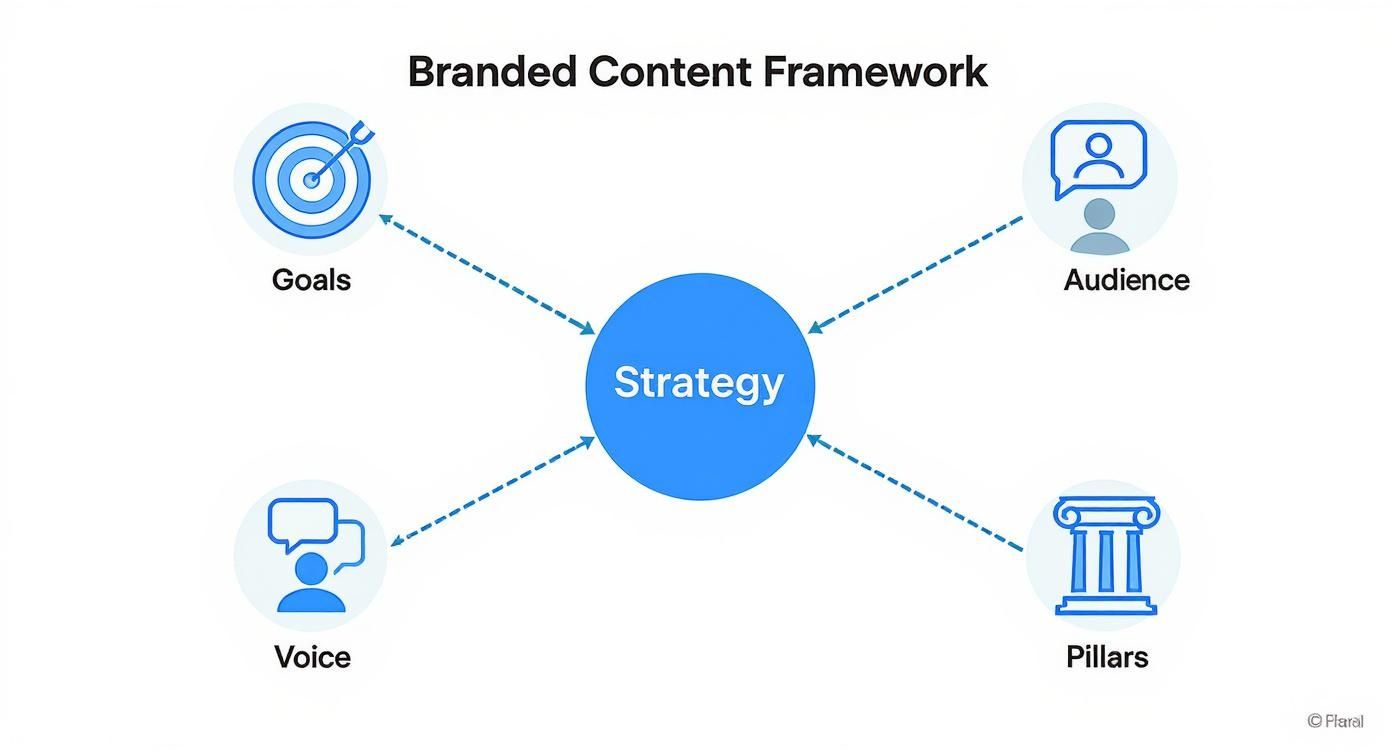
This framework is your anchor. It ensures every tactical decision you make flows from a well-defined strategy, connecting what you do back to who you’re trying to reach and what you want to achieve.
Master Creator Partnerships
Creator partnerships are so much more than just paying someone for a quick shoutout. It’s about finding and collaborating with influencers and creators whose audience and values genuinely line up with your own. The real magic happens when you give them the creative reins to tell your brand's story in their authentic voice.
Think of creators as skilled storytellers who have already built the trust you're trying to earn. A forced, overly scripted message will immediately fall flat, and it can damage both your credibility and the creator's. The goal is to find a partner who can weave your brand into their content so naturally that it feels like a genuine recommendation, not a sales pitch.
This approach requires trust and a willingness to let go of some control. When a creator is genuinely excited about your product, that authenticity shines through and creates a powerful message that a traditional ad could never match.
The best creator partnerships feel like true collaborations. The brand supplies the product and the core message, but the creator brings the unique perspective and storytelling style their audience already loves.
To get started on the right foot, focus here:
- Prioritize Alignment: Look for creators whose content pillars and audience demographics are a perfect match for your brand.
- Grant Creative Freedom: Give them a clear brief with your key messages, but let them handle the creative execution. That's what they do best.
- Think Long-Term: Building lasting relationships with a handful of key creators often delivers far better results than a bunch of one-off campaigns.
For brands ready to scale their partnerships, platforms like JoinBrands can take the headache out of finding and managing these relationships. You can get a deeper dive into building effective programs by checking out our guide on launching successful influencer marketing campaigns.
Inspire User-Generated Content
User-Generated Content (UGC) is pretty much the holy grail of social proof. It's authentic content—photos, videos, reviews—created by your actual customers. Unpaid and unscripted. When potential buyers see real people genuinely enjoying your product, it builds a level of trust that no branded message can ever achieve on its own.
Your job is to inspire and encourage this creation. Run a contest, create a fun branded hashtag, or just make a habit of featuring the best customer content on your own channels. This not only gives you a constant stream of authentic marketing assets but also makes your customers feel seen and valued, which is huge for loyalty.
Just remember to handle UGC ethically. Always, always ask for permission before you repost a customer's content and give them proper credit. It's a simple sign of respect that maintains trust and encourages even more people to share their experiences.
Use Native Social Ad Formats
The final piece of the puzzle is using paid advertising that doesn't feel like advertising. Native ads and sponsored social posts are designed to blend right in with the surrounding content, making for a much less jarring experience for the user.
These formats are perfect for branded content because they let you tell a story right inside someone's feed. For example, a well-produced and value-driven sponsored Instagram Story or a TikTok In-Feed Ad can feel just like another entertaining piece of content from a creator they follow. You're respecting the user's experience while still getting your message out to a broader, more targeted audience.
The data backs this up big time. In fact, 77% of marketers now use social videos in their campaigns, and video content accounts for a mind-blowing 82.5% of all internet traffic. As you can discover more insights about these content marketing statistics, it’s crystal clear that visual storytelling is no longer a "nice-to-have"—it's essential.
Branded Content Channels Comparison
Choosing the right channel mix depends entirely on your goals, audience, and resources. Some tactics are built for trust, while others are designed for reach. Here’s a quick breakdown to help you see where each one shines.
| Channel/Tactic | Primary Use Case | Key Benefit | Main Challenge |
|---|---|---|---|
| Creator Partnerships | Building trust and reaching niche audiences through authentic storytelling. | High credibility and engagement from a creator's established community. | Finding the right creators, ceding creative control, and measuring direct ROI. |
| User-Generated Content | Generating social proof and building a community around the brand. | Unmatched authenticity and cost-effective content sourcing. | Encouraging participation and maintaining a consistent flow of high-quality content. |
| Native Social Ads | Scaling content distribution and reaching targeted audience segments. | Precise targeting capabilities and a seamless user experience. | Ad fatigue and the need for high-quality creative that doesn't feel like an ad. |
Ultimately, the strongest strategies don't rely on just one of these channels. They blend them together—using native ads to amplify a great piece of creator content or featuring standout UGC in a paid campaign. It’s all about creating a cohesive system that works together to tell your brand’s story.
Learning from Real Campaign Successes
Frameworks and theory are great, but the real magic happens when you see branded content working in the wild. When you pull apart a successful campaign, you get to move past abstract ideas and see what strategic thinking and creative execution actually look like.
The best campaigns don't just sell you something; they build an entire world around the brand's core values.
Let's dive into a few iconic examples from completely different industries. By looking at their goals, creative decisions, and the channels they used, we can find a solid blueprint for what high-impact branded content marketing really is. These examples are packed with inspiration you can steal for your own brand, no matter your size or budget.
Red Bull Stratos High-Altitude Jump
Red Bull didn't just sponsor an event with its Stratos campaign—it created a global cultural phenomenon. The brand funded Felix Baumgartner's mind-bending freefall from the edge of space, transforming a high-stakes scientific mission into pure, unmissable entertainment.
This was never an ad about an energy drink. It was a documentary about smashing human limits, a value that sits at the very heart of the Red Bull brand.
- Strategic Goal: To cement Red Bull's identity as the go-to brand for adventure, extreme sports, and pushing boundaries.
- Creative Execution: A live-streamed, high-production event that felt more like a NASA launch than a marketing stunt. The content was gripping, educational, and intensely emotional.
- Channel Choice: The YouTube live stream was the killer move here, capturing a worldwide audience in real-time. It created a shared experience that traditional advertising could never touch, pulling in over 8 million concurrent viewers.
The campaign's genius was its sheer audacity and how perfectly it aligned with the brand's "gives you wings" motto. Red Bull became the enabler of an incredible human achievement, earning a level of brand love that a thousand 30-second spots couldn't buy.
The LEGO Movie An Entertainment Empire
This might just be the ultimate example of branded content: when the content becomes a blockbuster product in its own right. The LEGO Movie wasn't a 100-minute commercial for plastic bricks; it was a critically acclaimed, smash-hit film that just happened to take place entirely within the brand's universe.
The movie cleverly tapped into the nostalgia of adults who grew up with LEGOs while completely captivating a new generation of kids. Its story celebrated creativity, individuality, and working together—the very things you do when you play with LEGOs.
The real brilliance of The LEGO Movie is that it sells the feeling of playing with LEGOs, not the bricks themselves. It reminds everyone of the limitless creative world locked inside every box.
This single move transformed LEGO from a toy company into a full-blown entertainment powerhouse. The content was so good that people happily paid to watch it, opening up a massive and profitable new revenue stream. It's a masterclass in making your brand the stage for the story, not just another advertiser.
Apple Shot On iPhone Campaign
Apple's "Shot on iPhone" campaign is a masterstroke in using user-generated content (UGC) at a global scale. Instead of dropping millions on famous directors to create slick ads, Apple simply turned the camera over to its customers. They showcased the stunning photos and videos that real people were capturing with their devices every single day.
This strategy hits several targets at once:
- Product Demonstration: It's the most authentic proof you could ask for. The iPhone camera is so good, this is what you can do with it.
- Community Building: It makes customers feel like they're part of a creative club, celebrating their talent and artistry on a massive stage.
- Content Sourcing: It provides Apple with a bottomless well of beautiful, diverse, and incredibly cost-effective marketing assets.
By plastering these user-submitted photos on towering billboards and in TV spots, Apple tells a simple but powerful story: our product is so good that our customers are the best artists. The campaign is a perfect marriage of product marketing and community storytelling, cementing its place as a modern branded content legend.
How to Measure Your Branded Content ROI

Putting out incredible branded content is really only half the job. If you can’t actually prove it’s working, you'll have a tough time justifying the budget and scaling up your efforts. Measuring the return on investment (ROI) for branded content isn't about chasing one magic number; it’s about telling a complete story with your data.
Unlike a straightforward "buy now" ad, branded content builds value over the long haul, influencing audiences in ways that are subtle but incredibly powerful. To capture that full impact, you need to look at everything from the first touchpoint to the final sale. This framework helps you draw a clear line from your creative work to real business results.
To get a true handle on your return, it’s critical to understand How to Measure Content Performance from every angle. This means looking past simple vanity metrics to see the entire customer journey.
Top-Funnel Brand Health Metrics
At the very top of the funnel, your branded content should be making people more aware of your brand and improving how they feel about it. These metrics act like a pulse check on your brand’s overall health and visibility. They answer a simple question: "Is our content getting more people to know us and like us?"
Here are the key things to track:
- Brand Mentions: This is the raw count of how many times your brand gets talked about across social media, forums, and the web. You can use tools like Brand24 or Mention to keep tabs on this.
- Share of Voice (SOV): How much of the conversation in your industry is about your brand versus your competitors? A growing SOV is a fantastic sign that you're becoming a recognized authority.
- Sentiment Analysis: This goes a step further than just counting mentions. It analyzes whether the chatter is positive, negative, or neutral. When sentiment improves, you know your content is building genuine goodwill.
These big-picture indicators are essential for showing long-term value to stakeholders who are focused on market position and brand equity.
Metrics like share of voice and positive sentiment might not link directly to a sale today, but they are powerful leading indicators of future growth. They prove your brand is building a solid foundation for success down the road.
Mid-Funnel Engagement Metrics
Once you've grabbed someone's attention, the next challenge is holding it. These mid-funnel metrics show you how deeply your audience is actually engaging with your content. They prove you're not just reaching people—you're connecting with them.
For example, take a look at these key performance indicators:
- Video Completion Rate: What percentage of people are watching your videos all the way to the end? A high completion rate is a dead giveaway that your storytelling is hitting the mark.
- Average Time on Page: For articles and blog posts, this tells you how long people are sticking around. Longer times suggest they’re not just scanning; they're actively reading and absorbing your message.
- Comments, Shares, and Saves: These actions are gold. They’re far more valuable than a simple "like" because they show your content was so useful or entertaining that someone wanted to share it or save it for later.
By focusing on these engagement-heavy KPIs, you get a much clearer picture of what truly resonates. For a deeper dive, check out our guide on the most important content performance metrics.
Bottom-Funnel Business Impact Metrics
Finally, it all comes down to connecting your branded content to the bottom line. These are the metrics that tie your creative efforts directly to business goals like generating leads and driving sales. Attribution can sometimes be a puzzle, but modern analytics tools make it much easier to see how your content nudges people toward a purchase.
You should definitely be tracking:
- Assisted Conversions: In Google Analytics, this metric is a gem. It shows you how many sales your content helped with, even if it wasn't the very last click. It highlights the crucial role your content plays throughout the customer journey.
- Lead Generation: If your content has a call-to-action (CTA) like signing up for a newsletter or downloading a guide, you need to track how many leads it brings in.
- Referral Traffic: Keep an eye on how much traffic your branded content sends to important product or service pages on your main website.
Proving this financial link is more important than ever. With nearly half of B2B organizations planning to increase their content spend, the pressure to demonstrate ROI is on. Showing a clear path from a piece of content to a final conversion is the best way to secure that next round of investment.
Answering Your Top Branded Content Questions
As you start mapping out your own campaigns, you're bound to have some questions. It's totally normal. Getting these sorted out early on builds a solid foundation for your strategy, so let's clear up some of the most common ones.
What Is the Main Difference Between Branded Content and Content Marketing?
Great question. Think of it like this: content marketing is the entire library, and branded content is the award-winning novel everyone's talking about.
Content marketing is the big-picture strategy. It’s all the useful stuff you create to attract an audience and prove you know your stuff—think guides, blogs, and how-to articles. It’s content about your industry.
Branded content, on the other hand, is a specific play within that strategy. It’s all about storytelling and entertainment. Instead of a direct product pitch, you weave your brand's values right into the narrative. It’s the content a brand makes, not just content about the brand.
How Do I Keep Branded Content Feeling Authentic?
Authenticity isn't just a buzzword; it's everything. It starts with putting the audience's experience first, way ahead of any sales pitch. The real secret is to trust your creative partners. Give them the freedom to tell genuine stories that entertain or educate, and let the brand's role feel natural, not jammed in where it doesn't belong.
And transparency is non-negotiable.
Clear disclosures like #ad or #sponsored aren't just a legal hoop to jump through. They're a massive part of building and keeping your audience's trust. Honesty is the only way to build a real relationship.
Can Small Businesses Actually Succeed with Branded Content?
Absolutely. You don't need a Hollywood-sized budget to make an impact. Branded content is all about creativity and human connection, which is where small businesses often have an edge.
- User-Generated Content (UGC) Campaigns: Turn your customers into your best marketers. Encourage them to share content with your products, and you'll build a library of authentic, super-persuasive assets.
- Micro-Influencer Partnerships: Team up with creators who have smaller, but incredibly loyal, followings. Their recommendations often hit much harder within tight-knit communities.
- Killer Short-Form Video: You can create powerful, story-driven content for TikTok or Instagram Reels that connects on an emotional level without breaking the bank.
Success here comes from making a genuine connection with a niche community, and that's something small businesses are uniquely built to do.
What Are the Legal Rules for Branded Content?
Rule number one, and it's a big one, is clear and conspicuous disclosure. Regulatory bodies like the Federal Trade Commission (FTC) are very serious about this. Any sponsored content has to be clearly labeled so no one is confused. Vague terms won't cut it—use unambiguous labels like #ad or #sponsored where people will actually see them.
Beyond that, make sure you have the rights to any user-generated content you want to feature. Always get explicit permission before you repurpose a customer's photo or video in your marketing. Finally, any claims you make in your content have to be truthful and provable. When in doubt, just be transparent. It's always the right move.
Ready to connect with a global network of creators for your next campaign? JoinBrands makes it easy to find TikTok Shop Affiliates, UGC producers, and influencers who can bring your brand's story to life. Streamline your entire workflow from discovery to content approval and start building authentic connections today at https://joinbrands.com.