


 Unlock ai avatar generators to revolutionize your marketing
Content creation websites are essentially your brand's digital workshop, stocked with specialized tools to help you produce marketing assets. We're talking everything from authentic user-generated content (UGC) all the way to slick, professional video ads.
Think of them as a dedicated content creation hub for your marketing team—everything you need to keep pace with the relentless demand for fresh, high-quality creative.
Table of Contents
What Are Content Creation Websites

At its core, a "content creation website" isn't just one thing. It's an entire ecosystem of online services that help you make, source, or polish your marketing materials. Each platform solves a different piece of the content puzzle.
It helps to think about it like building a house. You wouldn't use a hammer for every single task, right? You'd need a saw for the lumber, a drill for the frames, and a paintbrush for the final touches. Content creation websites work the same way for marketers, giving you the right tool for the right job.
This digital-first approach is catching on fast. The global digital content creation market is on track to explode from USD 42.53 billion in 2026 to USD 122.11 billion by 2034, growing at an impressive 14.09% each year. This boom just goes to show how essential these platforms have become for any brand that wants to stay relevant.
The Modern Marketer's Challenge
Let's be honest: today's marketing teams are under constant pressure to churn out new content. Social media algorithms demand freshness, ad campaigns need endless creative variations for testing, and customers expect authentic, relatable visuals.
Trying to do all of that in-house is a recipe for burnout. It’s often slow, incredibly expensive, and just doesn't scale.
Content creation websites solve this problem by providing on-demand access to creative talent, automated tools, and streamlined workflows. They democratize content production, allowing brands of any size to compete with industry giants.
A High-Level Overview of the Landscape
These platforms generally fall into a few major categories, each playing a distinct role in a marketing campaign. Getting a handle on these differences is the first step toward building a content engine that actually works. For a deeper dive into the basics, this practical guide to content creation for websites is a great place to start.
To help you get oriented, here’s a quick breakdown of the main types of platforms you'll come across and what they're best used for.
Overview of Content Creation Website Categories
This table offers a quick reference guide to the major types of content creation platforms and their primary use cases for brands.
| Platform Type | Primary Function | Best For |
|---|---|---|
| Creator Marketplaces | Connecting with influencers and UGC creators for custom content. | Sourcing authentic social media ads, product photos, and video testimonials. |
| AI Generators | Using artificial intelligence to create new text, images, or videos. | Quickly generating ad copy variations, scripts, and unique visuals at scale. |
| Online Editors | Cloud-based tools for editing photos and videos without software. | Post-production polish, adding branding, and resizing assets for different channels. |
| Design Platforms | Template-driven tools for creating static graphics and presentations. | Designing social media posts, infographics, and marketing collateral quickly. |
Each category offers a unique solution, and the most successful brands often mix and match them to build a comprehensive content strategy.
Exploring Different Types of Content Platforms
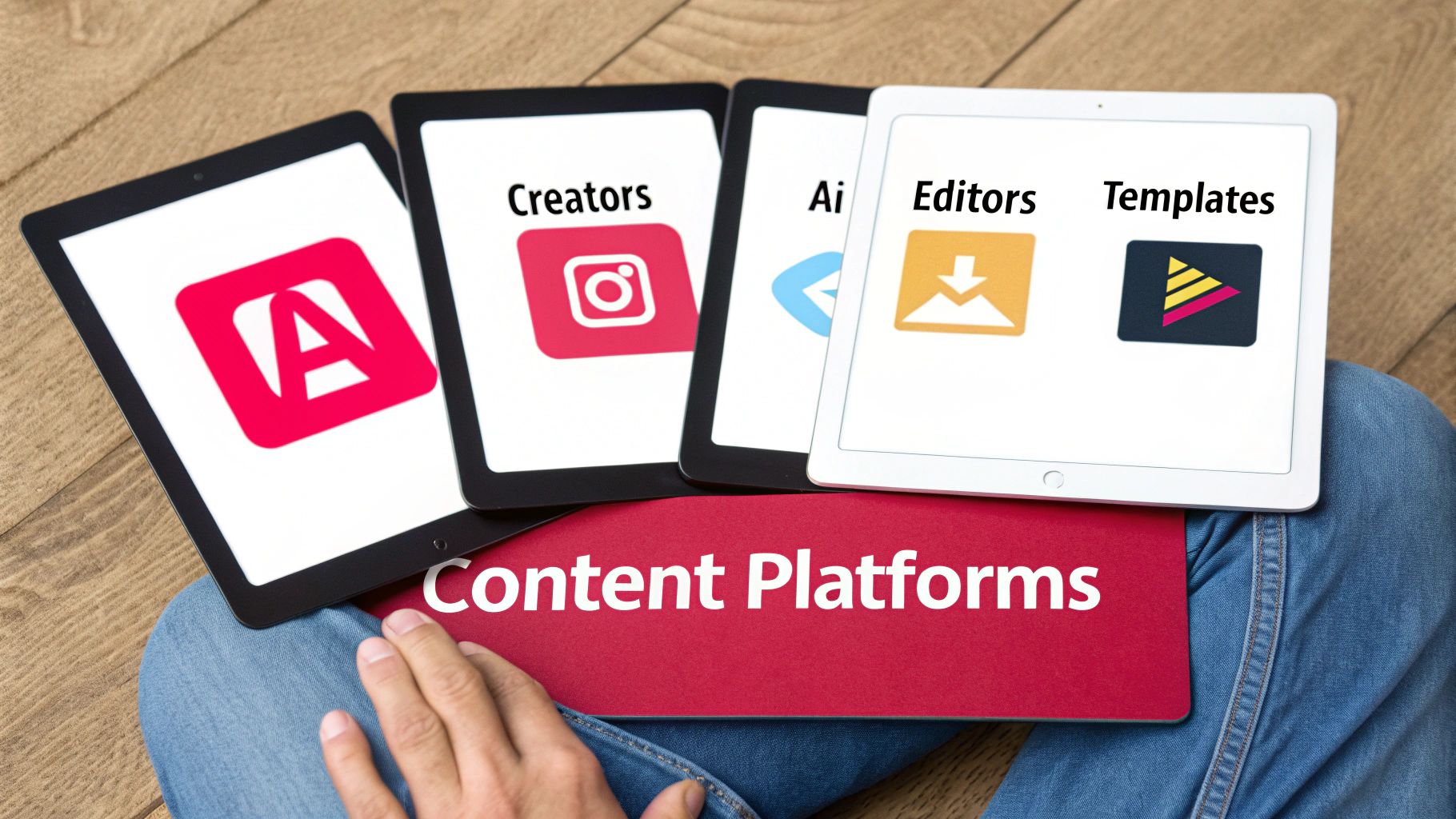
The world of content creation websites isn't a one-size-fits-all market. It’s more like a bustling ecosystem with four distinct pillars, each built to solve a specific marketing headache. Knowing your way around these categories is the secret to building a powerful and efficient content engine for your brand.
Think of it like putting together a high-performance pit crew. You wouldn't ask your tire guy to handle the fuel or your diagnostics expert to change the oil. You need different specialists for different jobs. The same logic applies here—you need the right platform for the task, whether it’s finding the perfect creator or just whipping up a quick social graphic.
Let's break down the four main types of platforms that make up the modern content creation landscape.
Creator Marketplaces and UGC Platforms
Let's say you need real, relatable content for your next ad campaign. Creator marketplaces and User-Generated Content (UGC) platforms are your direct line to actual people who can make that happen. They essentially act as a digital casting agency, connecting your brand with a massive network of creators ready to collaborate.
These platforms are gold for sourcing content that doesn't scream "advertisement." Instead of slick, high-budget productions, you get genuine videos and photos from people who actually know how to talk to an online audience. And that approach works—a whopping 79% of people say UGC heavily influences their buying decisions.
Here’s what the process usually looks like on these content creation websites:
- You post a brief: This is where you lay out your campaign goals, who you're trying to reach, and the kind of content you need.
- Creators apply: Vetted creators who are a good fit will apply to your project, often pitching their own creative ideas.
- You collaborate and approve: You pick the creators you like best, manage the whole process, and approve the final content, all right there on the platform.
The end result? You get full ownership of high-quality, authentic assets that are ready to roll for your ad campaigns.
AI Powered Content Tools
If creator marketplaces are your casting agency, then AI-powered tools are your tireless, automated production assistants. These platforms use artificial intelligence to churn out new content—text, images, and even video—from simple text prompts.
They are all about speed and scale. Need fifty different ad copy variations to A/B test on social media? An AI tool can spit them out in minutes. Need a unique background image for a product shot? A generative AI can create one from scratch, instantly. It’s a huge advantage for teams that need to produce a high volume of creative assets without a Hollywood-sized budget.
AI tools don't replace human creativity; they supercharge it. They take care of the repetitive, time-sucking tasks, freeing up your team to focus on the big picture—strategy, storytelling, and perfecting the final product.
The growth here is staggering. North America is leading the charge in the digital content creation space, and the U.S. market alone was valued at USD 9.73 billion in 2025. It’s projected to explode to USD 36.88 billion by 2035, which tells you everything you need to know about where the industry is heading. You can dig into more stats in the full digital content creation market analysis.
Online Video and Photo Editors
Once you have your raw content—whether it's from a creator or an AI tool—it needs a little polish before it's ready for the spotlight. Online video and photo editors act as your cloud-based editing suite, letting you do professional-level work right from your browser without needing expensive software or a supercomputer.
These platforms are perfect for all the essential post-production tweaks:
- Adding your brand’s logo and color palette
- Trimming video clips and adding background music
- Resizing images for Instagram, TikTok, and Facebook
- Creating animated text overlays and calls-to-action
Because they're built for teamwork, multiple people can jump into the same project, leave feedback, and sign off on the final cut in one place. This keeps your workflow smooth and your branding consistent across every channel.
Template and Design Platforms
Finally, we have template and design platforms. Think of these as your brand's in-house design agency, on call 24/7. Tools like Canva or Adobe Express are packed with huge libraries of pre-made templates for pretty much anything you can imagine, from Instagram stories to business presentations.
They’re built for non-designers, which means anyone on your marketing team can create professional-looking graphics in minutes. You can even upload your brand kit—logos, fonts, and colors—to make sure every single design stays on-brand. For teams that need a constant stream of social posts, blog headers, and infographics, these platforms are an absolute lifesaver.
How AI Is Revolutionizing Content Creation
Artificial Intelligence isn't some far-off concept anymore; it's a hands-on tool that's completely changing how marketing assets get made. AI-powered content creation websites have moved past theory and now offer real-world solutions to everyday marketing headaches, acting as a massive efficiency booster for teams of all sizes.
Think about an e-commerce brand launching a new product. The old way involved a week-long photoshoot and design process. Now, an AI tool can spit out 50 unique, high-quality social media ads in just an hour. This isn't science fiction—it's the new reality for content creation.
This isn't just a niche trend; it's quickly becoming the standard. The numbers don't lie: AI is turning content creation platforms into productivity powerhouses. By 2026, 80% of marketers will be using it for content and 75% for media production. This massive adoption is why the market is projected to jump from USD 32.28 billion in 2024 to USD 69.80 billion by 2030.
From Manual Matching to Smart Sourcing
One of the first places you'll feel AI's impact is in finding creators. It used to be a painful, manual slog of endless scrolling, tracking names in spreadsheets, and a whole lot of guesswork.
AI-driven creator matching flips that script completely. These smart systems crunch millions of data points—a creator’s performance history, their audience demographics, content style, and engagement rates—to pinpoint the perfect match for your brand in minutes, not days.
Think of it like a hyper-intelligent matchmaking service for your brand. Instead of swiping through profiles, you just plug in your campaign goals. The AI then serves up a curated list of high-potential creators, complete with predictions on how well they'll likely perform.
This isn't just about finding creators who look the part. The tech identifies influencers whose followers have a proven interest in products just like yours, giving your campaign ROI a serious boost right from the get-go.
Scaling Creative Production Instantly
Generative AI is another total game-changer. With a simple prompt, these tools can draft dozens of ad copy variations, dream up video scripts, or outline entire blog posts. This automation frees your team from the repetitive grind, letting them focus on big-picture strategy and creative direction.
The payoff here is huge, and it comes in two flavors:
- Speed: Brainstorming sessions that once ate up hours can now be done in seconds. This lets you A/B test different messages at a lightning-fast pace.
- Personalization: You can generate hyper-targeted copy for different audience segments without having to hire a massive team of writers.
This approach gives even the smallest teams the ability to run campaigns with the kind of creative variety that used to be reserved for giant agencies. For instance, brands can now generate AI models for clothing, which slashes content costs dramatically.
Making Content Creation More Accessible
When you boil it all down, AI makes the whole content creation process more democratic. It tears down the barriers that once stood in the way of producing high-quality, personalized content at scale.
Small businesses can suddenly punch above their weight, and larger companies can fine-tune their workflows for maximum efficiency. By automating the boring stuff and serving up data-driven insights, AI makes content creation faster, smarter, and way more effective.
Curious about putting these ideas into practice? Check out our guide on using AI for content creation. This technology lets marketers get back to what they do best: building real connections and telling stories that stick.
Building Your Content Creation Workflow
So, you’ve got a lineup of powerful content creation websites ready to go. That's a great first step, but the tools alone won't get you across the finish line. The real magic happens when you weave them into a smooth, repeatable workflow. A solid process is what separates a chaotic scramble for content from an efficient system that pumps out high-quality assets, every single time.
Think of it like a well-oiled assembly line. Each station has a specific job, and the product moves seamlessly from one stage to the next. Your content workflow should do the same, taking an idea from a spark of inspiration to a polished, published piece of content without hitting snags or bottlenecks. The goal here is to build a system that cuts out wasted time and makes sure every post, video, and image hits the mark.
Stage 1: Defining the Campaign Brief
Every great piece of content starts with a crystal-clear brief. This document is your project's command center, outlining exactly what you need, why you need it, and what a "win" looks like. Winging it without a brief is a recipe for miscommunication, endless revisions, and content that just doesn't land.
Your brief shouldn't be a solo effort; it needs to be a collaborative document where your team can weigh in and stay on the same page. It absolutely must define:
- Campaign Goals: What's the point of all this? Are we trying to drive sales, boost brand awareness, or capture leads?
- Target Audience: Who are we talking to? What do they care about? What problems can we solve for them?
- Key Messaging: If someone only remembers one thing from this content, what should it be?
- Content Specifications: Get granular. Lay out the formats (e.g., TikTok video, Instagram Reel), length, tone of voice, and any must-have visuals or calls-to-action.
A detailed brief empowers creators to nail it on the first try, which saves everyone a massive amount of time and money.
Stage 2: Sourcing and Vetting Creators
With your brief ready, it's time to find the right people for the job. This is where creator marketplaces really come in handy. Instead of sliding into DMs and hoping for a response, you can dive into a curated pool of vetted creators who are actively looking for brand deals.
Use the platform’s filters to zero in on your ideal creator based on their niche, audience demographics, engagement rates, and past work. You're looking for creators whose personal brand and content style already feel like a natural fit for your own. Don't get blinded by follower count; a creator with a smaller, super-engaged community is almost always more valuable than a macro-influencer with a passive audience.
The vetting process is non-negotiable. Spend time digging through creator portfolios, reading reviews from other brands, and analyzing their audience data. A perfect match means their followers are your target customers—ensuring your message actually connects with the people who matter.
Stage 3: Managing Production and Approvals
Once you've locked in your creators, the workflow shifts to production management. This is the stage that can quickly spiral into chaos if you're trying to manage everything through a messy web of emails, spreadsheets, and DMs. Using a platform with built-in project management tools is a game-changer for keeping things organized.
This is also where online editors and a clear approval process become essential. A streamlined system, like the one we detail in our guide to building a robust content approval workflow, is your best friend for maintaining quality control. Creators can upload their draft content right to the platform, and your team can jump in to provide feedback, request changes, and give the final sign-off—all in one place.
Stage 4: Distributing and Amplifying Your Assets
The final piece of the puzzle is getting your polished content out into the world. After all, the best content is useless if no one ever sees it. Your workflow needs a clear distribution plan that maps every single asset to its intended channel.
Many of the more advanced content creation websites now offer direct integrations with ad platforms. For example, some let you take a creator's approved video and push it straight into a TikTok Spark Ads campaign without ever leaving the site. This direct pipeline from creation to distribution is incredibly efficient. It lets you launch campaigns faster and start seeing a return on your investment almost immediately.
Choosing Between Unified and Specialized Platforms
When it comes to building your content engine, you’ll eventually hit a fork in the road. Do you cobble together a toolkit of specialized, best-in-class websites for each task? Or do you go all-in on a unified platform that pulls every step of the process under one roof?
This isn’t just a minor decision—it fundamentally shapes your team’s efficiency, budget, and how easily you can scale up. Think of it as the classic debate: hire a collection of individual experts for each job, or bring on a single, highly coordinated team that works together seamlessly. Each path has its own pros and cons, tailored to different business needs.
This workflow diagram shows all the moving parts in a typical content campaign, from the initial brief all the way to publishing.
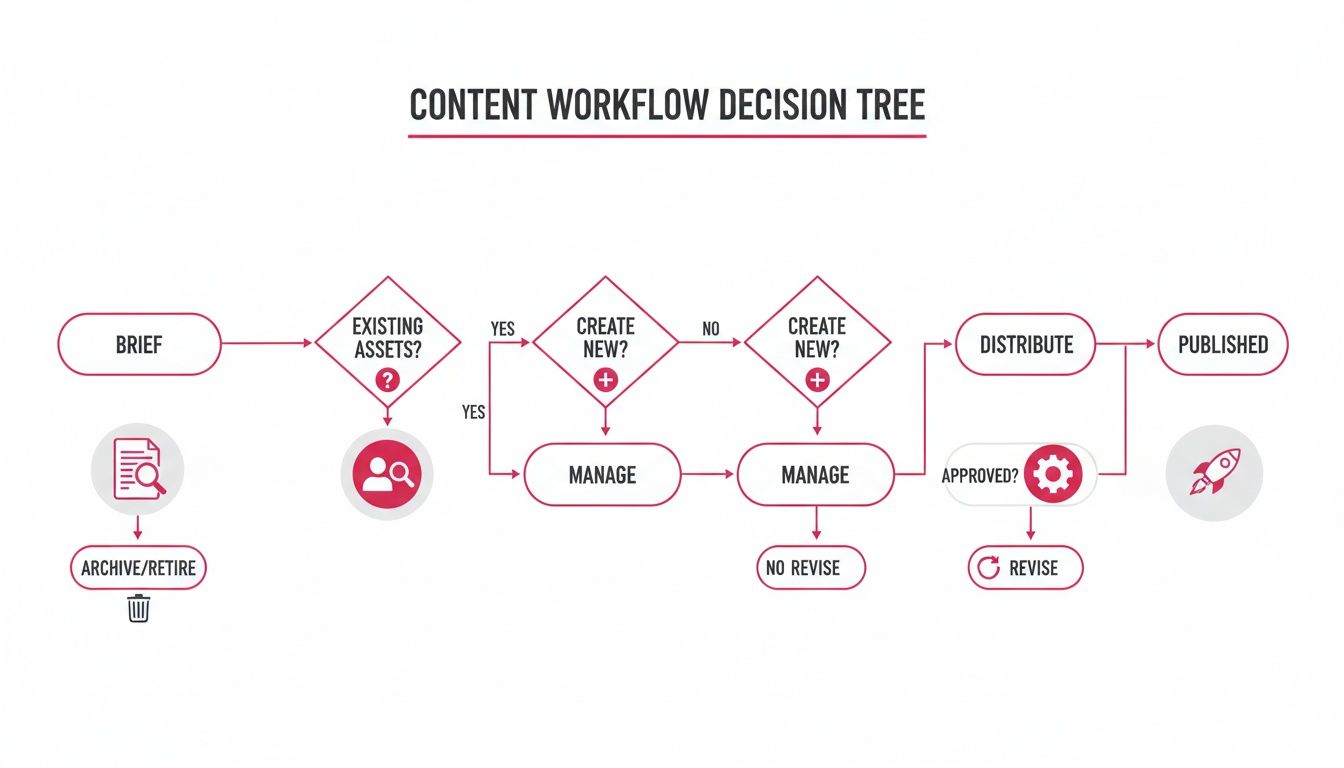
As you can see, juggling multiple tools can introduce a lot of friction, while a unified system is designed to smooth out the entire journey from idea to final asset.
The Specialized Tools Approach
Going the specialized route means you get to hand-pick the absolute best tool for every single job. You might use one platform to find creators, another for top-tier video editing, a third for graphic design, and yet another to handle approvals and feedback.
This à la carte strategy gives you access to some seriously powerful, feature-rich tools. A dedicated video editor, for example, will almost always have more advanced features than one built into an all-in-one platform. But this approach often comes with a whole host of hidden costs.
First, there’s the administrative nightmare of managing multiple subscriptions, logins, and billing cycles. More importantly, it creates data silos. Your team is stuck constantly exporting assets from one platform and importing them into another—a clunky process that kills efficiency and is a recipe for version control disasters.
The Unified Platform Advantage
A unified platform, like JoinBrands, brings the entire content creation lifecycle into one cohesive system. It’s like having a central command center for everything—from discovering creators and managing campaigns to approving content and analyzing performance.
This tight integration gets rid of the friction of switching between tools. Communication happens in one place, all your assets live in a single library, and workflows just… flow. Instead of juggling five different apps, your team has one source of truth, which is a game-changer for collaboration and speed.
The real magic of a unified system is operational clarity. When every step—from the initial brief to the final ad placement—is visible on one dashboard, you get a complete picture of your content operation. It makes it so much easier to spot bottlenecks and measure your actual ROI.
Ultimately, the best choice really depends on your team's specific needs. The table below breaks down the key factors to weigh.
Unified vs. Specialized Content Platforms: A Comparison
Evaluating whether an all-in-one platform or a collection of specialized tools is the right fit for your brand's needs.
| Factor | Unified Platform (e.g., JoinBrands) | Specialized Tools (Multiple Platforms) |
|---|---|---|
| Workflow Efficiency | High. A single, connected system reduces manual work and streamlines processes from start to finish. | Low. Constant switching between apps creates friction, data silos, and version control issues. |
| Cost Management | Predictable. Often a single subscription fee, making budgeting simpler and more transparent. | Complex. Multiple subscriptions add up, and costs can become difficult to track and justify. |
| Data and Analytics | Holistic. Centralized data provides a clear, end-to-end view of campaign performance and ROI. | Fragmented. Data is spread across platforms, making it difficult to get a complete picture of success. |
| Team Collaboration | Seamless. One shared workspace for briefs, feedback, and approvals improves communication and alignment. | Challenging. Information gets lost in emails and different app notifications, slowing down projects. |
| Scalability | Simpler. Easy to add new users and campaigns within one system as your team grows. | Complex. Onboarding new team members requires training on multiple, disconnected tools. |
For most brands, especially those trying to grow fast and work smart, a unified platform provides a much more sustainable and scalable way to handle the complexities of modern content creation.
Measuring Content Performance and ROI

Pouring money into content creation websites is really only half the battle. If you want to justify the spend and actually build a smart strategy, you need a clear, data-driven way to measure what’s working. Without solid metrics, you're flying blind. You have no real way to prove the value your content is bringing to the business.
This means you’ve got to look past the surface-level vanity metrics. Sure, likes, shares, and follower counts feel good and can give you a quick pulse check, but they don't tell the full story about your bottom line. Real performance measurement is all about connecting content directly to business outcomes.
Focusing on Business Critical KPIs
To get a true read on your impact, the focus has to shift to Key Performance Indicators (KPIs) that actually reflect business growth. These are the numbers the leadership team and the CFO really care about because they show a tangible return on your investment.
Here are the core metrics that should be front and center on your dashboard:
- Conversion Rate: This is the big one. It’s the percentage of people who take a specific action—like making a purchase or signing up for your list—after seeing your content. It’s the ultimate test of whether your message is hitting home.
- Cost Per Acquisition (CPA): This number tells you exactly how much you're spending to get a new customer through a particular campaign. A lower CPA means your content is working more efficiently to drive growth. Simple as that.
- Return on Ad Spend (ROAS): If you're running paid campaigns, ROAS is your best friend. It measures the gross revenue you generate for every single dollar spent on ads, giving you a crystal-clear picture of profitability.
Keeping an eye on these KPIs reveals which content formats, which creators, and which messages are actually turning viewers into customers. If you want to go deeper, our guide on essential content performance metrics breaks it all down even further.
This is where a unified platform becomes a massive advantage. When creator sourcing, campaign management, and analytics are all under one roof, you get a complete, end-to-end view of performance without having to stitch together data from five different spreadsheets.
The Importance of Governance and Usage Rights
Beyond just the numbers, solid governance is completely non-negotiable, especially when you’re pulling assets from multiple content creation websites. Getting a handle on content usage rights is a critical step in protecting your brand from legal headaches and keeping your branding consistent.
Think of it as the legal backbone of your whole content strategy. Every photo, video, or graphic you get from a creator comes with specific license terms that spell out how, where, and for how long you can use it. Ignoring these rights can lead to some seriously expensive legal battles down the road.
Any reputable platform will have straightforward terms that grant you full ownership and perpetual usage rights for the content you buy. This is your safety net, ensuring you can use those assets across all your marketing channels without ever worrying about future licensing fees or legal claims popping up.
Frequently Asked Questions
Jumping into the world of content creation websites can stir up a lot of questions, especially when you're trying to nail down the best fit for your brand. To clear up any confusion, we’ve tackled some of the most common questions marketers ask.
Think of this as your quick-reference guide. We’re aiming for practical, straightforward answers that build on what we’ve already covered, so you can feel confident picking the right tools for the job.
What Is the Difference Between a Creator Marketplace and a UGC Platform?
It’s a classic question, and the easiest way to think about it is proactive vs. reactive.
A creator marketplace is proactive. You go there to actively find and hire creators for a specific campaign you’re planning. It's like commissioning an artist for a project—you need new content, and you’re paying someone to make it happen.
A UGC platform, on the other hand, is mostly reactive. It helps you find, collect, and get the rights to use great organic content your customers have already posted online. While there can be some overlap, the core difference is that marketplaces are for commissioning new assets, and UGC platforms are for managing existing ones.
How Do I Choose the Right Platform for My Startup?
For a startup, it's all about one thing: solving your biggest content problem with maximum efficiency. Don't try to boil the ocean.
If you’re desperate for authentic ad creatives to drive your first sales and build social proof, a unified creator marketplace is your best bet. It’s a direct path to getting creator sourcing, project management, and content ownership all handled in one place, giving you the fastest return on your time and money.
But if your main goal right now is just to design some sharp social media graphics to build a brand presence, a simple template-based tool is a smarter start. The key is to pick the platform that solves your most immediate business need today. You can always add more tools to your stack as you grow.
Do I Own the Content I Get from These Websites?
This is a big one, and the answer isn't something to skim over. Ownership depends entirely on the platform's terms of service.
Reputable creator marketplaces are built from the ground up to solve this exact problem. They ensure that brands receive full usage rights and legal ownership of the content they pay for. This is a massive advantage over trying to source content informally or, worse, just grabbing it from social media—a shortcut that can land you in serious legal trouble.
Always, always read the fine print on asset ownership and licensing. A clear agreement is your protection, ensuring you can use that awesome new video across all your channels without worrying about surprise fees or legal headaches down the road.
Ready to stop juggling multiple tools and streamline your entire content creation process? JoinBrands is the all-in-one platform that connects you with over 250,000 creators to produce authentic, high-performing content at scale. Manage campaigns, approve assets, and measure ROI all in one place. Get started on JoinBrands today!