
 Boost Your Reach with measuring brand awareness: A Practical Guide
Finding the right YouTube influencer is less about searching and more about strategy. Before you even think about typing a keyword into YouTube's search bar, you need a solid game plan that outlines your goals, audience, and budget. This groundwork is what separates a high-return partnership from a scattered, ineffective one.
Table of Contents
Building Your Campaign Foundation
Jumping into a search for creators without a plan is like wandering through a massive forest without a map. You might stumble upon something interesting, but you're probably not going to find the specific treasure you're looking for. The most successful influencer campaigns are built on a solid foundation long before the first outreach email is ever sent. This is the work that prevents costly mistakes.
The whole process starts by asking one simple question: What does a "win" look like for this campaign? Are you trying to get your brand in front of a million new faces, or do you need to drive sales for a new product launch right now? These are two completely different goals that demand different types of creators.
Setting Clear and Actionable Goals
Your campaign goals are your North Star. They guide every single decision you'll make, from the type of influencer you choose to the metrics you track. Without them, you have no way to measure success or justify the investment.
Think about what you really need to accomplish. Common objectives for YouTube campaigns include:
- Boost Brand Awareness: This is all about visibility. The main goal is to introduce your brand to new people, and you'll measure success with metrics like video views, reach, and impressions.
- Drive Direct Sales: A pure conversion play. Here, success is measured by the cold, hard cash generated from unique discount codes or affiliate links.
- Generate High-Quality Leads: Perfect for products with a longer sales cycle. Your goal might be to capture email addresses or get sign-ups for a free trial or webinar.
- Increase Social Media Following: A great collaboration can funnel a creator's audience directly to your own social channels, helping you build your own community.
For example, a direct-to-consumer skincare brand might set a goal to hit a 3:1 return on ad spend (ROAS) with a beauty micro-influencer. That specific goal immediately tells you the campaign is all about sales, not just eyeballs. You can get more practical advice on this in our complete guide to influencer marketing campaigns.
Defining Your Target Customer Persona
Once you know what you want, you have to know who you want to reach. A detailed customer persona is non-negotiable. Don't just settle for "women aged 25-34."
Go deeper. What are their hobbies? What newsletters do they subscribe to? What YouTube channels are they already watching?
A well-defined customer persona acts as a filter. When you evaluate a potential influencer, you’re not just looking at their content; you’re analyzing whether their audience is your ideal customer. If there's a mismatch, the campaign is unlikely to succeed, no matter how great the creator is.
Let's say you sell high-performance, sustainable workout gear. Your ideal customer isn't just "someone who works out." They're probably eco-conscious, follow specific fitness styles like CrossFit or Pilates, and care more about quality than fast fashion. This level of detail is what helps you find a creator who serves that exact niche, ensuring your message actually connects.
Establishing a Realistic Budget and KPIs
Finally, you need to map out the money. Your budget isn't just the creator's fee; it's the total cost of the campaign.
Be sure to account for:
- Product Seeding: The cost of getting your product into the influencer's hands.
- Content Production: Some creators may have separate fees for higher-quality production.
- Platform Fees: If you're using a tool or an agency to find creators.
- Ad Boosting: You might want to put some ad spend behind the influencer's video to amplify its reach.
At the same time, define the Key Performance Indicators (KPIs) you'll be watching like a hawk. These should tie directly to the goals you set earlier. For brand awareness, your KPIs are views and impressions. For a sales campaign, your main KPI is the conversion rate from their link or code. Planning this upfront makes measuring your ROI a simple, data-driven process.
How to Actually Find the Right YouTube Creators
Alright, you’ve done the foundational work. Goals are set, the audience is defined, and the budget is locked in. Now comes the fun part: moving from planning to action and finding the creators who will bring your campaign to life.
This isn't about aimless scrolling. It’s a targeted hunt for partners whose audiences and content vibe are a perfect match for your brand. This process breaks down into two main paths: the old-school, hands-on manual approach and the faster, data-driven platform search.
Think of your campaign foundation as the blueprint for this hunt.
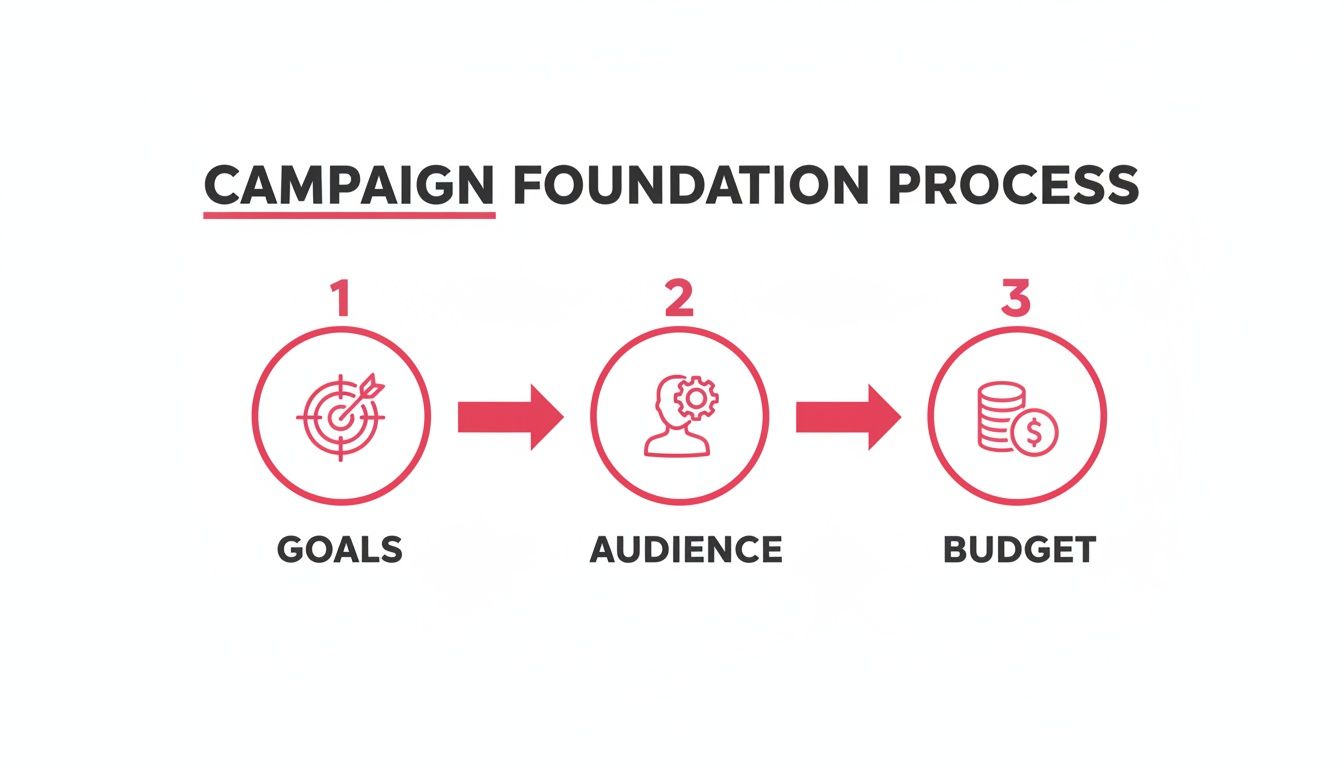
Every piece of that foundation—your goals, audience profile, and budget—acts as a filter. It helps you zero in on creators who are not just popular, but genuinely right for your brand.
Manual Discovery on YouTube
Jumping directly onto YouTube is a great way to get a real feel for the landscape. It's a classic boots-on-the-ground method that takes more time but gives you priceless insights into creator communities and what’s currently trending.
Start with the YouTube search bar, but here's the trick: think like your customer. Don't search for "tech influencer." Instead, use the exact phrases your ideal buyer would, like "best budget mechanical keyboard" or "WFH desk setup." The creators who pop up are already making content your audience is actively looking for.
Next, do a little competitive recon. Look up brands in your space and see who they're working with. This instantly gives you a pre-vetted list of influencers who are open to sponsorships in your niche.
Don’t stop there. When you find a creator you like, dig into their "channels" and "community" tabs. YouTubers constantly shout out and collaborate with others in their circle, leading you down a rabbit hole of potential partners. It’s a natural way to expand your list.
Unlocking Efficiency with Influencer Platforms
While manual searching is fantastic for getting a lay of the land, it's tough to scale. That's where influencer marketing platforms come in. Tools like JoinBrands were literally built to cut through the noise, letting you find a YouTube influencer with speed and precision.
Instead of guessing and digging, these platforms let you apply powerful, targeted filters based on real data.
Some of the most valuable filters you can use are:
- Audience Demographics: Go straight to creators whose followers match your target customer's age, gender, location, and even their specific interests.
- Niche & Keywords: Instantly pull up lists of influencers who specialize in your category, whether it's "vegan skincare" or "home espresso machines."
- Engagement Metrics: Filter by average views, engagement rate, and subscriber count to make sure you’re connecting with creators who have a genuinely active and loyal community.
This data-driven approach takes the guesswork out of the equation. You can build a solid shortlist of high-potential partners in a fraction of the time it would take to do it manually. Finding the right influencer marketing tools can be a game-changer for your discovery process.
Real-World Scenario: Let's say an e-commerce brand sells sustainable yoga mats in the UK and wants to find micro-influencers. On a platform, they could set their filters to:
- Location: United Kingdom
- Audience Age: 25-45
- Keywords: "yoga," "wellness," "sustainability"
- Subscriber Count: 10,000 – 50,000
In seconds, they get a curated list of creators who fit their exact profile, saving what would have been dozens of hours of manual research.
Why This Matters in a Growing Market
The need for efficient discovery is only getting more critical as the creator economy explodes. The influencer marketing industry is on a massive upward swing, projected to hit $24 billion this year and soar to $33 billion by 2025—more than tripling since 2020.
This growth is all about trust. For brands, tapping into YouTube's colossal audience of over 2.7 billion monthly users is no longer optional. It's essential. In fact, 50.2% of U.S. marketers are planning to work with YouTube creators in the coming year, highlighting just how central the platform has become. You can find more stats on the influencer market over at Statista.com.
By combining smart manual searching with the power of dedicated platforms, you create a discovery process that’s both insightful and efficient. This dual approach ensures you not only find creators who look good on paper but also those who are a genuine, authentic fit for your brand’s story.
Vetting Influencers Beyond the Subscriber Count

So you've got your shortlist of potential partners. It’s tempting to sort that list by subscriber count and start firing off emails, but that’s a classic rookie mistake. A massive following can easily be a vanity metric; the real gold is in the quality and relevance of a creator’s community.
This is where the real detective work begins—vetting your candidates to make sure they’re the right fit for your brand.
Think about it: a creator with 50,000 subscribers who consistently pulls in 20,000 views and hundreds of thoughtful comments per video is almost always a better bet than one with 500,000 subscribers who barely cracks 10,000 views. One has an active community, the other has a passive audience.
Analyzing Audience Demographics and Authenticity
First things first: you have to confirm that an influencer’s audience is actually your target customer. This is non-negotiable. If you sell high-end coffee equipment to people in the US and a creator’s audience is mostly teenagers in Southeast Asia, the partnership is dead on arrival, no matter how amazing their videos are.
Ask potential partners for a screenshot of their YouTube Studio analytics, specifically the "Audience" tab. This gives you undeniable proof of their viewers' age, gender, and top geographies. If a creator gets cagey about sharing this, that’s a massive red flag.
Beyond just demographics, you need to check for audience authenticity. Are there sudden, massive spikes in their subscriber growth? That can be a sign of bots or buying followers. What you want to see is steady, organic growth over time. Consistency is key.
Diving Deep into Content Quality and Brand Fit
Now for the fun part: become a fan. Go binge-watch their last 10-15 videos, paying close attention to their regular content and any past sponsorships. This qualitative review is where you get a real feel for who they are and what they stand for.
As you're watching, keep these questions in mind:
- Production Value: Is the video sharp and the audio clean? A creator's attention to detail in their own work is a good indicator of how they'll represent your brand. Little things, like knowing how to edit YouTube Shorts thumbnail for maximum impact, show they care about quality.
- Tone and Personality: Does their style—whether it's funny, educational, or inspirational—vibe with your brand’s voice? An edgy, sarcastic creator probably isn't the best choice for a family-focused brand.
- Past Sponsorships: How did they handle previous brand deals? Was it a natural, authentic recommendation, or did it feel like a jarring, salesy ad read? Look for creators who seem to genuinely use and believe in the products they promote.
This deep dive is crucial for avoiding brand safety nightmares. You have to be sure their past content doesn't contain anything that clashes with your company's values. A quick scan isn't enough; you need to know who you’re really getting into business with.
The Metrics That Truly Matter
Once you’ve confirmed the qualitative fit, it's time to back it up with hard data. For a moment, forget the subscriber count entirely and zero in on these engagement-based metrics.
Average Views Per Video
Just look at their last 10 videos and calculate the average view count. This number is a much better indicator of their current reach than their total subscriber base. It tells you how many people are actually tuning in right now.
Engagement Rate
This metric shows you how actively the audience interacts with the content. For a YouTube micro-influencer, a good benchmark is somewhere between 1.8% and 2.7%. You can figure it out with a simple formula:
(Total Likes + Total Comments) / Total Views x 100
A high engagement rate is a sign of a loyal, invested community that trusts what the creator has to say.
Comment Sentiment Analysis
Don't just count the comments—actually read them. What's the vibe? Are people asking smart questions, sharing their own experiences, and praising the creator? Or is the comment section a wasteland of spam and generic "nice video!" remarks? A vibrant, positive comment section is the hallmark of a healthy creator community.
To help you stay on track, I've put together a quick checklist. Use this as a scorecard when you're evaluating potential YouTube partners.
YouTube Influencer Vetting Checklist
| Vetting Criteria | What to Look For | Red Flags |
|---|---|---|
| Audience Demographics | Alignment with your target customer (age, gender, location). | Mismatched demographics; refusal to share analytics. |
| Content Quality | Professional video/audio; clear, engaging presentation. | Poor production value; inconsistent posting schedule. |
| Brand Fit & Tone | Personality and values align with your brand's voice. | Conflicting values; edgy or controversial past content. |
| Engagement Rate | Consistently high likes and comments (aim for 1.8%+). | Low interaction relative to views; bot-like comments. |
| Sponsorship History | Authentic, seamless brand integrations. | Jarring, salesy ad reads; history with competitor brands. |
| Comment Sentiment | Positive, thoughtful discussions and community interaction. | Spam, negativity, or generic, low-effort comments. |
| Growth Pattern | Steady, organic subscriber growth over time. | Sudden, unnatural spikes in subscribers or views. |
By using this checklist, you move beyond simple vanity metrics and start evaluating influencers based on what really drives results: a genuine connection with an engaged, relevant audience. This methodical approach will save you time, money, and a lot of headaches down the road.
Crafting Outreach That Gets a Response
You've done the hard work. You've sifted through countless channels, analyzed the data, and narrowed down your list to a handful of creators who feel like a perfect fit. Now comes the moment of truth: making contact.
This is where so many brands drop the ball. Top creators, the ones with truly dedicated communities, have inboxes that are a warzone of generic, copy-pasted partnership requests. If you want to find a YouTube influencer who's genuinely excited to work with you, your first message has to be the one that cuts through all that noise.
The secret isn't some magic template; it's real, honest-to-goodness personalization. Your outreach is your first impression, your chance to prove you're not just another brand chasing metrics. You’re a potential partner who's actually done their homework, respects their craft, and sees a real, authentic alignment.

Making Your First Message Count
Before you even think about hitting "send," ask yourself if your email does three things: proves you're a fan, clearly states why you're there, and makes it dead simple for them to reply. Generic flattery like "I love your channel!" is an instant trip to the trash folder.
Instead, get specific. Reference a particular video, a joke that landed, or a unique editing choice. "Your recent video on minimalist desk setups was fantastic—especially the cable management tip using binder clips. It's that kind of practical advice that made us think of you for our new ergonomic keyboard."
See the difference? That one sentence proves you've watched their content and get why their audience trusts them. It immediately separates you from the 90% of outreach that feels like it was written by a robot. Keep it short, suggest a clear collaboration idea, and end with a simple, low-pressure question like, "Would you be open to hearing more?" For a deeper dive, check out our guide on effective influencer marketing outreach.
Navigating Negotiations and Contracts
Once a creator signals they're interested, the conversation gets real. This is where you hash out the details, and it's about way more than just the money. This is your chance to set clear expectations and build a partnership that works for everyone.
A few key points you'll need to cover:
- Compensation: Is this a flat fee? A product exchange (super common for smaller creators)? Or maybe an affiliate model makes more sense?
- Content Usage Rights: Be crystal clear about where you can use their content and for how long. If you want the right to run their video as a paid ad, that needs to be specified upfront.
- Exclusivity: Are you asking them not to work with direct competitors for a while? This usually calls for a bump in their fee.
Remember, this is a massive landscape. We're talking about 65.3 million active creators on YouTube as of 2025. Only a tiny fraction—like the 14 channels with over 100 million subscribers—are global superstars. The cost reflects that diversity. A sponsored video could run anywhere from $60 for a nano-influencer to over $6,234 for creators pulling in close to a million views.
Always get everything in writing. A formal agreement protects both you and the creator. It locks in deliverables, payment schedules, and usage rights, preventing any "he said, she said" drama down the line.
The Art of the Creative Brief
Once you've agreed on the terms, it's time to build the creative brief. A great brief is a guide, not a script. It gives the influencer the direction they need to succeed without killing the very creativity you hired them for.
A solid brief should clearly outline:
- Campaign Goals: What does success look like? Is it driving traffic, boosting sign-ups, or something else?
- Key Talking Points: Give them the 2-3 absolute must-have messages about your product.
- Mandatory Inclusions: Any specific handles, calls-to-action, or tracking links that need to be there.
- The "Do's and Don'ts": Simple guardrails, like not showing competitor products or avoiding certain language.
The best collaborations I've ever seen happen when a brand trusts the creator's gut. You chose them for their voice and their unique connection with their audience. Give them the freedom to weave your product into their world naturally, and the results will feel far more genuine and be way more effective.
Managing Your Campaign for a Smooth Launch
You've got a signed agreement—congratulations. Now the real work begins. This is where you shift from discovery and negotiation into pure execution mode. All that strategic planning is about to become real content, real views, and hopefully, real results.
Getting the launch right is all about mastering the logistics. A smooth operational flow isn’t just about making your life easier; it sets the tone for your entire partnership. When creators get what they need on time and the process is clear, they can focus on what they do best: making incredible content that their audience loves. Your job now is to set them—and your campaign—up for a home run.
Mastering Product Seeding and Logistics
First things first: you have to get your product into the creator's hands. This sounds basic, but you'd be surprised how often poor logistics can derail a campaign before it even starts. Don't treat product seeding as a last-minute task; it's a critical first step.
The moment that contract is signed, confirm their shipping address and get the product out the door with tracking. Give them a heads-up on the estimated delivery date so they know when to expect it. It's a small touch, but it shows you're professional and organized, which builds immediate trust.
And don't forget the unboxing experience. This is the first tangible interaction the creator has with your brand. A little extra effort here—maybe a handwritten note or some premium packaging—can make a huge impression and might even score you some organic mentions before the official content even goes live.
Navigating the Content Review Process
This is probably the most delicate part of managing any creator partnership. You have to walk a fine line between ensuring the content hits your brand's key messages and not stifling the creator's voice. The goal here is collaboration, not micromanagement.
When the draft video comes in, pull up the creative brief you both agreed on. That's your source of truth. Check it against the essentials:
- Mandatory Inclusions: Are the key talking points there? Is the call-to-action clear? Is the tracking link correct?
- Brand Safety: Does anything in the video misrepresent your product or clash with your brand values?
- Clarity: Is the message about your product easy for a viewer to grasp instantly?
Try to resist the urge to give feedback on their editing style, jokes, or tone—unless it directly violates the brief. You hired them for their unique connection with their audience. Trust them to know how to talk to their people better than you do.
Pro Tip: Frame your feedback as questions or suggestions, not commands. Instead of saying, "You need to change this," try something like, "What do you think about tweaking this part to emphasize the main benefit a bit more? Just a thought!" This respects their creative ownership and makes the process feel like a true partnership.
Tracking Performance from Day One
Don't sit around and wait for the campaign to end before you start looking at the numbers. Real-time tracking is key. As soon as that video is live, you should be monitoring its performance to see what’s resonating and what’s not.
For direct-response goals, your two best friends are custom links and unique codes.
Custom UTM Links
A UTM (Urchin Tracking Module) is just a small piece of code you add to a URL to see where your traffic is coming from. By giving each creator their own unique UTM link, you can log into your analytics and see exactly how many clicks and sales their specific video drove. No guesswork involved.
Unique Discount Codes
This is one of the easiest and most effective ways to track sales. Assign a simple, unique code like "SARA15" to each influencer. It gives their audience a clear reason to buy now and makes it incredibly easy for you to attribute every single sale directly to their efforts.
By keeping a close eye on these KPIs from the get-go, you can get a real-time pulse on your ROI. This data is pure gold—not just for proving this campaign was a success, but for sharpening your strategy when you find your next YouTube influencer. A smooth launch and sharp tracking are what transform a one-off collaboration into a repeatable, data-driven growth engine for your brand.
Answering Your Top Questions About Finding YouTube Influencers
Even with a solid plan, jumping into the world of YouTube creators can feel a little daunting. A lot of questions tend to pop up, especially around budget, common mistakes, and how to actually tell if a campaign is working. It’s smart to have these concerns.
Getting these questions sorted out from the start is the best way to avoid expensive missteps and get your campaign moving in the right direction. Let's dig into the big ones.
How Much Does It Cost to Hire a YouTube Influencer?
This is always the first question, but the answer is never a simple number. The cost of a YouTube influencer partnership swings wildly depending on their audience size, engagement, the type of content they make, and what you’re asking them to do.
It’s not just about subscriber count. Here’s a rough breakdown of what you might expect:
- Nano-influencers (1k-10k subscribers): These creators are often happy to work for free products or a smaller fee, maybe in the $100-$200 range.
- Micro-influencers (10k-100k subscribers): For a dedicated video, you're typically looking at anywhere from a few hundred to several thousand dollars.
- Macro-influencers (100k-1M subscribers): Prices here can easily start at $5,000 and go up to $20,000 or more, especially for creators with killer performance metrics.
Here's a pro tip: Stop focusing on the subscriber number. The real gold is in the average view count and engagement rate. A creator with 50,000 subscribers who consistently gets 25,000 views per video is way more valuable than one with 200,000 subs who only pulls 10,000 views.
What Are the Biggest Mistakes to Avoid?
The influencer world has its share of trap doors, and a few common ones catch marketers all the time. The biggest mistake by far is getting obsessed with subscriber count. A huge audience is worthless if they aren't engaged or, even worse, if they aren't the right audience for your brand.
Another classic error is sending out lazy, generic outreach emails. Creators can sniff out a copy-paste job from a mile away, and it's a one-way ticket to their trash folder.
Finally, failing to do your homework can burn you badly. You absolutely have to vet an influencer for brand safety issues, past controversies, or signs of fake followers. Skipping this step can lead to a partnership that damages your reputation instead of building it.
If you want to dive deeper into the creator mindset and economy, you can also explore the Nereo blog for creator insights.
How Can I Measure the ROI of a YouTube Campaign?
Measuring your return on investment (ROI) all comes back to the goals you set before you even started. You can't know if you've won if you never defined the finish line.
Once you have clear goals, tracking performance becomes much easier.
For Direct Sales: This one is straightforward. Give each creator a unique discount code (like "CREATOR15") and a custom UTM affiliate link. This setup lets you track every single click and sale that comes directly from their video. No guesswork involved.
For Brand Awareness: If you just want to get your name out there, you'll be watching metrics like video views, reach (the number of unique viewers), and total impressions. It's also a good idea to monitor follower growth on your own social channels while the campaign is live.
For Engagement: Look at the raw numbers of likes, comments, and shares on the sponsored video. High engagement is a fantastic sign that the creator's message truly connected with their community, which is exactly what you want.
When you track these specific KPIs, you can calculate a real, tangible ROI and make smarter decisions about who you partner with next.
Ready to stop guessing and start connecting with vetted, high-performing YouTube creators? JoinBrands makes it simple to find authentic partners who align with your brand and drive real results. Use our powerful filters to discover creators in your niche, manage campaigns seamlessly, and track your ROI all in one place. Find your next YouTube influencer on JoinBrands today!