
 Mastering Brand Awareness KPIs for Real Growth
Finding the right YouTube partner is about so much more than just chasing view counts—it’s about connecting with a real, engaged community through content that actually builds trust. This guide is your playbook for moving past those flashy vanity metrics and finding YouTube influencers who can bring genuine credibility and long-term value to your brand.
Table of Contents
Why The Right YouTube Partner Is A Game Changer
While a platform like TikTok can give you a shot at fleeting virality, YouTube offers something far more durable: trust.
Audiences don't just scroll on YouTube; they go there for deep dives, honest product reviews, and detailed "how-to" videos. This makes the platform an absolute goldmine for brands that want to build authentic connections and lasting credibility.
Partnering with the right creator isn't just a one-off transaction. Think of it as an investment in evergreen content. A well-made review or tutorial can keep driving traffic, educating new customers, and generating sales for months—or even years—after it’s first published. The real challenge, of course, is sifting through the sea of creators to find the few who genuinely align with your brand's voice and values.
This is where a smarter, more strategic approach comes in. You have to be deliberate. Using a platform like JoinBrands can cut through the noise by connecting you with a massive network of pre-vetted creators.
Modern tools like this make it so much easier to find the right YouTube partners. You can quickly filter by niche, platform, and audience demographics to zero in on people who are a perfect fit from the start.
The Power of Niche Communities
The sheer scale of YouTube is staggering. We're talking about 2.49 billion monthly active users worldwide, making it an absolute powerhouse for brand reach. But honestly, the real magic often happens in the smaller, more dedicated communities.
We've seen that channels with 100,000 to 1 million subscribers frequently pull in the highest engagement rates—an impressive 3.47% on average. That number often blows the engagement on mega-channels completely out of the water.
These mid-tier creators have spent years cultivating strong, personal relationships with their audiences. Their followers see them as trusted peers, not distant celebrities.
Tapping into these highly-engaged niche audiences allows your brand message to be delivered by a credible source, significantly boosting its impact and resonance.
That level of authenticity is something you just can't replicate with a traditional ad buy. It's also a key driver when you start measuring influencer marketing ROI. By focusing on audience fit and genuine engagement over raw subscriber numbers, you're setting your campaigns up for truly meaningful success.
How To Build Your Discovery Playbook
Finding the right YouTube influencers isn’t about endlessly scrolling and hoping you stumble upon a hidden gem. You need a game plan. The most effective approach is a smart mix of manual, hands-on searching and leveraging powerful tech to build a pipeline of high-quality partners.
Think of the first phase as some good old-fashioned digital detective work. A great place to start is by looking at your direct competitors. Who are they already working with? A quick scan of their tagged videos or sponsored content can instantly reveal creators who are trusted in your niche, with an audience that’s already warmed up to what you offer.
This simple cycle—identifying, vetting, and partnering with creators—is the foundation of any killer campaign.
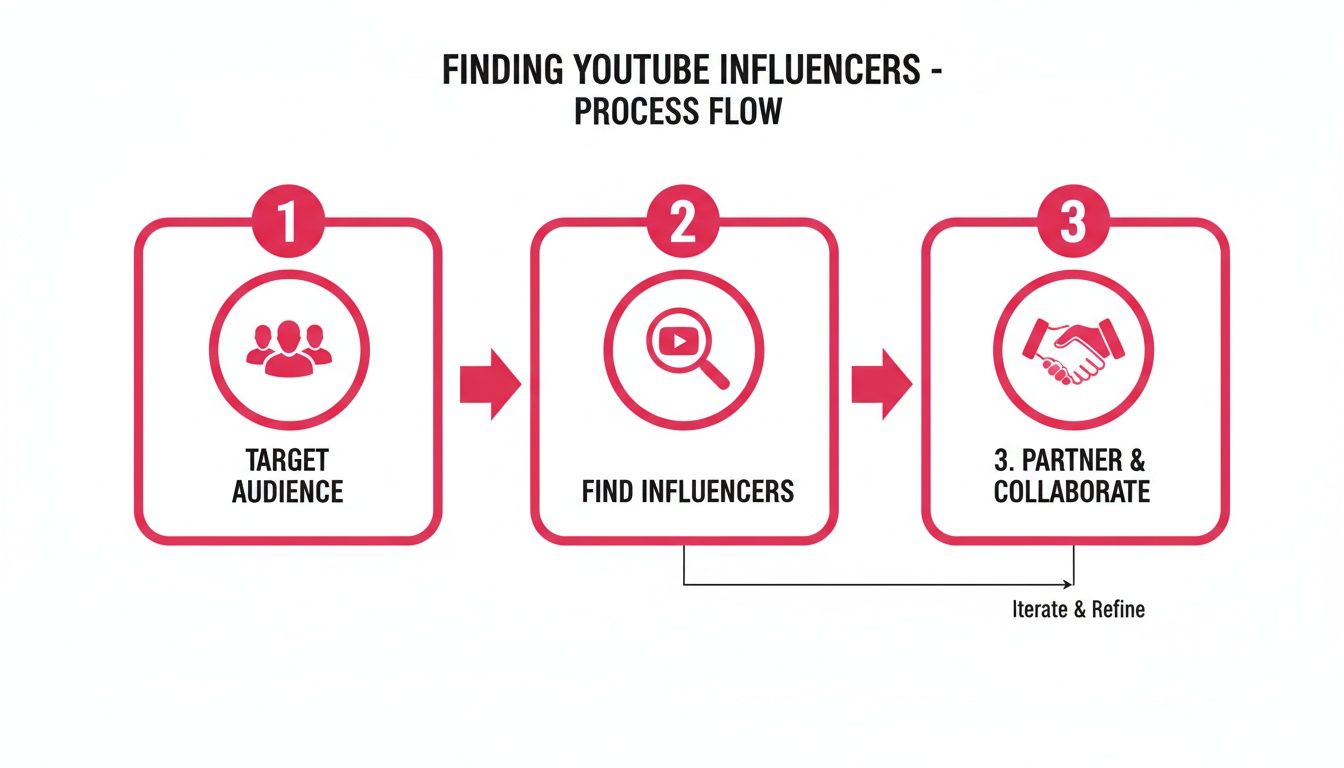
This process keeps you focused, moving from a big-picture target audience to specific, impactful partnerships that actually drive results.
Mastering YouTube Search
Beyond peeking at the competition, get comfortable with YouTube's own search bar. You have to think like your target customer. What would they type into YouTube to find solutions your product provides?
This is where you can get clever with advanced search queries to really narrow the field. Don’t just search for a broad topic; combine it with phrases that signal a creator’s content style or audience intent.
"skincare routine for beginners""unboxing tech gadgets under $100""sustainable fashion haul"
These long-tail searches are goldmines. They surface creators who are already making exactly the kind of relevant, high-intent content you're looking for. As you browse, keep an eye out for creators whose style and production value feel like a natural fit for your brand's own look and feel. It’s a manual process, sure, but it gives you an incredible feel for the landscape.
Pro Tip: Don’t stop at the video. The real magic is often in the comments. A lively, positive comment section is a massive green flag—it shows you a creator has built a genuine, engaged community that trusts their recommendations.
Accelerating Discovery with Platforms
Let’s be real: manual searching gives you great insight, but it doesn't scale. When you need to build a list of 50 or 100 potential partners, you need to bring in the technology. This is where dedicated influencer platforms change the game.
These tools are built to sift through millions of channels using hyper-specific criteria that go way beyond just subscriber counts. You can use specialized influencer marketing tools to drill down your search based on things like:
- Audience Demographics: Filter by age, gender, location, and even language to ensure you're actually reaching your people.
- Content Niche: Zero in on creators in specific categories, from gaming and beauty to personal finance and DIY home improvement.
- Performance Metrics: Find creators who are on an upward trajectory by setting benchmarks for average views, engagement rates, and subscriber growth.
This turns a needle-in-a-haystack search into a focused, data-driven process. The influencer marketing space is exploding, projected to hit nearly $33 billion globally in 2025. More than 50% of U.S. marketers are already planning to partner with YouTube creators for a reason.
YouTube’s strength is in its long-form, high-consideration content, which is perfect for building real trust. We’ve found that creators in the 100K-1M subscriber range often have the highest engagement rates, making them a sweet spot for authentic, high-ROI partnerships.
Vetting Creators Beyond The Follower Count
So, you've got a shortlist of potential creators. This is where the real work starts. A big subscriber number looks great on paper, but it can easily be a vanity metric, hiding an audience that's unengaged or, worse, completely fake. Vetting is the most important step—it's where you roll up your sleeves and confirm a creator's true influence before you spend a dime.
Think of it as a quality audit. You're moving past the flashy numbers to find the real signs of a healthy, authentic community. The goal here is to spot any red flags early, protecting your brand from a partnership that could end up doing more harm than good.
This isn't about being cynical; it's about being smart. A truly great partnership is built on the genuine connection between a creator and their audience. Your job is to make sure that connection is the real deal.
Analyzing Audience Health And Engagement
Your first stop should always be the comment section. It’s an absolute goldmine for understanding the creator's relationship with their community. Are the comments just generic "nice video!" posts, or are people having real, thoughtful conversations?
Look for genuine dialogue. Does the creator actually reply to comments and interact with their fans? A vibrant comment section filled with inside jokes, familiar names, and detailed feedback is a huge green flag. It’s no surprise that 61% of consumers find micro-influencers more genuine, and that authenticity shines brightest in the comments.
As you dig in, keep an eye out for these engagement red flags:
- Sudden Spikes: An account with consistently low engagement that suddenly gets a massive jump in likes or views on a single video could be a sign of bought engagement.
- Ratio Imbalance: A video with thousands of likes but only a dozen generic comments is highly suspicious. The numbers just don't add up.
- Follower-to-View Discrepancy: A channel with 500k subscribers whose videos consistently struggle to break 5,000 views probably has an inflated or inactive follower base.
Vetting isn't just about avoiding fraud; it's about confirming value. You want a partner whose audience actively listens, trusts their recommendations, and participates in the conversation.
Reviewing Past Brand Collaborations
A creator's track record with other brands tells you almost everything you need to know. Hunt down their previous sponsored videos and watch them with a critical eye. This will reveal their level of professionalism and their whole approach to brand partnerships.
Start by looking at the quality of the sponsored content itself. Did they just phone it in and read a script, or did they get creative and weave the product into their content in a way that felt natural? A creator who puts real effort into a brand deal is someone you want on your team. For a deeper dive, our guide on tracking key content performance metrics can give you a more detailed framework.
Finally, consider the types of brands they’ve worked with. A history of partnering with reputable, quality brands is a great sign—it shows they’re selective and care about their audience’s trust. On the other hand, if their channel is a revolving door of questionable or cheap products, that’s a major concern. It suggests they might just be chasing a paycheck, and that’s a risk to your brand’s reputation.
Crafting Outreach That Actually Gets A Response
Okay, you've done the legwork. You've found and vetted the perfect YouTube influencers for your brand. Now for the moment of truth: making first contact.
Let's be blunt: a generic, copy-paste email is a one-way ticket to their trash folder. Your approach here has to be thoughtful, personal, and show value right from the first sentence.
Think of it this way: creators are business owners, and their inbox is prime real estate. A lazy, impersonal pitch tells them you haven't done your homework and, frankly, don't respect their work. It’s critical to shift your mindset from "what can this creator do for me?" to "what could we build together that benefits both of us?"
Your initial email has to immediately prove you see them as a creative partner, not just another billboard for rent.

Personalization Is Your Superpower
The single most effective way to stand out is with genuine, specific personalization. Before you even think about writing, watch several of their recent videos. Seriously. Get a real feel for their tone, their inside jokes with their community, and the unique angles they take on topics.
Your outreach email needs to reference this directly. Mention something specific from a recent video that actually resonated with you or clicked with your brand's mission.
For instance, instead of the tired "I love your channel," try something like: "Your recent video on sustainable travel tech was fantastic—especially the point you made about battery longevity. That's a huge pain point we're trying to solve at [Your Brand]."
This simple act does a few critical things instantly:
- It proves you're a real fan, not a bot scraping for emails.
- It builds immediate rapport and a human connection.
- It creates a natural, relevant bridge to introduce your product.
An outreach email that feels like it could have been sent to anyone will be treated as such—ignored. A message that feels like it could only have been written for one creator is the one that gets a reply.
The Anatomy Of A Winning Pitch
Once you’ve nailed your personalized hook, structure the rest of your email for clarity and impact. Creators are busy people. Get to the point, but provide just enough information to spark their interest.
Here's a breakdown of a strong pitch:
- A Compelling Subject Line: Make it clear and intriguing, but avoid clickbait. Something straightforward like "Collaboration Idea: [Your Brand] x [Their Channel Name]" works great.
- The Personalized Hook: This is your specific reference to their content, as we just covered. It's non-negotiable.
- A Clear Value Proposition: Briefly explain who you are and why a partnership makes sense for their audience. How does your product solve a problem or add real value for their viewers?
- A Flexible Campaign Idea: Pitch a loose concept, not a rigid script. Something like, "We'd love to partner on a video exploring…" invites collaboration rather than dictating terms.
- A Clear Next Step: End with a simple, low-friction call to action. "If this sounds interesting, I'd be happy to share more details" is much better than demanding to schedule a call.
To really craft outreach that resonates, it helps to see things from their perspective. Understanding how YouTube influencers find sponsors can give you a massive advantage. This insight helps you frame your offer in a way that aligns with their goals, turning a cold pitch into a warm invitation for a genuine partnership.
Navigating Negotiations And Contracts Like A Pro
Alright, you've pinpointed a creator who feels like a perfect fit. The DMs have been friendly, the vibe is right, and now it's time to talk business. This is the part where you shift gears from "fan" to "partner" and lock in an agreement that protects everyone involved.
First up is almost always the money conversation. Let's be real, every deal looks a little different, but most partnerships fall into a few common buckets. The simplest is a flat fee per video—clean, straightforward, and easy for everyone to understand.
But don't stop there. Performance-based deals, like affiliate splits or commissions, can be absolute game-changers. They tie the creator's pay directly to the results they drive, which means everyone is pulling in the same direction. And if you're a newer brand, offering a product-only deal (often called "gifting") can be a fantastic way to start, especially with micro-influencers who are already genuinely hyped about what you're selling.
Determining Fair Market Rates
Figuring out what to pay isn't just about plucking a number out of thin air. It's part art, part science. Sure, subscriber count gives you a rough starting point, but the real value is buried in their performance metrics. I’d take a creator with 50,000 super-engaged, niche subscribers over one with 500,000 passive viewers any day of the week.
To negotiate effectively, you have to step into their world. It’s crucial to get a handle on what is monetization on YouTube and how creators build their income beyond just brand deals. This context helps you position your offer as a meaningful piece of their business, not just another paycheck.
Remember, this industry is exploding. A whopping 86% of marketers are planning to use influencer marketing in 2025, with the market racing toward $33 billion. On YouTube, creators pocket a 55% cut of ad revenue, so they have a solid financial baseline. Understanding this ecosystem is your key to making a fair offer that gets a "yes."
Crafting An Ironclad Contract
A handshake deal is not a deal. You need a clear, simple contract to protect your brand and the creator from any "he said, she said" drama down the line.
Think of your contract as a blueprint for a successful collaboration. It sets clear expectations and provides a roadmap for what happens if things don't go as planned.
Your contract needs to spell out the non-negotiables. Getting these details locked in on paper is what separates professional partnerships from amateur hour, making sure everyone is on the same page from day one.
Key Contract Clauses:
- Content Ownership: Who owns the video once it's live? Specify if your brand has the right to repurpose it for ads or other marketing channels. Get explicit here.
- Approval Process: Lay out the review process. How many rounds of feedback are included? What happens if more revisions are needed?
- Exclusivity: Define a reasonable period where the creator can't work with your direct competitors. Be specific about who those competitors are.
- Payment Terms: Don't leave any room for interpretation. State the total fee, the payment schedule (e.g., 50% upfront, 50% on completion), and how you'll be paying.
- FTC Disclosure: This is a big one. The contract must require the creator to follow all FTC guidelines by clearly disclosing the paid partnership in their content.
Got Questions? We've Got Answers
Stepping into the world of YouTube influencer marketing can feel a little overwhelming. Let's tackle some of the most common questions that pop up for brands just getting started.
How Much Does It Cost To Hire A YouTube Influencer?
Ah, the million-dollar question. The honest answer? It completely depends. There’s no standard rate card here; pricing is all over the map based on a creator’s subscriber count, their typical engagement, the niche they're in, and how much work the video involves.
As a general ballpark, a micro-influencer (think 10,000 to 100,000 subscribers) might ask for a few hundred to a couple of thousand dollars for a dedicated video. Once you get into the mid-tier (100k-1M subs), that range can jump to anywhere from $2,000 to $20,000, sometimes more. And the mega-influencers? That's a whole different conversation.
Lots of deals are also structured around a Cost Per Mille (CPM), which usually falls between $20 to $50 per 1,000 views. My advice? Don't be afraid to get creative with hybrid models. A smaller flat fee paired with a solid affiliate commission can be a great way to incentivize performance and make sure everyone wins.
What Are The Key Metrics To Track For A YouTube Campaign?
It's so easy to get fixated on views and likes, but those vanity metrics don't tell the whole story. The only KPIs that truly matter are the ones tied directly back to your campaign goals.
- If you're after awareness: Keep an eye on reach, impressions, and, of course, total video views.
- If engagement is your goal: Dive into the comment section—what's the volume and sentiment? How many shares is the video getting? What's the average watch time? This tells you if people are actually connecting with the content.
- If you need conversions: This is where the rubber meets the road. You need to be tracking click-through rates (CTR) on your links, how many people are hitting your landing page, and—most importantly—sales. Use unique discount codes and UTM parameters so you can attribute every dollar back to the campaign.
At the end of the day, the best metrics tell you about the customer's journey. You need to look past the surface to see how a creator is actually shifting audience behavior and delivering real business results.
How Do I Find An Influencer's Contact Information?
Most professional creators want brands to find them, so they usually don't hide their contact info. Your first stop should always be the "About" tab on their YouTube channel. Nine times out of ten, you'll find a business email right there.
No luck? Check their other social profiles. A lot of YouTubers will link to their manager or put a business contact in their Instagram or Twitter bio. And if all else fails, dedicated influencer marketing platforms are becoming the go-to for connecting directly and starting that partnership conversation.
What Is The Difference Between Shorts And Long-Form Videos?
Knowing the difference here is fundamental to building a smart YouTube strategy.
Long-form videos, which are usually eight minutes or more, are the classic YouTube format. This is your sweet spot for deep-dive product reviews, step-by-step tutorials, and authentic storytelling that builds trust. The real magic of long-form is its staying power; it can rank in YouTube's search results for years, delivering evergreen value.
YouTube Shorts, on the other hand, are the quick-hit, vertical videos that are under 60 seconds. They're built for grabbing attention, jumping on viral trends, and getting your brand discovered by a massive new audience.
A truly killer campaign uses both. You use long-form content to educate your core audience and drive conversions, and you use Shorts to cast a wide net for top-of-funnel awareness.
Ready to stop searching and start partnering? At JoinBrands, our platform connects you with over 250,000 vetted creators to bring your campaigns to life. Find your perfect influencer today!