
 What Is UGC Marketing and How Does It Drive Growth
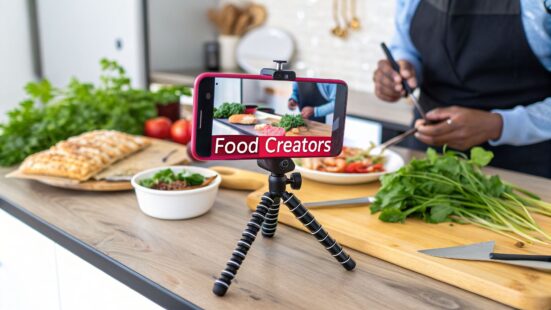
Food content creators are the modern-day storytellers of the culinary world, whipping up everything from viral recipes to must-watch restaurant reviews. They've become the new tastemakers, building communities that hang on their every word – and every bite. Their recommendations often carry more weight than traditional ads, turning a casual scroll through social media into a direct path to your shopping cart.
Table of Contents
The New Food Network: Why Creators Are Essential
Welcome to the new age of food media. The old guard – the big TV networks and glossy magazines – has been joined by a massive, decentralized force of individual creators. These digital-native experts have cultivated loyal audiences that are more engaged and niche than any traditional outlet could ever dream of reaching. They aren't just "influencers"; they're recipe developers, photographers, and trusted friends to millions.
For any brand looking to grow today, this shift isn't just a side tactic; it's a core pillar of modern e-commerce. To really get a handle on it, you need to understand what a content creator is and the diverse roles they play. This ecosystem gives brands a direct line to hyper-specific audiences, whether you're trying to reach vegan home cooks or artisanal coffee lovers.
They're Changing How We Shop
The impact these creators have on our buying habits is huge. They don't just show off a product; they weave it into a story, a mouth-watering recipe, or an honest-to-goodness review. This simple act turns passive scrolling into active consideration. A single TikTok showing off a new kitchen gadget can sell it out in hours.
This power comes down to two simple things:
- Authenticity: Creators build real trust because their passion is genuine. Their recommendations feel like getting advice from a friend who knows their stuff, not a corporate sales pitch.
- Relatability: They make content that reflects their audience's lives, kitchens, and dreams. It makes their suggestions feel both aspirational and totally achievable.
A Market That's Just Getting Started
If you need more convincing, just look at the numbers. The culinary content creation market is absolutely exploding. Valued at $20,987.76 million in 2025, it's projected to more than double to $46,230.99 million by 2032. That's a compound annual growth rate (CAGR) of a whopping 12.5%.
The takeaway is crystal clear: Food content creators aren't just a fleeting trend. They are a vital, scalable, and non-negotiable channel for brand growth, product discovery, and winning over new customers.
Working with them lets you tap into ready-made communities and use authentic storytelling to get real, measurable results. You can dive deeper into the strategic advantages by exploring the core benefits of influencer marketing. In today's crowded market, their ability to blend entertainment with education is a major advantage.
Finding the Right Creator for Your Brand
Jumping into the world of food content creators can feel like walking into a massive, bustling market. Every stall has something different to offer, and if you don't have a shopping list, it's easy to get lost. The secret isn't just finding a creator with a huge following; it's about finding the right type of creator whose unique style clicks with your campaign goals.
Think of it this way: you wouldn't hire a world-class pastry chef to perfect your Texas-style brisket. In the same vein, a creator known for quick, snappy recipe videos might not be the best partner for a brand focused on slow, mindful eating. Matching the creator's style to your brand's voice is the first and most critical step toward a partnership that actually moves the needle.
Beyond Follower Counts: Creator Archetypes
Follower count is just one small piece of a much bigger puzzle. The real magic is in a creator's specific skill set and the kind of content they're known for. Let's break down the most common archetypes you'll come across.
The Recipe Developer: These are the maestros of the kitchen, true artists skilled at creating original, mouth-watering recipes. They are the perfect partners for showing off your product as a star ingredient, proving its versatility and value in a way that’s both practical and educational.
The Food Reviewer: Think of them as trusted critics. Reviewers give their audience honest, in-depth opinions on everything from new snacks to local restaurants. A glowing review from a respected voice provides powerful social proof and can spark immediate interest in your product.
The ASMR Creator: These are sensory artists who use sound to create an incredibly immersive experience. For a food brand, this means highlighting the satisfying crunch of a potato chip, the crisp fizz of a soda, or the sizzle of onions hitting a hot pan. They make your product the undeniable star of a seriously captivating video.
The Professional Chef: Chefs bring a heavy dose of credibility and authority to the table, thanks to their professional training and culinary expertise. They are an ideal match for brands that want to be associated with quality, technique, and a true industry seal of approval.
This simple decision tree shows just how straightforward the logic is for driving business growth.

When growth is the objective, partnering with food content creators is one of the most direct and effective paths you can take.
Choosing the Right Food Creator for Your Campaign Goal
To help you connect the dots, here’s a quick-reference table that matches creator types with the campaign goals they're best suited for. Use this to guide your strategy and ensure you're picking the right partner for the job.
| Creator Type | Primary Platform | Best For Campaign Goal | Example Use Case |
|---|---|---|---|
| Recipe Developer | YouTube, Instagram, Blog | Product Integration & Education | A sauce brand partners with a creator to develop 3 unique dinner recipes using their new product. |
| Food Reviewer | TikTok, YouTube | Social Proof & Conversions | A snack company sends their new flavor to 10 reviewers for honest "first taste" videos. |
| ASMR Creator | TikTok, YouTube Shorts | Sensory Engagement & Brand Recall | A beverage company works with an ASMR creator to highlight the sound of pouring their fizzy drink over ice. |
| Professional Chef | Instagram, YouTube | Building Brand Credibility | A kitchen appliance brand has a chef demonstrate advanced techniques using their new blender. |
| Nano/Micro Creator | Instagram, TikTok | Authentic UGC & Community Buzz | A new coffee brand sends samples to 50 nano-creators to generate genuine morning routine content. |
This table isn't exhaustive, but it provides a solid framework for thinking about which creator archetype will deliver the results you're looking for.
Tiers of Influence: Nano, Micro, and Macro
Creators are also grouped by the size of their audience. Each tier brings its own unique set of advantages, and the best fit for your brand depends entirely on what you want to achieve. When vetting potential partners, checking out their influencer media kit template to win brand deals is a great way to get a snapshot of their audience and past campaign performance.
Choosing between one macro-creator and a whole squad of micro-creators is a major strategic decision. One gives you massive reach for a big splash, while the other builds deep, authentic trust through super-targeted engagement.
Nano-Influencers (1K-10K followers): These are everyday people with a small but mighty following. Their audience engagement is often off the charts, making them perfect for generating authentic user-generated content (UGC) and creating grassroots buzz around your product.
Micro-Influencers (10K-100K followers): Often specialists in a specific niche (like vegan baking or craft beer), micro-influencers command serious trust within their communities. Their high engagement rates make them ideal for driving conversions with a dedicated, ready-to-listen audience.
Macro-Influencers (100K-1M+ followers): These are the established digital celebrities of the food world. With their broad reach, a partnership with a macro-influencer is a powerhouse move for large-scale brand awareness campaigns, new product launches, or making a major impact in the market.
Understanding these different creator types is your first step to building a winning strategy. To dive even deeper, our guide on how to find foodie influencers offers more detailed tips and tactics to get you started.
Choosing Your Platforms and Content Formats
Picking the right platform for your campaign is a lot like choosing the right knife for a kitchen task. A chef's knife is a great all-around tool, but you wouldn’t use it to peel a potato. In the same way, the content that blows up on TikTok might completely fall flat on YouTube. Each platform has its own unique language, rhythm, and audience expectations.
To really nail it, you have to match your campaign goals, your product, and the creators you’re working with to the native feel of each platform. It’s not about being everywhere at once; it’s about being in the right places with a message that clicks. This is the strategic choice that separates a forgettable post from a viral hit that actually moves the needle for your business.
The Fast-Paced World of Short-Form Video
TikTok, Instagram Reels, and YouTube Shorts are the modern-day food truck rally – they're fast, loud, vibrant, and full of quick, amazing discoveries. The content here is made for grabbing attention and making an immediate impact.
The secret to winning on these platforms is all about speed and trends. Think quick-cut recipe videos, those oddly satisfying cheese pulls, or funny skits built around a food product. The audio is just as crucial as the visuals. Latching onto a trending sound can give your content a massive algorithmic boost, putting your product in front of thousands of new customers practically overnight. For a deeper look at creating content for specific platforms, check out our guide on the best types of content for social media.
What works best:
- Quick Recipes: 30-second videos showing a simple, delicious-looking recipe.
- Taste Tests & Reactions: Authentic, first-impression videos that capture genuine excitement.
- Educational "Hacks": Short tips that solve a common problem in the kitchen.
- Trending Challenges: Adapting a popular audio or video format to feature your product.
The Detailed Storytelling of Long-Form Video
If short-form video is a food truck, then YouTube is the gourmet restaurant serving a full-course meal. This is where people go when they want depth, detail, and genuine expertise. Viewers here are ready to invest more time – often 8-15 minutes – because they're looking for valuable, in-depth content.
Food creators on YouTube are masters at building long-term trust. They can dedicate an entire video to a thorough product review, a detailed step-by-step cooking tutorial, or a "day in the life" vlog that naturally weaves a brand's products into their daily routine. This format is a goldmine for brands with a complex story or a product that really shines with a detailed explanation.
A single, well-made YouTube video can become an evergreen marketing asset, driving views and sales for months or even years. Its search-friendly nature means your investment keeps paying off long after the campaign ends.
The Curated Visuals of Instagram
Instagram is the beautiful, glossy food magazine of the social media world. It's a platform driven by stunning visuals where high-quality photography and perfectly styled videos are king. The main feed is for that polished, "hero" content – think breathtaking food photos and aesthetically pleasing Reels.
But for many brands, the real magic happens in Instagram Stories. This is where creators can be more candid, raw, and interactive.
- Behind-the-Scenes: Showing the real, unedited process of making a dish.
- Q&A Sessions: Answering audience questions about a product in real time.
- Polls and Quizzes: Getting the community involved and gathering instant feedback.
Stories create a feeling of urgency and exclusivity, making them a fantastic tool for flash sales, limited-time offers, and building a direct, personal connection with your audience.
The Conversion-Focused Power of Amazon UGC
Finally, we have Amazon. Content on this platform has one main job: to turn shoppers into buyers. User-Generated Content (UGC) from food creators on Amazon product pages is wildly effective because it feels like a trusted review from a friend.
These videos are usually short, direct-to-camera, and refreshingly honest. A creator might unbox a new snack, show how to use a kitchen gadget, or just share their genuine experience with a food item. This kind of content answers those last-minute questions, busts through buyer hesitation, and provides the social proof someone needs to confidently click "Add to Cart." It’s less about entertainment and all about building trust right at the point of sale.
How to Launch Your First Creator Campaign

Moving from theory to your first real campaign can feel like a huge leap. But it’s really just a process. Think of it like a recipe: get your ingredients and steps in order, and you’ll create something great. Let's break down the entire workflow into simple, manageable steps.
The secret to a successful campaign actually starts long before you even think about contacting a creator. It begins with a crystal-clear vision of what you want to achieve. Vague goals like "getting more exposure" are impossible to measure and almost always lead to disappointment.
You need to define specific, measurable goals that connect directly to your business. This simple step will guide every other decision you make, from which food content creators you hire to the metrics you’ll obsess over later.
Set Clear and Measurable Goals
Your goals are your campaign's north star. Without them, you're just making noise. Start by asking yourself: what does a "win" look like for my brand right now?
Sales-Focused Goals: Is the main objective to move a specific product off the shelves? A great goal would be: "Increase online sales of our new pasta sauce by 20% within 30 days of the campaign launch." It’s specific, measurable, and has a deadline.
Content-Focused Goals: Maybe your marketing team is starving for fresh assets. Your goal could be: "Generate 50 high-quality UGC videos to use in paid ad campaigns over the next quarter."
Awareness-Focused Goals: Are you a new brand just trying to get on people's radar? A solid goal is: "Hit 1 million total video views across all creator content within the first two weeks."
Defining these objectives upfront is the only way you'll be able to measure your return on investment when it's all said and done.
Craft a Compelling Creative Brief
The creative brief is the single most important document you'll create. Seriously. It’s the bridge between your brand's vision and the creator's unique style. A great brief inspires creativity while setting clear boundaries to protect your brand. It should never be a restrictive script; instead, think of it as a collaborative framework.
A strong brief needs to include:
- Campaign Overview: A quick summary of why you're running this campaign.
- Key Messaging: The one or two main points you absolutely need the audience to remember.
- Mandatory Elements: Things like your brand handle, a specific campaign hashtag, or a required link.
- Clear 'Dos and Don'ts': Simple guidelines to prevent common mistakes. For example, "Do show the product in a real kitchen setting; Don't use filters that change the product's color."
Your brief is your insurance policy. A detailed yet flexible brief empowers food content creators to do their best work while ensuring the final content perfectly aligns with your marketing strategy.
Manage the Campaign Workflow
With goals set and a brief in hand, it’s go-time. This is the operational phase, and it involves a lot of moving parts that need to be carefully juggled.
Outreach and Vetting: Start by finding creators who genuinely fit your brand's vibe. When you reach out, personalize your message – nobody likes a copy-paste job. Once they reply, vet them carefully. Look past the follower count and dig into their engagement rate, read the comments, and check out their past brand partnerships to get a feel for their true influence.
Product Shipping: This sounds simple, but logistics can make or break a campaign. Coordinate shipping to make sure creators get their products on time. Good communication here prevents delays that can throw your entire timeline off track.
Content Review and Approval: Set up a clear, straightforward process for reviewing content. When giving feedback, always tie it back to the creative brief. A platform like JoinBrands can be a lifesaver here, with built-in approval tools that keep all your communications organized in one spot.
Payment and Execution: Once a piece of content is approved, process the payment quickly. A happy creator is a good partner. Confirm their posting dates and double-check that all deliverables are met as agreed.
With the influencer marketing market expected to jump from $21.1 billion in 2024 to $24 billion by 2025, getting this workflow right is no longer optional. You can get more insights on how top brands are winning by checking out the latest findings on influencer marketing trends.
Budgeting and Measuring Your Campaign Success

Two questions sit at the heart of every single marketing campaign: "What's this going to cost?" and "Did it actually work?" Answering them means getting real about how you pay food content creators and how you track the results they bring in.
Let’s pull back the curtain on both sides of this crucial equation. Budgeting for a creator campaign isn’t about plucking a number out of thin air. It’s a dynamic process based on a fair value exchange. The price tag reflects a creator's skill, the scope of the work, and how you plan to use the awesome content they create – not just their follower count.
Structuring Creator Compensation
There are a few solid ways to pay creators, and each one makes sense for different campaign goals. If you know your options, you can build partnerships that feel fair, transparent, and don't blow up your budget.
Flat Fees: This is as straightforward as it gets. You pay a fixed price for a specific set of deliverables – say, one Instagram Reel and three Stories. It’s perfect for predictable budgeting and is the go-to for most brand awareness campaigns.
Product Gifting (Product Seeding): Often a great starting point with nano and micro-creators, this involves sending free products in exchange for content. It's incredibly cost-effective, but keep in mind it doesn't guarantee a post. Think of it as a way to generate authentic UGC and organic buzz.
Affiliate Partnerships: This is a pure performance play. Creators earn a commission on every sale they drive through their unique link or promo code. It's a low-risk way to zero in on conversions because you only pay for tangible results.
Hybrid Deals: Honestly, many of the best partnerships mix and match. A common hybrid deal includes a modest flat fee to cover the creator's time and effort, plus an affiliate commission to light a fire under sales.
The final rate is always a negotiation, and it’s heavily influenced by things like content usage rights. If you want to use a creator's video in your paid ads for a full year, that's going to cost a lot more than a single organic post on their feed.
Measuring What Truly Matters
Once your campaign is live, the game shifts to measuring its impact. Sure, vanity metrics like likes and views can give you a rough idea of reach, but they don't tell the whole story. To actually prove the value of your investment, you need to track Key Performance Indicators (KPIs) that tie directly back to your original business goals.
Tracking the right KPIs is like using a GPS instead of a compass. A compass points you in the general direction, but a GPS gives you precise, turn-by-turn data to prove you're on the most efficient path to your destination.
It’s time to look past the surface-level numbers and dig into the metrics that show how a creator’s content actually influenced what their audience did next.
Key KPIs for Food Creator Campaigns
The KPIs you choose should be a mirror image of your campaign objectives. If your goal was to drive sales, track conversions. If it was to build awareness, keep your eyes on engagement and reach.
For Conversion-Focused Campaigns:
- Conversion Rate: The percentage of users who actually completed a desired action (like making a purchase) after clicking a creator's link.
- Cost Per Acquisition (CPA): Your total campaign cost divided by the number of new customers you landed. This tells you exactly how much it cost to win each sale.
- Click-Through Rate (CTR): The percentage of people who saw a link (in a Story, for example) and were interested enough to actually click on it.
For Awareness-Focused Campaigns:
- Engagement Rate: Calculated by (likes + comments + shares) / followers. A high rate is solid proof that the content really connected with the audience.
- Earned Media Value (EMV): This is an estimate of what all that organic buzz and exposure would have cost if you had to pay for it through traditional ads.
- Audience Sentiment: It’s not just about numbers. explore the comments to gauge whether the reaction to your brand and product was positive, negative, or neutral.
When you connect these concrete metrics back to your budget, you can calculate a clear Return on Investment (ROI). This data-driven approach is what transforms your creator marketing from a simple expense into a powerful, predictable growth engine for your brand.
Seeing It in Action: Real-World Food Creator Wins
Theory is one thing, but seeing how these partnerships play out in the real world is where it all clicks. Let's move past the planning stage and look at some proof. I've broken down a couple of winning campaigns between brands and food creators to show you what's possible.
These aren't just hypotheticals; they're mini-case studies that show how different goals demand different strategies. Each one highlights a unique objective, from stockpiling authentic content to driving sales right off the bat.
The Snack Startup and the UGC Army
A new healthy snack brand needed a library of authentic user-generated content (UGC) for their social media ads. The goal wasn't one viral hit, but a constant flow of relatable, high-quality videos that didn't feel like a polished, corporate ad shoot.
Instead of putting all their budget into one macro-influencer, they teamed up with 25 micro-creators who were already living and breathing the wellness lifestyle.
- The Goal: Get a ton of authentic, diverse UGC to run as paid ads.
- The Creator Match: Micro-creators with tight-knit, engaged communities focused on wellness.
- The Content: Creators were asked to make short videos showing how the snacks fit into their real lives – as post-workout fuel, a smart desk snack, or a go-to treat for their kids.
- The Result: The brand walked away with over 60 unique video assets ready to be repurposed. The ads running this creator-made content saw a 35% lower cost-per-acquisition (CPA) than their slick, studio-shot ads. Why? Because the content felt real and earned instant trust.
This just goes to show how a volume-based strategy with smaller creators can be an incredibly smart way to build a powerful content engine without breaking the bank.
The Kitchenware Brand and TikTok Affiliate Sales
A kitchenware company launched a slick new blender and wanted to see sales, like, yesterday. Their main goal was direct conversion, which made TikTok, with its powerful shopping features and viral potential, the perfect battleground.
They strategically chose to work with recipe creators who were already active in the TikTok Shop affiliate program.
When you partner with creators who know how to demonstrate a product's value and smoothly guide their audience to buy, you turn views directly into revenue. It’s the fastest way to prove the ROI of a campaign.
The creators whipped up fast-paced, eye-catching videos showing off the blender's best features while making drool-worthy smoothies and sauces. The "Shop Now" button was right there, making the leap from watching to buying almost effortless. By offering a competitive commission rate, the brand fired up creators to push the product hard. The result? Thousands of direct sales in the very first month, proving that great content plus native shopping tools is a killer combination.
This kind of partnership is a low-risk, high-reward play for any brand laser-focused on performance. It’s a true win-win, where the creator's success is directly tied to the brand’s bottom line.
Common Questions About Food Creator Marketing
Diving into partnerships with food content creators always brings up a lot of questions. Let's tackle some of the most common hurdles and points of confusion brands face, offering some quick, practical answers to help you navigate your first few campaigns with confidence.
Think of this as your go-to reference for those nagging "what if" scenarios. Getting these details right from the start can save you a world of headaches and ensure your partnerships are built on a solid foundation of clarity and mutual respect.
How Do I Handle Content Ownership and Usage Rights?
This is easily one of the most critical details to iron out, and it absolutely must be defined in a clear contract before anyone hits "record." The best practice is to negotiate rights for specific channels – like your brand's social media, website, or paid ads – for a set period, usually around 6-12 months.
You can go for a full buyout that gives you the content forever, but just know that it will cost significantly more. A formal agreement protects both you and the creator, making sure you can legally use the amazing content you've paid for exactly how you planned. Thankfully, platforms like JoinBrands often simplify this by building these terms directly into the campaign agreement.
What Is the Difference Between UGC and Influencer Marketing?
While they often overlap, they're really about two different goals. Influencer marketing is all about using a creator's audience and credibility to promote your product on their channels. The main goal here is to tap into their reach and build that all-important social proof.
User-Generated Content (UGC), on the other hand, is about getting authentic content for your brand to use in its own marketing, like in your social ads or on your product pages. In many UGC campaigns, the creator might not even post the content to their personal feed at all.
A modern, effective strategy is often a hybrid. The campaign secures both an influencer post for immediate reach and the raw video assets for the brand to use as UGC in future ads.
How Long Does It Take to See Results?
This one really depends on your campaign goals. If you're after brand awareness, you'll see metrics like video views and engagement almost instantly – as soon as a creator posts.
For sales-driven campaigns using promo codes or affiliate links, you can see results within hours of going live. But the full impact is best measured over several weeks to capture the long tail of conversions. And if a partnership is part of a longer-term strategy, like a detailed YouTube review that starts ranking in search, it might take months to see the full benefit. The key is to track both immediate spikes and the slower-burning indicators of success.
Is It Better to Work With One Big Creator or Many Small Ones?
This all comes down to your budget and what you're trying to achieve. A single macro-influencer can deliver a massive, immediate burst of awareness, which can be perfect for something like a new product launch.
However, a "squad" of several nano or micro-creators often generates a higher collective engagement rate, builds deeper community trust, and gives you a much larger volume of diverse UGC assets. For a lot of brands, spreading the budget across multiple smaller food content creators offers a more sustainable, cost-effective, and authentic way to drive results.
Ready to find the perfect food content creators for your next campaign? JoinBrands makes it easy to connect with over 250,000 vetted creators, manage campaigns, and generate high-impact UGC all in one place. Find your next creator on JoinBrands today!