

 6 Best Ways to Earn Money on TikTok in 2022
To really win with TikTok affiliates, you need a game plan that goes way beyond just sliding into DMs. The goal is finding creators whose authentic content actually gets people to click "buy." This means using the right platforms to find talent, putting together commission structures that get them excited, and giving them crystal-clear creative briefs.
you're not just hiring someone; you're building a real partnership that taps into TikTok's wild mix of entertainment and e-commerce.
Table of Contents
Why TikTok Affiliates Are a Must-Have for Growth
In the e-commerce world, you have to be where your customers are. And right now, that's TikTok. The platform has exploded from a fun video app into a social commerce juggernaut, drawing a straight line from a creator's post to a customer's shopping cart. If you're serious about growth, you simply can't afford to sit this one out.
The real magic of TikTok is its authenticity. A video from a TikTok affiliate doesn't feel like a polished, slick ad – it feels like a genuine tip from a friend you trust. That kind of peer-to-peer validation is gold for cutting through the marketing noise and instantly building credibility for your products.
The Unstoppable Rise of TikTok Commerce
Bringing TikTok affiliates into your marketing mix plugs you directly into one of the fastest-growing channels out there. TikTok is now home to roughly 1.58 billion monthly active users, and people are sticking around for nearly an hour every single day.
That heavy engagement leads to some serious shopping. A staggering 78% of TikTok consumers say they've bought a product after seeing it on the platform. Even more telling, 36% of all direct purchases made through social media now happen on TikTok. You can dig deeper into how TikTok is shaking up affiliate marketing statistics.
This isn't just another marketing tactic; a solid TikTok affiliate program is a full-blown sales channel. This is where platforms like JoinBrands become indispensable. They take the messy, manual process of outreach and turn it into a streamlined system for finding, managing, and scaling your creator partnerships. No more cold DMs, just a vetted network of creators ready to get to work.
By partnering with creators who already have the trust of a niche audience, you are essentially borrowing their credibility. This shortcut allows you to build brand affinity much faster than you could with conventional advertising alone.
A Snapshot of Program Benefits
Before we get into the nitty-gritty, let's zoom out and look at what a well-run TikTok affiliate program can really do for you. All the moving parts work together to create a powerful engine for both brand awareness and revenue. From authentic content to sales you can actually measure, every piece plays a vital role.
To give you a quick reference, here’s a breakdown of the core components of a TikTok affiliate program and what you should expect to see as a result.
TikTok Affiliate Program Snapshot
| Component | Description | Expected Outcome |
|---|---|---|
| Creator Discovery | Identifying affiliates whose audience and content style are a perfect match for your brand's vibe. | Increased brand relevance and a stronger connection with your target demographics. |
| Authentic Content | Giving creators the freedom to showcase products in their own unique, relatable way. | Higher engagement rates and more audience trust in what you're selling. |
| Performance Tracking | Using unique affiliate links and promo codes to accurately monitor every sale and conversion. | A clear ROI and data-backed insights to help you fine-tune and optimize your program. |
| Scalable Outreach | Using platforms to efficiently manage dozens or even hundreds of affiliate relationships at once. | Sustainable growth of your affiliate network without sinking all your time into it. |
This table should give you a clear picture of how a strategic approach to hiring TikTok affiliates can drive real, measurable results for your brand. Now, let's get into how to build it.
Finding TikTok Affiliates Who Align with Your Brand
When you start looking for TikTok affiliates, it’s easy to get star-struck by huge follower counts. But here’s the thing I’ve seen time and time again: a creator with a million followers who has zero connection to your audience is way less valuable than a micro-creator with 10,000 die-hard fans who hang on their every word.
The real goal is finding partners whose personal brand and audience are a natural fit for what you’re selling. When a creator genuinely vibes with your product, it shows. Their content feels less like a stiff ad and more like a real recommendation from a friend – and that’s what actually drives sales on TikTok.
Leveraging Creator Marketplaces
Let's be honest, manually scrolling through hashtags on TikTok hoping to find the perfect affiliate is a massive time sink. It rarely works out. This is exactly why creator marketplaces like JoinBrands are so crucial for brands and agencies. These platforms are designed to connect you with vetted creators, cutting out hours of guesswork.
You can get super specific with filters to find exactly who you need. Instead of just looking at follower counts, you can drill down by:
- Niche and Content Categories: Find creators who are already pros in your field, whether that's sustainable fashion, gaming gear, or clean beauty.
- Audience Demographics: Make sure their followers actually match your target customer – think age, gender, location, and what they’re into.
- Performance History: Check out their past campaign results to see how they've delivered for other brands.
Using a marketplace gives you a structured way to find affiliates with a proven track record. It also helps to understand the wider landscape of the best niches for affiliate marketing to see where your brand fits in the bigger picture.
Look Beyond Vanity Metrics
Everyone loves a high engagement rate, but that number only tells you part of the story. A post can have tons of likes and comments, but if it's all bots or shallow reactions, it means nothing for your bottom line. You have to dig deeper and look at the quality of that engagement.
Before you reach out, spend some real time in their comments section. Are people asking legit questions about the products they feature? Is the creator actually in there responding and building a community? Positive, thoughtful comments are a huge green flag. It shows an audience that truly trusts the creator’s judgment.
Don't just count the likes and comments; read them. The quality of the conversation happening in an affiliate's comment section is a direct reflection of their audience's trust and purchase intent.
If you want to go even deeper on this vetting process, we've got a full guide on how to find TikTok influencers who can become fantastic affiliate partners.
This infographic breaks down how an affiliate’s work translates from initial reach into actual sales for your brand.
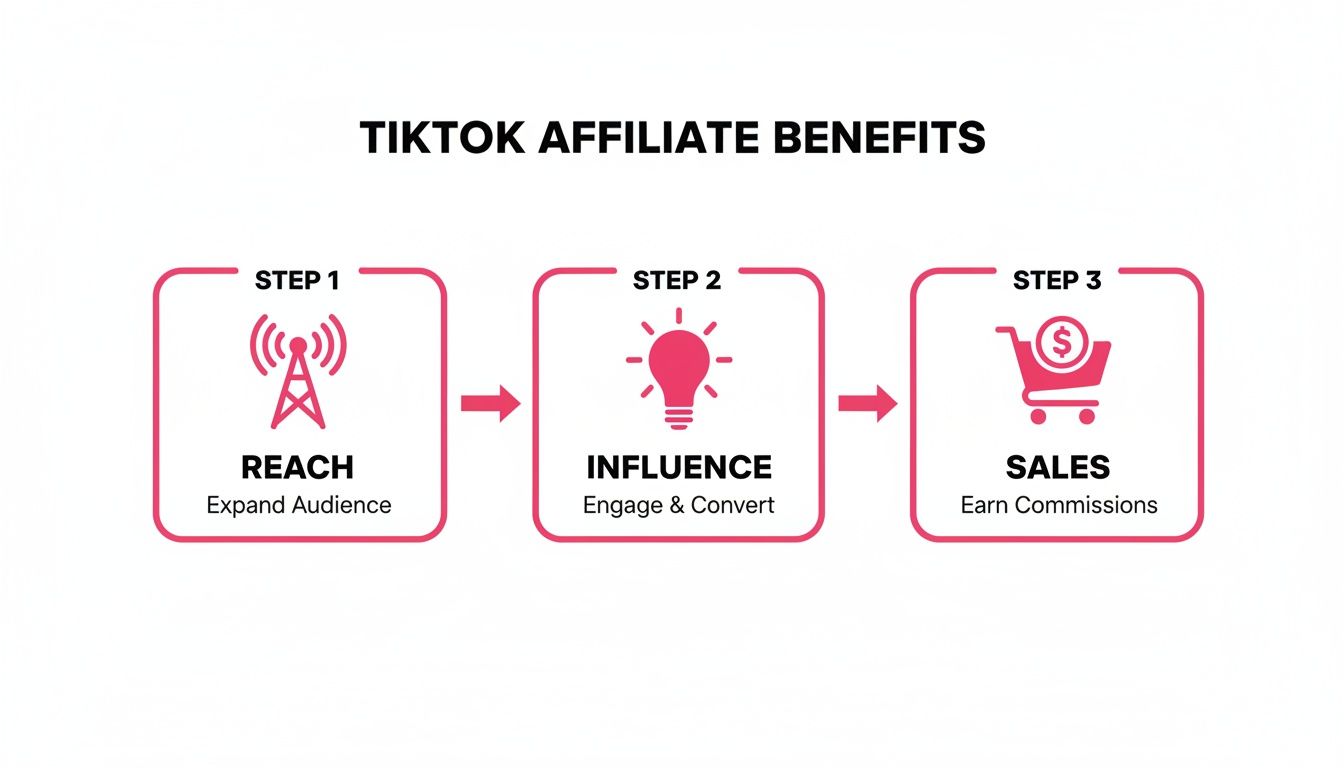
That flow from reach to revenue is entirely powered by the trust a creator has built with their audience. It's why vetting for authenticity is non-negotiable.
The Ultimate Vetting Checklist
Before you send out that contract, run every potential affiliate through this final checklist. This makes sure you're looking at the whole picture, not just stats on a screen.
Content Style and Authenticity: Does their video style match your brand's vibe? More importantly, does their content feel real, or is it overly polished and corporate? You want creators who aren't afraid to be themselves.
Audience Trust and Community: Go look at their past sponsored posts. Did their followers react positively, or did they get called a "sellout"? A creator who can work with brands while keeping their audience's trust is golden.
Previous Brand Collaborations: Who have they worked with before? Seeing partnerships with complementary (but not competing) brands is a good sign. It shows they know how to weave products into their content naturally, which will make your collaboration go a lot smoother.
Designing Offers That Attract Top Creators
You’ve found the perfect creators, the ones whose vibe and audience are a dead ringer for your brand. Now comes the hard part: getting them to actually partner with you. Top-tier TikTok affiliates get flooded with partnership requests every single week. A generic, copy-pasted message is a one-way ticket to the trash folder.
Your offer needs to be personalized, compelling, and show them what’s in it for them right from the jump.
The trick is to frame this as a real collaboration, not just a one-off transaction. Show them you've actually watched their stuff. Mention a specific video you loved and explain why their style is the perfect match for your product. That small, personalized touch immediately proves you value their creative voice and aren't just blasting out a template.
Crafting a Compelling Commission Model
The heart and soul of any affiliate offer is the commission structure. This is your chance to align your goals with the creator's motivation and get them fired up to drive real results. A one-size-fits-all approach is a recipe for failure; the best model depends entirely on what you're trying to achieve, whether it's massive brand awareness or hard-and-fast sales.
Here are the most common models you'll see when you hire TikTok affiliates:
Percentage-Based Commission: This is the classic. Affiliates earn a set percentage of every sale that comes through their unique link or discount code. It’s clean, easy to track, and directly rewards performance.
Tiered Rewards: This model is all about incentivizing your top performers. You increase their commission rate as they hit certain sales targets. For example, a creator might earn 10% on their first 50 sales, jump to 15% for the next 100, and hit 20% on every sale after that.
Hybrid Structures: This is a mix-and-match approach. You might offer a small flat fee upfront to cover the cost of creating the video, plus a percentage-based commission on all the sales it generates. This gives creators some guaranteed income while still motivating them to push for conversions.
From a pure performance perspective, TikTok affiliates are an incredible investment. Their engagement and click-through rates blow most other platforms out of the water. Nano creators (under 100k followers) can hit engagement rates of 7-18%. Some studies even show that influencers with up to 50,000 followers can see affiliate link engagement rates as high as 30.1% – that's a staggering 1,570% higher than similar influencers on Instagram.
Overall, affiliate links on TikTok average about 5.2% engagement, which is roughly 160% higher than you'd see on Instagram or YouTube. You can dig deeper into these powerful TikTok marketing metrics to see just how much potential is there.
Your commission structure sends a clear message about what you value. A high commission rate says, "We're confident in our product and believe in your ability to sell it." This confidence is often contagious and inspires creators to put more effort into their content.
To help you figure out which model makes the most sense for your campaign, here’s a quick breakdown of the pros and cons of each.
Comparing TikTok Affiliate Commission Models
Choosing the right commission structure is critical. It directly influences the type of creators you attract and how motivated they are to perform. This table breaks down the most common models to help you align your offer with your campaign goals.
| Commission Model | Best For | Pros | Cons |
|---|---|---|---|
| Percentage-Based | Driving direct sales and maximizing ROI. | Simple to understand and track; purely performance-based, so you only pay for results. | May be less appealing to creators who want guaranteed upfront payment for their work. |
| Tiered Rewards | Motivating top performers and scaling your program aggressively. | Encourages long-term partnership and continuous effort from your best affiliates. | Can be more complex to manage and requires robust tracking to handle multiple tiers. |
| Hybrid (Fee + %) | Securing high-quality content from in-demand creators. | Attracts top talent with guaranteed compensation; still incentivizes sales performance. | Higher initial cost and financial risk if the affiliate doesn't drive many sales. |
the best model depends on your budget and risk tolerance. If you're laser-focused on ROI, a percentage-based or tiered model is your best bet. If you need to lock in a top-tier creator for a big launch, the hybrid model might be worth the upfront investment.
Smart Negotiation and Outreach
With your commission model locked in, it’s time for outreach. Your first message needs to be short, personal, and packed with value. Don't lead with a lowball offer – start with a fair, competitive rate that shows you respect the creator's time, effort, and influence.
Here’s a simple but effective template you can adapt:
"Hi [Creator Name],
My name is [Your Name] from [Your Brand]. I'm a huge fan of your content, especially your recent video on [mention a specific video]. I was so impressed with how you [mention something specific you liked].
We have a new [Product Name] that I think your audience would absolutely love, and I believe your authentic style is the perfect fit to showcase it. We're looking for partners for our affiliate program and would love to offer you a [Commission Model, e.g., 15% commission on all sales] to start.
Would you be open to hearing more?
Best,
[Your Name]"
This approach works because it's respectful, direct, and proves you’ve done your homework. Just remember, negotiation is a two-way street. Be ready to discuss other terms like content usage rights, exclusivity periods, and payment schedules. A flexible and fair attitude will help you build the kind of strong, lasting partnerships that are profitable for everyone involved.
Getting Your Affiliates Set Up for Success
So you've found the perfect creators and hammered out the terms. Now the real work starts. A messy, confusing kickoff can doom a great partnership before it even begins. On the flip side, a smooth, professional onboarding process shows affiliates you’re serious, you respect their time, and you’re truly invested in collaborating.
This isn't just about shipping off a contract and some products. This is your chance to give them everything they need to create killer content – content that feels genuine to their followers while still nailing your brand's goals. Your job is to make their job easy so they can focus on what they do best: making incredible videos.

Building the Perfect Campaign Brief
Your campaign brief is easily the most critical document you'll hand over. I’ve seen it time and time again: a great brief sparks creativity and provides clear guardrails, but a bad one just leads to off-brand videos, endless revision requests, and totally frustrated creators. It needs to be a source of clarity, not a list of rules.
Think of it as the campaign playbook. It has to be detailed enough to keep things on track but flexible enough to let the creator’s actual personality shine. Trying to micromanage their creative process is a guaranteed way to get stiff, salesy content that their audience will sniff out from a mile away.
Here’s what I always include in my briefs:
- Brand Story & Key Messages: Don't just list product features. Tell them why your brand exists. Share your mission and lock in the one or two key takeaways you want their audience to remember.
- Content Guidelines (The Do's and Don'ts): Get specific about what to include and what to avoid. This covers everything from visual style and tone of voice to any specific words or phrases you’d rather they didn’t use.
- A Crystal-Clear Call-to-Action (CTA): What, exactly, do you want people to do after watching the video? "Click the link in my bio" or "Use my code TIKTOK15 for 15% off" – make it dead simple and direct.
- FTC Disclosure Rules: This part is completely non-negotiable. Affiliates must clearly disclose the partnership. That means using hashtags like #ad or #sponsored and, just as importantly, using TikTok's built-in branded content toggle for total transparency.
Your campaign brief should empower, not restrict. Give affiliates the core message and the essential boundaries, then trust them to translate it into their unique creative language. The best results always come from guided freedom.
Streamlining the Onboarding Workflow
Beyond the creative brief, a slick onboarding process involves a few practical steps. Getting this stuff right from the jump makes your affiliates feel supported and ready to roll without any frustrating delays. This is a make-or-break step when you decide to hire TikTok affiliates for a long-term partnership.
First, get the admin out of the way fast. As soon as they agree to partner, send over the contract and payment details. If you need a deeper dive on compensation models, our guide on how to pay influencers breaks down all the options and best practices.
Next up is product seeding. Get the products they'll be featuring shipped out immediately. And don't forget to give them the tracking info so they know when it's coming. Nothing kills campaign momentum like a creator who’s still waiting for the package to show up.
Finally, set them up with all the necessary tools and assets.
- A Brand Asset Folder: Put together a shared folder (Google Drive works great) with your logos, brand color codes, and any approved product photos they might need.
- Affiliate Platform Access: Get them logged into your affiliate tracking software so they can generate their unique links and start seeing their performance from day one.
- Communication Channel: Decide on a primary point of contact and a communication channel, whether that’s email, Slack, or a creator management platform like JoinBrands.
A well-oiled onboarding machine doesn't just make a great first impression – it sets the entire partnership up for success.
Alright, your affiliate program is live and creators are pumping out content. Now the real work begins. Launching a campaign without a clear way to measure what’s happening is like flying blind – sure, there's a lot of noise, but you have no idea what's actually driving sales. This is the part where you stop guessing and start making smart, data-backed decisions to scale up.
The goal here is to get way beyond vanity metrics like views and likes. To really get a grip on the value your affiliates bring, you have to connect their content directly to what matters most: your bottom-line business goals.

Defining Your Key Performance Indicators
Before you can tweak anything, you need to know what you’re measuring. Think of your Key Performance Indicators (KPIs) as the program's scorecard. They tell you what’s crushing it, what’s flopping, and where to put your money next.
For most brands hiring TikTok affiliates, these are the non-negotiable KPIs:
- Conversion Rate: This is the big one. It’s the percentage of people who clicked an affiliate's link and actually bought something. It tells you exactly how persuasive their content is.
- Click-Through Rate (CTR): This shows you how many people who saw the video bothered to click the link. A high CTR is a great sign of a compelling video and a strong call-to-action.
- Return on Ad Spend (ROAS): Simply divide the revenue you generated by what you paid in affiliate commissions. This gives you the direct financial return on your investment. No fluff.
- Average Order Value (AOV): Keep an eye on the AOV from each affiliate. It helps you spot who's driving higher-value customers to your checkout.
These metrics give you a crystal-clear picture of which partnerships are actually profitable. This is more important than ever, as hiring TikTok affiliates shifts from a side experiment to a core part of marketing. The affiliate industry is on track to blow past $12 billion in annual spend by 2025, and TikTok is carving out a huge slice of that. In fact, nearly 29.6% of all affiliate activity is already happening on TikTok, and 61% of marketers are now running influencer campaigns on the platform. You can find more of these affiliate marketing trends on affiliatestatistics.marketing.
Setting Up a Flawless Tracking System
Accurate tracking is the absolute foundation of a solid affiliate program. If you can't attribute sales correctly, you can't pay your partners, and you definitely can't make smart decisions. The mission is to build a system that catches every single click and conversion, every time.
There are a few solid ways to handle attribution:
- Unique Affiliate Links: This is the industry standard for a reason. Each creator gets a custom URL that tracks every click and every purchase that follows. It's the most straightforward and reliable method out there.
- Unique Discount Codes: Giving each affiliate their own promo code (like CREATOR15) lets you track sales right at checkout. This is a great backup, especially if a customer sees the video but comes back to buy later without clicking the link.
- Integrated Dashboards: Honestly, this is the easiest way. Using a platform like JoinBrands pulls everything into one place. It handles link generation, tracks performance in real-time, and gives you a single dashboard to see how every affiliate is doing.
This kind of comprehensive setup lets you dig much deeper into the data. To really understand how different touchpoints lead to a sale, it’s worth brushing up on what is attribution modeling in our detailed guide.
Without precise attribution, you’re just guessing. A robust tracking system takes the guesswork out of the equation, giving you the clarity to reward your top performers and put your budget where it will make the biggest splash.
Turning Insights into Action
Once the data starts flowing, it's time to find the gold. Look for the outliers – the good and the bad. Do you have one affiliate whose conversion rate is blowing everyone else out of the water? Dive deep into their content. What angles are they using? What are their video hooks?
Use what you learn to make your whole program better. If you notice that "unboxing" videos are consistently killing it while "how-to" tutorials are falling flat, tweak your future campaign briefs to ask for more unboxing content. It's all about continuous, data-driven improvement.
Here are a few ways to put your insights to work:
- A/B Test Your Offers: Give two similar affiliates slightly different deals, like 15% off versus free shipping, and see which one resonates more with their audience.
- Refresh Your Creative Briefs: Take what you’ve learned from top-performing content and update your briefs. Give new affiliates a playbook that’s already proven to work.
- Create Performance-Based Incentives: Build out tiered commission structures or offer cash bonuses for hitting sales milestones. It's a fantastic way to keep your best affiliates motivated and hungry for more.
Common Questions About Hiring TikTok Affiliates
Jumping into TikTok affiliate marketing feels like a big move, and it's smart to have questions before you throw your budget and time into it. Getting the common sticking points sorted out – from how much to pay to what a contract should look like – is how you launch a program that actually works.
Let’s tackle the big questions I hear from brands all the time. This way, you can get started with a clear playbook and find TikTok affiliates who will genuinely move the needle for your business.
How Much Should I Budget for TikTok Affiliates?
This is always the first question, but there's no magic number. Your budget really hinges on your goals, your industry, and the kinds of creators you’re hoping to work with. The good news? You don’t need a massive budget to see what works, especially if you start with nano and micro-influencers.
A performance-based commission model is the perfect place to start. It’s low-risk because you only pay for actual sales, which is a great way to test the waters. For most e-commerce brands, a 10-15% commission is a competitive rate that will get creators interested.
Of course, if you're aiming for more established creators, you’ll likely need to look at a hybrid model – that means a flat fee for the content creation itself, plus a commission on any sales they drive.
- Nano-influencers (1k-10k followers): Many are happy to work on a commission-only basis or in exchange for free products.
- Micro-influencers (10k-100k followers): They might ask for a small flat fee, somewhere in the $100-$500 range, on top of their commission.
- Mid-tier and above: This is where you’ll start negotiating higher flat fees to go along with performance-based payouts.
My advice? Start with a flexible budget. Set aside a small amount to run initial tests with a handful of micro-affiliates. Once you see who’s driving clicks and sales, you can double down on the creators and content styles that give you the best return.
Do I Need a Formal Contract?
Yes. Absolutely. No question about it. Even for a simple collaboration where you're just gifting a product, a clear, simple agreement protects both you and the affiliate. A contract isn't about being difficult; it's about making sure everyone is on the same page and avoiding headaches later.
Skipping this step is just asking for trouble. You could end up in a dispute over who owns the content, when payments are due, or whether the creator can work with your biggest competitor. A little paperwork upfront saves you from major issues down the road.
A solid affiliate agreement should always cover these key points:
- Scope of Work: Spell out exactly what you expect. How many videos? When should they post? Are there any specific talking points?
- Compensation: Be crystal clear on the commission rate, any flat fees, and the payment schedule (e.g., net-30).
- Content Usage Rights: This is a big one. Define how and where you can use the creator's content. Can you run it as a paid ad? Feature it on your website? For how long?
- FTC Disclosure Requirements: Make it mandatory for the affiliate to disclose the partnership using #ad, #sponsored, or TikTok's built-in branded content tool. This is a legal requirement.
- Exclusivity Clause: If you don't want them working with direct competitors for a while, define that period clearly in the agreement.
How Long Until I See Results?
Patience is your best friend in affiliate marketing. Sure, a video can go viral overnight and flood your store with sales, but that's like winning the lottery – it's the exception, not the rule. It's much more realistic to expect steady, incremental growth as your affiliates find their rhythm.
You should start seeing the first trickles of data – clicks, comments, maybe a few sales – within the first 2-4 weeks after your first affiliates post. But to get the full picture, you really need about a quarter (90 days). That gives you enough data to spot trends, identify your top performers, and make smart decisions to scale your program for the long haul.
Ready to stop guessing and start building a high-performing team of creators? JoinBrands makes it simple to find, manage, and scale your TikTok affiliate program. Connect with over 250,000 vetted creators and get the authentic content you need to drive sales. Start your campaign today on JoinBrands.