
 12 Best Content Calendar Template Resources for 2025
Finding the right influencer isn't about endlessly scrolling through feeds or chasing follower counts. It starts with a solid game plan: defining your goals, zeroing in on your target audience, and picking the right social media platform.
Get this foundation right, and you'll search for partners who can actually connect with your ideal customers.
Table of Contents
Building Your Foundation for Influencer Discovery
Jumping straight into hashtag searches is a classic rookie mistake—one that leads to wasted time and partnerships that just don't click. Before you even think about searching for creators, you need to lay the strategic groundwork. This first step is what turns a random hunt into a focused mission.
The process isn't complicated. It’s really about asking the right questions upfront to give yourself a clear roadmap. What does a "win" look like for this campaign? Who are we actually trying to talk to? Where do these people hang out online?
Answering these questions first saves you from the headache of vetting popular creators who, for all their followers, will never truly connect with your core customer.
Define Your Campaign Goals
Your entire search starts with one simple question: "What are we trying to achieve?" And no, vague answers like "brand awareness" won't cut it. You need specific, measurable goals that will directly influence the type of creator you look for.
Let's say you're launching a new skincare line. Your goal might be to generate authentic user-generated content (UGC) and build social proof through credible reviews. A creator known for honest, in-depth product testing is a much better fit here than a general lifestyle influencer.
On the other hand, if you're trying to drive immediate sales for a flash sale, your goal is pure conversions. In that case, you’d hunt for an influencer with a proven track record of driving traffic and sales—someone whose audience trusts their recommendations without a second thought.
This simple infographic breaks down this foundational process perfectly.
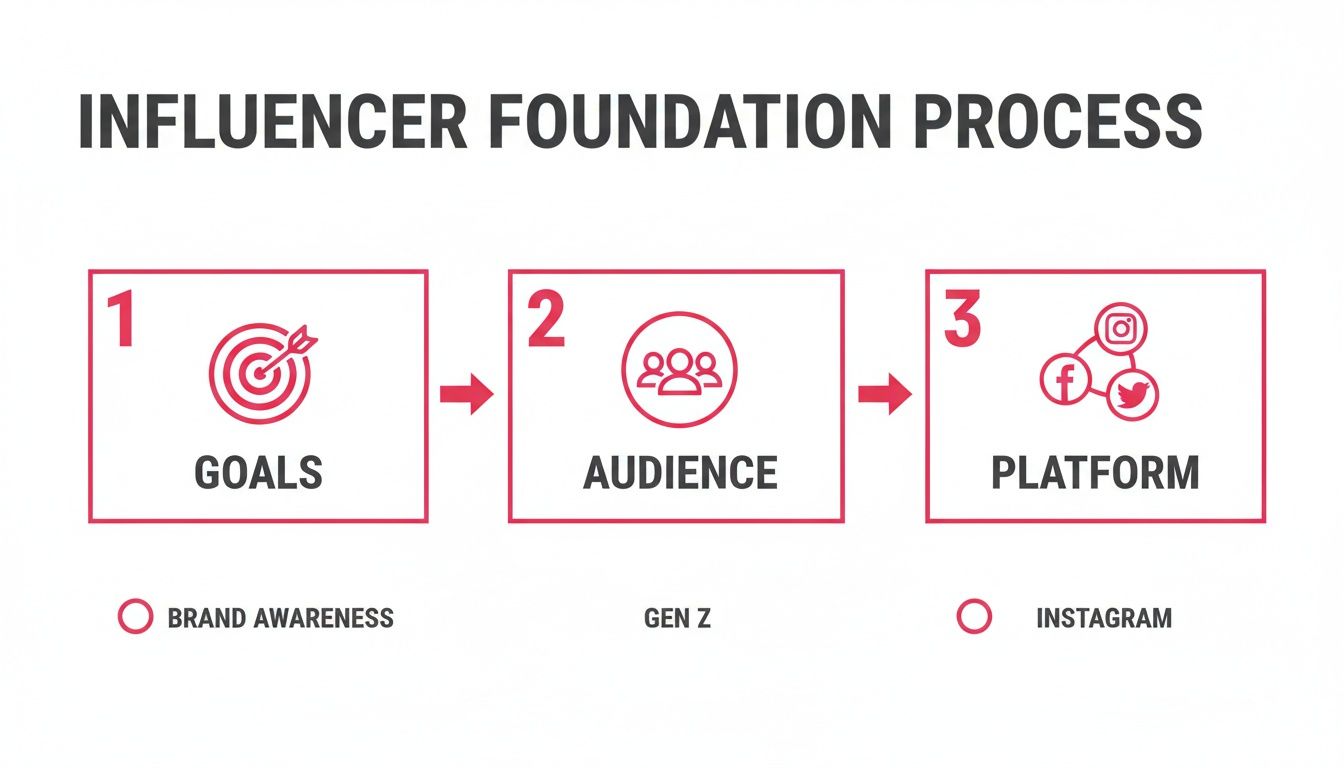
It’s all about sequence. Your goals inform your audience, and your audience dictates the platform. Each step builds on the last.
"Don't start with 'who.' Start with 'why.' Your campaign's objective is the single most important filter you have. It will immediately narrow the vast universe of creators down to a manageable pool of relevant candidates."
Pinpoint Your Target Audience and Platform
Once you've nailed down your 'why,' it's time to define your 'who.' Who is your ideal customer? You need to go deeper than basic demographics like age and location. Think about their lifestyle, their online habits, and the digital communities they're part of.
- Interests and Hobbies: What topics do they actively follow? Are they passionate about sustainable living, vintage fashion, or maybe competitive gaming?
- Digital Hangouts: Where do they spend their time? Are they scrolling TikTok for quick, funny skits, or are they on YouTube watching long-form tutorials?
- Trusted Voices: Whose opinions do they actually value? This is where you can start to piece together a picture of your ideal influencer persona.
This information feeds directly into your platform strategy. If you're targeting Gen Z, then TikTok and Instagram Reels are non-negotiable. But if you're trying to reach millennial homeowners, a YouTube creator who specializes in DIY home improvement might be your perfect match.
The influencer marketing industry is absolutely booming—rocketing from $1.7 billion in 2016 to a projected $32.55 billion in 2025. That explosive growth is powered by one thing: the ability to connect with niche audiences in a way that feels real. Aligning your brand with the right creators isn't just a tactic anymore; it's a core marketing function, just like using the 12 best AI tools for fashion brands has become essential for that industry.
Mastering The Search For The Right Creators
Alright, you've got your goals locked in. Now it's time to roll up your sleeves and actually find the people who will bring your brand to life. Knowing how to find an influencer is more art than science—it goes way beyond just searching a few hashtags. This is where you combine old-school digging, a bit of competitor espionage, and some smart tech to build your dream team of creators.
The mission isn't just to find accounts with a ton of followers. It’s about discovering creators whose content, audience, and genuine vibe are a perfect match for what you're building. Let's get into the nitty-gritty of how to build a killer shortlist of potential partners.

A Comparison Of Influencer Discovery Methods
Finding the right creators can feel like searching for a needle in a haystack, but knowing which methods to use (and when) makes all the difference. Some approaches are free but time-consuming, while others are fast but require a budget. Here's a quick breakdown to help you decide where to focus your energy.
| Discovery Method | Best For | Pros | Cons |
|---|---|---|---|
| Manual Platform Search | Finding authentic, niche creators with a genuine passion for your space. | – Completely free – Unfiltered view of content – High potential for finding hidden gems | – Extremely time-consuming – Hard to scale – Lacks deep audience data |
| Competitor Analysis | Quick wins and identifying creators already proven in your market. | – Creators are pre-qualified – Audience is already interested – Provides performance benchmarks | – Risk of brand overlap – Might not uncover unique voices – You're always one step behind |
| Influencer Platforms | Scaling your program quickly and making data-driven decisions. | – Powerful search filters – Access to detailed analytics – Streamlines workflow & outreach | – Can be expensive (monthly fees) – Some platforms have outdated data – Can feel less organic |
Each of these methods has its place. Your best bet? A blended approach. Use platforms for scale, competitor analysis for quick wins, and manual searches for those truly special, authentic partnerships that can't be found anywhere else.
Manual Deep Dives on Social Platforms
The most direct way to find creators is to just get in there and immerse yourself in the platforms where your audience hangs out. It takes time, no doubt, but it gives you a raw, unfiltered look at who’s actually connecting with your ideal customers. You need to think like your audience and see what they see.
Start by digging deeper than the obvious hashtags. Let's say you're a sustainable coffee brand. Instead of just searching #coffee, try diving into community tags like #lowwasteliving, #ecoconscious, or #plasticfreelife. This is how you find creators who are genuinely living your brand's values, not just talking about your product category.
Another killer manual tactic is to play with the platform's own recommendations. When you find one creator who seems like a great fit, check out the "Suggested for you" or "Similar accounts" features on Instagram. This can kick off a discovery loop, sending you down a rabbit hole of perfectly relevant talent.
Analyzing Your Competitors' Collaborations
Why do all the heavy lifting yourself? Your competitors have already poured time and money into finding and vetting influencers in your niche. Looking at their partnerships is one of the smartest shortcuts you can take. You get a pre-qualified list of creators who are open to brand deals and have an audience that’s already interested in products like yours.
But don't just see who they're working with—dig into how the audience is reacting.
- Read the Comments: Are people genuinely asking about the product? Is the vibe positive and authentic, or does it feel forced?
- Check the Engagement: Did the sponsored post perform as well as (or even better than) their regular organic content? A huge drop-off in likes and comments is a big red flag.
- Look for Repeats: Is this a one-and-done post, or is it part of a longer partnership? Repeat collaborations are usually a sign of a successful relationship and a solid ROI.
This kind of analysis helps you pinpoint proven winners and get a feel for what type of content resonates with your shared audience. You might even find an amazing micro-influencer your competitor worked with once and then forgot about.
Keep in mind, the goal isn't to copy your competitors' playbook. It's to learn from it. Use their efforts as a launchpad to build your own unique roster of brand ambassadors who are an even better fit for your specific message.
Leveraging Influencer Marketing Platforms
While manual searches give you that boots-on-the-ground perspective, they're not exactly efficient if you're trying to scale. This is where technology becomes your best friend. Influencer marketing platforms are built to solve the discovery problem with powerful search filters, deep analytics, and AI-powered recommendations. You can check out our breakdown of the top influencer marketing tools to see which platforms might work for you.
These tools let you search for creators using hyper-specific criteria that you could never filter for manually, such as:
- Audience Demographics: Filter by age, location, gender, and sometimes even estimated income.
- Performance Metrics: Find influencers with a specific minimum engagement rate or consistent follower growth.
- Content Keywords: Surface creators who have mentioned certain brands or keywords in their past content.
The choice of platform where you focus your search is also critical. Instagram is still a major player, with 68% of marketing specialists calling it out for its importance. But TikTok has become an absolute behemoth, delivering huge value for brands. To win today, you need a multi-platform strategy, which is why 59% of marketers are planning to increase their influencer partnerships this year. You can find more data on the state of influencer marketing over at HypeAuditor.com.
By combining these methods—manual digging, competitive analysis, and platform technology—you create a well-rounded approach that will consistently uncover the perfect creators for your brand.
Alright, you've got your shortlist of creators. Now the real work begins. This is the stage where so many brands make expensive mistakes. Finding people who look the part is easy, but actually vetting them to protect your brand and your budget? That's a different game entirely.
It requires a sharp eye and the discipline to look past the flashy vanity metrics.
This isn't about being cynical; it's about being smart. You're about to invest time and money into this partnership. Like any investment, you have to do your due diligence. A creator's follower count is just the book cover—you need to flip through the pages to see if the story actually holds up.
Go Beyond Follower Count and Analyze Engagement Quality
First rule of vetting: ignore the follower count, at least for now. It's often the least reliable metric for figuring out a creator's actual influence. What you really want to zoom in on is their engagement rate. It tells a much more honest story about how their audience actually interacts with their stuff.
A massive follower count with barely any likes or comments is a huge red flag. It’s a classic sign of an audience padded with bots, ghost followers, or people scooped up from shady giveaway loops. You're looking for an active, thriving community, not just a big number.
Calculating this is non-negotiable. For a quick spot-check, you can use our simple guide and engagement rate calculator to get a baseline for any creator you're thinking about. This one simple calculation is a powerful first filter to weed out the duds.
Scrutinize the Comments Section for Authenticity
Once you've confirmed their engagement rate looks solid, it’s time to get your hands dirty and dig into the quality of that engagement. The comments section is an absolute goldmine. It tells you everything about the creator’s community and the real connection they have with their audience.
Scroll through a bunch of their recent posts. Ask yourself:
- Are these real conversations? You want to see genuine questions, personal stories, and actual back-and-forth between the creator and their followers.
- Or is it all fluff? A wall of "Great post! 🔥" or single-emoji comments is a bad sign. It often points to engagement pods or bot activity designed to fake interaction.
- Does the creator actually reply? An influencer who takes the time to respond to comments is invested in building a real community. That’s exactly the kind of partner you want.
A healthy comments section feels like a real conversation, not a series of robotic compliments. This is where you can truly gauge the trust and loyalty an influencer has built with their audience.
Deep Dive into Audience Demographics
An influencer might have an incredible, super-engaged community, but if that community isn't your target customer, the partnership is dead on arrival. It's absolutely critical to make sure their audience lines up with the customer persona you built out in the beginning.
Don't be shy about this. Ask for their media kit or a screenshot of their audience analytics straight from the platform. Any professional creator will have this ready to go and will be happy to share it.
Here’s what you need to verify:
- Age and Gender Breakdown: Does their main audience match your ideal customer?
- Top Locations (Countries & Cities): Are their followers in places where you can actually sell your product?
- Audience Growth Patterns: Look for steady, organic growth. Huge, sudden spikes are suspicious and often mean they bought followers.
If a creator gets cagey about sharing this data, see it for the red flag it is. Transparency is everything in a good partnership, and this is the most basic info they should be willing to provide.
Assess Content Quality and Brand Alignment
Last but not least, step back and just look at their feed as a whole. Does their content style, their aesthetic, their general vibe—does it feel like your brand? This is subjective, but it’s one of the most important gut checks in the entire process. A bad aesthetic match will make the collaboration feel forced and inauthentic, torpedoing the whole campaign.
When you're looking through their portfolio, pay special attention to their video work. The quality of their motion content is a huge indicator of their professionalism, as platforms are prioritizing video more and more. If you're not sure what to look for, check out some examples of high-end quality motion content to get a benchmark.
Also, take a look at their past brand deals. Are they partnering with non-competing brands that share your values or target audience? That’s a great sign. It shows they know how to weave sponsored content into their feed naturally. If their profile is just a non-stop barrage of mismatched ads, their audience is probably burnt out, and your campaign will just get lost in the noise.
Crafting Outreach That Actually Gets a Reply
Alright, you've done the legwork and built a solid shortlist of creators who seem like a perfect match. But this next step? This is where a lot of brands completely drop the ball.
Think about an influencer's inbox. It's a war zone, absolutely flooded with lazy, copy-pasted pitches that get ignored or deleted on sight. Your mission, should you choose to accept it, is to write something that actually cuts through that noise and starts a real conversation.
This isn't about using some fancy template or slick sales talk. It's about showing you've done your homework and that you see them as a partner, not just a walking billboard for your product. A little bit of genuine personalization turns a cold pitch into a warm introduction.

Personalization Is Non-Negotiable
Sending a generic, impersonal message is the single biggest mistake you can make. Creators can spot a mass email from a mile away, and it's an immediate turn-off. To stand out, you have to prove you’re a real person who has actually paid attention to their content.
Before you even think about hitting "send," take a few minutes to make a real connection. Follow them on their platform of choice. Like and comment on a few of their recent posts. Find something specific—a detail, a quote, a technique—that you can reference in your opening line.
A solid personalized opener looks like this:
- Instead of: "Hi, I love your content!"
- Try: "Hi [Creator Name], I absolutely loved your recent video on sustainable coffee brewing—that pour-over technique was a game-changer for my morning routine!"
See the difference? That simple shift immediately shows you're a real fan, not just a marketer working off a spreadsheet. It proves you get their niche and respect the work they're doing.
Frame the Pitch as a Partnership
Your outreach should never, ever feel like a transaction. Your goal is to propose a collaboration that brings value to everyone involved. Influencers are running a business, and they're looking for partnerships that benefit their own brand and their audience just as much as yours.
Be direct and clear about why you think their specific voice and audience are the perfect fit for your brand. You have to connect the dots for them.
"Your outreach is your first impression. Frame it as a collaborative opportunity, not a list of demands. Explain the 'why' behind the partnership—why their unique perspective is exactly what your brand is looking for to tell a compelling story."
This approach respects their creative expertise and positions the collaboration as a win-win right from the start. For a much deeper dive, our guide on effective influencer marketing outreach breaks down even more strategies to help you nail your pitch every time.
Build a Clear and Simple Campaign Brief
Once you've got a conversation going and they've shown interest, you need to provide a campaign brief. This isn’t a restrictive, multi-page contract; think of it as a simple guide to make sure you're both on the same page. The trick is to give clear direction without killing their creativity.
An effective brief should be concise and hit these key points:
- Campaign Goal: What’s the number one thing you want to achieve? (e.g., "Drive sign-ups for our new webinar.")
- Key Messages: What are the one or two absolute must-haves you need them to communicate about the product?
- Deliverables: What exactly are you asking for? Be specific. (e.g., "One Instagram Reel and three static Stories with a trackable link.")
- Creative Freedom: Reassure them that while the key messages are important, you trust their vision to bring the campaign to life in a way that feels natural to their audience.
Getting this balance right is everything. You provide the strategic guardrails, and they get the creative license to do what they do best: connect with their community in their own unique voice. This not only leads to better, more authentic content but also lays the groundwork for a strong, long-term partnership.
Negotiating Terms and Measuring Real Success
So you’ve found the perfect creator, dug into their analytics, and you’re hitting it off. Now for the part that trips a lot of people up: talking money and figuring out what a "win" actually looks like. This isn't just about hammering out a contract; it’s about turning a promising conversation into a true professional partnership.
Getting this right means building a framework where both you and the creator are completely aligned on the goals, deliverables, and exactly how you'll measure the real-world impact. Nail this now, and you'll sidestep a world of headaches later while getting the data you need to prove this whole thing was worth it.
Demystifying Influencer Compensation
First things first: forget the idea that follower count equals a specific price tag. That’s an old, broken myth. Today's influencer compensation is way more nuanced, reflecting the actual work involved and the creator's true ability to move the needle.
A fair rate is a mix of things: their audience's engagement, how complex the content is, and what kind of usage rights you need.
There are a few ways this can go, and the right one really depends on your campaign.
- Flat Fee: This is as straightforward as it gets. You agree on a fixed price for a specific set of deliverables—say, one Reel and three Stories. It’s perfect for budgeting and when you know exactly what you need.
- Product Gifting (Product Seeding): A go-to for working with nano or micro-influencers. You send them free products, and in return, you might get a post. There's no guarantee of coverage, but it’s a super low-cost way to spark some genuine buzz and collect user-generated content (UGC).
- Commission/Affiliate: This is a pure performance play. The influencer gets a cut of any sales they generate through a unique tracking link or discount code. It’s a low-risk model that directly ties their pay to your results.
- Hybrid Model: This is often the sweet spot. You offer a smaller flat fee to guarantee their time and effort, plus a commission on sales. The creator gets some guaranteed income, and you get a partner who’s highly motivated to drive real conversions.
When you get to the negotiation table, be upfront about your budget and expectations. A creator with 25,000 hyper-engaged followers in a niche like sustainable tech can easily command a higher fee than a lifestyle creator with 100,000 passive followers. Focus on the value they bring, not just the vanity metrics.
Defining Your KPIs Before You Launch
You can't measure success if you never defined it in the first place. Before any content goes live, you and the influencer need to be crystal clear on the Key Performance Indicators (KPIs) that will define the campaign's success. These metrics have to connect directly back to the goals you set from the very beginning.
Don't just track everything for the sake of it. Pick a handful of primary and secondary KPIs that tell the most important story for this specific campaign.
"Your KPIs are your campaign's north star. If your goal is brand awareness, tracking click-through rates is a distraction. If your goal is sales, impressions are just vanity. Align your metrics with your objective from day one to measure what truly matters."
This clarity gets everyone pulling in the same direction. A creator who knows the main goal is webinar sign-ups will frame their call-to-action completely differently than one who thinks the goal is just racking up views.
Matching KPIs to Your Campaign Goals
Different goals need different ways of keeping score. A campaign designed to generate warm, fuzzy feelings about your brand will have a totally different report card than one built to move product off the shelves. This is where you need to get specific.
Here’s a simple table to help you connect your objectives to the right metrics.
| Campaign Goal | Primary KPIs | Secondary KPIs |
|---|---|---|
| Brand Awareness | • Reach • Impressions • Video Views | • Story Views • Follower Growth • Profile Visits |
| Audience Engagement | • Likes • Comments • Shares • Saves | • Engagement Rate • Audience Mentions • Click-Through Rate (CTR) |
| Conversions & Sales | • Clicks on Trackable Links • Conversion Rate • Revenue Generated | • Return on Ad Spend (ROAS) • Add to Carts • Cost Per Acquisition (CPA) |
Use this as a starting point. If you’re launching a brand-new product, your initial focus should be on awareness KPIs like reach and impressions. But if you're promoting a limited-time offer for an existing product, you'll be zeroed in on conversions and sales.
By laying this all out upfront, you build a transparent partnership from day one and give yourself a clear roadmap for proving the real return on your investment.
Common Questions About Finding Influencers
Diving into the world of influencer marketing can feel a bit like the wild west at first. It's totally normal to have questions. Getting a handle on the common sticking points is the first step toward building a strategy that actually works.
Let's clear up some of the most frequent questions we hear from brands who are figuring out how to find the right creators.
How Much Does It Cost to Hire an Influencer?
Honestly, there's no single price tag. Influencer costs swing wildly depending on their follower count, engagement rate, niche, and exactly what you're asking them to do.
A micro-influencer with 10,000-100,000 followers might ask for anything between $100 to $2,500 for a single post. On the other end of the spectrum, macro-influencers can easily command tens of thousands for one piece of content.
Many brands get their feet wet by gifting products to nano-influencers or using a platform to find affordable, pre-vetted creators. The most important thing is to stop focusing on the upfront cost and start thinking about the potential return on your investment (ROI). A smaller, super-engaged audience is almost always more valuable than a huge, passive one.
What's the Difference Between a UGC Creator and an Influencer?
This is a big one, and while the lines can get blurry, their core purpose is pretty distinct. It really boils down to intent and audience.
- An influencer has built an engaged community, and their main job is to share your brand's message with that community. You're paying for their reach and the trust they've built.
- A UGC creator is a specialist in producing authentic, relatable content (think killer videos and photos). The brand then uses this content in its own marketing channels, like social media ads or on its website.
Plenty of influencers are also incredible UGC creators. But you can also find amazing creators who just focus on making content and don't have a massive following of their own.
Here’s an easy way to think about it: You hire an influencer for their megaphone. You hire a UGC creator for the high-quality, authentic content they make, which you then put your own ad spend behind.
How Many Influencers Should I Work With?
The right number is all about your campaign goals and, of course, your budget. There’s no magic number here, but putting all your eggs in one basket is rarely the best move.
For something like a new product launch, a blended approach is fantastic. You could partner with one or two larger influencers to get that initial big splash and announce the launch. At the same time, you could activate a dozen micro-influencers to drive authentic social proof and a steady stream of user-generated content. If you're running more of an "always-on" strategy, a few long-term brand ambassadors might be the answer.
It's often far more effective to work with several highly-aligned micro-influencers than one pricey mega-influencer. This approach spreads your message across different communities and leaves you with a much larger library of content assets to use later.
What Are the Biggest Red Flags When Vetting an Influencer?
Protecting your brand has to be priority number one. When you're vetting potential partners, keep an eye out for these warning signs:
- A low engagement rate compared to their follower count. This is often the most obvious sign of fake followers.
- Generic or bot-like comments on their posts (e.g., just emojis or "Nice pic!").
- Sudden, massive spikes in their follower growth that look unnatural.
- A history of working with your direct competitors or, worse, brands that clash with your company's values.
Also, be wary if a creator seems hesitant to share their audience demographics or stats from past campaigns. A true professional will be transparent. How they communicate during your first few interactions is a huge indicator of what it will be like to work with them.
Ready to find the perfect creators for your next campaign? JoinBrands connects you with over 250,000 verified influencers and UGC creators, making everything from discovery to content approval simple. Start your first campaign today on JoinBrands.