
 A Complete Guide to Instagram Influencers Marketing
Long before your app ever hits the App Store, the real work of promotion begins. This isn't about a flashy launch day; it's about methodically building a foundation so that when you do go live, you have an audience waiting. The pre-launch phase is where you nail your messaging, build a waitlist of eager users, and recruit a small army of beta testers who will become your first champions.
Table of Contents
Building Your Pre-Launch Promotion Foundation

This pre-launch window is, without a doubt, the most critical part of your entire marketing strategy. It's where you build momentum, get a reality check on your concept from actual users, and smooth out the rough edges. Skipping this part is like trying to build a house on sand—it might look good for a minute, but it's not going to last.
First things first: you need to get crystal clear on your app's place in the universe. This means defining your Unique Value Proposition (UVP). What, specifically, does your app do that no one else does? How is it better, faster, or just plain different? This isn't just fluffy marketing-speak; it's the core of your message and will guide everything from your ad copy to your App Store description.
Identify and Understand Your Ideal User
Once you know your "what," you've got to figure out your "who." Creating a detailed user persona isn't optional. Don't just settle for broad demographics like "men, 18-34." You need to go deeper.
- Pain Points: What specific problems keep them up at night that your app can solve?
- Online Habits: Where do they hang out online? Are they scrolling TikTok, debating on Reddit, or networking on LinkedIn?
- Motivations: What's driving them? Are they chasing efficiency, entertainment, community, or status?
For example, let's say you're building a project management app for freelance designers. Your persona isn't just "freelancers." It's "Alex, a 28-year-old UI/UX designer who's drowning in email threads and spreadsheets trying to track client feedback and invoices, causing project delays and constant stress." See the difference? That level of detail makes finding and talking to your audience infinitely easier.
Create a High-Converting Pre-Launch Landing Page
Before you even write a single line of code, you need a landing page. Its mission is simple: collect email addresses from people who are interested in your app. This list of early adopters is pure gold. These are your first users, your best source of honest feedback, and your initial wave of word-of-mouth promotion.
Your pre-launch email list is your direct line to a group of people who have explicitly raised their hand and said, "I'm interested." Treat this list like gold—it's the seed from which your user community will grow.
Your landing page should scream your UVP, show off some mockups or a quick demo video, and have a can't-miss call-to-action to sign up for early access. Tools like Mailchimp or ConvertKit make spinning one of these up a breeze.
Recruit and Manage Beta Testers
Beta testing isn't just about squashing bugs. It's your first real chance to get qualitative feedback and start building a community of true fans. Aim to recruit 20-50 highly engaged users from your email list or from niche online communities where your ideal users live. If you want to really learn how to build that initial buzz, our guide on how to launch a new product has some great strategies.
Set up a structured feedback loop. A private Discord channel or a simple Google Form can work wonders. Ask them targeted questions about the onboarding experience, feature clarity, and whether the app actually delivers on its promise. These early evangelists won't just help you perfect the product; they'll be the first ones in line to leave glowing reviews the moment you launch.
Your Pre-Launch Promotional Checklist
To keep things straight, here’s a quick-glance table of the essential pre-launch activities. Think of this as your roadmap to a successful launch day.
| Activity | Primary Goal | Key Metric |
|---|---|---|
| Define Unique Value Prop (UVP) | Nail down your core messaging and differentiation. | A clear, one-sentence UVP statement. |
| Create User Personas | Deeply understand who you're building for. | Detailed persona document. |
| Build Pre-Launch Landing Page | Capture leads and validate interest. | Number of email sign-ups. |
| Start Building an Email List | Nurture early interest and build a community. | Email list growth rate. |
| Recruit Beta Testers | Gather product feedback and find bugs. | Number of active beta testers. |
| Establish a Feedback Loop | Systematically collect and analyze user insights. | Volume and quality of feedback. |
Executing these steps doesn't just prepare you for launch; it sets the stage for long-term, sustainable growth. By the time you hit "publish," you'll already have momentum.
Mastering App Store Optimization for Organic Growth
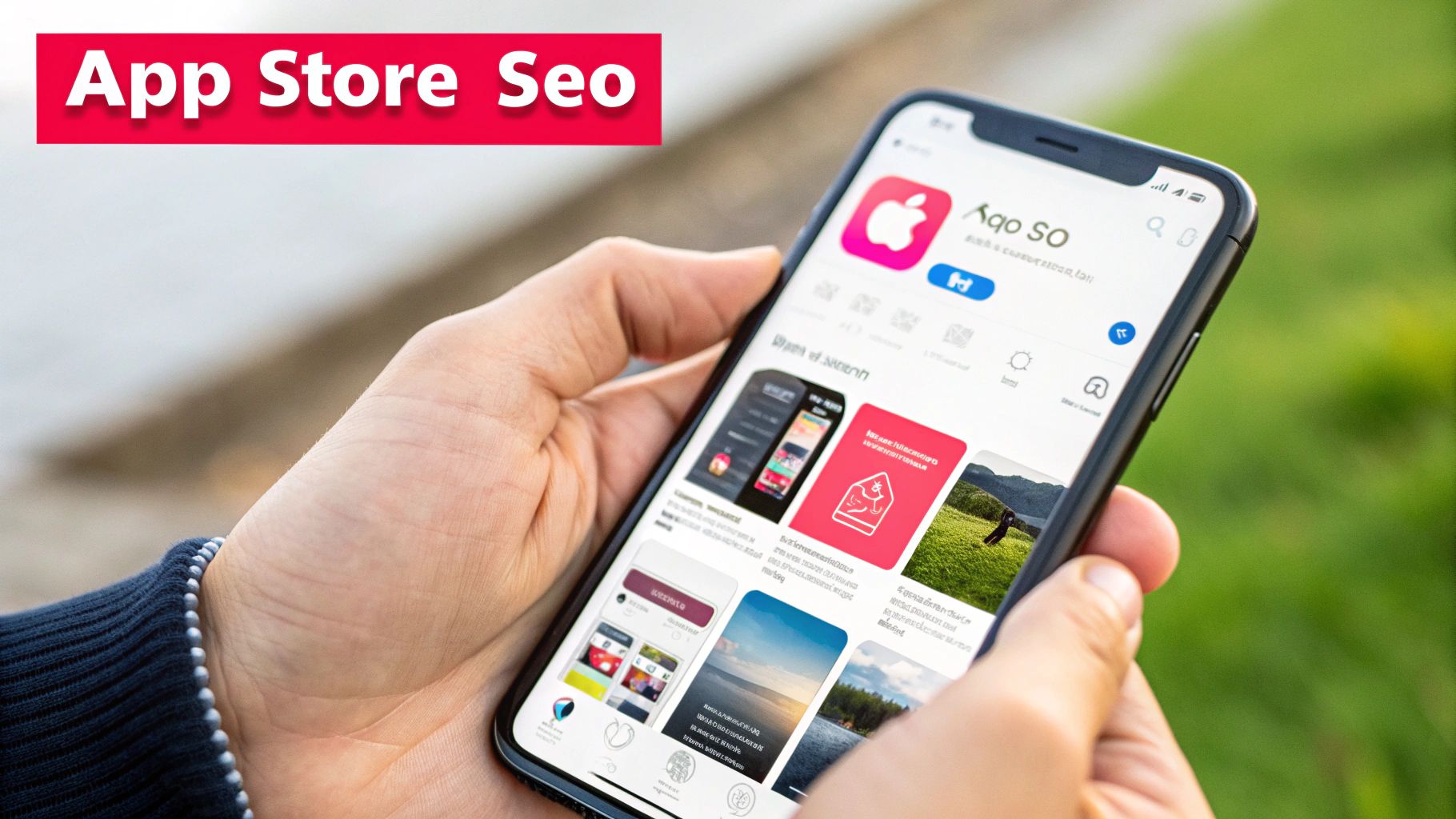
If paid ads are the fuel for your app's growth, think of App Store Optimization (ASO) as the engine. It’s the single most powerful strategy for driving a steady, sustainable stream of organic downloads. Nail your ASO, and your ideal users will find you through search without you spending a dime. It's the foundation of long-term discoverability.
The whole game starts with understanding the language of your audience. You need to get inside their heads and figure out the exact phrases they’re typing into the App Store or Google Play when they're looking for an app like yours. This isn’t a guessing game; it’s about rolling up your sleeves and doing the research.
Uncovering High-Impact Keywords
Your keyword strategy is the bedrock of everything else you'll do in ASO. The goal is to find that sweet spot: terms with high search volume that don't have impossible competition. Your primary keywords should be a dead-on description of your app's main function. Secondary keywords are your chance to target niche features or the specific problems your app solves.
For example, a meditation app's primary keyword is obviously "meditation." But they could pull in tons of extra traffic by targeting secondary terms like "sleep sounds," "anxiety relief," or "guided mindfulness."
Here's a battle-tested approach to building your keyword list:
- Brainstorm Core Terms: Start simple. How would you describe your app to a friend? Jot down every single word, synonym, and related concept that comes to mind.
- Spy on the Competition: Check out the top-ranking apps in your category. What keywords are popping up again and again in their titles and descriptions? ASO tools can even show you exactly what keywords your competitors are ranking for.
- Use the Right Tools: Don't fly blind. Platforms like App Radar or Sensor Tower give you real data on search volume, difficulty, and relevance, taking all the guesswork out of the process.
This research gives you a prioritized hit list of keywords to deploy across your store listing.
Crafting Your Title and Description
Your app's title and description are prime real estate for your most valuable keywords. The title, in particular, carries a ton of weight with the store algorithms. I've seen this simple formula work wonders: Brand Name – Primary Keyword or Brand Name: Core Benefit. Just look at "Calm – Sleep, Meditate, Relax." It's simple, descriptive, and effective.
The description is where you get to sell the dream while weaving in those secondary keywords. The key is to write for a human first, algorithm second. Keyword stuffing is a one-way ticket to getting ignored.
Your app store listing is an elevator pitch. You have seconds to capture a user's attention, communicate your core benefit, and convince them to tap "Get." Every word and every image must work together to tell that story instantly.
Make sure the first few lines—the snippet people see before they have to tap "more"—pack the biggest punch. Use bullet points or short, punchy paragraphs to highlight key features and show how you solve their problems.
Designing Your Visual Handshake
Text gets you discovered, but your visuals are what get you downloaded. Your icon, screenshots, and preview video are your app's first impression. It's a visual handshake, and a weak one can lose you a potential user in a heartbeat.
- The Icon: It has to be clean, memorable, and recognizable even when it's tiny. Stay away from text or busy designs. A great icon pops off the screen and stands out in a crowded search result.
- Screenshots: This is your chance to tell a story, not just show static screens. Overlay short, benefit-driven text to explain why what they're seeing matters. Guide the user through a quick journey of your app's coolest features.
- Preview Video: A snappy 15-30 second video can be a conversion machine. Show the app in action, focus on the most exciting parts, and keep it fast-paced. Always add upbeat music and use text callouts—most people watch with the sound off.
A/B Testing for Continuous Improvement
Your first shot at ASO is never your last. The real pros know that long-term success comes from constantly testing and optimizing every single piece of the puzzle. Both Google Play and the App Store have built-in tools for A/B testing your creative assets, so there's no excuse not to use them.
You can test different icons, new screenshot layouts, or a different video to see what combination gets you the most downloads. I've seen tiny tweaks—like changing an icon's background color or swapping the first scene in a video—lead to massive boosts in conversion. Treat ASO as a living, breathing process of refinement, not a "set it and forget it" task.
Scaling Your Reach with Paid User Acquisition
Organic growth is your foundation, but when you're ready to really hit the gas, a smart paid user acquisition (UA) strategy is the ultimate accelerator. Paid UA isn't about blindly throwing money at ads; it's a calculated way to reach your ideal users at scale and drive predictable, repeatable growth.
This is the point where you stop hoping users find you and start actively putting your app right in their path. It’s the engine that can take you from a handful of daily downloads to thousands, but only if you know which levers to pull.
Choosing Your Paid Acquisition Channels
The world of paid UA is massive, and not every channel is the right fit for every app. Your choice really boils down to your target audience and your app's category. The key is to start with a laser focus and only expand once you know what's working.
Let's look at some of the heavy hitters for app promotion:
- Apple Search Ads (ASA): For any iOS app, this is non-negotiable. You're catching users with super high intent at the exact moment they're searching for a solution in the App Store. It doesn’t get more direct than that.
- Google App Campaigns (GAC): Think of this as the Android equivalent, but with a much wider net. GAC uses Google's entire ecosystem, placing your app across the Play Store, YouTube, Search, and the Google Display Network. It’s a powerhouse.
- Meta Ads (Facebook & Instagram): Nothing beats Meta for its deep demographic and interest-based targeting. It's perfect for finding users based on their lifestyle, hobbies, and behaviors—even when they aren't actively looking for an app.
- TikTok Ads: If your audience skews younger or your app has a strong visual or entertainment hook, you have to be on TikTok. Its algorithm is incredible at serving content to hyper-engaged users who are ready to download.
Your goal isn't to be everywhere at once. It's to find the one or two platforms where your ideal users live and completely dominate them. Start small, test like crazy, and then pour your budget into what's winning.
Paid UA Channel Comparison for Mobile Apps
Choosing where to spend your first ad dollars can feel overwhelming. This table breaks down the top channels to help you make a more informed decision based on your specific app and goals.
| Channel | Best For | Key Targeting Options | Typical CPI Range |
|---|---|---|---|
| Apple Search Ads | High-intent iOS users actively searching for apps in the App Store. | Keywords, search match, demographics, customer type (new, returning). | $0.80 – $3.00 |
| Google App Campaigns | Broad reach across Android and iOS, leveraging machine learning for installs. | Location, language, in-app actions, user value (tROAS, tCPA bidding). | $0.50 – $2.50 |
| Meta Ads (FB/IG) | Finding users based on detailed interests, behaviors, and demographics. | Lookalike audiences, custom audiences (email lists), interests, behaviors. | $1.00 – $4.00 |
| TikTok Ads | Apps with strong visual appeal targeting Gen Z and Millennial audiences. | Interests, behaviors (video interactions), creator interactions, hashtags. | $0.70 – $3.50 |
Remember, these CPIs are just benchmarks. Your actual costs will depend heavily on your app category, creative performance, and targeting strategy. The best approach is always to test and find what works for you.
Budgeting and Campaign Objectives
Before you spend a single dollar, you need a crystal-clear objective. What, exactly, are you trying to achieve? Your goal will shape your entire strategy, from the creatives you design to the bids you place.
Are you just trying to get the maximum number of installs to climb the charts and build some initial buzz? Or are you focused on acquiring high-value users who will complete a specific action, like subscribing or making a purchase? The second option will almost certainly have a higher cost per install, but it can deliver a far better return on your ad spend. You can learn more about calculating your cost per acquisition to make sure your budget aligns with your goals.
Don't just chase cheap installs. A thousand users who download your app and never open it again are worth less than ten paying subscribers. Align your ad spend with your real business goals, not just vanity download numbers.
Start with a modest daily budget—something you're comfortable losing while you test. Once you gather data and start to see which ad sets and creatives are clear winners, you can strategically ramp up your spending.
The Power of Remarketing
Getting a new user is great, but bringing back someone who has already shown interest is often cheaper and much more effective. This is where remarketing comes into play. It’s the art of re-engaging users who downloaded your app but didn't convert or have since gone inactive.
For example, imagine a user downloaded your e-commerce app, added a pair of shoes to their cart, but never finished checking out. A perfectly timed remarketing ad showing them those exact shoes—maybe with a 10% discount code—can be ridiculously persuasive. For a gaming app, you could target players who haven't logged in for a week by advertising a new level or a limited-time event.
This focus on re-engagement is becoming a huge deal in app promotion. In fact, global remarketing spend for mobile apps is projected to hit a staggering $31.3 billion in 2025. That's a massive 37% jump from 2024.
Remarketing now makes up 29% of total app marketing budgets, which proves that the smartest marketers are prioritizing retention and lifetime value. This shift is a game-changer for brands, especially those on platforms like JoinBrands, where creator-driven content can be repurposed for sharp re-engagement campaigns. You can find more data on this trend in the latest top data trends on AppsFlyer.
This strategic pivot from pure acquisition to intelligent re-engagement is how the top apps turn fleeting interest into loyal, high-value users. By combining broad acquisition campaigns with targeted remarketing, you create a powerful system for sustainable growth.
Partnering with Creators to Build Authentic Buzz

In a world drowning in ads, a real recommendation from a trusted person doesn't just cut through the noise—it builds genuine trust. This is exactly why creator marketing has become a non-negotiable part of any serious app promotion playbook. It's about letting real people tell your story to drive downloads.
This isn't just about paying for a quick shoutout. It's a full-funnel strategy. You start by finding the right partners and end up with a treasure trove of high-performing, user-generated content (UGC) that you can sprinkle across all your other marketing channels. The perfect creator can take a simple feature and, through their unique lens, make it an absolute must-have.
Finding the Right Creators for Your App
Your entire creator campaign lives or dies by this first step: finding people whose audience is a mirror image of your ideal user. A bad fit here is just burning cash. Forget vanity metrics like follower counts for a second and laser-focus on engagement rates and audience demographics.
Platforms like JoinBrands can be a huge help here, giving you a direct line to a massive network of vetted creators. You can slice and dice the database by niche, platform, and audience size to quickly build a shortlist of potential partners.
When you're vetting them, keep an eye out for:
- Audience Alignment: Does their audience actually care about the problem your app solves? A tech reviewer is probably a better match for a productivity app than a lifestyle vlogger.
- Authentic Style: Does their content feel real? The best creator content never feels like an ad because it blends right into their natural style.
- Past Performance: Take a look at their previous brand deals. Did the content do well? Was the audience response positive or did they get called out for being a sellout?
Crafting a Brief That Inspires Creativity
Once you have your creators lined up, you need to give them a brief. A great brief gives them guardrails, not a rigid script. It provides all the essentials but leaves plenty of room for their creative magic. Micromanaging the process is the fastest way to get stiff, awkward content that nobody believes.
Your brief needs to be crystal clear on:
- The Core Message: What’s the one single thing you want people to remember about your app?
- Key Features to Highlight: Don't overwhelm them. Pick 1-3 "wow" features that are easy to show off and deliver instant value.
- The Call-to-Action (CTA): Be specific. Do you want them to "Download the app now," "Use my code for a free trial," or "Hit the link in my bio"?
- Mandatory Inclusions & Exclusions: List any required hashtags, handles to tag, or things they absolutely should not say or do.
Give creators the freedom to tell a story in their own voice. Your job is to provide the destination (the key message), but let them drive the car. The result will be far more compelling and believable than anything a marketing team could script.
This balance is everything. You're hiring them for their unique connection with their audience, so let them use it. To get a better feel for this, checking out some examples of successful influencer marketing campaigns can spark some great ideas.
Activating Advanced Creator Tactics
Beyond a standard post, you can pull creators into more advanced strategies that have a direct impact on your bottom line. This is how you turn creator content from a simple awareness play into a powerful, measurable acquisition machine.
For any app with e-commerce, TikTok Shop Affiliates is a complete game-changer. Creators can link directly to products within your app right from their videos. This creates a frictionless path from discovery to purchase, turning views directly into sales you can track.
Another incredibly powerful tool is TikTok Spark Ads. This lets you put ad spend behind a creator's best-performing organic video, blasting it out to a huge, targeted audience. You get the raw authenticity of a creator's post with the massive scale of paid advertising. It’s truly the best of both worlds.
Let’s be real: the app stores are incredibly crowded. In 2025, global app downloads are expected to hit a staggering 255 billion, a 7% jump from the previous year. With that kind of competition, using authentic voices isn't just a good idea—it's essential. Data has consistently shown that apps promoted with user-generated content see up to 29% higher engagement rates. That's a massive edge when you consider 70% of US digital media time is spent inside apps.
Ultimately, creator partnerships build a sustainable engine of authentic, persuasive content. It’s how you break through the clutter, connect with users on a human level, and turn genuine buzz into scalable growth.
Keeping Users Around with Smart Engagement
Getting someone to download your app is just the start. The real win isn't racking up download numbers; it's seeing how many of those people actually stick around. Smart engagement is what separates a flash-in-the-pan app from one that builds a loyal, active community.
This whole process kicks off the second they open your app. Your onboarding flow is your one shot at a great first impression. If it's clunky, confusing, or feels like a chore, you've just signed up for a ton of day-one churn. Nail that initial experience, though, and you dramatically increase the chances of that user becoming a regular.
Nailing the First-Time User Experience
The entire point of onboarding is to get new users to their "aha!" moment as fast as possible. This is that lightbulb moment when they truly get the value your app delivers. Don't just dump them on a generic home screen; you have to show them the ropes.
For a task management app, this could be as simple as prompting them to create their very first to-do item. If you've built a new social app, maybe you guide them to follow a few interesting accounts. The key is to keep it short, interactive, and laser-focused on the benefit.
A great onboarding experience feels less like a manual and more like a personal tour guide. It anticipates what the user needs, shows off the best features, and proves the app's value within the first 60 seconds.
When you get this initial interaction right, you set a positive tone for the entire relationship. It reassures them they made a good choice downloading your app and makes them far more likely to engage with you down the road.
Using Timely Communication to Keep Users Engaged
Once someone is successfully onboarded, your communication strategy is what keeps them coming back. Push notifications and email marketing are your go-to tools here, but you have to use them with surgical precision. Blasting out generic, frequent messages is the quickest way to get uninstalled.
The secret sauce is segmentation and personalization. You need to group users based on what they actually do inside your app:
- Newbies: Send them a welcome email series that points out cool features they might have missed.
- Lapsed Users: A gentle push notification like, "Your weekly report is ready!" can be the perfect nudge to bring them back.
- Power Users: Treat them like VIPs. Offer early access to new features or exclusive content to reward their loyalty.
Think about it: a fitness app could send a push to someone who hasn't logged a workout in three days, saying, "Ready for your next run? The weather looks perfect today!" That feels helpful and personal, not annoying.
Building Growth Loops That Fuel Retention
The best apps don't just hold onto users; they turn them into an army of promoters. This magic happens when you build growth loops—systems where the actions of your current users naturally bring in new ones.
A referral program is the classic example. When you reward a user for inviting a friend, you kick off a powerful, self-sustaining cycle. Dropbox famously nailed this by giving both the referrer and the new user extra storage space. It became a viral engine that was central to their early dominance.
You can even measure this with the viral coefficient (K-factor). The formula is straightforward: K = (Number of invites sent per user) x (Conversion rate of invites). If your K-factor is greater than 1.0, your app is officially achieving viral growth.
But referrals aren't your only play. Any content that can be shared can create a growth loop. A user posting a workout summary from a fitness app, a custom design from a creative tool, or a high score from a game all act as organic ads that pull new people into your orbit. To really master this, you should explore proven Customer Retention Marketing Strategies that can help you build a loyal user base that sticks around for the long haul.
Measuring Performance to Optimize Your Strategy
You can't improve what you don't measure. All the promotion in the world means nothing if you can’t tell what’s actually working. This is where we close the loop—using real data to refine every single part of your app promotion, making your efforts smarter and more effective over time.
This isn’t about chasing vanity metrics like download counts. It’s about focusing on the numbers that actually define the health of your app's business. Without a solid grip on your data, you're just flying blind, burning cash without knowing the return.
Tracking the KPIs That Actually Matter
To get a clear picture of what's happening, you need to zero in on a specific set of Key Performance Indicators (KPIs). These numbers tell the true story of your acquisition efforts and the long-term value of your users.
Your core metrics should always include:
- Customer Acquisition Cost (CAC): This is the total cost of your sales and marketing efforts to get one new customer. Just divide your total campaign spend by the number of new users you brought in. Simple, but critical.
- Lifetime Value (LTV): This metric predicts the total revenue a single user will generate over their entire time with your app. A healthy app business requires an LTV that is significantly higher than your CAC. No exceptions.
- Retention Rate: The percentage of users who come back to your app over a specific period (like Day 7 or Day 30). High retention is the clearest sign you've built something people genuinely value.
- Churn Rate: The flip side of retention. This measures the percentage of users who stop using your app. Pinpointing when and why they leave is your first step to fixing the leaks.
These are the vital signs of your app’s growth. Tracking them religiously shows you the real-world impact your promotional dollars are having on your bottom line.
Your marketing dashboard isn't just a report card; it's a roadmap. It tells you where you've been, but more importantly, it highlights the exact turns you need to take to reach your destination more efficiently.
Using Cohort Analysis to Understand User Behavior
One of the most powerful tools in your analytics arsenal is cohort analysis. This is just a fancy way of saying you group users based on a shared trait, usually their sign-up date. By watching these cohorts over time, you can see exactly how different groups of users behave.
For example, a cohort analysis might reveal that users you acquired from a specific TikTok campaign in May have a 20% higher Day 30 retention rate than those who came from a Google Ad campaign in June. That insight is pure gold. It tells you exactly where to double down on your ad spend and what kind of messaging clicks with your best users.
To really dig into user behavior and dial in your promotion, you have to use the right data. Explore the best mobile app analytics tools to track performance and start improving your retention for good.
Creating Your 30/60/90-Day Promotion Plan
A structured plan turns fuzzy goals into concrete actions. A 30/60/90-day plan gives you a clear framework to execute, measure, and iterate on your campaigns. It keeps the momentum going and ensures you’re focused on the right things at each stage.
Here’s a rough sketch of what that could look like:
Days 1-30: Foundation & Launch
- Goal: Drive initial downloads and get that crucial early feedback.
- Tactics: Roll out your ASO keyword strategy, launch initial Apple Search Ads, and activate your first wave of creator content.
- Metrics: Cost Per Install (CPI), Day 1 Retention.
Days 31-60: Optimization & Learning
- Goal: Analyze the early data to sharpen your targeting and creative.
- Tactics: A/B test app store screenshots, scale the ad campaigns that are actually working, and launch a user referral program.
- Metrics: Day 7 Retention, CAC, Viral Coefficient.
Days 61-90: Scaling & Retention
- Goal: Scale the profitable channels and boost user lifetime value.
- Tactics: Ramp up the budget on high-performing creator campaigns and build out segmented push notification flows.
- Metrics: LTV, Churn Rate, ROI.
This journey—from onboarding a new user to turning them into a loyal advocate—is the core of sustainable growth.
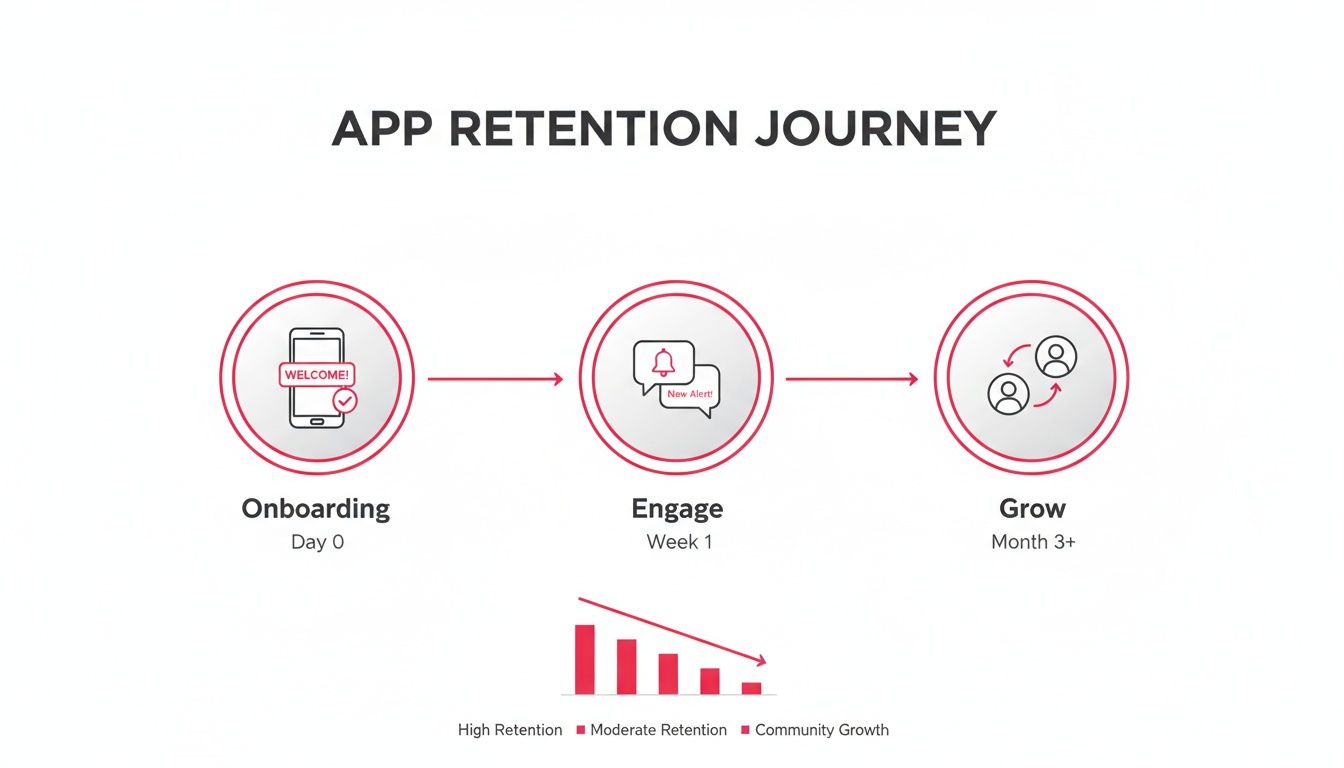
As you can see, successful retention isn’t a one-and-done event. It’s a continuous process of delivering value. This structured, data-driven approach is how you build a promotional engine that doesn't just acquire users, but builds a thriving, profitable app business.