




 8 Best Days to Post on Social Media in 2025 for Maximum Reach
Before you can even think about recruiting affiliates, you need to build a program they’re actually excited to join. It's a common mistake to jump straight to outreach, but the real magic happens when you lay a solid foundation first.
Think of it this way: your program is the product, and affiliates are your customers. If the offer isn't compelling, the terms aren't clear, and the tools aren't there to help them succeed, even the best outreach email will fall flat. Getting this part right is what attracts high-caliber partners and kicks off your relationships on the right foot.
Table of Contents
Building a Program Top Affiliates Want to Join

So, what makes a program irresistible? It goes way beyond just setting up tracking links. You need to create an entire ecosystem where partners feel supported, valued, and genuinely motivated to shout about your brand from the rooftops.
Experienced affiliates are savvy. They’ve seen it all, and they can spot a disorganized or unprofessional program from a mile away. They're looking to partner with brands that are serious about mutual success. Let's break down how to build a program that gets a confident "yes" from the people you want to work with.
First, Nail Down Your Ideal Affiliate Persona
You wouldn't run a marketing campaign without a customer persona, right? The same logic applies here. You have to know exactly who you're trying to attract. Is it:
- Niche Bloggers who live and breathe SEO and write incredibly detailed reviews?
- YouTube Creators with loyal subscribers who hang on their every word?
- Industry Podcasters who have the ear of a super-targeted community?
- Your Own Superfans who already love your product and can offer authentic testimonials?
Each of these groups has different needs. A blogger will obsess over cookie duration and deep-linking capabilities. A TikToker, on the other hand, will want ready-made video assets and a unique discount code they can share instantly. Defining your persona shapes your entire approach.
Craft an Offer They Can't Refuse
Your value proposition is your elevator pitch. It has to cut through the noise and immediately answer an affiliate’s core question: "What's in it for me?" And trust me, it’s about more than just the commission rate.
A killer value proposition tells a potential partner three things: how much money they can realistically make, how you'll help them succeed, and why they should promote you over a competitor.
Take a look at programs like Shortimize's Affiliate Program to see how it's done. A strong offer combines a competitive commission structure with excellent support and perks that make affiliates feel like true partners, not just another number in a spreadsheet.
The Non-Negotiable Program Foundations
Before you hit "send" on that first email, you absolutely must have your operational house in order. These are the non-negotiables that create a seamless experience and protect your brand.
- Flawless Tracking: This is everything. If an affiliate doesn't trust that you can accurately track the sales they send, they won't promote you. Period. Using a reputable platform is a must.
- Clear Terms of Service: Your affiliate agreement should leave no room for confusion. Spell out commission rates, payout schedules, promotional rules (like PPC bidding restrictions), and grounds for termination.
- High-Converting Creative Assets: Don’t make your partners start from scratch. Give them a library of professionally designed banners, email swipe copy, high-res product photos, and social media templates. The easier you make it for them to promote, the faster they will.
Getting this foundation right is what separates a thriving, scalable program from one that feels like a constant struggle. Affiliate marketing is a massive growth lever—over 80% of brands rely on it. And with the industry projected to hit $48 billion by 2027, there's a huge opportunity for those who build their programs the right way from the start.
(Need a quick refresher on the fundamentals? Our guide on what is affiliate marketing covers all the basics.)
Finding and Qualifying the Right Affiliate Partners

The success of your affiliate program boils down to one simple truth: quality beats quantity, every single time. It's easy to get caught up in vanity metrics, recruiting hundreds of partners who look good on paper but end up generating zero sales. That’s a surefire way to burn through your time and budget.
Instead, the goal is to build a program that actually moves the needle on revenue. This requires a targeted, multi-channel approach focused on finding and qualifying the right partners.
Think of it like building a championship team. You wouldn't just sign anyone who showed up to tryouts; you'd scout for individuals whose skills and mindset perfectly match your team's goals. It's time to move beyond just sticking a "Join Our Program" link on your website and start actively hunting for partners who are a natural fit.
Uncover Affiliates in Your Competitor's Backyard
One of the sneakiest—and most effective—ways to find proven affiliates is to see who's already making money promoting your competitors. These are content creators who have already demonstrated they can sell products like yours to an audience that's primed and ready to buy.
So, how do you find them? It's time for a little strategic intelligence gathering:
- Analyze Backlink Profiles: Use an SEO tool to see who’s linking to your competitors' affiliate or review pages. This is a goldmine for finding bloggers and publications already active in your space.
- Search for Review Content: Go to Google and search for things like
"competitor name" reviewor"best competitor alternative". This will immediately surface content from affiliates who specialize in comparisons and deep-dive analyses. - Monitor Social Mentions: Keep an eye on hashtags and keywords related to your competitors on platforms like X (formerly Twitter), Instagram, and TikTok. You'll quickly spot the influencers who are driving the conversation.
This isn't about poaching. It's about identifying experts in your niche and showing them why partnering with you is a better move—whether it's a superior product, better commissions, or stronger support.
Tap Into Your Existing Customer Base
Your most passionate customers can become your most powerful and authentic affiliate partners. They already know your product, they love it, and they use it. Their recommendations come from a place of genuine enthusiasm, not just the promise of a paycheck.
Look for opportunities to turn these happy customers into brand advocates. A simple, targeted email to customers who have made multiple purchases or left a glowing review can be incredibly effective. The trust is already there; you just need to give them a way to share their love.
Pro Tip: Your best advocates are often hiding in plain sight. Keep an eye on your social media mentions and support tickets to find "superfans" who are constantly singing your praises. A personal invitation to one of these customers can forge an incredibly loyal and motivated partnership.
Use Advanced Search and Social Listening
Beyond your direct competitors and customers, the internet is teeming with undiscovered talent. The trick is knowing how to find them. This means going beyond basic searches and using more precise methods to pinpoint potential partners.
Think about the specific problems your product solves and the exact keywords your ideal customers are searching for. Then, use that insight to find the creators who are already dominating those conversations.
- Google Search Operators: Use advanced queries to filter the noise. For example, a search like
inurl:blog "best project management software for startups"will show you blog posts hyper-focused on that topic. - Hashtag and Keyword Tracking: Set up alerts on social listening tools for terms relevant to your industry. This helps you discover creators who are actively talking about the topics your audience cares about. Platforms like JoinBrands can even connect you directly with creators who have an established presence in your niche.
- Explore Niche Communities: Don't overlook the power of forums, subreddits, and industry-specific Facebook Groups. Participating in these communities can help you identify influential members who would make fantastic affiliate partners.
By weaving these strategies together, you create a powerful, continuous pipeline of high-quality affiliate candidates. This proactive approach to recruiting is what separates a stagnant program from one that consistently grows with partners who are perfectly positioned to represent your brand and drive real sales.
Crafting Outreach That Gets Opened and Answered

Alright, you've got your list of high-potential partners. Now for the hard part. The inboxes of top-tier affiliates are a battlefield, flooded with generic "partnership opportunity" emails every single day. Most of them get deleted without a second glance. If you want to cut through that noise, you have to stop thinking about volume and start thinking about value.
The real goal here isn't just to get an email opened. It's to kickstart a real conversation and build a genuine relationship. That means you've got to prove you did your homework, show that you understand what makes them tick, and pitch a partnership that feels like a win for their audience, not just a quick payday for you.
The Anatomy of a Standout Outreach Message
That first impression is everything. A generic, copy-paste email is an instant red flag—it tells them you haven't invested a single second in figuring out who they are. Every great outreach message I've ever seen boils down to three key things: it's personal, it has a clear value proposition, and it ends with a simple call to action.
- Personalization is Non-Negotiable: Drop a reference to a specific piece of their content. Mention their latest blog post, a point they made in a YouTube video, or something they shared in a community. It proves you're a real person who actually pays attention.
- Highlight the "Why You": Don't just drone on about your amazing brand. Connect the dots for them. Explain why you believe a partnership would be a perfect fit for their specific audience. How does your product solve a problem their followers actually have?
- Make It Easy to Say Yes: Keep that first email short and sweet. End with a low-friction next step. Instead of demanding they sign up right away, just ask if they're open to learning more.
This kind of thoughtful approach is absolutely critical. Affiliate spending in the U.S. is on track to hit nearly $12 billion, and it’s projected to climb to $16 billion in the coming years. With affiliates driving roughly 16% of all e-commerce sales, the stakes are high. To attract the partners who deliver these results, your outreach has to be as compelling as the market is valuable. You can find more stats on the growth of affiliate channels on PostAffiliatePro.com.
Writing Subject Lines That Demand a Click
Let's be real: your subject line is the gatekeeper. If it's boring, spammy, or vague, the rest of your perfectly crafted email is completely worthless. The best ones are personal, create a little curiosity, and hint at a mutual win.
Ditch the generic stuff like "Partnership Opportunity" or "Affiliate Program Invitation." Get specific.
Before: Collaboration Inquiry
After: Loved your review of [Competitor Product]!
Before: Join Our Affiliate Program
After: A partnership idea for your [Audience Niche] audience
The trick is to sound less like a marketer blasting out an email and more like a peer who has a genuinely interesting idea worth hearing. That simple switch can make a huge difference in your open rates.
From Good to Great: An Outreach Makeover
Let's break down a real-world example to see how a few tweaks can turn a bad pitch into a great one.
The Generic "Before" Email:
Subject: Partnership with [Your Brand]
Hi [Affiliate Name],
I found your blog and I think you would be a great fit for our affiliate program. We sell [product] and offer a 15% commission on all sales. Let me know if you are interested in joining.
Thanks,
[Your Name]
This email is dead on arrival. It's impersonal, lazy, and all about what the sender wants. It's destined for the trash folder.
Now, let's give it a shot of personality and value.
The Personalized "After" Email:
Subject: Your thoughts on [Topic] + a partnership idea
Hi [Affiliate Name],
Just finished reading your latest post on [Specific Blog Post Title], and your point about [Specific Insight] really hit home. I’ve been following your work for a while—your deep dives are exactly what this space needs.
Because you focus so much on helping your audience [Solve a Problem], I thought our [Product Name] might be a perfect fit for you to check out. We built it specifically to help with [the exact problem they cover].
Our top partners, who have similar audiences to yours, are earning great returns. I’d be happy to set you up with a free account to test it out for yourself, no strings attached.
Would you be open to learning a bit more?
Best,
[Your Name]
See the difference? This version proves you’re a fan, connects your product to their content, and offers value upfront with a no-pressure ask. This is how you recruit the kind of affiliates who become valuable, long-term partners.
Onboarding New Affiliates for Long-Term Success
Getting an enthusiastic "yes" from a potential partner is a huge win, but it’s just the starting line. The next 48 hours are absolutely critical. A seamless, professional onboarding process transforms an interested affiliate into an active, motivated partner who feels valued from day one. If you drop the ball here, you risk losing all that recruitment momentum.
Think of it like the first day at a new job. If you show up and no one knows who you are, your desk isn't ready, and you can't access any tools, you immediately feel disconnected. The same principle applies to affiliate partnerships. Your goal is to eliminate friction and empower them to start promoting—and earning—as quickly as possible.
Filtering for Quality with a Smart Application Process
Before you can even think about onboarding, you need a way to filter applicants. Let's be honest: not everyone who applies will be a good fit. A lightweight but effective vetting system is your first line of defense against low-quality or misaligned partners.
Your application form shouldn't be a 20-page questionnaire, but it does need to capture the essentials.
Here’s what I always recommend including:
- Primary Promotion Channels: Ask for direct links to their blog, YouTube channel, social media profiles, or newsletter. This is non-negotiable for vetting their content quality and seeing them in action.
- Audience Demographics: A brief description of who their audience is and what they care about helps you quickly confirm if there's a genuine alignment.
- Promotional Methods: How do they actually plan to promote you? Are they masters of SEO-driven reviews, wizards with email marketing, or social media gurus?
- Experience with Similar Products: Have they promoted brands in your niche before? This can be a great indicator of relevant experience and an audience that’s already warmed up to your type of product.
This initial screen helps you quickly separate the serious partners from the rest, ensuring you invest your onboarding efforts where they'll actually pay off.
Building the Ultimate Affiliate Welcome Kit
Once an affiliate is approved, don't just send them a login link and wish them luck. This is your chance to really shine. A comprehensive digital welcome kit is the single most important tool for activating a new partner. It should be a one-stop shop for everything they need to hit the ground running.
Platforms like JoinBrands really help here by providing a centralized dashboard where creators can find campaign details, assets, and everything else in one spot.
Take a look at how an organized platform interface helps streamline this process.
This kind of clear, accessible dashboard means affiliates can immediately find what they need without having to hunt through old emails or constantly ask you for basic information. Your welcome kit should serve a similar purpose, centralizing key resources.
Here's what to pack into your welcome kit:
- A Personal Welcome Message: A short video or a personalized note from the affiliate manager goes a long way. It shows there’s a real person on the other side and starts building that all-important relationship.
- Login & Link Access: Simple, clear instructions on how to access their dashboard and, most importantly, find their unique affiliate links.
- Brand & Content Guidelines: A simple one-pager on your brand voice, the do's and don'ts, and any promotional restrictions (e.g., no bidding on branded keywords). Keep it concise.
- Creative Asset Library: Give them direct access to logos, banners, high-quality product images, and even pre-written "swipe copy" for emails and social posts to make their job easier.
- Key Product Information: Links to your top-selling product pages, bullet points on key features, and a summary of your unique selling propositions.
- Performance and Payout Details: A quick refresher on the commission structure, cookie duration, and payout schedule. Knowing exactly how their efforts translate to earnings is a huge motivator. Understanding the factors that influence affiliate marketing conversion rates is key for both of you.
The goal of onboarding isn't just to provide information; it's to build confidence. A well-prepared affiliate is a confident affiliate, and a confident affiliate starts promoting faster.
This structured approach sets a professional and supportive tone for the entire partnership. It proves you're invested in their success, which in turn encourages them to invest their time and effort into promoting your brand effectively right from the very beginning.
Designing a Commission Structure That Motivates
Let's be honest: your commission structure is the engine of your affiliate program. It's the first thing potential partners look at, and it answers their most pressing question: "Is promoting this brand actually worth my time?"
A killer structure does more than just pay people. It attracts high-quality affiliates, keeps them motivated to perform, and makes sure the partnership is a win-win for everyone involved.
You can't just pull a number out of thin air. Your commission has to be competitive enough to catch a creator's eye but sustainable enough that it doesn't sink your profit margins. It's a balancing act that requires you to know your numbers inside and out.
Choosing The Right Commission Model
Not all commission models are created equal. The right one for you depends entirely on your business goals. Are you trying to drive a huge volume of new customers? Maximize the average order value? Lock in long-term subscribers? Each structure encourages different behaviors from your affiliates.
To help you decide, here’s a look at the most common models I've seen work for brands just like yours.
Comparing Common Affiliate Commission Models
An overview of different commission structures to help you choose the best fit for your business goals and affiliate types.
| Commission Model | How It Works | Best For | Potential Downside |
|---|---|---|---|
| Cost Per Acquisition (CPA) / Flat-Rate | You pay a fixed dollar amount for every sale or qualified lead. | Brands that need predictable acquisition costs and straightforward tracking. Great for lead gen. | Doesn't incentivize affiliates to drive higher-value sales. May not be attractive for high-ticket items. |
| Revenue Share (% of Sale) | Affiliates earn a percentage of the total order value from their referrals. | E-commerce businesses with varied product prices. Encourages affiliates to promote higher-value items. | Payouts fluctuate with order values, making budgeting slightly less predictable. |
| Tiered Commissions | Commission rates increase as affiliates hit specific performance milestones (e.g., more sales, higher revenue). | Motivating top performers and fostering long-term loyalty. Excellent for mature programs looking to scale. | Can be more complex to track and manage. Initial lower tiers might not attract top-tier affiliates. |
| Recurring Commissions | Affiliates earn a commission for the initial sale and for subsequent subscription renewals. | Subscription-based businesses (SaaS, membership sites, subscription boxes). | Higher long-term payout per customer, which requires a solid customer lifetime value (LTV). |
Choosing the right model sets the foundation for a healthy partnership. It clearly communicates what you value and how you define success.
Setting A Sustainable And Attractive Rate
Once you've picked a model, it's time to nail down the actual rate. This means looking inward at your own financials and outward at what your competitors are offering. A great starting point is to research common affiliate marketing commission rates to make sure your offer stands out.
Your rate must be grounded in your business's financial reality. Start by digging into your Customer Lifetime Value (LTV) and profit margins. If you have a high LTV, you can probably justify a more generous commission upfront, knowing that customer will deliver more value over time.
You also need a rock-solid grasp of your acquisition costs. If you haven't already, check out our guide on how to calculate cost per acquisition to get started.
Your commission structure is more than just a payout; it's a communication tool. It tells affiliates which actions you value most and how you define a successful partnership. A thoughtful structure can be your best recruitment asset.
This is why having a solid vetting process is so crucial. You want to offer these motivating commissions to partners who are truly aligned with your brand and ready to succeed.
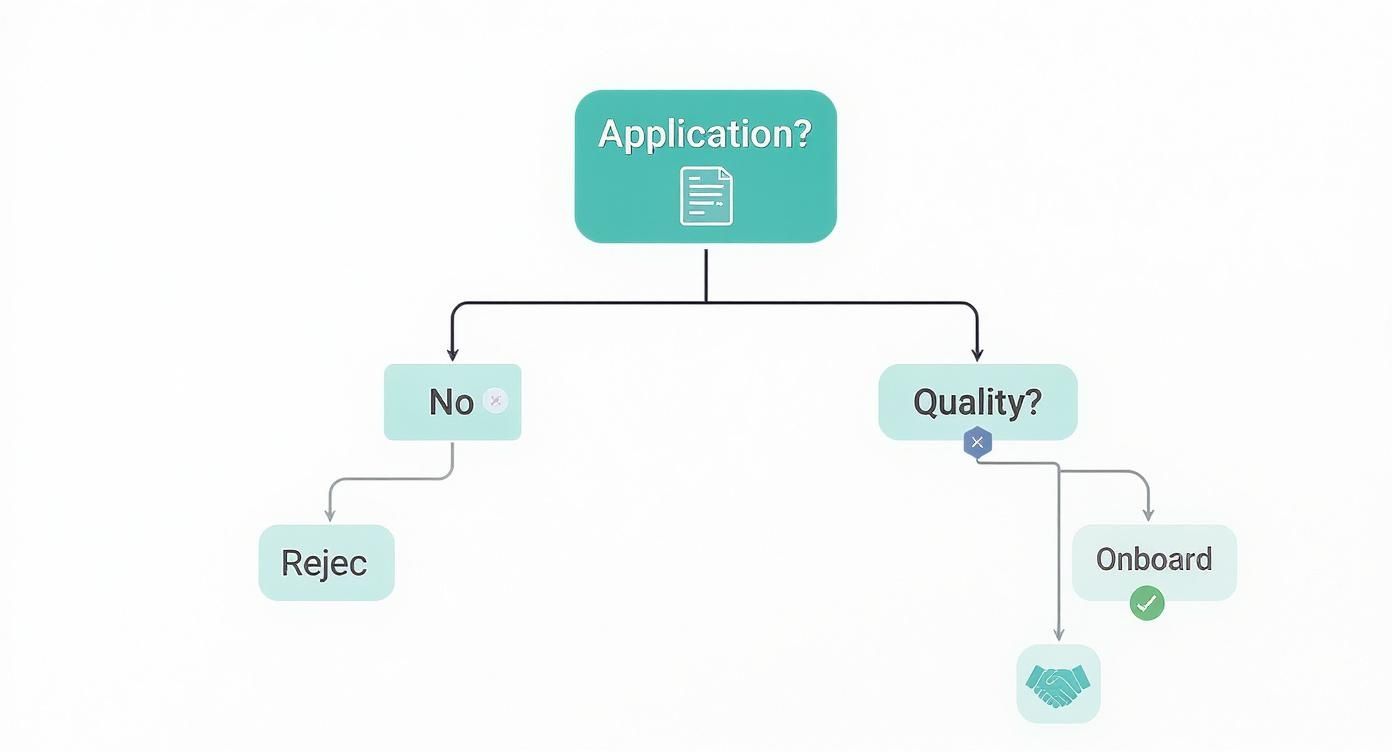
By filtering applications carefully before onboarding, you ensure your top-tier commission structure is reserved for partners who will actually move the needle.
Incentivizing Performance Beyond Commissions
A strong commission is your foundation, but don't stop there. Creative incentives are what keep your program exciting and top-of-mind for busy affiliates. These extra perks can make your program far more appealing than a competitor's, even if their base rate is a little higher.
Think about introducing some performance-based bonuses to light a fire under your partners:
- Launch Contests: Roll out a leaderboard during a new product launch. Offer cash prizes, exclusive merch, or even a trip to the top-performing affiliates.
- Performance Bonuses: Set a juicy, high-value target—like a $500 bonus for hitting $10,000 in sales in a single quarter. It gives your top performers something big to shoot for.
- Exclusive Coupon Codes: Give your best partners a unique, higher-value discount code for their audience. It makes their followers feel special and boosts conversion rates, which is a win for everyone.
Remember, the affiliate market is global. North America currently accounts for over 40% of total affiliate revenue, but don't sleep on international expansion. Over 70% of Australian companies with affiliate programs are already operating overseas, proving that a strong compensation plan can attract amazing partners from anywhere in the world.
Your Affiliate Recruitment Questions, Answered
Even with the perfect game plan, a few questions always pop up when you're diving into the world of affiliate recruitment. Getting these sorted out early will save you a ton of headaches and help you build a program you're confident in. Let's tackle some of the most common questions affiliate managers have.
Think of this as your cheat sheet for navigating the tricky parts of building and scaling your partner program.
How Much Should I Pay My Affiliates?
This is the million-dollar question, and honestly, there's no single magic number. The right commission rate really depends on your industry and, most importantly, your profit margins.
For physical products, a commission of 5-15% of the sale price is a pretty standard and competitive place to start. But if you're in the digital world—think software, SaaS subscriptions, or courses—the game changes. Rates there are often much beefier, ranging from 20% to even 50%. Some even offer a recurring slice of the pie for as long as a customer stays subscribed.
Before you set anything in stone, do a little recon and see what your direct competitors are offering. Your goal is to be attractive enough to catch an affiliate's eye, but sustainable for your business in the long run.
One of the smartest moves you can make is setting up a tiered commission structure. It’s a killer incentive that rewards your top performers with a higher rate once they smash certain sales goals. This really motivates them to push your brand over others. Also, never forget your Customer Lifetime Value (LTV); a higher commission upfront is a no-brainer if your customers tend to stick around for a long time.
What’s the Difference Between an Affiliate Network and an In-House Program?
This is a big strategic fork in the road. An affiliate network, like ShareASale or CJ Affiliate, is essentially a giant marketplace. It connects you with a ready-made army of publishers (your future affiliates) and handles all the heavy lifting like tracking, payments, and reporting.
The biggest pros of a network are:
- Instant Access: You get to tap into thousands of vetted affiliates right out of the gate.
- Simplified Management: The network's tech takes care of all the backend headaches for you.
Of course, there’s a catch: the cost. You're typically looking at setup fees plus a percentage of every single commission you pay out.
An in-house program is the DIY route. You run the whole show yourself using specialized software. The upside? You have total control over your brand, your data, and how you talk to your partners, all while dodging those network fees. The trade-off is that you have to recruit every single affiliate yourself, which is a massive investment of time and energy upfront. A lot of brands will start on a network to get some momentum and then build their own in-house program as they grow.
How Long Does It Take to See Results From Affiliate Recruitment?
Let's be real: affiliate marketing is a marathon, not a sprint. You should be prepared for it to take anywhere from 3 to 6 months to see consistent, meaningful results.
The first few months are all about getting your program set up, finding your first batch of partners, and getting them onboarded. From there, it takes time for those affiliates to create the kind of high-quality content that actually converts—we're talking detailed blog posts, in-depth video reviews, and tutorials that build trust with their audience.
Sure, some affiliates might drive a few sales in their first week, but the real power players, the content creators, often need several months for their promotional work to really gain traction. Patience is your best friend here, along with consistent communication to keep your partners in the loop.
What Are the Most Common Mistakes to Avoid When Recruiting Affiliates?
The single biggest mistake I see brands make is chasing quantity over quality. Recruiting a thousand low-quality affiliates who generate zero sales isn't a strategy; it's a colossal waste of your time and resources. You're far better off finding a smaller, highly-engaged group of partners who are a perfect fit for your brand.
Another classic blunder is sending out generic, impersonal outreach emails that just scream "mass blast." Personalization is everything. Show them you've actually looked at their work and know who they are.
Finally, a "set it and forget it" mindset is a guaranteed path to failure. Your affiliate program is not a passive income stream for your business. It needs active management, regular check-ins, and ongoing support to keep your partners motivated and excited to promote you.
Ready to streamline your affiliate recruitment and management? JoinBrands connects you with over 250,000 creators and influencers, providing the AI-powered tools you need to find the perfect partners, manage campaigns, and drive sales. Find your next top-performing affiliate today.