

 How to Recruit Affiliates Who Actually Drive Sales
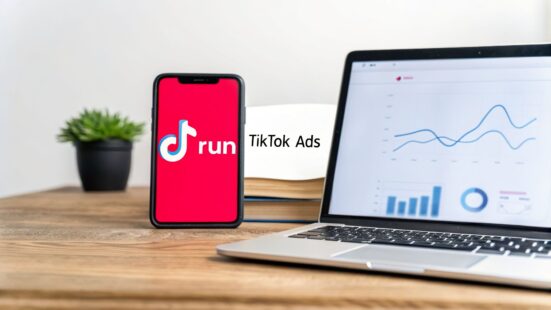
Before you can even think about launching your first ad, you've got to lay the proper groundwork. This isn't just about creating an account; it's about setting up your entire advertising ecosystem so you can track what's working and what isn't. The first steps are to create a TikTok for Business account, install the TikTok Pixel on your website, and then get familiar with the TikTok Ads Manager, which will be your command center.
Getting this foundation right is non-negotiable for any e-commerce brand that's serious about results.
Table of Contents
Setting Up Your TikTok Ads Manager for Success

Think of this initial setup as building the foundation for a house—if you rush it or cut corners, you're guaranteed to run into major headaches down the line. For DTC brands, this means ensuring every click, add-to-cart, and purchase is tracked with surgical precision.
Putting in the time upfront saves you from the classic pitfalls many new advertisers face: inaccurate data, wasted ad spend, and no way to retarget high-intent website visitors. Trust me, the effort you invest now will pay for itself ten times over when you’re ready to scale your campaigns confidently.
Create Your TikTok for Business Account
First things first, you need to create a dedicated ad account through the TikTok for Business portal. This is a separate entity from your personal profile or even your brand's organic TikTok page. It’s the central hub where all your advertising magic happens.
During the setup process, you’ll be asked for basic business info like your industry and location. This isn't just for show; it helps TikTok tailor the ad experience and serve up more relevant insights. If you already have a TikTok profile for your brand, you can (and should) connect it later on. For anyone starting from scratch, you can learn more about how to create a TikTok business account here: https://joinbrands.com/blog/how-create-tiktok-business-account/
If you’re just getting started, an in-depth guide on TikTok ads for small business can provide some excellent, tailored strategies.
Connect and Authorize Your Assets
With your Ads Manager up and running, the next critical step is to link everything to your TikTok Business Center. This is where you manage all your advertising assets in one place, and it unlocks some of the most powerful features for e-commerce brands.
Here's what you'll manage inside the Business Center:
- Ad Accounts: Control permissions and billing, which is essential if you're running different campaigns or managing ads for multiple clients.
- TikTok Profiles: Link your brand's organic TikTok profile. This is absolutely essential if you want to run Spark Ads (more on that later).
- The TikTok Pixel: Your data lifeline. You'll create and manage your Pixel from here, ensuring all your ad campaigns can track what’s happening on your website.
The single biggest mistake I see new advertisers make is failing to properly link their organic TikTok account to their Business Center. Without this connection, you cannot run Spark Ads, which leverage authentic creator content and almost always outperform standard, brand-created ads.
Install and Verify the TikTok Pixel
The TikTok Pixel is a small piece of code that you install on your website. It's the critical link between your ad campaigns and your online store, keeping track of every user action—from page views and add-to-carts to, most importantly, purchases. Without a working Pixel, you’re basically flying blind.
Luckily, most e-commerce platforms like Shopify have simple, one-click integrations that make installation a breeze. Once it’s installed, you absolutely must verify that it’s firing correctly. You can use the free TikTok Pixel Helper Chrome extension or the testing tools built right into Ads Manager.
A properly installed and verified Pixel empowers you to:
- Track Conversions: See exactly which ads are driving sales and leads.
- Build Custom Audiences: Create powerful retargeting lists of people who visited specific pages, added items to their cart but didn't buy, or even initiated checkout.
- Optimize for a Lower Cost-per-Action: The algorithm crunches your Pixel data to find more people who are likely to take the action you want, making your campaigns more efficient over time.
Building Your E-commerce Campaign Strategy
Alright, so your Ads Manager is good to go and the Pixel is firing. Now for the fun part—actually building a campaign that gets results.
A winning TikTok campaign isn't just about flashy videos. It all starts with a crystal-clear, strategic goal. The single most important setting you’ll choose is your campaign objective, because it tells TikTok's algorithm exactly what you want it to hunt for.
I've seen so many brands burn through their budget by picking a broad objective like 'Traffic' when what they really want is sales. This just leads to a ton of clicks that never convert. For any e-commerce brand, your objective has to map directly to a specific action in your customer's journey.
Choosing the Right Campaign Objective
Think of your objective as giving TikTok its marching orders. If you tell it to find people who will simply watch your video, that’s exactly what it will do—but it won’t necessarily find people who are ready to pull out their credit cards. For DTC brands, the goal is almost always to drive a specific, measurable action on your website.
Here’s how to line up your goals with TikTok’s objectives:
- Driving Immediate Sales: The Website Conversions objective is your absolute best friend. This is the one you want for driving purchases, add-to-carts, or any other high-value action on your site. The algorithm will zero in on users with a history of buying from ads.
- Launching New Products: Just dropped a new product? You might need to build some initial buzz and social proof first. A Video Views or Reach campaign can be a great top-of-funnel play to get eyeballs on your brand. This generates hype and collects valuable data you can use to build retargeting audiences later.
- Generating Leads: If you're selling a high-ticket item or just trying to build up your email list, the Lead Generation objective is fantastic. It lets you capture user info right inside the TikTok app, which seriously cuts down on friction and boosts sign-ups.
Your campaign objective dictates the type of user TikTok will show your ad to. Choosing 'Conversions' tells the algorithm, "Find me shoppers," while choosing 'Traffic' just says, "Find me clickers." For e-commerce, you almost always want the shoppers.
Having a clear strategy makes all the difference. To dig deeper into turning those views into revenue, check out our complete guide on how to sell products on TikTok for more advanced tactics.
CBO vs. ABO: Where to Put Your Money
After you've locked in your objective, you need to decide how to manage your budget. TikTok gives you two main ways to do this: Campaign Budget Optimization (CBO) and Ad Group Budget Optimization (ABO). How you choose here will dramatically shape how you test your creative and audiences.
With ABO, you set a separate budget for each ad group inside your campaign. This gives you direct, granular control over how much you spend on a specific audience or creative test. It’s perfect for the initial testing phase when you need to give each ad group a fair shot to prove itself.
On the other hand, CBO lets you set one master budget at the campaign level. TikTok’s algorithm then takes the wheel, automatically shifting your budget to the best-performing ad groups in real-time. This is the go-to method for scaling your winning campaigns because it efficiently pours fuel on what's already working without you having to constantly babysit it.
Here’s a quick-and-dirty comparison to help you match your goals to the right objective.
Matching Your Goals to TikTok Campaign Objectives
Choosing the right objective is half the battle. This table breaks down common e-commerce goals and pairs them with the TikTok campaign objective most likely to get you there. Think of it as a cheat sheet for telling the algorithm exactly what you want.
| E-commerce Goal | Recommended TikTok Objective | Primary Use Case |
|---|---|---|
| Maximize online sales | Website Conversions (Purchase) | This is your workhorse for driving direct sales and achieving a positive ROAS. |
| Increase cart value | Website Conversions (Add to Cart) | Great for getting users to the checkout, even if they don't buy immediately. |
| Build an email/SMS list | Lead Generation | Capture contact information directly in-app with a pre-filled form. |
| Promote a new collection | Reach | Maximize the number of unique people who see your ad for a big launch. |
| Build social proof/engagement | Video Views | Get as many views as possible to create buzz and retargeting audiences. |
| Drive traffic to a blog/landing page | Traffic | Best used for content promotion, not direct sales. Use with caution for e-commerce. |
Ultimately, you should always start with your end goal in mind and work backward. If you want sales, optimize for conversions. It's that simple.
A really effective workflow that we use all the time is to start with an ABO campaign for testing. Once you've found your winning ad groups—the ones hitting your target CPA or ROAS—you move them into a brand new CBO campaign to scale. This two-step process makes sure you're making smart, data-backed decisions before you start spending the big bucks.
Finding Your Customers with Advanced Targeting
You can have the most amazing creative and a perfectly dialed-in campaign objective, but if you're showing it to the wrong people, you're just burning cash. This is the moment your ad spend either becomes a powerful revenue engine or a very expensive mistake. For any e-commerce brand serious about a positive return on ad spend (ROAS), moving beyond basic demographic targeting is non-negotiable.
TikTok's real magic is in its ability to pinpoint users based on what they're actually doing on the platform. You're not just targeting an age bracket; you're targeting someone who just binged three videos on sustainable skincare or dropped a "like" on content featuring home gym equipment. This is the secret sauce to running TikTok ads that actually convert.
Mastering Interest and Behavior Targeting
Think of this as the difference between casting a wide net and using a laser-guided fishing spear. Instead of just blanketing "women ages 25-34," you can get way more specific and find people with genuine purchase intent.
Here’s how I break it down:
- Interest Targeting: This is your top-of-funnel play. It lets you reach people based on the long-term content categories they consistently engage with. If you sell high-performance running shoes, you can target broad interests like "Sports Equipment" or "Fitness & Health" to build initial awareness.
- Behavior Targeting: Now this is where it gets fun. You can target users based on their recent actions—we're talking likes, comments, shares, and watch-completions—within specific video categories in the last 7 or 15 days.
A DTC coffee brand, for example, could target users who have recently engaged with videos under the "Food & Beverage" category that also feature creator hashtags like #espresso or #coffeerecipe. You’re hitting an audience that has coffee on the brain right now.
The infographic below really drives home the main goals we advertisers are chasing, whether it's direct sales, brand buzz, or lead generation.

It’s a great reminder that every successful campaign starts with a clear, measurable outcome—something you can only achieve by pairing the right objective with razor-sharp targeting.
Building High-Value Custom and Lookalike Audiences
While finding new customers with interest and behavior targeting is great, your most valuable audiences are almost always the ones you already own. This is where Custom Audiences and Lookalike Audiences come into the picture. Honestly, they're the backbone of profitable scaling.
A Custom Audience is simply a group of users you create from your own data sources. This is your low-hanging fruit—people who already know who you are.
You can build them from a few key sources:
- Customer Files: Upload a list of past buyers (emails, phone numbers) to find their profiles on TikTok.
- Website Traffic: Put your TikTok Pixel to work by building audiences of site visitors, product viewers, or cart abandoners.
- App Activity: If you have an app, you can track in-app events to retarget your most engaged users.
- Engagement: Easily create lists of users who've interacted with your ads or your organic TikTok profile.
Once you have a solid Custom Audience (think: a list of your best customers), you can unleash the power of a Lookalike Audience. TikTok’s algorithm takes a deep dive into the traits of your source audience and then scours the platform to find millions of new users who share similar characteristics and behaviors. This is hands-down the most effective way to scale your campaigns and find new customers who look just like your existing ones.
Start by creating a Lookalike Audience from a high-quality source, like a list of at least 1,000 past purchasers. This gives the algorithm rich, meaningful data to work with, resulting in a much higher-quality audience than one built from, say, general website visitors.
What makes these tools so potent is the sheer scale of the platform. With a potential ad audience of nearly 1.59 billion people as of January 2025, TikTok’s algorithm has an enormous pool to pull from to find the perfect lookalikes for your brand. It effectively turns your own customer data into a powerful acquisition machine. You can dig into more of these fascinating TikTok ad statistics and insights at marketingltb.com.
Setting Smart Budgets and Bidding Strategies
Your budget and bid strategy dictate how your money gets spent and how aggressively TikTok goes after your target audience. Mess this up, and your profitability goes out the window.
There are three main bid strategies you need to know:
- Lowest Cost: This tells TikTok to get you the most results possible for your budget. It's fantastic for maximizing volume, especially early on, but your cost per acquisition (CPA) can swing a bit.
- Cost Cap: Here, you set a maximum average CPA you're willing to pay. This gives you much more cost stability and ensures your CPA stays at or below your target as you scale.
- Value Optimization: This is a more advanced strategy (you'll need a healthy Pixel for this) that tells TikTok to find users likely to spend more, optimizing for a higher ROAS instead of just a lower CPA.
For a new campaign, I always recommend starting with a daily budget of $50 per ad set using the Lowest Cost bidding strategy. This gives the algorithm enough data and breathing room to find its footing. Once an ad set proves itself and is consistently hitting your target CPA, that's when you can switch to a Cost Cap strategy to start scaling the budget while protecting your margins.
Creating TikTok Ads People Actually Watch

Let's get one thing straight. On platforms like Facebook or Google, your targeting and bidding strategy can save a mediocre ad. On TikTok, your creative is everything. Users are hardwired to swipe away from anything that even smells like a polished, traditional commercial.
The only rule for success is simple: Don't make ads. Make TikToks.
This means you have to lean into the platform's raw, authentic, and ridiculously fast-paced vibe. The goal isn't to interrupt someone's scrolling session; it's to blend right into their "For You" page so seamlessly that you earn their attention.
Hook Viewers in the First Three Seconds
You have a blink-and-you'll-miss-it window to stop the scroll. Seriously, TikTok’s own data shows that ads highlighting the key message or product within the first three seconds see a massive lift in performance. Forget the slow build-up or the fancy logo intro—get straight to the point.
Your hook has to hit them immediately. It could be a provocative question, a common problem, or a super satisfying "before and after."
Here are a few hook frameworks we've seen crush it for e-commerce brands:
- Problem/Solution: Start with the pain point. "Tired of your fresh produce going bad?" then immediately show your food storage container saving the day.
- Intriguing Question: "What if you could get a full night's sleep without waking up?" then pan to your cozy weighted blanket.
- "TikTok Made Me Buy It": This is a classic for a reason. Open with that phrase and dive right into a quick, high-energy product demo.
- Visual Payoff: Show a filthy surface getting power-washed to perfection or a pimple patch pulling out gunk. It's oddly satisfying and impossible to look away from.
The idea is to create an instant visual payoff or information gap that makes them need to see what happens next.
Leverage Trends and Sounds Authentically
TikTok runs on sound. For a huge chunk of users, it's basically a music discovery app. Hopping on a trending audio track is one of the fastest ways to make your ad feel native and relevant.
But here’s where most brands mess up: you can't just slap a popular song on a boring ad and call it a day. You have to understand the context of the trend. Spend some time scrolling the "For You" page to see how real people are using a sound before you try to wedge your product into it.
A huge mistake is jumping on a trend a week after it's peaked. By then, it's old news. Use TikTok's Creative Center to spot rising trends and sounds so your content feels fresh, not forced.
Beyond music, keep an eye out for trending video formats, editing styles, and challenges. When you participate authentically, you're signaling to users that your brand actually gets the platform's culture.
The Power of UGC and Creator Partnerships
Here’s the unfiltered truth: content from real customers and creators will outperform your glossy, brand-produced ads almost every single time. It's all about trust and authenticity. User-Generated Content (UGC) feels less like a sales pitch and more like a genuine recommendation from a friend.
Actively sourcing UGC is a killer strategy. You can run a hashtag campaign encouraging customers to post about your product, or you can work with platforms that connect you to a network of vetted UGC creators. This content is your golden ticket because it provides instant, undeniable social proof.
For a deeper dive into the technical requirements for your videos, our guide on TikTok ad specifications covers all the details to make sure you're perfectly optimized.
Turn Authentic Content into Ads with Spark Ads
Okay, so you found a creator who posted an amazing organic video about your product. Now what? This is where Spark Ads come in, and they are a complete game-changer.
This native ad format lets you boost a creator's existing organic post directly from their account (with their permission, of course).
This is incredibly powerful for a few reasons:
- Insane Credibility: The ad runs under the creator's handle, not your brand’s, which makes it feel way more authentic.
- Built-in Social Proof: The ad carries all the original likes, comments, and shares, which is basically a glowing public endorsement.
- Better Performance: Because they don't look or feel like typical ads, Spark Ads often see much higher engagement rates and lower costs.
Imagine a skincare brand partnering with a creator on a "Get Ready With Me" video. Once it's posted, the brand can use Spark Ads to push that video out to a much wider, targeted audience. You're basically taking a creator's trusted voice and putting an ad budget behind it to drive sales.
How to Analyze and Optimize Your Ad Performance

Getting your first campaign live is just the beginning. The real work—and the real money—is in the optimization. This is the part of the process where you turn a campaign that's just spending money into a predictable growth engine for your brand.
When you open your TikTok Ads Manager, you'll be hit with a wall of data. Most of it is noise. Your job is to cut through that noise and focus on the numbers that actually drive your business forward. Learning to read these signals is what separates the pros from the rookies.
Identifying Your Most Important KPIs
For any e-commerce brand, there are only a handful of Key Performance Indicators (KPIs) that truly matter. These are the metrics that tell you if you're actually making money. Don't get distracted by a million views if none of them are turning into customers.
Your most critical e-commerce KPIs are:
- Return on Ad Spend (ROAS): This is your north star. It's the total revenue you earn for every single dollar you spend on ads. If your ROAS is above 1.0x, you're in the green.
- Cost Per Acquisition (CPA): This is exactly what it costs you to get a new customer. You absolutely must know your product margins to have any idea what a "good" CPA looks like for your business.
- Conversion Rate (CVR): This is the percentage of people who buy something after clicking your ad. A dismal CVR often points to a problem with your landing page or offer, not necessarily the ad itself.
If you're looking to get even more granular with your data, especially with TikTok Shop, diving into resources on Mastering TikTok Shop Analytics for Ecommerce Success can give you a serious edge.
Diagnosing Underperforming Ads
So, your ROAS is in the toilet. Now what? It's time to put on your detective hat. Secondary metrics are the clues that tell you why your main KPIs are suffering.
When your sales numbers are weak, start digging into these metrics to find the culprit:
- Click-Through Rate (CTR): A low CTR (think anything below 1%) is a huge red flag that your creative is boring. It's not stopping the scroll, the hook is weak, or the call-to-action isn't compelling enough to earn a tap.
- Cost Per Click (CPC): Are your CPCs through the roof? This can burn through your budget before anyone even sees your product page. It often means your creative is getting stale or you're fighting a bidding war for your audience.
- Add to Cart (ATC) Rate: If you're getting plenty of clicks but nobody is adding to their cart, the problem isn't the ad—it's your product page. Is the price a shock? Does the page take forever to load on a phone? Is your value proposition unclear?
Following this process ensures you're fixing the right problem. Never kill a potentially great ad creative when the real issue is a clunky mobile checkout experience.
A Practical Framework for A/B Testing
Smart, methodical testing is how you go from good to great. A/B testing (or split testing) is the simple practice of changing one single variable at a time to see what actually moves the needle. It takes all the guesswork out of optimization.
Don't ever test more than one thing at a time. If you change the headline, the video, and the audience all at once, you'll have no idea which change was responsible for the lift (or dip) in performance.
Always start by testing the big, high-impact elements first.
- Creative: Test two wildly different video concepts. Pit a UGC-style review against a slick, polished product demo.
- Hook: Once you have a winning video format, test the first 3 seconds. Try a question-based hook versus a problem/solution hook.
- Audience: Run a Lookalike Audience built from your past purchasers against a broad, interest-based audience to see who converts better.
- Landing Page: Use the exact same ad but send traffic to two different product pages. Maybe one has a different headline or a special offer.
When you nail this, the results can be powerful. On average, TikTok ads can pull in a 2.4x ROAS, generating about $2 in revenue for every $1 spent. That’s the power of the algorithm when you feed it the right inputs.
Scaling Winning Campaigns Without Wrecking Performance
You did it. You found a winning ad set that's consistently hitting your ROAS and CPA targets. The first instinct is to crank the budget to the moon. Resist that urge.
A huge, sudden budget increase can throw the algorithm for a loop, forcing it back into the learning phase and tanking your performance.
Instead, scale methodically.
Increase the daily budget on your winning ad set by no more than 20-30% every 48 hours. This gives the algorithm enough time to find more customers at a stable cost.
For even faster growth, try horizontal scaling. Just duplicate your winning ad set and target a new, similar audience. This strategy protects your hard-won performance and lets you scale your ad spend reliably.
Got Questions About Running TikTok Ads?
If you're diving into TikTok advertising, you probably have a few questions. That's a good thing. Getting clear on the fundamentals helps you sidestep common mistakes and ensures every dollar you spend is working as hard as possible.
Let's walk through some of the most common questions I hear from e-commerce brands just getting their sea legs on the platform.
How Much Should I Actually Spend on TikTok Ads When I'm Just Starting?
This is the big one, right? My go-to advice is to set a daily budget of at least $50 per ad set. Anything less, and you’re basically flying blind. The algorithm just won't get enough data to start learning and optimizing, leaving you without any real insights.
For your very first test campaign, think about a total budget in the ballpark of $500 to $1,000, spread out over one or two weeks. This gives you enough runway to test a couple of different audiences and a handful of creative angles to figure out what actually clicks with people.
Quick tip: In this early phase, don't get hung up on immediate sales or profitability. Your goal is data. Keep a close eye on leading indicators like Click-Through Rate (CTR) and Cost Per Click (CPC). Once you spot a winning combo of creative and audience, that's when you can confidently start to scale up the budget.
What's the Real Difference Between a Spark Ad and a Regular Ad?
Understanding this is a game-changer. A regular "In-Feed Ad" is exactly what it sounds like—an ad you build and publish straight from your brand's ad account. It shows up on the "For You" page with a little "Sponsored" tag, so it’s pretty obvious it came from a brand.
A Spark Ad, however, is a whole different beast. It’s a native format that lets you boost an existing organic post directly from a creator's account (with their permission, of course). The ad runs under the creator's handle, bringing all their social proof—likes, comments, shares—along for the ride.
More and more brands are leaning heavily into Spark Ads, and for good reason. They just feel more authentic and blend seamlessly into the feed. This authenticity almost always translates to higher engagement and much better performance than a traditional, polished brand ad.
My Ads Are Getting Tons of Views but Zero Sales. What Gives?
Ah, the classic—and most frustrating—dilemma. When you're getting views but no conversions, it's a sure sign of a disconnect somewhere in your funnel. Don't panic and kill the ad just yet. Instead, let's play detective.
First, take a hard look at your ad creative itself.
- Is your call-to-action (CTA) crystal clear? Are you telling people exactly what to do next?
- Does the video set the right expectations for what the product is and how much it costs? Sticker shock on the landing page is a real conversion killer.
Next, pull up your landing page on a phone—not your computer.
- How fast does it load? Even a one-second delay can tank your conversion rate.
- Is the product from the ad front and center, above the fold? No one wants to go on a scavenger hunt.
- Is the checkout process ridiculously simple? Remove every possible point of friction.
Finally, revisit your targeting. You might be reaching an audience that loves your content but has absolutely no intention of buying. Try testing a lower-funnel objective like 'Complete Payment,' or better yet, build a retargeting audience of people who watched most of your video but didn't click. They're already warm; they just need a little nudge.
Ready to turn authentic creator content into high-performing ads? JoinBrands connects you with over 250,000 creators to produce UGC that converts. Find the perfect creators for your brand and launch your next campaign today.