



 8 High-Converting Influencer Outreach Email Templates for 2025
Writing a creative brief is all about capturing your project's purpose, audience, and core message in one focused document. It acts as a strategic roadmap, giving your creative team a clear direction to produce work that actually hits your business goals.
Table of Contents
Why Your Creative Brief Is Your Most Important Document
Think of a creative brief as the architectural blueprint for your marketing campaign. You wouldn’t build a house without one, right? Without a solid plan, you risk building something that's unstable, blows the budget, and ultimately doesn't work.
A great brief is the single most important document that stands between a wildly successful campaign and a costly failure. It’s not just paperwork; it’s the strategic foundation that prevents wasted time, endless revisions, and a whole lot of frustration.
This document is your secret weapon for alignment. It guarantees that everyone—from the marketing manager to the graphic designer—shares the exact same vision for the project's goals, audience, and message. This alignment is what turns good ideas into incredible execution.
The Foundation of Successful Campaigns
The link between a clear brief and a successful outcome isn't just a gut feeling; the data backs it up. Research from the Association of National Advertisers (ANA) found that a "tight brief with clearly defined objectives" was rated the top reason for great creative work by over 900 executives.
On the flip side, "poor creative briefs, lacking in focus and clarity" was identified as the biggest roadblock. When a brief is vague or uninspired, you run into the same old problems:
- Wasted Resources: The creative team spends hours just guessing what you want. This leads to multiple rounds of revisions that burn through time and money.
- Off-Target Creative: The final work might look good, but it completely misses the mark with the target audience or fails to achieve the business objective.
- Team Frustration: Nothing kills morale faster than miscommunication. It breeds frustration and poisons the collaborative spirit needed for innovative work.
A creative brief shouldn't just instruct; it should inspire. Its purpose is to provide sharp, strategic focus that liberates the creative team to do their most effective and imaginative work, rather than restricting them with vague demands.
Shifting from Instruction to Inspiration
At the end of the day, learning how to write a creative brief is about mastering the art of strategic communication. It’s about translating dry business needs into a compelling story that ignites your team's passion.
When a brief is clear, insightful, and genuinely inspiring, it empowers creatives to do what they do best: solve problems. They can pour all their energy into building something amazing instead of trying to decipher what you really wanted.
For a deeper dive into the specific methods and strategies, this comprehensive guide on how to write a creative brief that works is a fantastic resource. It sets the stage for a project where everyone is confident, aligned, and aiming for the same target from day one.
The Core Components of an Effective Creative Brief
A killer creative brief is built on a handful of non-negotiable components that bring absolute clarity to a project. Forget the guesswork. Think of these elements as the foundation of your entire campaign; if one is weak, the whole structure is at risk. When done right, every piece works together to create a single source of truth for your creative team.
The path from a vague idea to a tangible result can get messy, fast. A bad brief sends everyone down a rabbit hole of confusion and revisions, while a well-crafted one lights the way forward.
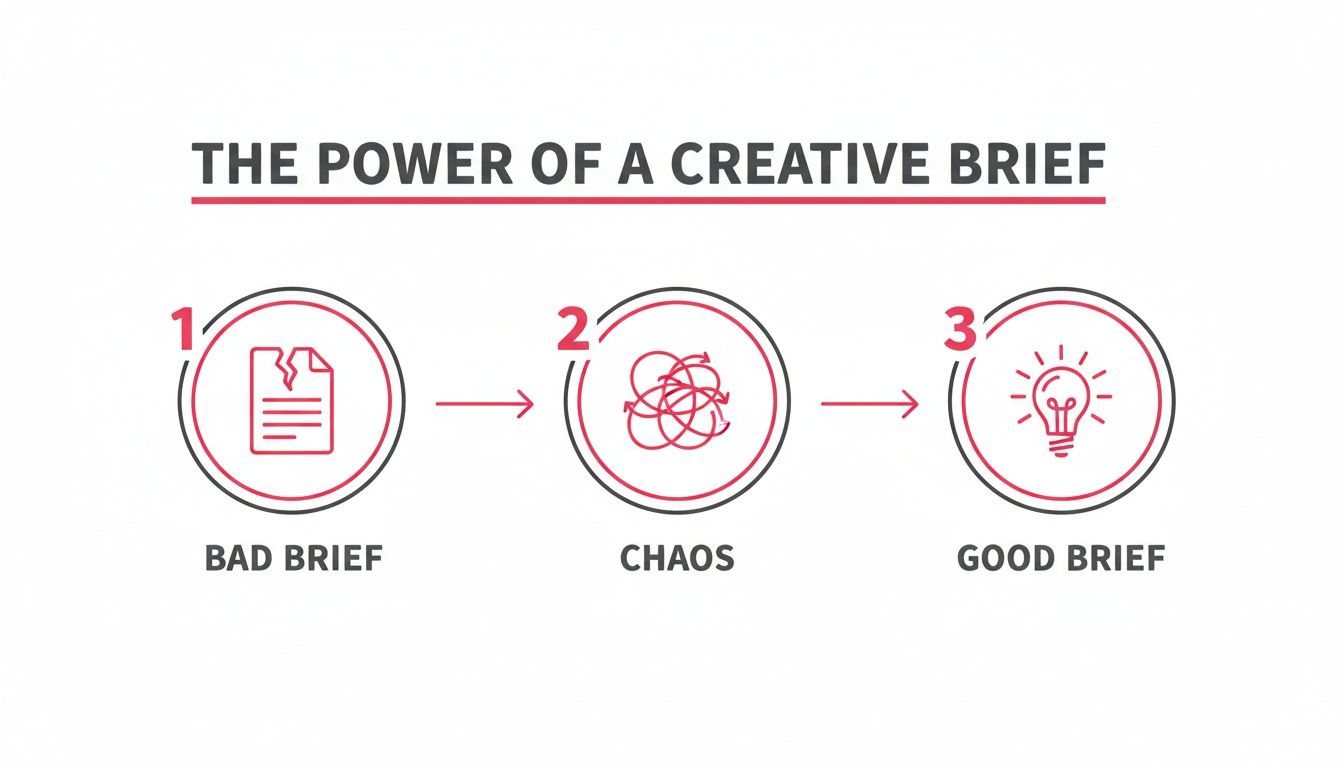
This visual says it all. The quality of your brief directly predicts the success (or failure) of the creative process. A good brief isn't just a document; it's the strategic tool that prevents chaos and inspires incredible work from the get-go.
Your Project’s Foundational Questions
Before you get into the nitty-gritty, your brief needs to answer a few big-picture questions. This is the high-level context everyone on the team needs to grasp the project's purpose and scope.
So, what are the absolute essentials? I've seen hundreds of briefs over the years, and the best ones always nail these core components. They cut through the noise and give the creative team exactly what they need to start brainstorming.
Here’s a quick breakdown of what every brief should contain:
| Essential Components of a Creative Brief |
| :— | :— | :— |
| Component | What It Answers | Why It's Critical |
| Project Background | Why are we doing this, right now? | Provides the "story" behind the project, giving creatives much-needed context. |
| The Business Problem | What core business challenge are we trying to solve? | Frames the project around a real-world problem, not just a marketing task. |
| Target Audience | Who, specifically, are we talking to? | Moves beyond simple demographics to inspire creative that truly connects. |
| Key Competitors | Who else is vying for our audience's attention? | Helps the team understand the market and find ways for the brand to stand out. |
| Objectives | What does success look like in measurable terms? | Defines the finish line so everyone knows what they're working towards. |
| Core Message | What is the one thing we must communicate? | Forces focus and ensures the creative output has a sharp, memorable point. |
| Deliverables & Specs | What are we actually making? | Eliminates ambiguity about the final assets, from formats to dimensions. |
| Budget & Timeline | What are our constraints? | Sets realistic expectations for what can be achieved with the available resources. |
Nailing these eight elements is the difference between a project that sings and one that falls flat.
Defining Objectives and the Core Message
Once the foundation is set, it's time to get specific about what you want to achieve and what you need to say. This is where you kill ambiguity.
An effective brief must set measurable objectives. Are you aiming to boost event attendance by 5 percent? Or maybe you're looking to increase website traffic by 25 percent? Whatever it is, define it clearly. This document becomes the blueprint for everyone involved.
Next, you have to distill your message. What is the single most important thing you want your audience to hear? This is often called the "Single-Minded Proposition," and it's brutally effective. It’s the one takeaway that sticks, even if they forget everything else.
Key Takeaway: Resist the urge to cram in multiple messages. A great brief has one core idea. Forcing this focus is the hardest—and most valuable—part of the whole process.
Finally, get practical. Outline the non-negotiables that keep the project anchored in reality. Define the specific deliverables (e.g., three short-form videos, one landing page, two email banners), the budget, and a realistic timeline with key milestones.
It’s tempting to grab a generic file and just fill in the blanks, but customizing these sections is vital. If you need a solid starting point, this creative brief template is a great resource that you can adapt to fit your project's unique needs.
Defining Your Audience Beyond Demographics

If you want creative work that actually lands, you have to know who you’re talking to. And I mean really know them.
Just listing out "millennials, age 25-35, urban" is a one-way ticket to generic concepts that don't move the needle for anyone. Creatives need human details to work with, not cold, lifeless data points.
The whole point here is to ditch the surface-level demographics and build a deep, almost empathetic understanding of your audience. When you do this, the brief transforms from a boring document into a genuine source of inspiration. It's about painting a vivid picture of a single person.
Creating Your Customer Pen Portrait
Ever heard of a "pen portrait"? It's a short, story-like description of your ideal customer. You give them a name, a personality, a life. This isn't about pulling details out of thin air; it’s about taking all your research and molding it into something a creative can actually connect with.
Instead of just demographics, a solid pen portrait digs into:
- Motivations: What really drives them? What are they hoping to achieve in life?
- Frustrations: What little (or big) problems do they deal with every day? What drives them crazy about products like yours?
- Media Habits: Where do they hang out online? Who do they actually trust for recommendations?
- A "Day in the Life": Seriously, what does their average Tuesday look like from the moment they wake up to when they go to bed?
This detailed picture gives your team a real person to design for. They can ask, "Would Sarah actually like this?" instead of "Does this appeal to our target demographic?"
A pen portrait transforms your audience from a statistic into a character in a story. This shift in perspective is often the difference between creative that is merely seen and creative that is truly felt.
Data-driven briefs are non-negotiable for campaign success these days. Building these customer portraits is probably the single most important part of writing a brief because it determines whether your big idea will resonate or fall flat. One brand, for example, discovered their audience was way more active on Pinterest than they realized. That little insight allowed their creative team to come up with platform-specific ideas that killed it.
Uncovering The Human Truths
So, where do you find all these juicy, human details? The answers are hiding in your data, but you have to know what to ask. Your job is to turn raw analytics into a compelling story.
A great starting point is talking to your customer-facing teams. Your sales reps and customer support staff are sitting on a goldmine of stories about customer pain points, weird requests, and what truly makes them happy. Ask them about the most common questions they get. This qualitative stuff is priceless.
Next, a thorough social media audience analysis can uncover all sorts of hidden gems. You can get deep into the weeds with social listening tools to see the exact language your audience uses, the online communities they're part of, and the influencers they follow. For instance, being able to properly identify the perfect audience is a universal need, even for things like crowdfunding campaigns.
When you blend the hard numbers with these qualitative insights, you get a complete, 360-degree view. This full picture is what empowers your brief to guide the creative team toward work that isn't just targeted, but is also authentic and genuinely moving.
Finding the Insight That Sparks Great Ideas

This is where the real magic happens. A killer campaign idea is never pulled from thin air; it’s born from a genuine human insight. This is that "aha!" moment, the spark that connects your business goals with what your audience actually feels and believes.
But finding that spark isn't about waiting for a lightning bolt of genius to strike. It’s more like digging for gold. You have to get past the surface-level stuff to find the rich vein of truth buried underneath.
This single compelling idea becomes the engine for the entire creative process. It gives your team a powerful launchpad to build something that feels real and hits home, turning a simple marketing message into a truly memorable experience.
Distinguishing Observation from Insight
First things first, you need to understand the crucial difference between an observation and an insight. An observation is just a fact—a statement about your audience or the market. An insight is the hidden motivation or emotional truth behind that fact.
Let's break it down:
- Observation: "People are spending more time watching short-form video content." (Okay, that's just a fact.)
- Insight: "People feel overwhelmed by complex information and crave bite-sized entertainment that offers a quick escape without demanding too much mental energy." (Now that explains the why.)
The observation tells you what people are doing. The insight tells you why they're doing it, and that's the stuff that great creative is made of. Your brief has to deliver this deeper understanding to the team.
An observation states the obvious, but an insight reveals the unseen. Your creative brief must deliver the latter. It should challenge assumptions and reframe a common behavior in a new, compelling light.
This is the very core of effective brand storytelling—finding a human truth your brand can genuinely connect with.
Unearthing Your Core Insight
So, where do you find these game-changing insights? They live at the intersection of three key areas: your business objective, your audience's reality, and a broader cultural truth.
- Your Objective: What problem is your business really trying to solve? Get specific. "Sell more shoes" is an objective, sure. But "Help new runners feel confident enough to start their first training program" is an objective that hints at a powerful human need.
- Audience Reality: Go back to your audience personas. What are their deepest frustrations or desires related to this problem? What tensions exist in their daily lives that your brand could potentially resolve?
- Cultural Truth: What’s happening in the wider world that shapes how your audience sees things? Is there a shared belief, a new trend, or a common anxiety that connects to both your objective and your audience?
When you find that sweet spot where all three of these circles overlap, you've struck gold. That’s your insight. It’s the one sentence in the brief that will make a creative person lean in and say, "Oh, that's interesting." That's the spark you’re looking for.
Writing and Presenting a Brief That Inspires Action
Even the most buttoned-up, strategically brilliant brief is totally useless if it just gathers dust in someone's inbox. The final, and maybe most important, step in this whole process is mastering the delivery. Your real goal here is to turn a simple document into a catalyst for genuine excitement and killer ideas.
This all starts with the writing itself. The best briefs are concise but not cryptic. You have to ditch the corporate jargon and buzzwords immediately—they are the fastest way to kill inspiration before it even starts. Instead, use simple, direct language. Talk to your creative team like the strategic partners they are.
Think of it like you're telling a story. You’re setting up a challenge, introducing the hero (your audience), and presenting a compelling reason why this whole quest matters. That simple shift in mindset transforms a boring list of requirements into a mission everyone is fired up to join.
Making the Brief a Collaborative Tool
One of the biggest mistakes I see people make is writing the brief in a vacuum and then handing it down like a set of commandments from on high. That top-down approach is an almost foolproof way to guarantee the creative team feels zero ownership. A much, much better way to work is to make the process collaborative from the get-go.
Pull in your creative lead or director while you’re still wrestling with the brief. They can ask the clarifying questions you didn't think of, challenge your assumptions, and offer a priceless perspective on what’s actually feasible from a creative standpoint. This early collaboration builds crucial buy-in and ensures the final brief is both inspiring and grounded in reality.
A brief should be a conversation starter, not a final verdict. Involving the creative team early doesn’t mean letting them write the strategy; it means ensuring the strategy is communicated in a way that they can grab and run with.
This collaborative spirit fosters a sense of shared purpose. When the team feels like they’ve had a hand in shaping the direction, they become far more invested in the outcome. It stops being "your" brief and becomes "our" mission.
Turning the Briefing into a Kickoff Session
Finally, and I can't stress this enough: never, ever just email the brief. The document itself is only half the tool. The other half is the presentation—the actual briefing meeting where you bring it all to life. This session is your one chance to set the tone for the entire project.
Here’s how to make that meeting count:
- Don't just read it out loud. Seriously. Nobody wants to sit through a meeting where you narrate a document they could have read themselves in five minutes.
- Tell the story behind it. Share the context and the passion that led to this project. Why does this matter to the business? More importantly, why should the team care?
- Encourage questions and debate. You need to create an open forum. The best, most unexpected ideas often spark to life when someone challenges a part of the brief.
- Show, don't just tell. Whenever you can, use mood boards, competitor ads, or other examples to help everyone visualize the desired tone and feel you're aiming for.
This meeting isn't just a formality; it's the official project kickoff. It’s where you transfer all that strategic thinking and your own enthusiasm directly to the team. A passionate, engaging presentation can ignite the creative energy needed to get everyone firing on all cylinders from day one, turning that simple document into a powerful launchpad for amazing work.
Alright, let's tackle these common questions that always seem to pop up when you're wrestling with a creative brief. Even the most seasoned pros have these debates, so let's clear the air and get you moving forward with confidence.
Think of this as your final checklist before you hit "send" and kick off something amazing.
How Long Should a Creative Brief Be?
This is the big one, isn't it? The magic number is usually one to two pages. And that's a hard limit.
Your real goal isn't hitting a word count; it's achieving absolute, unshakeable clarity. The brief needs to be meaty enough to give the creative team everything they need, but lean enough that they can digest it all in one sitting.
If you find yourself creeping onto page five or six, it's a huge red flag. You're probably burying the most important points in fluff. Be ruthless. Cut out the corporate jargon, the buzzwords, and anything that doesn't directly serve the purpose of sparking a brilliant idea.
The perfect brief is long enough to give direction but short enough to keep everyone focused. It's a strategic guide, not an encyclopedia. Always choose impact over volume.
Who's Actually in Charge of Writing This Thing?
Officially, a brand manager, account manager, or strategist usually "owns" the document. But let's be real: the best briefs are never a solo mission. They're a team sport.
Whoever is holding the pen needs to act more like a journalist, pulling insights from every corner of the business.
This means you’ve got to talk to the real experts:
- The Marketing Team: They know the campaign goals and KPIs inside and out.
- The Sales Team: These folks are on the front lines, hearing customer pain points and objections every single day. Their insights are pure gold.
- The Product Team: They can give you the deep dive on the unique features and user benefits you need to highlight.
- The Creative Team: Get their input early! A quick chat can ensure the strategic direction is actually inspiring and not a creative dead end.
When you bring everyone to the table, you build buy-in from the get-go. The final document ends up being smarter, sharper, and far more effective.
Project Brief vs. Creative Brief—What's the Difference?
It’s an easy mistake to make, but mixing these two up can cause a world of confusion. The distinction is absolutely critical.
A project brief is all about the operations. It’s the nuts and bolts—the "how" and "when." You'll find lists of specific deliverables, hard budgets, and firm timelines here. It’s a project manager’s best friend.
A creative brief, on the other hand, is all about the inspiration. It's the "why" and "what" that fuels the actual creative work. This document gets into the soul of the audience, the core problem you're solving, and the single most important message that will spark that big idea.
One manages logistics; the other fuels imagination.
How Do I Present the Brief to the Team?
Whatever you do, please don't just email the brief as an attachment with a "let me know if you have questions" sign-off. That’s how great projects go to die.
You have to treat the briefing like a real event. Schedule a dedicated kickoff meeting and turn it into a moment.
Walk the team through the story of the brief, don't just read the words on the page. Get them excited about the opportunity. Explain the strategic thinking behind the decisions, and most importantly, open the floor for a real discussion. A dynamic, passionate presentation sets the tone for the entire project and gets the creative energy flowing from day one.
Ready to streamline your entire creative process? With JoinBrands, you can create crystal-clear briefs, connect with over 250,000 talented creators, and manage your campaigns all in one place. Stop chasing approvals and start inspiring amazing content. Learn more and get started today at JoinBrands.