

 Influencer Relationship Management: The Complete Guide
When you hear influencer marketing automation, don't think of robots taking over creative jobs. Instead, picture a super-efficient assistant who handles all the tedious, repetitive parts of your campaigns. This frees you up to focus on the human side of things: strategy, creativity, and building genuine relationships with creators.
It's the tech that turns the chaotic, manual grind of finding influencers and tracking results into a smooth, scalable, data-backed operation. For any brand serious about making an impact with creator partnerships, this shift isn't just nice to have – it's essential.
Table of Contents
Why Manual Influencer Marketing Is No Longer Sustainable
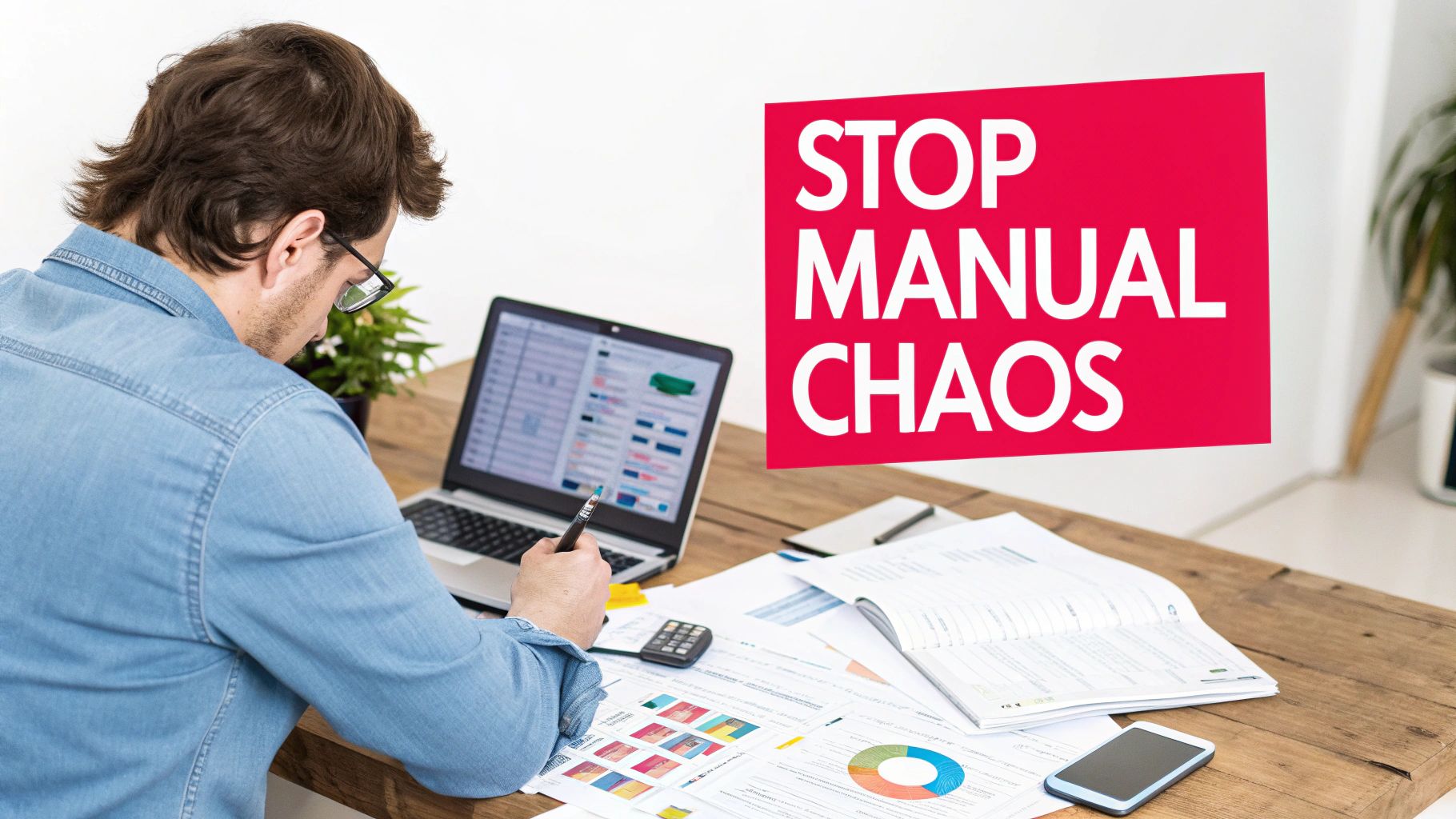
The days of simply trading products for posts are long gone. Trying to manage a modern influencer campaign by hand is like trying to direct rush-hour traffic with a whistle. It's just not going to work. You'll get overwhelmed, create bottlenecks, and quickly fall behind.
Too many marketers are buried in spreadsheets, lost in endless email chains, and struggling to prove their efforts are actually moving the needle on sales.
This manual approach grinds everything to a halt. Countless hours are vaporized searching for the right creators, vetting profiles for fake followers, and haggling over contracts one by one. And once a campaign finally goes live? The chaos just continues with tracking down posts, gathering content, and punching numbers into a calculator to figure out engagement.
The True Cost of Inefficiency
This hands-on method doesn't just eat up your time; it actively caps your brand's potential. Scaling a program from ten influencers to a hundred becomes an administrative nightmare. Worse yet, without a central hub for all your data, connecting campaign activities to your bottom line feels like pure guesswork. Good luck trying to justify your budget with that.
At its core, the problem with manual management is the lack of clear, actionable data. You're forced to make strategic calls based on gut feelings instead of hard numbers, which is a pretty risky way to spend your marketing dollars.
The Automation Imperative
The industry's explosive growth makes it clear: we need a better system. The global influencer marketing space is on track to hit a staggering $32.55 billion by 2025, which is a massive 35% jump from the previous year's $24 billion. This incredible expansion is being powered almost entirely by automation tools that handle everything from discovery to ROI tracking.
This is where influencer marketing automation becomes your greatest asset. It’s not just about clawing back a few hours in your day. It’s about completely transforming your workflow from a reactive, messy scramble into a proactive, organized engine for growth.
Think of it as the command center that finally brings order to the chaos. It provides the solid foundation needed for effective marketing campaign management software to truly deliver. By automating the drudgery, you can finally focus on what really matters: building authentic creator relationships and driving results you can actually measure.
What Influencer Marketing Automation Actually Does
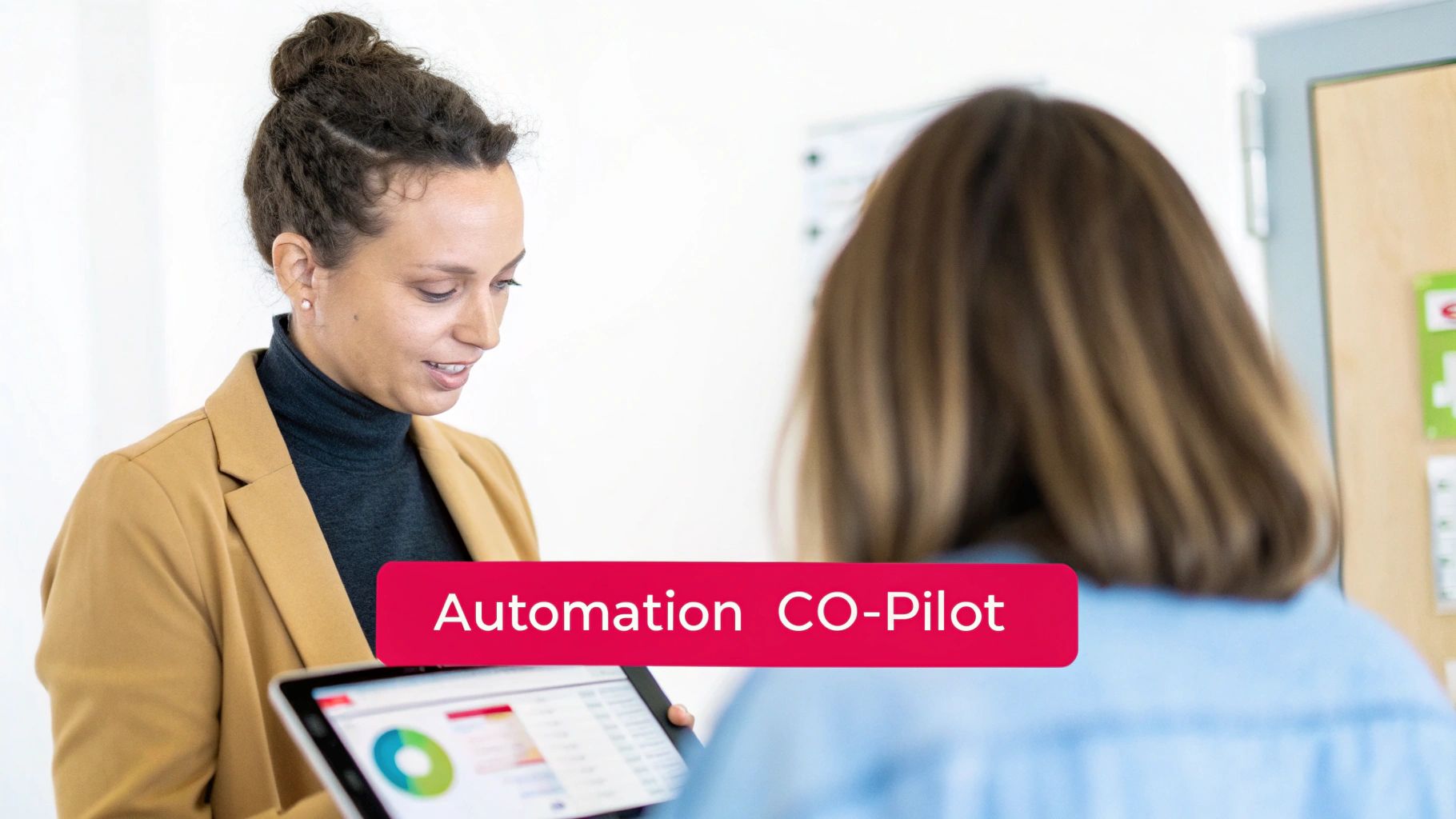
Think of influencer marketing automation as your campaign’s dedicated co-pilot. You’re the pilot, focused on the big-picture strategy, creative direction, and building real human connections. Meanwhile, your co-pilot handles all the repetitive, data-heavy, and time-sucking tasks with machine-like speed and precision.
It’s not here to replace the marketer – it’s here to empower them. This technology acts as a force multiplier, taking over the manual grunt work that bogs down campaigns and keeps them from scaling.
Instead of drowning in spreadsheets and an inbox that never seems to empty, you get a streamlined command center. This shift lets you graduate from guesswork to a data-driven workflow, helping you make smarter, faster decisions that actually grow your brand.
The Four Pillars of Automation
At its core, influencer marketing automation does four critical jobs that transform the entire campaign process. Think of these as the main tasks your "co-pilot" handles to eliminate the most common manual bottlenecks.
AI-Powered Discovery and Vetting: Manually hunting for creators is like panning for gold in a river the size of the Amazon. Automation uses AI to sift through millions of profiles in seconds, pinpointing creators whose audience, content style, and engagement metrics are a perfect fit. It also flags red flags like fake followers or poor audience quality.
Automated Outreach and Communication: Sending personalized emails one by one is impossible when you’re trying to scale. Automation tools manage communication with hundreds of potential partners at once using smart templates, automated follow-ups, and one central inbox. Nothing falls through the cracks.
Real-Time Content Tracking and Collection: The second a campaign goes live, the manual chase for content begins. Automation platforms constantly scan social media for your campaign hashtags and mentions, automatically finding and saving creator content the moment it’s published. This ends the tedious task of hunting down posts for good.
Instant Analytics and Performance Reporting: Pulling together reports from scattered data is a recipe for headaches and bad intel. An automated system connects all the dots for you. It gathers data from every touchpoint – clicks, views, conversions, and sales – and puts it into a clear, visual dashboard that gives you an instant, accurate picture of your ROI.
An automated workflow turns messy, disconnected data points into a clear narrative of campaign performance. It answers the ultimate question – "Is this actually working?" – with definitive numbers, not just a gut feeling.
From Manual Guesswork to Data-Driven Precision
To really get the impact, just look at the difference between the old way and the new way of running a campaign.
Before Automation (The Old Way):
- Discovery: Hours spent scrolling through Instagram, relying on hashtags and intuition.
- Outreach: Juggling a massive spreadsheet with names, emails, and follow-up reminders.
- Tracking: Manually searching for posts and taking screenshots to prove they went live.
- Reporting: Wasting days exporting data and plugging numbers into a report just to calculate basic engagement.
After Automation (The Smart Way):
- Discovery: Set your ideal creator criteria and get a vetted list of perfect matches in minutes.
- Outreach: Launch a personalized outreach sequence to 200 creators in the time it used to take to email five.
- Tracking: A live feed populates with every piece of creator content the second it’s posted.
- Reporting: A real-time dashboard shows your earned media value, conversion rate, and cost per acquisition at a glance.
This isn't just about saving time; it's about completely changing how you operate. To better understand how these platforms work, it helps to know the key differences between automation and AI, as most modern tools use a mix of both. this technology gives you the bandwidth and the data to build an influencer program that can truly scale.
The Real Payoff of an Automated Workflow
Understanding what influencer marketing automation is feels academic. Seeing why it’s a total major advantage is where things get interesting. When you bring automation into the mix, you fundamentally transform your creator program from a time-sucking, resource-draining headache into a powerful and predictable growth engine. The benefits aren’t just about saving a few hours here and there; they're about unlocking a level of scale and precision that was simply out of reach before.
It all boils down to four key pillars that directly solve the biggest nightmares of manual campaign management: achieving real scale, accurately measuring ROI, winning back your team's time, and making decisions based on data, not guesswork. This is the difference between just managing a campaign and actually leading a strategic growth initiative.
Scale Your Campaigns Exponentially
The first and most obvious win is the ability to scale. Managing ten influencers by hand can feel like a full-time job. With automation, you could manage a hundred creators with the same effort – or even less. This isn't just a small step up; it's a complete operational overhaul.
Just imagine trying to personally onboard, track content for, and process payments for dozens of creators at once. It's a logistical nightmare. An automated system juggles all these repetitive tasks simultaneously, letting you build a diverse army of creators instead of a small, hand-picked squad.
The market is already heading this way. A massive 59% of marketers are planning to increase their influencer partnerships, and with 76% of C-suite executives boosting their budgets, automation is the only way to keep up without burning out. You can dive deeper into these numbers in the full influencer marketing benchmark report.
Measure ROI with Unprecedented Precision
For years, proving the financial return of influencer marketing felt like trying to catch smoke. Marketers knew it worked, but pinning down the exact numbers was a constant struggle. Automation finally provides a clear answer by directly connecting campaign activities to bottom-line results like sales and conversions.
An automated workflow moves ROI from a fuzzy estimate to a hard metric. By tracking every link click, discount code redemption, and affiliate sale in real time, you can finally prove – with undeniable data – that your creator program is driving revenue.
This kind of insight is gold when it comes to justifying your budget and planning your next move. You can finally see which creators are your top sales drivers, which types of content are hitting the mark, and where to double down on your investment for the best possible return. For a closer look at this process, check out our guide on effective social media campaign reporting.
Reclaim Your Time for Strategic Work
Think about all the hours your team sinks into administrative busywork. Hunting for creator contact info, sending endless follow-up emails, chasing down late content, and trying to stitch together reports from a dozen different spreadsheets. Influencer marketing automation gives you all that time back.
Instead of getting lost in the operational weeds, your team is freed up to focus on the high-value work that actually requires human insight and creativity:
- Building real relationships with your best-performing creators.
- Brainstorming creative campaign ideas that truly connect with your audience.
- Analyzing performance data to spot trends and uncover strategic opportunities.
- Negotiating long-term partnerships that deliver lasting value.
This shift empowers your team to work on the business, not just in it. You can see how this plays out in these platform workflow examples that show different tasks being automated. By offloading the grunt work to technology, you unlock your most valuable resource: your team's strategic brainpower.
Manual Vs Automated Influencer Marketing Workflows
To really grasp the difference automation makes, it helps to see a side-by-side comparison. The table below breaks down common influencer marketing tasks, contrasting the old manual slog with the new, smarter automated approach.
| Task | Manual Approach (The Old Way) | Automated Approach (The Smart Way) |
|---|---|---|
| Creator Discovery | Hours of scrolling social media, using hashtags, and searching Google. | AI-powered search filters creators by niche, audience, and performance data in seconds. |
| Outreach & Onboarding | Sending individual emails, negotiating one-by-one, manually sending contracts. | Automated email sequences, standardized digital contracts, and a central creator portal. |
| Content Tracking | Manually checking influencer feeds, chasing for posts, and saving screenshots. | System automatically detects when content goes live and pulls it into a central dashboard. |
| Performance Reporting | Cobbling together data from spreadsheets, platform analytics, and link shorteners. | Real-time dashboards that automatically track clicks, conversions, sales, and ROI. |
| Creator Payments | Tracking invoices, processing individual payments, and handling tax forms manually. | Automated, one-click payments to all creators at once, with integrated tax compliance. |
This table highlights not just a time-saving measure but a complete strategic shift. Automation doesn't just make your old process faster; it enables an entirely new, more effective way of working.
How Automation Streamlines Your Entire Campaign
Think of a knockout influencer marketing campaign like a high-performance engine. Every single part has to work together perfectly, from finding the right creator to getting real, measurable results. Influencer marketing automation is the system that connects all those moving parts, making sure the entire machine runs smoothly and powerfully.
Instead of wrestling with a bunch of disconnected, manual tasks, automation creates one cohesive workflow. Each stage flows logically into the next, cutting out the friction and administrative drag that slows you down.
Let's break down exactly how this tech plugs into every phase of a campaign.
Stage 1: Discovery And Vetting
The absolute foundation of any great campaign is finding the right partners. Manually sifting through millions of creator profiles isn’t just slow; it’s practically impossible to do well when you're trying to scale. This is where automation immediately proves its worth.
AI-powered discovery tools are like a hyper-intelligent search engine for people. You can go way beyond simple keyword searches and filter creators by incredibly specific criteria:
- Audience Demographics: Pinpoint creators whose followers perfectly match your target customer’s age, location, gender, and even their interests.
- Performance Metrics: Instantly see who the proven performers are by analyzing engagement rates, video view counts, and past campaign results.
- Content Aesthetics: Use visual search to find creators whose style and brand vibe are a perfect match for your own.
But it’s not just about finding people; automation is crucial for vetting them, too. These platforms automatically scan for red flags like fake followers, weird engagement spikes, and poor audience health. This saves you from sinking your budget into partnerships that are doomed from the start. It’s a data-driven approach that removes the guesswork and makes sure you’re building your campaign on a solid foundation of authentic creators.
Stage 2: Outreach And Negotiation
Once you’ve got your shortlist of ideal creators, the next massive hurdle is managing all that communication. Sending hundreds of individual emails, trying to track responses in a spreadsheet, and manually sending follow-ups is a fast track to burnout and missed opportunities.
Automation turns that chaos into a clean, organized process. You can build personalized email templates that automatically pull in each creator’s name, a key stat, or even a recent post you loved. From there, you can launch an entire outreach sequence in minutes.
A huge win here is automated follow-ups. The system can send a polite nudge to creators who haven't replied after a few days, keeping your proposal top-of-mind without you having to live in your inbox.
Negotiation gets a lot more structured, too. Platforms can handle digital contracts, help you standardize rates based on performance data, and create a central place for all communications, keeping everything tidy and easy to find.
This visual shows how these automated workflows help you scale your efforts, precisely measure what's working, and get your valuable time back.
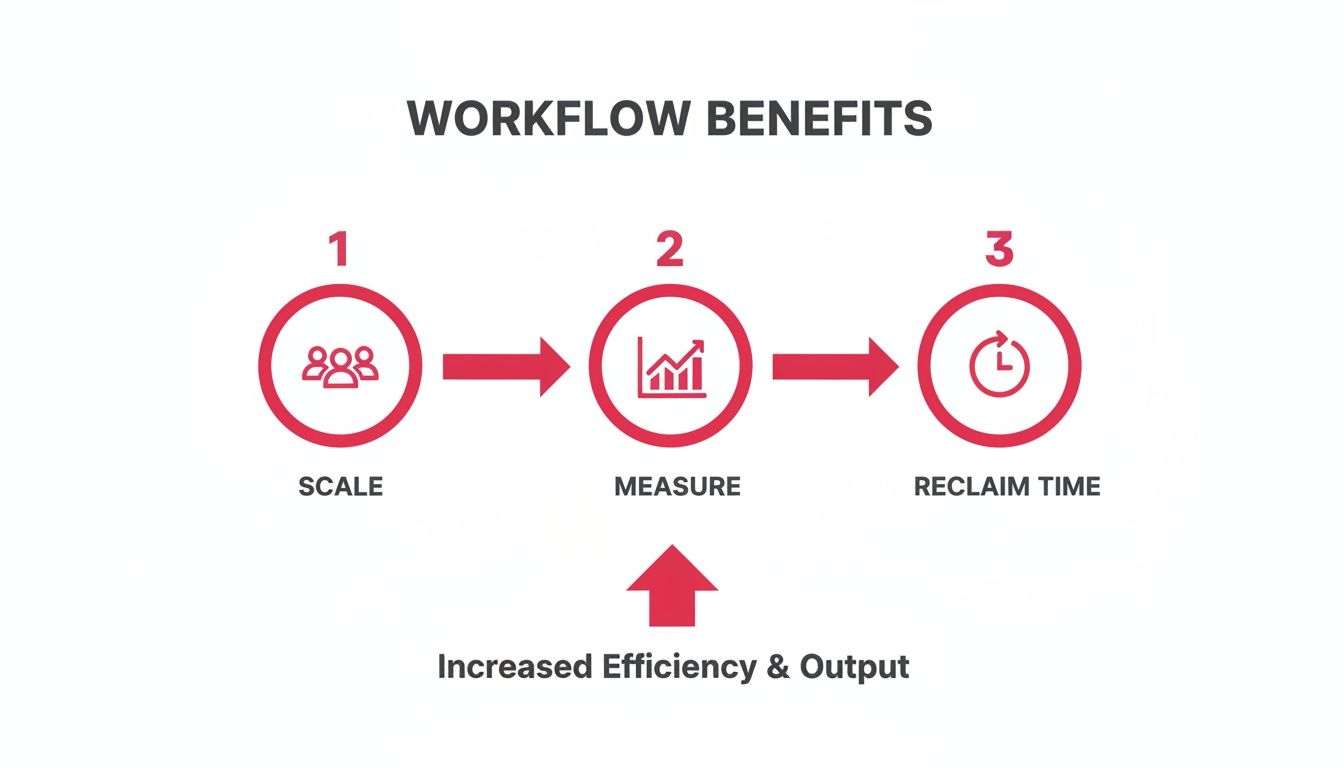
By automating the repetitive stuff at each stage, you create a powerful cycle of efficiency. It frees you up to focus on strategy instead of being buried in admin work.
Stage 3: Campaign Management And Content Collection
Contracts are signed, the campaign is live, and now the real work begins. Manually hunting down every story, post, and video is one of the most soul-crushing parts of influencer marketing. Automation completely eliminates this.
The second a creator posts content using your campaign hashtag or mentions your brand, the platform automatically spots it and pulls it in. All of that user-generated content gets collected into one central, organized dashboard. This gives you a few immediate wins:
- Proof of Performance: You have an instant, complete record of every deliverable. No more chasing creators for links or screenshots.
- Content Library: All approved assets are stored in one place, ready for you to repurpose on your own social channels, ads, or website.
- Real-Time Monitoring: You can see what’s live and how it’s doing at a glance, letting you make quick adjustments if something isn’t working.
This automated collection makes sure nothing falls through the cracks and saves your team countless hours of manual grunt work.
Stage 4: Performance Reporting And ROI Analysis
And now for the most important part: measuring success. Without automation, reporting is a painful chore of mashing together data from different places – social media analytics, affiliate link trackers, sales reports. The final numbers are often incomplete and don't show up until weeks after the campaign is over.
An integrated automation platform fixes this by creating a single source of truth. It connects all the dots for you, tracking key metrics in a live dashboard. You can instantly see things like:
- Earned Media Value (EMV): A dollar figure showing what your influencer content would have cost if you’d paid for it as traditional advertising.
- Conversion Tracking: See exactly which sales, sign-ups, or downloads came from specific influencer links or discount codes.
- Cost Per Acquisition (CPA): A crystal-clear metric showing how much it costs to get a new customer through your influencer campaigns.
This immediate, clear-cut data lets you definitively prove the ROI of your campaigns. You can see which creators are driving the most value and use those insights to make your next campaign even better, ensuring every marketing dollar is spent wisely.
How to Choose the Right Automation Platform
Picking an influencer marketing automation platform is a big deal. You're not just buying another piece of software; you're investing in a partner that will become the command center for your entire creator program.
Getting it wrong leads to clunky workarounds and a budget that vanishes with little to show for it. But the right tool? It feels like adding a new, incredibly efficient member to your team.
The market is flooded with options, and every single one claims to have a game-changing list of features. To cut through that noise, you have to stay focused on what your brand actually needs to succeed. It’s easy to get sidetracked by flashy features, but the real value is in the core functions that will make a tangible difference in your daily grind and your bottom line.
Define Your Core Needs First
Before you even think about booking a demo, take a hard look at your own operations. What works for a massive enterprise with a global footprint will likely be overkill – and way too expensive – for a nimble DTC brand. Your specific needs should be the lens through which you evaluate every option.
Get your team together and ask some tough questions:
- What are our biggest time-wasters right now? Is it the endless hunt for good creators? Maybe it's tracking down content or chasing invoices.
- How critical is direct sales attribution? Do we need a platform that plugs deep into our e-commerce backend, or are we more focused on building brand awareness?
- Honestly, what’s our team's tech-savviness? Be real. Do you need something so intuitive a new intern could use it, or can your team handle a more powerful, complex system?
- What other tools are we already using? The new platform absolutely must play nice with your existing marketing stack, whether it’s your CRM, email provider, or analytics dashboard.
Having clear answers to these questions creates a scorecard you can use to grade every platform you look at.
Key Evaluation Criteria for Any Platform
With your needs clearly defined, you can start digging into the platforms themselves. A few criteria are simply non-negotiable. Think of these as the essential pillars of any solid automation tool. If a platform is weak in any of these areas, it's not a contender.
The best platforms don’t just automate tasks; they provide actionable insights. They should make it easier to understand not just what happened in your campaign, but why it happened and how you can improve next time.
You need to see real strength in four key areas: integration capabilities, the depth of analytics, user experience, and the pricing structure. A weakness in any one of these can cause major headaches later. A platform with brilliant analytics is useless if it can't connect to your Shopify store. A powerful tool is worthless if your team finds it too confusing to actually use.
As you look around, you can also explore a broader list of influencer marketing tools to get a better sense of the feature sets available across the market.
Questions to Ask During a Product Demo
The sales demo is your moment to put the platform through its paces. Don't just sit back and watch the presentation. Come armed with a checklist of specific, tough questions that force them to go beyond their polished sales pitch.
Here are a few you should definitely ask:
- Sales Attribution: "Show me exactly how your platform tracks sales from multiple influencer touchpoints. What happens if a customer clicks one creator's link but checks out with another's discount code?"
- Fraud Detection: "What's your specific process for flagging fake followers or inauthentic engagement? Can you show me what that looks like on a real creator profile right now?"
- Content Rights: "How does the platform handle content usage rights? Can we set up different agreements and permissions for different tiers of creators?"
- Support and Onboarding: "What does your onboarding and customer support process actually look like for a team our size? What's your average response time for support tickets?"
Making a smart, informed decision now will pay off for years to come. It ensures you end up with a partner that doesn't just meet your needs today, but grows right alongside your brand.
Mastering Your Automation Strategy
A powerful tool is only as good as the strategy behind it. Bringing influencer marketing automation into your workflow isn't about flipping a switch and walking away. It’s about being smart and integrating technology to supercharge what your team already does best.
The goal is to build better, more authentic connections with creators and customers, not replace real conversations with robotic ones.
This is what we call the 'human-in-the-loop' philosophy. Let the machines handle the grunt work – the repetitive data entry, the performance tracking, the scheduling. That frees up your team to focus on what actually matters: building genuine relationships, brainstorming creative campaigns, and handling nuanced negotiations. When you get technology and human insight working together, you build a creator program that’s both ruthlessly efficient and genuinely engaging.
Set Clear Goals Before You Start
Before you even think about launching an automated campaign, you need to define what winning looks like. If you don't have clear key performance indicators (KPIs), you're just automating activity for the sake of it, not driving real results. Vague goals like "increase brand awareness" just won't cut it.
You need to set specific, measurable targets that tie directly back to your bigger business objectives.
- For Sales-Focused Campaigns: Maybe you're aiming for a Cost Per Acquisition (CPA) of under $25 or a Return on Ad Spend (ROAS) of 4:1 from your creator discount codes.
- For Audience Growth: A solid goal could be to grow your follower count on a specific platform by 15%, with at least a 3% engagement rate on campaign content.
- For Lead Generation: You could set a target to generate 500 qualified leads through influencer-driven landing page sign-ups within the first quarter.
Having concrete numbers like these from the get-go gives your automation a clear purpose and makes it possible to actually measure its impact.
Personalize Everything, Even at Scale
One of the biggest traps people fall into with automation is letting their communication become generic and impersonal. Creators get dozens of pitches a day, and a robotic, copy-paste email is a one-way ticket to the trash folder. Your automation platform should be a tool for personalizing at scale, not a crutch for being lazy.
Use smart templates that can automatically pull in specific details for each creator. Mention a recent post of theirs you genuinely enjoyed, call out an impressive stat about their audience engagement, or reference a shared interest you noticed on their profile. It’s a small effort that shows you’ve actually done your homework and see them as a person, which can dramatically boost your response rates.
The golden rule of automated outreach is simple: Automate the process, not the personality. The message should always feel like it came from a human who is genuinely excited to collaborate, even if technology helped get it there.
Use Data to Continuously Refine Your Approach
Your automation platform is a data-gathering machine. Don't let that goldmine of information go to waste. The insights it provides are exactly what you need to make your next campaign even better than the last.
Make it a habit to regularly review your performance dashboards to see what’s working and what’s not. Is a certain type of content driving way more conversions? Are creators in a specific niche generating a much higher ROI? Use this data to double down on your wins and quickly pivot away from strategies that are falling flat.
With AI being integrated into these tools, this process is getting even easier. In fact, 66.4% of marketers report getting better results from tools that help with audience analysis and performance prediction. You can dig deeper into these trends and discover how AI is impacting influencer marketing growth.
This constant cycle of launching, measuring, and refining is what turns your influencer program from a set of disconnected campaigns into a powerful, ever-improving growth engine. It’s how you make sure your investment pays off again and again.
Frequently Asked Questions
It's totally normal to have a few questions swirling around as you think about bringing automation into your influencer marketing workflow. Getting these cleared up is the first step toward making a smart, confident decision for your brand. Let's tackle some of the most common concerns we hear from marketers.
Will Automation Replace My Marketing Team?
Absolutely not. This is probably the biggest myth out there, but the reality is the complete opposite. These tools are built to empower your team, not make them redundant.
Think of an automation platform as a super-efficient assistant. It takes on all the repetitive, manual tasks that eat up your team's day – things like tracking down metrics, sending follow-up emails, and organizing content. This frees up your people to focus on what they do best: building genuine relationships with creators, brainstorming killer campaign ideas, and thinking strategically about the bigger picture.
Is This Software Only For Large Enterprises?
That might have been true years ago, but the game has changed. While huge global brands definitely get a ton of value from influencer marketing automation, the market is full of options for businesses of all sizes.
Many platforms now offer flexible, scalable plans specifically designed for small and medium-sized businesses. When you factor in the time saved and the improved campaign results, these tools often pay for themselves surprisingly quickly. It’s not about how big your company is; it’s about how big you want to grow.
The real magic of automation is that it lets a small team punch way above its weight class. It levels the playing field, giving growing brands the power and reach to compete with the big guys.
How Can I Measure The ROI Of Automation?
This is where automation truly shines. The days of fuzzy metrics and guessing games are over. The best platforms come with built-in analytics dashboards that make measuring your return on investment crystal clear.
You'll be able to prove the value of your creator programs – and the software itself – with hard data. You can measure ROI through concrete metrics like:
- Conversion Rates: Easily tracked with unique discount codes and custom affiliate links.
- Website Traffic: See exactly how many visitors are coming from specific influencer posts.
- Earned Media Value (EMV): Put a dollar value on the organic buzz you're generating.
- Direct Sales Attribution: Connect the dots between a creator's post and a customer's purchase.
With these numbers at your fingertips, you can confidently justify your budget and fine-tune your strategy for the best possible results.
Ready to stop the manual grind and start scaling your creator programs with data-driven precision? JoinBrands is the all-in-one platform that connects you with over 250,000 creators and automates your entire workflow, from discovery to ROI reporting. Book a demo today and see how you can amplify your brand's social presence and accelerate sales.