

 Marketing Influencers Instagram: marketing influencers instagram insights
Let's be honest, the old marketing playbook is collecting dust. Banner ads get ignored, TV commercials are skipped, and consumers are tired of being sold to. They want real connections and authentic advice—and they're finding it with the creators they follow on Instagram.
This is why working with Instagram influencers isn't just a trend; it's a fundamental shift in how brands build trust and grow. It’s all about tapping into the power of social proof. People trust people, not logos.
Table of Contents
Why Instagram Influencers Are Your Next Growth Channel

When an influencer shares your product, it’s not just another ad. It’s a personal stamp of approval delivered to a dedicated audience that hangs on their every word. This approach instantly builds credibility and closes the trust gap that many brands struggle with on their own.
The Power of Authentic Storytelling
Think about the last time a friend recommended a restaurant or a new gadget. You probably trusted their opinion way more than a flashy billboard, right? Influencer marketing works on that exact same principle, just scaled up.
Creators are master storytellers. They know how to weave your product into their daily lives so it feels natural and genuinely helpful. This authentic integration sparks real interest and drives purchases because the promotion is framed as a cool discovery, not a hard sales pitch. It’s the difference between being helped and being sold to.
An influencer partnership allows your brand to borrow the trust that a creator has spent years building with their community. This authentic connection is something traditional advertising simply cannot replicate.
Tapping Into a Massive and Engaged Audience
There's a reason Instagram is the go-to platform for these collaborations—the scale is massive. It's the undisputed king of influencer marketing, with over 2.11 billion monthly active users scrolling, liking, and shopping.
A huge chunk of this audience, 44.7%, is in the prime 25-34 age demographic, which is a goldmine for brands targeting millennials who set e-commerce trends. With 68% of marketers globally calling Instagram essential for their influencer strategies, the platform's dominance is undeniable. You can dive deeper into the numbers by checking out the latest state of influencer marketing reports.
And this isn't just for the big-name players; it’s a powerful tool for brands of all sizes.
- Startups can get immediate market validation and create buzz without needing a massive ad budget.
- Established enterprises can tap into new demographics and give their brand image a fresh, modern feel.
- Direct-to-consumer (DTC) brands can drive sales directly and track their return on investment with incredible precision.
By partnering with the right influencers on Instagram, you're not just buying an ad spot—you're gaining access to a pre-built, highly engaged community that's ready to listen.
Choosing the Right Influencer for Your Brand
Picking the right influencers in Instagram is a lot like casting for a movie. You don’t just hire the biggest star; you hire the right actor for the role. It’s less about chasing massive follower counts and more about finding a true strategic partner whose audience, voice, and values perfectly align with your brand.
It's easy to get star-struck by a creator with millions of followers. But if their massive audience doesn't care about your niche product, you're just shouting into the void. On the flip side, a smaller creator with a super-dedicated, passionate community can drive incredible results. This is where understanding the different tiers of influencers is key to making your marketing budget work harder.
Decoding the Influencer Tiers
The influencer world isn't one-size-fits-all. Each tier brings something different to the table, and the best fit really depends on what you want to achieve—whether that's boosting sales, building brand awareness, or just getting killer content for your own feed.
Let's break down the main categories:
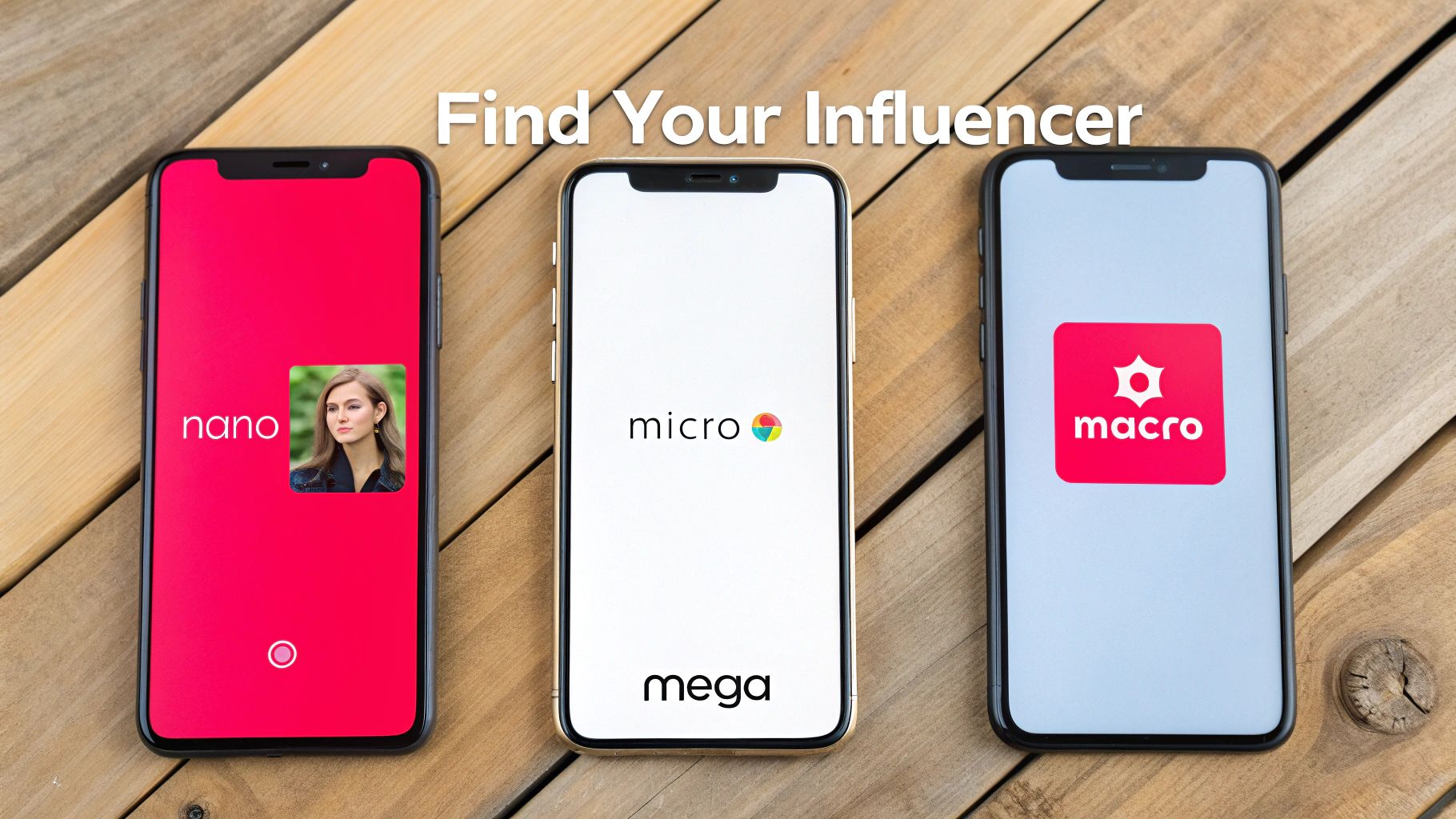
Nano-Influencers (1K – 10K followers): These are your everyday enthusiasts. Their real power comes from a deep, authentic bond with a small but mighty community. A recommendation from them feels like advice from a trusted friend, which is why they often have sky-high engagement and can drive real sales for niche products.
Micro-Influencers (10K – 100K followers): For many brands, this is the sweet spot. Micro-influencers have found a great balance between solid reach and genuine authenticity. They’ve built up real credibility in a specific area—like sustainable fashion or gluten-free baking—and their followers hang on their every word.
Macro-Influencers (100K – 1M followers): These are often professional creators or established personalities who have turned content into a career. Partnering with them gets your brand in front of a lot of eyes, making them perfect for big-splash awareness campaigns or major product launches.
Mega-Influencers (1M+ followers): Think celebrities and digital superstars. Mega-influencers offer massive, almost unmatched reach. They're the go-to for top-of-funnel campaigns designed to make your brand a household name.
The smartest strategies often use a mix of tiers. You could use a few macro-influencers to blast out a message and then activate an army of nano-influencers to drive that message home on a community level. It’s a powerful one-two punch.
Finding Your Niche and Validating Authority
Follower count is just one piece of the puzzle. The most critical factor is niche alignment. You have to find creators whose audience actually cares about what you're selling. If you sell high-performance hiking gear, you should be working with outdoor adventurers, not urban fashion bloggers, no matter how popular they are.
It’s also important to remember that influencers are essentially personal brands. When you're vetting them, you're really looking at the strength of their brand and the trust they've built. Understanding the basics of building a strong personal brand helps you see which creators have done the work to earn real authority.
Here’s what to look for to validate their influence:
- Engaged Comment Section: Are people leaving thoughtful comments and asking real questions? Or is it just a wall of fire emojis? Real conversations are a sign of a healthy, tuned-in community.
- Consistent Content Quality: Look through their feed. Is there a consistent style, voice, and quality? Professionalism and a clear brand identity shine through.
- Audience Demographics: Don't be afraid to ask for a media kit. You need to make sure their audience’s age, location, and interests line up with your target customer. A mismatch here is a total waste of time and money.
Finding the perfect creator can feel like a huge task, but breaking it down makes it manageable. To get started, check out our guide on how to find Instagram influencers for practical tips and tools. It'll help you move from theory to action and find partners who can actually move the needle for your business.
How to Analyze Influencer Performance Metrics
Forget the massive follower count for a second. It's the ultimate vanity metric, and honestly, it can be incredibly misleading. True success with Instagram influencers isn't about how many people could see your content—it’s about how many people actually care. This is where you learn to separate the genuine partners from the ones with hollow numbers, ensuring your budget actually drives business.
Think of an influencer's profile as a storefront. A huge crowd outside means nothing if no one walks in, browses, or buys anything. Your job is to look past the crowd size and measure the real activity happening inside.
Engagement Rate: The Community Health Score
The first and most important metric to check is the engagement rate. This number is the vital sign of an influencer's community, telling you exactly how active and interested their audience really is. A high engagement rate means followers are consistently liking, commenting, sharing, and saving the creator's posts—all signs of a strong, authentic connection.
On the flip side, a rock-bottom engagement rate, especially on a profile with hundreds of thousands of followers, is a massive red flag. It could mean their followers are inactive, uninterested, or worse, just plain fake.
Calculating it is pretty simple:
- Add up the total likes and comments on a recent post.
- Divide that sum by the influencer's total follower count.
- Multiply the result by 100 to get the percentage.
Let's say a creator with 50,000 followers gets 2,500 likes and 200 comments on a post. The math looks like this: (2700 / 50,000) * 100 = 5.4%. That’s a very healthy rate. If you want to skip the manual math, you can use a free engagement rate calculator to quickly vet any profile you're looking at.
A strong engagement rate is your proof that an influencer has earned their audience's attention, not just their follow. It’s the difference between a passive audience and an active community ready to take action.
Beyond Reach: Audience Quality and Authenticity
While engagement is king, you also have to dig into the "who" behind the numbers. Audience quality is all about making sure an influencer’s followers actually match your target customers. A creator can have stellar engagement, but if their audience is mostly in a country you don’t ship to, the partnership is a non-starter.
Ask potential partners for a screenshot of their audience demographics from their Instagram Insights. You need to see:
- Location: The top cities and countries their followers are in.
- Age Range: The primary age brackets that make up their audience.
- Gender: The split between male and female followers.
This data is your gut check for alignment. But don't stop there—look for signs of authenticity. Spend a few minutes scrolling through their comment sections. Are people asking genuine questions and having real conversations, or is it just a wall of fire emojis and "Great post!" from spammy-looking accounts? Real conversation is a powerful sign of a legitimate, tuned-in community.
Tracking What Truly Matters: Sales and Conversions
At the end of the day, you're investing in influencer marketing to grow your business. That means you absolutely have to track the metrics that connect directly to your bottom line. These are the numbers that matter to your finance team and prove the campaign's ROI.
The key is to create a crystal-clear path from the influencer's content straight to your checkout page.
- Unique Discount Codes: Give each influencer a custom code (like "CREATOR15"). This makes it dead simple to track every single sale they drive.
- UTM Parameters: Build custom URLs with UTM tracking for any links they share in their bio or Stories. This lets you see the exact traffic, conversions, and revenue from that specific source right inside your analytics dashboard.
- Affiliate Links: This is a fantastic performance-based model. Set up an affiliate partnership where the influencer earns a commission on sales. It incentivizes them to perform and gives you undeniable sales data.
- Click-Through Rate (CTR) on Stories: For any Story campaign with a "link in bio" prompt or a swipe-up link, keep an eye on the CTR. This shows you how good the influencer is at actually getting their audience to take that next step.
By focusing on these performance-based KPIs, you shift your influencer collaborations from a fuzzy brand awareness play into a predictable, measurable sales channel. This data-driven approach is how you fine-tune your strategy, double down on what works, and prove real value to your business.
Selecting Your Instagram Collaboration Format
Choosing the right influencers in Instagram is only half the battle. Picking the right content format? That’s how you actually win your audience's attention. Think of it like a carpenter showing up to a job—they wouldn't use a sledgehammer to hang a picture frame. The same logic applies here. You need to pick the collaboration format that lines up perfectly with what you're trying to achieve.
A format that’s absolutely brilliant for building brand awareness might completely miss the mark for driving sales, and the other way around. Each one is a unique tool in your kit. An Instagram Feed Post is your glossy magazine ad, perfect for lasting, beautiful brand imagery. A Reel is a punchy TV commercial built to go viral. And an Instagram Story? That's your urgent, direct-response radio ad designed to get someone to act right now. The secret is matching the tool to the job.
Formats for Brand Awareness and Reach
When your main goal is simply getting your brand in front of as many new people as possible, you need formats designed for maximum visibility. These collaborations are all about creating a memorable first impression and building that all-important brand recognition.
Sponsored Feed Posts: This is the classic influencer partnership. A high-quality photo or a carousel of images lives forever on the creator’s feed, giving you fantastic long-term value. It’s perfect for showing off your product in an aspirational, visually stunning way that locks in your brand’s look and feel.
Instagram Reels: As Instagram’s engine for short-form video, Reels are literally engineered for virality. A creative, funny, or educational Reel featuring your product can explode onto the Explore page and reach hundreds of thousands of people who don't even follow the creator. It's an incredibly powerful tool for top-of-funnel awareness.
Giveaways and Contests: Let's be honest, nothing gets people talking like a giveaway. By asking users to follow your brand, like the post, and tag friends to enter, you can kickstart some serious follower growth and expand your reach like crazy. It’s a tried-and-true way to get people genuinely excited about your brand.
Formats for Driving Sales and Conversions
If your goal is more immediate—say, driving traffic for a new product launch or hitting those Q4 sales targets—you need formats that make it dead simple for people to click, shop, and buy. These collaborations are all about creating urgency and removing any and all friction from the checkout process.
This decision tree gives you a quick visual of how to align influencer metrics with your primary goals, whether you're chasing engagement or sales.
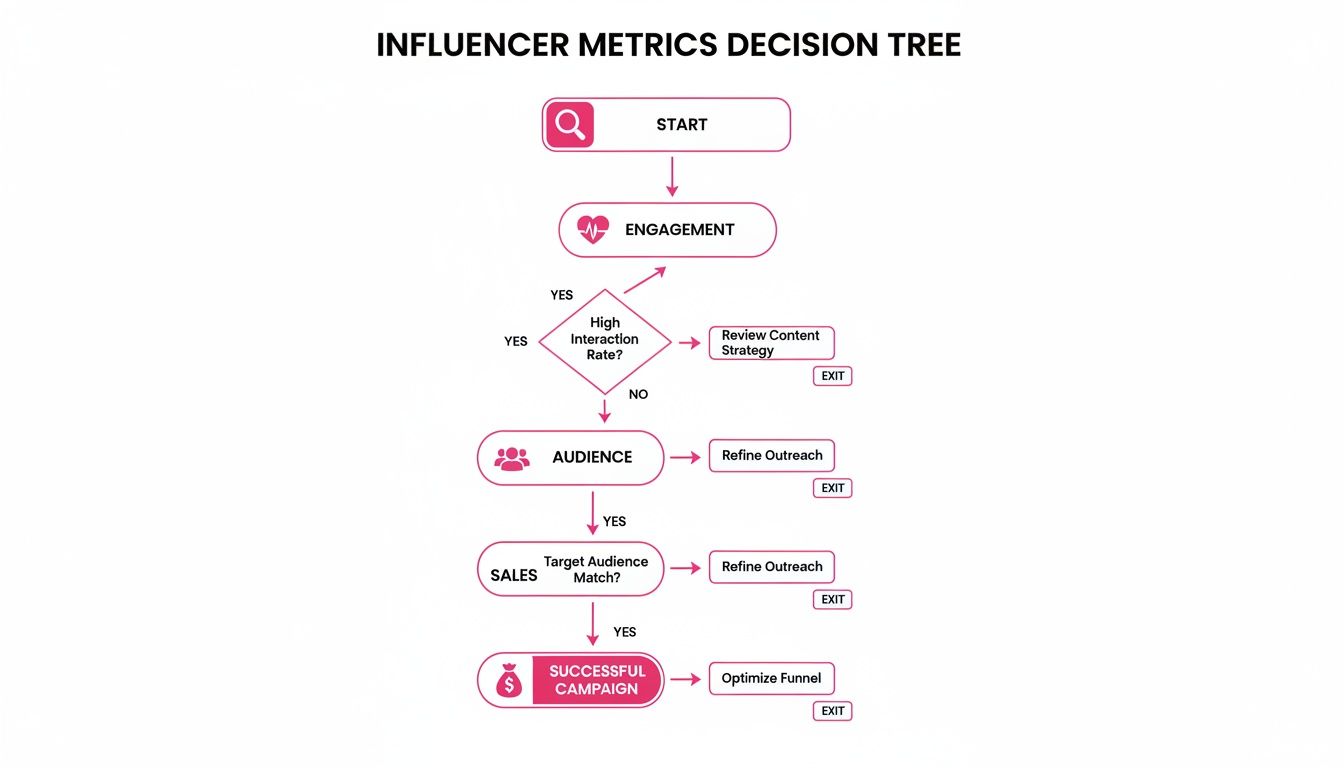
As the chart shows, once you’ve confirmed a creator has solid engagement and the right audience, your next step is picking a format that connects directly to your sales funnel.
Here are the best formats for turning followers into actual customers:
Instagram Stories with Links: The 24-hour lifespan of Stories creates a natural sense of "act now or miss out." When an influencer slaps a direct link sticker on a Story, it becomes an insanely powerful conversion tool, sending highly interested traffic straight to your product page with a single tap. In fact, nearly 40% of users say they become more interested in a brand after seeing it in Stories.
Affiliate Marketing Links: Giving influencers unique, trackable affiliate links to pop in their bio or Stories is a performance-based dream. You only pay a commission when they generate actual sales, making it a low-risk, high-reward strategy that gives you crystal-clear ROI.
A truly great influencer strategy often mixes and matches different formats within the same campaign. For instance, a creator could build excitement with a gorgeous Feed Post one day, then follow up with a series of urgent, link-driven Stories the next to really drive home the sale.
By thinking strategically about your goals from the very beginning, you can select the perfect blend of collaboration formats. This ensures your partnerships with influencers in Instagram aren't just creative exercises, but effective campaigns that deliver real, measurable results for your business.
Comparing Instagram Collaboration Formats
To make it even clearer, let's break down how each format stacks up against common marketing goals. This table should help you quickly identify the best tool for the job.
| Format | Primary Goal | Key Metric to Track | Best For |
|---|---|---|---|
| Sponsored Feed Post | Brand Awareness, Aesthetic | Engagement Rate, Likes, Comments | Building long-term brand image and showcasing product quality. |
| Instagram Reels | Maximum Reach, Virality | Views, Shares, Reach | Reaching new audiences and creating memorable, shareable content. |
| Instagram Stories | Urgency, Direct Traffic | Link Clicks, Swipe-Ups | Flash sales, limited-time offers, and driving immediate website traffic. |
| Giveaways/Contests | Audience Growth, Engagement | Follower Growth, Entry Comments | Rapidly increasing follower count and generating community buzz. |
| Affiliate Links | Direct Sales, Conversions | Sales Revenue, Conversion Rate | Performance-based campaigns where proving direct ROI is critical. |
Ultimately, choosing the right format isn't about what's trendy—it's about what works for your specific objective. A balanced approach that leverages the unique strengths of each format will always outperform a one-size-fits-all strategy.
Building Your First Influencer Campaign
Alright, let's move from theory to action. This is where the real work begins. Kicking off your first campaign with influencers in Instagram can feel like a massive project, but when you break it down, it’s really just a series of well-planned steps. The secret to a killer campaign? A solid foundation of clarity, communication, and mutual respect between you and your creators.
Think of it like building a house. You wouldn’t just start nailing boards together without a blueprint, right? The same logic applies here. You need a rock-solid plan that spells out your goals, expectations, and everyone’s role to make sure the final product is exactly what you imagined.
Defining Crystal-Clear Campaign Goals
Before you even dream of sending a single DM, you have to know what winning looks like. Vague goals like "increase brand awareness" just won't cut it. Your objectives need to be specific, measurable, and directly tied to your business's bottom line.
Get granular. Instead of just wanting "more sales," aim for something concrete like, "a 15% increase in online sales from Instagram traffic in Q3." This simple shift turns a fuzzy wish into a clear target you can build a strategy around and actually measure.
Here are a few examples of strong, measurable goals:
- Generate 500 qualified leads by promoting a free e-book download in Stories.
- Hit an average campaign engagement rate of 4% or higher across all influencer content.
- Drive $10,000 in direct revenue, tracked through unique affiliate links and creator discount codes.
Once you have these clear goals locked in, every other decision—from who you hire to what they post—becomes a whole lot easier.
Crafting the Perfect Creator Brief
Your creator brief is your campaign’s blueprint. It’s the single most important document for telling an influencer everything they need to know to create content that lands perfectly. But here's the trick: a great brief is a delicate balance. It provides firm direction without stomping all over the creator's unique style.
Remember, you're hiring them for their authentic voice and the trust they've built. A brief that's too restrictive will only lead to content that feels stiff and scripted, which completely defeats the purpose.
A well-crafted brief acts as guardrails, not a cage. It guides the creator toward your campaign goals while giving them the freedom to produce the authentic content their audience loves and trusts.
Make sure your brief always includes these key elements:
- Campaign Objectives: A quick, clear summary of what you're trying to accomplish.
- Key Messages: The one or two core ideas you absolutely need the audience to hear.
- Deliverables: The exact number and type of posts required (e.g., 1 Feed Post, 3 Stories).
- Content Do's and Don'ts: Any specific brand guidelines, like words to avoid or features to make sure they highlight.
- Call to Action (CTA): What do you want people to do? ("Shop the link in bio," "Download the app," etc.).
- Disclosure Requirements: A clear instruction to use #ad or Instagram’s "Paid Partnership" tag. It's the law!
Sourcing Creators and Managing Logistics
With your brief ready to go, it’s time to find your partners. You can start by searching relevant hashtags, checking out who your competitors are working with, or using a platform to make the whole process smoother. For your first influencer campaign, you might want to look into tools like the Saucial App to help manage everything in one place.
Once you have a list of potential collaborators, the real vetting begins. Dig deeper than their follower count. Look at their engagement metrics, audience quality, and the kind of work they've done for other brands. Don't be shy about asking for their media kit to get a detailed breakdown of their audience demographics.
After you've made your selections, it's time to make it official. Never, ever work on a verbal agreement. A simple contract is non-negotiable and protects both you and the influencer.
Your agreement should clearly cover:
- Payment Terms: The total compensation and a clear payment schedule.
- Content Usage Rights: How and where you can repurpose the amazing content they create for you.
- Exclusivity Clauses: Whether they're allowed to work with your direct competitors during the campaign.
- Approval Process: A timeline for content review and feedback so everyone stays on the same page.
Finally, handle the logistics like a pro. If you’re sending products (product seeding), make sure they arrive on time and are beautifully packaged. Keep the lines of communication open and respectful throughout the entire campaign. A positive experience can easily turn a one-off project into a long-term brand ambassadorship, which is where the real magic happens.
To see how all these pieces come together in the wild, it's super helpful to check out some real-world influencer marketing campaign examples for a little inspiration.
Measuring Your Campaign Success and ROI
So the content is live. Your job isn't over—far from it. Now comes the moment of truth: proving the value of your investment.
Measuring the success of a campaign isn't about guesswork or vanity metrics. It’s about connecting hard data back to your original goals. This is how you turn creative partnerships into a predictable growth engine for your business, separating the brands that get lucky from those that build scalable, repeatable success.
By tracking the right things, you can justify your budget, show tangible results to stakeholders, and gather the insights you need to make your next campaign even better.
Tracking Direct Revenue and Conversions
The cleanest way to calculate Return on Investment (ROI) is by tracking the direct sales your campaign generated. This is where you connect the dots between an influencer’s content and your checkout page, giving you a crystal-clear picture of what’s actually moving the needle.
Think of it as creating a direct financial trail from a specific creator to a specific sale. A few simple but powerful tools make this happen:
- Unique Discount Codes: Giving each influencer a custom code (like "SARA15") is the easiest way to attribute sales. Every time a customer uses that code, you know exactly who sent them.
- Affiliate Links: Trackable links used in Stories or bios let you see every click and conversion that comes from a specific influencer. This performance-based model is fantastic for proving direct ROI.
- UTM Parameters: Building custom URLs for your campaign links allows you to see detailed traffic and conversion data right inside Google Analytics, showing you precisely how much revenue each creator drove.
With this data, calculating a basic ROI is simple math. If you spent $1,000 on a collaboration and it generated $5,000 in sales, your return is a whopping 400%. That hard number is pure gold when it's time to prove your campaign’s value.
Measuring Indirect Value and Brand Impact
Not all value shows up immediately at the checkout. Many campaigns are designed to build brand equity, which pays off big time over the long haul. While these metrics are less direct, they're crucial for understanding the full impact of your efforts.
Tracking direct sales tells you what happened today. Measuring brand impact tells you how your campaign is building a stronger, more recognizable brand for tomorrow.
Keep an eye on these key indicators of indirect value:
- Earned Media Value (EMV): This metric puts a dollar figure on your campaign’s organic buzz. It estimates what you would have paid for the same reach and engagement through traditional advertising, quantifying all the "free" exposure your brand gets from shares, mentions, and conversations.
- Follower Growth: Did your brand’s Instagram account see a noticeable jump in followers during the campaign? A significant increase is a strong sign that the influencer's audience was genuinely interested and wanted to connect with you directly.
- Brand Sentiment: Dive into the comments and DMs. Are people saying great things about your brand? A clear shift from neutral or unknown to overwhelmingly positive sentiment is a massive win for your brand’s reputation.
When you combine direct sales data with these powerful brand-building metrics, you get the complete story of your campaign's performance. This holistic approach lets you show off both immediate financial returns and the long-term strategic value that working with influencers in Instagram brings to your business.
Common Questions About Instagram Influencers
Diving into the world of Instagram influencers always kicks up a few questions, especially around the tricky subjects of budget, discovery, and the all-important legal rules. Getting these sorted out from the get-go means you can build a campaign with confidence, knowing it’s both effective and playing by the book. Let's get into the most common ones.
How Much Do Instagram Influencers Actually Cost?
This is the million-dollar question, isn't it? The honest answer is: it completely depends. There’s no universal price list. An influencer's cost is a mix of their audience size, how engaged that audience is, and what you’re actually asking them to do.
A good rule of thumb looks something like this:
- Nano-influencers (1k-10k followers) are often happy to work in exchange for free products, though some might charge around $25-$150 per post.
- Micro-influencers (10k-100k followers) typically fall in the $150-$1,500 range.
- Macro and Mega creators are in a different league, often commanding thousands of dollars for a single Reel or post.
But here’s a pro tip: try to shift your thinking from "cost" to "potential ROI." The right partner, even if they seem a bit more expensive upfront, can deliver value that blows your initial investment out of the water if their audience genuinely converts.
How Do I Find Authentic Influencers for My Niche?
This is where the real detective work begins. A great starting point is to simply search hashtags that your ideal customers are using. See who’s creating standout content and getting real, authentic conversations going in the comments. Another classic move is to check out who your competitors are working with and who your target audience is already following and trusting.
If you want to skip hours of manual scrolling, influencer marketing platforms are a game-changer. These tools have powerful search filters that let you pinpoint vetted creators by their niche, engagement stats, and even the specific demographics of their followers. It’s a much more direct route to finding the right fit.
What Are the Rules for Disclosing Paid Posts?
This one is non-negotiable. Being upfront and transparent isn't just good ethics; it's the law.
In the US, the Federal Trade Commission (FTC) has clear guidelines: influencers must disclose when their content is sponsored. No exceptions.
This is usually done by placing a clear hashtag like #ad or #sponsored right at the beginning of the caption—not buried at the end. An even better practice is to use Instagram's own "Paid Partnership" label, which adds a clear heading to the post. Always, always make sure these disclosure requirements are spelled out in your contract to keep everyone protected.
Ready to stop searching and start collaborating? JoinBrands gives you everything you need to find authentic creators, manage your campaigns smoothly, and track your results, all in one spot. Explore our network of over 250,000 creators today!