
 Unlocking Influence The Guide to Influencer AI
Instagram influencer marketing is all about brands and creators teaming up to build real trust with engaged audiences. Forget generic billboard ads; think of it as a recommendation from a friend whose taste you actually respect. This isn't about simple shoutouts anymore. It's about building genuine relationships that drive awareness, engagement, and—most importantly—sales.
Table of Contents
What Is Instagram Influencers Marketing
At its heart, Instagram influencer marketing is a collaboration. A brand works with a creator who has spent time building a dedicated community around a specific niche, whether that's sustainable fashion, homebrewing, or vintage video games. Instead of just blasting a corporate message out into the void, brands get to tap into an influencer’s credibility and unique voice. It’s a powerful, modern form of social proof.
This whole approach lives and dies by authenticity. When an influencer recommends a product they genuinely use and love, their followers see it as a trusted endorsement, not just another ad. That personal connection is exactly why so many direct-to-consumer (DTC) and e-commerce brands have made it a cornerstone of their growth strategy. It’s not just about getting your product seen; it's about getting it seen by the right people, from a source they already trust.
The Power of Platform and People
The choice of platform is no accident. Instagram is the undisputed king of influencer marketing, pulling in the lion's share of brand investments. A staggering 79% of marketers pick Instagram for their campaigns, and 68% of specialists consider it absolutely essential.
This dominance makes sense when you look at the numbers. With over 2.11 billion monthly active users—a huge chunk of whom are in the prime 25-34 age demographic—the platform is teeming with consumers hungry for authentic recommendations. To really get a handle on this dynamic, it helps to see things from the creator's side and learn how to thrive as an influencer in the digital age.
To put it simply, the benefits are directly tied to real-world business goals. Here’s a quick rundown of what brands get out of these partnerships.
Core Benefits of Instagram Influencer Marketing at a Glance
This table breaks down the main advantages for brands that invest in Instagram creator collaborations, showing how each benefit leads to a tangible business outcome.
| Benefit | Description | Key Business Outcome |
|---|---|---|
| Authentic Trust | Creators have already earned their followers' confidence, giving your brand an instant credibility boost. | Increased Brand Loyalty and Positive Sentiment |
| Niche Audience Reach | You can connect with highly specific communities, like vegan chefs or minimalist home organizers, ensuring your message is always relevant. | Higher Conversion Rates and Lower CPA |
| High-Quality Content | Influencers are expert content creators, providing you with a library of authentic assets for your own marketing channels. | Reduced Content Production Costs |
| Measurable Sales Growth | Through affiliate links, discount codes, and direct endorsements, campaigns can lead directly to trackable conversions and revenue. | Increased Sales and Demonstrable ROI |
Ultimately, working with Instagram creators moves your marketing from being a disruptive interruption to a welcome recommendation.
In essence, Instagram influencers marketing transforms advertising from a disruptive interruption into a valuable recommendation, fostering genuine connections that build lasting brand loyalty and drive meaningful growth.
How to Choose the Right Influencer for Your Brand

Picking the right partner for your instagram influencers marketing campaign is so much more than a numbers game. It's easy to get distracted by big follower counts, but the real magic happens when a creator's audience and content style click perfectly with what you’re trying to achieve. The creator with a million followers might sound like a dream, but they could be a terrible fit for a niche brand that needs to drive actual sales.
Think of it like choosing the right tool. You wouldn't bring a sledgehammer to hang a picture frame, right? In the same way, the "best" influencer is completely relative to your goal. Are you looking to get your name out there in a massive way, or do you need authentic content that convinces people to click "buy now"? Each objective points to a totally different type of creator.
This is the classic "horses for courses" strategy, and it’s the secret to getting a real return on your investment. Before you can pick the right person, you have to understand the different tiers of influencers and what each one brings to the table. This is ground zero for building a smart partnership that will actually move the needle for your business.
Decoding the Influencer Tiers
Influencers are usually bucketed into four main tiers based on their audience size. Each tier offers a unique set of pros and cons, from the tight-knit, high-trust communities of Nano-influencers to the celebrity-level broadcast power of Mega-influencers.
- Nano-Influencers (1,000 – 10,000 Followers): These are your everyday people with a strong, often local or super-niche following. Their superpower is authenticity and the deep trust they've built with their small community.
- Micro-Influencers (10,000 – 100,000 Followers): Often seen as the sweet spot for many brands, Micro-influencers are genuine experts in their niche. They deliver a great balance of respectable reach and incredibly high engagement, frequently outperforming much larger accounts.
- Macro-Influencers (100,000 – 1 Million Followers): These are your established, often professional creators—think seasoned bloggers, vloggers, or well-known social media personalities. They’re fantastic for scaling up a campaign and reaching a much larger audience.
- Mega-Influencers (1 Million+ Followers): We're talking celebrities, athletes, and major public figures here. Mega-influencers deliver massive, TV-ad-level awareness. They’re best used for huge campaigns where broad visibility is the only thing that matters.
The smartest Instagram influencers marketing strategies rarely stick to just one tier. The real wins come from mixing it up—maybe using a Macro-influencer for broad reach while deploying an army of Micro-influencers to build trust and drive conversions.
Matching Influencer Type to Campaign Goal
Okay, let's connect the dots between these tiers and what you actually want to accomplish. Your campaign goal should be the North Star guiding your entire selection process.
If your main objective is driving direct sales or generating a ton of high-quality User-Generated Content (UGC), then Nano and Micro-influencers are your secret weapons. It's a well-known fact in this space: as follower counts go up, engagement rates tend to go down. Micro-influencers have fiercely loyal communities that hang on their every word. Our guide on how to find Instagram influencers can show you exactly how to locate these performance-driving partners.
To their followers, these creators feel more like a trusted friend than a billboard. That authenticity is gold for any campaign focused on click-throughs, conversions, or building a library of real customer content.
On the flip side, if your goal is massive brand awareness or launching a new product to the masses, then Macro and Mega-influencers are your go-to. Their value is in their astronomical reach. A single post can put your brand in front of millions of eyeballs instantly, creating a wave of buzz that smaller creators just can't match.
By understanding this fundamental trade-off between broad reach and deep resonance, you can build a much smarter instagram influencers marketing strategy that delivers exactly the results you’re looking for.
Crafting Your Winning Campaign Strategy
Once you've found the right influencer, it’s time to pick your play. A winning Instagram campaign isn't about crossing your fingers and hoping for the best. It’s about choosing a specific, goal-oriented strategy that lines up perfectly with what you’re trying to achieve. Think of it as a playbook where every option is designed for a different outcome, whether that's building rock-solid trust, going viral, or ringing the cash register.
Choosing the right strategy means you're not just borrowing an audience; you're shaping a story that actually connects. The best campaigns never feel like ads. They feel like a natural part of the creator's world, adding real value to their community while hitting all your key metrics. Let's break down four powerful strategies that brands are using to crush it on Instagram right now.
Drive Authenticity with User-Generated Content Campaigns
User-Generated Content (UGC) is today’s word-of-mouth, and it’s one of the most powerful tools you have. A UGC campaign is all about encouraging influencers and their followers to create and share content that features your product. This simple move transforms passive followers into active participants in your brand's story.
The main goal here is to build a massive library of authentic social proof. When potential customers see real people—not just polished models—using and loving your product, it builds an incredible amount of trust. Plus, these assets are super versatile. You can repurpose them on your website, in ad creative, and across other social channels, which drastically cuts down your content creation costs.
A strong UGC campaign does more than just sell a product; it builds a community. It creates a sense of belonging and turns customers into genuine brand advocates who are emotionally invested in your success.
Go Viral with Instagram Reels Collaborations
Short-form video is dominating social media for one simple reason: it's incredibly engaging, highly shareable, and a favorite of the Instagram algorithm. A Reels-focused collaboration is your ticket to explosive organic reach. This strategy involves partnering with creators to produce short, entertaining, or educational videos that showcase your product in a dynamic way.
Video formats are proven to boost an influencer's impact. In fact, brands see 85% higher engagement through short-form video, and a whopping 82% of influencers are now shifting their focus to formats like Reels. This trend alone should make video campaigns a top priority if you're trying to maximize visibility.
The key is to give creators the freedom to weave your product into their unique style, whether that’s through a trending dance, a quick how-to, or a funny skit. A great Reel feels native to the platform and can go viral in a flash, exposing your brand to millions of potential customers way beyond the influencer's immediate following.
Amplify Reach with Boosted Influencer Posts
What if you could take a top-performing organic post from a creator you trust and put some ad dollars behind it? That's the magic of boosting influencer posts, often done through Instagram's Branded Content Ads. This hybrid strategy blends the authenticity of influencer content with the laser-focused targeting of paid ads.
You start by finding a creator's post that's already getting great organic engagement. Then, instead of creating a traditional ad from scratch, you amplify that exact post to a new, highly targeted audience. This works so well because the content comes from a trusted voice, making it feel way less like a disruptive ad. It allows you to scale content that’s already proven to work and drive traffic or sales with creative that has been validated by an engaged community. As you map out your partnerships, think about all the angles, including social media and blog collaborations which can also be amplified.
Tie Investment to Revenue with Affiliate Marketing
For brands that are laser-focused on ROI, an affiliate marketing strategy is the ultimate performance-based play. In this setup, you give influencers unique, trackable links or discount codes to share with their audience. Instead of a flat fee, you pay them a commission for every sale or lead they drive.
This model creates a direct line between your marketing spend and actual revenue, making it a low-risk, high-reward approach. It’s especially effective with micro-influencers whose followers deeply trust their recommendations. By offering a solid commission, you motivate creators to actively promote your products long-term, essentially turning them into a dedicated, performance-driven sales team. This strategy ensures every dollar you spend on your instagram influencers marketing is directly tied to your bottom line.
Your Step-by-Step Campaign Management Workflow
Running a successful Instagram influencer campaign isn’t about some stroke of creative genius. It's about having a disciplined, repeatable process. Think of it like a project plan where each stage builds on the last, making sure no detail gets missed. This kind of structure is what prevents miscommunication, keeps everything on schedule, and actually delivers the results you’re after.
Following a clear workflow turns what could be a chaotic mess into a manageable series of checkpoints. From setting clear expectations at the start to measuring performance at the end, this five-step framework is your roadmap to a flawless campaign.
Step 1: Writing a Comprehensive Brief
The creative brief is the single most important document in your entire campaign. It’s the blueprint that ensures you and the creator are marching toward the same goal. A vague brief gets you generic, forgettable content, but a detailed one gives influencers the clarity they need to create something that’s both on-brand and authentic to their audience.
Your brief needs to clearly outline these key pieces:
- Campaign Objectives: What are we trying to achieve here? Drive traffic to a landing page? Get tons of user-generated content? Boost brand awareness?
- Key Talking Points: What are the non-negotiable messages about the product that must be included?
- Content Deliverables: Be specific. How many posts and in what format? (e.g., two Reels, one Story series with three frames, one static post).
- "Do's and Don'ts": This is where you set the guardrails. Mention any specific phrases to avoid, brand colors to feature, or competitor names to steer clear of.
A great brief doesn't stifle creativity; it channels it. By providing clear direction on the "what" and "why," you give creators the freedom to excel at the "how." The result is content that feels both genuine and strategically sound.
Step 2: Creator Discovery and Vetting
With your brief ready to go, it’s time to find the right partners. This part goes way beyond just glancing at follower counts. Real vetting means doing a deep dive into an influencer's content, their audience demographics, and past performance to make sure they’re a perfect match for your brand and goals.
During this stage, you’re also on the lookout for red flags. Check for telltale signs of fake followers, low-quality engagement (like a sea of generic "Nice pic!" comments), or a history of controversial posts. A thorough vetting process protects your brand’s reputation and makes sure your investment goes toward creators with real influence and a genuinely engaged community.
Step 3: Contracting and Negotiation
Once you’ve found your ideal creators, it’s time to make the partnership official. A clear, legally sound contract is completely non-negotiable. This document protects both you and the influencer, and it wipes out any confusion about deliverables, timelines, and payment.
A solid contract should always cover these key areas:
- Compensation: Lay out the payment amount, how it’s structured (flat fee, commission-based), and the payment schedule.
- Content Usage Rights: Be crystal clear about how and where you can repurpose the creator’s content. Can you use it in your paid ads? On your website? And for how long?
- Exclusivity Clause: Define whether the creator is blocked from working with your direct competitors for a certain period.
- FTC Disclosure Requirements: Mandate that all sponsored content is clearly and correctly labeled using hashtags like #ad or #sponsored, as required by law.
The flow of a campaign, from initial user-generated content to amplified posts, is a common strategy you'd want to cover in your agreement.
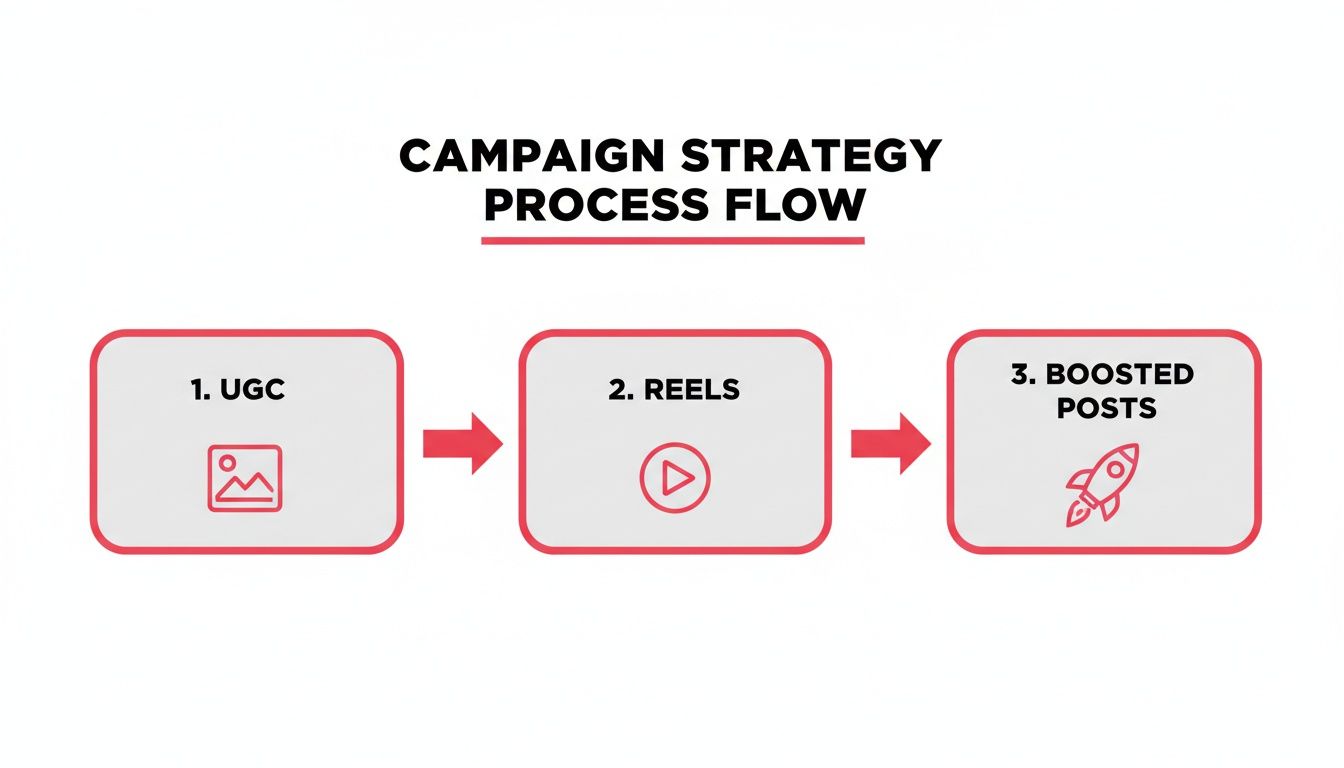
This visual shows that natural progression from organic content creation to paid amplification—a proven path for getting the most mileage out of an influencer’s work.
Step 4: Content Review and Approval
Setting up a smooth content approval process is crucial for maintaining your brand standards without micromanaging your creators into oblivion. This workflow gives you a chance to provide feedback on drafts before they go live, ensuring the final posts are polished, on-message, and ready for primetime.
The trick is to be collaborative, not controlling. Offer constructive feedback that respects the creator’s unique style while gently nudging the content toward your campaign goals. Platforms like JoinBrands make this way easier by giving you a central dashboard to review drafts, leave comments, and give the final thumbs-up all in one spot.
Step 5: Performance Measurement
The final step is all about closing the loop with data. As soon as the campaign is live, you have to start tracking its performance against the KPIs you set back in the brief. This isn't just about vanity metrics like counting likes; it’s about understanding the real business impact of your instagram influencers marketing efforts.
Track the numbers that matter to your core objectives—whether that’s reach for awareness, engagement rate for community building, or click-throughs and conversions for sales. Digging into this data shows you what worked, what flopped, and gives you incredibly valuable insights to make your next campaign even better. This data-driven approach turns every campaign into a learning opportunity.
How to Measure Your Campaign Success and ROI
Launching an influencer campaign without a solid measurement plan is like driving blind. You're putting in the time and spending the budget, but you have no real way of knowing if you're actually heading in the right direction. To really understand if your strategy is working, you need to look past simple vanity metrics like 'likes' and zero in on the Key Performance Indicators (KPIs) that prove tangible business value.
This is where you answer the big question from your boss or stakeholders: "Was it worth it?" By tracking the right data, you can definitively show the impact of your campaigns, justify your budget, and make smarter, data-backed decisions for the next collaboration. The trick is to tie your KPIs directly to the goals you set at the very beginning.
Tying Metrics to Your Core Objectives
Not all metrics are created equal, and the ones that matter most will change depending on what you're trying to accomplish. A campaign built to generate widespread buzz is going to be measured very differently from one designed to drive direct sales.
Let's break down the most important KPIs based on three common campaign goals.
1. Building Brand Awareness
If your primary goal is to get your brand in front of new eyeballs or announce a new product, your focus should be on reach and visibility.
- Reach: This is the total number of unique users who saw the influencer’s content. It tells you exactly how big of an audience your message was exposed to.
- Impressions: This is the total number of times the content was displayed, whether it was clicked on or not. A high impression count means your content is popping up frequently in people's feeds.
2. Driving Audience Engagement
When you want to build a real community and foster a deeper connection with your audience, engagement metrics are your north star. These show that people aren't just seeing your content—they're interacting with it.
- Engagement Rate: This is the holy grail. It’s calculated as (Likes + Comments + Saves + Shares) / Followers x 100. A high rate is a dead giveaway that the content truly resonated with the creator's audience.
- Comments and Saves: These are high-intent actions. Comments signal an active conversation, while saves indicate that people found the content so valuable they wanted to come back to it later.
3. Generating Conversions and Sales
For performance-focused campaigns, the only thing that really matters is the bottom line. These KPIs directly measure the financial impact of your efforts.
- Click-Through Rate (CTR): This measures the percentage of people who clicked the link in a post or story. It’s a strong indicator of how well the influencer's call-to-action landed.
- Conversion Rate: This tracks the percentage of users who completed a desired action after clicking, like making a purchase or signing up for your newsletter.
- Return on Ad Spend (ROAS): This is the ultimate proof of ROI. It's calculated by dividing the revenue generated by the campaign by the total cost.
Budgeting and Proving Your Return
Figuring out how to allocate your budget and prove it was money well spent is fundamental. At the end of the day, the financial proof of your campaign's success is often the most compelling data you can present.
Brands score a jaw-dropping $4.12-$4.21 return for every $1 invested in Instagram influencer campaigns. This means a single $500 micro-influencer post could potentially yield over $2,100 in revenue, showcasing the powerful ROI when campaigns are executed effectively. Discover more about these impressive influencer marketing statistics on dash.app.
Pricing models in this space vary, but they generally fall into three buckets: a flat fee per post, a commission-based (affiliate) structure, or product seeding (gifting). Your choice should align with your budget and what you hope to achieve.
For brands that are laser-focused on the bottom line, tracking your return is everything. To learn more about this, check out our detailed guide on how to calculate influencer marketing ROI. By using unique discount codes and UTM-tagged links, you can precisely attribute sales to specific influencers and demonstrate a clear, positive return on every dollar spent.
Essential Tools to Scale Your Influencer Marketing
Let's be honest: trying to manage an Instagram influencer marketing campaign with spreadsheets and email chains is a recipe for absolute chaos. Sure, it might work when you're juggling one or two collaborations. But the second you try to scale, that manual approach completely falls apart.
You end up drowning in administrative tasks, wasting countless hours that should be spent on strategy.
The answer is a dedicated creator marketing platform. Think of it as your mission control, a central command center for your entire influencer program. These tools are specifically designed to automate the most grueling parts of the workflow, freeing you up to focus on what actually matters: building great relationships and analyzing results. They aren't just a nice-to-have; they're a must-have for any brand serious about growth.
The Power of an All-in-One Platform
An all-in-one platform handles everything, from the first spark of finding a creator to the final campaign report and payment. Instead of hopping between a dozen different apps and spreadsheets, you get one single source of truth for all your creator partnerships.
This unified approach is a game-changer. It delivers massive value by:
- Saving Hundreds of Hours: It puts tedious tasks like creator discovery, outreach, product shipping, and content approval on autopilot, slashing your manual workload.
- Reducing Administrative Overhead: With centralized communication and contract management, you can say goodbye to messy email threads and forgotten details.
- Providing Actionable Data: Integrated analytics give you real-time performance data. You'll know exactly what's working so you can make smarter decisions and prove your campaign's impact.
The real power of a creator marketing platform is that it transforms your influencer program from a series of disjointed tasks into a streamlined, scalable, and measurable marketing channel. It's the difference between guessing and knowing.
Key Features to Look For
When you're looking at different platforms, zero in on the features that will solve your biggest operational headaches. A great tool should feel like a co-pilot, making even the most complex processes feel simple. For a deeper look at the best options out there, our list of top influencer marketing tools is the perfect place to start.
Here are the core functions you should look for:
- Creator Discovery and AI Matching: You need to be able to instantly find relevant influencers using advanced filters for audience demographics, engagement rates, and content style. The best platforms use AI-powered matching to suggest the perfect creators for your specific campaign goals.
- Campaign Management Dashboards: A visual dashboard that tracks every deliverable, deadline, and conversation in one place is non-negotiable. This ensures nothing ever falls through the cracks.
- Automated Product Shipping: If you send out products, this is a must. Integrating your logistics allows you to seamlessly ship products to hundreds of creators without touching a spreadsheet.
- Performance Analytics: Your platform should provide detailed reports on reach, engagement, conversions, and ROI. This is how you measure success and optimize future campaigns to get even better results.
Instagram Influencer Marketing FAQs
Diving into influencer marketing can feel like learning a new language, especially when you get down to the nitty-gritty details. Let's walk through some of the most common questions brands have when they're just getting started.
First up, the big one: how do you actually pay creators? This isn't a one-size-fits-all situation. Rates can swing wildly depending on a creator's audience size, how engaged their followers are, and what you’re asking them to create. The most common models are a simple flat fee per post or video, a commission-based affiliate partnership, or gifting products (often called product seeding), which is a great way to start with smaller creators.
Clarifying Content Usage Rights
Another huge question that often trips people up is about content ownership. Who owns the photos and videos, and what can you do with them after the campaign is over? You have to nail this down in your contract.
Here's the golden rule for content rights: unless you explicitly negotiate for full ownership or specific usage rights in writing, you can't just take a creator's content and run it in your own ads or plaster it on your website.
Make sure your agreement is crystal clear on these three points:
- Where can you use it? Spell out the exact channels, like your website, paid social ads, or email newsletters.
- How long can you use it? Set a clear timeline, like for six months or one year.
- Can you edit it? State whether you have permission to crop, resize, or alter the content for different formats.
Understanding FTC Disclosure Guidelines
Finally, brands always want to know about the legal side, especially when it comes to FTC guidelines. The rules are actually pretty straightforward: the relationship between a brand and an influencer has to be disclosed clearly and conspicuously.
This means you can't beat around the bush. Sponsored posts must be obviously labeled as ads. Influencers should use unambiguous tags like #ad or #sponsored, or use Instagram’s built-in "Paid partnership" label. Hiding these disclosures "below the fold" where someone has to tap "more" to see them is a major no-no and won't keep you compliant.
Ready to streamline your entire campaign workflow? JoinBrands connects you with over 250,000 creators and provides the tools to manage everything from discovery to payment in one place. Find your perfect partners and scale your influencer marketing at https://joinbrands.com.