
 YouTube Shorts Monetization Requirements Unlocked
Here's the simple truth about key opinion leader marketing: it's about partnering with genuine subject matter experts to build authentic brand trust. Think of a renowned dermatologist recommending a skincare product; their authority comes from years of experience and credentials, not just a large social media following. This strategy uses pure credibility to influence buying decisions in a way traditional advertising simply can’t.
Table of Contents
What Is Key Opinion Leader Marketing Anyway

Let’s cut through the buzzwords. Key Opinion Leader (KOL) marketing is when a brand strategically teams up with an individual who has serious authority, expertise, and respect in a specific field. These people aren't just popular; they're professionals whose opinions actually shape industry trends and guide what consumers buy.
Unlike broad-reach influencers who often build an audience around lifestyle content, KOLs earn their following based on professional achievements and deep, specialized knowledge. Their power comes from proven expertise, which makes their recommendations feel more like trusted advice from a mentor than a paid ad.
The Foundation of Trust and Authority
At its core, KOL marketing runs on a simple principle: transferred trust. When a respected expert gives your product a thumbs-up, their credibility essentially rubs off on your brand. This is an incredibly potent tool in a world where most of us have become skeptical of slick, traditional advertising.
A recommendation from a trusted expert is often the final push a consumer needs to make a purchase. Their endorsement cuts through the noise of conventional marketing by providing an authoritative, third-party validation that resonates deeply with discerning audiences.
This approach is a game-changer, especially for brands in complex or highly specialized industries. For example, a tech company might partner with a respected software engineer, a supplement brand with a certified nutritionist, or a financial services firm with a veteran investment analyst.
Why KOL Marketing Is Gaining Momentum
The pivot toward expert-led marketing isn't just a fleeting trend—it’s a direct response to how we, as consumers, have changed. People are tired of impersonal ad campaigns and crave authenticity. We're actively seeking out real guidance from people who truly know what they’re talking about.
The numbers don't lie. The global key opinion leader marketing market is set to explode from USD 73.25 billion in 2025 to a staggering USD 187.94 billion by 2034, growing at a compound annual rate of 12.5%. This rapid expansion shows just how vital expert-driven strategies have become for modern brands.
This growth is being fueled by a few key things:
- Enhanced Credibility: KOLs give a brand immediate authority, something that's incredibly difficult and expensive to build through other channels.
- Targeted Reach: Their followers are a built-in community of people genuinely interested in that specific niche, making sure your message lands with a highly relevant audience.
- High-Impact Content: Content created with a KOL is usually educational and provides real value, which naturally leads to higher engagement and a much longer-lasting impact.
- Authentic Storytelling: An expert can break down a product's benefits in a nuanced, believable way that connects with consumers on a much deeper level.
In short, KOL marketing stops just showing a product and starts explaining why it matters, all from a perspective the audience already trusts. This deep, authentic connection is the very foundation of effective social influence marketing, where genuine authority is what truly drives results.
KOLs vs. Influencers: What Marketers Need to Know
It’s one of the most common mix-ups in marketing today: using "Key Opinion Leader" and "influencer" as if they mean the same thing. While both are powerful allies for any brand, confusing them can sink your campaigns before they even start, leading to mismatched partnerships and disappointing results.
Getting this fundamental distinction right is the key to unlocking the real power of your partnerships. The core difference isn't about follower count—it's about the source of their authority. One builds their audience through personality and being relatable, while the other commands respect through professional credibility and years of proven expertise.
The Expert vs. The Entertainer
A Key Opinion Leader's (KOL) influence comes directly from their professional life. They are respected experts in a specific field—think doctors, scientists, financial analysts, or seasoned industry veterans. People follow them for their deep knowledge and trustworthy insights, not just their lifestyle.
An influencer, on the other hand, usually builds their following with captivating content, a magnetic personality, and a relatable online persona. Their power comes from forging a strong, almost personal, connection with their followers. You can take a deeper dive into this dynamic in our detailed guide on what an influencer is and how they operate. While a KOL can absolutely become an influencer, their authority is always built on a foundation of professional standing.
Where Their Power Comes From
Think of it this way: an influencer is like that popular friend whose recommendations you trust because you genuinely like them and can relate to their life. A KOL is more like a trusted professor or doctor—you follow their advice because you respect their extensive qualifications and years of dedicated experience.
The trust an audience places in a KOL is rooted in their professional credentials and achievements. This creates a powerful form of validation that is difficult for brands to replicate, making their endorsements feel less like advertisements and more like expert consultations.
This difference has a huge impact on how their content lands with an audience. An influencer’s post about a new snack might drive sales through pure enthusiasm and beautiful visuals. But when a nutritionist (a KOL) explains the health benefits of that exact same snack, it adds a layer of credibility that builds long-term brand trust and actually educates the consumer.
To make this crystal clear, let's break down the strategic differences between KOLs and traditional influencers. This table highlights their unique strengths, helping you decide who to partner with based on your specific marketing goals.
KOL vs. Influencer: A Strategic Comparison
| Attribute | Key Opinion Leader (KOL) | Influencer |
|---|---|---|
| Source of Authority | Professional expertise, credentials, and reputation in a specific field. | Relatability, personality, and content creation skills. |
| Primary Goal | To educate, inform, and share expert insights with their audience. | To entertain, engage, and build a strong community connection. |
| Content Style | Often educational, technical, and based on factual evidence or experience. | Primarily focused on lifestyle, entertainment, and personal storytelling. |
| Audience Trust | Based on respect for their professional knowledge and achievements. | Based on a personal connection, authenticity, and shared interests. |
| Best For | Building brand credibility, validating product claims, and reaching niche audiences. | Driving broad awareness, generating social proof, and boosting sales. |
As the table shows, their value propositions are distinct. One offers deep-seated authority and credibility, while the other excels at creating broad appeal and immediate connection.
Choosing the Right Partner for Your Goals
So, who do you choose? It all comes down to what you want to achieve. If your goal is to quickly boost brand awareness and generate a ton of buzz around a new product launch, a lifestyle influencer with a large, engaged following is probably your best bet.
But if you're trying to build deep trust, validate a complex product, or establish your brand as an authority in its niche, partnering with a KOL is the smarter move. For example, a fintech app gets far more credibility from an endorsement by a respected financial planner than from a popular travel vlogger.
Ultimately, successful key opinion leader marketing is all about making this strategic choice correctly from the very beginning.
Building Your First KOL Marketing Campaign
Okay, so you get what KOL marketing is. But moving from theory to actually launching a campaign can feel like a huge leap. The good news? With a structured approach, it's not as intimidating as it looks. It's more of a step-by-step playbook.
The key to a killer partnership isn't just snagging a big name; it's about building a campaign with crystal-clear, measurable objectives from the get-go.
Before you even think about sending that first outreach email, you need to define what success actually looks like for your brand. This is the most critical step. It will steer every single decision you make, from the type of expert you partner with to the content you create together. Flying blind is not a strategy.
Start with Your Strategic Goals
Your campaign's purpose needs to be specific and something you can actually measure. Are you trying to build brand credibility in a market that's giving you the side-eye? Maybe you need to drive super-qualified leads for a new product launch. Or perhaps you just want to flat-out increase sales.
Each goal demands a totally different game plan and a different kind of KOL.
Common goals for a KOL marketing campaign usually fall into one of these buckets:
- Building Credibility and Trust: Getting an expert's seal of approval to back up your product claims and position your brand as a real player in your niche.
- Driving High-Quality Leads: Using a KOL’s platform to educate a very specific audience and gently guide them into your sales funnel.
- Increasing Conversions: Partnering with a KOL to give informed consumers that final, authoritative nudge they need to click "buy now."
- Educating the Market: Having a trusted expert break down complicated topics or product features, making your solution feel way more approachable.
Once you’ve locked in your main goal, you can dive into the real work: finding the right expert to carry your torch. This is where solid, old-fashioned research makes all the difference.
This infographic nails the core distinction: KOLs bring Authority and Expertise, while typical influencers are more about Reach and Relatability.
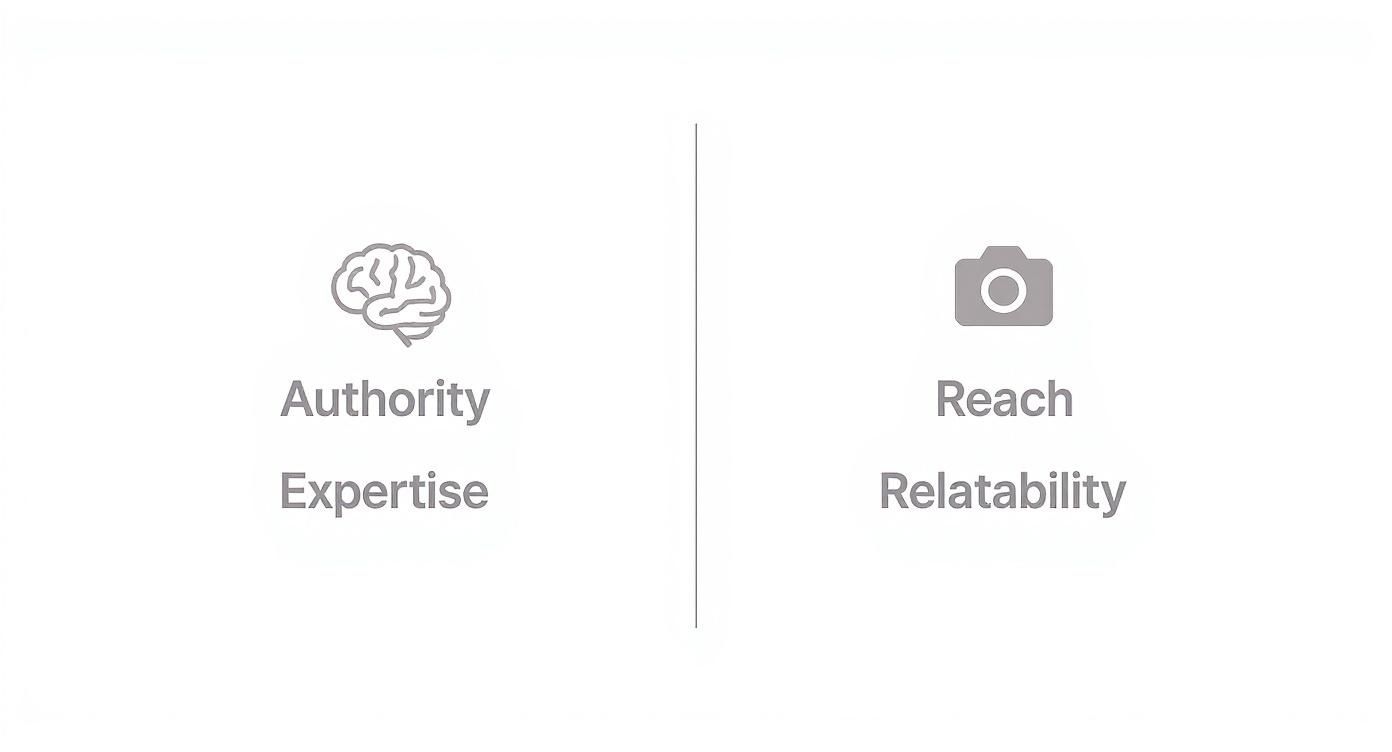
It’s a simple visual, but it drives home a crucial point. Successful KOL marketing is all about finding partners whose main asset is their proven expertise, not just a big follower count.
Finding and Vetting the Right Experts
The hunt for the right KOL is less about vanity metrics and much more about genuine alignment. A small, hyper-engaged audience of industry pros can be infinitely more valuable than a million casual followers. Your search should be laser-focused on three things: relevance, credibility, and engagement.
Here's a practical workflow to find and vet potential KOLs:
- Identify Potential Candidates: Start looking for the experts who are actually active and respected in your industry. Think speakers at major conferences, authors of important research, or pros who share serious knowledge on platforms like LinkedIn, X (formerly Twitter), or niche industry forums.
- Analyze Their Audience: Dig deeper than the follower count. Does their audience look like your ideal customer? Read the comments and discussions on their posts. You'll quickly get a feel for the quality of their community and the depth of their influence.
- Verify Their Credentials: Do your due diligence. Confirm their professional background, check out their publications, and verify their experience. Real KOLs have a track record you can easily find. A quick Google search should tell you a lot about their contributions to the field.
- Assess Brand Alignment: Go through their past content. Do their values and tone match your brand's? A mismatch here will feel forced and inauthentic, and it can damage both of your reputations.
A partnership with a KOL is a strategic alliance built on mutual respect and shared values. The best collaborations feel natural because the expert genuinely believes in the product's value, making their endorsement an authentic extension of their professional opinion.
Crafting Your Outreach and Collaboration Plan
Once you've got a solid shortlist of vetted experts, your outreach has to be personal and professional. Generic, copy-paste email templates are a one-way ticket to the trash folder.
Show them you've done your homework. Reference their specific work and explain exactly why you think a partnership would be a fantastic fit for your brand and their audience.
For your KOLs to truly connect with their audience, you have to understand how to create engaging content that resonates. The best approach is a co-creation process. You bring the key brand messages, they bring the expert insights, and together you create something that's both authentic to their voice and powerful for your goals.
Finally, get a clear agreement in place. It should spell out all the specifics: deliverables, compensation, timelines, and content ownership. Whether you're offering a flat fee, a long-term retainer, or a performance-based deal, total transparency is the foundation of a healthy, productive relationship. Nailing this process gives you a repeatable roadmap for one successful KOL campaign after another.
Measuring the True ROI of Your KOL Partnerships
Likes and shares feel good, but let's be honest—they don't pay the bills. To prove your key opinion leader marketing is actually moving the needle, you have to look past those surface-level vanity metrics and dig into the key performance indicators (KPIs) that really matter to the business.
Measuring the return on investment (ROI) from a KOL partnership isn't just about one number. It's a balanced approach. You need to track the hard data—the quantitative results—and also appreciate the softer, more nuanced qualitative wins. Getting this complete picture will not only justify your spending but give you the insights to make your next campaign even better.
Focusing on Quantitative Business Outcomes
The most straightforward way to prove success is to track the numbers that tie directly to revenue and customer growth. These are the tangible results that show exactly how a KOL collaboration impacted your finances. Without them, you're just guessing.
The key is to set up clear tracking before the campaign kicks off. This is the only way you can confidently attribute sales and leads back to your KOL’s hard work.
Here are the essential quantitative metrics you need to be watching:
- Conversion Rate from Unique Codes: This is the easiest win. Give your KOL a unique discount code or a trackable affiliate link. It's the cleanest way to see exactly how many sales their specific endorsement drove.
- Return on Ad Spend (ROAS): Simply divide the revenue generated by the total cost of the partnership. A 4:1 ROAS means you made $4 for every $1 you spent. It doesn't get much clearer than that.
- Customer Acquisition Cost (CAC): How much did it cost to get a new customer through this KOL campaign? Compare that to your other marketing channels. A great partnership should bring you a lower, more efficient CAC.
- Website Traffic and Referral Sources: Jump into your analytics and watch for the spike in referral traffic from the KOL’s channels. Also, keep an eye out for increases in direct traffic and branded searches, which signal that more people are becoming aware of you.
These hard numbers give you undeniable proof of performance, making it simple to report back to stakeholders and show the value of your investment. If you want to go deeper, there are plenty of tools and metrics for measuring social media ROI that can offer an even more granular view.
Assessing Qualitative Impact and Brand Health
While sales are king, some of the most powerful benefits of KOL marketing aren't found on a spreadsheet. A respected expert doesn't just move products; they build trust, shift perceptions, and create a halo of credibility around your brand.
The true value of a KOL partnership often extends beyond immediate sales. It's an investment in your brand's long-term reputation, authority, and the trust you build with your target audience. This qualitative impact can pay dividends for years to come.
Measuring these shifts requires a different toolkit and a more observant eye.
To get a handle on this qualitative ROI, focus on these areas:
- Social Listening and Sentiment Analysis: Track conversations about your brand before, during, and after the campaign. Are people talking about you more positively? Is your brand name popping up in expert discussions? A positive shift in sentiment is a huge win.
- Audience Feedback and Comments: The comment section on a KOL’s post is a goldmine. Look for gems like, "I've been looking for a solution like this," or "I trust their opinion, so I'm going to try it." This is direct proof that their influence is working.
- Surveys and Brand Perception Studies: Run simple pre- and post-campaign surveys. Ask your target audience about brand awareness, trust, and perceived expertise to measure how much the needle has moved.
It’s crucial to remember that the influencer marketing world is massive. Projections show it will drive between $38 to $46 billion in e-commerce sales in 2025. But here's the catch: about $23 billion of that is 'indirect' awareness that leads to purchases down the line, while $21 billion is directly trackable revenue. This split underscores the need for a blended measurement strategy that captures both the immediate sales and the long-term brand lift.
How Technology Can Streamline Your KOL Campaigns

When your KOL marketing program starts to take off, that initial buzz can quickly get buried under a mountain of admin work. Trying to juggle contracts, track down payments, and stitch together performance reports from a dozen different spreadsheets isn't just a headache—it's a surefire way to make costly mistakes.
That manual grind just isn't built to last. Luckily, a new wave of technology is designed to fix this exact problem, turning logistical chaos into a smooth, efficient operation.
Think of KOL management platforms as the central nervous system for your campaigns. They bring everything—scattered docs, endless email threads, and payment reminders—into one unified system built for clarity and data-driven results.
Unifying Your Entire Workflow
Imagine one dashboard where you can find the right experts, manage all your agreements, and see real-time results. That’s what a good management platform delivers. It frees you up from chasing paperwork so you can focus on what actually matters: building great relationships and sharpening your strategy.
These platforms are designed to manage the entire lifecycle of a partnership, from that first outreach message to the final payment and performance review. This all-in-one approach is what keeps things moving and ensures no critical detail gets lost in the shuffle.
The market is clearly shifting in this direction. The broader creator economy is projected to hit an incredible USD 202.7 billion by 2035. More importantly, the KOL management software segment is expected to grab 53.2% of that market share in 2025. This shows a massive industry-wide move toward tech solutions for managing collaborations. You can explore the full market analysis on Future Market Insights to dig deeper into these trends.
Key Functions of a KOL Management Platform
These systems come packed with tools designed to automate and organize every moving part of your campaigns. They provide the framework you need to grow your efforts without letting quality or control slip.
Most solid platforms offer features that solve the biggest pain points in key opinion leader marketing:
- Advanced Discovery and Vetting: Use powerful search filters to find experts based on their niche, audience makeup, engagement stats, and previous campaign performance. This is worlds faster than scrolling through social media feeds for hours.
- Automated Outreach and Communication: Keep all your conversations in one place. Use templates and automated sequences to handle initial outreach, all while keeping the communication organized and personal.
- Centralized Contract and Payment Management: Generate, send, and store contracts digitally. Set up automatic payments tied to completed deliverables, which keeps your KOLs happy and paid on time—a huge factor in building strong, lasting relationships.
- Integrated Performance Dashboards: Get a live look at key metrics like reach, engagement, conversions, and ROI. These dashboards give you the hard data you need to prove your campaign's value and make smart adjustments on the fly.
A dedicated platform lets you stop reacting to problems and start proactively building a strategy based on data. It gives you the visibility to see what’s working, invest more in your best partnerships, and make smarter decisions for your next campaign.
Gaining a Competitive Edge with Technology
Bringing a KOL management platform into your workflow isn't just about making your job easier; it's about gaining a serious competitive advantage. While your competition is lost in spreadsheet purgatory, you're moving with speed and precision.
You can launch campaigns faster, build better relationships with top-tier experts, and get instant access to the data you need to pivot when the market shifts. For DTC and e-commerce brands, where being fast and agile is everything, this kind of tech support is a total game-changer.
Ultimately, the right technology helps you build a KOL marketing program that is scalable, repeatable, and incredibly effective. For a deeper dive into the available options, take a look at our guide on the essential influencer marketing tools that can take your efforts to the next level.
Common Questions About Key Opinion Leader Marketing
Alright, let's get down to brass tacks. Venturing into the world of key opinion leader marketing can feel like navigating a new city without a map. It’s a powerful strategy, no doubt, but the nuances can leave even seasoned marketers with a few questions.
We're going to tackle the most common ones we hear—the practical, "how-do-I-actually-do-this" stuff—so you can move from theory to execution with total confidence.
How Much Does It Cost to Hire a KOL?
This is always the first question, and the only honest answer is: it depends. Unlike buying a Facebook ad where you have clear rate cards, KOL compensation is a different ballgame. There's no one-size-fits-all price tag, because you're not just buying reach; you're buying credibility.
The final number is a blend of their professional standing, the industry they're in, their audience's trust, and exactly what you're asking them to do.
Think of it like this—the cost is shaped by a few key factors:
- Industry and Niche: An expert in a highly specialized field like enterprise cybersecurity or surgical robotics is going to command a much higher fee than a lifestyle guru. Their knowledge is rare, valuable, and hard-won.
- Level of Expertise: There's a world of difference between a newly certified nutritionist and a world-renowned cardiologist with decades of published research. You're paying for a career's worth of authority.
- Scope of Deliverables: A single educational video is one thing. A year-long partnership involving content creation, speaking at your annual conference, and sitting on an advisory board is something else entirely. The bigger the "ask," the bigger the investment.
- Audience Size and Engagement: While it's not the only thing that matters, a KOL with a massive and highly engaged following of industry professionals has a platform that's incredibly valuable. They'll price their services to reflect that.
Think of it this way: you're not buying an ad, you're retaining a top-tier consultant. You are paying for the authority, credibility, and trust they’ve spent years—sometimes decades—building.
What Is the Best Way to Find a Relevant KOL?
Finding the right expert is less of a social media scroll and more of a strategic hunt. The goal isn't to find the biggest name, but the most aligned name for your brand. You need to look where genuine expertise is actually being shared and recognized in your industry.
While you might find some great people on LinkedIn or X (formerly Twitter), the true authorities often hang out in different circles.
Here are a few places to start digging:
- Industry Conferences and Events: Who’s on the main stage giving keynotes? Who’s leading the most packed breakout sessions? These are the people their peers pay to see.
- Professional Publications and Journals: Look at who is authoring the influential articles, research papers, or books in your field. Their work is their résumé.
- Academic Institutions: Professors and university researchers are literal pillars of knowledge. Many are active consultants and are deeply respected for their unbiased, evidence-based viewpoints.
- Niche Online Communities: Who are the most respected voices in those tight-knit industry forums, Substack newsletters, or private Slack channels? Find the people your ideal customers are already quoting.
How Do I Approach a Potential KOL?
Your first outreach needs to be sharp, professional, and personal. Remember, you're contacting a busy professional, not a full-time content creator who lives in their DMs. A generic, copy-paste email will get you deleted in a heartbeat.
Your goal with that first message is simple: show them you've done your homework and that you genuinely respect their specific expertise.
Here’s how you nail the approach:
- Be Specific and Personal: Don't just say you "love their work." Mention the specific keynote they gave last month or a particular point from a paper they published. This proves you're not just spamming a list.
- Explain the "Why": Clearly connect the dots. Why is their unique perspective the perfect match for your brand and what you're trying to achieve? How does their expertise relate directly to your product?
- Propose a Partnership, Not a Transaction: Frame this as a genuine collaboration. You're not just trying to pay them to say something. You want to co-create something valuable that their audience (and yours) will appreciate.
- Make It Easy to Say Yes: Keep that first email short and to the point. Introduce your brand, state your intention, and suggest a brief call to explore the idea. Don't hit them with a five-page proposal on day one.
A great partnership starts with a great first impression. Show them you respect their time and their knowledge, and you’ll set the stage for a powerful relationship that is at the very core of successful key opinion leader marketing.
Ready to stop searching and start connecting with the right experts? JoinBrands is an all-in-one creator marketing platform that simplifies every step of your KOL campaign. From AI-powered creator matching to seamless contract and payment management, we provide the tools to find, manage, and measure your partnerships efficiently. Launch your first campaign with JoinBrands today and build brand trust with authentic, expert-led content.