
 Your Ultimate Guide to Choosing an AI Video Maker
So, what exactly is a Key Opinion Leader (KOL) in marketing?
Think of a KOL as someone whose opinion doesn't just get heard—it gets respected. These aren't your typical social media influencers. A KOL's authority comes from their professional credentials, deep industry experience, and proven expertise, not just their follower count.
Table of Contents
What Is KOL Marketing and Why It Matters

Let's say you're launching a groundbreaking new skincare line. You could run a flashy ad campaign and hope for the best. Or, you could have a renowned dermatologist break down the science behind your product for their audience. Which one carries more weight?
That dermatologist is your Key Opinion Leader. Tapping into their authority is the essence of KOL marketing.
This strategy isn't about chasing viral trends; it's about building trust through genuine expert validation. When a KOL recommends something, their followers see it as professional advice backed by years of specialized knowledge.
The Power of Expert Trust
In today's crowded markets—especially in sectors like health, finance, and tech—consumers are naturally skeptical. They're tired of slick ads and are actively looking for credible sources to guide their purchasing decisions. A KOL cuts through that noise by providing that crucial third-party verification.
The shift toward creator-led strategies is impossible to ignore. The global influencer marketing industry has ballooned to a market size of $32.55 billion, reflecting a massive compound annual growth rate of 33.11% since 2014. This tells us one thing: brands are moving their budgets to voices that create real, authentic connections.
A key opinion leader doesn't just have an audience; they have a following that trusts their judgment implicitly. Their recommendation is less like an advertisement and more like professional advice from a trusted source.
To help you tell these roles apart, here’s a quick breakdown of the key players in creator-driven marketing.
Quick Guide to Key Marketing Roles
| Role | Primary Value | Audience Relationship | Best For |
|---|---|---|---|
| KOL | Expertise & Credibility | Professional & Authoritative | High-consideration products (tech, health, finance), building trust |
| Influencer | Relatability & Reach | Aspirational & Entertaining | Lifestyle products, brand awareness, driving trends |
| Ambassador | Loyalty & Advocacy | Long-term & Authentic | Building brand community, sustained promotion |
| UGC Creator | Authenticity & Social Proof | Peer-to-Peer & Genuine | Showcasing real-world use, building trust through customer voice |
This table makes it clear that while each role has its place, KOLs offer a unique layer of authority that can be a game-changer for the right kind of brand.
Why It Works for E-commerce
For direct-to-consumer (DTC) and e-commerce brands, working with KOLs offers some killer advantages. It’s not just about reaching more people; it’s about connecting with the right people through a message they'll actually believe.
- Builds Instant Credibility: Partnering with an expert instantly transfers their credibility to your brand. Think of a respected tech reviewer unboxing your new gadget or a professional chef using your kitchen tool—it’s an immediate stamp of approval.
- Educates Your Audience: Have a complex product? A KOL is the perfect person to break down its features and benefits in a way that's easy for consumers to grasp and get excited about.
- Drives Qualified Traffic: A KOL's audience is niche and highly engaged. When they recommend a product, the people clicking through to your site are already educated and have high purchase intent. They're not just browsing; they're ready to buy.
Ultimately, KOL marketing elevates your brand from just another option on the shelf to a recommended, expert-backed solution. To dive deeper into this world, you can explore more insights on KOL marketing.
Understanding KOLs, Influencers, and Brand Ambassadors
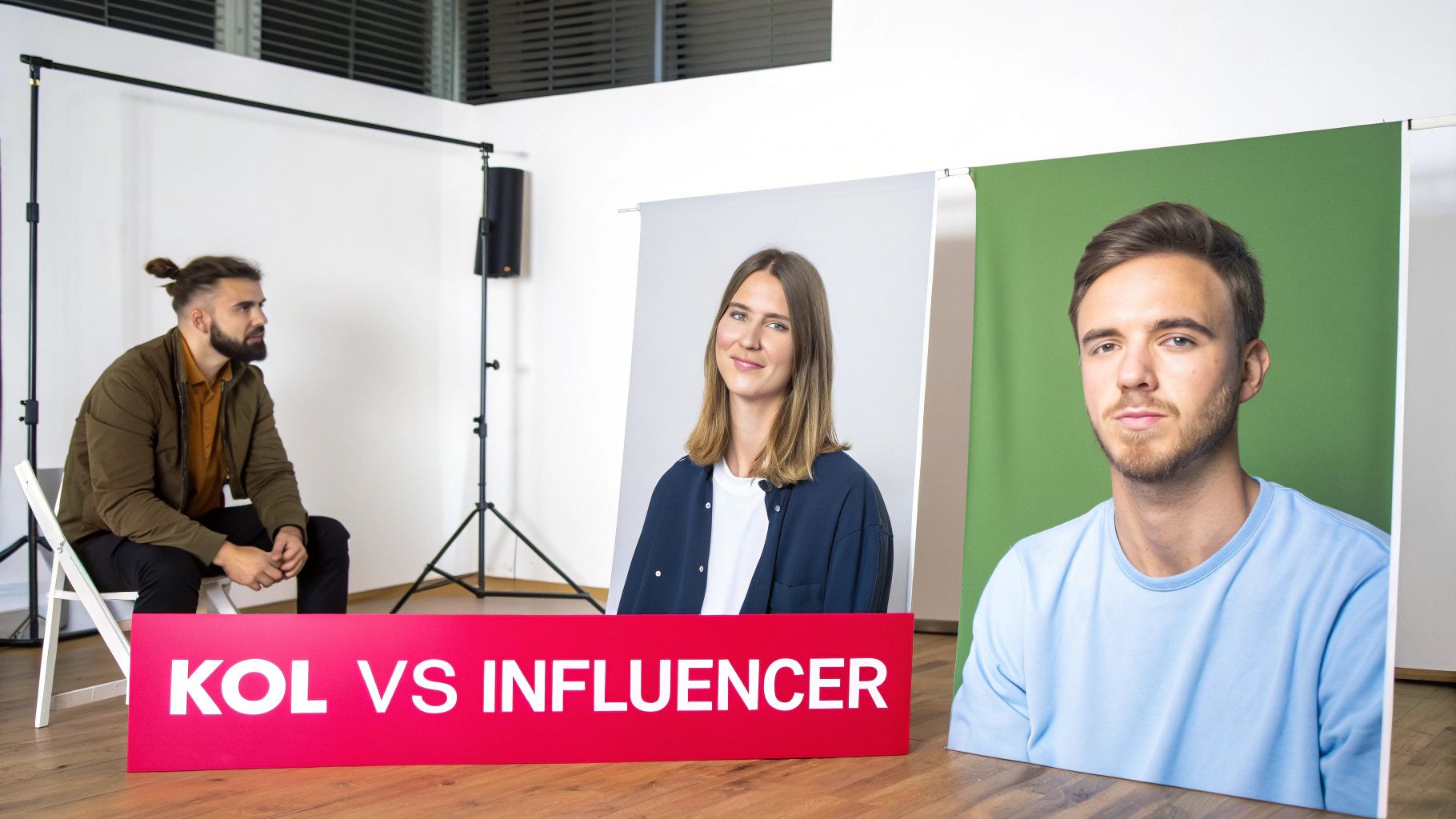
It’s easy to throw the terms KOL, influencer, and brand ambassador around like they’re the same thing. But lumping them all together is a classic marketing mistake. Each one brings something totally different to the table, and knowing when to call on each is key to getting the results you actually want.
Think of it like building a legal case. You have different experts for different jobs. The KOL is your star witness—the seasoned pro with credentials so solid their testimony is practically irrefutable. The influencer is the charismatic storyteller who can capture the hearts and minds of the jury. And the brand ambassador is the loyal client whose long-term, heartfelt testimonial speaks volumes.
Each one is powerful, but their influence comes from a completely different place. Mix them up, and you might send in a storyteller when what you really need is an expert to validate your claims.
The Core of a Key Opinion Leader
A Key Opinion Leader (KOL) gets their clout directly from their day job and deep expertise. Their authority is built on credentials, years of experience, and respect from their peers in a specific industry, whether it's medicine, finance, or tech. They don't need a massive follower count; the weight of their professional opinion is what matters.
For example, when neuroscientist Dr. Andrew Huberman talks about a health supplement on his podcast, people listen. They trust him because he's a tenured professor at Stanford, not just because he's a popular podcaster. That's KOL marketing in a nutshell: using professional credibility to build rock-solid consumer trust.
The Reach of an Influencer
An influencer, on the other hand, builds their audience from the ground up through killer content and a magnetic social media presence. Their power is in being relatable, entertaining, and having a knack for starting trends. While some are experts in their niche, their real currency is the connection they have with their followers.
A lifestyle vlogger sharing their morning skincare routine is a perfect example. Their audience buys the products not because the vlogger is a board-certified dermatologist, but because they trust their taste and feel like they know them personally. Influencers are your go-to for creating buzz and making a product feel cool and desirable.
A KOL tells you why a product works based on technical or scientific expertise. An influencer shows you how a product fits into an aspirational lifestyle. Both are powerful, but they serve different strategic purposes.
This distinction is everything. Launching a complex piece of tech? A KOL’s in-depth review provides the validation a cautious buyer needs. Selling a trendy pair of sneakers? An influencer’s “get ready with me” video creates instant social proof and FOMO.
The Loyalty of a Brand Ambassador
A Brand Ambassador is all about the long game. This is usually someone who was already a genuine fan of the product and enters into a formal, long-term partnership to share their authentic story over time. They could be a KOL or an influencer, but what sets them apart is their sustained loyalty.
Think of Serena Williams and Nike. Her partnership has spanned decades. She isn't just pushing a shoe for a single campaign; she embodies the brand's core values of determination and greatness. This creates an incredibly strong bond between her personal brand and the company. You can learn more about what brand ambassadors do to see how they build such powerful communities.
Ultimately, picking the right partner comes down to one question: what’s your goal? Are you trying to educate a skeptical audience, create a viral moment, or build a loyal tribe? Your answer will point you straight to the right collaborator for the job.
Knowing when to bring in a Key Opinion Leader is just as critical as picking the right one. While influencers can generate buzz pretty much anytime, the authority of a KOL is a strategic asset. You pull it out for specific, high-stakes moments. Using a KOL in marketing is all about precision, not just spray-and-pray volume.
Here's a way to think about it: an influencer is like a megaphone, blasting your message far and wide to a general audience. A KOL, on the other hand, is like a specialized microscope. They allow a discerning audience to see the intricate details and scientific proof that make your product genuinely valuable. You don't need a microscope for every task, but when you do, it's often the only tool for the job.
Launching a Technically Complex Product
When your product's value is buried in science, technology, or complex ingredients, a typical ad campaign can easily fall flat. Shoppers have serious questions that demand expert answers, and that's precisely where a KOL shines. Their credibility acts as a bridge, connecting your product's technical features to a customer's real-world understanding and trust.
Imagine you're launching a new fitness tracker with a proprietary heart rate variability (HRV) sensor. A lifestyle influencer might look great wearing it at the gym. But a sports scientist or cardiologist can actually break down why that HRV data is a game-changer for athletic performance and recovery.
This is the perfect time to call in a KOL:
- Health & Wellness: Got a new supplement with a unique formulation? A respected nutritionist or medical doctor can explain the science behind the ingredients.
- Tech Gadgets: Introducing a drone with advanced navigation AI? A professional drone pilot or a tech engineer can validate its performance claims through real, rigorous testing.
- Skincare & Beauty: Selling a serum with a newly discovered active ingredient? A dermatologist can explain how it works on a cellular level and why it’s a cut above the rest.
A KOL’s job here is to translate complex specs into tangible benefits. They provide the "why it works" that gives people the confidence to make a high-consideration purchase.
Entering a New or Skeptical Market
Trying to break into a new country or a category filled with wary consumers is a battle for trust from day one. Your brand is an unknown, and you need to build credibility—fast. A respected local or industry-specific KOL gives you an instant stamp of legitimacy.
Let's say a US-based sustainable apparel brand wants to enter the European market. They could partner with a well-regarded European materials scientist. This expert could independently validate the brand's eco-friendly claims, making them resonate with a new, eco-conscious audience that might otherwise be skeptical of a foreign company’s marketing fluff.
Educating Consumers on a Nuanced Category
Some products demand more than just awareness; they require deep consumer education. Think about categories like financial services, specialized software, or products for babies and children. In these spaces, customers aren't just buying a thing—they're investing in their safety, their financial security, or a very specific outcome.
In these cases, a KOL becomes an educator and a guide.
- A fintech app could team up with a certified financial planner to create content about responsible investing strategies.
- A baby food brand might work with a pediatrician to develop a series discussing infant nutrition and key developmental milestones.
The goal in these scenarios isn't just a quick sale. It's about building a foundation of knowledge and trust. The KOL's endorsement is almost secondary to the valuable, authoritative information they share, which naturally positions your brand as the expert-approved solution.
By timing your KOL in marketing efforts for these key moments, you ensure your investment delivers maximum impact.
How to Launch a Successful KOL Campaign
Pulling off a killer KOL marketing campaign isn’t about winging it. It demands a thoughtful, structured game plan from beginning to end. Unlike some influencer marketing where spontaneity can be a secret weapon, working with top-tier experts requires absolute professionalism and meticulous planning.
This isn't about just sending out some freebies and hoping for the best. We're talking about building a real professional partnership—one that’s built on mutual respect and perfectly aligned goals. A well-oiled campaign cuts through the noise of vague goals like "brand awareness" and hones in on tangible results you can actually measure.
By breaking down the process into clear stages, you can steer the collaboration, keep everyone on the same page, and create content that truly moves the needle for your business.
Setting Clear Goals And KPIs
First things first: you have to define what a "win" looks like. If you don't set clear objectives from the start, you'll have no way to measure your ROI or know if the partnership actually paid off. Vague goals just lead to vague, unsatisfying results.
Instead of just aiming for "more reach," you need to lock in specific, trackable Key Performance Indicators (KPIs). The goals you set will directly influence which KOL you partner with and the kind of content you create together.
- For Sales and Conversions: Your main KPI might be the number of sales driven through a unique discount code or an affiliate link. Keep a close eye on your Cost Per Acquisition (CPA) and Return on Ad Spend (ROAS).
- For Lead Generation: Trying to grow your email list? Track how many people sign up from a dedicated landing page that the KOL shares with their audience.
- For Audience Education: Here, you'll want to measure engagement metrics. Think comments, shares, and saves on educational content. You can also track the click-through rate to a more in-depth blog post or whitepaper.
The more focused your goals are, the easier it becomes to see if you're winning. A successful campaign is one that moves a specific, predetermined needle for your business—not just one that racks up a bunch of views.
Identifying And Vetting The Right Experts
Finding the perfect KOL has less to do with their follower count and everything to do with their authority and how well they align with your brand. A classic mistake is getting star-struck by a huge following that has zero relevance to your product. The right expert commands an audience that mirrors your ideal customer and trusts their recommendations without question.
When you're vetting potential partners, you have to look beyond the surface. Dig deep.
- Audience Demographics: Do their followers actually match your target customer? Use analytics to check their age, location, and interests.
- Engagement Quality: Don't just look at the number of comments; read them. Are people asking smart questions and having real discussions? Or is it all just "Great post!"? High-quality engagement is a sign of a genuinely connected community.
- Content Authenticity: Scroll through their past sponsored posts. Does the partnership feel natural and authentic, or does it stick out like a sore thumb? The best KOLs weave brand collaborations into their content so seamlessly you barely notice it's an ad.
This infographic breaks down a common workflow for using KOLs to hit specific business milestones.
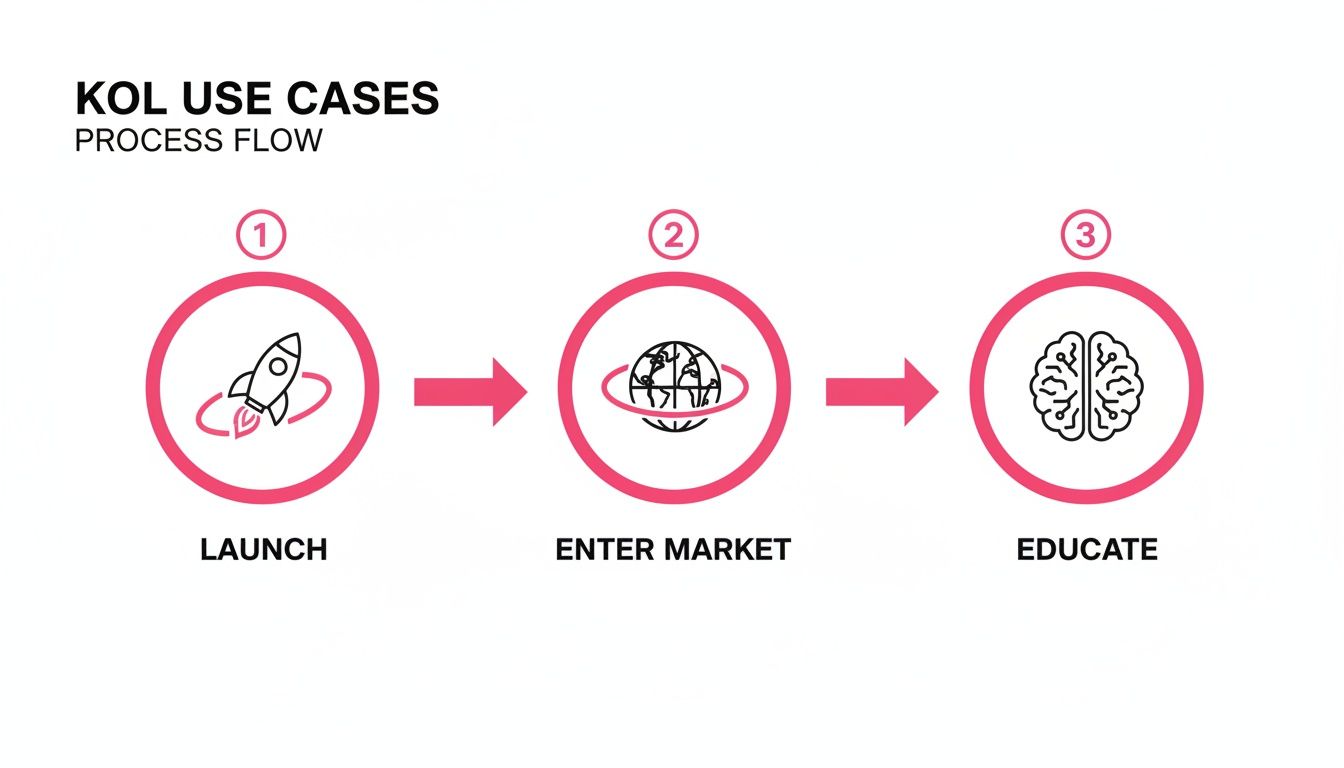
As you can see, KOLs can be strategically brought in at crucial moments—whether you're debuting a new product, breaking into a crowded market, or needing to educate potential customers.
To help you organize your process, here is a simple checklist you can follow.
KOL Campaign Workflow Checklist
| Phase | Key Action | Pro Tip |
|---|---|---|
| 1. Planning | Define Campaign Goals & KPIs | Be specific. "Increase sales by 15%" is better than "increase sales." |
| Identify & Vet Potential KOLs | Look for audience alignment and engagement quality, not just follower count. | |
| Set a Realistic Budget | Factor in KOL fees, product costs, and any amplification spend. | |
| 2. Outreach | Craft a Personalized Pitch | Mention their specific work to show you've done your homework. |
| Negotiate Terms & Compensation | Be clear, professional, and respectful of their expertise. | |
| Finalize a Campaign Contract | Get everything in writing: deliverables, timeline, usage rights, and payment. | |
| 3. Execution | Create a Comprehensive Brief | Provide clear goals but allow for creative freedom. Don't send a script. |
| Ship Products & Provide Info | Make sure they have everything they need well in advance of the deadline. | |
| Review & Approve Content | Offer constructive feedback that respects their authentic voice. | |
| 4. Measurement | Track KPIs During the Campaign | Use unique links or codes to monitor performance in real-time. |
| Analyze Final Results | Compile all the data and compare it against your initial goals. | |
| Gather Learnings for Next Time | What worked? What didn't? Use these insights to improve future campaigns. |
Following a structured checklist like this ensures no critical steps are missed, leading to a smoother, more effective collaboration from start to finish.
Crafting A Compelling And Professional Outreach
Once your shortlist is ready, it's outreach time. Remember, the most respected KOLs get flooded with partnership requests daily. A generic, copy-and-paste email is a one-way ticket to the trash folder. Your outreach has to be personal, professional, and prove you’ve actually paid attention.
Here's what your initial pitch should cover:
- A Personalized Intro: Start by mentioning a specific article, video, or post of theirs you genuinely liked. It shows you value their work.
- A Clear Brand Intro: Briefly explain who you are, what you do, and—most importantly—why you think their expertise is the perfect match.
- The Partnership Ask: Be direct about what you have in mind. Is it a single product review? A series of educational videos? A webinar?
- Compensation: State upfront that this is a paid partnership. Show respect for their time and credibility by making a professional offer.
After you've connected and agreed on the terms, you'll need a solid creative brief. This brief is a guide, not a script. It should cover the campaign goals, key talking points, and any must-haves (like FTC disclosures), but it must give the KOL creative freedom to speak in their own voice.
For more tips on navigating the entire process, check out our in-depth guide to running an influencer marketing campaign.
Measuring the ROI of Your KOL Marketing
So, you've launched a KOL campaign. That’s a real investment of time, money, and energy. But how do you actually prove it was worth it? To show the real value of your KOL in marketing efforts, you have to look past the flashy vanity metrics like follower counts and zero in on the numbers that actually move the needle for your business.
Measuring return on investment (ROI) isn't just about counting likes. It’s about drawing a straight line from the KOL’s content to real-world business results, whether that’s getting your brand name out there, making customers seriously consider a purchase, or driving direct sales. When you measure correctly, you have the hard data you need to justify your budget and make your next collaboration even smarter.
Key Metrics Across the Marketing Funnel
A great KOL campaign doesn't just do one thing; it influences customers at every single step of their journey. To get the full picture of your ROI, it helps to map your KPIs to the classic marketing funnel: Awareness, Consideration, and Conversion. This framework shows you exactly where your KOL is making the biggest impact.
For instance, a campaign that gets a ton of eyeballs but zero sales might still be a massive win if your main goal was simply to introduce your brand to a whole new audience.
Awareness Metrics (Top of Funnel): This is all about how many new, relevant people are seeing your brand for the first time.
- Reach: The total number of unique people who saw the KOL's content.
- Impressions: The total number of times the content was shown, regardless of whether it was clicked.
- Share of Voice: How much your brand is being talked about within the KOL’s community compared to your competitors.
Consideration Metrics (Middle of Funnel): This stage tells you how well the KOL is getting their audience to actually engage with your brand.
- Engagement Rate: Likes, comments, shares, and saves are clear signs that the audience isn't just scrolling by—they're interested.
- Click-Through Rate (CTR): The percentage of people who saw the KOL's post and clicked the link to your website or landing page.
- Website Traffic: The amount of new traffic coming straight from the KOL’s referral links.
Conversion Metrics (Bottom of Funnel): These are the money metrics. They directly connect the campaign to your revenue.
- Conversion Rate: The percentage of visitors from the KOL’s link who took a specific action, like buying a product or signing up for a newsletter.
- Cost Per Acquisition (CPA): Your total campaign cost divided by the number of new customers you gained.
- Sales from Promo Codes: Tracking unique discount codes is one of the clearest ways to attribute sales directly to a KOL.
Setting Up a Solid Tracking System
You can't measure what you don't track. It’s that simple. To accurately tie results back to your KOL, you absolutely have to set up a clear tracking system before the campaign ever goes live. If you don't, you’re just guessing where your sales and traffic came from.
The goal is to create a direct, unbreakable line between the KOL’s content and a customer’s action. This turns ambiguous "buzz" into hard, measurable data that proves the campaign's financial worth.
Here are the essential tools you'll need:
UTM Parameters: These are just simple tags you add to the end of a URL. They tell your analytics software exactly where the traffic came from. You can create unique UTMs for each KOL, and even for each platform they post on, giving you incredibly detailed data.
Dedicated Landing Pages: Build a unique landing page just for the KOL's audience. This not only makes tracking a breeze but also lets you tailor the message and offer. A cohesive experience like this can seriously boost your conversion rates.
Unique Discount Codes: This is one of the most straightforward ways to track direct sales. Give each KOL their own code (like "EXPERT15"), and you'll see exactly how much revenue their specific endorsement generated at checkout.
By combining these tracking methods with qualitative feedback, like checking the audience sentiment in the comments section, you can build a truly comprehensive report. For a deeper dive, check out our guide on calculating influencer marketing ROI, which covers more advanced formulas and strategies. This data-driven approach is what will empower you to prove the true impact of your KOL partnerships.
Streamlining Your KOL Campaign Management
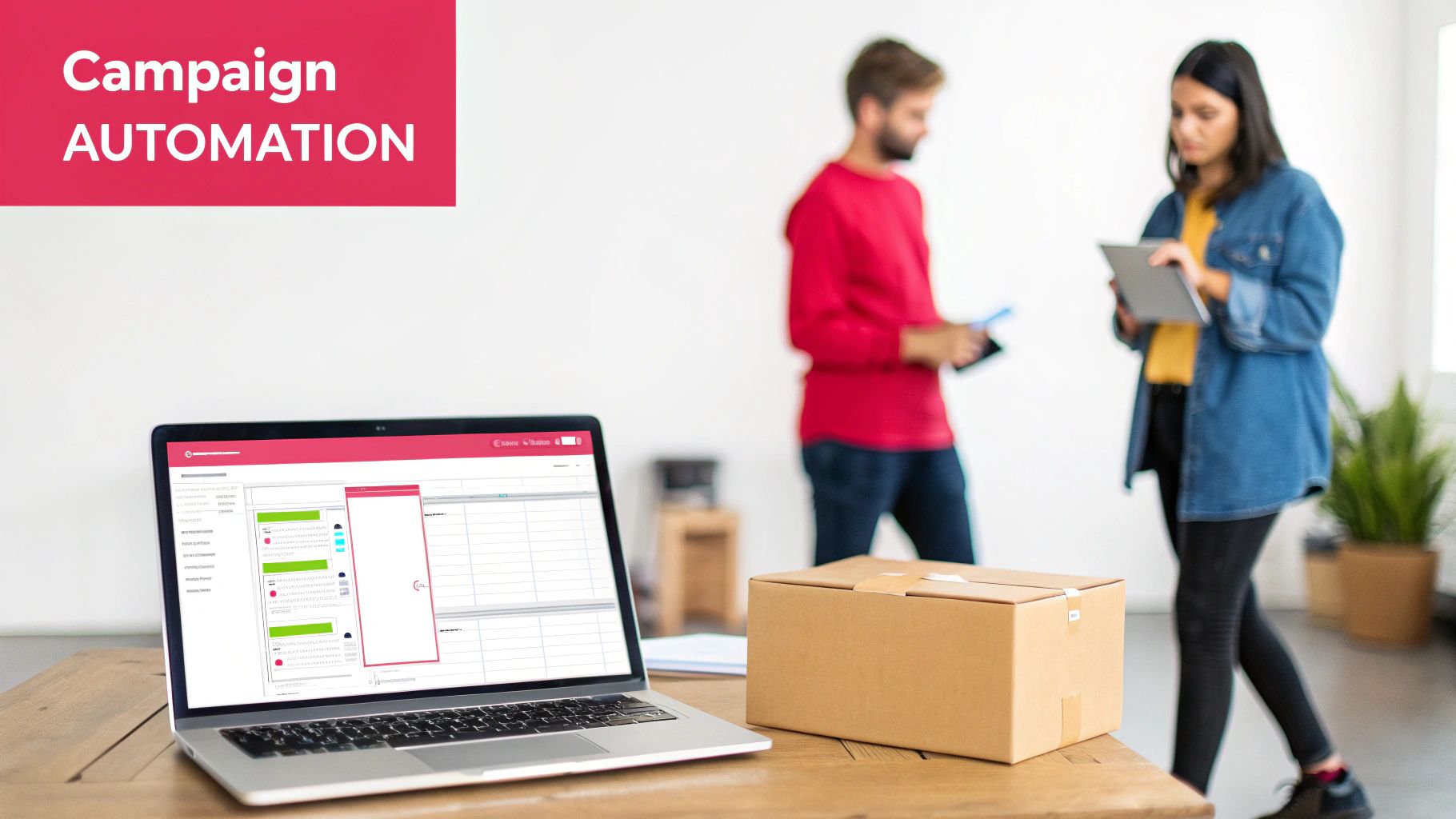
Managing even one KOL partnership comes with a shocking amount of admin work. Now, imagine scaling that up to a handful of experts. The manual effort can quickly spiral out of control. Juggling spreadsheets, chasing endless email threads, and processing payments by hand isn't just inefficient—it's a perfect recipe for expensive mistakes and rocky relationships.
For growing e-commerce brands, this logistical nightmare is a huge pain point. As you try to expand your KOL in marketing program, the DIY approach simply falls apart. Your team ends up burning more time on busywork than on what actually moves the needle: building solid partnerships and crafting a killer creative strategy.
This is exactly why a dedicated creator marketing platform isn't just a nice-to-have; it's essential. It takes a messy, time-sucking process and turns it into a smooth, scalable operation.
Centralizing Your Campaign Workflow
Think of a creator marketing platform as the command center for your entire KOL strategy. Instead of hopping between a dozen different tools and inboxes, everything you need lives under one roof. These platforms are purpose-built to automate the most tedious parts of campaign management, freeing up your team to do their best work.
A platform like JoinBrands lets you manage the entire lifecycle of a KOL campaign from a single dashboard. This solves a bunch of key problems all at once.
- Creator Discovery: Smart filters help you pinpoint vetted experts based on their niche, engagement stats, and audience demographics, saving you from countless hours of manual searching.
- Contract Management: Forget the back-and-forth. Standardized templates and digital signatures make the agreement process seamless and professional for everyone involved.
- Product Shipping: Integrated logistics take the headache out of getting products into your partners' hands, complete with tracking to make sure everything arrives on time.
- Performance Tracking: Real-time analytics dashboards replace the soul-crushing task of manual data entry, giving you instant insights into how your campaign is performing and what your ROI looks like.
By automating these tasks, you build an efficient workflow that can grow right alongside your program.
A centralized platform transforms your KOL program from a jumble of disconnected tasks into a cohesive, measurable system. It means you can launch campaigns faster, collaborate more effectively, and ultimately get a much better return on your investment.
Gaining Deeper Campaign Insights
Beyond just making things easier, these platforms provide the kind of data that helps you sharpen your strategy over time. To really streamline your KOL campaign management and get a feel for what content is popping off, you can use specific social media monitoring tools like a TikTok Story Viewer. When you know what’s resonating with audiences, you’re in a much better position to co-create killer content with your KOL partners.
At the end of the day, adopting a creator marketing platform is about shifting your focus from administration to strategy. When your workflow is dialed in and your data is crystal clear, you can spend less time putting out fires and more time building the expert relationships that drive real brand credibility and meaningful growth.
Got Questions About KOL Marketing? We’ve Got Answers.
Diving into the world of Key Opinion Leaders can feel like you're learning a new language. As more and more brands lean on expert-led strategies, it's totally normal to have a few questions. This is where we clear the air.
Let's tackle some of the most common things marketers ask about using a KOL in marketing. Think of this as your quick-start guide to sidestepping common mistakes and building powerful partnerships with experts who can give your brand a serious credibility boost.
How Do I Actually Measure The ROI Of A KOL Campaign?
Measuring the return on your investment (ROI) with a KOL goes way beyond just counting likes and shares. To get a real feel for how the campaign is performing, you have to track the metrics that tie directly back to your business goals—like sales.
The cleanest way to see what's working is to trace sales and other key actions right back to the KOL's content.
- Affiliate Links and Promo Codes: Give each KOL their own unique, trackable link or a special discount code. This is hands-down the most straightforward way to see direct sales and calculate your return on ad spend (ROAS).
- UTM Parameters: Create custom URLs with UTM tags. This lets you see exactly how much traffic a KOL is sending to your site through your analytics platform, helping you track not just sales but also new leads and overall engagement.
- Dedicated Landing Pages: Build a specific landing page just for a KOL’s audience. This funnels all their traffic to one spot, making it super simple to measure conversion rates for that specific partnership.
Want to calculate a basic ROI? It's simple: (Revenue Generated – Campaign Cost) / Campaign Cost. This gives you a no-fluff financial snapshot of how well the campaign paid off.
Can Small Brands Even Work With KOLs?
Yes, 100%. In fact, KOL marketing can be a game-changer for small and medium-sized e-commerce brands, especially if you're in a niche market where an expert's stamp of approval means everything. The trick is to prioritize alignment over a massive audience.
Smaller brands can find huge success by teaming up with micro-KOLs. These are experts with smaller, but incredibly dedicated and trusting followings. Think about it: a dermatologist with 15,000 followers who hang on their every word can drive more qualified sales for a new skincare serum than a general lifestyle influencer with a million followers.
These partnerships are usually much more affordable and often come across as more genuine to the audience. For a small brand, one powerful endorsement from a trusted expert can provide the instant credibility you need to go toe-to-toe with the big guys. It’s all about finding that perfect expert whose authority clicks with your ideal customer.
Ready to streamline your KOL campaigns and connect with vetted experts? JoinBrands offers an all-in-one platform to discover creators, manage partnerships, and track your ROI seamlessly. Start your campaign today!