
 How to Find Brand Ambassadors That Drive Real Growth
Working with Instagram influencers is all about tapping into the trust and connection creators have with their followers. It’s a powerful way to turn genuine recommendations into revenue. Instead of just running another ad, you’re using authentic storytelling to reach potential customers who actually want to listen.
Table of Contents
Building Your Instagram Influencer Marketing Foundation
Jumping straight into scrolling for influencers without a clear plan is a recipe for wasted time and money. Seriously, it's like setting sail without a map. A truly successful campaign starts with a solid foundation, making sure every dollar you spend and every creator you partner with is pushing you toward your real business goals. This means getting way more specific than just "I want more followers."
The first move is to translate your big-picture business goals into sharp, specific campaign objectives. Are you trying to drive immediate sales for a new product launch? Or maybe your main goal is to build up a library of authentic user-generated content (UGC) you can use in your own ads down the road? Each of these goals demands a totally different strategy and a different set of metrics to track success.
Defining Your Goals and KPIs
Clarity is everything here. Before you even glance at an influencer's follower count, you need to know exactly what a "win" looks like for your brand.
- Brand Awareness: The main goal is just to get your brand in front of a new, highly relevant audience. Here, you'll be watching metrics like reach, impressions, and follower growth. A skincare brand launching a new serum, for example, might team up with a handful of beauty influencers to get as many eyes on the product as possible.
- Driving Sales: This one's all about direct revenue. You’ll be tracking things like conversion rates, click-through rates (CTR) from UTM-tagged links, and how many sales are coming from unique discount codes you give to each influencer.
- Content Generation: If you're starving for authentic content to use on your own channels, the primary objective is to source high-quality UGC. Success is measured by the sheer volume and quality of the assets you get back – think polished Reels, gorgeous static posts, and engaging Stories.
Getting this foundation right helps you see the entire path from your initial idea to the final results.
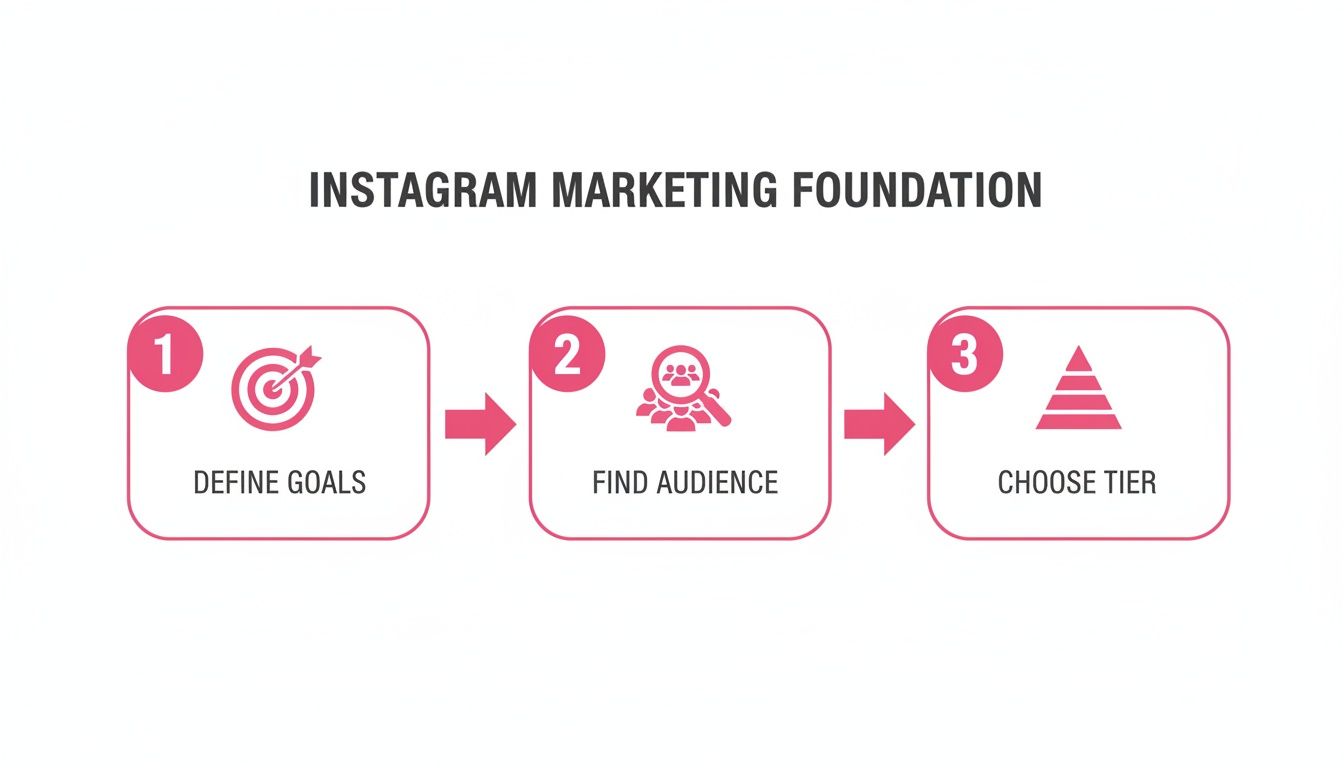
This flowchart nails it: defining your goals is the non-negotiable first step. Only then can you figure out who your audience is and which creators are the right fit.
Pinpointing Your Target Audience
Okay, so your goals are locked in. Now, who are you actually trying to reach? You have to build a detailed profile of your ideal customer. And I mean detailed. Go way beyond basic demographics and explore their psychographics. What are their hobbies, their values, their biggest pain points? What kind of content do they obsess over on Instagram?
Knowing this inside and out is how you find marketing influencers on Instagram whose followers are a perfect match, not just some random, broad demographic. This level of precision is what separates campaigns that pop from those that flop.
A critical mistake I see all the time is brands assuming a massive follower count automatically means the right audience. An influencer’s vibe might seem to match your brand, but if their followers aren't your ideal customers, the campaign will fall flat. Every time.
Getting this strategic focus right is more important than ever. In 2025, the global influencer marketing industry exploded to an eye-watering $32.55 billion in spending, and Instagram is still leading the pack. The platform has over 2.11 billion monthly active users, with a massive 44.7% sitting in that prime 25-34 age bracket. It's a goldmine for brands that do their homework. This is exactly why 68% of marketing specialists see Instagram as absolutely essential for their campaigns. You can discover more insights about the state of influencer marketing in 2025 right here.
How to Find and Vet the Right Instagram Influencers
Once your goals are crystal clear, the real hunt begins. Finding the perfect partners is more art than science, blending data-driven analysis with a gut check on brand fit. It’s about looking past shiny follower counts to find creators who genuinely connect with the audience you want to reach.
Manual discovery is always a solid starting point. explore relevant hashtags your ideal customers are actually using – not just broad ones like #fitness, but niche, community-driven tags like #veganmealprepideas. See who’s creating compelling content and getting real, authentic engagement.
Another smart move is to see which marketing influencers Instagram creators your competitors are already working with. This gives you a pre-vetted list of creators who are already familiar with your market and producing content that resonates.
But let's be honest, manual searching can only take you so far. To really scale your efforts and get deeper insights, creator marketing platforms like Upfluence or GRIN are essential. They let you filter creators by audience demographics, engagement rates, location, and keywords, saving you countless hours of scrolling.
Look Beyond the Follower Count
A massive follower count is a vanity metric, not a guarantee of success. The real magic often happens with smaller, more engaged communities. This is where nano and micro-influencers absolutely shine.
Recent data shows these smaller creators are engagement powerhouses. Micro and nano-influencers on Instagram can see engagement rates as high as 2.19%, easily outpacing their mega-celebrity counterparts.
It's a huge shift in the industry. Representing a massive 76% of all Instagram influencers, creators with 1K-100K followers are not only more affordable but often drive far better results. In fact, 73% of brands are now prioritizing these creators for their unbeatable engagement-to-cost ratio.
This is exactly why a thorough vetting process is non-negotiable. You can't just look at the numbers on the surface.
A Practical Look at Instagram Influencer Tiers
To give you a clearer picture of the landscape, it helps to break down the different tiers of influencers. Each tier comes with its own set of expectations for engagement, cost, and the type of collaboration they're best suited for.
| Influencer Tier | Follower Count | Average Engagement Rate | Typical Cost Per Post (US) |
|---|---|---|---|
| Nano | 1K – 10K | 2.5% – 5% | $10 – $100 |
| Micro | 10K – 100K | 1.5% – 2.5% | $100 – $500 |
| Mid-Tier | 100K – 500K | 1% – 2% | $500 – $5,000 |
| Macro | 500K – 1M | 0.8% – 1.5% | $5,000 – $10,000 |
| Mega | 1M+ | < 1% | $10,000+ |
As you can see, the sweet spot for many brands, especially those focused on community-building and direct response, is often in the nano and micro tiers. You get more bang for your buck and a much more authentic connection.
Vetting Potential Creator Partners
Once you've got a shortlist, it's time to put on your detective hat. A creator's profile is a goldmine of information if you know what you’re looking for.
Here’s what I always check:
- Content Quality and Alignment: Does their aesthetic actually match your brand's? Look for high-quality photos and videos, a consistent editing style, and a tone of voice that feels authentic. If you're a minimalist skincare brand, an influencer with a loud, flashy feed just isn't the right fit, no matter their numbers.
- Audience Sentiment: Read the comments. Are they genuine conversations or just a string of fire emojis and spam bots? Real engagement involves questions, discussions, and positive feedback. This tells you their audience is truly listening and not just passively scrolling.
- Previous Brand Partnerships: Check out their past sponsored posts. Do they promote products that align with yours, or do they promote anything and everything? A creator who is selective and thoughtful about their partnerships will have a much more trusting audience.
The single biggest red flag is a high follower count with suspiciously low engagement. If an account has 100,000 followers but only gets 50 likes and a handful of generic comments per post, it’s a strong indicator of fake followers or bots. Always check the engagement-to-follower ratio.
A healthy ratio is typically between 1-3%. Anything significantly lower warrants a much closer look. Tools that analyze audience authenticity can be a lifesaver here, helping you spot fake followers and ensure you’re investing in a real, active community.
For a more detailed breakdown of these techniques, check out our guide on how to find Instagram influencers that are a perfect fit for your brand. This deep dive will equip you with even more tools for making smart, data-backed decisions.
Getting Influencer Outreach and Negotiation Right
Alright, so you've done the legwork. You’ve pinpointed the perfect Instagram creators who vibe with your brand and speak directly to your ideal audience. Now comes the make-or-break moment: the first message. How you slide into their DMs or inbox can mean the difference between a thriving partnership and getting left on read.
Let's be real: creators get dozens of generic, copy-paste requests every single day. Yours has to stand out. The secret? Personalization that proves you've actually paid attention.
A generic "Hey, love your content!" is a fast track to the trash folder. Instead, you need to reference something specific. Connect a piece of their work directly to why you think they'd be a fantastic fit for your brand.
For example, skip the vague compliments and try something with a bit more substance: "Your recent Reel on making cold brew at home was not only beautifully shot but also genuinely helpful. That's exactly the kind of authentic, valuable content our audience at [Your Brand] goes crazy for, which is why I had to reach out."
That small bit of effort shows you see them as a creative partner, not just another name on a spreadsheet. If you want to really nail your messaging, our guide on influencer marketing outreach is packed with templates and proven strategies.
What's In It For Them? Crafting a Real Value Prop
While everyone needs to get paid, top-tier creators are looking for more than just a check. They want to work with brands they actually like and see a mutual benefit. Your pitch needs to spell out what they get out of the deal beyond the fee.
Think of your value proposition as a mix of tangible and intangible perks:
- Generous Product Seeding: Don't just send one sample for a photo. Give them enough product to actually use and fall in love with it.
- Long-Term Partnership Potential: Hint at the possibility of an ongoing relationship. Frame this first project as the start of something bigger, turning them into a true brand ambassador.
- Creative Freedom: Make it clear you trust their creative eye. Emphasize that you want their unique voice and style to lead the way.
- Exposure to Your Audience: Got a decent following yourself? Let them know you'll be sharing their content and tagging them, giving them a chance to grow their own audience too.
This shifts the dynamic from a one-off transaction to a collaborative partnership. You're not just buying a post; you're investing in a relationship.
Nailing the Negotiation
Once a creator shows interest, it's time to talk terms. This is where clarity and transparency are your best friends. Going into the conversation with a clear list of what you need will make everything run smoother for both of you.
Your negotiation checklist should cover a few key areas to avoid any "I thought you meant…" moments down the road. A solid, written contract is absolutely non-negotiable.
Key Negotiation Points to Lock Down
- Deliverables: Be painfully specific here. "An Instagram post" is way too vague. Define the exact formats and quantities, like one 60-90 second in-feed Reel and three consecutive Story frames with a link sticker.
- Content Usage Rights: This is a big one. Be crystal clear about where and for how long you can use their content. Can you feature it on your website? Repurpose it for paid ads? For three months? Six months? A full content buyout will cost more, but it gives you maximum flexibility.
- Exclusivity: Do you need them to avoid working with direct competitors for a while? If so, state it plainly. This will likely bump up their rate. A common exclusivity window is 30 days before and after the campaign goes live.
- Payment Terms: Lay out the total compensation, the payment schedule (a 50% upfront, 50% upon completion structure is standard), and how they'll be paid. It builds trust and ensures they get paid on time for their hard work.
Pro tip: Have a standardized contract template ready to go. It’s a total major advantage. It ensures you cover all your bases, protects both you and the creator, and shows that you're a professional and organized partner. Never, ever rely on a verbal agreement or a DM chat to seal the deal.
Writing a Creative Brief That Inspires Great Content
After you’ve shaken hands on a deal, the creative brief becomes the single most important document for your entire campaign. Seriously. It’s the blueprint. It's what guides the creator, making sure their content feels like it's coming from your brand without crushing the very authenticity that drew you to them in the first place.
A great brief is all about balance. You need to provide clear guardrails but leave enough open space for their creative magic to happen. Think of it less like a set of rigid rules and more like an inspirational guide. Your real job here is to empower the influencer, giving them all the context and tools they need to knock it out of the park.
Get this right, and you'll prevent miscommunication, slash the need for endless revisions, and get content that actually hits your goals.
The Core Components of an Effective Brief
A winning brief doesn’t have to be a novel, but it absolutely must be thorough. It should answer every question a creator might have before they even think to ask it. That kind of clarity builds confidence and sets you both up for a smooth collaboration from day one.
Here are the non-negotiable elements to include:
- Campaign Goals & KPIs: Always start with the "why." Are you trying to drive traffic to a new product launch? Boost app downloads? Maybe you just need a library of authentic UGC. Get specific. Instead of "increase sales," say, "Our goal is to drive 500 clicks to our new spring collection page, tracked via your unique UTM link."
- Key Messages & Talking Points: What are the one or two things the audience absolutely must take away from the content? Give them a few core talking points, but please, don't write a script for them. For example, offer flexible points like, "Mention the product is made with sustainably sourced materials" or "Highlight our 30-day money-back guarantee."
- A Crystal-Clear Call-to-Action (CTA): Tell the creator exactly what you want their followers to do next. Is it "Shop Now"? "Learn More"? "Use code INFLUENCER15 for 15% off"? An ambiguous CTA is a recipe for lost conversions.
If you want to make sure you're covering all your bases, using a structured guide is a major advantage. You can find a fantastic creative brief template that dives deep into all these essentials, ensuring you don’t miss a single crucial detail.
Setting Creative Guardrails Without Killing Creativity
This is the tightrope walk where so many brands stumble. They either provide a brief that's so vague the creator is left completely guessing, or one so restrictive it produces robotic, billboard-style content that flops.
The sweet spot? A simple, clear list of "Do's and Don'ts."
Brand Voice & Visual Guidelines
Don't just say "be professional." Describe your brand's personality. Are you witty and a little sarcastic? Or are you more informative and luxurious? The best way to do this is to show, not just tell. Share examples of past content you love, whether it's from your own channels or other creators.
Your brief needs to communicate the vibe. For a wellness brand, you might specify "a calm, natural, and bright aesthetic." For a gaming accessory company, you'd want "a dynamic, high-energy, and tech-focused feel." A visual mood board is your best friend here.
The "Do's and Don'ts" List
This is your brand safety net. Keep it concise and easy to scan.
- Do: Show the product being used in a real-life setting, tag our official Instagram account
@YourBrand, and include the campaign hashtag#YourCampaign. - Don't: Mention any of our competitors by name, use filters that dramatically change the product's color, or feature other brands in the same post.
Finally, lay out the logistics in plain English. Clearly state the deliverables (one Reel, three Stories), the draft submission deadline, and the final go-live date. A transparent workflow prevents any last-minute panic and ensures everything launches without a hitch. This is how you empower marketing influencers on Instagram to deliver incredible, on-brand content every single time.
Turning Up the Volume and Tracking the Results
Hitting "publish" on an influencer's post isn't the finish line – it's the starting gun. The brands that really crush it with influencer marketing know that an organic post is just the first domino to fall. If you want to see a massive return, you need a smart plan to amplify that content and a rock-solid system to measure what’s actually moving the needle.

This is where you bridge the gap between organic buzz and scalable, targeted advertising. When you turn a high-performing post into an ad, you're combining the creator's authentic voice with the incredibly powerful targeting of Meta's ad platform. Suddenly, their credibility is in front of thousands of potential customers who look just like their most engaged followers.
From Organic Posts to Paid Powerhouses
The best tool for the job is Instagram’s Branded Content Ads. This feature lets you promote a creator's post or Story as an ad, but it comes directly from their handle, not yours. This is a huge deal. It feels like a natural recommendation from a creator someone already trusts, not another disruptive sales pitch from a brand account.
This strategy is a major advantage for a few big reasons:
- Authenticity at Scale: You keep the genuine vibe of the original post while getting it in front of a much, much bigger audience.
- Laser-Focused Targeting: You can tap into Meta's ridiculously detailed targeting to serve the ad to specific demographics, interests, and even lookalike audiences modeled after your best customers.
- Constant Optimization: It allows you to A/B test different ad versions, calls-to-action, and audience segments to squeeze every last drop of performance out of your budget.
Think of it like this: the organic post proves the content works. Paid amplification takes that proven winner and puts it on steroids.
Tracking What Actually Matters
Likes and comments are nice for the ego, but they don't pay the bills. To prove the real-world value of your influencer campaigns, you have to track metrics that tie directly back to your business goals. One study showed that businesses earn an average of $5.78 for every dollar spent on influencer marketing, but you'll never hit that number if you're measuring the wrong stuff.
The single biggest mistake I see brands make is failing to set up proper tracking before a campaign goes live. Trying to attribute sales after the fact is a nightmare. You need a clear system in place from day one.
So, how do you do it? The secret is creating unique, trackable links and codes for every single influencer. This is non-negotiable for any campaign aiming to drive traffic or sales.
- UTM Parameters: These are simple tags you add to the end of a URL. They feed data directly into tools like Google Analytics, telling you exactly where your traffic is coming from. You can create unique UTMs for each influencer, giving you super granular data on clicks, conversions, and revenue.
- Affiliate Links: For a more direct sales-tracking setup, give influencers unique affiliate links. These use cookies to track purchases made by anyone who clicks, automatically attributing sales and often calculating commissions.
- Unique Discount Codes: This is one of the easiest and most effective methods out there. Give each creator a custom code (like "SARA15"). It not only gives their followers a reason to buy but also makes it incredibly simple for you to see exactly how many sales each person is driving.
Matching Your Goals to the Right Campaign Metrics
The metrics you obsess over should change based on what you’re trying to achieve. A brand awareness campaign looks very different from a direct sales campaign. There's no one-size-fits-all dashboard.
This table breaks down which metrics to focus on for the most common campaign goals.
| Campaign Goal | Primary KPIs to Track | Why It Matters |
|---|---|---|
| Brand Awareness | Reach, Impressions, Video Views, Follower Growth | This tells you how many new eyeballs saw your brand and how far your message spread. It’s all about expanding your footprint. |
| Engagement | Likes, Comments, Shares, Saves | These metrics show you if the content actually resonated. Did the audience find it valuable enough to interact with? |
| Website Traffic | Clicks, Click-Through Rate (CTR), Landing Page Views | This measures how good the influencer is at getting their audience to take the next step and visit your site or product page. |
| Sales & Conversions | Conversion Rate, Revenue, Return on Ad Spend (ROAS) | These are the bottom-line numbers. They prove the direct financial impact and ROI of your campaign. |
When you align your measurement strategy with your core objectives, you stop guessing. You can pinpoint your top-performing partners, shift your budget to what's working, and confidently prove the ROI of your investment in marketing influencers on Instagram.
Got Questions About Instagram Influencer Marketing? We’ve Got Answers.
Jumping into Instagram influencer marketing can feel like you're learning a whole new language. As you start putting your plans into action, a ton of practical questions are bound to come up. Getting clear, no-nonsense answers is the key to making smart moves that protect both your brand and your budget.
This section is all about tackling the most common hurdles brands face. From figuring out what a fair payment looks like to nailing down the legal side of content rights, these insights will help you navigate the process like a pro.
How Much Should I Pay an Instagram Influencer?
This is the million-dollar question, and the honest answer is: it depends. There's no magic number, and influencer rates are all over the map. Pricing is a cocktail of follower count, engagement rates, the creator’s niche, and exactly what you're asking them to create.
A nano-influencer (1K-10K followers) might be thrilled with free products or a small fee between $10-$125 per post. Move up to a micro-influencer (10K-100K followers), and you're often looking at a range of $100 to $1,000.
But instead of getting hung up on a flat rate, it's way smarter to tie your offer to their potential return. A great starting point is to calculate their historical Cost Per Engagement (CPE). This gives you a performance-based benchmark to make sure the rate actually makes sense for your goals.
The best way to approach compensation is as a flexible negotiation. Always kick things off by asking for their media kit or rate card. It shows you respect them as a business partner and gives you a solid baseline to start the conversation.
How Do I Handle Content Usage Rights?
Pay close attention to this one. Getting content usage rights wrong is a one-way ticket to some serious legal headaches. This stuff needs to be spelled out with crystal clarity in your contract before any content gets made.
First, decide exactly how and where you plan to use the creator's content.
- Will it go on your website's product pages?
- Will you feature it in your email newsletters?
- Most importantly, are you going to run it as a paid ad?
Your agreement has to specify the duration of these rights. The most common terms you'll see are:
- 6-month license: Pretty standard for using content on your organic social feeds and website.
- 1-year license: A good option if you plan to feature the content more heavily in your marketing over time.
- Perpetuity (Full Buyout): This gives you the right to use the content forever, anywhere you want. It’s definitely the most expensive choice, but it offers total flexibility.
At the absolute minimum, you need to secure the rights to use the content on your own social channels and for paid amplification. Always, always get it in writing.
What Are the Most Common Mistakes to Avoid?
Even the most experienced marketers can trip up on an influencer campaign. Knowing the common pitfalls is the best way to sidestep them completely. A few simple mistakes can easily drain your budget and even tarnish your brand's reputation if you aren't careful.
The single biggest error we see is brands choosing marketing influencers on Instagram based on follower count alone. It's a classic vanity metric that tells you nothing about their audience's authenticity or how engaged they actually are. A creator with 500K followers and a dismal 0.5% engagement rate is way less valuable than one with 50K followers and a healthy 3% engagement rate.
Another frequent misstep is a bad creative brief – one that's either way too restrictive or far too vague. A brief that reads like a movie script will just suffocate the creator's personality, and you’ll end up with content that feels like a stiff, corporate ad. On the flip side, a brief with zero direction is an invitation for off-brand content that completely misses the point of the campaign.
Finally, trying to run a campaign without the right tracking tools is just a recipe for wasted money. If you’re only looking at likes and comments, you have no real way to measure ROI. Without using UTM parameters or unique discount codes, you're flying blind, unable to attribute sales or optimize your next campaign for better results.
Ready to streamline your entire influencer marketing process? JoinBrands connects you with over 250,000 creators and gives you the tools to manage campaigns, track content, and drive real growth. Discover the perfect partners for your brand and launch your next campaign in minutes.