


 How to Find an Amazon Storefront: A Complete Guide
Measuring brand awareness is all about figuring out how familiar your target audience is with who you are and what you sell. This means digging into a mix of hard data, like website traffic and social reach, and pairing it with softer feedback from surveys and online chatter. This isn't just about stroking your ego; it's a real-deal indicator of how well your marketing is working and where your future revenue is coming from.
Table of Contents
Why Measuring Brand Awareness Drives Real Growth
Let's kill the idea that brand awareness is some "fuzzy," intangible concept. For today's direct-to-consumer (DTC) brands, it's a straight line to sustainable revenue and die-hard customer loyalty. Think of it as the foundation you build every other marketing effort on. Without it, your performance marketing gets more expensive and customer acquisition costs can quickly spiral out of control.
Tracking awareness helps you map the journey a customer takes from barely recognizing your logo to actively seeking you out. It's the critical shift between someone just seeing your brand and someone choosing your product over a competitor's. That's where the real growth happens.
From Visibility to Viability
Having strong brand awareness is like having a buffer in a crazy competitive market. When people are faced with a choice, they almost always lean toward what they know. This isn't just a gut feeling; the data backs it up time and time again, showing that brand familiarity has a massive influence on purchasing decisions.
A recent study drove this point home, revealing that 59% of global shoppers prefer to buy new products from brands they already know. And that preference is even stronger in developing markets, where it jumps to 68%. It just goes to show how important building that trust through visibility really is. You can dig into more of these consumer habits in this branding statistics research.
This creates a huge advantage for you:
- Increased Purchase Preference: Familiarity builds trust. When people trust you, your brand becomes their go-to choice.
- Higher Market Share: The more people who know and prefer your brand, the bigger piece of the market you'll naturally own.
- Improved Customer Loyalty: A strong brand creates an emotional connection, turning one-time buyers into fans who stick around for the long haul.
To give you a clearer picture, let's break down the key metrics you'll be looking at.
Key Brand Awareness Metrics At a Glance
Before we dive deep into the specific tools and tactics, here’s a quick rundown of the main quantitative and qualitative metrics you’ll want to get familiar with.
| Metric Type | Example Metric | What It Measures |
|---|---|---|
| Quantitative | Direct Traffic | How many people type your URL directly into their browser. |
| Quantitative | Social Media Reach | The total number of unique people who see your content. |
| Quantitative | Share of Voice (SOV) | Your brand’s visibility compared to your competitors. |
| Qualitative | Brand Recall Surveys | How well people remember your brand without being prompted. |
| Qualitative | Social Listening Sentiment | The overall tone (positive, negative, neutral) of online conversations. |
| Qualitative | Focus Group Feedback | In-depth insights into perceptions, opinions, and attitudes. |
This table gives you a starting point. Now, let’s explore how modern platforms help you not just track these numbers but actually improve them.
The Role of Modern Marketing Platforms
In a digital world overflowing with noise, just creating awareness isn't enough—you have to measure it strategically. This is where creator marketing platforms like JoinBrands become so valuable. They’re not just tools for getting your name out there; they are sophisticated systems designed to meticulously track the impact of your efforts.
By connecting with authentic creators, you generate user-generated content (UGC) that pulls double duty. It's a powerful brand-building asset, but it's also a trove of measurable data. Every single view, share, and comment on a creator's post is a clear signal of your brand's growing footprint.
This approach transforms brand awareness from a vague goal into a tangible, high-value business asset. It gives you the hard data you need to prove ROI and make smarter decisions about your marketing budget, ensuring every dollar you spend is directly contributing to growth. For a deeper look at the foundational strategies, be sure to check out our complete guide on how to build brand awareness.
Tracking the Numbers Behind Your Brand's Visibility
While perception and sentiment give your brand’s story color, hard data provides the structure. This is where we shift from the softer side of things to the cold, hard numbers—using quantitative metrics to get a clear, objective snapshot of your brand's footprint. These numbers are your most direct signs of whether your awareness efforts are actually landing.
One of the purest signals of strong brand recall is Direct Traffic. When you hop into your Google Analytics, this is the metric showing you who typed your URL directly into their browser or used a bookmark. They didn't stumble upon you through a search or a social media link; they knew exactly who you were and came straight to you. Seeing a steady climb in direct traffic is powerful proof that your brand is becoming top-of-mind.
For example, a DTC coffee brand that sponsors a popular podcast might see a 15% lift in direct traffic while the campaign is live. These aren't just random visitors. They're listeners who heard the brand name, remembered it, and actively sought it out later. This kind of data point helps prove the ROI of that sponsorship beyond just counting how many people used a discount code. To really get a handle on this, you'll need solid systems for marketing analytics.
It all feeds into a simple, direct line from awareness to preference, and finally, to purchase.
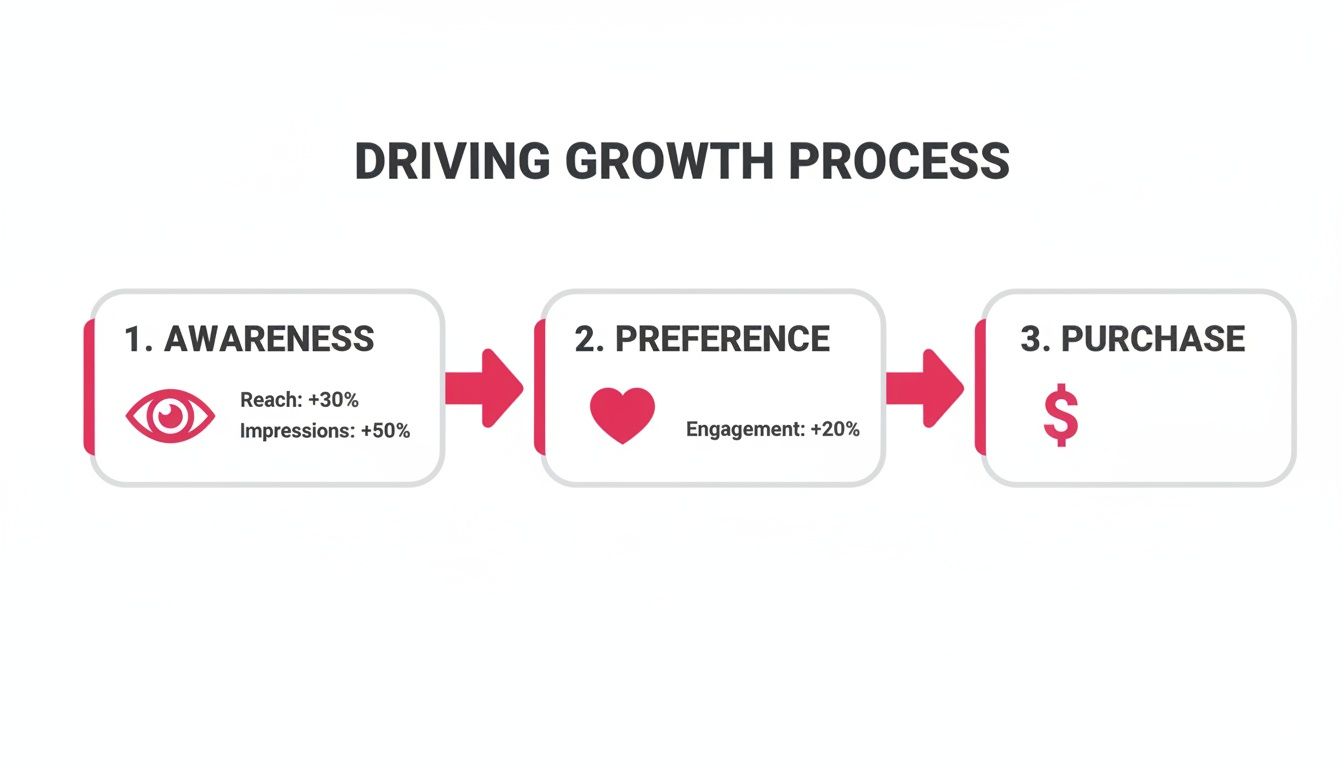
This flow really boils it down: your visibility efforts build that initial awareness, which helps nurture preference for your brand, ultimately leading people to make a purchase.
Navigating Social Media Metrics
On social platforms, it’s ridiculously easy to get lost in a sea of data. Two of the most foundational—and often confused—metrics are Reach and Impressions. Getting the difference is critical if you want to accurately measure brand awareness.
- Impressions are the total number of times your content was displayed on someone's screen. If one person sees your post five times, that’s five impressions.
- Reach is the total number of unique people who saw your content. That same person who saw your post five times? They only count as one in your reach total.
Impressions tell you how frequently your content is showing up in the feed, while reach tells you how wide your net is being cast. You need both. High impressions but low reach could mean your content is just being blasted to the same small group of super-fans over and over, but you aren't actually expanding your brand’s horizons. A killer influencer campaign, on the other hand, should give you a major boost in both. If you want to get into the nitty-gritty, our guide explains exactly https://joinbrands.com/blog/how-to-calculate-reach/ and apply it to your strategy.
Calculating Your Share of Voice
Knowing your own metrics is only half the picture. You also need to know where you stand in the larger conversation. That's where Share of Voice (SOV) comes in. SOV measures your brand's mentions and visibility compared to your direct competitors. It answers the big question: "Of all the conversations happening in our industry, what percentage is about us?"
Share of Voice is your competitive benchmark for awareness. It moves the measurement from an internal report card to a real-world assessment of your market position. A growing SOV is a leading indicator of future market share growth.
Calculating SOV isn't something you can do by hand; it requires social listening tools like Sprout Social, Brandwatch, or Mention. These platforms track mentions of your brand, products, and important keywords across social media, blogs, and news sites. Then, they do the same for your competitors.
The formula itself is pretty straightforward:
(Your Brand Mentions / Total Industry Mentions) x 100 = Your Share of Voice
Let’s say you're a new sustainable sneaker brand. After running a big UGC campaign through a platform like JoinBrands, you use a listening tool to see what happened. You find your brand was mentioned 500 times last month. Your top three competitors were mentioned a combined 2,000 times.
Your SOV would be: (500 / (500 + 2000)) x 100 = 20%.
Tracking this number quarter-over-quarter gives you an objective way to see if your marketing is actually cutting through the noise and stealing the spotlight from your rivals.
Uncovering How Your Audience Truly Perceives Your Brand
Hard numbers are great for telling you what is happening with your brand awareness efforts. Qualitative data, on the other hand, is where you discover why. This is the moment we move past simple visibility metrics and start measuring how people actually feel about your brand.
It’s all about getting inside the heads of your audience to understand their thoughts, feelings, and the associations they have with your name. After all, those perceptions are what ultimately drive them to choose you over a competitor.
Think about it: analytics can show you how many eyeballs saw your latest ad, but they can't tell you if that ad made people feel inspired, annoyed, or just plain indifferent. Digging into the qualitative side fills these critical gaps, giving you a much richer, more complete picture of your brand's health. This is how you build a brand that doesn't just get noticed, but gets chosen.

Go Beyond Mentions with Social Listening
One of the most immediate ways to tap into this is through social listening. This isn't just about counting how many times your brand gets mentioned online. Modern tools let you dive deeper to analyze the sentiment behind those mentions, automatically flagging them as positive, negative, or neutral.
Let’s say you’re a skincare brand that just dropped a new serum. Your mention count might be through the roof, which looks great on paper. But social listening gives you the context. Are people raving about their glowing skin (positive), complaining about the high price point (negative), or just asking where they can buy it (neutral)? That context changes everything.
You’ll start to see patterns you would have otherwise completely missed. Maybe you find that customers in one specific city consistently praise your eco-friendly packaging, while another group finds it hard to open. These are the kinds of actionable insights that hard data rarely reveals on its own.
Crafting Effective Brand Perception Surveys
Surveys are your direct line to your audience, but getting honest, useful feedback is an art form. The key is knowing how to ask the right questions, especially when it comes to measuring brand recall.
There are two main approaches here:
- Unaided Recall: This is the gold standard for measuring top-of-mind awareness. The question is open-ended, like, "When you think of sustainable athletic shoes, what brands come to mind first?" You provide zero hints.
- Aided Recall: Here, you give them a little nudge. You'll provide a list of brands to jog their memory. For instance, "Which of the following sustainable athletic shoe brands have you heard of? (Allbirds, Nike, Veja, Your Brand)."
Aided recall helps you gauge broader recognition, but unaided recall tells you who is truly winning the mental real estate in your category. A smart survey strategy uses a mix of both to paint a complete picture.
By combining both aided and unaided questions in your surveys, you can measure not just if people know you exist, but how easily they can retrieve your brand from memory when a need arises. This is the difference between being a known option and being the first choice.
The Goldmine of Reviews and Media Features
Never underestimate the power of online reviews. Sites like G2, Yelp, Google, or niche industry forums are overflowing with unfiltered brand perception data. These are real customers voluntarily sharing detailed opinions about their experiences.
Pay close attention to the specific language they use. Do people consistently describe your customer service as "fast and friendly" or is "slow and frustrating" a common theme? Do they rave about your product's "durability" or complain that it feels "cheap"? This language is a roadmap for your marketing. If everyone loves your durability, you should be shouting that from the rooftops in your ad copy.
Likewise, earned media features give you a valuable third-party perspective. When a respected journalist or blogger reviews your product, they're lending their credibility to your brand. Tracking these features helps you understand how the influential voices in your space are framing your story.
Tapping Into Authentic Creator Content
User-generated content (UGC) from creators is like having a real-time focus group running 24/7. When you partner with creators through a platform like JoinBrands, you're getting more than just exposure—you're getting an authentic interpretation of your brand.
The way a creator unboxes your product, the words they choose to describe it, and the real-life situations they use it in are all genuine reflections of a consumer's perspective.
This is more important than ever. Research shows that 77% of consumers prefer shopping with brands they follow on social media, and 81% of consumers need to trust a brand before they'll buy from it. For DTC brands using channels like TikTok Shop Affiliates, this creator-driven content is a direct and highly measurable form of brand awareness. You can explore more of these powerful branding statistics and consumer trends to see just how deep the connection goes.
Watching this content roll in provides priceless feedback on how your brand is perceived and used "in the wild." You’ll often uncover creative use cases or messaging angles your own team hadn't even thought of.
Getting Direct Audience Feedback Through Surveys
Digital analytics tell a powerful story about what people do, but they can't read your audience's mind. To really get a handle on brand awareness, you have to go straight to the source. Surveys are your most direct line of communication, turning fuzzy concepts like "brand recall" into concrete data you can actually use.
This isn't about blasting out a generic questionnaire and hoping for the best. It’s a strategic process. You need to ask the right questions to the right people at the right time. When you nail it, a well-designed survey gives you undeniable proof that your brand is carving out more mental real estate within your target market.
The Power of Pre- and Post-Campaign Surveys
One of the smartest ways to use surveys is for benchmarking. Before you kick off a major marketing push—like a big creator campaign—you launch a survey to establish a clear baseline. This first survey simply measures your brand's current awareness levels with your target demographic.
Then, once the campaign wraps up, you send out the exact same survey to a similar audience segment. The change in the results is what we call "brand lift," and it gives you a quantifiable measure of your campaign's impact.
This method shifts the conversation from, "I think the campaign worked," to, "We increased unaided brand recall by 12% among our key demographic." It's the kind of hard data you need to justify marketing spend, especially for top-of-funnel investments that don't have a clear, direct path to conversion.
Unaided Recall vs. Aided Recall
The heart of any good brand awareness survey beats around two key question types: unaided and aided recall. Getting the difference between these two is crucial for gathering insights that actually mean something.
Unaided Recall is the true test of top-of-mind awareness. It’s when you ask broad, open-ended questions without giving any clues or hints.
- Example Question: "When you think of buying sustainable running shoes, what brands come to mind first?"
This type of question shows you which brands truly own the category in the consumer's mind. If your name pops up frequently in these unprompted answers, you’ve hit a major milestone in brand salience.
Aided Recall, on the other hand, gives the respondent's memory a little jog by providing a list of options. It’s designed to measure a broader level of recognition.
- Example Question: "Which of the following sustainable running shoe brands have you heard of? (Please select all that apply)" You would then list your brand alongside several competitors.
This question helps you figure out if your brand is at least in the consideration set, even if it isn't the first one that springs to mind.
A healthy brand strategy is all about moving customers from aided to unaided recall. Aided recall means they know you exist; unaided recall means they think of you on their own when they have a need.
Designing Your Survey Questions
Using tools like SurveyMonkey, Typeform, or even Google Forms, you can build and send out your survey pretty easily. The secret is to keep it short and focused. Always start with the broader, unaided questions before you move to the more specific, aided ones. This helps you avoid biasing the initial responses.
Here’s a quick comparison table to help you design your questions and understand what each type is best for.
Aided vs. Unaided Recall Survey Questions
| Question Type | Example Question | Best Used For |
|---|---|---|
| Unaided Recall | "What brands come to mind when you think about [product category]?" | Measuring top-of-mind awareness and identifying your strongest competitors. |
| Aided Recall | "Which of these [product category] brands have you heard of?" | Gauging overall brand recognition and benchmarking against a known competitor set. |
| Brand Attributes | "Which of the following words would you use to describe [Your Brand]?" | Understanding brand perception and whether your messaging is landing correctly. |
| Purchase Intent | "Based on what you know, how likely are you to consider purchasing from [Your Brand] in the next 6 months?" | Connecting awareness directly to future sales potential and purchase consideration. |
By mixing these question types, you can build a comprehensive survey that measures not just if people know you, but how they know you and what they think about your brand. This kind of direct feedback is gold for refining your messaging, targeting, and overall marketing strategy.
Tying Creator Marketing to Measurable Brand Lift
Creator marketing often feels like it lives in its own universe, totally separate from the hard data we get from performance channels. But that’s a misconception. When you structure your campaigns with awareness as a core goal, you can draw a direct, data-backed line between creator content and tangible brand growth.
This is how you close the loop, turning user-generated content (UGC) from a simple creative asset into a powerful engine for genuine brand lift. The trick is to design campaigns where metrics like total impressions, UGC reach, and engagement on creator posts are your primary KPIs. Instead of just chasing conversions, the goal becomes maximizing visibility and embedding your brand in the minds of new audiences.
Achieving Critical Memory Retention
Ever wonder why you keep seeing ads for the same product over and over again? There's a science to it. We know from experience that it typically takes 5-7 impressions for a consumer to actually remember a brand. This "memory threshold" is a foundational concept you can't ignore.
Brand recall is the single biggest driver of brand lift, accounting for a staggering 38.7% of awareness gains in emerging media. This means getting your brand seen repeatedly isn't just a tactic; it's the primary way to build lasting recognition.
This is where a strategic, multi-creator campaign becomes so incredibly powerful. One influencer might reach a segment of your audience once or twice, but collaborating with a diverse group of creators ensures your message is delivered multiple times across different channels and formats.
This is exactly what platforms like JoinBrands are built for. By connecting you to a network of over 250,000 creators, they make it possible to get this kind of reach at scale. Using authentic UGC and formats like Spark Ads, you can generate the critical mass of impressions needed to finally cross that memory threshold.
Using Hybrid Metrics for a Fuller Picture
While pure awareness metrics are valuable, you don't have to completely abandon performance tracking. You can—and should—use "hybrid" metrics that track both visibility and direct action. This gives you a much more complete view of a creator's true impact.
Two of the most effective hybrid tools are dead simple:
- Creator-Specific UTM Parameters: Give each creator a unique UTM link to your website. This is non-negotiable. It lets you track every single click they drive, helping you see which creators are not only generating high engagement but are also compelling their audience to take the next step.
- Unique Discount Codes: Assigning a unique promo code to each influencer (e.g., "SARA15," "MIKE15") is a classic for a reason. It directly attributes sales to specific creators, but it also functions as an awareness metric. Even if a code isn't used, its very existence reinforces the brand-creator connection.
These hybrid metrics are incredibly useful for building a data-backed business case for your creator marketing spend. You can show stakeholders that a campaign not only increased your brand's reach by 2 million impressions but also drove 500 direct site visits and 50 attributed sales. Suddenly, you have a powerful, multi-layered story of success.
From Content Creation to Campaign Analysis
To really nail brand awareness measurement through creator marketing, your workflow needs to be seamless from start to finish. It all begins with a clear creative brief that explicitly outlines awareness as the primary goal and specifies the metrics that matter most.
Platforms designed for this purpose help streamline the entire process. You can match with creators whose audiences align perfectly with your target demographic, manage product shipping, and approve content all in one place.
Once the campaign goes live, the focus shifts to aggregating the data. You'll be tracking impressions, reach, engagement, and, of course, the performance of your hybrid metrics. This structured approach ensures that your creator campaigns aren't just creative side projects—they're measurable, strategic initiatives that contribute directly to your brand's bottom line.
If you're looking to tighten up your entire process, our complete guide on mastering influencer marketing campaigns is the perfect next step.
Common Questions About Measuring Brand Awareness
If you're trying to wrap your head around brand metrics, you're not alone. Whether you're a startup founder juggling a dozen tasks or a seasoned marketer fine-tuning your strategy, getting straight answers is key. Let's tackle some of the most common questions we get about measuring brand awareness.
How Often Should I Measure Brand Awareness?
There's no magic number here, but a balanced rhythm works best. For most D2C brands, a comprehensive brand health check every quarter is a great pace. This gives your campaigns enough runway to actually shift consumer perceptions, but it’s still frequent enough to help you make smart decisions for the next quarter.
That said, you definitely shouldn't be flying blind for three months. Some metrics need a much closer look.
- Weekly Check-ins: Keep a steady pulse on your direct traffic, social media mentions, and overall engagement rates. These are your early warning signals.
- Daily Pulse Checks: Share of Voice (SOV) can swing wildly, especially if you or a competitor launches a big campaign. It's smart to monitor this daily or at least a few times a week using a social listening tool.
Think of it this way: your quarterly survey is the deep-dive physical exam, while your weekly dashboard is like checking your heart rate. You need both for a complete picture of your brand's health.
What Is the Difference Between Brand Awareness and Brand Recognition?
People often use these terms interchangeably, but they’re actually different rungs on the ladder of customer connection. Nailing the distinction will help you set much sharper goals.
Brand awareness is the ground floor. It just means a consumer knows your brand exists within a specific category. They might have seen an ad or heard your name dropped, but the connection is pretty light.
Brand recognition is the next step up. This is when someone can identify your brand just by seeing your assets—your logo, specific colors, packaging, or a catchy jingle—even without your name attached. The golden arches or the Nike swoosh are the gold standard for brand recognition.
Ultimately, the goal is brand recall, which is when your brand is the first one that pops into a consumer's head when they think of a product category. Your entire strategy should be about moving people up this ladder, from basic awareness to automatic, top-of-mind recall.
Brand awareness gets you invited to the party. Brand recognition helps people find you in the crowd. Brand recall makes you the reason they showed up in the first place.
Can Small Brands Effectively Measure Brand Awareness on a Budget?
Absolutely. You don't need a six-figure budget or a suite of enterprise tools to get solid, actionable data. The trick is to be scrappy and make the most of the free or low-cost tools already available to you.
- Google Analytics: This is your best friend. Use it to track Direct Traffic, a powerful and free indicator of how many people are seeking you out by name.
- Google Trends: Another free gem from Google. You can easily track search interest for your brand over time and even pit it against your main competitors to see how you stack up.
- Native Social Media Analytics: Every platform, from Instagram to TikTok, gives you a free dashboard. Use it to track follower growth, post reach, and brand mentions without spending a dime.
- Low-Cost Survey Tools: Platforms like Typeform or SurveyMonkey offer free or affordable plans that are perfect for sending quick brand perception surveys to your email list or social followers.
By piecing together the insights from these accessible sources, even the leanest startup can create a surprisingly clear picture of its brand awareness.
What Is a Good Share of Voice Percentage to Aim For?
This is a great question, but there's no universal "good" number. Your target Share of Voice (SOV) is completely relative to your industry and how crowded it is. A solid SOV in a packed market like skincare will look very different from a niche B2B software category.
However, there is a powerful rule of thumb to follow: aim for a Share of Voice that is at least equal to your market share. For instance, if your company currently commands 10% of the market, you should be shooting for a minimum of 10% SOV.
Here's where it gets exciting: when your SOV starts to exceed your market share, that's a massive leading indicator of future growth. It means you're punching above your weight and generating more conversation than your current size suggests. This is how you set the stage to steal market share from the big guys.
Ready to turn these insights into action? JoinBrands connects you with over 250,000 creators to generate authentic UGC that boosts every metric we've discussed. Start building and measuring a brand that gets noticed, remembered, and chosen. Discover the right creators for your brand at https://joinbrands.com.