


 Whitelisting Social Media A Guide to Scaling Creator Ads
Your product launch marketing plan is more than just a document; it's the strategic roadmap guiding every single action you take to bring your new product into the world. It’s the master plan, covering everything from building buzz before you even launch to the big day itself and all the crucial follow-up analysis. A solid plan is what makes the difference between a coordinated, high-impact launch and one that fizzles out.
Table of Contents
Building Your Pre-Launch Strategic Foundation

Long before you drop the first teaser on social media or greenlight a single ad, the real heavy lifting of a launch begins. This is the foundational stage, where you lay the strategic groundwork that will support everything else you do. Rushing this part is like building a house on a shaky foundation—it might look fine for a minute, but it's guaranteed to crumble under pressure.
Let's be real: the market is crowded and unforgiving. Think about it—over 30,000 new consumer products hit the global market every year. What’s even more sobering is that only 40% of developed products actually make it to launch. Of those, a mere 60% manage to generate any revenue at all. These numbers aren't meant to scare you; they're meant to underscore just how critical a rock-solid marketing strategy is.
Defining Your Ideal Customer Profile
First things first, you need to get crystal clear on who you're selling to. Forget vague demographics. We're talking about creating a laser-focused Ideal Customer Profile (ICP). An ICP isn't just "millennial women who live in cities." It's a living, breathing portrait of the exact person who will get immense value from your product and turn into its biggest fan.
To get this right, you have to dig deep and answer some specific questions:
- What keeps them up at night? Pinpoint the exact problems and daily frustrations your product is built to solve.
- Where do they hang out? Figure out which blogs they read, podcasts they listen to, and influencers they trust. This is where you'll find them.
- What makes them pull out their wallet? Are they motivated by a good deal, cutting-edge features, glowing reviews, or a brand that shares their values?
Imagine you're launching a new project management tool. A weak profile is "small businesses." A powerful ICP is "Alex, a 35-year-old agency owner managing a team of 5-10. Alex is overwhelmed by scattered client emails and constantly worried about missing deadlines. They listen to business podcasts on their commute and follow agency growth experts on LinkedIn." See the difference? That level of detail makes every marketing decision ten times easier.
Establishing Clear and Measurable Goals
Once you know exactly who you're talking to, you need to decide what you want to achieve. Launching without clear goals is just making noise. This is where the SMART framework (Specific, Measurable, Achievable, Relevant, Time-bound) becomes your best friend.
Don't settle for a vague goal like "make a lot of sales." A powerful, SMART goal sounds like this: "Achieve 500 new paying customers within the first 30 days of launch." This gives your team a finish line to run toward and a clear way to know if you've won. These early steps are just as crucial as getting your business structure right. For our friends up north, a good primer on how to register a company in Canada can help nail that foundational piece.
A launch without clear goals is just an announcement. A launch with defined KPIs is a business strategy. Your pre-launch foundation ensures you’re executing the latter.
Analyzing the Competitive Landscape
Finally, it's time for an honest look at the competition. The goal here isn't to copy what everyone else is doing; it's to find your own lane. A solid competitive analysis helps you uncover your Unique Value Proposition (UVP)—that one special thing you do better than anyone else in the market.
To help structure your thinking, it’s useful to break down this foundational phase into its core parts.
Core Components of Pre-Launch Planning
This table gives a quick snapshot of the essential pre-launch activities and what you should be aiming to achieve with each one.
| Activity | Objective | Key Outcome |
|---|---|---|
| Market Research | To understand customer needs and market size. | A validated ICP and TAM (Total Addressable Market). |
| Competitive Analysis | To identify competitors' strengths and weaknesses. | A clear Unique Value Proposition (UVP). |
| Goal Setting (SMART) | To define what success looks like for the launch. | Specific, measurable launch KPIs. |
Nailing these components is absolutely essential for a strong start.
This groundwork ensures your product doesn’t just show up to the party—it makes a grand entrance. To get a more complete picture of the entire process, you can explore our detailed guide on how to launch a new product.
Creating Unstoppable Pre-Launch Momentum
The weeks before your launch are pure gold. This is your chance to build an audience that isn't just aware of your product but is genuinely counting down the days until they can buy it. We're not talking about just making noise; this is about cultivating real excitement. A solid pre-launch turns your big day from a hopeful announcement into a can't-miss event.
This whole period boils down to storytelling. Your product is more than a list of features—it's the answer to a problem, a better way of doing something. Your job is to tell that story through every piece of content, turning casual observers into die-hard fans who are invested in your journey.
Crafting Your Pre-Launch Narrative
Before you even think about a social media post, you need to nail down the story you want to tell. This narrative is the emotional engine of your pre-launch campaign. It has to feel authentic, be compelling, and stay consistent everywhere you show up.
Dig into the "why" behind your product. What was the spark that led to its creation? What frustrating problem does it finally solve? Share the real journey—the setbacks, the wins, and the passion that fueled its development. Pulling back the curtain makes your brand human and gives people a reason to care.
Imagine a sustainable fashion brand. They could share stories about tracking down eco-friendly materials or feature the artisans who actually craft the clothing. That creates an emotional hook that's way more powerful than just the product itself, building a community around shared values.
Powering Your Story with Strategic Content
Once your narrative is set, it's time to map out a content calendar that brings it to life. The aim here is to create a steady drumbeat of anticipation. Keep your audience guessing and engaged by mixing up your content formats.
Your calendar should be a strategic blend of a few key things:
- Teaser Content: Think cryptic images, short video clips, or countdown timers that hint at what's coming without giving it all away. This gets people talking and speculating.
- Behind-the-Scenes Access: Post photos of your team in action, sneak peeks of the design process, or quick videos from the factory. That kind of transparency builds trust and makes your audience feel like they're on the inside.
- Value-Driven Blog Posts: Write articles that tackle your ideal customer's pain points—the very problems your product is designed to fix. This establishes you as an expert and attracts an audience that’s already searching for your solution.
This strategy keeps you consistently in front of your audience, building that all-important familiarity and excitement. Every piece of content adds another layer to your story, pulling them deeper into your world and that much closer to hitting "buy" on launch day.
A great pre-launch campaign doesn't just announce a product; it reveals a story. It invites people to be part of something new, transforming them from potential customers into early evangelists.
Partnering with Influencers to Amplify Your Message
To really get that unstoppable momentum going, you have to push your message beyond your own channels. This is where influencer marketing becomes a critical part of your product launch marketing plan. It's not about chasing creators with the biggest follower counts; it's about finding the ones with the right followers—people who are a perfect match for your Ideal Customer Profile.
The right influencer partnership gives your product instant credibility and social proof before it's even available. Their authentic endorsement is a powerful signal to their community that your product is something special. JoinBrands makes this whole process way easier, letting you filter through a huge network of creators to find your perfect match based on niche, audience demographics, and engagement rates. You're not just buying exposure; you're tapping into a pre-built community that's ready to love what you've created.
The influencer marketing space is projected to hit $23.6 billion by 2025, and 59% of marketers are planning to increase their partnerships. Why? Because it works. A whopping 76% of social media users say creator content has influenced their buying decisions. In an age where brand loyalty is dropping, tapping into social discovery isn't just a good idea—it's essential. You can read the full research on these digital marketing trends. We also have a deeper guide on how to build successful influencer marketing campaigns that drive real results.
Building Your High-Intent Email List
Social media is fantastic for building buzz, but your email list is your single most valuable pre-launch asset. It’s a direct line to your most interested and engaged potential customers. Your number one goal during the pre-launch phase should be getting as many qualified people onto this list as possible.
Set up a dedicated landing page with a killer offer in exchange for an email. A generic "join our newsletter" button won't cut it here. You need to offer something genuinely valuable:
- Exclusive early access to the product before anyone else.
- A special launch-day discount just for subscribers.
- Entry into a giveaway to win the new product.
- Access to an exclusive guide or webinar that solves a problem related to your product.
Push this landing page everywhere—in your social media bio, at the end of every blog post, and have your influencer partners promote it. Every single email you collect is someone raising their hand and saying, "I'm in." These are the people who will be lined up and ready to buy the second you go live.
Executing a High-Impact Launch Day Blitz
The moment is finally here. After months of planning, creating content, and warming up your audience, launch day is the payoff for all that hard work. This isn't just about flipping a switch; it's about conducting a coordinated, multi-channel marketing blitz to make the biggest possible splash.
Success on launch day is all about a powerful, unified campaign where every channel works together. Your owned channels (website, email list), earned media (PR mentions, influencer posts), and paid advertising (PPC, social ads) must all push the same compelling message at the exact same time. This creates an echo chamber effect, making your product's debut feel like an event nobody wants to miss.
Orchestrating Your Owned Channels
Your owned media is the bedrock of your launch day push because you have complete control. Your website's homepage needs to become a bold announcement, pointing visitors straight to the new product. Double-check that all your site navigation is updated and that the path from discovery to checkout is buttery smooth.
At the same time, your email list—the high-intent audience you've been carefully nurturing—gets the VIP treatment. You need to craft a launch-day email that’s full of energy and has a crystal-clear call-to-action. Think of it less as a simple notification and more as the starting gun for your most loyal followers.
This process flow shows how content, influencers, and your email list all build momentum that converges on launch day.
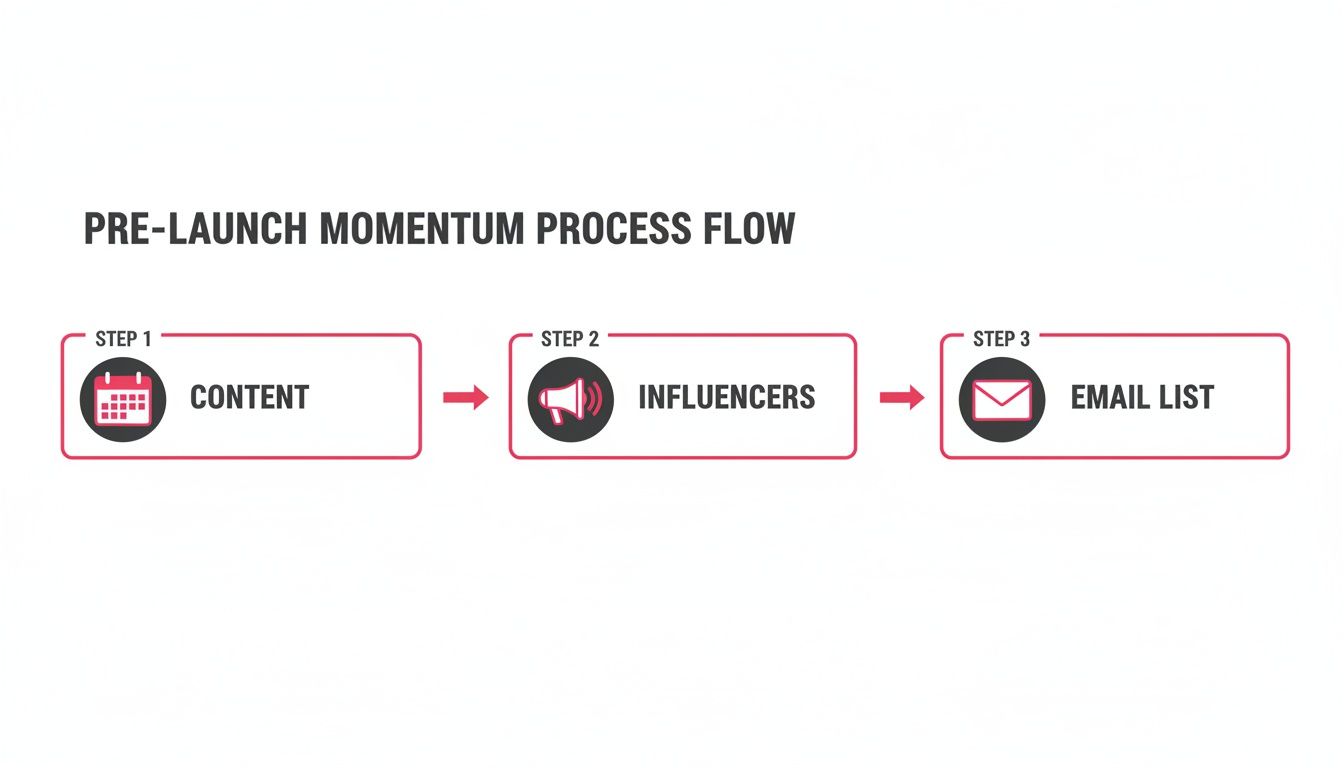
Each of these streams has to come together to create a powerful, coordinated push. That’s how you get a truly successful launch.
Activating Your Earned and Paid Media
While you steer your owned channels, earned and paid media give you the amplification needed to cut through the noise. This is where all that pre-launch coordination with influencers and press contacts really pays off. On launch day, your partners should be ready to publish their reviews, unboxing videos, and endorsements, lending their credibility to your new product.
Inside the JoinBrands platform, you can manage this in real time. Use the chat feature to give your influencers the green light and keep tabs on when their content goes live. This ensures their posts hit at the same time as your own announcements, maximizing the impact.
Paid advertising is the fuel on the fire. Your launch day campaigns should be live across every relevant platform, targeting lookalike audiences you’ve built from your email list and website visitor data.
Here’s a simple breakdown:
- Social Ads: Take your best-performing teaser content and update it with a direct "buy now" link. Focus on eye-catching formats like Instagram Reels and YouTube Shorts.
- Search Ads (PPC): Bid aggressively on your brand name and core product keywords. You want to capture every high-intent searcher who is actively looking for you on launch day.
Let's be real—the market is brutally competitive. In fact, only 3% of newly launched products manage to break $50 million in first-year sales. That statistic shows just how thin the margin for error is. Iconic launches, like the original iPhone back in 2007, show what’s possible when a masterful blend of timing, buzz, and strategic spending creates a true cultural moment. You can dig into more of these marketing statistics and benchmarks to see what you’re up against.
Deciding where to focus your energy on launch day can be tricky. Each channel serves a different purpose, from driving immediate sales to building long-term brand equity. This table breaks down the primary role of each channel, what to measure, and a practical tactic you can use.
Launch Channel Strategy Comparison
| Channel | Primary Role | Key Metric | Example Tactic |
|---|---|---|---|
| Email Marketing | Drive immediate sales from your most loyal audience | Click-Through Rate (CTR) to the product page | Send a launch announcement with an exclusive, time-sensitive offer to your subscriber list. |
| Influencer Marketing | Build social proof and credibility through trusted voices | Engagement Rate on influencer posts | Coordinate with influencers for a synchronized "unboxing" or "first look" post at a specific time. |
| Paid Social Ads | Amplify reach to new, targeted audiences | Cost Per Acquisition (CPA) | Run video ads showcasing the product in action, targeting lookalike audiences of your existing customers. |
| PPC/Search Ads | Capture high-intent buyers actively searching for a solution | Conversion Rate from ad clicks | Bid on branded keywords and long-tail product-specific terms to dominate search results. |
By using a mix of these channels, you create a comprehensive blitz that reaches people at different stages of awareness and intent. The goal is to make your launch feel like it's happening everywhere at once.
Monitoring Performance in Real Time
A launch day blitz is anything but a "set it and forget it" activity. A solid product launch marketing plan must include a strategy for real-time monitoring and optimization. You need to keep a close eye on your key performance indicators (KPIs) from the second you go live.
Your launch day dashboard is your command center. Watch the data like a hawk and be prepared to pivot instantly. Agility is your greatest asset when the stakes are this high.
Set up a dedicated dashboard to track these essential metrics:
- Website Traffic: Are you seeing the expected spike from your email and social announcements? Use a tool like Google Analytics to monitor traffic sources in real time.
- Conversion Rate: How many visitors are actually becoming customers? If this rate is lagging, you might have some friction in your checkout process that needs a quick fix.
- Social Media Engagement: Keep an eye on mentions, shares, and comments. What are people saying? Jump in to answer questions and amplify positive feedback immediately.
- Ad Performance: Monitor your click-through rates (CTR) and cost per acquisition (CPA). If one ad creative is crushing it, reallocate your budget to double down on what’s clearly working.
By tracking these indicators, you can make fast, data-backed decisions on the fly. If an influencer's post is sending a tidal wave of traffic, you might want to boost it with some paid spend. If a particular ad is a dud, pause it and shift those funds to a better performer. This kind of active management ensures you're squeezing the most value out of every dollar and every minute of your launch day.
How to Sustain Momentum After the Launch
The champagne has been popped, the initial sales are in, and the launch-day adrenaline is starting to wear off. Now what? That initial burst of excitement is fantastic, but it's fleeting. The real measure of a successful launch isn't just the day-one numbers; it's what you do in the following weeks and months to keep the fire burning.
If you're not careful, you'll hit the dreaded post-launch slump. To avoid it, you have to pivot your strategy. The game is no longer about building hype—it’s about building relationships and proving your product's worth for the long haul.
Your first customers are everything. They're the ones who took a risk on you, and their experiences are now your most powerful marketing asset. The focus has to shift to capturing their stories, turning them into advocates, and making sure they stick around.
Harnessing the Power of Early Adopters
That first wave of customers is a goldmine. They hold the key to the social proof you need to convince the next round of buyers. Your top priority is to make it incredibly easy—and rewarding—for them to share what they think. Don't just sit back and hope for reviews to roll in; you need a system.
This is the perfect time to tap into a platform like JoinBrands. You can find creators who are already among your new customers or recruit new ones to try out your product. A simple offer of a free product in exchange for an honest video testimonial or some user-generated content (UGC) can work wonders.
Why? Because this content feels real. It's far more believable than a slick, polished ad.
A polished ad says, "We think our product is great." A genuine customer testimonial says, "This product actually solved my problem." One is a claim; the other is proof.
When you commission UGC, you're not just getting a few marketing assets. You're building an entire library of authentic stories that show your product working in the real world. These videos, photos, and reviews will become the backbone of your social media, website content, and ad campaigns for months to come.
Shifting Content from Hype to Help
Before the launch, your content was all about building anticipation. Now, it needs to be about education and delivering value. Your new customers will have questions, and the people still on the fence need more information before they'll pull the trigger. It's your chance to become the go-to resource for your product's niche.
Your content plan should now revolve around:
- Detailed How-To Guides: Create blog posts and video tutorials that walk users through every feature. Think beyond the basics and include some advanced tips and tricks.
- Real-World Use Cases: Show, don't just tell. Put together case studies featuring happy clients or showcase how different types of customers are solving their unique problems with your product.
- Answering Common Questions: Pay close attention to your support tickets, social media comments, and sales inquiries. What are people asking over and over? Turn those questions into a robust FAQ page or a series of quick, helpful videos.
This educational approach does two critical things. First, it helps new customers get the most out of their purchase, which means fewer support requests and less churn. Second, it shows potential buyers exactly how your product can solve their problems, making their decision to buy much easier.
Nailing Customer Onboarding and Retention
Getting a new customer is only the first step. The post-launch phase is all about customer retention, and keeping a customer is always more profitable than finding a new one. A smooth onboarding process ensures people don't just buy your product—they actually use it, love it, and become loyal fans.
Set up an automated welcome email sequence that does more than just say "thanks for your order."
- The Welcome Email: Send it immediately. Confirm the purchase and let them know what to expect next.
- The "Getting Started" Guide: A day or two later, send a simple, actionable guide to help them get their first quick "win" with the product.
- The Check-In: After a few more days, send a friendly check-in. Ask how things are going and point them toward your new educational content or support resources.
- The Ask: Once they’ve had enough time to really use the product, ask them for a review or a testimonial.
This kind of proactive communication makes customers feel seen and supported. It dramatically increases the odds they'll stick around, leave you a glowing review, and tell their friends about you. This is how you transform a launch from a single event into the foundation of a sustainable business.
Measuring Success and Optimizing for Growth

A successful launch isn't the finish line. Honestly, it’s just the starting gun for the real race: sustained growth. Once the initial buzz dies down, your focus needs to pivot hard from execution to evaluation.
Think of your product launch marketing plan as a living document. The data you're collecting right now is the fuel that will power its next evolution. Without a clear picture of what worked and what flopped, you’re just guessing. This final phase is all about creating a tight feedback loop—using cold, hard data to make smarter decisions, refine your strategy, and make sure your product thrives long after launch day.
Identifying Your Most Critical Metrics
To really understand how you did, you need to track the right numbers. It's easy to get lost in vanity metrics like raw impression counts, but they don't tell the whole story. Instead, zero in on the key performance indicators (KPIs) that directly map to the health of your customer journey, from their first click to the final sale and beyond.
Your performance dashboard should tell a complete story, connecting your marketing efforts to actual business results. A few non-negotiable metrics to keep a close eye on include:
- Customer Acquisition Cost (CAC): This tells you exactly how much you’re shelling out to get each new customer. If your CAC starts creeping up, it’s a red flag that your current channels might be getting saturated or losing steam.
- Conversion Rate by Channel: This one is huge. It breaks down which of your marketing channels are actually good at turning prospects into buyers. Was it the influencer campaign that moved the needle, or did those targeted Facebook ads outperform everything else?
- Customer Lifetime Value (LTV): This is the ultimate measure of long-term health. It calculates the total revenue a single customer is expected to generate over time. A healthy LTV-to-CAC ratio—ideally 3:1 or better—is a strong signal of a sustainable business.
It’s also crucial to understand how different touchpoints contribute to a conversion. To get a much clearer view of your customer's winding path to purchase, you can explore our in-depth guide on what is attribution modeling.
Conducting an Honest Post-Launch Review
Data tells you what happened, but a frank team discussion is where you uncover the why. A few weeks after the launch, get everyone in a room for a "post-mortem" meeting to dissect the entire campaign. This can't be a blame game; it has to be a collaborative session laser-focused on learning and getting better.
Keep the framework for the discussion simple:
- What Went Well? Kick things off by celebrating the wins. Did the influencer content absolutely crush expectations? Did the email campaign smash your previous open-rate records?
- What Didn't Go as Planned? Now, get brutally honest. Did the website buckle under the launch day traffic? Was a key marketing message just plain confusing to customers?
- What Will We Do Differently Next Time? This is the most important question. Translate all your findings into concrete, actionable takeaways for the next campaign.
For example, a team might discover their influencer content drove 50% of launch day sales, but their paid ads had a painfully high CAC. The takeaway is crystal clear: double down on creator partnerships and completely rethink the ad strategy next time around.
A post-launch review without actionable next steps is just a conversation. A review that generates a concrete list of process improvements is the foundation of your next victory.
Optimizing for Long-Term Growth
The insights you pull from your data and team review are what give you the power to optimize for the future. Continuous improvement is the whole game here. Use what you've learned to refine everything from your messaging and channel mix to your core target audience.
This becomes an ongoing cycle: measure, learn, adapt, and repeat. If you find that customer testimonials are your most powerful conversion tool, then you should immediately make gathering them a core part of your onboarding process. To really dig into the impact of your launch and optimize effectively, you can also use advanced tools like AI Brand Tracking for SaaS Companies to get deeper insights into brand perception and your position in the market.
This data-driven approach takes the guesswork out of your marketing. It transforms your product launch marketing plan from a one-time checklist into a dynamic strategy that gets smarter and more effective over time, driving predictable and sustainable growth for your brand.
Your Product Launch Questions, Answered
Launching a new product can feel like you're trying to solve a massive puzzle with a million moving pieces. It’s totally normal for questions to pop up, even when you think you have a solid plan.
Let’s tackle some of the most common ones we hear from brands just like yours.
How Far in Advance Should I Start Planning My Launch?
This is a big one, and the answer isn't the same for everyone.
For most direct-to-consumer products, the sweet spot is about 3-6 months before you plan to go live. This gives you enough breathing room to really dig into market research, start building an email list of people who are genuinely interested, create all your marketing content, and line up any partnerships without constantly feeling like you're behind.
However, if you're launching something more complex, like a B2B software with a long sales cycle, or you're stepping into a super-crowded market, you'll want to extend that timeline. Pushing it out to 9-12 months is a much safer bet. Trust me, rushing the pre-launch is one of the quickest ways to sink a product before it even has a chance to swim.
What Are the Biggest Launch Mistakes I Should Avoid?
So many launches run into the same, completely avoidable problems. Just knowing what they are puts you way ahead of the game.
Here are the pitfalls we see most often:
- Building in a Vacuum: This happens when you create a product you think people want, without doing the research to find out if they actually do.
- A Confusing Value Prop: You fail to clearly and simply explain what problem your product solves and who it's for. If you can't say it in one sentence, you've got a problem.
- Launching to Crickets: You skip the crucial pre-launch buzz-building phase and end up with no audience on day one. It's like throwing a party and not sending any invitations.
- Forgetting "What's Next": All the focus goes to launch day, but there's no strategy for keeping the momentum going and engaging all your new customers.
One of the most critical errors is not setting clear, measurable goals from the very beginning. If you don't define what a successful launch looks like in real numbers, how will you ever know if you actually achieved it?
How Much Should I Budget for My Product Launch?
Figuring out a launch budget can feel more like an art than a science, but there are some solid guidelines to get you started.
A good rule of thumb is to set aside 20-30% of your product's projected first-year revenue for the launch marketing budget. This ensures you’re putting enough fuel in the tank to make a real splash without going overboard.
Of course, that percentage can shift quite a bit depending on your industry and your game plan. A new consumer app, for example, might need a bigger budget that leans heavily into paid ads and influencer campaigns to cut through the noise. On the flip side, a niche B2B software might pour more of its budget into creating deep-dive content, detailed case studies, and materials to help their sales team close deals.
Ready to connect with creators and supercharge your next launch? With a network of over 250,000 influencers and UGC creators, JoinBrands provides the tools you need to build authentic buzz and drive sales. Start your campaign today!