



 Marketing Influencers Instagram: marketing influencers instagram insights
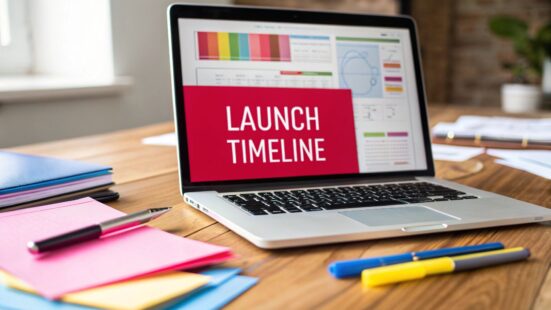
A product launch timeline template is essentially a reusable playbook that transforms the potential chaos of a launch into a predictable, coordinated process. It's a strategic map outlining every critical task, milestone, and dependency—all the way from those initial pre-launch brainstorms to the final post-launch analysis.
The goal is simple: get your marketing, sales, and development teams perfectly aligned. This avoids those last-minute scrambles, missed deadlines, and costly errors that can tank an otherwise great product.
Table of Contents
Why a Timeline Template Is Your Best Launch Insurance
Let's be real—launching something new can feel like trying to navigate a storm without a map. Teams often end up in silos, crucial tasks slip through the cracks, and deadlines become more like suggestions than hard stops. This kind of disorganization is exactly why so many product launches fail to hit their targets.
Think of a well-structured timeline template as your best insurance against this chaos.
It's so much more than a glorified to-do list. It’s the single source of truth that rallies every single stakeholder around a common goal. When the marketing team knows precisely when the final product build is locked, they can schedule their content and ad campaigns with total confidence. The sales team can then prep their outreach knowing the exact feature set they’ll be selling.
Turning Chaos into Coordination
Without a shared timeline, you’re flying blind and operating on pure assumption. The social media manager assumes the product photos will be ready by Tuesday, while the product manager assumes everyone has signed off on the final packaging. These little misalignments have a nasty habit of snowballing into major delays.
A template drags these hidden dependencies out into the open for everyone to see.
It visually connects tasks, making it crystal clear that creator outreach can't kick off until the creative brief is finalized. Or that the paid ads can't go live until the landing page is published and tested. This kind of visibility is invaluable for spotting and clearing bottlenecks before they derail your momentum.
A timeline isn't about boxing you in or stifling creativity. It’s about building a stable foundation so that the creative and strategic work can actually shine, without being derailed by logistical nightmares. It provides the structure a launch needs to build momentum, not lose it.
De-Risking Your Go-To-Market Strategy
The stakes for any product launch are incredibly high. The market is noisy, and breaking through requires precision. It's a shocking statistic, but with around 30,000 new products hitting the market each year, a staggering 95% fail to find any real, lasting success. This just goes to show how critical meticulous planning really is. You can dig deeper into these numbers in this research from Asana on product launch success rates.
A solid launch template directly tackles the main reasons behind these failures.
- Aligns Cross-Functional Teams: It breaks down those invisible walls between departments, ensuring marketing, sales, product, and support are all reading from the same script.
- Ensures Market Readiness: By scheduling key checkpoints for market research, messaging validation, and beta testing, you’re confirming that you’re launching a product people actually want to buy.
- Manages Resources Effectively: It gives you a bird's-eye view of who is responsible for what (and when), preventing team burnout and making sure your resources are focused on the highest-impact activities.
Planning a product launch is full of potential tripwires. A timeline template is your secret weapon for anticipating and navigating these challenges, turning a complex process into a manageable one. Here’s a look at how it directly solves some of the most common launch-killers.
Common Launch Pitfalls and Template Solutions
| Common Failure Point | How a Timeline Template Solves It | Example Task in Template |
|---|---|---|
| Siloed Teams & Miscommunication | Creates a single source of truth where all departments see updates and dependencies in real-time. | Marketing team to receive final product images from Design by EOD Friday. |
| Unclear Roles & Responsibilities | Every task is assigned to a specific owner, eliminating the "I thought you were doing that" problem. | Assign Owner: Finalize landing page copy - [Content Lead Name] |
| Missed Deadlines & Bottlenecks | Visually links dependent tasks, showing how a delay in one area impacts the entire launch schedule. | Creator onboarding cannot begin until creator contracts are signed and returned. |
| Poor Resource Allocation | Provides a clear overview of team workload, preventing burnout and ensuring no one is over- or under-utilized. | Review weekly workload for the content team to ensure bandwidth for video production. |
| Lack of Post-Launch Follow-Up | Schedules post-launch activities like performance analysis and customer feedback collection from day one. | Schedule post-launch debrief meeting with all stakeholders for 2 weeks post-launch. |
Ultimately, using a product launch timeline template is a proactive move. It helps you get ahead of challenges, manage all the moving parts, and build a repeatable process for success. Instead of leaving your launch to chance, you’re giving your team a strategic playbook built to deliver results, time and time again. This simple document is often the difference between a launch that fizzles out and one that truly makes an impact.
Building Your Master Launch Timeline from Scratch
Let's be real: moving from a great idea to a product people can actually buy is messy. A simple to-do list just won't cut it. You need a master launch timeline—think of it as the central nervous system for your entire project. This isn't just about listing tasks; it's about seeing the whole picture and understanding how every single piece fits together.
When you take the time to build your own timeline, you're forced to think through the tricky stuff. You have to consider dependencies, who's doing what, and what a realistic deadline actually looks like. It’s this process that turns a vague goal into a concrete, day-by-day roadmap your team can actually follow. This structure is what separates a chaotic launch from a coordinated success.
A solid template is the bridge that gets you from total chaos to a smooth, successful launch.

Without this structure, you're just guessing. A template brings order and clarity, turning a disorganized pile of tasks into a clear path forward.
Defining Your Core Launch Phases
Every single product launch, big or small, can be broken down into three main stages. Organizing your timeline around these phases keeps things logical and helps you group tasks in a way that makes sense. It’s like the three acts of your launch story.
The Pre-Launch Phase: This is where the real grunt work happens. We're talking everything from market research and product development sprints to creating all your marketing assets and locking in creator partnerships. It’s all about building momentum so everything is perfectly in place before the big day.
The Launch Day Phase: This is it—the moment your product goes live. It might only last 24 to 48 hours, but this period is jam-packed with critical, time-sensitive tasks. Think deploying the final code, hitting "publish" on announcements, and watching those initial performance metrics like a hawk.
The Post-Launch Phase: The work is far from over. This final phase is all about gathering user feedback, digging into the performance data against your KPIs, squashing any immediate bugs, and planning for the first round of updates. It’s about keeping the momentum going and learning from what just happened.
Visualizing the Workflow with Gantt Charts
Once you have your phases mapped out, you need to see how all the tasks connect. This is where a Gantt chart becomes your best friend. These charts have been around since 1915 for a reason—they are amazing for mapping out detailed schedules and dependencies. They’re essential for spotting task relationships and setting realistic due dates, which is how you avoid those costly delays.
A Gantt chart gives you that bird's-eye view of the entire project on one timeline. You can see at a glance:
- Which tasks need to finish before others can start (dependencies).
- How long each task should take.
- Who is responsible for what.
That visual clarity is incredibly powerful. It lets you spot potential roadblocks weeks or even months ahead of time, giving you plenty of room to adjust the plan.
Breaking Down Milestones into Actionable Tasks
Big, scary-sounding milestones like "Marketing Go-Live" or "Final Product Sign-Off" can feel impossible to tackle. The trick is to break them down into smaller, more digestible sub-tasks. This micro-planning makes the whole thing feel less daunting and way easier to track.
Take the "Creator Outreach" milestone, for example. It could be broken down into these smaller steps:
- Finalize Creator Brief: Pinpoint campaign goals, key messaging, and content requirements.
- Identify Potential Creators: Use a platform like JoinBrands to find creators who fit your niche.
- Send Initial Outreach: Contact your shortlisted creators with the campaign proposal.
- Negotiate Contracts: Lock in the terms, deliverables, and payment details.
- Ship Product Samples: Get the product into creators' hands with plenty of time to work their magic.
A detailed task breakdown does more than just organize your work. It creates a culture of accountability. When every small step has a clear owner and a specific deadline, there’s no room for ambiguity or confusion about who is responsible for what.
To make sure your creators have everything they need, a solid brief is non-negotiable. Check out our guide on how to create a comprehensive creative brief template to ensure your partners understand your vision right from the start.
Setting Realistic Timelines and Building Buffers
One of the biggest mistakes I see in launch planning is being way too optimistic with deadlines. Let's be honest, things almost always take longer than you think—a bug fix, a content approval, a vendor delay. A smart product launch timeline accounts for this.
Always build buffer days into your schedule, especially around your most critical milestones. If a task feels like it will take five days, schedule it for seven. This "cushion" gives your team the breathing room they need to handle unexpected hiccups without derailing the entire launch.
And to set those realistic timelines in the first place? Talk to the people who are actually doing the work. Don't just hand down deadlines from on high. Ask your developers, marketers, and content creators for their estimates. Their hands-on experience will give you a much more accurate picture of the real effort involved. For a great example of this in action, looking at a practical website development timeline template can give you some fantastic ideas for building your own. This kind of flexibility turns your template into a living document that adapts to reality, not a rigid plan that shatters at the first sign of trouble.
How to Adapt Your Timeline for Different Launches
Your master product launch template is a fantastic starting point, but let’s be real—it’s not a one-size-fits-all magic bullet. Trying to force a massive 12-week plan onto a minor feature update is just as bad as trying to cram a flagship product launch into a month. You’ll end up frustrated and burning resources.
The real skill is learning how to adapt that core framework. A quick software patch, a new product line, or a seasonal campaign each has its own rhythm. You don’t need to reinvent the wheel every time. Instead, you just need to know which levers to pull—compressing some phases, expanding others, and being ruthless about prioritizing what actually matters for this specific launch.
This is how your plan stays a useful guide instead of a restrictive cage.
The 4-Week Sprint for Fast Feature Drops
Picture this: you're about to release a highly requested integration for your SaaS product. The market window is tight, and speed is the name of the game. This is the perfect time for a condensed, 4-week launch sprint.
You aren’t cutting corners here; you're just channeling all your energy into what will move the needle the fastest. The goal is to hit your existing user base hard and fast to generate immediate awareness and drive adoption.
For a rapid launch like this, the focus shifts dramatically:
- Marketing Focus: Forget a multi-month content calendar. Your priority is a handful of high-impact assets: a sharp announcement blog post, a quick demo video, and some in-app notifications to grab attention.
- Creator Outreach: Instead of a broad, drawn-out campaign, you could activate a small group of 5-10 power users or brand advocates for some quick, authentic social proof. A platform like JoinBrands is perfect for finding and mobilizing these creators in a hurry.
- Technical Readiness: The heavy lifting on the development side is probably done. Now, it's all about final QA, deployment, and making sure your support team has the talking points down for any user questions.
In a 4-week sprint, there's no room for long beta tests or endless messaging reviews. It's all built on agility and trusting your team to execute.
The 16-Week Marathon for Major Product Debuts
Now, let's flip the script. You’re gearing up to launch a brand-new, flagship physical product. This isn’t an update; it's a major market entry. You need to build buzz from scratch.
This is where a comprehensive, 16-week marathon comes into play. It gives you the runway you need for a much deeper, more strategic go-to-market plan. A longer timeline lets you layer in complex activities that are just impossible in a sprint, which is crucial for de-risking the launch and making sure every detail is polished.
The luxury of a longer timeline isn't about taking more time for the same tasks. It’s about having the space to be more strategic—to test, learn, and build a powerful groundswell of demand before your product ever hits the shelves.
A 16-week plan allows you to build momentum methodically. By the time launch day rolls around, the market isn't just aware of your product—they're actively waiting for it.
Comparing a 4 Week vs 16 Week Launch Timeline
The core phases of your launch—pre-launch, launch, and post-launch—will always be there. But what you do in those phases can look completely different. Understanding where to shift your focus is key to allocating resources correctly and setting realistic expectations for your team.
Here's a quick look at how the priorities change between a sprint and a marathon.
| Launch Phase | Key Focus in a 4-Week Launch | Key Focus in a 16-Week Launch |
|---|---|---|
| Product Readiness | Final QA testing, documentation updates, and bug fixes for an existing product. | Comprehensive beta testing with user groups, supply chain coordination, packaging design, and final prototype approvals. |
| Marketing & Content | Core asset creation: announcement blog, email blast, and social media graphics. | Full-funnel content strategy: top-of-funnel blog posts, lead magnets, case studies, video series, and a press kit. |
| Creator & PR | Activating a small group of existing brand advocates for quick social proof. | Building relationships with top-tier influencers, media outreach for reviews and features, and coordinating a large-scale UGC campaign. |
| Sales Enablement | Updating internal talking points and providing a brief training for the support team. | Developing comprehensive sales decks, battlecards, competitor analysis, and conducting in-depth training for the entire sales organization. |
Ultimately, adapting your timeline is about being a realist. Take a hard look at the scope of what you're launching and choose the path that gives your product the best shot, whether that’s a focused sprint or a strategic marathon.
The Non-Negotiable Milestones for Your Launch Checklist
A product launch timeline is just a series of dates on a calendar until you anchor it with meaningful milestones. These are the big, non-negotiable checkpoints that tell you if you're actually on track or just busy. They turn a simple schedule into a powerful launch plan, making sure no critical detail gets lost in the frantic push toward launch day.
When you start thinking about your launch in distinct phases—each with its own set of must-haves—everything becomes clearer. It naturally organizes your tasks, moving from the foundational product work to the external-facing marketing and sales blitz. This is exactly what separates a smooth, coordinated launch from a chaotic, last-minute scramble.

Product and Technical Readiness
Before you can even dream of marketing, the product itself has to be rock-solid. This stage is all about nailing down the final details and squashing any bug that could ruin a user's first impression. Trust me, one critical glitch can derail an otherwise perfect launch.
Your checklist here needs to be airtight:
- Final Bug Sweeps and QA Sign-Off: The dev team has done its final pass, and the QA team has officially given the green light. No exceptions.
- Finalize Packaging and Unboxing Experience: For physical products, this means all designs are approved, printed, and ready for that first production run.
- Lock In App Store Assets: Screenshots, compelling descriptions, and demo videos are all finalized and prepped for submission to the Apple App Store or Google Play.
- Performance and Stress Testing: The engineering team has confirmed the product can handle the inevitable launch day traffic surge without breaking a sweat.
Marketing and Communications Go-Live
Once the product is ready, the focus flips to building hype and getting your story out there. This is where your messaging, content, and outreach all come together to create a wave of interest that crests on launch day.
Your marketing checklist will likely include these heavy hitters:
- Press Release Finalized and Distributed: The official announcement is written, approved by everyone, and sent to your media list under embargo.
- All Launch Content Published: This is your big moment—the announcement blog post, the landing page, and any supporting case studies go live.
- Social Media Campaign Activated: All those pre-scheduled posts fire off across your channels, driving traffic and sparking conversations.
- Creator Content Approved and Scheduled: For creator-led campaigns, this is the moment of truth. You’ve given the final nod to all the user-generated content (UGC), and creators are set to post. To see how this works in the wild, check out our guide on how to launch a new product with creators.
A timeline tells you when, but a checklist defines what. Without a detailed list of deliverables for each milestone, you're just tracking dates, not progress. This is the difference between being busy and being productive.
Sales and Customer Support Enablement
Your internal teams need to be just as ready as your audience. A killer launch can turn sour fast if your sales team can't answer basic questions or your support crew gets blindsided by a flood of tickets. Enablement is about arming them with the knowledge and tools they need to win from minute one.
Key enablement milestones you can't skip:
- Sales Battlecards Distributed: Your reps get their hands on concise, one-pagers with key messaging, competitor takedowns, and answers to common objections.
- CRM and Sales Tools Updated: The new product info, pricing, and all relevant fields are live in your CRM. Reps need to be able to track leads and deals accurately from the get-go.
- Help Docs and Knowledge Base Published: All customer-facing support articles, FAQs, and tutorials are live and easy to find.
- All-Hands Team Briefing Conducted: You hold one final meeting to walk the entire company through the launch day plan, key messaging, and exactly what their role is.
To really tie it all together, a comprehensive product launch checklist template is invaluable. Breaking these big milestones into granular to-do lists ensures absolutely nothing slips through the cracks, giving your product the polished, professional launch it deserves.
Assigning Roles and Tracking Your Launch Success
A beautifully designed timeline can fall apart without one crucial element: clear ownership.
When tasks are just listed on a spreadsheet without a champion, they have a funny way of never getting done. This is where your timeline template evolves from a simple schedule into a powerful accountability tool. Assigning a specific owner to every single task—from the smallest content piece to the largest technical milestone—eliminates ambiguity and ensures everyone knows exactly what they’re responsible for.
This clarity prevents the dreaded "I thought you were doing that" conversation that can send a launch spiraling. It also empowers your team by giving them direct ownership over their piece of the puzzle, which is a huge motivator.

Defining Roles for a Cohesive Launch Team
For a launch to run smoothly, every key function needs a designated leader. This doesn’t mean one person does all the work, but it does mean there's a single point of contact responsible for a specific domain. Honestly, this structure is a lifesaver when things get hectic.
Here are some of the essential roles you'll want to define in your launch template:
- Launch Lead (or Product Manager): This is the captain of the ship. They orchestrate the entire timeline, resolve cross-functional conflicts, and make sure every department is aligned with the core launch objectives.
- Marketing Lead: They own the entire go-to-market strategy. This person is on the hook for everything from content creation and creator campaigns to ad activation and press outreach.
- Technical Lead: The guardian of the product itself. They oversee the final development sprints, QA testing, and the actual technical deployment on launch day.
- Sales Lead: This person is responsible for getting the sales team ready to go. Think training materials, CRM updates, and ensuring reps are prepped to convert all the demand marketing is about to generate.
Defining these roles upfront is a game-changer. If you want to dive deeper into organizing all these moving parts, it's worth exploring different types of marketing campaign management software that can help formalize these workflows.
Embedding KPIs Directly Into Your Timeline
Let's be real: a great launch isn't just about shipping on time; it's about hitting your business goals. That’s why your timeline needs to be more than a project plan—it has to be a performance tracking tool.
By embedding key performance indicators (KPIs) directly into your timeline, you connect every single activity to a measurable outcome. This data-driven approach allows you to see what’s working in real-time and make smart adjustments on the fly. You're no longer just guessing if your efforts are paying off; you have the numbers right there to prove it.
Integrating KPIs into your timeline transforms it from a static schedule into a dynamic dashboard for success. It forces you to define what winning looks like before you even start, ensuring every task is purposefully driving toward a measurable goal.
Tracking Metrics Across Every Launch Phase
Success metrics aren't static; they evolve as you move through the launch. What you measure in the weeks leading up to the big day is very different from what you'll track in the months that follow. Your template should absolutely reflect this reality.
Pre-Launch KPIs (Building Momentum)
This phase is all about building buzz and validating interest.
- Landing Page Sign-Ups: Are your teaser campaigns actually generating a waitlist?
- Creator Engagement Rate: Are the influencers you’ve partnered with creating authentic buzz that resonates with their audience?
- Social Media Mentions: Is the online chatter about your upcoming product starting to grow?
Launch Day KPIs (Making an Impact)
It's go-time. These metrics tell you how strong your initial splash was.
- Initial Sales or Sign-Ups: How strong is that initial burst of activity in the first 24-48 hours?
- Website Traffic: Are your announcements driving a significant spike in visitors?
- Press Mentions/Features: Did your PR outreach successfully land coverage in your key publications?
Post-Launch KPIs (Sustaining Growth)
The launch isn't over when the product is live. After the initial excitement fades, you need to track KPIs like active user count, product adoption rate, and customer retention to truly evaluate performance. This ongoing, data-driven cycle is the foundation of an effective long-term launch process.
Answering Your Toughest Launch Timeline Questions
Even with a perfect product launch timeline template, things get messy. Questions pop up, unexpected roadblocks appear, and what looked great on paper suddenly feels… chaotic. Anticipating these common sticking points is often the difference between a minor course correction and a full-blown launch crisis.
Let's dive into some of the most frequent questions I hear from teams trying to wrangle their launch timelines. Think of this as the extra clarity you need to solve problems before they spiral.
How Detailed Should My Initial Timeline Be?
It’s a balancing act, and one that trips up a lot of teams. You want enough detail to see the big picture, but not so much that you're paralyzed by planning.
A good rule of thumb is to get granular for the next 30-60 days. For anything beyond that, stick to high-level milestones. You don't need to map out every single social media post for a launch that's six months away. Instead, focus on the big rocks first:
- Finalizing key product features
- Securing your initial creator partnerships
- Getting the core marketing strategy approved
You can always fill in the finer details as you get closer to those milestones. This keeps the plan actionable without being overwhelming.
What’s the Best Way to Handle Unexpected Delays?
First, take a breath. Delays are inevitable. It’s not about avoiding them entirely; it’s about how you react when they happen. This is exactly why you build buffer time into your schedule—it’s your first line of defense for small hiccups.
When a significant delay hits, don't just hope for the best. Act.
- Assess the Impact: The first thing to do is figure out the ripple effect. What other tasks and milestones just got pushed back? A Gantt chart is your best friend here, as it visually shows you all the downstream dependencies.
- Communicate Immediately: Tell everyone who needs to know, right away. Nothing makes a problem worse than hiding it. Be upfront about the delay and the potential consequences.
- Re-Prioritize Aggressively: This is where you get creative. Can another task be fast-tracked to make up time? Is there a non-critical feature you can de-scope to claw back a few days? Look for opportunities to regain momentum elsewhere.
What Are the Best Tools for Managing a Launch Timeline?
Honestly, the "best" tool is the one your team will actually use consistently. I've seen teams with expensive, top-of-the-line software fail because nobody updated it, and teams succeed with a simple spreadsheet because they were disciplined.
It really comes down to your team's size and the complexity of the launch.
- Free and Simple Options: For smaller teams or more straightforward launches, don't overcomplicate it. Tools like Google Sheets, Trello, or the free tier of Asana work beautifully. They give you what you need to assign owners, set due dates, and see progress at a glance.
- Powerful Paid Platforms: When you're juggling a lot of cross-functional teams and complex dependencies, it's often worth investing in a more robust tool. Platforms like monday.com, Wrike, or Jira offer advanced features like interactive Gantt charts, resource management, and automated reporting that can be a lifesaver.
The tool itself is less important than the discipline of using it. A simple spreadsheet that everyone updates daily is far more effective than powerful software that gathers digital dust.
Ready to streamline your creator outreach and content production milestones? With JoinBrands, you can find, manage, and collaborate with over 250,000 creators in one place, making it easier than ever to keep your launch timeline on track. Learn more about managing creators with JoinBrands.