





 JoinBrands’ Creator Masterclass Live #3: The UGC Trends That Defined 2025 and What to Expect in 2026
Think of the last time you bought something online. You probably saw an ad, clicked a link, landed on a website, browsed a bit, added to your cart, and finally checked out. It's a journey—one with a lot of steps where you could have easily dropped off.
Now, what if you could just buy that cool thing you saw in a creator's video right there in your feed? No new tabs, no extra clicks. That's the magic of social ecommerce.
Table of Contents
Your New Storefront: Social Ecommerce Platforms Explained

Let's break it down with a simple analogy. Your traditional e-commerce site is like a physical, brick-and-mortar store. You have to convince people to get in their car and drive to your location.
Social ecommerce platforms, on the other hand, are like setting up a killer pop-up shop in the middle of a packed music festival. Your customers are already there, hanging out, having a good time, and you're just making it ridiculously easy for them to buy.
This simple shift completely flips the old customer journey on its head. Shopping is no longer a separate, intentional act; it's woven directly into the social fabric. A customer sees a product they love in a video, taps a button, and buys it—all without ever leaving the app. That seamless flow from discovery to purchase is what makes this so powerful for brands.
The Shift From Social Selling To Social Shopping
For years, brands have been doing "social selling," which really just meant using social media as a billboard to herd traffic over to an external website. It worked, but it was clunky. Every click away from the feed was a chance to lose a customer.
Social ecommerce isn't about selling; it's about enabling native shopping. It’s a subtle but critical difference that aligns perfectly with how people actually want to discover products today. They're tired of being interrupted by ads and would much rather find new things organically through content they genuinely enjoy.
What really sets it apart?
- Integrated Checkout: The entire transaction happens inside the social app. No more bouncing users to another site.
- Content-Driven Discovery: People find your products through authentic user-generated content (UGC), influencer videos, and livestreams—not boring product grids.
- Community as a Sales Force: Trust is built through real engagement. Likes, comments, and shares become the new social proof, carrying more weight than a standard product review ever could.
To truly grasp how these elements work together, it helps to see them side-by-side.
Core Concepts of Social Ecommerce at a Glance
This table breaks down the fundamental pillars of social ecommerce, explaining what each component means and why it's crucial for DTC brands.
| Concept | Description | Why It Matters for Brands |
|---|---|---|
| Native Shopping | The ability for users to browse and buy products directly within a social media app, without being redirected to an external website. | It dramatically reduces friction in the buying process, which means higher conversion rates and a much smoother customer experience. |
| In-Feed Discovery | Customers stumble upon products organically while scrolling through content from creators, friends, or brands they follow. | This makes marketing feel less like an interruption and more like a natural part of their entertainment, leading to stronger brand affinity. |
| Social Proof | Trust and credibility are built through visible community engagement, such as likes, comments, shares, and authentic creator testimonials. | Shoppers are far more likely to trust recommendations from peers and creators than traditional ads, driving more confident purchase decisions. |
| Creator-Led Commerce | Influencers and UGC creators act as trusted curators, showcasing products in authentic, real-world contexts and driving sales through their content. | This leverages the power of authenticity and relatability, connecting your products with highly engaged, niche audiences that are ready to buy. |
By weaving these concepts into your strategy, you're not just selling products—you're building a community-powered sales engine.
A Market Reshaping Commerce
This isn't just some passing fad; it's a seismic shift in how retail works. The global social commerce market is on a rocket ship, projected to explode from $2 trillion in 2025 to a staggering $8.5 trillion by 2030.
Think about that. By 2026, experts predict that nearly one out of every six dollars spent online will come directly from social platforms.
The core idea is simple but profound: meet customers where they are. Instead of pulling them to your store, you bring the store to them, creating a frictionless path to purchase powered by community and content.
This approach is practically tailor-made for Direct-to-Consumer (DTC) brands. It gives you a direct channel to your audience, allowing you to build relationships and loyalty right where they're already spending their time. By getting a handle on these core concepts, you'll be perfectly positioned to ride the wave of the latest social commerce trends.
Why Your Brand Cannot Afford to Sit This Out
The way people shop has fundamentally changed. We've moved from intentional, destination-style buying to spontaneous, content-driven purchases. For DTC brands, this isn't just another trend to watch from the sidelines; it's a seismic shift that completely redraws the path from discovery to checkout.
Ignoring this evolution is like keeping your storefront on a quiet side street while your customers are all gathered at a massive block party a few miles away. You might have the best products in the world, but if you're not where the people are, you're basically invisible. Social ecommerce platforms are that block party.
The old sales funnel—awareness, interest, consideration, purchase—is officially broken. It was built for an era where shopping was a separate, deliberate activity. Today, that whole journey has collapsed into a single moment. A potential customer can see a product, get a trusted recommendation, and buy it, all within the span of a 30-second video.
This shift transforms the customer journey from a linear funnel into a dynamic, content-first ecosystem. The endless scroll is now directly wired to the 'add to cart' button, turning every single post into a potential point of sale.
For modern consumers, especially younger generations, this seamless experience isn't a cool new feature—it's the bare minimum. They live their lives in social feeds and fully expect the brands they follow to meet them there with integrated, frictionless shopping.
The New Main Street for Modern Shoppers
So, who's driving this change? Gen Z and Millennial consumers, without a doubt. These digital natives don't just use social media to connect; they use it as their main engine for discovering new products and getting validation before they buy. They trust creators far more than traditional ads and would much rather shop inside the apps where they already spend hours every day.
This reality has huge financial implications. A closer look at the demographics of social commerce shows that Millennials make up 33% of spending, with Gen Z right on their heels at 29%. Combined, these two generations are responsible for over 62% of all transactions happening on social ecommerce platforms. It’s a clear sign of how comfortable they are with in-app purchasing. You can explore more ecommerce statistics to see just how dominant this audience is becoming.
Bottom line: if these generations are your target market, your main storefront is no longer just your website. It's TikTok, Instagram, and any other platform where authentic content is king.
The Cost of Inaction Is Market Share
Brands that are jumping on this new model aren't just adapting; they're actively stealing market share from slower competitors. The early adopters on platforms like TikTok Shop and Instagram Shops are building direct relationships with customers, collecting invaluable first-party data, and creating powerful sales channels driven by their own communities.
Think about the massive competitive advantage this creates:
- Less Friction: By letting customers check out right in the app, you get rid of all the extra clicks and page loads that cause people to ditch their carts on traditional websites.
- Real Trust: Sales are driven by genuine creator content and user recommendations, building a level of credibility that a slick ad campaign can only dream of.
- Impulse Buys: You capture the sale right when a customer's interest is at its peak, turning a moment of inspiration into an immediate transaction.
On the flip side, brands that stick only to the old playbook risk fading into the background. As more and more commerce happens within social apps, a website-only approach will feel clunky and disconnected to the modern shopper. You'll be asking people to leave the party to come visit your quiet store—and most of them just won't make the trip. The time to get social ecommerce platforms into your core strategy isn't on the horizon; it’s already here.
The Essential Features of a Winning Platform
A killer social e-commerce strategy is only as good as the tools you're using. We've talked about the why, so now let's get into the what. It's time to break down the specific features that take a platform from being a basic social media add-on to a legit sales powerhouse. These aren't just flashy extras; they are the core mechanics that make that smooth, in-app shopping experience a reality.
Think of it like building a high-performance race car. You need way more than just a frame and four wheels to win. You need a roaring engine, a flawless transmission, and a smart dashboard giving you all the right info. In social e-commerce, the features are those critical parts, all working together to get your brand from the discovery phase to checkout in record time.
At the end of the day, a winning platform has to turn mindless scrolling into a real shopping moment. That magic happens with a set of integrated tools built to grab a customer's attention right when it sparks.
Seamless In-App Checkout
The single most critical feature of any real social e-commerce platform is a native, in-app checkout. This is the engine of your social store, plain and simple. It lets a customer go through the entire purchase—from adding an item to their cart to punching in their payment info—without ever having to leave the app.
Every single extra click or redirect to another website is a chance for a potential customer to bail. In fact, a clunky checkout process is one of the biggest reasons people abandon their carts. By getting rid of that friction, you make the path to purchase incredibly short and cash in on the impulse that drives so many social media buys.
Shoppable Content and Product Tagging
If the checkout is your engine, then shoppable content is the fuel. This is the feature that lets you tag your products directly inside photos, videos, and even live streams. When a user sees a creator rocking a jacket they absolutely love, they can just tap the tag to see the product details, price, and a link to buy it right then and there.
This turns every piece of content you post into a live, interactive storefront. It's like a mannequin in a shop window, but a thousand times more effective because it's baked into authentic content that people already trust and want to watch. It makes shopping feel like a natural part of the discovery process, not some pushy sales pitch.
A winning platform doesn’t just show products; it embeds them into the stories and content that customers love, making the act of shopping a seamless extension of their social experience.
The best platforms give you robust tagging options for all kinds of content:
- Static Posts: Tagging products in your slick, high-quality images on Instagram or Facebook.
- Short-Form Video: Adding product links directly into your TikToks or Instagram Reels.
- Live Streams: Featuring and pinning products during live shopping events to drive real-time engagement and sales.
Creator Collaboration and Affiliate Tools
Let's be real: modern social commerce runs on creators. The right platform has to come with built-in tools that make it dead simple to partner with influencers and user-generated content (UGC) creators. Think of them as your high-performance pit crew, getting your brand's message out there and driving sales through their genuine connection with their audience.
Look for features that handle the whole creator workflow, from finding them to paying them. A solid platform will offer:
- Affiliate Link Generation: Easy tools for creators to make their own unique, trackable links or discount codes so you can see exactly who is driving sales.
- Commission Tracking: An automated system that keeps tabs on sales from each creator and handles their commission payouts without you having to lift a finger.
- Content Management: A central spot to review and approve creator content before it's posted, making sure everything is on-brand. If you want to dive deeper, you can explore our guide to marketing campaign management software.
Robust Integration Capabilities
Finally, your social e-commerce platform can't be an island. It has to be the central hub that plugs right into the rest of your tech stack. These integrations are like the sophisticated dashboard of your race car, giving you total control and a clear view of your whole operation.
It's the central nervous system that connects your social storefront to your back-end operations. Without it, you're stuck doing manual data entry, dealing with inventory headaches, and trying to manage a logistical nightmare.
Key integrations should include:
- E-commerce Platforms: Direct sync with Shopify, BigCommerce, or WooCommerce to keep your product catalogs, prices, and inventory perfectly updated.
- Inventory Management Systems: Real-time updates to make sure you never sell something that's out of stock and can manage fulfillment like a pro.
- Creator Marketing Platforms: Connections to tools that help you find, manage, and chat with your network of creators and affiliates.
By making sure you have these essential features locked down, you’re not just opening up a new sales channel. You're building a scalable, automated, and seriously effective engine designed to turn social engagement into real, measurable revenue.
Fueling Your Sales Engine with Creators and UGC
If social ecommerce platforms are the engine, then authentic content is the high-octane fuel that makes them run. Let's be honest, traditional advertising just doesn't have the punch it used to. Today's shoppers are way more likely to trust a recommendation from a real person than a polished ad from a brand.
This is exactly where creator marketing and user-generated content (UGC) become your most powerful assets.
This isn't about shelling out big bucks for celebrity endorsements. It’s about partnering with creators who have real, genuine connections with niche audiences. These are the people producing authentic reviews, tutorials, and lifestyle content that build a level of trust that glossy campaigns simply can't buy.
When a potential customer sees a creator they actually follow unbox and get excited about your product, it feels less like a sales pitch and more like a trusted tip from a friend. That personal touch is the secret sauce of social ecommerce, turning passive viewers into engaged buyers.
From a Simple Post to a Shoppable Asset
The real magic happens when you turn that authentic content into a direct sales channel. A great piece of UGC isn't just a nice post for your feed; it’s a shoppable asset just waiting to be switched on. Social ecommerce platforms give you the tools to make this happen seamlessly.
By tagging products directly in a creator’s video or photo, you completely close the gap between inspiration and purchase. A viewer doesn't have to leave the app, search for your website, and then hunt for the product. They can just tap, add to cart, and check out—all within seconds of seeing the post that got them interested. This frictionless experience is crucial for capturing impulse buys and maximizing conversions.
User-generated content is no longer just social proof. On modern platforms, it becomes the storefront itself, turning authentic moments into direct revenue streams and building a community-driven sales force.
For any DTC or e-commerce marketer, getting this workflow right is non-negotiable for growth. If you want to build a serious content pipeline, it's worth exploring a comprehensive user-generated content strategy. This kind of approach ensures you have a steady stream of authentic assets you can repurpose everywhere, from social ads to your own website.
The diagram below breaks down how core platform features make this content-to-commerce journey possible.
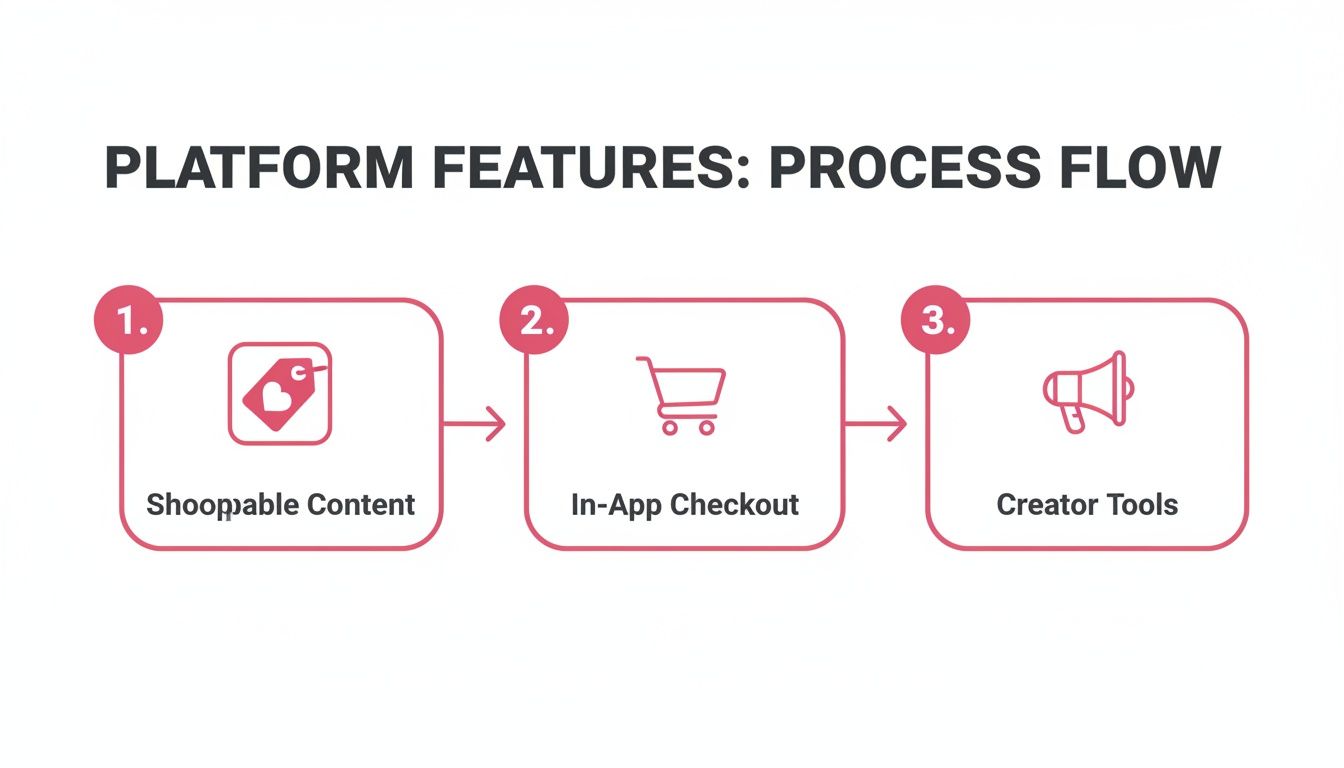
This process shows how shoppable content tags, smooth in-app checkouts, and integrated creator tools all work together to create a customer experience that's built for conversions.
Investing in the Right Content Formats
Not all creator content is created equal. Different formats are good for different things and land differently on each platform. A quick, punchy unboxing video might kill it on TikTok Shop, while a detailed tutorial could be a home run on YouTube Shorts or Instagram Reels.
Strategically investing in the right mix is key to getting the most out of your budget. You need to match the content format to your campaign goals—whether that's driving immediate sales, building brand awareness, or just educating customers about a product. To really get your sales engine going, you also need to think about building your organic reach. Understanding tactics for how to gain more real followers on Instagram can seriously amplify the impact of your creator and UGC efforts.
To help you decide where to put your resources, I've broken down some of the most effective content formats for social ecommerce.
Comparing Content Formats for Social Ecommerce
This table compares different types of creator-driven content to help you decide where to invest your resources for maximum impact.
| Content Format | Best For | Key Platforms | Measurement Focus |
|---|---|---|---|
| Product Unboxing | Generating excitement and showcasing the "out-of-box" experience for new or visually appealing products. | TikTok, Instagram Reels | Views, Engagement Rate, Clicks to Product Page |
| Authentic Reviews | Building trust and credibility by providing honest feedback and real-world usage examples. | YouTube Shorts, TikTok | Conversion Rate from Post, Comments and Questions |
| How-To Tutorials | Educating customers on product usage, demonstrating value, and overcoming potential purchase hesitations. | Instagram Reels, YouTube | Watch Time, Saves, Add-to-Cart Rate |
| Lifestyle Content | Integrating the product naturally into a creator's daily life to showcase its aspirational benefits. | Instagram Stories, Pinterest | Brand Mentions, Follower Growth, Traffic to Store |
| Live Shopping | Creating urgency and driving impulse buys through real-time product demos, Q&A sessions, and limited-time offers. | TikTok Live, Instagram Live | Live Viewers, Real-Time Sales, Average Order Value (AOV) |
By carefully picking your content formats and the creators you work with, you build a versatile and powerful marketing engine. This approach doesn't just drive sales; it builds a loyal community around your brand, creating a sustainable growth loop powered by authenticity and trust.
Picking the Right Platform and Proving It Was Worth It
With so many social ecommerce platforms out there, it’s easy to get overwhelmed. The trick is to tune out the noise and zero in on what actually lines up with your brand’s goals. Think of this less like picking a tool and more like finding the right business partner. The decision has to be rooted in who your customers are, what you can handle operationally, and how you're going to track real results.
A platform with millions of users is completely useless if your target audience isn't on it. The first step is deceptively simple: go where your customers are. If you’re selling to Gen Z, you absolutely have to be looking at TikTok Shop. If your brand is more visual and aspirational, Instagram and Pinterest should be at the top of your list.
This choice dictates everything that follows, from the style of your content to the creators you work with. Don't chase the trendiest platform; chase your audience.
A No-Nonsense Checklist for Platform Evaluation
To make a smart call, you need to vet any potential platform against a few core criteria. This isn't about features for features' sake—it's about finding the best fit for your business.
- Audience and Demographic Fit: Does the platform's user base look like your ideal customer? Dig into the age, interests, and shopping habits that are common on the platform.
- Creator and Affiliate Tools: How simple is it to work with creators? Look for built-in affiliate link generators, automatic commission tracking, and simple workflows for approving content.
- Tech Stack Integration: Will it play nicely with the tools you already use? You need deep, seamless integrations with your e-commerce platform (like Shopify or BigCommerce), your inventory system, and your CRM.
- Content Format Strengths: Does the platform shine with the content that best shows off your products? Whether it’s short-form video, live shopping events, or slick image carousels, make sure the format works for you.
When you get this right, your social commerce strategy feels like a natural part of your brand, not something you awkwardly tacked on.
Stop Chasing Vanity Metrics and Start Measuring ROI
Once your platform is live, the real work begins. Likes and shares feel good, but they don't keep the lights on. To actually prove that your social ecommerce efforts are working, you have to track the Key Performance Indicators (KPIs) that tie directly back to revenue. It’s time to forget the fluff and focus on what moves the needle.
The real goal of social ecommerce isn't to just show up; it's to be profitable. Success isn't measured in followers, but in conversion rates, customer lifetime value, and a solid return on what you've invested.
This pivot from tracking engagement to tracking economics is what turns a fun social media campaign into a sustainable business strategy. It’s how you’ll justify your budget and show the higher-ups that social commerce is a serious revenue channel.
The KPIs That Actually Prove Business Impact
To get a crystal-clear view of your ROI, build a dashboard that keeps these metrics front and center. They tell the true story of how your social ecommerce channels are performing.
- Conversion Rate from Social: This is the big one. What percentage of people who click on a shoppable post or a creator’s affiliate link actually buy something? Track this for every platform and campaign to see what’s truly driving sales.
- Average Order Value (AOV) from Creators: Are customers coming from creator content spending more per order? A higher AOV from social tells you the content is doing a great job of upselling or showing off your products' value.
- Customer Acquisition Cost (CAC) via Social: How much are you spending to get a new customer through a specific platform? Compare this to your other marketing channels to see how efficient it is.
- Social-Attributed Revenue: Use UTMs, affiliate links, and platform analytics to measure the total dollar amount of sales that started on social. This is the hard number that proves direct financial impact.
By focusing on these concrete metrics, you can confidently evaluate different social ecommerce platforms, tweak your campaigns for better profitability, and build a powerful, community-driven sales engine that delivers results you can take to the bank.
See How Top DTC Brands Are Winning with Social Ecommerce

Theory is one thing, but seeing a strategy actually work in the wild is what really counts. To get a feel for the real-world power of social ecommerce platforms, let's pull back the curtain on a few direct-to-consumer (DTC) brands that are absolutely crushing it, turning social feeds into serious revenue streams.
Think of these examples as a practical playbook you can start adapting for your own brand. By looking at how successful companies in fashion, beauty, and home goods get it done, we can move past the buzzwords and get straight to execution. Each story breaks down a specific challenge, the strategy they used, and the results they saw.
The Fashion Brand That Turned TikTok into a Sales Machine
A fast-fashion brand was hitting a wall trying to connect with Gen Z. Their polished, traditional ads were getting ignored, and they needed a way to build real hype for their weekly product drops without blowing their budget.
Their solution was as simple as it was effective. Instead of forcing glossy ads on their audience, they went all-in on TikTok Shop and teamed up with a small army of micro-influencers to create authentic "try-on haul" videos. These creators weren't just models; they were styling full outfits, giving their honest opinions, and linking directly to the products right there in their videos.
The impact was immediate and pretty staggering.
- Creator-driven sales shot up to account for over 40% of their total revenue from TikTok in the very first quarter.
- The brand saw a 300% explosion in user-generated content as inspired customers started making their own haul videos.
- Their customer acquisition cost on TikTok was 50% lower compared to their other paid social channels.
This shift changed their marketing from an annoying interruption into a form of entertainment that their target audience actually wanted to watch.
The big lesson here? On a platform like TikTok, authenticity is everything. This brand won by empowering creators to tell their story, which turned organic, relatable content into a direct and highly profitable sales channel.
By letting the community lead the conversation, they built a loyal following that felt like they were in on a new trend, not just being sold to.
The Home Goods Brand That Mastered Instagram Shopping
Now for a different challenge. A DTC home goods company specializing in minimalist decor knew their products were beautiful, but their studio-shot photos felt a little cold. They looked great, but they lacked the real-life warmth that inspires someone to actually click "buy."
So, they transformed their entire Instagram feed into a shoppable, user-generated lookbook. The brand kicked off a campaign encouraging customers to share photos of their products in their own homes with a specific hashtag. From there, they simply re-posted the best UGC and tagged every product using Instagram Shops.
Suddenly, potential buyers could see the decor in all kinds of real-life settings—from a tiny, cozy apartment to a spacious modern house. It finally answered that critical question every shopper has: "Yeah, but how would this look in my space?"
The results spoke for themselves.
- Conversion rates from their Instagram feed jumped by an incredible 70% after they rolled out the shoppable UGC strategy.
- They organically built a huge library of authentic visuals, which drastically cut their spending on expensive professional photoshoots.
- The average time users spent browsing their Instagram Shop doubled as people got lost scrolling through real-home inspiration.
This case study is proof that for visual products, context is king. By turning their own customers into storytellers, the brand created powerful social proof and made the journey from seeing something cool to buying it completely seamless. These examples show that when you pair the right social ecommerce platform with a smart content strategy, the results can be remarkable.
Got Questions About Social Ecommerce? We Have Answers.
Jumping into social ecommerce is exciting, but let's be real—it also brings up a ton of questions. Let’s walk through some of the most common things marketers ask when they're getting their footing. Think of this as your cheat sheet for building a solid strategy from the get-go.
What Kinds of Products Actually Sell Well on Social?
Honestly, while almost anything can sell, some products just have a natural edge here. If your product is visual, fits into a specific lifestyle, and is easy to "get" in a few seconds, you're already ahead of the game.
It's all about what pops in a photo or a short video. We see the best results with:
- Fashion and Apparel: Perfect for styling clips and try-on hauls that show fit and feel.
- Beauty and Cosmetics: Nothing beats a good tutorial or a raw, authentic review.
- Home Decor and Unique Goods: These shine when you can show them in a real home, not just on a white background.
Products that are easy to buy on a whim also do incredibly well. If someone can see it, love it, and buy it without a ton of deliberation, it's a perfect match for social commerce.
How Should We Measure Success? It Feels Different.
That's because it is different. Success in social ecommerce isn't just about that final click and purchase. Of course, direct sales are important, but you have to look at the entire customer journey and how social nudges people along.
Don't just track sales; track influence. Your real goal is to see how social content is actually driving revenue, even if the customer clicks away and buys from your website two days later. This means breaking out of those siloed channel reports and adopting a more connected view of what's working.
You'll want to keep an eye on metrics like engagement on your shoppable posts, the conversion rates driven by specific creators, and the total revenue you can attribute back to your social channels.
What Are the Biggest Hurdles We'll Face Getting Started?
Every new strategy has a few tripwires, and social ecommerce is no exception. One of the biggest headaches is just keeping your product info—like inventory and pricing—synced up between your main e-commerce store and all your different social shops. It can get messy, fast.
Another common challenge is the content treadmill. You need a constant flow of authentic, platform-native content that feels right for each audience, which is a big lift. And finally, properly tracking a sale that starts on social but finishes somewhere else requires a pretty dialed-in analytics setup.
Ready to build a powerful creator marketing engine to fuel your social commerce strategy? JoinBrands connects you with over 250,000 creators to produce authentic, high-impact content that drives real sales. Learn more and get started today at JoinBrands.