
 Mastering the Content Approval Process
At its core, social influence marketing is all about building trust and guiding what people buy through authentic voices they already follow and respect. Think of it as the digital version of word-of-mouth, turning personal recommendations into marketing campaigns that actually connect with people and get them to act.
Table of Contents
What Is Social Influence Marketing
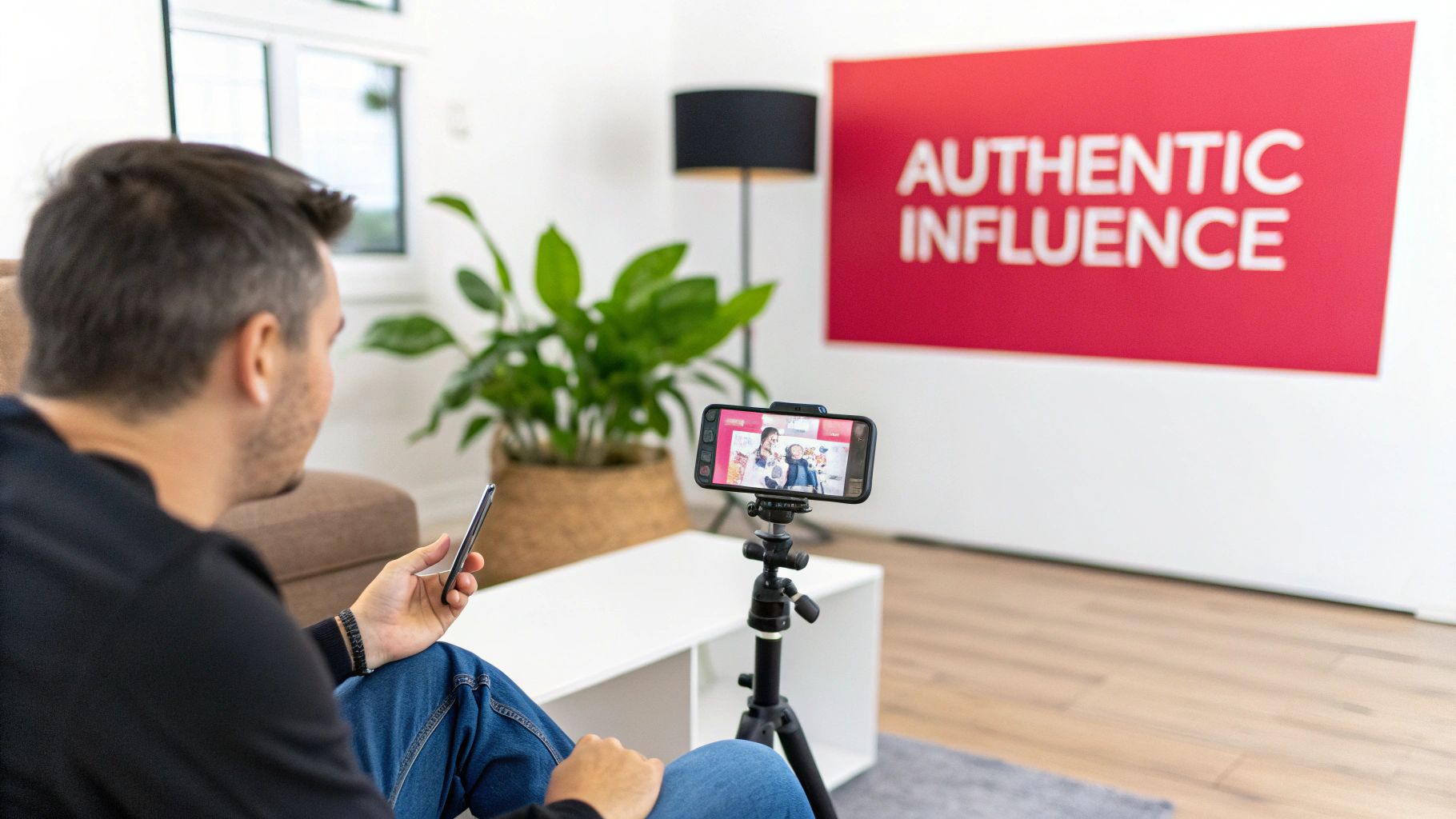
Social influence marketing is a world away from traditional advertising. Instead of a brand shouting its own message, a trusted creator shares their real experience with a product. This creates a story that's far more persuasive and relatable. It’s become a huge part of modern marketing for one simple reason: people are sick of disruptive ads and are desperate for something genuine.
The industry's explosive growth tells the whole story. The market shot up from $1.4 billion in 2014 to a projected $32.55 billion by 2025. It's not just hype; over 80% of marketers confirm it works, proving it’s no longer a niche tactic but a major advertising channel.
The Creator Economy Is Where It All Happens
This entire strategy lives and breathes within the creator economy. This is the ecosystem of individuals who have built loyal communities around specific passions, from makeup tutorials to financial advice. These creators come in all sizes, from nano-influencers with super-engaged, niche followings to mega-celebrities with millions of fans. Each type offers something different for a brand.
The real power of social influence marketing isn't just about the follower count. It's about the trust that a creator has painstakingly built with their audience. When that trust is extended to a brand, it creates an endorsement that feels authentic and incredibly powerful.
To really get a handle on this, it helps to break down influencers by their audience size. It's also worth checking out our deep dive into the different https://joinbrands.com/blog/influencer/ and the unique roles they can play in your campaigns.
Comparing Different Tiers of Influence
Not every influencer is right for every job. A nano-influencer could be perfect for driving deep engagement within a local community, whereas a macro-influencer can blast your brand's name out to the masses. Who you partner with depends entirely on what you want to achieve. For a closer look at how different companies, especially smaller ones, are navigating this space, check out this great guide on Influencer Marketing for Small Businesses.
To help you visualize where your brand fits into this world, we’ve put together a quick comparison of the different creator tiers.
Understanding the Tiers of Social Influence
This table is a quick reference guide to help you understand the different types of influencers. Think of it as a cheat sheet for figuring out who to partner with based on your campaign goals.
| Influencer Tier | Follower Count | Key Characteristics | Best For |
|---|---|---|---|
| Nano | 1k – 10k | Hyper-niche audience, highest engagement rates, strong community trust. | Localized campaigns, product testing, and driving authentic conversations. |
| Micro | 10k – 100k | Focused expertise, high relatability, and strong audience connection. | Targeted product promotions, building credibility, and generating user content. |
| Macro | 100k – 1M | Broad reach, professional content, established as a voice in their niche. | Large-scale brand awareness, new product launches, and high-impact campaigns. |
| Mega | 1M+ | Celebrity status, massive audience reach, mainstream media attention. | Maximizing visibility, celebrity endorsements, and major brand announcements. |
Choosing the right tier isn't just about the numbers; it's about finding the right fit for your brand's voice and your campaign's objectives. A well-placed micro-influencer can often deliver more bang for your buck than a celebrity who doesn't quite align with your audience.
It’s easy to hear a term like "social influence" and immediately lump it in with all the other marketing buzzwords floating around. But while things like influencer marketing, affiliate programs, and user-generated content (UGC) are definitely in the same ballpark, they each play a very different position on the team.
Getting these differences straight is the key to building a powerful, integrated strategy instead of just running a bunch of disconnected campaigns that don't add up.
Think of social influence marketing as the big-picture philosophy. It’s the long game, the overarching strategy focused on building real relationships and earning trust within a community. The goal isn't just to snag a single sale; it's to create genuine brand advocacy that sticks around for the long haul.
Social Influence vs. Influencer Marketing
A lot of people use these terms interchangeably, but there's a critical difference. Influencer marketing is a tactic that lives inside the broader strategy of social influence. It’s usually a specific, time-bound campaign where you partner with creators for a defined project.
For example, a one-off collaboration with a fitness creator to promote a new protein powder is a classic influencer marketing campaign. But building a multi-year partnership with that creator, turning them into a true brand ambassador who naturally weaves your product into their lifestyle? That’s social influence marketing in action.
Social Influence vs. Affiliate Marketing
Here’s where the core motivation really shifts. Affiliate marketing is a straight-up transactional deal. An affiliate gets a commission for every sale they drive through their unique link or code. The primary goal is direct conversion, and the whole relationship is built on performance metrics.
An influencer might also be an affiliate, but their real value goes way beyond the sale. Their job in a social influence strategy is to build brand love, spark conversations, and create content that feels real. The trust they have with their audience is the main asset. For an affiliate, the main asset is their ability to get clicks that convert.
Social influence is about nurturing relationships, not just chasing clicks. While a sale is a great outcome, the real prize is the lasting trust and credibility a brand gains by aligning with respected voices in a community. This focus on authenticity is what separates it from purely sales-driven tactics.
Affiliate programs are an incredible tool for driving revenue, no doubt. But they just don't have the storytelling and brand-building depth that a true social influence strategy brings to the table.
Social Influence vs. User-Generated Content
User-Generated Content (UGC) is pure gold. It’s any content—photos, videos, reviews, social media posts—created organically by actual customers or fans, not the brand. Think of it as the digital version of word-of-mouth, and it’s wildly effective because it’s seen as totally unbiased. In fact, nearly 90% of consumers say UGC sways their buying decisions more than promotional emails.
So, what's the connection? A great social influence marketing campaign almost always sparks a wave of high-quality UGC. When an influencer authentically shares their experience, it gives their followers the inspiration and confidence to do the same.
- UGC: An excited customer posts an unboxing video on their own. It's a fantastic, one-off piece of social proof.
- Social Influence: A brand partners with a creator, whose authentic review then inspires hundreds of their followers to create and share their own unboxing videos.
By understanding how these pieces fit together, you can build a much smarter marketing machine. You can use influencer marketing for tactical launches, affiliate marketing to drive bottom-line sales, and UGC to showcase authentic social proof—all guided by the strategic, long-term vision of social influence.
Choosing the Right Platforms for Your Campaign
Picking the right social media platform for your campaign is a lot like choosing the right fishing spot. You have to go where the fish are biting. No matter how great your bait is, you won't get any results if you're casting your line into an empty pond. Your entire strategy hinges on showing up in the digital spaces your audience already knows and loves.
Every platform has its own vibe, its own unwritten rules, and its own content style. A brilliant idea on one can totally bomb on another. Getting a feel for these digital ecosystems is non-negotiable before you even think about your budget.
This infographic breaks down how social influence really works—from the core idea to how it plugs into campaigns, affiliate programs, and UGC.
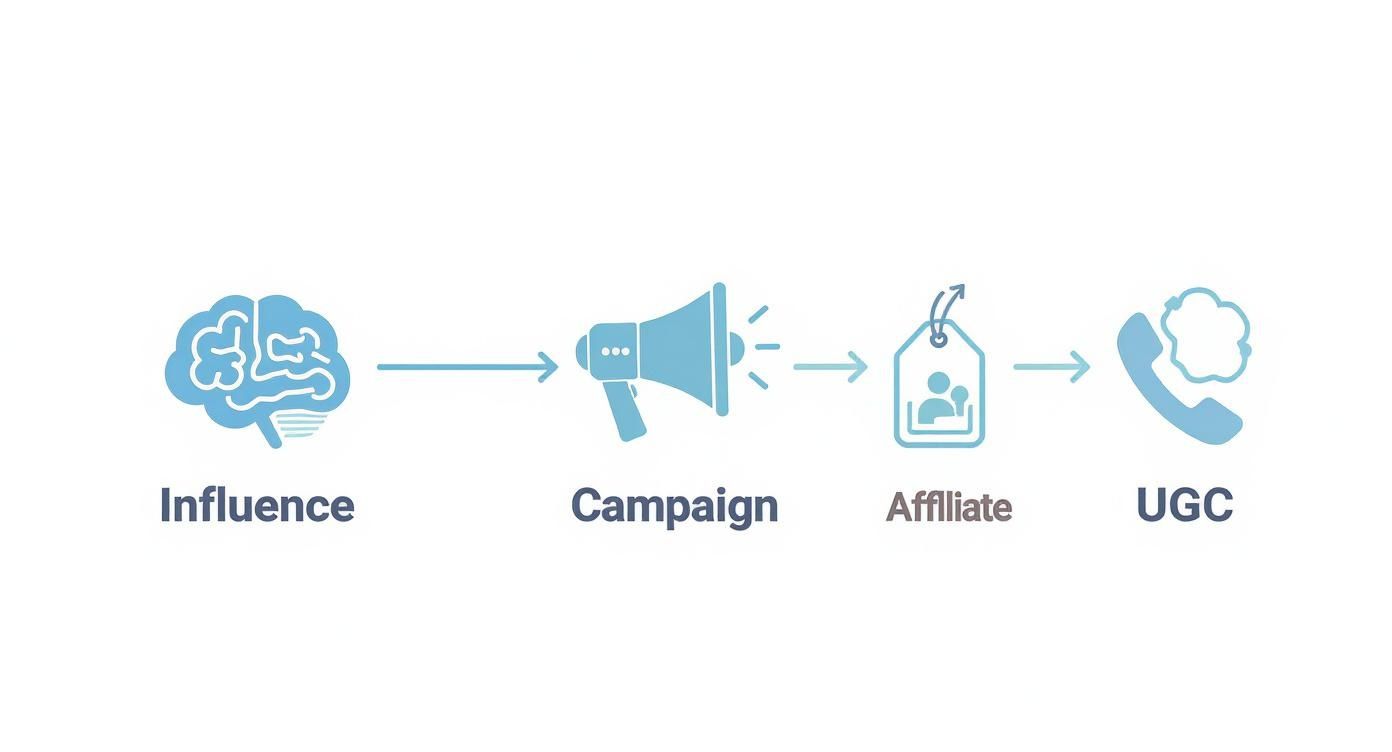
As you can see, a single campaign can trigger a bunch of different marketing tactics. It's all about an integrated approach.
Matching Platform Culture to Brand Goals
Your first move is to get a handle on the unique personality of each major channel. Don't just look at user counts; think about why people are there and what they expect to see.
- TikTok: This is the engine of internet culture. The algorithm is king, prioritizing pure entertainment over follower counts. It’s perfect for brands that want to connect with younger audiences through short, fun, and authentic video content.
- Instagram: A visual-first world that’s all about lifestyle marketing, beautiful aesthetics, and building an aspirational brand story. Between Stories, Reels, and stunning photos, it's a go-to for fashion, beauty, food, and travel.
- YouTube: This is where you go deep. It's the home of long-form video, making it the best place to build authority and really educate your audience. Detailed tutorials, honest product reviews, and behind-the-scenes videos do incredibly well here, creating serious trust over time.
- LinkedIn: For B2B brands, this is the main event. It's all about professional expertise, industry insights, and establishing thought leadership. Working with respected experts on LinkedIn can give your brand massive credibility with decision-makers.
Figuring out these nuances is the first step, but with so many options, it can still feel like a lot. If you're looking for a more detailed breakdown, our guide on influencer marketing platforms can help you sort through the choices.
Platform Smackdown: Where to Invest Your Influence Budget
Still on the fence about where to focus your efforts? This table cuts through the noise and gives you a side-by-side look at the top contenders. It’s all about matching your brand’s voice and goals to the platform where your audience is ready to listen.
| Platform | Primary Audience | Avg. Engagement Rate | Best Content Format | Strategic Advantage |
|---|---|---|---|---|
| Millennials (25-40) | 1.94% | Polished Photos, Reels, Stories | High-quality visual storytelling and brand building. | |
| TikTok | Gen Z (Under 25) | 5.69% | Short-form, trending videos | Unmatched viral potential and cultural relevance. |
| YouTube | Broad (18-49+) | 1.63% | Long-form tutorials, reviews, vlogs | Deep audience trust and long-term authority. |
| Professionals (30-55) | 2.61% | Text posts, articles, short videos | B2B credibility and thought leadership. |
Each platform offers a unique opportunity. The key isn’t to be on every single one, but to dominate the ones that matter most for your brand.
Analyzing the Data Behind Platform Selection
A smart choice is always backed by numbers. While Instagram and TikTok are the heavyweights, they play very different games. Instagram’s market is set to blow past $22 billion by 2025, making it a powerhouse for massive reach.
On the flip side, TikTok often sees engagement rates topping 9%—completely dwarfing Instagram’s typical 2-3%. This sets up a classic strategic choice: use Instagram for scale and TikTok for its explosive viral potential. And don’t forget YouTube, which still pulls in over $1 billion in influencer marketing spend thanks to its incredibly dedicated audiences. You can dig into more stats about the global influencer market size on Statista.com.
This data helps you build a multi-channel strategy that makes sense. You might use YouTube for foundational trust, Instagram for a polished brand image, and TikTok to jump on trends and drive huge, short-term awareness.
The best social influence marketing strategies don't just pick one platform. They create a connected ecosystem where content is tailored to each channel's strengths, working together to build a consistent and compelling brand story across the digital landscape.
In the end, it’s not about being everywhere. It’s about being where it counts. A focused presence on two perfect-fit platforms will always crush a scattered approach across five that are just okay. When you line up your brand, your goals, and your audience with the right channel, you’re setting up a campaign that doesn't just reach people—it actually resonates.
Building Your First Social Influence Campaign

Alright, let's get our hands dirty. Moving from a neat strategy document to a real, live campaign is where the magic happens. It might feel like a huge leap, but if you break it down into manageable steps, the whole process becomes much less intimidating. Think of this as your blueprint for covering all the bases and launching with confidence.
It all boils down to one simple question: What are we actually trying to do here? Without a solid answer, you’re just throwing spaghetti at the wall.
Laying the Foundation with Clear Objectives
Before you even start dreaming about creators or viral content, you have to lock in your campaign's main goal. Is this all about getting your name out there? Driving sales? Something else entirely? A campaign built to create buzz for a new product launch is going to look completely different from one designed to get webinar sign-ups.
Most campaign goals fall into one of these buckets:
- Brand Awareness: Getting your brand in front of new eyeballs. We measure this with things like reach, impressions, and how often people are talking about you versus competitors.
- Lead Generation: Getting contact info from potential customers. Here, you're tracking metrics like form completions, email sign-ups, or content downloads.
- Direct Sales: Pushing for immediate purchases. This is all about tracking promo codes, affiliate links, and, of course, conversion rates.
- Community Engagement: Sparking conversations and building loyalty. You’ll see success in the form of comments, shares, and a steady stream of user-generated content.
Once you know your primary objective, it's time to get specific with SMART goals (Specific, Measurable, Achievable, Relevant, Time-bound). Don't just say "increase sales." Aim for something like, "achieve a 15% increase in sales through creator promo codes within Q3." This single sentence will become your North Star for every decision that follows.
Finding and Vetting the Right Creators
With your goals set, it’s time to find the people who can help you hit them. This is arguably the most make-or-break part of the entire process. A great partnership feels natural and authentic. The wrong one feels forced and can seriously hurt your credibility.
Start by zeroing in on creators whose audience looks a lot like your ideal customer. Someone might have a million followers, but if those followers don't care about what you're selling, it's a wasted effort. You have to look past the vanity metrics.
A creator's true value isn't just their follower count; it's the trust and authenticity they've built with their community. Vetting for genuine engagement and brand alignment is non-negotiable for a campaign that resonates rather than repels.
As you vet potential partners, dig into these key factors:
- Engagement Rate: Do the math. Add up the likes and comments on a few recent posts, divide that by their total follower count, and multiply by 100. A high rate points to an active, engaged community.
- Audience Quality: Use tools to sniff out fake followers and bots. You want to see real conversations happening in the comments, not just a wall of fire emojis.
- Content Alignment: Does their vibe match your brand? Check out their tone, visual style, and the values they project. An edgy comedian probably isn't the best fit for a serene wellness brand.
- Past Partnerships: Look at their previous sponsored posts. Do they promote brands thoughtfully, or does their feed look like a walking billboard? You want a partner, not just a hired gun.
Crafting Compelling Outreach and Creative Briefs
Once you have your shortlist, it's time to reach out. Your first message needs to be personal and professional. Nobody likes a generic, copy-pasted pitch. Show them you've actually watched their content by mentioning a specific video or post you enjoyed.
When a creator shows interest, you move on to the creative brief. This document is the backbone of your entire collaboration. A good brief gives clear direction but doesn't suffocate creativity. It needs to cover the campaign goals, key messages, what you need them to create, and any must-haves like specific hashtags or FTC disclosures.
The best briefs, however, are a starting point for a conversation. They leave room for the creator to bring their own unique voice and style to the table—that's why you picked them, after all. If you micromanage the content until it sounds like a corporate press release, you kill the authenticity that makes social influence marketing so powerful in the first place.
To make sure your creators can produce amazing work, it helps to know what’s out there. Exploring the best content creation tools for social media can give them the resources they need to create professional-grade content that still feels genuine and engaging.
Measuring the True Impact of Your Campaigns
Likes and follower counts look great on a report, but let's be honest—they don't pay the bills. To really prove the value of your social influence marketing, you have to measure what actually moves the needle for your business.
This means shifting your focus from feel-good vanity metrics to the key performance indicators (KPIs) that connect directly to your bottom line.
The very first step is tying your KPIs back to your original campaign goals. Without that connection, you're just collecting numbers in a vacuum. A solid framework helps you tell the complete story of your campaign’s performance, from the first eyeball on a post all the way to a completed sale.
Core Metrics Beyond the Likes
To get the full picture, you need to track metrics across three distinct stages of the customer's journey: awareness, engagement, and conversion. Each one answers a different, crucial question about how well your campaign is working.
Awareness Metrics: This is all about eyeballs. How many people saw your campaign? Track reach (the number of unique people who saw your content) and impressions (the total number of times your content was seen). It's also smart to monitor share of voice to see how your brand's conversation stacks up against competitors.
Engagement Metrics: Here's where you find out if people actually cared. Forget just likes. Look at comments, shares, and especially saves. These actions show your content was compelling enough to make someone stop scrolling and do something, signaling a much deeper connection.
Conversion Metrics: This is the money shot. This is where you prove your campaign drove real business results. Track the click-through rate (CTR) on your links, the conversion rate on your landing pages, and sales generated from creator-specific promo codes or UTM links. These are the numbers that directly show your return on investment.
The best social influence campaigns don't just make noise; they drive action. By tracking the entire funnel from reach to revenue, you can definitively prove how your creator partnerships are fueling real business growth.
Calculating Your Return on Investment
Calculating ROI is the ultimate way to justify your marketing spend and get the green light for future budgets. It might sound complicated, but the basic formula is pretty simple.
First, add up all your campaign costs. This includes everything from creator fees and the cost of products you sent out to any platform or tool subscriptions you used.
Next, figure out the financial return your campaign generated. The easiest way to do this is by tracking sales from those custom promo codes or affiliate links. With those two numbers, you can calculate your ROI and see the direct financial impact. For a more detailed walkthrough, check out our guide on how to measure influencer marketing ROI.
And the potential returns are huge. By 2025, influencer marketing is expected to bring back an average ROI of $5.78 for every dollar spent, with the best campaigns hitting $20 or more. When 74% of shoppers say they've bought something based on an influencer's post, the power of these authentic voices is crystal clear. You can find more of these powerful influencer marketing stats at Thunderbit.com.
Analyzing Qualitative Feedback
Numbers only tell half the story. The real context comes from the qualitative feedback—the comments, DMs, and user-generated content that pop up.
Pay close attention to audience sentiment. Are people excited? Curious? Confused? This kind of feedback gives you incredible insights into your product and messaging that you’d never get from a spreadsheet.
Looking at this qualitative data helps you understand the why behind the numbers. It gives you a genuine feel for how the community perceives your brand and how well the creator partnership resonated. This complete picture, blending hard data with human sentiment, is what gives you the confidence to fine-tune your strategy for the next campaign.
Avoiding Common Social Influence Pitfalls
Running a successful social influence campaign means you have to navigate a minefield of potential traps. It's smart to learn from other people's mistakes, but it's even better to avoid making them in the first place. Too many brands stumble over the same few hurdles, turning what could have been a great campaign into a very expensive lesson.
The good news? These common pitfalls are totally avoidable with a bit of planning and the right perspective. From picking the wrong partners to getting tangled up in creative control issues, understanding these challenges is the first step to building campaigns that actually work—without the headaches.
The Fake Follower Epidemic
One of the most common and costly mistakes is picking creators based only on their follower count. Sure, a massive audience looks impressive on the surface, but it can easily be a mirage. Influencer fraud is a huge problem, with some creators pumping up their numbers with bots and fake accounts.
This doesn't just burn through your budget; it absolutely tanks your credibility. To get around this, you have to look past the vanity metrics and put on your detective hat.
- Check the Engagement Rates: A creator with 500,000 followers but only a couple hundred likes per post is a massive red flag. Real engagement should scale with the audience size.
- Read the Comments: Are people having real conversations, or is it just a wall of generic emojis and one-word replies? Genuine communities actually talk to each other.
- Use Vetting Tools: Platforms like JoinBrands have built-in tools that analyze an influencer's audience health, flagging suspicious activity before you ever commit to a partnership.
Killing Creativity with Control
Another trap brands fall into is trying to micromanage the creative process. It's tempting to hand over a rigid script and a long list of do's and don'ts, thinking you're controlling the message. But this approach almost always backfires, sucking the life and authenticity right out of the content.
Remember, you're partnering with creators for their unique voice and the trust they’ve built with their audience. Turning them into a corporate puppet breaks that connection and makes the content feel like a stiff, awkward ad nobody wants to see. It’s time to shift your thinking from a client-vendor relationship to a true creative partnership.
The best brand-creator partnerships are built on mutual trust. Give them a clear brief with your key messages and goals, but then give them the freedom to bring it all to life in their own style. Their authenticity is the whole point.
Ignoring Legal and Ethical Lines
Finally, overlooking disclosure rules is a mistake you just can't afford to make. The Federal Trade Commission (FTC) has crystal-clear guidelines that require influencers to disclose when their content is sponsored. Failing to follow these rules can lead to hefty fines and do serious damage to your brand's reputation.
This isn't an area for ambiguity. Simple, clear hashtags like #ad or #sponsored need to be placed where people will actually see them—not buried at the end of a novel-length caption. Make compliance a non-negotiable part of your contract and double-check every piece of content to make sure the rules are being followed. This protects the creator, your brand, and most importantly, the trust you have with your audience.
Frequently Asked Questions
Even with the best strategy in hand, you're bound to have a few questions when you get into the nitty-gritty of social influence marketing. Let's tackle some of the most common ones that pop up, giving you clear, straightforward answers to help you move forward with confidence.
How Much Does Social Influence Marketing Cost?
This is the big "how long is a piece of string?" question. There's really no single price tag. The cost swings wildly depending on who you're working with, the platform, how much effort the content requires, and the campaign's duration. It’s a massive spectrum.
A nano-influencer (1k-10k followers) might be thrilled to work for free products or a small fee, maybe somewhere in the $10-$100 per post range. At the other end of the scale, macro-influencers (500k-1M followers) will command thousands. And if you're talking about mega-influencers with celebrity status? That can run into the tens or even hundreds of thousands.
The real key is to match your budget to your goals. You might find that a network of highly-engaged micro-influencers delivers a much better return than one expensive celebrity shout-out.
What Is the Difference Between EMV and ROI?
Great question. Both of these metrics are about measuring a campaign's value, but they tell completely different parts of the story. Nailing the distinction is crucial if you want to report on your success accurately.
Return on Investment (ROI) is your hard-and-fast financial report card. You calculate it as (Profit – Cost) / Cost, showing you the actual, tangible revenue your campaign brought in. Earned Media Value (EMV), on the other hand, is a bit softer—it's an estimate of what your organic reach would have cost if you had to buy it through traditional ads.
Think of it this way: EMV is fantastic for gauging brand awareness and reach, while ROI cuts straight to the financial bottom line. Both are valuable, but they serve very different masters in your final analysis.
How Do I Ensure Influencers Follow FTC Rules?
This one is non-negotiable. Making sure your partners comply with Federal Trade Commission (FTC) disclosure rules protects your brand, the creator, and the trust you have with your audience. The best approach is to be proactive and bake compliance right into your workflow from day one.
First, make disclosure a mandatory clause in your creator contracts. Spell it out clearly: all sponsored content must include an unambiguous label like #ad, #sponsored, or #BrandPartner right at the beginning of the caption. No hiding it at the bottom of a long post.
Beyond that, you should be reviewing all content before it goes live to double-check that the disclosures are in place. Many platforms, like Instagram, have even made it easier with built-in "Paid Partnership" tools that add a standardized, unmistakable label to the content. Using these native tools is the cleanest, most transparent way to go.
Ready to stop juggling spreadsheets and start launching campaigns that actually deliver? JoinBrands connects you with over 250,000 vetted creators eager to amplify your social presence and drive real sales. Start your first campaign today on JoinBrands.