

 A Guide to Branded Content Marketing
A winning social media campaign is built on a solid foundation. Before you even think about creative concepts or drafting a single post, you have to know what you're trying to achieve. This first step—translating big-picture business objectives into cold, hard numbers—is what separates campaigns that make an impact from those that just make noise.
Table of Contents
Laying the Groundwork with Clear Goals and KPIs
Jumping into content creation without a plan is like setting off on a road trip with no map and no destination. Sure, you'll be moving, but you'll have no idea if you're getting anywhere meaningful. The most critical part of your entire campaign plan is defining your North Star: your goals and the metrics (KPIs) you'll use to measure them.
This isn't about fuzzy ambitions like "getting more engagement." It's about setting precise, actionable targets that tie directly back to what the business actually cares about.
From Business Objectives to Social Media Goals
Every campaign kicks off to support a larger business objective. Maybe you're launching a new product, trying to drive sign-ups for a webinar, or boosting foot traffic to a new retail location. Your first job is to distill that high-level objective into a specific goal for your social media channels. This is where you turn abstract corporate-speak into a clear mission for your team.
Here's how that looks in the real world:
- Business Objective: Increase Q3 sales for our new skincare line.
- Social Media Goal: Generate 1,000 qualified leads for the new product through Instagram and TikTok.
- Business Objective: Boost brand recognition in a new market.
- Social Media Goal: Increase brand mentions and reach by 30% among our target demographics in that region.
Taking the time to do this ensures your social media efforts aren't just a side project. They become a vital part of the company's growth engine. It's the difference between being busy and being effective.
Setting SMART Goals for Measurable Success
Once you have a goal, you need to make it SMART: Specific, Measurable, Achievable, Relevant, and Time-bound. This framework is your best friend for cutting through ambiguity and creating targets that are impossible to misinterpret. A vague goal is a recipe for failure; a SMART goal is a roadmap to success.
Let's break it down:
- Specific: Don't just say "increase website traffic." Get granular: "increase website traffic from Pinterest by 25%."
- Measurable: Pinpoint your Key Performance Indicators (KPIs) from the start. This could be conversion rate, click-through rate (CTR), or cost per lead. If you're focusing on brand awareness, it's worth checking out this guide on choosing the right brand awareness KPIs.
- Achievable: Set an ambitious target, but keep it realistic based on your budget, team size, and past performance.
- Relevant: Make sure the goal actually pushes your main business objective forward.
- Time-bound: Give yourself a deadline, like "within Q2" or "over the next 30 days."
This visual shows the simple but powerful flow from a broad objective down to a specific KPI.
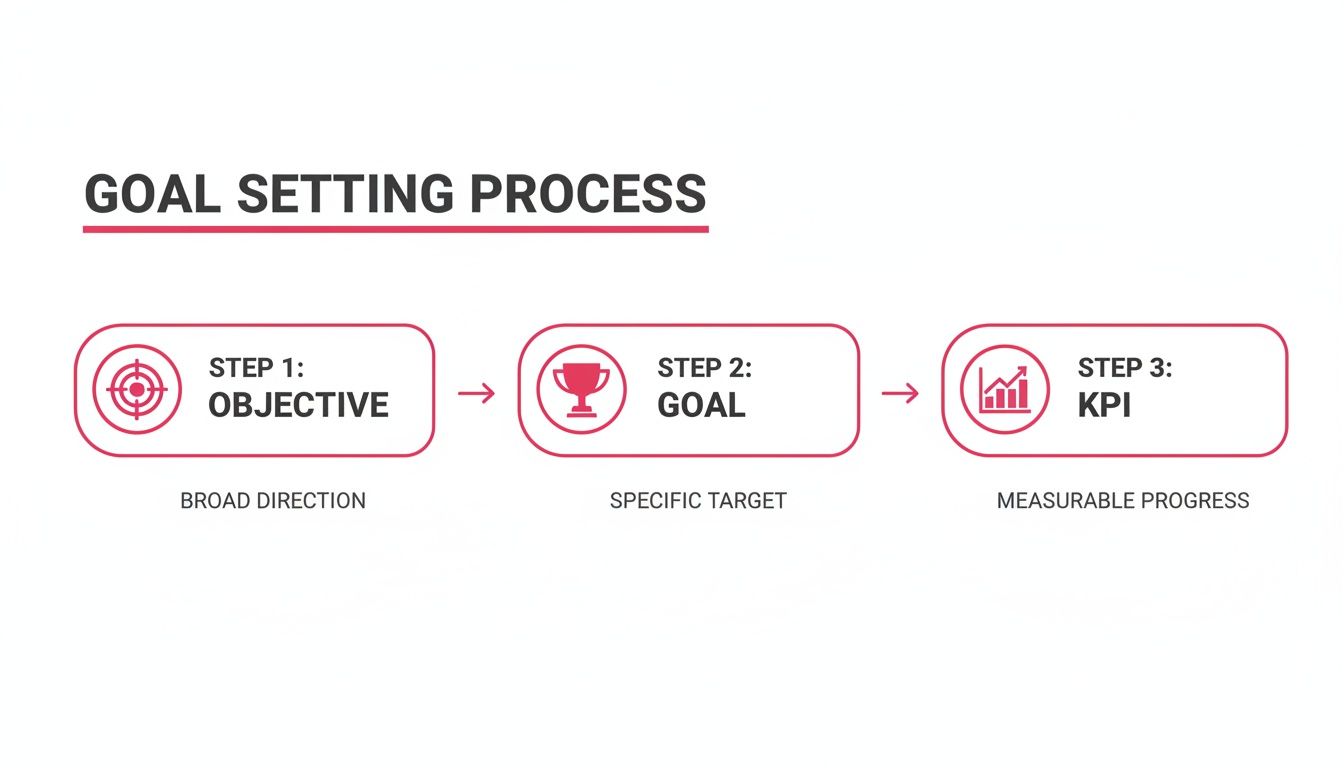
Following this process means every single action you take can be measured against a clear definition of success.
Why Defined KPIs Are Non-Negotiable
This is where the rubber meets the road. Your KPIs are the specific data points that prove whether your strategy is actually working. Without them, you’re flying blind. You can't prove your team's value, and you certainly can't make smart decisions to optimize the campaign as it runs.
A campaign without KPIs is just a collection of content. A campaign with clear KPIs is a strategic investment that delivers provable value to the business.
Let's look at some examples. For a DTC brand dropping a new sneaker, key KPIs might be conversion rates from TikTok Shop links or the number of add-to-cart actions from Instagram Stories. For a SaaS company, the focus would likely be on webinar sign-ups from LinkedIn ads or the download rate of a gated e-book.
This isn't just theory; it's backed by data. Campaigns with clearly defined, SMART goals can achieve an 80% higher ROI from their social media efforts. This data-driven approach takes the guesswork out of the equation, letting you double down on what’s working and quickly pivot away from what isn’t.
To make this crystal clear, here’s a table that connects common business objectives directly to the social media metrics that matter.
Mapping Business Objectives To Social Media KPIs
This table provides a simple framework for translating broad business goals into specific, trackable social media KPIs. It helps ensure every action you take is aligned with what the business truly values.
| Business Objective | Primary Social Media Goal | Key Performance Indicator (KPI) | Example Metric |
|---|---|---|---|
| Increase Sales | Drive Conversions | Conversion Rate, Cost Per Acquisition (CPA) | Percentage of users who purchase after clicking a link |
| Boost Brand Awareness | Increase Reach & Impressions | Reach, Impressions, Share of Voice | Number of unique users who saw your content |
| Generate Leads | Collect Contact Information | Lead Generation Rate, Cost Per Lead (CPL) | Number of form submissions from a social media ad |
| Improve Customer Loyalty | Foster Community Engagement | Engagement Rate, Customer Mentions | Likes, comments, shares, and saves per post |
| Drive Website Traffic | Increase Clicks to Site | Click-Through Rate (CTR), Website Sessions | Percentage of impressions that result in a click |
Using a map like this ensures you're not just chasing vanity metrics. Instead, you're focusing on the numbers that directly contribute to growth, proving the value of your social media campaigns to stakeholders and leadership.
Finding Your Audience and Crafting Your Message
With your campaign goals locked in, it’s time to get laser-focused on who you're talking to. A killer social media campaign speaks directly to the right people, and that's just not possible if your picture of the audience is fuzzy or generic. This is where we move beyond basic demographics and really get inside the heads of our ideal customers.
It’s not enough to know their age and location. You have to speak their digital language. A Gen Z audience on TikTok, for example, is fluent in raw, unfiltered video and user-generated trends. Flip that, and a professional crowd on LinkedIn wants insightful carousels and hard data. If you miss these nuances, it's like showing up to a party in the wrong country—your message completely misses the mark.

Building Your Audience Personas
To create a message that truly connects, you've got to build detailed audience personas. Think of a persona as a fictional character who represents your perfect customer. This little exercise is huge because it humanizes your audience, making it a whole lot easier to create content that feels like it was made just for them.
Your persona needs to be more than just the basics. You have to dig deep into their psychographics and online habits. To get this right, dedicated social media audience analysis tools can give you some serious insights into your target demographics and their online circles.
Make sure each persona includes these key elements:
- Pain Points: What keeps them up at night? What problem are they trying to solve that your product is the answer to?
- Values & Motivations: What do they actually care about? Is it sustainability, convenience, or maybe social status?
- Preferred Channels: Where do they really hang out online? Don't just guess—use your analytics to get the real story.
- Content Consumption Habits: Are they scrolling through short-form videos, reading in-depth articles, or engaging with polls and quizzes?
- Key Influencers: Who do they already trust for recommendations in your niche?
Nailing down two or three of these well-defined personas will become your North Star for every creative decision, from the copy's tone to the creators you bring on board.
Developing a Compelling Campaign Narrative
Once you know who you're talking to, you can figure out what to say. This isn't about rattling off product features; it's about telling a story. A solid campaign narrative is the central idea that ties all your content together, creating a consistent and memorable story across every channel.
Your narrative should be simple, powerful, and tie directly back to your audience's problems and values. It’s the "why" behind your entire campaign.
A great campaign message doesn't just describe what you sell. It articulates the change you want to create for your customer. It’s the emotional hook that makes them stop scrolling and pay attention.
Let's say a sustainable fashion brand’s narrative is "Style that doesn't cost the earth." This simple idea drives every piece of content—from behind-the-scenes videos of their ethical production process to creator collabs focused on conscious shopping.
Establishing Key Talking Points
Finally, you need to break that big narrative down into specific, consistent key talking points. These are the bite-sized messages you and your creators will repeat everywhere. They keep everything consistent and hammer home your core message.
For that sustainable fashion brand, the talking points might look like this:
- Made from 100% recycled materials.
- Ethically produced by skilled artisans.
- Timeless designs built to last, not for fast fashion trends.
These points become the backbone of your creative briefs, social copy, and ad scripts. They provide a clear framework that keeps the brand message tight while still giving creators room to be creative. It’s this methodical approach that turns a campaign from a bunch of random posts into a unified story that builds a real connection and gets people to act.
Crafting Your Channel-Specific Creative Strategy
Okay, you've got your campaign goals locked in and you know exactly who you're talking to. Now comes the fun part: creating the actual content that's going to stop them in their scroll.
One of the biggest mistakes I see brands make time and time again is creating one piece of content and just blasting it everywhere. That one-size-fits-all approach is a recipe for wasted effort. Think about it—the high-energy, trend-driven chaos of TikTok is a world away from the buttoned-up, professional vibe of LinkedIn. Your content needs to speak the native language of each platform.
A truly effective creative strategy is all about tailoring your message and format to fit the unique culture of each channel. This ensures your content doesn't just show up, but actually belongs.
Play to Each Platform’s Strengths
Every social platform has its own algorithm and a unique set of user expectations. You can't fight the algorithm; you have to work with it. The trick is to lean into what each channel does best. This is how you maximize your reach and make a real impact.
Let’s imagine you're launching a new eco-friendly water bottle. Here’s how a multi-channel creative plan might look:
- Instagram: Kick things off with a slick, visually stunning Carousel post that highlights the bottle's design features. Follow that up with a stream of authentic Reels from creators showing the bottle out in the wild—on a hike, at the gym, you name it.
- TikTok: This is where you get playful. Create short, snappy videos that piggyback on a trending sound. Maybe you do a fun "leak-proof test" that's surprising and shareable. It's also the perfect place for creator collaborations.
- YouTube: Go a bit deeper here. A "day in the life" vlog from an influencer that naturally features the bottle works wonders. Or, you could create a detailed YouTube Short that quickly compares its features against the competition.
- LinkedIn: Time to switch gears. An article or a document post detailing the sustainable materials used in production would be perfect for targeting B2B partners or corporate wellness programs.
As you build out your plan, don't be afraid to get creative. Exploring trends like marketing memes can spark some seriously engaging ideas for certain platforms. The goal is to map your core campaign message to the formats that each platform's algorithm is rewarding right now.
The Power of a Killer Creative Brief
To get everyone on the same page—from your in-house team to your freelance creators—a detailed creative brief is absolutely non-negotiable. This document is the single source of truth for your campaign's creative vision. It turns your high-level strategy into clear, actionable instructions, cutting down on endless revisions and keeping the brand voice consistent.
A great creative brief doesn't just tell creators what to do; it inspires them by giving them a clear understanding of the 'why' behind the campaign. It provides the guardrails they need to be creative without straying from the core message.
Your brief needs to be crystal clear and cover all the essentials. It’s the foundation for getting high-quality, on-brand content back every single time. For a deep dive, check out our complete creative brief template that you can steal for your own campaigns.
A solid brief has to include:
- Campaign Objectives: What is this specific piece of content supposed to achieve?
- Audience Insights: Who are we talking to on this platform? What do they care about?
- Key Messages: The one or two talking points that absolutely must come across.
- Tone of Voice: Are we funny and witty? Educational and authoritative? Aspirational?
- Visual Guidelines: Any specific colors, fonts, logos, or aesthetic vibes to stick to.
- The "Do's and Don'ts": Clear rules of the road (e.g., "Don't mention competitors by name," or "Do show the product in motion").
- Call to Action (CTA): What do we want the viewer to do next?
This level of detail empowers creators to nail the assignment on the first try, which saves everyone a ton of time and headache.
Make User-Generated Content a Core Part of Your Strategy
Let's be real: authenticity is the only currency that matters today. People trust recommendations from real people way more than they trust slick, polished ads from brands. That's why incorporating user-generated content (UGC) isn't just a "nice to have"—it's a critical part of a modern creative strategy.
UGC provides the social proof that builds trust and gets people to act. But you can't just sit around and hope it happens organically. You need to be proactive.
By partnering with creators, you can generate a steady stream of authentic content at scale. Platforms like JoinBrands are designed for exactly this, connecting you with a massive network of creators ready to produce genuine, relatable content. You can then take that content and repurpose it everywhere: on your social channels, in your paid ads, and even on your product pages.
The results speak for themselves. Integrating authentic user-generated content through influencers can boost conversion rates by 4.6% on average. When you make UGC a deliberate piece of your plan from day one, you build a powerful engine for authentic storytelling that truly connects with your audience.
Bringing Your Campaign to Life with a Content Calendar
Okay, you've got your campaign goals locked down and a solid creative strategy in place. Now for the fun part: turning those big ideas into a day-to-day action plan. This is where a detailed content calendar becomes the absolute heartbeat of your campaign.
Think of it as the operational tool that transforms your channel strategy from a document of good intentions into a well-oiled machine. It’s what keeps everything running smoothly from launch day to the final report. A great content calendar provides a single source of truth for your entire team, ensuring everyone knows what’s publishing, where it’s going live, and when. No more last-minute scrambles.

Finding Your Posting Rhythm
One of the first questions I always get is, "How often should we be posting?" Honestly, there's no magic number. It’s a delicate balance between staying visible and just plain annoying your audience. Post too little, and you're forgotten. Post too much, and you risk looking spammy and getting hit with unfollows.
The sweet spot really depends on the platform and your audience’s habits. X (formerly Twitter), for example, moves at a blistering pace; posting multiple times a day is often necessary just to stay in the conversation. Over on LinkedIn, however, audiences crave quality over quantity. A few highly insightful posts a week will get you much further.
If you're just starting out, here are some solid baselines:
- LinkedIn: Go for 3-5 high-quality posts per week, typically during standard business hours.
- Instagram: A feed post 3-7 times weekly is a good rhythm, but you'll want to supplement that with daily Stories to stay top-of-mind.
- TikTok: This platform rewards consistency above all else. Aim for 1-3 videos every single day to keep the algorithm happy.
Treat these as a starting point, not gospel. The real answer is in your own data. Keep a close eye on your engagement rates as you test different frequencies and let your followers' behavior guide your strategy.
Nailing the Timing for Maximum Reach
Beyond how often you post, when you post is just as critical. Dropping your content right when your audience is most active gives it a huge initial boost. This signals to the platform’s algorithm that your post is valuable, which means it gets shown to even more people.
Don’t guess. Every major platform gives you the data you need. Dive into your Instagram Insights, TikTok Analytics, or other native tools to see the exact days and hours your followers are scrolling. If you’re managing a global audience, you might even need to schedule posts to hit peak times across different time zones.
Strategic timing isn’t about finding a single "magic hour." It's about understanding your audience’s daily routines and meeting them where they are, whether it’s during their morning commute, their lunch break, or their evening scroll session.
This data-first approach gives your content the best possible shot at getting seen, liked, and shared right out of the gate.
Building a Calendar That Can Bend, Not Break
While structure is key, a calendar that’s too rigid can quickly become a liability. The social media world moves incredibly fast. You need the flexibility to jump on a breaking trend or react to a timely cultural moment. The best calendars are a framework, not a straitjacket.
I've found the best approach is to plan your core "pillar" content weeks in advance but intentionally leave gaps in your schedule. This buffer allows your team to be agile, creating and publishing reactive content that feels current and relevant. It’s this mix of planned and spontaneous posts that makes a brand feel both professional and genuinely human.
Our downloadable social media campaign planning template is built for this exact purpose. It includes all the fields you need to stay organized yet flexible:
- Date and Time: The exact moment each piece of content goes live.
- Platform: The specific channel the post is designed for.
- Content Format: Is it a Reel, Carousel, Story, or text post?
- Copy and Hashtags: The final, approved caption and hashtags.
- Visuals: A link to the approved image or video file.
- Status: A dropdown to track workflow (e.g., Draft, In Review, Approved, Scheduled).
This kind of structure gives you the organization needed to execute a complex campaign while maintaining the agility to capitalize on real-time opportunities. It’s the final piece of the puzzle in turning your campaign vision into a tangible reality.
Amplifying Your Reach with Creators and Paid Ads
Look, you can craft the most brilliant creative concept and map out a flawless content calendar, but if you're banking solely on organic reach, you’re playing on hard mode. Let's be real: organic reach on most platforms is a shadow of its former self. To actually hit the ambitious goals you set out in the beginning, you need to put some serious power behind your content.
This is where a one-two punch of amplification comes in: partnering with authentic creators and running smart, targeted paid ad campaigns. When you blend the genuine trust from creator marketing with the sharp precision of paid media, you build a growth engine that organic efforts alone just can't compete with. It's how you stop whispering to a small crowd and start broadcasting to the right people, at scale.

Weaving in Creators for Authentic Amplification
Today's consumers are incredibly sharp. They can sniff out a corporate ad from a mile away and have become masters at tuning them out. That’s exactly why creator marketing isn't just a fleeting trend—it's a core piece of any modern marketing strategy. Creators have spent years building real trust with their communities, and their recommendations land with the weight of a trusted friend's advice.
Bringing creators into your campaign from the get-go ensures your message is delivered in a voice your audience already knows and listens to. But let's be honest, managing this process can get messy fast. Finding the right people, briefing them, and getting content approved can turn into a logistical headache.
This is where all-in-one creator marketing platforms are a game-changer. Using a tool like JoinBrands, you can wrangle the entire workflow into one streamlined, manageable process.
- Discovery: Ditch the endless manual searches. You can filter a massive network of creators by niche, audience demographics, and platform to pinpoint the perfect match for your campaign.
- Briefing: Send your detailed creative brief directly through the platform. This guarantees every creator gets the same clear instructions and guidelines, avoiding any "lost in translation" moments.
- Content Management: Creators submit their content for your review right in the platform. You can give feedback and approve final versions all in one spot, finally killing those chaotic, never-ending email chains.
A centralized dashboard lets you manage multiple creator partnerships at once, helping you scale up your efforts without losing control or brand consistency.
Building Your Paid Media Plan
Once you have a steady stream of high-quality creator content rolling in, it's time to pour some gasoline on the fire with a strategic paid media budget. Your social media campaign planning template absolutely needs a dedicated section for this—it’s that crucial for maximizing your return. A smart ad plan isn’t about just boosting every post; it's about making calculated bets on your best content.
First, carve out a specific portion of your total campaign budget just for amplification. A solid starting point is to dedicate 30-50% of your total budget to paid ads. This ensures your most compelling content actually gets the visibility it deserves. And the data backs this up: brands that combine influencer partnerships with paid ads often see a 41% stronger ROI than with paid ads alone. It's why a platform like JoinBrands, with its deep network of creators for TikTok Shop, Instagram, and YouTube, is such a powerful ally. You can find more social media marketing stats to help dial in your budget.
Think of paid media as a powerful megaphone for your most authentic content. It takes a message that resonates with a small, engaged community and broadcasts it to a much larger, highly targeted audience.
Your paid plan should be built around a few key tactics:
- Boost Your Winners: Keep a close eye on your organic content. When a post starts to pop off—getting high engagement, lots of saves, and great comments—put ad spend behind it to push it out to a broader lookalike audience.
- Run Hyper-Targeted Ads: Use those detailed audience personas you built earlier to create ads that speak directly to specific demographics, interests, and online behaviors. This is your go-to for driving hard conversions, like webinar sign-ups or direct product sales.
- Amplify Creator Content with Spark Ads: Platforms like TikTok have amazing tools like Spark Ads, which let you put ad spend directly behind a creator's post. This is incredibly effective because the ad runs natively from the creator's account, keeping all its authentic flair while getting the massive reach of a paid campaign.
When you bring together the trust built by creators and the precision targeting of paid ads, you're doing more than just racking up views. You're driving real, measurable results that tie directly back to your campaign goals.
Here's a quick look at how you might break down your campaign budget to accommodate these different moving parts.
Sample Campaign Budget Allocation
| Expense Category | Description | Budget Allocation (%) | Example Cost ($) |
|---|---|---|---|
| Creator Payments | Fees for content creation, usage rights, and posting. | 40% | $4,000 |
| Paid Ad Spend | Budget for boosting posts, running Spark Ads, and targeted campaigns. | 40% | $4,000 |
| Platform/Tool Fees | Subscription costs for creator platforms, scheduling, or analytics tools. | 10% | $1,000 |
| Product Seeding | Cost of providing free products to creators for their content. | 5% | $500 |
| Contingency | A buffer for unexpected costs or to double down on successful tactics. | 5% | $500 |
| Total | 100% | $10,000 |
This balanced approach ensures you're not just paying for content creation but also investing in getting that content seen by the right audience.
Measuring What Matters and Proving Your ROI
The last post is scheduled, the creator content is officially live, and your campaign is out in the wild. A lot of people see this as the finish line, but really, it’s the starting gun for the most important phase of all: measurement. This is where you connect all the dots, turning raw numbers into solid proof of your campaign's value and uncovering the insights that will make your next one even better.
Honestly, a campaign without any analysis is just a missed opportunity. If you don't have a clear picture of what worked, what totally flopped, and why, you're basically just winging your entire marketing strategy. The last part of your social media campaign planning template needs to be all about tracking, reporting, and proving your return on investment (ROI). This is what elevates your work from just "making content" to being a real, measurable growth driver for the business.
Connecting Metrics Back to Your Original Goals
Remember those KPIs you carefully laid out way back at the beginning? They're now your North Star. Every single metric you track should directly answer a question related to your initial goals. If you were aiming for brand awareness, you shouldn't be obsessing over sales numbers just yet; you should be deep-diving into reach and impressions.
It's way too easy to get lost in a sea of data, so you have to stay focused. Tune out the noise and zero in on the numbers that actually matter for this specific campaign.
Here’s a practical way to think about it, based on common campaign goals:
- For Awareness Campaigns: You're all about getting more eyeballs on your brand. That means you’ll be tracking Impressions (how many times your content popped up on a screen), Reach (how many unique people saw it), and Share of Voice (how your brand's chatter stacks up against the competition).
- For Engagement Campaigns: The name of the game here is building a community and sparking conversations. Your go-to metrics will be Engagement Rate (likes, comments, shares, saves divided by followers), the raw number of Comments, and any growth in User-Generated Content.
- For Conversion Campaigns: This is all about getting people to do something. You’ll be glued to your Click-Through Rate (CTR), Conversion Rate from your social traffic, Cost Per Lead (CPL), and, of course, the big one: Sales Revenue.
The goal of measurement isn't just to report numbers; it's to tell a story. That story should clearly articulate how your team's efforts on social media directly contributed to a meaningful business outcome.
Gathering and Synthesizing Your Data
Your data is going to come from a few different places. The native analytics tools—like Instagram Insights, TikTok Analytics, and LinkedIn Page Analytics—are your first port of call. These are goldmines for information on individual post performance, audience demographics, and engagement trends.
To get a bird's-eye view, you might want to look at third-party tools that can pull data from all your channels into one clean dashboard. It makes it so much easier to compare what's happening across platforms and identify bigger trends. And if you're running paid ads, your ads manager is where you'll find the really critical stuff like Cost Per Click (CPC) and Return On Ad Spend (ROAS). For a more in-depth look at how to put all this together, our guide on social media campaign reporting is a super helpful resource.
Turning Data into Actionable Insights
Okay, you've got all the numbers. Now the real work begins. You have to look past the spreadsheets and start asking the big "why" questions. Figuring out the answers is what fuels genuine, long-term growth and makes every future campaign smarter.
Your final analysis should nail down the answers to these core questions:
- Which content formats killed it? Did Reels blow Carousels out of the water? Did educational posts get way more saves than your behind-the-scenes stuff? This info should directly shape your content calendar moving forward.
- Which channels delivered the most bang for your buck? Maybe TikTok brought in massive reach, but LinkedIn generated leads that were much higher quality. Knowing this helps you shuffle your budget and resources more effectively next time.
- Which creators made the biggest splash? Don't just look at follower counts. Dig into which creator partnerships sparked the most conversation or drove the most clicks. This helps you pinpoint your true brand champions for future collaborations.
- What was the actual ROI? This is the bottom-line question everyone wants answered. Calculate it by taking the total revenue you brought in, subtracting the total campaign cost (creator fees, ad spend, tools, etc.), and then dividing that number by the total cost.
This final breakdown isn't just a report card; it’s a strategic blueprint. The insights you pull from this process are the fuel that powers your entire marketing engine, ensuring every single campaign you launch is more targeted, efficient, and impactful than the one before it.
Common Questions About Campaign Planning
Even with the best social media campaign planning template in hand, a few questions always seem to pop up. Let's tackle some of the most common ones I hear from marketers to get you launching with total confidence.
What’s the Ideal Campaign Length?
This is probably the first question everyone asks. While there's no single magic number, most campaigns really hit their stride when they run for about four to six weeks.
That timeframe gives you enough breathing room to build momentum, gather some truly meaningful data on what's working, and make smart adjustments without your audience getting tired of seeing you.
Of course, shorter, punchier campaigns of one to two weeks can be absolute gold for things like a flash sale or a big webinar promotion. On the flip side, you might have longer, "always-on" campaigns that are less about a single push and more about long-term brand building.
Strategy vs. Campaign Plan: What's the Difference?
It’s easy to get these two mixed up, but they serve very different purposes.
Think of your content strategy as your North Star—it’s the big-picture vision for why and how you're using content to hit your business goals all year round. It’s your constitution.
A campaign plan, on the other hand, is a specific, time-bound mission. It’s a sprint with a clear finish line, like launching a new product or running a holiday promotion. Your campaign plans are the individual projects that live inside your broader strategy.
Your strategy is the constitution; your campaign plan is the specific law enacted to achieve a timely goal. Both are critical, but they serve different functions in your marketing efforts.
How Much Should I Budget for a Campaign?
Ah, the million-dollar question. The answer varies wildly depending on your industry, goals, and the channels you’re focusing on. A really solid framework to start with is the 70-20-10 rule:
- 70% of your budget should go to your bread-and-butter strategies—the proven tactics you know will deliver, like boosting your top-performing organic posts.
- 20% is your "what's next" fund. Use this to experiment with newer formats or platforms where your audience is starting to hang out.
- 10% is reserved for your bold, high-risk, high-reward ideas. This is where you test the crazy stuff that might just pay off big.
As a general rule of thumb, plan to set aside at least 30-50% of your total campaign budget for paid amplification. Creating amazing content is only half the battle; you need to make sure people actually see it.
Ready to streamline your entire campaign workflow, from finding creators to tracking ROI? With JoinBrands, you get an all-in-one platform to manage briefs, approve content, and amplify your message with over 250,000 creators. Start your next winning campaign today.