


 Navigating Google Ads Conversion Tracking on Shopify
Effective social media marketing for ecommerce is all about building a system that turns followers into actual customers, not just collecting likes for vanity's sake. It’s about creating a strategic plan where your content and your ads are working hand-in-hand to hit sales goals. The whole point is to show up on platforms where your audience is ready to buy, using authentic creator content to build real trust and drive conversions.
Table of Contents
Building Your Ecommerce Social Media Strategy

Before you even think about posting a single image or video, you absolutely have to lay the groundwork. A killer social media presence doesn't just happen by accident; it’s the direct result of a plan built to achieve specific business outcomes. I've seen too many brands fall into the trap of chasing follower counts without a clear connection to revenue – it's a fast way to burn through your budget with nothing to show for it.
The first move is to ditch generic marketing goals and define what success actually looks like for your bottom line. Forget just aiming for "more engagement." We need to focus on ecommerce-specific KPIs that tell the real story of your business's health.
- Conversion Rate: What percentage of people coming from social media are actually buying something?
- Average Order Value (AOV): When they do buy, how much are they spending in a typical transaction that started on social?
- Customer Lifetime Value (CLV): Over time, how much revenue does a customer you acquired through social media bring in?
Focusing on these numbers shifts your entire perspective from surface-level buzz to tangible financial results. It makes sure every ounce of effort is intentional. It's also crucial to understand how this all fits into your larger ecommerce growth strategies so you can scale the brand effectively.
Define Your Brand Voice and Persona
Your brand voice is its personality. Are you witty and a bit sarcastic like Wendy's, or are you inspiring and motivational like Nike? Whatever it is, that voice needs to be consistent everywhere you show up, or you'll never build recognition and trust.
Think about your ideal customer. Seriously, picture them. How do they talk? What makes them laugh? What do they care about? Your brand's voice should sound like it belongs in their world. It creates a feeling of community and makes your brand relatable. This isn't just about what you say, but how you say it – from your captions to your comment replies.
A well-defined brand voice does more than just attract followers; it attracts the right followers – the ones who are most likely to become loyal customers because they feel a genuine connection to your brand's personality and values.
Conduct a Practical Competitive Analysis
Knowing what your competitors are doing on social media is like getting a free peek at their playbook. The goal here isn't to copy them. It's to spot opportunities and find the gaps they've left wide open. A quick-and-dirty analysis can tell you exactly what’s working (and what's not) for brands trying to reach the same people you are.
Start by picking three to five of your direct competitors and see what they're up to on major platforms like TikTok and Instagram.
- Content Themes: What are they posting most often? Is it all glossy product shots, a ton of UGC, or are they trying to be educational with their videos?
- Engagement Patterns: Look at which posts are getting the most love – likes, comments, and shares. This is a direct signal of what your shared audience finds interesting.
- Untapped Opportunities: What are they missing? Maybe they're completely ignoring TikTok Shop, or their Instagram Reels game is weak. That's your opening.
Getting this groundwork done ensures every piece of content you create and every ad dollar you spend is strategically sound. It's how you turn social media from a content-publishing chore into a powerful, predictable engine for ecommerce growth.
Choosing Social Platforms That Actually Sell
Trying to be everywhere at once is a classic recipe for burning out and getting nowhere. When it comes to social media for ecommerce, the goal isn't just to show up on every platform – it's to dominate the channels where your customers are already primed to buy. It's about putting your energy and budget where you'll see the highest return.
Let's ditch the "spray and pray" approach and get strategic. For most DTC brands, the real action happens on three visual-first powerhouses: TikTok, Instagram, and Pinterest. Each one offers a totally different environment and toolset for driving sales.
TikTok: The New Ecommerce Juggernaut
Not long ago, TikTok was just for viral dances. Now? It's a full-blown social commerce engine. Its algorithm is scary good at matching products with hyper-interested buyers, sparking those "TikTok made me buy it" moments that can lead to explosive sales for ecommerce brands. The magic is in how it seamlessly blends entertainment with shopping.
The real major advantage here is TikTok Shop. By 2026, it's projected to hit $23.41 billion in US ecommerce sales alone – that’s a massive 48% jump year-over-year. Globally, it's on a path to generate around $87 billion in GMV. A mind-blowing 43.8% of TikTok users actually become buyers, all because the platform collapses the entire sales funnel into a single, compelling video or livestream. For a deeper dive, check out this analysis on how creators and platforms are powering shopping in 2026.
For an ecommerce brand, ignoring TikTok Shop is like having a fully stocked, beautifully designed retail store… and keeping the doors locked. The whole ecosystem is built to turn an impulse view into an immediate purchase, making it non-negotiable for DTC growth.
Instagram: The Visual Product Showcase
So many ecommerce brands have built their empires on the back of visually stunning platforms like Instagram. It’s got a polished, almost magazine-like feel that’s perfect for building brand equity and showing off your products in a curated, lifestyle context. If TikTok is all about raw authenticity, Instagram is where you craft your brand’s aspirational look and feel.
This platform is fantastic for driving product discovery, especially through these key formats:
- Instagram Reels: Your go-to for quick product demos, behind-the-scenes content, and hopping on trends to capture a massive audience.
- Shoppable Posts and Stories: This is a must. Tagging products directly in your photos and videos removes all friction, letting people tap and shop without ever leaving the app.
- Carousels: These are perfect for telling a story, showcasing a product from every angle, or walking customers through key features.
The people scrolling Instagram are already in a browsing and discovery mindset. If you can serve them high-quality, inspiring visuals, you can easily guide them from that first spark of inspiration right through to checkout.
Pinterest: The Intent-Driven Discovery Engine
Pinterest plays a completely different game than the other social platforms. People aren't there to kill time by scrolling passively. They are actively planning, researching, and searching for things to buy. They're building vision boards for their dream home, their next vacation wardrobe, or a new hobby. This means the audience on Pinterest has incredibly high purchase intent.
Think of it less like a social network and more like a visual search engine. When someone searches "summer outfit ideas," that's a direct signal they're looking to buy. If you’re a fashion brand, having your shoppable Product Pin show up in those results is a straight line to a sale.
The key to winning on Pinterest is optimizing your Pins with the right keywords – just like you would for Google – and linking them straight to your product pages. It’s more of a long-term strategy than the fast-paced world of TikTok or Instagram, since Pins have a much longer shelf life and can drive traffic and sales for months, or even years. This makes it an incredibly powerful and sustainable channel for any ecommerce business.
Ecommerce Social Platform Comparison
To help you decide where to focus your efforts, here's a quick breakdown of how these platforms stack up for ecommerce brands.
| Platform | Primary Audience | Best Content Formats | Key Ecommerce Features |
|---|---|---|---|
| TikTok | Gen Z & Millennials | Short-form video, Livestreams, Creator content (UGC) | TikTok Shop, In-feed Video Shopping Ads, LIVE Shopping, Creator Marketplace |
| Millennials & Gen X | Reels, Stories, Carousels, High-quality images | Shoppable Posts & Stories, Product Tags, Instagram Checkout, Live Shopping | |
| Gen X & Millennials (Female-skewed) | Product Pins, Idea Pins, Static images, Short video | Shoppable Product Pins, Rich Pins, Visual Search (Lens), Catalogs | |
| YouTube | Broad (All Ages) | Long-form video (reviews, tutorials), Shorts | Product links in descriptions, YouTube Shopping, Shoppable Ads |
the best platform depends on your specific product and target audience. Use this table as a starting point to align your brand with the channel where your customers are most likely to discover and buy.
Mastering Creator and UGC Content Strategies
Let's be real: the days of polished, high-production brand ads dominating social media are over. Today’s customers are savvy. They can spot a sales pitch from a mile away and crave authenticity above all else. They trust recommendations from real people far more than a perfectly curated ad.
This is exactly where creator partnerships and user-generated content (UGC) come in. They're no longer just buzzwords; they're your most powerful assets for building trust and driving sales.
Building a strategy around authentic voices isn’t just a passing trend. It’s a fundamental shift in how brands connect with people online. This means moving beyond the old model of just paying a mega-influencer for a single, forgettable shout-out. The real magic happens when you collaborate with creators who have genuine connections with their audiences and, even better, empower your own customers to become your best marketers.
The money is following the trend. For the first time, brands are spending more on influencer marketing than on traditional social ads, which tells you everything you need to know about where trust now lies. This boom is a perfect match for ecommerce, where creators essentially act as the new digital storefronts. While Facebook is still a giant in U.S. social commerce, with 60.9% of shoppers making purchases there, TikTok is hot on its heels at 35%, and that growth is almost entirely fueled by this authentic, creator-led content. If you want to dive deeper into the numbers, Hootsuite's blog has some great stats.
The Difference Between UGC Creators and Influencers
It's easy to lump all creators into one big bucket, but knowing the difference between a traditional "influencer" and a "UGC creator" is critical for your strategy. Think of them as two different tools in your marketing toolkit – both valuable, but for different jobs.
- Traditional Influencers: These are your distribution channels. They've spent years building a dedicated following, and when you partner with them, you're really paying for access to their audience. The content they create goes on their channels to introduce your product to their community.
- UGC Creators: These folks are content specialists, not necessarily audience builders. You hire them to create authentic, native-looking content (like videos and photos) that your brand owns and uses in its own marketing. You might run their video as a Spark Ad or post it directly to your Instagram feed. Here, you're buying high-quality creative assets, not reach.
From my experience, a blended strategy works best. Use influencers for big-picture awareness campaigns and tap UGC creators to generate a steady stream of authentic, conversion-focused creative for your paid ads.
How to Find and Vet the Right Creators
Finding creators who genuinely vibe with your brand is way more important than chasing high follower counts. A creator with 10,000 highly engaged followers who absolutely love your niche is infinitely more valuable than one with a million followers who couldn't care less.
Your vetting process needs to be thorough but fast. Here's what to look for:
- Check for Audience Alignment: Go deeper than just demographics. Do the comments on their posts sound like your ideal customer? Are they asking questions and showing interest that aligns with your product?
- Analyze Engagement Quality: Look past the vanity metrics. Are people leaving thoughtful comments and starting real conversations? This is a sign of a trusting, active community, not just a bunch of bots.
- Review Past Collaborations: See how they've worked with other brands. Did the content feel forced, or was it a natural fit for their feed? Don't be afraid to reach out to a non-competing brand they’ve worked with for an informal reference check.
This simple decision tree can help you nail down which platform to focus on based on what you sell.
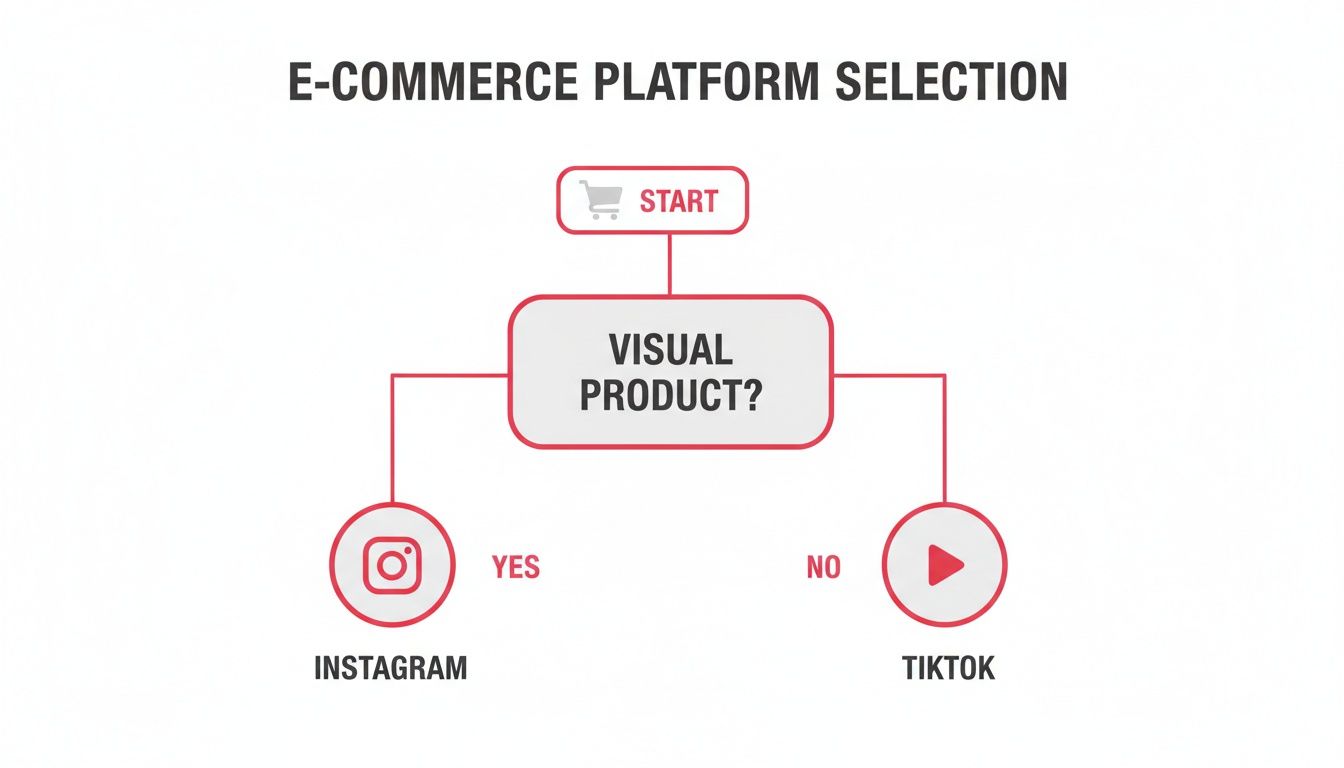
The flowchart gets to the heart of a key strategic choice: if your product is all about aesthetics, lead with a highly visual platform like Instagram. For pretty much everything else, lean into the dynamic, video-first world of TikTok.
Launching a Scalable UGC Program
One-off creator partnerships are great, but a scalable UGC program is a major advantage. It turns your entire customer base into a content-generating engine, creating a sustainable flow of authentic material that truly connects with new buyers.
The most powerful claim a brand can make is not its own, but one made by a happy customer. A successful UGC program operationalizes this principle, turning customer satisfaction into your most persuasive marketing asset.
To kick things off, you need to make it incredibly easy and appealing for customers to create and share content about your products. Building a successful program often starts with launching a clear and compelling campaign. For a deeper explore structuring your efforts, this user-generated content strategy guide is a fantastic resource.
By mastering both creator partnerships and user-generated content, you build a powerful, two-pronged marketing machine. You get the targeted reach of dedicated creators while also nurturing a community of brand advocates whose genuine excitement becomes your most effective sales tool.
Developing Content That Converts Clicks to Customers

Let’s be real. Having a solid strategy and great creators are key, but it's the actual content that stops the scroll and starts the sale. For ecommerce brands, your content has to do more than just get a laugh or a like; it has to guide a potential customer from "what's this?" to "I need this."
Every video, image, and caption needs to be engineered to get someone one step closer to checkout.
The trick is to create assets that feel completely at home on the platform – whether it's a quick TikTok or an aesthetic Instagram Reel – while still showing off your product’s value. It’s time to ditch the polished, corporate-style ads and lean into formats that feel authentic and relatable. This is the heart of successful social media marketing for ecommerce: a constant flow of content that grabs attention without screaming "buy now!"
You nail this balance by telling stories that showcase real benefits, not just a list of features. Instead of listing what your product does, show how it solves a real-world problem or just makes someone's day a little better.
Proven Content Formats That Actually Drive Sales
You don't need to reinvent the wheel to build a high-performing content library. From what we've seen, a few specific formats consistently crush it because they align perfectly with how people consume content and make buying decisions today.
Start building out your content calendar around these core pillars:
- Short-Form Product Demos: Forget boring instructional videos. Think quick, satisfying clips of your product in action. A 15-second Reel showing a stain remover instantly lifting a coffee spill from a white shirt is infinitely more powerful than a paragraph describing its formula.
- Authentic Behind-the-Scenes (BTS) Footage: People love feeling like they're getting an insider’s look. Show the care that goes into packing an order, introduce the person who designed the product, or give a glimpse of how it’s made. This builds a human connection and fosters a ton of trust.
- Customer Testimonials and Social Proof: Let your happy customers do the selling for you. Repost a customer's excited unboxing video or turn a glowing five-star review into a clean, shareable graphic. This kind of social proof is exactly what a hesitant buyer needs to see.
Mixing these formats keeps your feed interesting and hits all the right notes: it educates, entertains, and – most importantly – converts.
Writing a Creative Brief That Gets Results
A clear, concise creative brief is your secret weapon. It's the single most important document for making sure the content you get from creators is on-brand, effective, and not a total surprise. Without one, you're just hoping for the best. A great brief gives creators the direction they need while leaving them room to work their magic.
Keep it simple – a one-page doc covering the essentials is perfect. The goal is to make sure every piece of content has a clear purpose.
A well-structured creative brief isn't about controlling the creator; it's about aligning their creativity with your business goals. It’s the difference between getting a random video and receiving a powerful marketing asset designed to convert.
Here’s what your brief absolutely must include:
- Campaign Goal: Be specific. What is the one thing you want the viewer to do? (e.g., "Click the link to shop the new spring collection," or "Use code TIKTOK15 for 15% off.")
- Key Talking Points: Give them 2-3 non-negotiable points to hit. This could be a unique feature ("it's waterproof!"), a key benefit ("saves you 10 minutes every morning"), or a limited-time offer.
- The "Hook": Suggest a punchy opening. For instance, "Start by saying, 'Here are three reasons this travel mug has replaced my Stanley.'" This ensures those crucial first three seconds grab attention.
- Call to Action (CTA): Don't be vague. Tell the creator exactly what to say and do. "Point to the link in our bio and say 'Shop the full collection at the link in bio!'" or "Tell viewers to tap the orange shopping cart button to buy now!"
- "Do's and Don'ts": A few simple guardrails go a long way. A "Do" might be "Show the product in bright, natural light." A "Don't" could be "Please don't use any filters that change the product's color."
This framework gives creators the structure they need without stifling their authenticity – which is the whole reason you hired them. It sets everyone up for success and ensures you get content that’s ready to drive sales the moment it goes live.
Putting Some Fire Behind Your Best Content With Paid Ads
Organic reach is fantastic, but let's be real – it has a ceiling. To really move the needle and scale your ecommerce brand, you've got to put some ad spend behind your best-performing content. This is where you shift from crossing your fingers and hoping the right people see your posts to ensuring they do.
But this isn't about blindly boosting every post. We need to be surgical. The game plan is to pinpoint your organic winners – those videos and images that are already buzzing with engagement – and transform them into laser-focused ad campaigns. This whole approach takes the guesswork out of your ad spend because you’re doubling down on content that’s already proven it can connect with an audience.
The Magic of Spark Ads and Creator Content
On platforms like TikTok, the line between an organic post and a paid ad gets beautifully blurry, and that's all thanks to formats like Spark Ads. Instead of running a super-polished, corporate-looking ad that practically screams "I'm an ad!", Spark Ads let you amplify a creator's authentic video straight from their own account.
For an ecommerce brand, this is a massive win. The ad shows up as a native post from a creator people already trust, which instantly builds credibility and dodges the ad blindness so many users have developed. Time and again, the data shows these ads pull in higher engagement and a much better return on ad spend (ROAS). Why? Because they feel like genuine recommendations, not an annoying sales pitch.
By leveraging a creator's handle, you’re tapping directly into their built-in trust and social proof. It just feels like a natural part of the "For You" page.
Turning Top Instagram Posts into Customer Magnets
The exact same thinking applies to Instagram. See a Reel that got way more shares than usual? Or a carousel post with a ton of saves? Those aren't just vanity metrics; they're gold mines for your paid strategy. They're screaming signals from your audience about what they find valuable.
You can easily juice these high-flyers right from the Instagram app or get more granular with the Meta Ads Manager. The trick is to push this proven content beyond your current followers.
- Lookalike Audiences: Build an audience based on people who have already bought from you or are highly engaged with your profile. You’re essentially telling Meta, "Go find me more people like these."
- Detailed Targeting: Get specific by layering in interests. If you sell sustainable activewear, you can target users who are into both "yoga" and "eco-friendly products."
When you promote content that’s already a hit to these new, hyper-relevant audiences, you're introducing your brand to people who are statistically primed to be interested. If you really want to dial in your campaigns, digging into a full guide to Instagram Reels advertising can give you some more advanced plays.
Your best organic content is basically a free focus group. When a post takes off, your audience is literally telling you what kind of creative they want to see. Ignoring that feedback and creating separate, untested ad creative from scratch is a huge missed opportunity.
A No-Nonsense Budgeting Plan for Ecommerce Ads
Figuring out how much to spend can feel like a shot in the dark, but you don't need a huge budget to make an impact. The smartest way to start is small, with a daily budget you're comfortable with, and then scale up once you see the results rolling in.
A Simple Starting Framework:
- The Test Run: Set aside a modest budget ($20-$50 per day) for a campaign that promotes just one of your top organic posts.
- Watch the Numbers: Let it run for 3-5 days and then check your key metrics. Is your ROAS positive? Is the money you're making from the ad more than what you're spending? Keep an eye on your cost per purchase (CPA), too.
- Scale or Cut: If the ROAS is looking good, start bumping up the daily budget by 20-25% every few days. This gradual increase helps you scale without wrecking your campaign's efficiency. If it’s a dud, pause it and try again with a different top-performing post.
This cycle of testing and iterating lets you make decisions based on real data. You're only adding more fuel to the fires that are already burning bright, which is the key to minimizing risk while maximizing your shot at profitable growth. This is what smart social media marketing for ecommerce looks like in practice.
How to Track Performance and Optimize for Growth
If you’re not measuring your efforts, you're not marketing – you're just guessing. Effective social media marketing for ecommerce is all about a data-driven feedback loop. You have to track what’s working, ditch what isn’t, and constantly refine your approach. It’s time to look past vanity metrics like likes and followers and get laser-focused on the numbers that actually move the needle for your business.
The real goal here is to connect every dollar spent and every piece of content posted to a tangible result. Did that viral TikTok actually drive sales, or just a bunch of views? Are your Instagram ads delivering a positive return on ad spend (ROAS)? To answer these questions, you need to be dialed into the key performance indicators (KPIs) that truly matter for an ecommerce brand.
Setting Up Your Measurement Framework
Before you can optimize anything, you’ve got to get your tracking in order. This means building a reliable system to follow the customer from their first click on social media all the way to the final sale.
First things first: make sure your tracking pixels, like the Meta Pixel and TikTok Pixel, are correctly installed on your website. These little snippets of code are non-negotiable. They're what allow you to attribute sales back to specific ads and content, giving you a clear picture of what’s actually making you money.
Once your pixels are firing correctly, it's time to zero in on the metrics that tell the real story of your performance.
Vanity metrics make you feel good, but conversion metrics pay the bills. The most successful ecommerce brands are obsessed with understanding the entire customer journey, from the first impression on social media to the final purchase confirmation.
For a deeper explore all the numbers you should be watching, check out our complete guide on how to track social media analytics for more actionable insights.
Key Ecommerce Social Media Metrics to Track
To get the full picture of how your campaigns are doing, you need to blend platform-specific data with your core business metrics. This table breaks down the essentials you absolutely need to keep a close eye on.
| Metric | What It Measures | Why It Matters |
|---|---|---|
| Return on Ad Spend (ROAS) | The total revenue generated for every dollar spent on advertising. | This is your ultimate profitability metric. A ROAS above 1.0 means you're making more money than you're spending. |
| Cost Per Purchase (CPP) | The average cost to acquire one paying customer from a specific ad or campaign. | This helps you understand the efficiency of your ad spend and whether a campaign is financially sustainable. |
| Click-Through Rate (CTR) | The percentage of people who saw your ad and clicked on it. | A high CTR indicates your creative and copy are compelling enough to grab attention and spark interest. |
| Conversion Rate (CVR) | The percentage of website visitors from social media who complete a purchase. | This tells you how effective your landing page and overall site experience are at turning traffic into sales. |
Keeping these four metrics on your radar will give you a powerful, at-a-glance view of your social media performance and where you need to focus your optimization efforts.
A Simple Optimization Checklist for Growth
Once you have a steady stream of data coming in, the real work begins. Optimization is an ongoing process of testing, learning, and iterating – it never really stops.
Use this straightforward checklist to create a cycle of continuous improvement for your campaigns:
A/B Test Your Creatives: Never assume you know what will work. Always run at least two different ad creatives against each other. Test different hooks, visuals, or calls to action to see what really resonates with your audience.
Refine Your Audience Targeting: Are your ads being shown to the right people? Experiment with different lookalike audiences, interest targeting, and demographic filters. A great ad shown to the wrong audience will always fail.
Analyze Your Top Performers: Find your winners – the ads with the highest ROAS and lowest CPP. Double down on what’s working by putting more budget behind those campaigns, and use them as a blueprint for your next batch of creatives.
Cut Underperforming Ads Quickly: Don’t be afraid to pull the plug on campaigns that aren’t delivering. Wasting money on ads that aren’t converting is one of the fastest ways to drain your marketing budget.
By consistently applying this track-and-optimize framework, your social media efforts will become more predictable, profitable, and efficient over time.
A Few Common Questions We Get
How Much Should My Ecommerce Brand Budget for Social Media?
Honestly, there's no magic number here. But if you're just dipping your toes into paid ads, a good rule of thumb is to set aside 10-20% of your total marketing budget. For a brand new to the game, that might only be $500-$1000 a month to get a feel for different platforms and see which creative hits the mark.
Instead of fixating on a dollar amount, get obsessed with your Return on Ad Spend (ROAS). If you're consistently hitting a profitable ROAS, that's your green light to scale up confidently.
The smartest way to play it is to start small and let the data guide you. Carve out a test budget, pinpoint which channels and content are actually making you money, and then pour your returns back into what’s already working.
How Can We Get Started With UGC?
Getting a user-generated content program off the ground doesn't have to be some huge, complicated thing.
A super simple way to start is by creating a unique, branded hashtag and just asking your customers to use it when they post. You could even run a small contest or giveaway – offer a prize for the best photo or video that features your product. It gets the ball rolling.
Another easy win? Proactively reach out to customers who are already tagging your brand organically. Drop them a friendly message and ask for permission to feature their content on your own channels. Most people are thrilled to be featured! This is a fantastic way to build a real community and gather authentic social proof without a big upfront investment in your social media marketing for ecommerce.