
 7 Advanced Content Repurposing Strategies for 2025
Effective social video production isn't just about posting random clips and hoping for the best. It's a systematic process – planning, creating, and distributing video content built specifically for social platforms to hit real business goals. This approach transforms video from a simple creative exercise into a powerful, repeatable system for driving sales and brand growth.
Table of Contents
Building Your Strategic Foundation for Social Video
Before you even think about shooting a clip or messaging a creator, you need a solid strategy. This is what separates the viral hits from the expensive flops. Too many brands dive headfirst into production, chasing engagement without a clear purpose, which almost always leads to wasted time and money. The most successful video campaigns are built on a foundation of clear business objectives that steer every creative decision.
Forget vague goals like "more followers." You need to anchor your video strategy to tangible business outcomes. Are you trying to boost sales on TikTok Shop, drive qualified app downloads, or generate leads for a B2B service? Each of these goals demands a completely different creative angle, a different type of creator, and a unique call-to-action.
Understanding What Your Audience Actually Wants
Once you know why you're making videos, you need to figure out who you're making them for. Effective audience research goes way beyond basic demographics. It’s about uncovering what your customers genuinely want to watch, what problems they're trying to solve, and which content formats they’re already glued to and sharing.
This means you need to get your hands dirty. explore the comment sections on your competitors' posts. Browse relevant subreddits. Analyze your own past content to see what worked and what didn't. What questions are people constantly asking? What inside jokes are landing? What pain points keep popping up? These insights are pure gold, ensuring your content feels like part of the conversation, not a jarring interruption.
A classic mistake is creating content the brand wants to make, not what the audience wants to see. The best social video fits so seamlessly into a user's feed that it doesn't even feel like an ad.
The Power of a Comprehensive Creative Brief
All your strategic work comes together in one critical document: the creative brief. Think of this as the North Star for your entire campaign, keeping your internal team and external partners perfectly aligned. It’s where you translate your business goals and audience insights into clear, actionable instructions for creators. When using platforms like JoinBrands, a killer brief is what allows the AI to find the perfect creators who can produce authentic, on-brand content that just works.
A strong brief needs to include:
- Campaign Objective: What's the single most important action you want the viewer to take?
- Target Audience: Describe your ideal viewer in detail – what are their struggles and motivations?
- Key Message: If the viewer remembers only one thing, what should it be?
- Mandatory Inclusions: List any specific product features, talking points, or branding elements that absolutely must be in the video.
- Creative Do's and Don'ts: Set clear guardrails to guide the creator's style while still giving them the freedom to be creative and authentic.
Short-form video has become the undisputed champion of social content, delivering the highest ROI at 41% compared to all other video formats. This is exactly why 92% of marketers are either maintaining or increasing their video marketing budgets. They're seeing real results, like better user understanding (93%), stronger brand awareness (93%), and a direct lift in sales (83%).
If you need extra firepower for your video efforts, partnering with a specialized social media agency can bring in expert knowledge. To get an even deeper understanding of the planning phase, check out our guide on how to create a social media marketing strategy. Nailing this foundational plan is the most important part of the entire process – it's what sets the stage for content that doesn't just get views, but actually converts.
How to Find and Partner with the Right Creators
Authenticity is the currency of social media, and the right creator partnership is where you cash in. Let's be honest: just blasting out generic messages to creators with big follower counts is a surefire way to get ignored. A truly successful social video strategy hinges on finding partners who genuinely click with your brand’s voice and whose audience implicitly trusts their recommendations.
This all starts with looking past vanity metrics. A million followers means absolutely nothing if that audience is disengaged or a terrible fit for your product. Instead, the real work is in sourcing, vetting, and collaborating with creators who can actually move the needle.
Sourcing Creators Beyond a Simple Search
Manually scrolling through TikTok or Instagram for the right person can feel like searching for a needle in a haystack. If you want to find the right talent without losing your mind, you need a more systematic approach. This is where creator marketing platforms really shine, letting you slice and dice through massive talent pools with precision.
Think about the specific filters you can use to find exactly who you need:
- Niche Specialists: Need someone who lives and breathes "sustainable skincare" or "vegan protein recipes"? You can search for creators who focus on those specific topics to hit a super-relevant audience.
- Platform Experts: You can pinpoint creators who are masters of their craft, whether that's creating viral TikToks or producing slick YouTube Shorts.
- Location-Based Creators: If you’re a local business or running a campaign in a specific region, you can easily find creators in that city or state.
- TikTok Shop Affiliates: For e-commerce brands, this is a goldmine. Finding creators already killing it on TikTok Shop gives you a direct path to driving sales.
Platforms like JoinBrands use AI-powered matching to connect your creative brief directly with creators who have a proven track record in your specific vertical. To cast an even wider net, you might also consider working with top influencer marketing agencies who have established relationships with a broad range of talent.
Vetting for Quality and Brand Fit
Okay, so you've got a shortlist of potential partners. Now comes the most important part: the vetting process. This is where you dig deep and separate the true professionals from the hobbyists. Don't just glance at their follower count; you need to analyze their portfolio for what really matters.
First, evaluate their content quality. Is their video and audio clear? Do they have a basic grasp of lighting and composition? A creator doesn't need a Hollywood studio, but their content should meet a quality standard that makes your brand look good.
Next, explore their engagement metrics. Look right past the likes and go straight to the comments. Are people having real conversations, or is it just a sea of "great post!" comments and bots? Authentic engagement is a huge tell – it shows the creator has built a genuine community that trusts what they have to say.
The single most important question to ask is: "Does this creator's personal brand and values align with ours?" If a creator's post about your product feels forced or totally out of character for them, their audience will smell it a mile away, and the entire campaign will fall flat.
Building Strong and Collaborative Partnerships
Finding the right person is only half the battle. Building a strong partnership is what ultimately leads to incredible social videos. This all comes down to clear communication, fair pay, and a collaborative mindset that empowers the creator to produce their best work.
Always start with a detailed contract or agreement that lays out all the expectations. This is non-negotiable and should cover:
- Deliverables: The exact number and type of videos you expect.
- Usage Rights: Where and for how long you can use the content (e.g., paid ads, your website, etc.).
- Timeline: Clear deadlines for drafts and final posts.
- Compensation: The payment amount and when they'll get paid.
Negotiating fair compensation is absolutely key to a healthy, long-term relationship. Rates vary wildly, but be ready to pay for a creator's skill, their time, and the access they provide to their audience. Offering a fair rate shows you value their work and sets the tone for a positive partnership. For a deeper dive, you can learn more about how to find influencers for your brand with strategies that help build these lasting relationships.
When you treat creators like true creative partners – not just hired guns – you create an environment where they can produce their most compelling and effective content for your brand.
Nailing Your Production and Editing Workflow
If you want to scale up your social video production, you need a smart, repeatable system. The idea is to ditch the chaotic email threads and messy feedback cycles for a smooth process that turns raw creator footage into killer social content – without the usual bottlenecks. Trust me, when you're juggling multiple creators and campaigns, an organized workflow isn't just nice to have; it's absolutely essential to keep quality high and things moving fast.
The first step? Create a central hub for all creator submissions. Stop letting video files pour in through emails, DMs, and a random assortment of file-sharing links. Instead, use a dedicated platform or even a simple project management tool. This gets all your raw footage, revisions, and final cuts into one place, nicely timestamped and easy for the whole team to find. It instantly kills that dreaded "Wait, which version is the final final one?" question.
Once a creator sends in their first draft, your feedback needs to be crystal clear and constructive. Vague notes like "make it more engaging" are totally useless. Give them actionable, timestamped feedback. For example, "At 0:05, can we add a text overlay with the product name?" or "The audio is a bit low from 0:15 to 0:20." That kind of specificity helps the creator know exactly what to change, which makes the revision process way faster. For an even tighter system, you can find some great advice on building a formal content approval workflow to keep everyone aligned.
Mastering the Technical Details
Beyond just managing submissions and feedback, a solid workflow has to account for all the technical bits and pieces that make or break social video today. Getting these details right from the very beginning saves you from time-sucking re-edits later and makes sure your content is set up for maximum impact on every platform.
The most fundamental piece of the puzzle is the aspect ratio. For platforms like TikTok, Instagram Reels, and YouTube Shorts, 9:16 vertical video is non-negotiable. It’s the full-screen format everyone expects, and uploading a horizontal video will immediately make your content look amateurish and out of place.
Just as critical are the safe zones. Every platform has its own interface clutter – usernames, captions, like buttons – that sits on top of the video. If you put any crucial text, logos, or calls-to-action in those areas, they'll get covered up. You absolutely have to edit with these safe zones in mind, keeping all the important stuff centered and visible.
This flowchart gives a good overview of the partnership process, which is really the kickoff point for any production workflow.
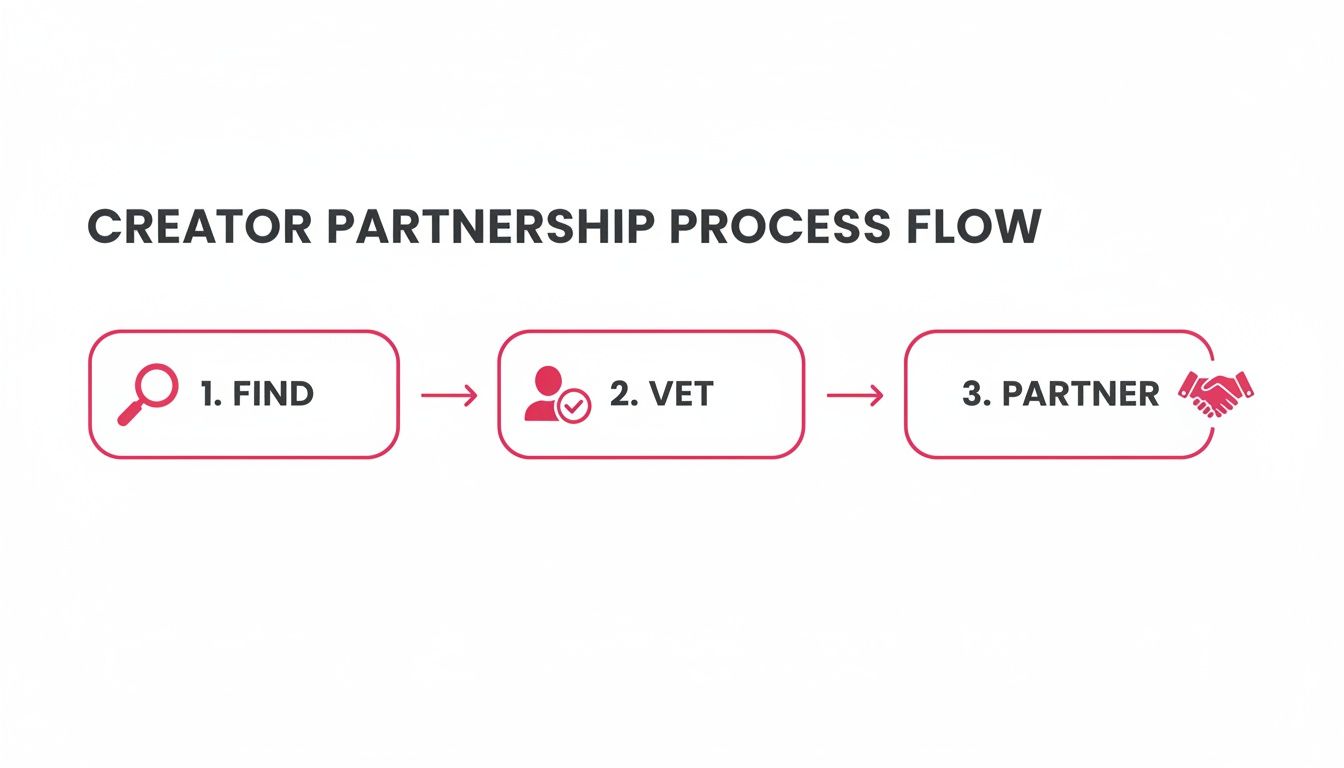
As you can see, it all starts with finding the right talent, vetting them, and then formalizing the partnership. That's what sets the stage for a smooth production phase.
Editing Techniques for High Retention
The first three seconds. That's all you get to convince someone to stop scrolling. Your editing workflow has to be built around techniques that grab attention instantly and refuse to let go. This isn't about fancy cinematic effects; it's about fast-paced, dynamic editing made for short attention spans.
Here are a few techniques that just plain work:
- The Quick Cut: Ditch the long, lingering shots. Use quick cuts every 1-3 seconds to build energy and keep the viewer’s brain locked in.
- Trending Audio: Hopping on a trending sound or song is one of the fastest ways to make your content feel native to the platform. It's a powerful shortcut to grabbing interest.
- Dynamic Captions: Don't settle for the standard auto-captions. Style your captions with color, animations, or emphasis on key words to make them pop. This makes your video more accessible and way more visually interesting.
The most effective social videos don't feel overproduced. The goal is to create content that looks authentic and native while still being polished enough to represent your brand professionally. This balance is key to building trust with viewers.
By setting up a structured submission process, mastering the technical formatting, and using viewer-focused editing techniques, you’re not just making videos – you're building an efficient engine for your social video strategy. This kind of system lets you handle a higher volume of content without ever sacrificing quality, turning great ideas into high-performing assets at scale.
Getting Your Video Right for Each Social Platform
One of the biggest mistakes I see brands make is creating one video and blasting it across every social channel. That’s a recipe for failure. The high-energy, trend-driven clip that absolutely crushed it on TikTok will likely fall flat on Instagram.
Why? Because every platform has its own unwritten rules, its own culture, and its own algorithm. True success isn't about creating three totally separate videos. It’s about being smart and adaptable. You start with one solid concept and then tweak the editing, sound, and captions to make it feel like it truly belongs on each platform. That's how you get the most mileage out of your work.
Tailoring Content for TikTok
TikTok is all about jumping on trends, being part of the conversation, and grabbing attention fast. The algorithm loves content that hooks viewers instantly and uses whatever is blowing up on the platform at that moment. You have to think like a user, not a marketer.
Using trending sounds and music is pretty much non-negotiable. Seriously, just picking the right audio can be the difference between 100 views and a million. The sound isn't just background noise; it's often the entire punchline or premise of the video.
Interactive features are also your secret weapon here. Get familiar with tools like:
- Stitch and Duet: These are gold. They literally invite other users to use your video to create their own, which can kickstart a massive ripple effect.
- Polls and Q&A Stickers: Simple, effective ways to get people to tap the screen and signal to the algorithm that your content is engaging.
- Text-to-Speech: This feature is a core part of the TikTok aesthetic. Using it makes your video feel more native and is great for accessibility.
Optimizing Your Video for Instagram Reels
While Reels looks a lot like TikTok with its vertical format, the vibe is different. It’s often a bit more polished, more aspirational. Instagram users, especially on the Explore page, tend to reward higher-quality visuals. A raw, shaky video that might feel authentic on TikTok can look out of place on a carefully curated Instagram feed.
Your main job is to create a powerful visual hook in the first 1-2 seconds. We're talking high-resolution footage, good lighting, and sharp editing. This is critical if you want to land on the Explore page, which is a huge engine for discovering new audiences.
Think of your Instagram Reel strategy as a moving, breathing part of your brand’s visual identity. It should feel like your best grid posts brought to life – visually stunning and offering real value, whether that's through inspiration, a quick tutorial, or just pure entertainment.
Driving Channel Growth with YouTube Shorts
YouTube Shorts plays a fascinating double role. On one hand, it's for quick, snackable content just like Reels and TikTok. But on the other, it’s an incredibly powerful tool for feeding your main, long-form YouTube channel. The Shorts algorithm is great at pushing your content to people who are already interested in your niche, making it a fantastic discovery tool.
The key is to create a bridge between your Shorts and your longer videos. Your Short should be a compelling teaser or a single, valuable nugget that leaves people wanting more. Always end with a gentle nudge, encouraging viewers to check out a related full-length video on your channel.
For example, you could pull a 60-second "pro tip" from a 20-minute tutorial. This delivers instant value in the Short while creating a clear path for engaged viewers to subscribe and dive deeper into your content. The end goal here is less about a single viral hit and more about using short-form video to build a loyal, long-term subscriber base.
Measuring Performance to Scale Your Success
If you can't measure your social video production, you can't improve it. Simple as that.
In a world of endless scrolling and fleeting attention, getting tons of views is a nice ego boost, but it doesn’t actually pay the bills. The real goal is to figure out what drives business results and then pour your resources into doing more of that. This means shifting your focus from vanity metrics to the key performance indicators (KPIs) that truly matter.
Views and likes are surface-level. They tell you people saw your video, but not much else. To get a real sense of what's working, you need to dig deeper into how people are actually interacting with your content and, more importantly, what they do next. That's how you prove the tangible value of your video efforts and make smart decisions about where to invest your budget.
Key Metrics That Actually Matter
To get a clear picture of performance, you need to track a few core metrics that tell a complete story. Instead of getting hung up on the view count, start prioritizing data that reveals real audience engagement and intent.
These are the numbers that should live on your performance dashboard:
- Watch-Through Rate: What percentage of viewers watched your entire video? A high rate is a huge win on social media – it means your content was compelling enough to hold their attention from start to finish.
- Average Watch Time: How long did people stick around on average? If you have a 30-second video but the average watch time is only four seconds, you know your intro isn't hooking people effectively.
- Click-Through Rate (CTR): This is the percentage of viewers who clicked the link in your post, bio, or video. CTR is a direct signal of how well your video is motivating viewers to take that next step.
- Conversion Rate: This is the ultimate bottom-line metric. It tracks how many viewers completed a desired action after clicking, like making a purchase, signing up for a newsletter, or downloading your app.
When you focus on these metrics, you stop guessing what works and start knowing for sure. This data gives you the concrete evidence you need to justify your budget and scale your most successful campaigns.
Using A/B Testing to Refine Your Strategy
The best way to figure out what actually resonates with your audience is to test everything. Simple, controlled experiments – known as A/B tests – let you compare two different versions of a video element to see which one performs better. This is how you systematically improve your results over time.
Don't overcomplicate it. You can start with small, simple tests that yield powerful insights. For instance, you could test two different video hooks in the first three seconds to see which one grabs a higher average watch time.
A/B testing removes the guesswork from your creative process. Instead of debating whether a soft or direct call-to-action is better, you can let your audience’s behavior give you the definitive answer.
Here are a few A/B testing ideas to get you started:
- Creator Styles: Pit a polished, professional-looking video from one creator against a more raw, authentic UGC-style video from another.
- Calls-to-Action (CTAs): Test a text overlay that says "Shop Now" versus one that says "Link in Bio." Which one gets more clicks?
- Thumbnails: Try a thumbnail with a person's face versus one that just shows the product. See which one stops the scroll.
Building a Data-Driven Feedback Loop
The final, and most crucial, step is turning all that performance data into actionable insights for your next campaign. This creates a powerful feedback loop where every video you produce makes the next one smarter.
When you see that videos from a certain creator consistently drive a high conversion rate, you know to reinvest in that partnership. It's a no-brainer.
This process involves translating your analytics directly into your next creative brief. If your data shows that videos under 20 seconds have the best watch-through rate, your next brief should specify that length. If you discover that "how-to" videos generate the most shares, that should inform your content strategy moving forward.
By analyzing which creators, formats, and messages deliver the best results, you can confidently double down on what works and cut what doesn't. This data-driven approach is the key to scaling your social video production, proving its ROI, and building a predictable engine for growth.
Got Questions About Social Video Production? We've Got Answers.
As brands get serious about social video, the same questions pop up time and time again. Let's clear the air on some of the most common ones so you can scale your video efforts with total confidence.
How Much Should I Actually Budget for This?
This is the million-dollar question, isn't it? The honest answer is: it depends. A single UGC video might only cost a few hundred dollars, while a huge campaign with a top-tier influencer can run into the tens of thousands.
But here’s how you should be thinking about it: shift your focus from the upfront cost to the potential return. Don't try to boil the ocean on your first attempt.
Start with a smaller test budget. Use it to work with a handful of micro-influencers on one specific campaign. Track everything – and I mean everything. Figure out your baseline cost-per-click, cost-per-lead, or cost-per-sale. Once you have that data, you're no longer guessing. You know exactly what's working, and you can pour more budget into the creators and video styles that are actually driving results.
What’s the Real Difference Between UGC and Influencer Video?
They can look pretty similar on your feed, but strategically, they serve very different purposes. Nailing this distinction is crucial for building a smart video plan.
User-Generated Content (UGC): Think of this as content that feels like it was made by a real customer. It’s raw, relatable, and screams authenticity. This is the stuff that builds massive trust. Brands love running UGC in their own paid ad campaigns because it just doesn't feel like a traditional ad. It feels like a real person's recommendation.
Influencer Video: This is content created by an established creator that gets posted directly to their audience. You're not just buying a video file here; you're buying access. You're tapping into the creator's built-in distribution channel and the credibility they've spent years building with their followers.
The best part? Many creators are pros at making both. You can hire a creator to produce a fantastic UGC-style ad for your own channels and pay them to post a separate video to their followers. It’s a powerful one-two punch.
The real magic happens when you match the content type to your goal. Use UGC to pack your ad creative with authentic, high-trust assets. Use influencer posts to get in front of brand new, highly engaged audiences.
How Do I Legally Use Creator Videos in My Ads?
Pay close attention to this one, because getting it wrong can land you in some serious hot water. You can never just assume you have the rights to use a creator's video in your ads, on your website, or anywhere else. You need a clear, written agreement. Period.
This means using a formal contract or a platform that has iron-clad terms of service built-in. This agreement needs to spell out exactly where and how you're allowed to use the video.
Make sure your agreement clearly defines these key terms:
- Usage Rights: Be specific. List every single channel you plan to use (e.g., paid ads on Meta, TikTok Spark Ads, organic social, your website homepage).
- Duration: How long do you have the rights? A year? In perpetuity? Get it in writing.
- Exclusivity: Does this agreement prevent the creator from working with your direct competitors for a certain amount of time?
This isn't just about protecting your brand; it protects the creator, too. It prevents future arguments, ensures you have the legal clearance you need, and makes sure the creator is compensated fairly for how their work is being used.
Ready to streamline your entire creator collaboration process? JoinBrands provides the tools you need to find creators, manage campaigns, and secure content rights all in one place. Find your perfect creator today on JoinBrands.