
 Unlocking Influence The Guide to Influencer AI
Sponsorships on Instagram are pretty simple at their core: brands pay creators to talk about their products or services. But think of it less like a billboard and more like a recommendation from a trusted friend. This is all about tapping into authentic influence to reach niche audiences that old-school advertising just can't touch.
Table of Contents
What Instagram Sponsorships Mean for Brand Growth

When you get down to it, an Instagram sponsorship is a strategic partnership, not just another line item in your ad spend. It’s how a brand’s message gets transformed from a corporate broadcast into a personal conversation.
The moment a creator shares your product, they’re lending you their most valuable asset: the trust they’ve painstakingly built with their community. That's the real power of creator-led marketing. Instead of interrupting people with ads they’d rather skip, sponsorships weave your brand right into the content they already love and follow. It just feels more genuine and, frankly, works a lot better with audiences who are tired of being sold to.
The Power of Authentic Connections
On social media, authenticity is everything. People are drawn to real stories and relatable personalities, and that's exactly what sponsorships allow brands to tap into. By finding the right creators to work with, you can get in front of highly engaged, niche communities that would be incredibly difficult and expensive to target any other way.
These collaborations do more than just get eyes on your product; they build credibility and what we call social proof. A recommendation from a respected creator is a powerful endorsement. It signals to their followers that your brand is legit and worth checking out—a crucial step in turning a curious scroller into a loyal customer.
A well-executed sponsorship doesn't just sell a product; it builds a narrative around your brand, making it part of a lifestyle or community that consumers want to join. It’s storytelling, not just advertising.
To learn more about building this kind of connection, check out our guide on how to build brand awareness.
Key Content Formats for Sponsorships
Instagram gives you a versatile toolkit for sponsored content, and each format has its own job to do. Knowing when to use which one is key to building a campaign that actually works.
Instagram Posts (Single Image or Carousel): These are the backbone of many campaigns. They’re perfect for showing off high-quality visuals and telling a more detailed story. Since they live on a creator's feed forever, they offer long-term value and act as a lasting piece of social proof.
Instagram Stories: With their 24-hour lifespan, Stories create a sense of urgency and intimacy. They're fantastic for behind-the-scenes content, quick tutorials, Q&A sessions, or driving immediate action with interactive features like polls and swipe-up links.
Instagram Reels: As the platform's answer to short-form video, Reels are built for maximum reach and discovery. This is where you want to put your fun, engaging, and potentially viral content that can introduce your brand to a massive new audience, even beyond the creator’s own followers.
To help you decide, here’s a quick breakdown of how these formats stack up against each other.
Key Instagram Sponsorship Formats at a Glance
This table offers a quick summary comparing the primary sponsored content formats on Instagram, highlighting their best use cases and typical goals.
| Format Type | Primary Goal | Best For | Content Lifespan |
|---|---|---|---|
| Feed Posts | Brand Storytelling, Social Proof | High-quality visuals, detailed captions, building lasting credibility. | Permanent (on feed) |
| Stories | Urgency, Direct Engagement | Behind-the-scenes content, Q&As, limited-time offers, driving traffic. | 24 Hours |
| Reels | Reach, Virality | Entertaining & educational short-form videos, trend participation. | Permanent (on Reels tab) |
Each format plays a unique role, and the most successful campaigns often mix and match them to hit different objectives.
The growth here is impossible to ignore. The use of the #ad hashtag has shot up by 133% among influencers, which tells you just how mainstream transparent promotion has become. This is all part of a much bigger trend, with the entire influencer marketing market expected to reach $32.55 billion globally by the end of 2025.
How Sponsorship Pricing and Deal Structures Actually Work
Figuring out the money side of Instagram sponsorships can feel like trying to hit a moving target. There’s no universal price tag, and that’s because every creator, campaign, and audience is completely different. But if you get a handle on the common deal structures, you'll be able to negotiate with confidence and make sure your investment is a smart one.
Think of it like hiring a contractor. You could pay a fixed price for the whole project, give a salesperson a commission on what they sell, or pay for an ad based on how many people see it. Sponsorship pricing works in a very similar way, and each model has its own strengths.
The Flat Fee Model
The most common and straightforward approach is the flat fee. It's exactly what it sounds like: you and the creator agree on a fixed price for a specific set of deliverables. For example, you might pay a creator $500 for one Instagram Reel and two Stories. Simple.
This structure is a brand’s best friend for budgeting. You know exactly what you’re spending and what you’re getting in return, which is perfect for managing marketing spend. The creator gets paid for their time, effort, and access to their audience, no matter how many sales the content brings in. It’s the go-to model for building brand awareness and getting high-quality content made.
The Performance-Based Model
Next up is the performance-based model, which usually looks like an affiliate or commission deal. Instead of a big payment upfront, you give the creator a cut of the sales they generate. This is almost always tracked with unique discount codes or special affiliate links.
This is like having a commission-only salesperson on your team. The risk is incredibly low because you only pay for actual results. It’s a fantastic option for direct-to-consumer brands that are laser-focused on driving sales and need to see a direct return on investment (ROI). It also gives creators a real incentive to make content that genuinely convinces their followers to buy.
The secret to making a performance deal work is finding that sweet spot for the commission rate—it has to be motivating for the creator but still profitable for your business. It’s a true partnership where everyone wins when sales are booming.
The CPM or Hybrid Model
A less common but still relevant structure is based on CPM (Cost Per Mille), which means you pay a certain amount for every thousand views or impressions the sponsored content gets. This feels a lot like traditional digital advertising and is often used by bigger brands aiming for massive reach.
What's more common these days is the hybrid model, which cherry-picks the best parts of different structures. A popular hybrid approach is paying a smaller flat fee upfront (to cover the creator's production costs) and adding a performance-based commission on sales. This gives the creator some security while giving the brand a performance incentive—a balanced partnership that really works.
For a deeper look into all the ways you can set up payments, our guide on how to pay influencers breaks it all down.
What Influences the Price Tag
So, what actually determines the final cost? A creator's follower count is just the starting point. Several other factors play a much bigger role.
- Engagement Rate: A creator with 10,000 super-engaged followers is almost always more valuable than one with 100,000 silent ones. High engagement means a loyal, trusting audience that listens.
- Niche and Expertise: Creators in specialized fields like finance, B2B tech, or sustainable living can command higher rates because their audience is so specific and their authority is so high.
- Content Quality and Production: Is it a simple selfie or a cinematic video with professional editing? High-quality production takes more time and skill, and the price reflects that.
- Campaign Scope and Usage Rights: How many posts are you asking for? Do you need exclusivity? Do you want the rights to use their content in your own ads? All of these things will significantly bump up the price.
Sponsorship costs are rising because the market is maturing, and value is now tied to proven results, not just vanity metrics. In 2024, the average price for a sponsored post climbed to $418, a 15.17% jump from the previous year. Top-tier creators are now earning over $45,000 for a single post. This isn't just arbitrary; it's backed by performance. Instagram Reels, for instance, are hitting an impressive 2.08% engagement rate, making them an absolute powerhouse for DTC campaigns. You can find more stats like this in this great report on Instagram statistics that are transforming marketing strategies on fluctur.com.
Running a Seamless Sponsorship Campaign from Brief to Post
A great sponsorship campaign isn’t a single transaction; it's a collaborative project that runs like a well-oiled machine. It’s built on crystal-clear communication and a predictable workflow that both you and the creator can count on. Following a set process, from the initial vision to the final post going live, is the secret to avoiding missed deadlines, off-brand content, and mismatched expectations.
It all starts with a single document that becomes your campaign’s North Star: the creative brief.
Crafting an Inspiring Creative Brief
The creative brief is easily the most important document in your entire campaign. Don't think of it as just a list of instructions. It’s an inspiration tool that gives creators the context and creative freedom they need to produce authentic, high-performing content. A weak brief leads to generic, cookie-cutter posts, but a great one sparks genuine creativity.
Your brief needs to clearly lay out the campaign's goals (what are we trying to achieve?), the target audience (who are we talking to?), and the key messages (what absolutely must be said?). Just as important, though, is defining what not to say and providing brand guidelines without being so rigid that you stifle their personality. The goal is to guide, not dictate. You want the creator's unique voice to shine through.
Need a starting point? For a deep dive, check out our comprehensive creative brief template that breaks down everything you should include.
A solid brief usually covers:
- Campaign Objectives: Are you driving brand awareness, direct sales, or gathering user-generated content?
- Key Talking Points: List 2-3 essential features or benefits you want the creator to hit on naturally.
- Content "Do's and Don'ts": Set clear guardrails, like avoiding certain phrases or not mentioning competitors.
- Call to Action (CTA): What, specifically, do you want the audience to do? (e.g., "Shop the link in my bio," "Use code CREATOR20").
- Mood Board & Examples: Visuals are perfect for aligning on the desired aesthetic and tone.
Managing Logistics: Product Delivery and Approvals
Once the brief is locked in, the logistical gears start turning. First up is product delivery. This is a simple but critical step—any delays here will push back the entire campaign timeline. Communicate shipping details clearly and always provide tracking information so the creator knows exactly when to expect their package.
After the creator has the product and works their magic, it’s time for the approval process. This is your chance to make sure the content hits all the marks from the brief before it goes live. You’ll want to establish a clear and reasonable timeline for feedback, usually giving yourself 24-48 hours to review everything.
The approval stage isn't about micromanaging the creator's work. It's a final quality check to catch any factual errors, ensure proper brand representation, and confirm that all disclosure requirements are met.
The logistics and goals of your campaign are often tied to how the deal is structured in the first place.
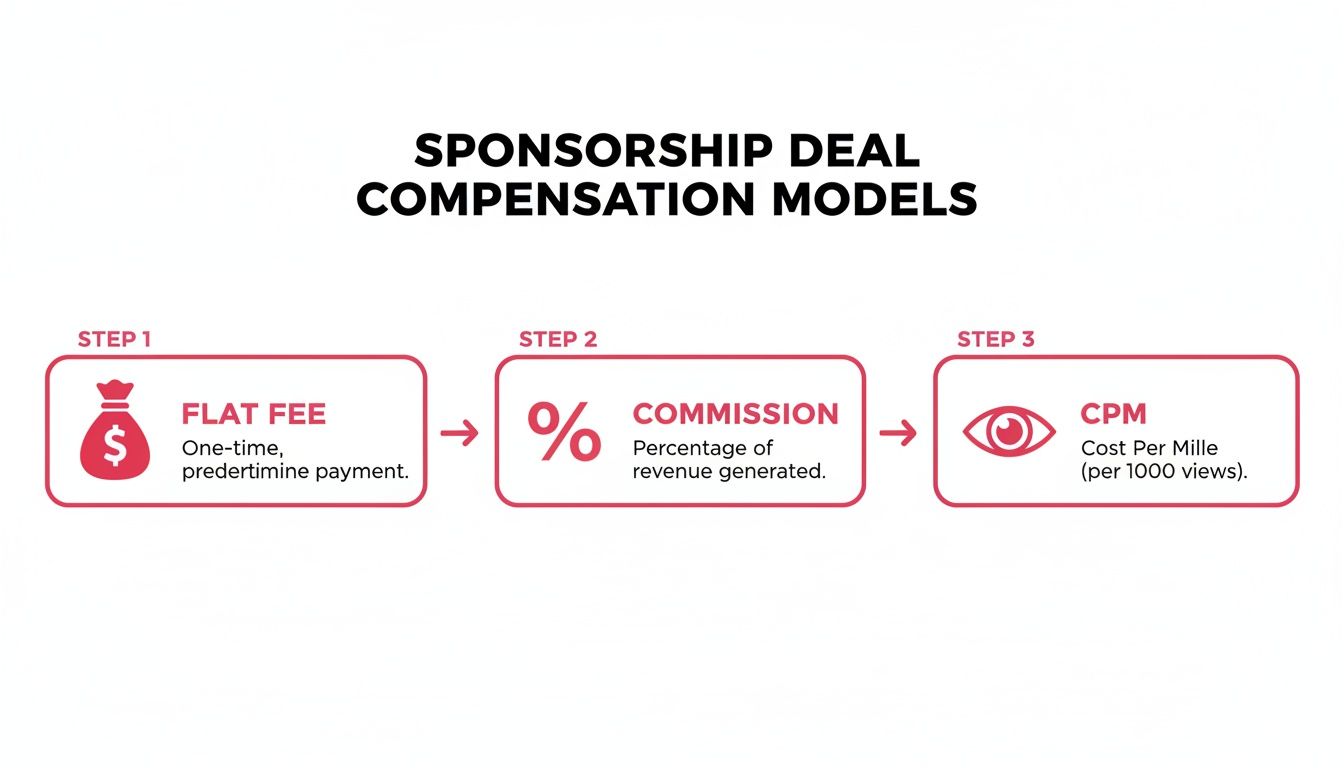
Understanding these compensation models is key to building a deal that makes sense for everyone involved.
Defining Content Usage Rights
Here’s a common mistake that can lead to major headaches down the road: not clarifying content usage rights upfront. Just because you paid for a sponsored post does not mean you own the content and can use it wherever you want. The creator always retains the copyright to their work unless your agreement says otherwise.
Before any work begins, your contract must spell out exactly how and where you can use the creator’s content. Can you repurpose it on your own social media channels? Use it in paid ads? Feature it on your website? Each of these scenarios typically requires extra compensation and has to be negotiated in advance. Getting these terms in writing protects both you and the creator and prevents any disputes later on, ensuring the collaboration is smooth and professional from start to finish.
Mastering Legal Rules and Disclosure on Instagram
In the world of influencer marketing, trust is everything. It’s the entire foundation of a successful partnership. Audiences follow creators because they trust their voice and believe in their recommendations. When that trust gets shaky because of hidden or confusing ads, the value of the sponsorship completely disappears for everyone involved.
That’s why getting the disclosure rules right for sponsorships on Instagram isn’t just about staying out of legal hot water. It’s about protecting the very credibility that makes these collaborations so powerful in the first place. Transparency isn't optional.
Demystifying FTC Guidelines
In the United States, the Federal Trade Commission (FTC) is the referee for all things advertising. Their rules for influencers are refreshingly straightforward: if there’s a “material connection” between a brand and a creator, you have to disclose it. Plain and simple. This means if you paid them or even just sent them free products, their audience has a right to know.
The FTC cares most about clarity. Vague hashtags like #collab, #sp, or #partner just don’t cut it anymore because they can be confusing. The disclosure needs to be so obvious that anyone scrolling their feed can immediately understand it's an ad.
“The guiding principle is transparency. An endorsement must be clearly identifiable as advertising to the average consumer. Hiding disclosures deep in a caption or behind a ‘more’ button doesn’t cut it.”
This isn't just a friendly suggestion; it's a legal requirement designed to stop deceptive advertising. Ignoring it can lead to hefty fines for both the brand and the creator. It’s a risk that’s just not worth taking.
Best Practices for Clear Disclosure
So, what does a good disclosure actually look like? The key is to make it impossible to miss.
Here are the essential best practices to follow:
- Use Clear and Simple Language: The best disclosures are the most direct. Hashtags like #ad, #sponsored, or #advertisement are the gold standard. There’s zero room for misinterpretation.
- Place It Prominently: Don’t bury the disclosure at the bottom of a long caption or get it lost in a sea of other hashtags. The FTC wants it "above the fold," meaning it must be visible before someone has to tap "…more" to see the rest of the text.
- Make It Visible in Video: For Reels and Stories, the game is a little different. The disclosure needs to be written right on the video itself. It also has to stay on screen long enough for someone to actually read it—a quick flash that’s gone in a second won’t fly.
Using Instagram’s Branded Content Tools
To make all of this even easier, Instagram created its own Branded Content tools. When a creator uses this feature, a clean "Paid partnership with [Brand Name]" label shows up right under their username at the very top of the post, Story, or Reel.
Honestly, this tool is the cleanest and most official way to handle disclosure. It's impossible to miss, it’s recognized by the platform, and it creates a professional link between the creator and your brand.
But there’s another huge perk for brands: access to data. When a creator tags you using the "Paid Partnership" label, you get to see the post's reach and engagement metrics directly. This makes it way easier to measure your campaign's real impact. It’s a true win-win that boosts transparency and gives you the valuable insights you need.
Measuring the True Impact of Your Sponsorships

Once your sponsored content is live, the real work begins. To figure out if your investment was worth it, you have to measure its impact with the right data. Going beyond surface-level likes and comments is absolutely critical for proving the value of your sponsorships on Instagram and making smarter bets on future campaigns.
Think of it this way: likes are like applause at a concert. It feels great, but it doesn’t tell you if anyone is actually going to buy the album. You need to dig deeper into the numbers that connect directly to your business goals. That’s where the real story is.
Key Performance Indicators That Actually Matter
To get the full picture, you’ll want to track a mix of metrics that cover awareness, engagement, and conversion. Each one answers a different question about how the sponsorship performed and what the audience did next.
When your campaign is running, keep a close eye on these KPIs:
- Reach & Impressions: Reach tells you how many unique accounts saw the content, while impressions count the total number of times it was viewed. High reach is a fantastic start for brand awareness, but it's just the first step of the journey.
- Engagement Rate: This is a vital health check for your content. It’s calculated by dividing all the interactions (likes, comments, shares, saves) by the reach. A strong engagement rate means the content didn't just appear in a feed—it made people stop, think, and interact.
- Click-Through Rate (CTR): If driving traffic was your goal, CTR is your new best friend. It measures the percentage of people who clicked the link in the creator's bio, Story, or post. This is a direct sign of how compelling your call to action really was.
A high reach with a low engagement rate is a major red flag. It suggests the content was seen by a lot of people but failed to capture their interest, pointing to a potential mismatch between the creator, the message, and the audience.
The Essential Metrics for Instagram Sponsorships
Keeping track of your campaign's performance can feel overwhelming, but focusing on the right numbers makes all the difference. This table breaks down the key performance indicators (KPIs) you should monitor to understand what’s working and what’s not.
| Metric | What It Measures | Why It's Important |
|---|---|---|
| Reach | The number of unique accounts that saw the sponsored content. | Measures the total size of the audience you reached; crucial for awareness goals. |
| Impressions | The total number of times the sponsored content was displayed. | Indicates frequency and visibility; a high number shows the content was served often. |
| Engagement Rate | The percentage of the audience that interacted (liked, commented, shared, saved). | Shows how much the content resonated with the audience; a key indicator of quality. |
| Click-Through Rate (CTR) | The percentage of viewers who clicked on your link (in bio, Story, etc.). | Directly measures how effective your call-to-action was at driving traffic. |
| Conversions | The number of desired actions taken (e.g., sales, sign-ups, downloads). | The ultimate measure of success for performance-based campaigns. |
| Cost Per Mille (CPM) | The cost to reach 1,000 impressions. | Helps you understand the cost-efficiency of the campaign for generating awareness. |
| Return on Ad Spend (ROAS) | The total revenue generated for every dollar spent on the sponsorship. | The bottom-line metric that proves the financial return on your investment. |
By tracking these metrics together, you get a holistic view of your sponsorship's performance, from initial visibility all the way to a tangible return for your business.
Connecting Metrics to Business Goals
Data is just noise until you give it context. The final step is tying these numbers back to your original campaign objectives to calculate your return on investment. This is how you translate social media stats into real-world business results.
For example, if your goal was to drive sales, you need to track conversions. This is usually done with unique discount codes (like "CREATOR15") or UTM-tagged links that show you exactly how many purchases came directly from that creator's content.
From there, you can calculate your Return on Ad Spend (ROAS). Just divide the total revenue from the sponsorship by what you paid the creator. A ROAS of 3:1, for instance, means you earned $3 for every $1 you spent.
Brands are pouring serious money into this channel for a reason. With over $8 billion spent on Instagram influencers annually, the pressure to prove ROI has never been higher. The data shows it often pays off: the average engagement rate for influencer posts hit 1.8% in 2024, with Reels leading the charge at an impressive 2.08%. You can explore more data on global influencer engagement trends on Statista.com. This level of performance is why tracking is non-negotiable—it proves your strategy works and tells you where to put your money next.
Sidestepping Common Sponsorship Pitfalls
Let's be honest, learning from your own mistakes is slow and expensive. A much faster way to sharpen your Instagram sponsorship strategy is to learn from the mistakes others have already made. Navigating this world definitely has a learning curve, but dodging a few common blunders can save you a ton of time, money, and headaches.
Getting these things right from the start leads to much stronger partnerships and, most importantly, results that actually move the needle for your brand.
Many brands get starstruck by a huge follower count, thinking it's a golden ticket to a successful campaign. This is a classic vanity metric, and it can be incredibly misleading, often leading to campaigns that completely miss the mark.
Mistake 1: Chasing Follower Counts
The number one rookie error is picking a creator just because they have a massive follower number. A huge audience is worthless if they aren't engaged or, even worse, if they aren't your target customer. This approach completely ignores the single most critical ingredient for success: genuine connection.
- What Not to Do: You pour your budget into a mega-influencer with 2 million followers, but their audience is super broad and scattered globally. Your product, a niche vegan skincare line for US customers, gets totally lost in the noise. The result? High reach numbers that look good on paper but deliver almost zero sales.
- What to Do Instead: You find a micro-influencer with 15,000 followers who are genuinely passionate about sustainable beauty. Their audience hangs on their every word. Their recommendation comes across as authentic and trustworthy, driving real sales and starting actual conversations about your brand.
Mistake 2: Overly Restrictive Creative Briefs
Another all-too-common misstep is handing a creator a creative brief that reads like a movie script. When you dictate every single word, shot, and angle, you completely muzzle the creator's unique voice—which is the whole reason you wanted to work with them! This almost always results in content that feels stiff, forced, and screams "AD!" in the worst possible way.
Authenticity is the currency of influencer marketing. Micromanaging the creative process is like printing counterfeit bills.
The best partnerships are built on trust. You provide clear guardrails and key messages, but then you give the creator the freedom to do what they do best: speak to their audience in a way that feels natural and hits home.
Mistake 3: Vague Content Usage Rights
This is one of the most expensive mistakes you can make. It happens when a brand fails to clearly define content usage rights before the campaign kicks off. It's a common assumption that paying for a sponsored post means you now own that content and can splash it across your website, social channels, or your own paid ads.
That assumption is flat-out wrong. Unless you have it in writing, the creator owns the copyright to their work. Leaving this ambiguous can lead to nasty legal surprises and unexpected invoices down the road when you want to repurpose that awesome content.
- What Not to Do: A creator makes a killer Reel for your campaign. You're so thrilled with it that you immediately start running it as a paid ad. A week later, you get a big invoice from the creator for unauthorized usage, and the relationship is soured.
- What to Do Instead: Before any contracts are signed, you negotiate crystal-clear usage rights. You agree to a slightly higher flat fee that explicitly grants you the right to repurpose the content on your brand’s social media and in paid ads for a 90-day period. Everyone knows exactly where they stand, and you avoid any future disputes.
Got Questions About Instagram Sponsorships? We've Got Answers.
Diving into the world of sponsorships on Instagram can feel like learning a new language. You've probably got a ton of practical questions floating around. Let's clear up some of the most common ones brands have when they're just starting out.
How Much Should I Budget for My First Instagram Campaign?
There’s no magic number here. A smaller brand can absolutely see real results by starting with just a few hundred dollars. The trick is to focus on nano or micro-influencers, who are often more flexible and sometimes open to performance-based deals that keep your initial risk low.
Honestly, the dollar amount isn't nearly as important as the strategy behind it. Start small, but be specific. Set a clear, measurable goal, like hitting 20 sales or gaining 500 new followers. Find creators with super-engaged audiences in your niche, track everything, and then—once you see what works—you can confidently scale up your budget.
How Do I Find the Right Influencers for My Brand?
This is crucial: always, always prioritize genuine alignment over a massive follower count. The campaigns that truly kill it are the ones where a creator's audience is a mirror image of your target customer and their personal brand just feels right for your company.
Don't just glance at their follower number. Dig into their content. Is it high-quality? Does it feel authentic? Look at past sponsored posts—are people actually engaging? You can try searching manually with hashtags and keywords, but fair warning, it's a slow and often frustrating process.
Pro Tip: Influencer platforms are a game-changer. They let you filter creators by niche, audience demographics, and past performance. This helps you find a partner who is a true brand fit, not just another popular account with a big number next to their name.
What's the Difference Between Gifting and a Paid Sponsorship?
Getting this straight is non-negotiable. Gifting is when you send a product for free with absolutely no strings attached. The creator has zero obligation to post about it. Think of it as a nice gesture that might get you some exposure, but there are no guarantees.
A paid sponsorship, on the other hand, is a formal business deal. It's a contract. The creator is paid to create specific content, and you get guaranteed exposure. This relationship is buttoned up with an agreement, clear expectations, and a legal requirement to disclose the partnership with tags like #ad. Simply put, paid deals give you control, predictability, and measurable results that gifting just can't promise.
Ready to stop guessing and start connecting? With JoinBrands, you can tap into a network of over 250,000 creators to generate authentic content that actually drives sales. Find the perfect influencer for your brand and manage your entire campaign in one place. Discover your next great partnership today at https://joinbrands.com.