
 How Is Reach Calculated and Actually Measured
For early-stage startups, influencer marketing isn't just another channel to test. It's the secret weapon you pull out when you need to build a brand from scratch, fast. It’s how you generate immediate social proof and get in front of the right people, even when your ad budget is next to nothing. This is especially true for direct-to-consumer (DTC) brands that need to earn trust before they can earn a single dollar.
Table of Contents
Why Influencer Marketing Is Your Startup's Secret Weapon
Let's be real—as a startup, you're in a constant fight for attention. You've got an amazing product, but you're up against established giants with deep pockets. How do you even begin to compete? This is precisely where a smart startup influencer marketing strategy stops being a "nice-to-have" and becomes your primary engine for growth.

Building Trust When You Have None
Credibility is everything when you're the new kid on the block. A slick website and some polished ads aren't enough to convince skeptical buyers to take a chance on you. Influencer partnerships are the ultimate shortcut to building that crucial social proof.
When a creator your target audience already follows and trusts starts talking about your product, that trust rubs off on your brand. It's the digital version of a friend's recommendation, and that's still the most powerful marketing there is. For a startup, this is gold. It helps you crush that initial customer hesitation and start building a real community from day one. You can dive deeper into the core benefits of influencer marketing in our detailed guide.
The Ultimate Content Generation Machine
One of the biggest headaches for a lean startup is the constant need for fresh, high-quality content. Your social feeds and ad campaigns are hungry, but your team is stretched thin. Partnering with influencers effectively turns them into a scalable content creation engine.
Collaborating with creators gives you a steady pipeline of user-generated content (UGC)—authentic photos, videos, and reviews that feel real because they are real. This isn't just more relatable; it flat-out performs better in paid campaigns.
Instead of dropping thousands on a single, sterile photoshoot, you can work with dozens of creators to build a diverse library of assets. You can then repurpose this treasure trove of UGC everywhere:
- Paid Social Ads: Creator content feels native to the feed and stops the scroll far better than polished brand ads.
- Website & Product Pages: Sprinkle authentic creator photos on your site to build confidence right where people are about to buy.
- Email Marketing: Feature real customer content in your newsletters to boost engagement and show your product in action.
A Cost-Effective Go-To-Market Strategy
The influencer marketing world is exploding, set to grow from $8 billion in 2019 to over $24 billion by the end of 2024. For a scrappy startup, this growth has created a massive ecosystem of micro-influencers who are both affordable and incredibly effective.
How effective? Their engagement rates often hit 6.23% on Instagram, blowing past the 2.8% seen by mega-influencers. This allows you to tackle your top goals—brand awareness (53% of marketers) and conversions (48%)—without needing a venture-sized budget.
When you're just starting out, every dollar has to count. Let's look at how influencer marketing stacks up against the old standby: traditional paid ads.
Startup Marketing Channels A Quick Comparison
| Metric | Traditional Paid Ads | Startup Influencer Marketing |
|---|---|---|
| Trust & Credibility | Low. Often seen as disruptive and untrustworthy. | High. Built on an existing relationship of trust with the creator. |
| Content Authenticity | Low. Polished, corporate, and often ignored. | High. Genuine, relatable content that feels like a peer recommendation. |
| Audience Targeting | Broad. Relies on platform algorithms, which can be hit-or-miss. | Hyper-Specific. Taps directly into niche, pre-built communities. |
| Initial Cost | High. Requires significant spend to test and find winning ads. | Low. Micro-influencers are affordable, allowing for broad testing. |
| Long-Term Assets | None. Once the ad stops, the value disappears. | High. You gain a library of repurposable UGC for future campaigns. |
| Conversion Rates | Varies. Can be low due to ad fatigue and skepticism. | Often higher due to the social proof and trusted endorsement. |
As you can see, for a startup focused on building trust, generating authentic content, and making the most of a tight budget, influencer marketing offers a clear advantage. It’s a strategy built for today’s market, where authenticity sells more than a big ad spend ever could.
Setting Smart Goals and Budgets That Actually Work
Jumping into influencer marketing without a clear goal is like setting sail without a map. Sure, you might bump into some interesting islands along the way, but you're definitely not going to reach your intended destination. To make every dollar and partnership actually count, you need a solid game plan that defines exactly what success looks like for your startup.
And forget vague aspirations like "boost brand awareness." For a startup, every goal has to be tied to a tangible business outcome. Your core objective will shape everything that follows, from the creators you pick to the content you ask them to produce.
Defining Your Key Performance Indicators
The first thing to do is translate your broad business needs into specific, measurable Key Performance Indicators (KPIs). What needle are you really trying to move right now? A pre-launch startup has completely different needs than one trying to pour gas on sales.
Here are a few of the most common, actionable goals I see startups focus on:
- Drive Direct Sales: This is the most straightforward goal of them all. Success is measured by tracking actual conversions from influencer content, usually with unique discount codes or affiliate links. Your core KPI here is Cost Per Acquisition (CPA) or Return on Ad Spend (ROAS).
- Generate High-Quality UGC: If your biggest problem is a lack of authentic content for your ads and social feeds, then your goal is to build a content library. Success is measured by the volume and quality of the user-generated content you get back. A key KPI could be Cost Per Asset (CPA)—just divide your campaign cost by the number of usable photos and videos.
- Boost Social Engagement: For brands that need to build an active, buzzing community, the focus is all on interaction. The KPIs you'll watch are engagement rate (likes, comments, shares), follower growth on your own brand account, and general audience sentiment.
- Increase Website Traffic: Need to drive top-of-funnel interest and capture more leads? This is your goal. You'll measure success through click-through rates (CTR) from influencer Stories and bio links, which you can track precisely using UTM parameters.
A critical mistake I see startups make is trying to achieve everything at once with a single campaign. You have to focus. If you're optimizing for sales, your creator selection and brief will look totally different than if you’re optimizing for a boatload of UGC.
Matching Your Budget to Your Goals
Your budget obviously dictates the scale and type of influencer marketing you can run. The good news? You don't need a massive budget to see real results. What's far more important is aligning your spending with your primary KPI.
Let's break down what's realistic at different budget levels.
The Scrappy Startup Budget ($500/month)
With a modest budget, your entire focus should be on efficiency and getting assets in the door. Forget about paying large sums for a single post. Instead, this budget is perfect for:
- Product Gifting Campaigns: Team up with 10-15 nano-influencers (1k-10k followers) by sending them free products in exchange for some honest content.
- UGC-Focused Partnerships: Pay small flat fees to creators specifically to produce a batch of high-quality photos and videos that you can own and repurpose for your ads.
- Primary Goal: Generate a library of authentic UGC and gather that crucial initial social proof.
The Growth-Focused Budget ($2,000/month)
At this level, you can start to blend awareness with actual performance. You have enough cash to test a few different approaches and begin tracking direct-response metrics much more seriously.
- Micro-Influencer Collaborations: Start working with 5-8 micro-influencers (10k-50k followers) on paid posts, like Instagram Reels or TikTok videos.
- Affiliate Programs: Structure some performance-based deals where creators earn a commission on the sales they drive. This is a great way to minimize your upfront risk.
- Primary Goal: Drive targeted traffic and your first real sales while continuing to build out your content library.
The Scaling Budget ($10,000+/month)
Once you have a more significant investment, you can execute multi-faceted campaigns designed for scalable growth. This kind of budget allows for deeper partnerships and much more sophisticated tracking.
- Multi-Creator Campaigns: Launch coordinated campaigns across 20-30+ micro- and mid-tier influencers to create a widespread social buzz all at once.
- Long-Term Ambassadorships: Partner with your top-performing creators on 3-6 month contracts, turning them into genuine brand champions.
- Paid Amplification: Set aside a portion of your budget to run influencer content as Spark Ads on TikTok or partnership ads on Instagram. This lets you extend the reach to a much larger, more targeted audience.
- Primary Goal: Achieve a measurable and predictable ROAS, turning influencer marketing into a reliable sales channel.
By setting specific goals first and then aligning your budget to hit those objectives, your startup's influencer marketing efforts will transform from hopeful experiments into a true growth engine.
How To Find and Vet The Right Creators For Your Brand
Finding the right creator for your startup isn't about chasing the biggest follower counts. It's about finding a genuine partner whose community trusts them implicitly. The perfect creator is a storyteller who aligns with your brand, and getting this match right is single-handedly the most important step for launching a campaign that actually moves the needle.
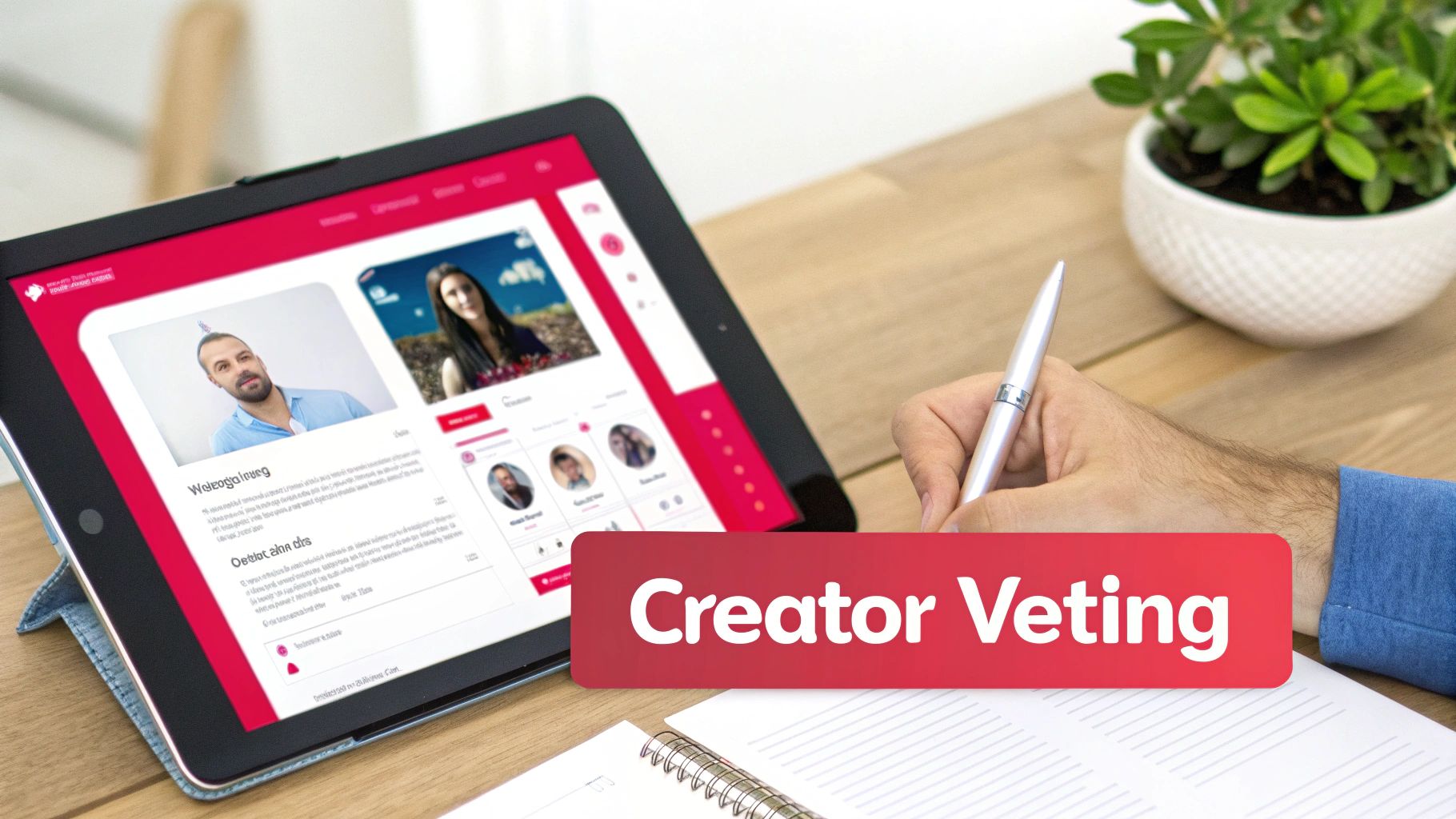
I know the process can feel like searching for a needle in a haystack, but it really boils down to two things: smart sourcing and diligent vetting. You have to know where to look and, more importantly, what to look for once you start building a list.
Where To Source Your Future Brand Champions
Your creator search can be as scrappy as a manual hunt or as streamlined as a dedicated platform. For a startup, I always recommend a mix of methods to build out that initial roster of potential partners.
A great place to start is just by manually searching on platforms like TikTok and Instagram. Dive into hashtags that are relevant to your niche (think #cleanskincare, #homedecorideas, or #veganrecipes) and see who’s making great content. Don't forget to see who your competitors are working with, and even check the tagged posts of brands you love to find creators who are already fans of similar products.
Of course, as you grow, manual sourcing gets old fast. That's where creator marketplaces and platforms become a lifesaver. They let you filter creators by niche, audience demographics, engagement rate, and location, which can shave hours off your discovery process. For a startup trying to move quickly, these tools are a game-changer.
Looking Beyond Follower Count: What Really Matters
Okay, so you've got a list of potential creators. Now the real work begins. Vetting is where you dig in to make sure a creator is a true fit for your brand and can actually deliver on your goals. A huge follower count can be a vanity metric; you need to analyze the real health and authenticity of their community.
The most important metric to look at is engagement rate. This is the percentage of their audience that actively likes, comments, shares, and saves their content. A healthy engagement rate, especially in the comments, signals a loyal and tuned-in community. A creator with 10,000 followers and a 5% engagement rate is far more valuable than someone with 100,000 followers and a 0.5% rate.
Don't be fooled by vanity metrics. An influencer with a million followers and 20 generic comments per post is a red flag. A micro-influencer with 8,000 followers and dozens of genuine, conversational comments is a gold mine for a startup.
Next up, you have to analyze their audience demographics. Most creators with a business account can easily share a breakdown of their audience's age, gender, and top locations. Does this data line up with your ideal customer? If you're selling a skincare product for women aged 25-34 in the US, a creator whose audience is mostly teenage boys in Brazil is a terrible fit, no matter how good their content is.
Your Essential Creator Vetting Checklist
To keep your vetting process consistent and thorough, use a simple checklist for every potential partner. This helps you spot both the green flags that signal a great partnership and the red flags that could mean trouble ahead. Our guide on how to find microinfluencers offers some more advanced tips for this phase, too.
Here's a quick checklist to guide your evaluation:
- Content Authenticity & Quality: Does their content feel genuine and well-made? Do they have a distinct style that matches your brand's vibe?
- Audience Engagement Quality: Actually read the comments. Are they real conversations or just a wall of fire emojis and spam? A lively comment section is an amazing sign.
- Brand Alignment & Values: Scroll through their past content and partnerships. Do they promote brands or values that clash with yours? Consistency is everything for building trust.
- Signs of Fake Followers: Look for weird spikes in follower growth, super-low engagement for their follower count, and comment sections full of bots. There are also plenty of online tools that can help analyze an account's authenticity.
- Professionalism & Communication: How do they come across in their bio and captions? A professional attitude usually means a smoother partnership down the road.
By methodically sourcing creators and then vetting them against these critical points, you stop guessing. You start building a solid foundation for your influencer program based on authentic partnerships that connect with real people and drive real growth.
Crafting a Campaign Brief Creators Actually Love
A vague or overly restrictive campaign brief is the fastest way to get mediocre content that completely misses the mark. For startups trying to make every dollar count, your brief isn't just a list of instructions—it’s your primary tool for inspiration and alignment.
The goal is to give creators a crystal-clear understanding of what you need without stifling the creative magic that made you want to partner with them in the first place. Think of it as a collaboration blueprint. When you get it right, it eliminates guesswork, prevents those dreaded endless revision cycles, and sets the stage for a partnership that both sides are genuinely excited about. A great brief respects the creator's time and talent, which almost always leads to content that feels authentic and performs exceptionally well.
The Anatomy of a Perfect Brief
Your campaign brief should be concise but comprehensive. Creators are busy professionals who live and die by clarity. So, ditch the corporate jargon and focus on giving them exactly what they need to knock it out of the park.
A well-structured brief is the foundation of any successful influencer campaign. To avoid confusion and ensure creators have everything they need, here’s a breakdown of the essential components to include in your brief. This structure helps set clear expectations from the start.
Essential Components of a Startup Campaign Brief
| Component | What to Include | Why It Matters |
|---|---|---|
| Campaign Objective | The one key goal. Clicks to a product page? App downloads? UGC for ads? Get specific (e.g., "Drive 500 sign-ups for our new beta"). | A clear goal helps the creator frame their content for a specific action, making the campaign measurable and more likely to succeed. |
| Key Talking Points | 2-3 core messages or benefits. These are guidelines, not a script. Highlight a key feature, a unique solution, or your brand's mission. | This ensures your core value proposition is communicated without forcing the creator to sound like a corporate spokesperson. |
| Content Deliverables | The exact number and type of assets. (e.g., "One 60-second TikTok video, three static Instagram Story frames with a link sticker"). | Specificity prevents misunderstandings. You get what you paid for, and the creator knows exactly what to produce. |
| The "Dos and Don'ts" | Simple guardrails. Do: "Show the product in a real-life setting." Don't: "Please avoid mentioning competitors by name." | This provides creative direction without micromanaging, protecting your brand while respecting the creator's style. |
| FTC Disclosure | Clear instructions to use #ad or #sponsored visibly in captions and on-screen text. Make it easy for them to comply. | This is non-negotiable for legal compliance. Providing clear guidelines protects both your brand and the creator from legal trouble. |
By including these elements, you’re not just providing instructions; you're building a framework for a successful partnership that respects the creator’s process and aligns with your startup’s goals.
And don't forget the platform specifics. Your brief should clearly define which platforms to post on, which requires you to understand the differences between TikTok and YouTube Shorts to truly optimize for reach.
Good Brief vs. Bad Brief: A Tale of Two Campaigns
The difference between a helpful brief and a restrictive one is night and day. A good brief inspires creativity; a bad one feels like micromanagement and produces robotic content.
Let's look at a couple of real-world examples.
The Bad Brief (aka The Creativity Killer):
"We need a 45-second video. Start by holding the product up to the camera and say, 'I'm so excited to tell you about Brand X!' Then, read these three bullet points from our website. Make sure the background is white. Post at 4 PM on Tuesday."
This is far too rigid. It reads like a script and leaves zero room for the creator to connect with their audience in their own voice—which is the entire reason you hired them! The content will feel forced and, frankly, it'll probably bomb.
The Good Brief (aka The Collaboration Starter):
"We'd love a 45-60 second Reel showing how our planner helps you manage a busy week. Our main goal is driving clicks to the product page. Please highlight how the weekly layout feature saves you time. Feel free to incorporate it into your authentic 'day in the life' style. Just be sure to include #ad in the first line of the caption!"
See the difference? This brief provides the goal (clicks), a key talking point (weekly layout), and creative freedom. It empowers the creator to do what they do best: make content that actually resonates with their audience.
Streamlining the Process with a Platform
For a small startup team, trying to manage multiple briefs, contracts, content approvals, and payments through a chaotic mix of emails and spreadsheets is a recipe for disaster. This is where a dedicated creator platform can be a total game-changer, centralizing your entire workflow into one dashboard.
As you can see, platforms like JoinBrands help you create, distribute, and manage all your campaign briefs from a single command center.
Using a tool to structure your brief ensures every creator gets the same clear, consistent information. That consistency is absolutely critical if you want to scale your influencer marketing from one-off campaigns to a predictable growth channel.
Executing and Scaling Your Influencer Program
You've got your goals locked in and you know which creators you want to work with. Now for the fun part: turning that strategy into a real, living, breathing program.
This is where the rubber meets the road. It’s all about building repeatable systems that your small team can manage without getting buried in spreadsheets and email chains. A smooth operational flow is what separates a one-off campaign from a scalable growth channel.
Nailing the day-to-day logistics—from getting products out the door to having a simple content approval process—is everything. It’s this rhythm that lets you juggle multiple partnerships at once and actually scale your efforts.
Managing the Campaign Workflow
Once a creator says "yes," the clock starts ticking. For a startup, there's no time for endless back-and-forth or missed deadlines. A crisp, clear workflow shows you respect their time (and yours) and keeps the campaign on track from kickoff to payment.
Your workflow should cover a few key milestones:
- Contracting and Onboarding: Kick things off with a simple agreement. No need for 20 pages of legalese. Just outline the deliverables, timeline, and payment terms. Once it's signed, send over a welcome packet with the campaign brief and any product info they need.
- Product Shipping: Get the product in the mail ASAP. Always use a trackable service and share the tracking number with the creator so they know when to expect it. Nothing kills momentum like a creator asking, "Hey, did that ever ship?"
- Content Submission and Review: Set a firm deadline for content drafts. When you give feedback, be direct, constructive, and tie it back to the original brief. This avoids subjective changes and keeps revisions to a minimum—ideally just one round.
- Approval and Scheduling: After you've approved the content, lock in the post date and time. Give them a friendly reminder about the essentials: tracking links, discount codes, and the all-important FTC disclosures like #ad.
- Payment and Offboarding: Pay your creators on time, every time, based on the terms you agreed to. It’s a simple way to build a great reputation. Finish up with a thank-you note and let them know you'll be in touch with the results.
Turning Top Performers into Brand Ambassadors
You’ll quickly notice that some partnerships just work. A small handful of creators will consistently drive clicks, sales, and genuine buzz. These aren't just one-off wins; they're your future brand ambassadors.
Don't let these relationships end after one post. It’s time to play the long game.
Transitioning your best creators from one-time collaborators to long-term ambassadors is a game-changer. It shifts the dynamic from a transaction to a true partnership, giving you a powerful, authentic advocate who builds deep trust with their audience over time.
Instead of paying per post, offer these top-tier partners a 3- or 6-month contract with a monthly retainer. This gives them predictable income and secures a steady stream of high-quality, authentic content for your brand.
Scaling with User-Generated Content and Paid Ads
One of the smartest ways to scale your program is by getting more mileage out of the content you’ve already paid for. Every photo and video a creator makes is a valuable asset that can live on long after the initial post.
This is why your influencer agreement must include the rights to repurpose their content—often called user-generated content (UGC)—in your own marketing channels.
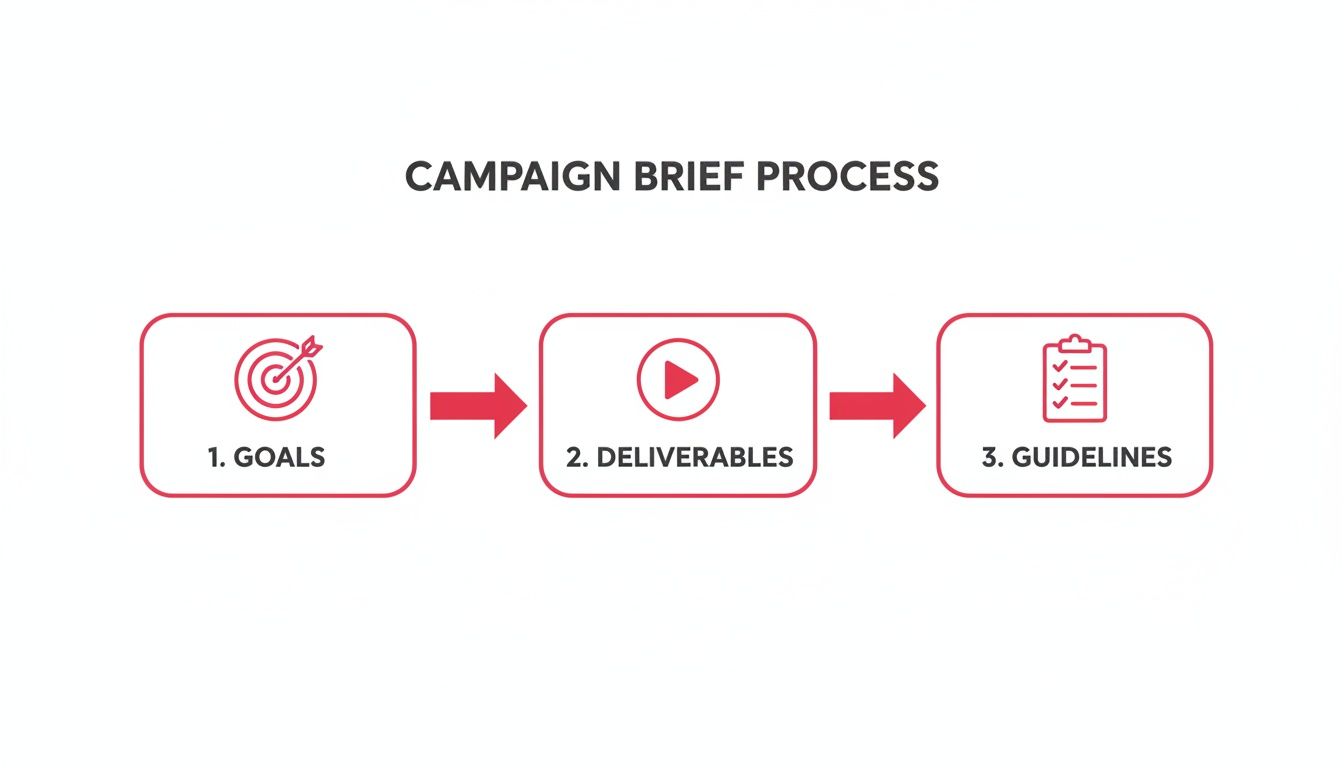
As this shows, it all starts with a great brief. When you're clear about your goals and what you need from the creator, you get content that's perfectly suited for repurposing.
Now, here's where the real magic happens: pairing that authentic UGC with a paid ad budget.
By running creator content as a paid ad (sometimes called "whitelisting" or using partnership ads), you can blast its reach to a massive, highly-targeted audience. You're combining the trust of a real person's recommendation with the precision of paid social.
Research shows that campaigns using creator content in paid ads often see a 40% higher return on investment compared to ads with brand-created visuals. For a startup, that's huge. It means your ad budget works harder, your customer acquisition cost goes down, and you squeeze maximum value from every single partnership.
Measuring ROI and Proving Influencer Value
So, how do you really know if your influencer marketing is working? Likes and comments are nice ego boosts, but for a startup, every dollar has to pull its weight and drive a real, tangible return. Proving the value of your campaigns means getting past those surface-level numbers and tying everything directly back to business impact.

This all starts with setting up a clear tracking system from day one. When you can draw a straight line from a creator’s post to a new customer, your influencer program stops being an "experiment" and starts becoming a predictable growth engine. The goal here is simple: make data-driven decisions, not educated guesses.
Moving Beyond Vanity Metrics
First things first, you have to shift your focus from vanity metrics to performance-based key performance indicators (KPIs). While views and likes might show you have reach, they don't pay the bills. Your startup needs to be laser-focused on the actions that directly fuel growth.
These are the metrics that actually matter for a startup:
- Conversion Rate: What percentage of users who clicked a creator's link actually completed a desired action, like making a purchase? This is your north star for sales.
- Cost Per Acquisition (CPA): How much did it cost you to get one new customer from a specific influencer campaign? A low CPA means you're running an efficient program.
- Click-Through Rate (CTR): The percentage of people who saw a link in a creator's bio or story and actually clicked it. This tells you how compelling their call-to-action is.
- User-Generated Content (UGC) Value: What's the dollar value of the content you got from the partnership? This is a huge, often overlooked asset.
It's easy to get dazzled by a post that gets 100,000 views but drives zero sales. I've seen it happen. A post from a micro-influencer that only gets 5,000 views but results in 25 sales is infinitely more valuable. Always focus on impact, not just impressions.
Tools for Tracking Performance
To measure these KPIs, you need the right tools in your arsenal. The good news is you don’t need a complicated or expensive setup to get started. A few straightforward methods can give you a surprisingly clear picture of your campaign’s performance and help you calculate your influencer marketing ROI.
Here are the absolute non-negotiables for tracking:
- Unique Discount Codes: This is the simplest way to track direct sales. Assign a distinct code (like "CHLOE15") to each influencer. In your e-commerce backend, you can see exactly who drove which sale.
- UTM Parameters: These are little snippets of text you add to a URL that feed data directly into Google Analytics. A UTM-tagged link can tell you the source (the influencer), medium (social), and the specific campaign, giving you granular data on traffic and on-site behavior.
- Affiliate Links: Perfect for performance-based campaigns. These links automatically track every click and sale generated by a creator, which makes commission payouts a breeze. This model is great because it perfectly aligns the creator's incentives with your sales goals.
To get a true sense of profitability, it's critical to know how to calculate Return on Ad Spend (ROAS). For a deeper dive, check out our complete guide on measuring influencer marketing ROI.
Calculating the Value of UGC
One of the most overlooked returns from influencer marketing is the library of high-quality content you get. This user-generated content has real, tangible value because it saves you the cost of producing those assets yourself.
Calculating this is pretty straightforward. Think about what you would have paid a freelance photographer or videographer for a similar set of assets.
Let’s say a creator gave you five high-quality photos and two videos as part of a $250 partnership. If a professional photoshoot for that same amount of content would have cost you $1,500, you’ve already pocketed $1,250 in value before a single product has even sold. You can then repurpose that content for your own paid ads, social media feeds, and website, squeezing even more value out of your initial investment.
Your Burning Questions About Startup Influencer Marketing
Jumping into influencer marketing can feel like you're learning a whole new language. You've got questions about everything from costs to contracts, and that's completely normal. We've been in the trenches with countless founders, so we've heard it all.
Here are the most common questions that come up, with straight-to-the-point answers to get you over those initial hurdles and into your first campaign with confidence.
So, How Much Does This Actually Cost?
This is the big one, but the answer is way more flexible than you might think. There's no single price tag. The cost is all over the map and depends entirely on a creator's audience size, how engaged their community is, and exactly what you're asking them to do.
The best part for a lean startup? You can get in the game with a surprisingly small budget.
Here’s a realistic look at the numbers:
- Nano-Influencers (1k-10k followers): A lot of these creators are happy to collaborate in exchange for free products. This is often called "gifting" or "product seeding." If they do charge, it's usually a small fee, somewhere between $50 to $250 per post.
- Micro-Influencers (10k-100k followers): For many startups, this is the sweet spot. You can expect to pay anywhere from $250 to over $1,000 per post. The final price really hinges on their performance metrics and what kind of content you need.
The real key for any startup is to obsess over value, not just price. A $300 partnership that drives ten sales is a massive win. A "free" product gifting campaign that results in zero content? That's actually a net loss when you factor in your time and product cost.
Should I Pay with Free Product or Cash?
Ah, the classic "product vs. cash" debate. The right move really depends on your immediate goals and where the creator is in their own journey.
Gifting products is a fantastic play when your main goal is to generate that initial buzz and start building a library of user-generated content (UGC) without breaking the bank. It's a low-risk way to get your product into the hands of dozens of creators and see what sticks.
But once you start working with more established micro-influencers, cash becomes the standard. Let's be real: they are running a business. Paying them fairly for their work, their time, and the audience they've built is non-negotiable for creating professional, long-term partnerships. Honestly, a hybrid model—offering both your product and a fee—is often the most effective approach.
How Do I Handle Contracts Without a Lawyer on Retainer?
Don't let the word "contract" intimidate you. We're not talking about 30-page legal documents here. For most startup influencer campaigns, a simple, clear agreement is all you need to protect both your brand and the creator. It’s about setting clear expectations from the get-go.
Your agreement should just outline the essentials in plain English:
- Deliverables: Spell out exactly what content you're getting (e.g., 1 Instagram Reel, 3 Stories with a link sticker).
- Timeline: When are drafts due? When does the final content go live?
- Compensation: The exact payment amount and the terms (e.g., 50% upfront, 50% on completion).
- Content Usage Rights: This is critical. Make sure you state that you have the right to repurpose their content on your own channels, like your website, emails, or even in your paid ads.
- FTC Disclosure: You need a clause that requires them to clearly disclose the partnership with #ad or #sponsored.
Many platforms, ours included, have standardized contract templates that cover these bases. It’s a huge time-saver for a small team.
What’s More Important: TikTok or Instagram?
Stop chasing trends. The best platform is simply where your target audience hangs out. Follow your customer, not the hype.
Instagram is a powerhouse for visual products, building a tight-knit community with Stories, and reaching a slightly older Millennial demographic. The link stickers in Stories are still one of the best ways to drive direct traffic to your website.
On the other hand, TikTok is the king of reaching a younger (Gen Z) audience with raw, authentic, short-form video. Its algorithm is an incredible discovery engine, which means even a tiny brand can go viral overnight if the content hits just right.
The ideal strategy? Eventually, you'll want to be on both. But if you're just starting out, pick one, get really good at it, and then expand. Don't spread yourself too thin.
Ready to stop guessing and start growing? JoinBrands is the all-in-one platform that connects you with over 250,000 vetted creators, making it simple to launch, manage, and scale your startup influencer marketing program. Find your perfect partners and start generating authentic content that drives real sales. Get started on JoinBrands today!