



 How to Edit TikTok Videos After Posting: 2026 Guide
Most advice about hiring a TikTok Shop agency starts in the wrong place. It starts with reach, creator volume, or reported ROAS. That's backwards.
A brand manager doesn't need prettier dashboards. You need to know whether paid distribution is producing cash-efficient sales after every mandatory cost hits the P&L. On TikTok Shop, that means looking past top-line ad metrics and into affiliate commissions, returns, fulfillment pressure, agency scope, and whether your partner knows how to run commerce operations instead of just creator outreach.
That's the gap in most conversations around a TikTok Shop agency. The hype is easy. Financial accountability is harder. That's where good operators separate themselves from presentation-first agencies.
Table of Contents
Why Your TikTok Shop Agency ROAS Might Be Misleading
A lot of brands assume that if an agency reports strong ROAS, the account is healthy. That assumption breaks quickly when you audit the math.
A recent TikTok Shop audit revealed that many agencies are “shockingly awful” with ads, with performance metrics far below expectations, according to this LinkedIn post discussing TikTok Shop agency ad performance. That matters because weak ad buying doesn't always show up as an obvious disaster in the dashboard. It often hides behind blended reporting, selective attribution windows, and incomplete cost accounting.
Where agencies make weak performance look acceptable
The most common reporting problem is simple. Agencies show revenue divided by media spend, then stop there.
That number can be directionally useful, but it's not enough to judge profitability on TikTok Shop. A campaign can look efficient in-platform while still underperforming once you account for creator payouts, product economics, returns, and the actual operating model behind the account.
Practical rule: If your agency can't explain exactly which costs sit outside the ROAS number, you're not looking at a decision-grade metric.
Another issue is scope confusion. Some firms sell themselves like a TikTok Shop agency, but operationally they're closer to a creator outreach service with light media buying attached. If they don't own the commerce workflow end to end, they often miss the variables that shape actual returns.
What a useful performance conversation sounds like
A serious agency discussion should answer questions like these:
- What revenue is being counted: Are you looking at ad-attributed sales only, blended shop sales, or creator-driven sales that would have happened without paid amplification?
- What costs are excluded: Are affiliate commissions, returns, fulfillment issues, and agency fees outside the headline number?
- What action follows the report: Can the team identify which creator assets deserve more budget and which ones should be cut?
If those answers are fuzzy, your reported ROAS is probably flattering the account.
Decoding ROAS for TikTok Shop
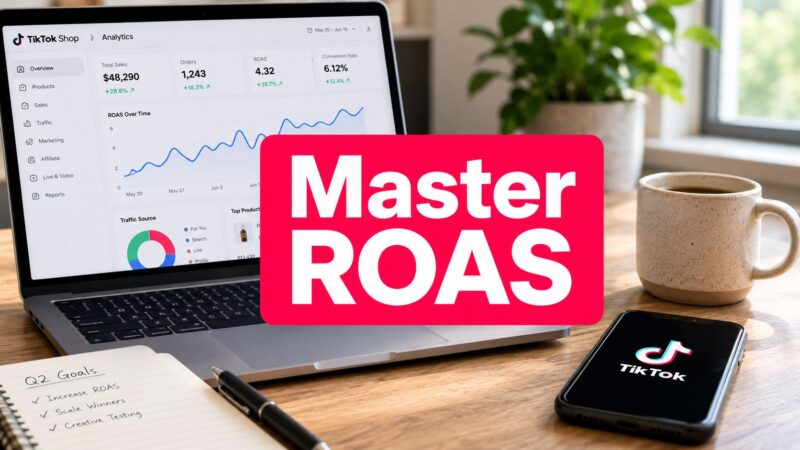
ROAS is the simplest paid media metric on TikTok Shop. At its most basic, it answers one question: for every dollar you give TikTok, how many dollars come back in attributed sales?
The formula is straightforward:
ROAS = Revenue / Ad Spend

The clean version of ROAS
Think of ROAS like a vending machine test. You put money in. Sales come out. If the machine returns more sales relative to what you spent, the ratio improves.
That's why media teams like ROAS. It's fast to calculate, easy to compare across campaigns, and useful for budget allocation. If one creator ad consistently produces stronger attributed sales than another, ROAS helps you decide where to push the next budget tranche.
Why TikTok Shop complicates a simple metric
TikTok Shop isn't just a paid traffic channel. It's a commerce ecosystem where ads, affiliate content, organic pickup, LIVE selling, listing quality, and fulfillment all influence the outcome. So the clean formula is only the first layer.
A strong TikTok Shop agency treats ROAS as an operating signal, not the final verdict. If a Video Shopping Ad performs well, the next question isn't just “can we spend more?” It's also “is this asset still profitable after creator commission, return risk, and product margin?”
Here's the practical way to use ROAS:
- Use it for speed. It helps you spot which creatives and creators deserve more testing.
- Use it for comparisons. It's a useful way to rank assets inside the same account.
- Don't use it alone. It doesn't tell you whether the campaign is making money.
The brands that scale well on TikTok Shop don't obsess over a single dashboard metric. They use ROAS to find momentum, then pressure-test that momentum against real unit economics.
What to ask your team for
If your agency reports ROAS, ask for the surrounding context:
- Asset-level performance: Which UGC videos, Spark Ads, or creator posts are driving the result?
- Attribution clarity: Are you evaluating paid-only performance or a blended number that includes halo effects?
- Operational context: Did listing updates, stock issues, or fulfillment delays influence the result?
ROAS matters. It just matters most when it's attached to clear attribution and clean cost accounting.
The Hidden Costs That Inflate Your ROAS
Reported ROAS often flatters bad economics. I see this in agency audits all the time. The dashboard shows efficient spend, but the P&L says the account is barely breaking even because key costs were left outside the analysis.

Paid ads don't erase affiliate commission
One of the easiest ways to overstate TikTok Shop performance is to treat paid creator ads like normal media buys. They are not.
If you amplify a creator's TikTok Shop content with paid media, the sale can still carry the creator's affiliate commission on top of the ad spend, as explained in this breakdown of TikTok Shop commission rates and paid amplification. That means the same order may be paying for traffic twice through two different lines on your P&L.
The practical mistake is simple. An agency reports a healthy paid ROAS, but the brand team never sees the extra commission burden tied to those conversions. On lower-margin products, that gap is enough to turn a “winning” campaign into a loss.
Commission structure can either help or hurt margin
Commission rates are not just a recruiting tool for creators. They are a margin decision.
Open Plan rates can run high enough to make broad seeding expensive if your product margin is already tight. Targeted creator deals can be more controlled, but only if the agency is selective and measures conversion quality, not just content output. Returns add another wrinkle because commission treatment on returned orders affects the actual contribution from each sale, as noted earlier.
A better operating approach is to keep baseline affiliate terms disciplined, then increase commission only for creators who have already proven they can convert profitably. Paying high rates to unproven partners is one of the fastest ways to inflate top-line revenue while shrinking contribution margin.
Agency pricing changes the break-even point
Agency fees matter more than many brands admit. A monthly retainer may look manageable in isolation, but it raises the revenue threshold the account has to clear before TikTok Shop becomes financially attractive.
Some agencies also create a subtler problem. They spend enough to keep activity high and reporting positive, but not with enough rigor to produce durable profit after fees, creator costs, and operational drag. If the team needs constant intervention to hold a mediocre ROAS number, the account is more expensive than it looks.
That is why I judge agency performance against net contribution, not media efficiency alone. A campaign should not just cover ad spend. It should justify the management cost required to run it.
The true profitability stack
A sale on TikTok Shop needs to absorb every real cost tied to that order:
| Cost layer | Why it matters |
|---|---|
| Ad spend | The direct cost to generate the purchase |
| Creator commission | Often still applies when creator content is amplified with ads |
| Agency retainer | Raises the break-even point for the whole program |
| COGS | Determines how much gross margin is available before marketing costs |
| Shipping and fulfillment | Delivery cost and service issues can wipe out thin margins |
| Returns and clawbacks | Revenue recognized today may reverse later |
This is the number that matters in practice: revenue left after all variable selling costs and the agency fee are accounted for.
A top-line ROAS figure is only the first check. Financial accountability starts when your agency shows what is left after commission, fees, fulfillment, and return risk.
ROAS vs ROI vs LTV vs CAC
ROAS gets too much authority in TikTok Shop conversations because it's fast and visible. It's useful, but it's only one lens.
A brand manager needs four lenses. Each one answers a different question, and the right metric depends on the decision in front of you.
Key Growth Metrics Compared
| Metric | What It Measures | When to Use It |
|---|---|---|
| ROAS | Revenue generated relative to ad spend | Use it when comparing creatives, creators, or campaigns inside a paid media account |
| ROI | Overall return after broader business costs are considered | Use it when deciding whether the entire channel or program is financially worth continuing |
| LTV | The longer-term value a customer generates after the first purchase | Use it when you're willing to accept lower first-order efficiency to acquire stronger repeat buyers |
| CAC | The cost to acquire a customer | Use it when you need to compare acquisition efficiency across channels, not just inside TikTok Shop |
How these metrics work together
ROAS is tactical. It helps media buyers decide where to put the next dollar.
ROI is managerial. It tells you whether the channel is creating actual business value once the full program is considered.
LTV and CAC are strategic. They matter most when your product line supports repeat behavior, subscriptions, replenishment, bundles, or strong post-purchase monetization. In those cases, a weaker first sale may still be rational.
A high-growth account can tolerate lower short-term ROAS if it's acquiring the right customer. It can't tolerate fuzzy CAC and weak retention economics.
What brand managers should prioritize
If you're in launch mode, focus on ROAS and CAC first. You need to know whether your creative and audience strategy can acquire customers efficiently enough to keep testing.
If the account is already moving volume, shift the conversation toward ROI. That's where hidden costs become impossible to ignore.
If the product has repeat purchase behavior, force the agency conversation beyond the first transaction. A TikTok Shop agency that only talks about immediate ROAS may be optimizing for reporting optics instead of long-term account value.
What a High-Performing TikTok Shop Agency Does
A high-performing TikTok Shop agency protects margin, not just reported ROAS.
That sounds obvious, but plenty of agencies still operate like creator brokers with an ad account attached. They can recruit affiliates, push out UGC, and show top-line sales spikes. The hard part is controlling the costs behind those sales, spotting where paid amplification is being wasted, and fixing the operational issues that keep the account from converting efficiently.

Start with official partner status
Official TikTok Shop Partner status, or TSP status, is a useful filter. Certified partners usually get better platform access, faster support paths, and more experience inside Seller Center than generalist agencies.
It is still just a filter. I would not treat certification as proof of performance. Some TSPs are operationally sharp. Others still run paid media with weak controls and broad commission structures that eat the brand's profit. Ask what they manage day to day, how they handle escalation with TikTok, and where they have produced profitable scale, not just GMV growth.
Look for full-stack ownership
Strong agencies own the full commercial system, not one slice of it.
That usually means they can handle shop operations, creator recruitment, affiliate program design, UGC production, paid media, and LIVE support when the category justifies it. If those functions sit with different vendors or disconnected teams, the account usually develops expensive blind spots. Paid spend scales before listings are fixed. Creator output rises while conversion quality falls. Finance sees rising sales, but contribution margin gets thinner.
The biggest difference is ownership. A serious agency can tell you who is responsible for listing conversion, who approves creator tiers, who decides which assets get media support, and who is accountable when spend is being pushed behind content that never proved it could sell organically.
Reporting should help you cut waste
Weekly reporting is not enough if it only packages metrics the brand has already seen inside the dashboard.
Useful reporting helps a brand manager make hard calls. Which creator videos deserve paid budget. Which products should be pulled back because return economics are too weak. Which affiliate relationships are inflating cost of sale. Whether GMV Max or Spark Ads are adding incremental value, or just cannibalizing sales that would have happened anyway.
A good agency also separates signal from optics. It should not blend creator-driven sales, affiliate commissions, ad spend, platform fees, discounts, and operational costs into one flattering ROAS number. It should show the actual cost to produce each sale.
They challenge bad spend, even when it lowers reported ROAS
This is the part weak agencies avoid.
A high-performing team will tell you to stop spending on assets that look busy but convert poorly. It will cut underperforming creators faster than a relationship-driven agency wants to. It will push back on broad paid support for affiliate content if the contribution margin is not there after commissions and media spend.
That can make short-term reporting look worse. It usually makes the business healthier.
Accountability test: Ask your current TikTok Shop agency which creators, products, and paid assets they would pause today to protect margin. Strong teams answer clearly, with reasons tied to conversion, contribution, and cost control.
Actionable Strategies to Improve Your TikTok ROAS
A lot of brands try to improve ROAS by hunting for a better ad tactic. The bigger gains usually come from fixing the economics around the ad account first. On TikTok Shop, media rarely fails by itself. Margin gets squeezed by weak product selection, loose commission rules, tired creative, and reporting that hides what each sale cost.

Fix the controllable inputs before adding more spend
Start with the parts of the program that change contribution margin fastest.
- Set commission tiers with intent. Keep open affiliate recruiting on a lower baseline commission, then reserve richer payouts for creators who have already shown they can convert profitably. Paying higher rates too early makes scale look healthy in GMV while margin deteriorates underneath.
- Only amplify proven content. If a creator video has weak watch-through, poor click intent, or low product trust, paid spend usually magnifies the inefficiency. Strong paid assets often show signs of conversion before media support is added.
- Repair the product page before scaling traffic. Bad titles, weak imagery, missing compliance details, and thin product proof reduce conversion after the click. More traffic into a weak listing increases spend faster than revenue.
This is the discipline many agencies skip because it slows launch speed. It also prevents brands from paying to test problems that should have been fixed inside the shop first.
Make measurement tighter so bad spend is obvious
Blended reporting protects weak decisions. Asset-level reporting exposes them.
Review performance with narrower cuts:
- Split creator-driven sales from paid media results
- Measure each video on its own economics
- Label creative by hook, offer, product angle, and creator type
- Pause weak assets early, even if production cost was high
If you need a workflow layer for creator sourcing and TikTok Shop affiliate campaigns, JoinBrands is one option that supports TikTok Shop jobs and creator collaboration workflows. The tool matters less than the operating model. The goal is to reduce manual handoff errors between creator production, approvals, whitelisting, and ad launch.
Here's a useful explainer on how many operators think about campaign structure and optimization:
Use stricter financial rules in the media plan
The strongest ROAS improvements usually come from better filters, not more platform complexity.
- Price paid amplification with affiliate payouts included. If a sale still triggers creator commission after you add media spend, evaluate the full cost of sale before increasing budget. A campaign can look efficient inside ads reporting and still miss your margin target.
- Use GMV Max and Spark Ads selectively. They tend to work best when content already matches platform behavior and the product converts cleanly. They tend to disappoint when used to force scale on average creative.
- Track return patterns and post-purchase friction. Front-end ROAS can look strong while refunds, cancellations, or fulfillment issues erase contribution later.
- Build repeatable creative angles, not one-off winners. One strong video helps for a week. A system that can reproduce the same buying trigger across multiple creators gives an agency room to scale without losing control of CAC.
A practical rule works well here. Do not fund uncertainty at full price. Fund validated assets, validated offers, and creators who have already earned more budget.
Your ROAS Optimization Checklist
A profitable TikTok Shop program isn't built from a single media metric. It comes from disciplined math, cleaner reporting, and an agency model that owns the whole commerce engine.

Use this checklist in your next agency review:
- Audit hidden costs. Include ad spend, creator commission, returns, fulfillment friction, and agency fees before calling a campaign profitable.
- Check commission logic. Keep Open Plan broad but controlled, and reserve higher payouts for creators who've already earned more budget.
- Review asset-level data. Don't accept blended reporting if you're trying to decide what to scale.
- Verify agency scope. A real TikTok Shop agency should own commerce operations, not just creator outreach.
- Ask for weekly decision support. Reports should tell you what to cut, what to scale, and what's blocking conversion.
- Measure beyond ROAS. Use ROI, CAC, and LTV when the business decision requires a broader financial view.
- Pressure-test paid amplification. If a creator ad needs spend, verify that the economics still work after mandatory affiliate payout.
- Protect the customer experience. Listings, compliance, logistics, and returns all shape whether paid growth sticks.
The brands that win on TikTok Shop don't chase the highest reported ROAS. They build a system where reporting matches reality, operators own outcomes, and budget moves toward proven assets with clear margins.
If you need a simpler way to source TikTok Shop affiliate creators, manage content production, and keep creator workflows organized without bolting together separate systems, JoinBrands is worth evaluating. It gives brands a single place to run TikTok Shop jobs, coordinate with creators, and move from content production to activation with less operational drag.