

 What Is Creator Marketplace TikTok: A Guide for DTC Brands in 2026
A winning TikTok Shop marketing strategy is all about blending authentic, creator-led content with a smart paid ads approach to drive sales right inside the app. This isn't your old-school marketing playbook. We're in an ecosystem where entertainment and commerce have become one and the same, turning genuine user-generated content into your most powerful sales tool.
Table of Contents
The New Reality of Social Commerce

Welcome to the new frontier of e-commerce. Here, "shoppertainment" isn't just some buzzword—it's the entire game plan for modern brands. For any business that's serious about growth today, having a dedicated TikTok Shop marketing strategy is no longer optional.
We've blown past the days of passive social media marketing. Success now demands a fully integrated approach where your content, community, and commerce all collide in one seamless experience. This guide will give you a practical framework built on three core pillars that work together to turn casual viewers into loyal customers, all without them ever having to leave the TikTok app.
Understanding the Core Pillars
Look, this isn't about chasing viral trends that fizzle out in a week. It's about building a sustainable engine for real, predictable growth. To pull that off, your strategy needs to balance three critical areas.
Let's break down the core components of a successful TikTok Shop strategy. Each pillar serves a distinct purpose but they all work together to create a powerful, self-sustaining system for growth.
Core Pillars of a TikTok Shop Strategy
| Pillar | Primary Objective | Key Actions |
|---|---|---|
| Creator Partnerships | Build trust and drive initial sales through authentic voices. | Recruit and manage a network of creator affiliates. Focus on those who genuinely connect with your product and audience. |
| Paid Amplification | Scale what works by reaching new, targeted audiences. | Use data from organic sales to identify top-performing videos. Amplify them using TikTok's Spark Ads to maximize reach and ROI. |
| Operational Excellence | Ensure smooth, scalable execution of your campaigns. | Develop streamlined workflows for creator briefing, product seeding, content approvals, affiliate payouts, and performance tracking. |
As you can see, a solid operational foundation is what allows the creative and paid elements to thrive and scale effectively.
The platform's growth has been nothing short of explosive. Since its U.S. launch, TikTok Shop has become a dominant force, using aggressive discounts and creator incentives to fundamentally reshape how influencer marketing works. It rocketed from $15 million to $1.1 billion in monthly GMV, and sales projections are only soaring higher as more people get comfortable with in-app shopping. You can find more insights on TikTok Shop's massive growth on redstagfulfillment.com.
The key is to stop thinking of TikTok as just another social channel and start treating it as a primary, self-contained storefront. The path from discovery to purchase is shorter here than anywhere else.
By mastering these pillars, you create a powerful flywheel. Authentic creator content builds trust and brings in those crucial first sales. The data from those sales tells you exactly which videos to put money behind with paid ads. And all the while, your efficient workflows make sure the whole process runs smoothly, letting you scale your efforts without descending into chaos. This guide will walk you through the actionable steps to build, launch, and optimize this very system for your brand.
Building Your Army of Creator Affiliates
Let's be real: your products aren't going to sell themselves on TikTok Shop. You need trusted voices to do it for you, and that's where a high-performing team of creator affiliates becomes your most valuable asset. The goal isn't just getting a one-off feature; it's about partnering with creators who can genuinely drive sales and build long-term value for your brand.
Forget vanity metrics like follower counts. Seriously. A creator with millions of followers is completely useless if their audience doesn't match your ideal customer. A winning TikTok Shop strategy prioritizes relevance over reach, every single time. Your first move is to find creators whose content and community align perfectly with what you sell.
Identifying High-Potential Partners
Often, the best affiliates are already fans of products like yours. Start by digging through hashtags related to your niche or the problems your product solves. Look for creators who are consistently dropping authentic, engaging content in that space.
Once you’ve got a shortlist, it's time to do some real vetting. Don't just skim their last few videos. You need to dig deeper to understand their actual performance and how connected they are to their audience.
- Analyze Past Performance: Hunt for previous sponsored posts or TikTok Shop videos. Did they actually generate sales? Check the comments—are people asking where to buy the product, or just saying "nice video"? A high comment-to-like ratio is often a great sign of a highly engaged community.
- Request Audience Demographics: Don't be shy about asking for a screenshot of their audience analytics. You have to confirm their followers' age, gender, and location match your target market. If there's a mismatch here, it's a hard pass.
- Assess Authenticity: Does their content feel genuine? TikTok users can spot a forced, robotic ad from a mile away. The best partners are the ones who can weave your product into their natural content style without missing a beat.
For a deeper dive into discovery, check out our guide on how to find TikTok influencers for more advanced search techniques.
Crafting Outreach That Gets a Response
Creators get buried in generic, copy-paste messages every single day. If you want to stand out, your message has to be personal, concise, and show them what's in it for them. Prove you've actually watched their content and understand their vibe.
Instead of a boring template, try something specific. Reference a recent video they posted and explain exactly why you think your product would be a killer fit for their audience. Keep it brief and get straight to the point about the partnership.
Pro Tip: Your first message should feel like the start of a conversation, not a demand. Mentioning a specific video shows you've done your homework and respect their work, making them far more likely to reply.
Choosing the Right Collaboration Model
Not all partnerships are built the same. The right model really depends on your budget, your goals, and the creator's level of influence. Having a flexible approach will get you the best results.
Common Partnership Models:
- Commission-Only: This is a fantastic low-risk model when you're just starting out. Creators earn a percentage (usually 10-20%) of every sale they drive. It’s purely performance-based, which gives creators a huge incentive to make content that actually converts. The only catch? It can be a tougher sell for more established creators.
- Product Seeding: You send free products to creators in exchange for an honest review or feature. This is a brilliant way to build relationships with micro-influencers, test the waters, and generate some initial user-generated content (UGC) without a big upfront investment.
- Hybrid Model (Fee + Commission): For your top-tier creators, a hybrid model is often the way to go. You pay a modest flat fee to secure their time and creativity, plus a commission on sales. This structure respects their creative effort while still giving them a reason to push for conversions.
By carefully picking your partners, personalizing your outreach, and choosing the right collaboration structure, you can build a sustainable sales engine powered by authentic voices. This "army" of affiliates will become the bedrock of your entire TikTok Shop strategy, driving both immediate sales and long-term brand credibility.
Creating a Scalable Creator Management Workflow
A brilliant TikTok Shop strategy falls flat without solid execution. Once you've rallied your army of affiliates, the real work starts—handling the day-to-day operations without drowning in logistical chaos. A scalable workflow is the engine that keeps your creator program humming, turning one-off collabs into a predictable sales machine.
This isn’t about micromanaging your partners. It’s about building a system that gives them the creative freedom they need while making sure your brand’s goals are met. Without a repeatable process for briefing, shipping, approvals, and payouts, you'll spend all your time putting out fires instead of focusing on growth.
The goal is to build a system so seamless that both you and your creators can focus on what you do best. Let's break down the essential pieces of a workflow that saves time, keeps everyone happy, and drives a real return.
Designing Crystal-Clear Campaign Briefs
The campaign brief is your single most important document. A vague brief leads to off-brand content and endless revision cycles, which frustrates creators and wastes your time. A great brief, on the other hand, sets clear expectations and actually inspires creativity.
Think of your brief as a guide, not a script. It needs to provide just enough direction for brand alignment but leave plenty of room for the creator’s authentic voice to shine through.
Here’s what every effective brief absolutely must include:
- Campaign Goals: Are you trying to drive direct sales, generate UGC for ads, or just boost brand awareness? Get specific.
- Key Talking Points: Give them 2-3 essential benefits or features of the product. Skip the technical jargon and focus on the value for their audience.
- Mandatory Elements: This is where you list required hashtags (like #TikTokShop or #Ad), specific calls-to-action ("Tap the orange shopping cart!"), and any product links they must use.
- Creative Do's and Don'ts: Offer guidance on the vibe. For example, "Do show the product in a real-life setting" or "Don't use filters that change the product's color."
A strong brief empowers creators by defining the finish line, not dictating every step of the race. It gives them the confidence to create content that is both authentic to them and effective for your brand.
This process chart illustrates the core stages of identifying and onboarding affiliates for your TikTok Shop marketing strategy.
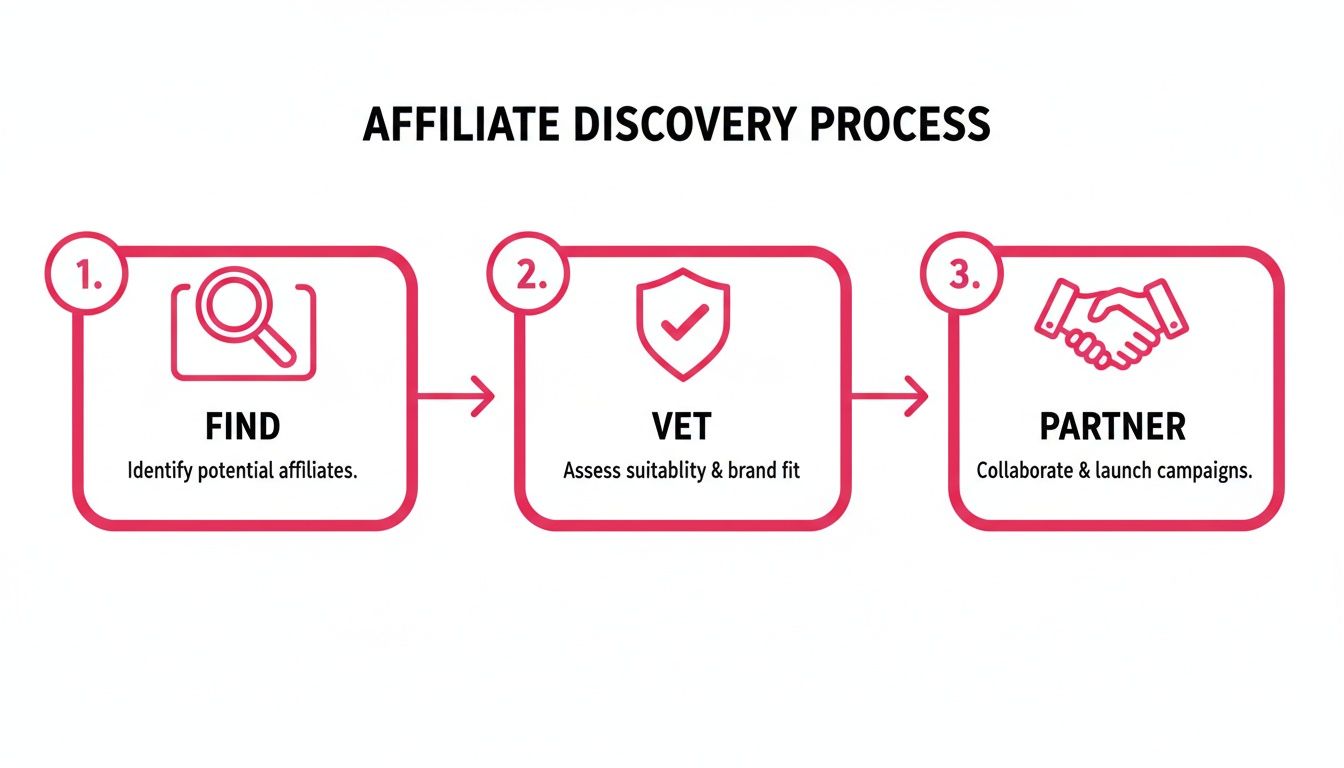
Each step, from finding potential partners to vetting their performance and finalizing the partnership, is a crucial part of building a successful affiliate program.
Streamlining Product Seeding and Logistics
Getting your product into creators' hands quickly is a critical—and often overlooked—part of the workflow. A shipping delay can bring an entire campaign to a grinding halt.
Set up a clear system for product seeding right from the get-go. Use a centralized spreadsheet or a platform like JoinBrands to track creator addresses, what they’re getting, ship dates, and tracking numbers. This stops products from getting lost in the mail and makes sure everyone is on the same page.
To make it even smoother, you can automate parts of the process. Create a simple form where creators can punch in their shipping info and product choices. Once they hit submit, it can trigger an alert for your fulfillment team, cutting down on manual data entry and human error.
Managing Content Approvals and Payouts
The approval process can easily become a major bottleneck. To avoid this, set a clear and reasonable timeline. Let creators know you'll give them feedback within 48-72 hours of a draft submission. And then actually stick to it—this shows you respect their time.
When you do give feedback, be specific and constructive. Instead of just saying, "I don't like it," try something like, "Could you add a clearer shot of the product's texture in the first five seconds?" This gives them something actionable to work with.
Finally, timely payments are absolutely non-negotiable for keeping creator relationships strong. Whether you're paying a flat fee or commission, be upfront about the payment schedule. TikTok Shop’s built-in affiliate system makes commission tracking a breeze, but if you're paying flat fees, make sure your process is just as reliable. Paying on time builds trust and makes top creators want to work with you again and again.
Amplifying Your Wins with Paid Ads and UGC
This is where the real magic happens. Your creator partnerships are working, affiliates are driving sales, and you’ve got a steady stream of organic content. That’s fantastic, but it’s just the beginning.
Organic content is your testing ground. Paid amplification is how you take those proven wins and turn them into a full-blown, scalable revenue machine. You now have a goldmine of data showing you exactly which videos and creators connect with your audience. It's time to pour some fuel on that fire.
Instead of trying to create slick, polished ads from scratch, you’re going to boost the authentic videos that have already proven they can sell. This approach works so well because it feels native to the platform. You're not interrupting someone's scroll with an ad; you're promoting a genuine piece of content that looks and feels exactly like everything else on their For You Page.
Mastering Spark Ads for Social Proof
The key to this entire strategy is Spark Ads. This isn't just another ad format; it's a game-changer. Spark Ads let you run ads using an existing organic video, directly from a creator's account (with their permission, of course).
When someone sees a Spark Ad, it looks identical to a regular TikTok. It has the creator's handle, the original caption, and all the likes, comments, and shares it's already racked up.
Think about that for a second. Instead of an ad that screams "I'm from a brand!", the promotion feels like an authentic recommendation from a real person. That built-in social proof is incredibly powerful. It instantly signals to new viewers that the video is worth watching and the product is worth checking out.
Let's say your creator partner, @HealthyHabitHacks, posts a video about your new protein powder that drives 500 sales organically. With Spark Ads, you can take that exact video and push it to 2 million new users interested in fitness. The ad carries all its original engagement, making it instantly more credible than any standard brand ad could ever be.
Identifying Which UGC to Promote
Don't make the mistake of boosting every video. You need to be selective and let the data guide you. The goal here isn't just reach; it's finding the videos with the highest potential for a killer return on ad spend (ROAS).
Here’s what I look for in winning creator content:
- Strong Organic Sales: This is non-negotiable. If a video is already driving sales without any ad spend behind it, it’s a golden ticket.
- High Engagement Rate: Go beyond just views. Look for a high number of shares, saves, and genuine, positive comments. These are the signals the algorithm loves.
- Clear Call-to-Action (CTA): The best videos for ads are the ones that naturally guide viewers to the orange shopping cart or the product link. It shouldn't feel forced.
- High View-to-Purchase Rate: Dig into your analytics. What percentage of viewers actually go on to make a purchase? This tells you how persuasive the content truly is.
A common mistake is to only boost the videos with the most views. A video with fewer views but a much higher conversion rate is almost always a smarter bet for your ad budget. It's about efficiency, not vanity metrics.
Setting Up for Paid Success
Once you've picked your winners, it's time to head over to TikTok Ads Manager. I always recommend starting with a modest budget to test the waters before you scale. Define your target audience based on the demographics, interests, and behaviors of your existing customers.
This strategic investment is more important than ever. By 2025, TikTok Shop is projected to capture 18.2% of total U.S. social commerce sales, growing by an incredible 108% year-over-year to hit $15.82 billion in revenue. You can dig into more of this data on TikTok Shop's market dominance at emarketer.com. A smart paid strategy isn't optional anymore; it's essential for growth.
Keep a close eye on your campaign metrics, especially cost per purchase and ROAS. If a Spark Ad is crushing it, gradually increase the budget. If it's a dud, don't be afraid to kill it and move that budget to a different creator's video. This iterative process is how you turn authentic organic content into a predictable, profitable growth engine. You can also get more practical tips on our blog about the power of user-generated videos in marketing.
Measuring What Matters for Long-Term Growth

If you're not measuring your efforts, you're just guessing. A winning TikTok Shop strategy doesn't chase superficial metrics like views and likes; it focuses on the numbers that actually hit your bottom line. It’s time to get serious about data.
This shift from chasing virality to tracking profitability is what separates a flash in the pan from sustainable, long-term growth. By homing in on the right key performance indicators (KPIs), you turn your TikTok Shop from a social media experiment into a predictable and scalable revenue machine. This is how you start making smarter decisions, justify your marketing spend, and build a real asset for your brand.
Core Metrics That Drive Business Decisions
Let’s put the vanity metrics aside for a moment. To truly get a pulse on your TikTok Shop's health, you need to live and breathe a few core financial and conversion-focused numbers. These are the metrics that tell you what’s working, what’s a waste of money, and where to double down.
Start by building a simple dashboard—even a Google Sheet will do the trick—to track these essential figures every single week. This regular check-in will keep you grounded in what's actually happening.
Here's a breakdown of the essential metrics to track, what they mean for your business, and the industry benchmarks to aim for.
Key Performance Indicators for TikTok Shop Success
| Metric | What It Measures | Why It's Important | Good Benchmark |
|---|---|---|---|
| Gross Merchandise Value (GMV) | The total revenue from all products sold before any fees or costs are deducted. | It's your top-line revenue and the clearest indicator of sales volume from your shop. | Varies by industry, but consistent month-over-month growth is key. |
| Conversion Rate (CVR) | The percentage of users who make a purchase after clicking on your product. | A high CVR means your content and product page are compelling and effective. A low CVR signals a disconnect. | 1-2% is a solid starting point. Anything above 3% is excellent. |
| Return on Ad Spend (ROAS) | The amount of revenue generated for every dollar spent on paid ads (like Spark Ads). | This is your North Star for paid campaigns, telling you if your ads are profitable. | A 3:1 ROAS (you make $3 for every $1 spent) is a common goal. |
| Average Order Value (AOV) | The average dollar amount a customer spends in a single transaction. | Increasing AOV is a powerful way to boost revenue without needing more customers. | Aim to increase this over time with bundles, upsells, or multi-product showcases. |
Tracking these metrics gives you a clear, data-backed view of your performance, allowing you to make informed decisions instead of relying on guesswork.
Beyond these, it's crucial to understand how to measure marketing ROI to make sure your TikTok efforts are genuinely profitable and contributing to your overall business goals.
Using Data to Optimize Your Creator Partnerships
Your data is also your secret weapon for managing and optimizing creator relationships. When you track performance on a per-creator basis, you can quickly spot your top performers and make data-backed decisions about where to invest your budget.
Stop relying on gut feelings. Some creators produce stunning, high-view-count content that drives zero sales. Others might have a less polished style but command a fiercely loyal audience that buys everything they recommend. The numbers don't lie.
The single most valuable insight you can gain is identifying which creators are your true sales drivers. Once you know who they are, you can build stronger, more lucrative partnerships, moving from one-off gigs to long-term ambassador programs.
If you want to dive deeper into this, it’s worth understanding the different ways to assign credit for a sale across various touchpoints. You can learn more in our article about https://joinbrands.com/blog/what-is-attribution-modeling/.
Running Simple Tests to Continuously Improve
The final piece of the puzzle is creating a feedback loop. Your data shouldn’t just sit in a report; it should fuel a constant cycle of testing and iteration. And you don’t need a complex A/B testing setup to get started.
Here are a few dead-simple tests you can run:
- Test Different Offers: Give one group of creators a 15% off code and another a "Free Shipping" offer. Track which one drives a higher CVR and total GMV.
- Compare Content Styles: Have two similar creators produce different types of videos for the same product. Maybe one does a "problem/solution" format, while the other uses a trending sound. Measure which one performs better.
- Experiment with Hooks: Ask a creator to test two different hooks in the first three seconds of their video. See which version grabs more attention (better watch-through rate) and ultimately drives more clicks and sales.
By consistently measuring what matters and using that data to inform your creator strategy and content experiments, you create a powerful engine for growth. This is how you stop hoping for viral hits and start building a predictable, profitable, and scalable TikTok Shop.
Your TikTok Shop Marketing Questions Answered
Jumping into any new channel is going to come with a lot of questions. A solid TikTok Shop strategy isn’t just about checking boxes; it’s about knowing the little details that can make or break your entire effort. Let's dig into the most common questions brands have so you can move forward with confidence.
How Much Should I Pay TikTok Shop Creators?
This is, without a doubt, the question I hear most often. And the real answer is: it depends. There’s no magic number, but the most scalable and effective way to start is almost always with a performance-based model.
The standard commission for a TikTok Shop affiliate usually lands somewhere between 10% and 20% of the product's sale price. If you’re just getting your feet wet on the platform or are working with a tight budget, starting with a commission-only deal is a fantastic, low-risk way to drive initial sales and build up a bank of user-generated content (UGC) at the same time.
Once you start seeing the data roll in, you'll quickly spot your top performers. These are the partners you want to invest more in. At that point, you can shift to a hybrid model—maybe a modest flat fee to lock in their time and creativity, plus their commission to keep them hungry for sales.
Key Takeaway: Don’t just send out free products and cross your fingers. While product seeding is a great way to kickstart relationships with smaller creators, a formal affiliate structure with clear commission rates is what turns this into a real, measurable sales channel. Let the data tell you who your true MVPs are.
What Types of Products Sell Best on TikTok Shop?
You can technically sell almost anything on TikTok Shop, but some categories just crush it. The common thread here is demonstrability. Can a creator show off your product’s value or its "wow" factor in a quick, engaging video?
Products that are highly visual, solve a very specific problem, or tap into that impulse-buy reflex tend to fly off the virtual shelves. If you can show a dramatic before-and-after or a surprisingly clever way to use something, you've got a potential winner on your hands.
Top-performing categories usually include:
- Beauty and Skincare: Think viral serums, unique makeup tools, and anything that shows an immediate, visible result.
- Clever Home Gadgets: Items that make daily chores easier or have a unique, satisfying function are huge hits.
- Affordable Fashion and Accessories: Trendy pieces and "dupes" for high-end products almost always do incredibly well.
- Wellness and Fitness Products: Unique supplements, portable workout gear, and self-care items really connect with health-conscious audiences.
On the flip side, if your product is a high-ticket item that needs a long explanation or a complicated setup, you’re in for a much tougher sell in this fast-paced environment. The key is to lead with items that are easy to understand and look great on camera.
How Long Until I See Real Results?
Patience is everything with TikTok Shop. It’s easy to dream about going viral overnight, but building a sustainable, predictable sales channel is a more strategic game. Realistically, you should expect a ramp-up period of about 90 days to get everything firing properly.
Think of it as a three-month launch plan.
Month 1: Foundation Building
This first month is all about getting set up and doing outreach. Your main goal should be to onboard your first wave of 10 to 20 creator affiliates. You’ll be busy sending out products, finalizing briefs, and getting that initial content in the pipeline. Sales will probably start to trickle in, but this phase is really about planting seeds.
Month 2: Data Collection
By the second month, content will be going live and you'll start to see your first real sales data. This is your time for observation and learning. Don't just watch the sales numbers; look at which creator styles are connecting, what video formats are getting traction, and which product features people are buzzing about in the comments.
Month 3: Optimization and Scaling
Come month three, you should have enough data to start making smart moves. Now it's time to optimize. Double down on what's working—give your best creators more opportunities—and politely phase out partnerships that aren't hitting the mark. This is also the perfect time to launch your first Spark Ads to put some paid muscle behind your proven, highest-converting videos.
This methodical approach is what turns TikTok Shop from a gamble into a reliable growth engine. It’s the consistent effort and data-backed tweaks that lead to predictable revenue, not just hoping for a one-off viral hit.
Ready to build and manage your army of creator affiliates without the operational headaches? JoinBrands provides the tools you need to find the right partners, streamline your workflows, and scale your TikTok Shop marketing strategy. Discover how our platform can help you turn creator content into predictable revenue at https://joinbrands.com.