


 8 Unbeatable Bio Ideas for Tik Tok to Boost Your Profile in 2026
User-generated content (UGC) is pretty much the modern-day version of word-of-mouth marketing—the kind that actually gets new customers walking through your door.
It's the real, authentic photos, videos, and reviews your actual customers are creating. This stuff provides powerful social proof that polished, professional ads just can't compete with. For local businesses, this isn't just some passing trend; it’s a fundamental shift in how communities build trust and decide where to spend their money.
Table of Contents
Why UGC Is Your Most Powerful Marketing Asset
Let’s be honest: the slick, professionally produced commercials and glossy magazine ads are losing their touch. People just don't trust them like they used to.
Today, trust isn't built by brands shouting from a megaphone; it's built by people. This is exactly why user-generated content has become the most important tool in a local business's marketing kit. It’s the raw, unscripted, and genuine content from the very people you serve every day.
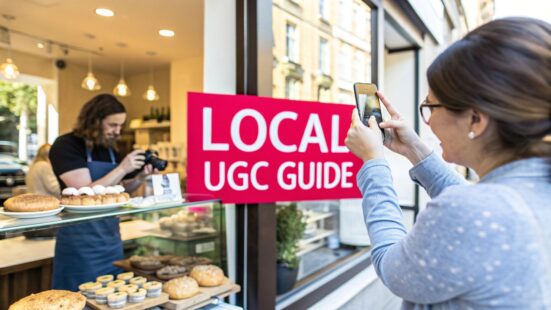
Think about a local bakery in your neighborhood. Instead of dropping thousands on a commercial photoshoot, its Instagram feed is a vibrant collection of customer photos. You see a kid with chocolate all over their face, joyfully eating a croissant. You see a beautifully decorated cake as the centerpiece of a birthday party. You see a simple, perfect shot of someone's morning coffee and pastry.
Every single one of those images is a personal endorsement. It's a real story that resonates so much more deeply than any branded message ever could. This is the heart of UGC for local businesses: turning your happy customers into your most enthusiastic and effective marketers.
Building Authentic Connections and Trust
The real magic of UGC is its authenticity. When a potential customer sees a real person—not a paid actor—genuinely enjoying your product or service, it creates an instant sense of credibility. It's a neighbor, a friend, or just someone like them, and that peer-to-peer validation is incredibly persuasive.
The data backs this up completely. A recent survey found that a staggering 84% of people are more likely to trust a brand that features UGC in its marketing. That's a huge number, and it shows that content from real customers directly shapes how people feel about you.
This trust leads directly to sales, with 77% of consumers reporting that UGC impacts their purchasing choices.
The bottom line is simple: People trust people. When you let your customers tell your story, you're not just selling something; you're building a community around shared, positive experiences.
The Tangible Business Benefits
Beyond just building a great community vibe, a solid UGC strategy delivers real, tangible benefits that hit your bottom line. It's an incredibly cost-effective way to generate a constant stream of fresh, relevant content without blowing your marketing budget. This keeps your social media and website looking dynamic and current.
Here’s a quick look at the advantages a local business gains by leaning into user-generated content:
Core Benefits of UGC for Your Local Business
| Benefit Area | Impact on Business | Example |
|---|---|---|
| Authenticity | Builds genuine trust and credibility that ads can't replicate. | A customer's unedited photo of their meal at your cafe. |
| Cost-Effectiveness | Dramatically reduces content creation costs. | Using customer-submitted videos instead of hiring a video crew. |
| Engagement | UGC posts see higher interaction rates because they're relatable. | A customer's Instagram Story tagging your shop gets more shares. |
| Social Proof | Shows potential customers that others love and use your products. | Displaying Google Reviews from happy customers on your website. |
| Community | Fosters a loyal following and makes customers feel valued. | Running a photo contest and featuring the winner on your feed. |
By making customer content the heart of your marketing, you kickstart a self-sustaining cycle of promotion that feels genuine and community-driven. To really get into the weeds on this, you can check out our complete guide on the benefits of user-generated content. This approach doesn't just get new people in the door; it builds deeper loyalty with the customers you already have.
Designing a Realistic UGC Game Plan
Okay, so you're sold on the why of user-generated content. Now for the how—and this is where most local businesses get stuck. You know customer content is gold, but where do you even start? The key is building a game plan that doesn’t just add another overwhelming task to your plate. It needs to become a real, working marketing engine for your business.
A smart UGC strategy isn't about collecting every single customer photo you can find. It’s about getting the right content, the kind that actually moves the needle on your specific business goals. You have to know what you're aiming for before you ask your customers to start sharing.
Define What Success Looks Like for You
Before you even think about a hashtag or printing a sign for your counter, stop and ask yourself: what am I really trying to achieve here? A fuzzy goal like "get more UGC" is a recipe for wasted effort. You need to get specific.
What does that look like in the real world for a local business?
- Build trust on your website: Maybe your goal is to feature compelling video testimonials on your services page to instantly show new visitors you’re the real deal.
- Boost local discovery: You want to turn your geotagged Instagram feed into a vibrant gallery of customer photos, making your spot the place for locals to check into.
- Climb the local search rankings: Your primary objective might be getting more positive, detailed Google Reviews to push your business higher in the local map pack results.
- Ditch the stock photos: You’re tired of generic visuals and want a library of real customer images to use in your email newsletters and social media ads.
Nailing down your main objective first will shape every other decision you make. It keeps your efforts focused and, more importantly, effective.
Pinpoint Your Most Valuable Content
Once your goal is crystal clear, it’s much easier to identify the most valuable types of content to get you there. Let’s be honest, not all UGC is created equal, especially for different types of businesses.
A local contractor, for instance, gets a massive credibility boost from a single before-and-after photo of a kitchen remodel. A coffee shop, on the other hand, lives and dies by those aesthetic latte art shots and pictures of customers soaking up the cozy vibes. Think about what truly puts your value on display.
Let's break it down:
- For a hair salon: Before-and-after transformation pics or short video clips of a client’s happy reaction are absolute gold.
- For a restaurant: High-quality photos of your signature dishes, videos of friends laughing over a meal, or a glowing review about your amazing service are what you're after.
- For a boutique: Customers styling your clothes their own way? That’s powerful social proof and a ton of inspiration for other shoppers.
This is how authentic content works its magic. It creates a simple but powerful flow: it starts with authenticity, which builds trust, and trust is what ultimately drives sales.
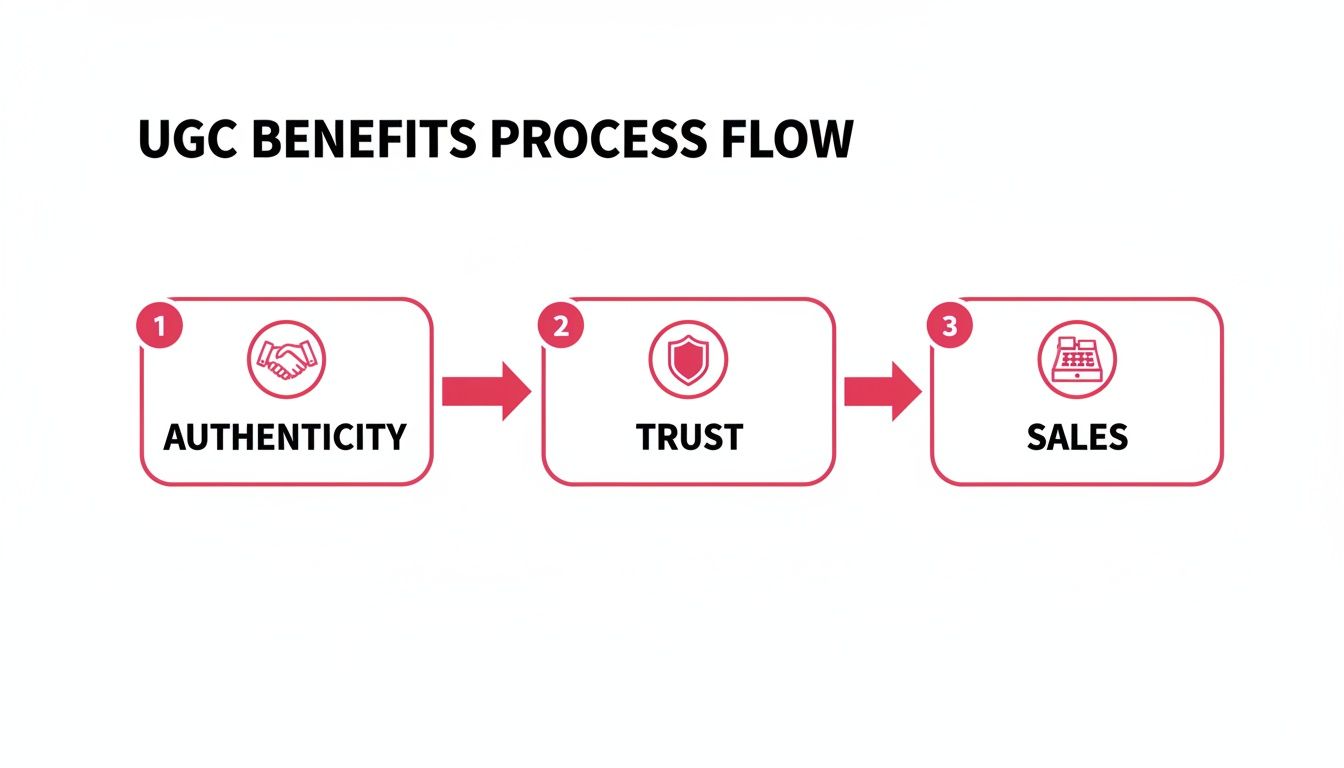
This isn’t just about making your marketing look pretty. Genuine customer content is a direct line to building the credibility you need to grow your revenue.
Low-Effort Ideas to Encourage Sharing
Now for the fun part: actually getting your customers to create and share content. The secret is to make it easy, fun, and feel totally natural—not like you're demanding something from them. You don't need a huge budget for this, just a little creativity. To get some more advanced ideas, it's worth checking out these powerful user-generated content strategies.
Something as simple as a well-designed sign at your checkout counter or a fun prompt on your menu can do the trick. A sign that says, "Love your new look? Share it with #YourSalonStyle for a chance to be featured!" can work wonders.
Pro Tip: Make your requests specific. Instead of a generic "Tag us in your photos," try something more engaging like, "Show us where you're enjoying our coffee today! Tag @YourCafe and use #YourCityCoffee." It gives customers a clear, simple call-to-action.
The impact here is real, both financially and in terms of loyalty. The data shows that weaving customer content into your marketing can boost conversion rates by an average of 4.5%. Even better, the sense of community that UGC builds fosters stronger customer bonds—engaged customers are 50% more likely to make repeat purchases.
Building a solid plan right from the start is what separates the businesses that succeed with UGC from those that just hope for the best. For a deeper dive into the nuts and bolts, our guide on creating a user-generated content strategy offers more frameworks to help you get started. A little planning goes a long way in turning random customer posts into a predictable and powerful marketing asset.
How to Ethically Source and Use Customer Content
That feeling when you see a customer post an amazing photo of your product or a glowing review? It's gold. But before you rush to plaster that content all over your marketing, we need to talk about the most crucial step: getting permission.
It sounds a bit formal, but it’s really about respect. The moment you decide to use someone else’s photo, video, or review, you’re dealing with their creative work. The good news is, handling this the right way doesn’t have to be a headache.
The core principle is simple: always ask for permission. Just because a customer tags your local business in a post doesn't give you a free pass to use it however you want. Sure, a quick reshare to your Instagram Story is usually fine and expected. But using that same photo in a paid Facebook ad or on your website? That's a different league entirely, and you need explicit consent.
Think of asking for permission as an opportunity. It’s a chance to personally thank a happy customer, compliment their great taste, and make them feel seen. A little genuine appreciation goes a long way.

The Art of the Ask: Crafting Your Outreach
When you spot a fantastic piece of UGC, your approach should feel human, not like an automated bot. Slide into their DMs with a message that shows you actually looked at and loved what they created. Your goal is to make them feel like a valued member of your community, not just a content vending machine.
For something like an Instagram DM, keep it simple and friendly:
- Start with a real compliment: "Wow, we absolutely love this photo you took at our cafe! The lighting is perfect."
- Be upfront about your plans: "We'd be honored to feature it on our main Instagram feed and possibly on our website."
- Ask for permission directly: "Would you be okay with us sharing it? We’ll be sure to give you full photo credit, of course!"
This kind of friendly, transparent approach almost always works. It shows you value the person behind the post, which is the foundation of sourcing UGC for local businesses ethically.
To make this even easier, here are a few outreach scripts you can adapt.
UGC Outreach and Permission Scripts
Here are some ready-to-use templates for requesting UGC usage rights across different platforms.
| Platform | Outreach Script Template | Key Permission Point to Confirm |
|---|---|---|
| Instagram DM | "Hi [Username]! We are obsessed with this photo. Seriously, you captured the vibe perfectly! Would you be cool with us sharing it on our feed and stories? We'll credit you, of course!" | "By saying 'yes,' you're confirming you own this photo and are happy for us to share it on our social channels. Sound good?" |
| TikTok Comment | "OMG this video is everything! 🔥 We'd love to share this on our own TikTok. Let us know if that's okay!" | (Move to DMs for confirmation) "Just to confirm, you're giving us permission to repost this on our TikTok page, right?" |
| Email (for Reviews) | "Hi [Name], thank you so much for your wonderful review! It made our day. We'd love to feature your comments on our website's testimonials page. Would that be alright with you?" | "Just confirming you're okay with us using your first name and review on our website and in marketing materials. Thanks again!" |
| Google Review Reply | "Thank you for the fantastic 5-star review, [Name]! We're so glad you enjoyed your visit. Your feedback is so helpful, we'd love to share it on our social media pages. Hope that's okay!" | (Implicit consent) For public reviews, you have more leeway, but it's still best practice to acknowledge you'll be sharing it. |
Remember to always adjust the language to fit your brand's voice. The key is to be genuine and transparent.
Securing Usage Rights Without the Legal Headache
Getting that initial "yes" is step one. Step two is clarifying how and where you can use their content. For most day-to-day UGC, you don't need a formal, multi-page contract. A clear, documented agreement right there in your DMs or email thread is usually enough.
Crucial Takeaway: You need to explicitly state where you plan to use the content. If there’s even a chance you might use it in paid ads, on your website, or in print flyers, you have to mention it. This protects both you and the creator.
A simple follow-up message can lock this down:
"That's fantastic, thank you so much! Just to confirm, by agreeing, you're giving us permission to use this photo on our social media channels, website, and in our digital marketing. We'll always credit your handle. Does that work for you?"
Getting that second confirmation creates a clear digital paper trail of their consent. For larger campaigns, paid collaborations, or if you just want extra peace of mind, using a simple content creator contract template can provide more detailed protection for everyone involved.
According to the U.S. Copyright Office, copyright protection is automatic for original creative works like photos and videos. This is exactly why getting permission isn't just a nice thing to do—it's a must.
Organizing Your Approved UGC Library
Once you start getting those permissions, you'll quickly realize that a messy camera roll filled with screenshots just won't cut it. You need a system to keep track of your approved content.
Don't worry, you don't need to buy expensive software. Here are a few simple and free ways to build your own UGC library:
- A Dedicated Cloud Folder (Google Drive/Dropbox): This is my go-to. Create a main "Approved UGC" folder. Inside, make subfolders like "Customer Photos," "Cafe Vibe," or "Product In Use." When you save a file, rename it with the creator's handle (e.g.,
best-burger-shot-by-@foodieguy.jpg). - A Simple Spreadsheet Tracker (Google Sheets): Create a sheet to log everything. Make columns for the creator’s handle, a link to their original post, the date you got permission, and a quick note on usage rights (e.g., "Social media and website only").
- A Visual Board (Trello/Pinterest): If you're more of a visual person, a private Trello or Pinterest board works great. Each card or pin can represent a piece of content. Just drop the creator's info and permission details in the description.
An organized system like this is a game-changer. It turns random customer shout-outs into a powerful, searchable library of authentic marketing assets you can pull from anytime, knowing you have the rights to do so.
Putting Your Customer Content to Work
You've done the legwork. You've found amazing customer content and you've secured the permissions. Now it's time for the payoff—turning that library of authentic UGC into a marketing engine that builds trust and drives real sales.
This is where your collection of customer photos, videos, and reviews stops being just a folder of assets and starts working for you.
Simply reposting every tagged photo isn’t a strategy. The real magic happens when you place the right kind of UGC on the right platform, at the right time. That stunning photo of your signature dish? Perfect for an Instagram Reel. That glowing, detailed Google Review? That's the centerpiece for a high-converting landing page.

Beyond the Social Media Feed
While social media is usually the first place people think of for UGC, its power goes way beyond your Instagram or TikTok profile. Your own digital turf—your website and email list—is prime real estate for showcasing social proof where it counts the most: right at the moment a customer is about to make a decision.
Think about it. A potential customer lands on your website's services page. Placing a gallery of customer photos or a short video testimonial right next to your service descriptions can instantly boost their confidence. It’s no longer just you saying you're great; it's a whole chorus of their peers.
Pro Tip: Embed a live social media feed directly on your homepage. Tools like Taggbox or Curator.io can automatically pull in posts using your brand's hashtag. This creates a dynamic, self-updating wall of customer love that keeps your site fresh and credible.
This tactic is so effective because it taps directly into how people shop today. Online reviews are a huge piece of this puzzle. In fact, a staggering 98% of consumers read online reviews for local businesses. This behavior is so ingrained that user-generated content is now a major driver for search rankings, accounting for roughly 25% of organic search results for top brands. You can discover more insights about UGC's impact on consumers to see just how essential this trust signal has become.
Platform-Specific Plays for Maximum Impact
Different channels need different approaches. A one-size-fits-all strategy just won't cut it. Here’s a breakdown of how to tailor your UGC for the platforms that matter most to local businesses.
- Instagram Reels & Stories: This is where you bring customer content to life. Don't just post a static photo. Compile several customer images into a quick, upbeat Reel set to a trending song. Use the "Add Yours" sticker in your Stories to encourage more people to share their own experiences.
- TikTok Videos: Try using the Stitch or Duet feature with a customer's video review. For example, a local coffee shop could "Stitch" a customer's video of their latte art with a behind-the-scenes clip of the barista making it. It’s conversational, engaging, and feels native to the platform.
- Google Business Profile: Think of this as your digital storefront—UGC is your curb appeal. Regularly upload your best customer photos to the "Photos" section of your profile. When you get a fantastic review, screenshot it, pop it into a simple graphic using a tool like Canva, and share it across your other social channels.
- Email Newsletters: Your email list is a captive audience. Feature a "Customer of the Week" photo in your newsletter or create a section showcasing your top three favorite reviews from the month. This reinforces your community and reminds subscribers of the great experiences others are having.
Let's walk through a real-world example. A local hardware store runs a "DIY Weekend Warrior" campaign, asking customers to post photos of their finished home improvement projects with the hashtag #HometownHardwareDIY.
- On Instagram: They create a Reel featuring a fast-paced slideshow of the best project photos.
- On their website: They build a dedicated "Project Gallery" page featuring these customer-submitted images, linking directly to the products used in each project.
- In their newsletter: They highlight the most impressive project of the month, complete with a mini-interview with the customer who built it.
This multi-channel approach guarantees the UGC gets maximum visibility while serving different goals on each platform—from quick entertainment on social media to providing deep social proof on their website. When you put your customer content to work strategically, you create a powerful, authentic narrative that resonates far more than any traditional ad ever could.
Tracking What Actually Matters with UGC
You’ve launched your campaigns, the content is rolling in, and your social feeds are looking better than ever. But now for the million-dollar question: is any of this actually working?
To really get a handle on the value of UGC for your local business, you have to look past the easy-to-spot vanity metrics like likes and follows.
The real goal here is to draw a straight line from your UGC efforts to real-world business results. Are those customer photos driving more people to your website? Are those glowing reviews leading to more phone calls and bookings? Measuring what truly moves the needle is how you'll prove the ROI of your strategy and figure out where to double down.
Moving Beyond Vanity Metrics
It's tempting to get caught up in the thrill of a post getting a ton of shares or seeing your follower count tick upward. Those things feel good, but they don't necessarily pay the bills. The true measure of success is how UGC impacts your bottom line.
You need to shift your thinking from "How many people liked this?" to "How many people who saw this took an action that matters?" That means tracking metrics that tie directly to customer behavior and, eventually, sales.
Here are the core areas you should be obsessing over:
- Engagement Rate: How are real people interacting with customer content versus your own branded posts?
- Website Conversions: Are the pages featuring UGC turning more visitors into leads or paying customers?
- Click-Through Rate (CTR): Are your ads and emails getting more clicks when you feature customer content?
- Review Sentiment & Volume: Is the general feeling of your online reviews getting better, and are you getting more of them?
These are the numbers that tell the real story.
Key Performance Indicators to Watch
Let's get into the weeds on exactly what to track. The good news is you can do most of this with tools you're probably already using, like Google Analytics and your social media insights.
UGC vs. Branded Content Engagement
This is your ground zero. You need to establish a baseline to see if authentic, customer-shot content is outperforming your polished, professional posts. It's as simple as diving into your Instagram or Facebook Insights.
- Pull up your last ten UGC posts (think reshared customer photos or video testimonials).
- Calculate their average engagement rate (likes + comments + shares ÷ followers).
- Now, do the same for your last ten branded posts (like your own promotional graphics or service announcements).
More often than not, you’ll see UGC pull ahead. Some studies have shown that engagement can jump by as much as 28% when brands start mixing in customer videos with their regular content. It just feels more real.
Conversion Lift on Key Website Pages
This is where you can literally see UGC making you money. Pick a high-stakes page on your website—maybe your service booking page, a specific product page, or your "request a quote" form.
First, track its conversion rate for a solid month without any UGC on it. Then, add a gallery of customer photos or a few hard-hitting testimonials to that same page. Let it run for another month and track the conversion rate again. That difference? That's your "conversion lift."
Real-World Example: A local salon adds a "See Our Clients' Results" section with customer-submitted before-and-after photos to their "Hair Coloring Services" page. They use Google Analytics to monitor the page's goal completions and see a 15% increase in appointment bookings originating from that page.
Click-Through Rates in Ads and Emails
Nothing screams "trustworthy" like seeing a real person using and loving a product. This makes UGC an absolute powerhouse for ads and email marketing. The next time you run a local Facebook ad campaign or send out a promo email, run a dead-simple A/B test.
- Version A: Use your standard, slick branded image.
- Version B: Use an authentic, high-quality customer photo.
Keep the text and call-to-action exactly the same. Once the campaign is over, look at the click-through rate (CTR). You might be surprised. UGC-based ads have been known to get up to 4x higher CTRs and a 50% drop in cost-per-click. People just click on what they trust.
Monitoring Review Sentiment Over Time
Finally, don't sleep on your online reviews. They are the original, foundational form of UGC. Your goal shouldn’t just be to get more reviews, but to see the overall sentiment improve.
Set a recurring calendar event every quarter to check your average star rating on Google, Yelp, and Facebook. Since you started actively asking for and featuring customer feedback, is the trendline pointing up? Even a simple spreadsheet where you log your rating each month can show you powerful trends in customer satisfaction. This qualitative data gives you the full picture of your brand's reputation, and it's just as important as any conversion rate.
Common Questions About Local Business UGC
Even with a solid plan, jumping into user-generated content can feel a little daunting. A few nagging questions always seem to pop up, and that's perfectly normal. Let's tackle the most common concerns I hear from local business owners and give you some straight, practical answers.
What If I Get Negative UGC?
This is the big one, isn't it? It's often the number one fear, but I want you to reframe this. Negative feedback is an opportunity, not a crisis. A critical post or a bad review gives you a public stage to show off just how incredible your customer service is.
When you respond quickly, professionally, and with real empathy, you can turn a bad experience around. Sometimes, you can even turn that unhappy customer into a loyal advocate. The absolute worst thing you can do is ignore it. A thoughtful reply shows everyone—not just the original poster—that you care, you're listening, and you're committed to making things right. That builds way more trust than a feed full of nothing but shiny, perfect posts ever could.
How Much UGC Is Enough?
Honestly, there's no magic number here. The goal isn't to hit some arbitrary quota; it's about creating a consistent, fresh stream of real customer content.
If you're just starting out, a good benchmark is to feature UGC in about 20-30% of your social media posts. This creates a nice balance, keeping your feed authentic without completely taking over your own branded messages. As you get the hang of it, you might find that UGC for local businesses in your space gets amazing engagement, and you can definitely bump that percentage up.
The key is consistency, not sheer volume. One high-quality, authentic customer photo every week is far more valuable than ten mediocre ones dumped all at once. It shows ongoing customer love and keeps your marketing feeling current.
Do I Need to Pay for UGC?
For a local business? Absolutely not. The most powerful UGC is the stuff that comes from genuine customers who just plain love what you offer. That's the gold standard. Paid collabs with influencers are a totally different ballgame. Your core strategy should be all about encouraging and celebrating that organic, unpaid love.
That said, you can definitely nudge things along with non-monetary incentives. Things like this work wonders:
- Contests and Giveaways: Run a photo contest where the best shot wins a gift card or a freebie. It’s simple and effective.
- Customer Features: Never underestimate the power of a shoutout! Simply highlighting a customer's post on your official page is often all the reward someone needs.
- Exclusive Discounts: As a little thank you, offer a small discount code to customers whose content you feature.
What If My Customers Are Camera-Shy?
Totally fair. Not everyone is itching to be in the spotlight, and that's okay. You can still encourage fantastic UGC that doesn't put them on the spot.
Pivot your ask. Instead of them, focus on the product or experience. Ask customers to share photos of that beautifully plated dish from your restaurant, the new fence your team just installed, or your product being used "in the wild."
You can also run campaigns that are all about written content. Ask for their best tip using your service or their favorite memory at your shop. This still gets you valuable, authentic content without making anyone feel awkward. If you're looking for more deep dives into local marketing, you can explore additional marketing insights on their blog.
Ready to turn your happy customers into your most powerful marketing team? JoinBrands makes it easy to source, manage, and scale your user-generated content campaigns. Connect with a network of over 250,000 creators and get the authentic content you need to build trust and drive sales. Start your first UGC campaign with JoinBrands today!