

 10 Essential Mobile App Marketing Strategies for Explosive Growth in 2026
User-generated campaigns aren't just a marketing buzzword; they're a completely different way to think about building your brand. Instead of the brand creating all the content, these campaigns are built around the photos, videos, reviews, and stories shared by your actual customers, fans, and followers.
This simple switch transforms people from just passive buyers into active storytellers for your brand.
Table of Contents
What Are User Generated Campaigns Anyway?
Think about how marketing has worked for decades. It's been a monologue. A brand stands on a stage and talks at an audience, hoping the message sticks. A user-generated campaign flips that script entirely. It turns marketing into a lively community conversation where your brand is the topic, but your customers are leading the discussion.
At its heart, a UGC campaign is a planned effort to encourage, gather, and feature content from the very people who use and love your products. It's the digital version of word-of-mouth, but scaled up for today's social world. Instead of creating perfectly polished ads, you’re curating authentic, relatable content from real people. This is a huge deal because modern consumers are tired of traditional advertising but overwhelmingly trust what their peers have to say.
From Monologue to Dialogue
A traditional ad is like a billboard—it’s a one-way street. A user-generated campaign, on the other hand, is like hosting a town hall meeting. You might set the agenda (the campaign goal and the prompt), but it's the community that brings the real substance, energy, and different points of view. This does more than just sell something; it builds a genuine sense of belonging.
User-generated content is the modern-day word-of-mouth. It builds a level of trust and authenticity that even the most well-crafted brand message struggles to achieve on its own. It's the difference between being told something is great and seeing a friend genuinely love it.
The Many Faces of UGC
These campaigns can take on all sorts of shapes and sizes. That’s the beauty of it—this strategy is incredibly versatile and can be adapted to almost any platform or marketing goal you have.
Here are a few of the most common formats you'll see:
- Photo or Video Contests: Brands ask their audience to post visual content featuring a product, usually tied together with a unique campaign hashtag.
- Hashtag Challenges: You've definitely seen these on TikTok and Instagram. They prompt users to create content around a specific theme, trend, or action, creating a wave of related posts.
- Review and Testimonial Drives: These campaigns are all about collecting genuine feedback. That feedback then becomes powerful social proof on product pages, in social media posts, and even in paid ads.
- Community Storytelling: This involves inviting users to share how a product made a difference in their lives. The result is often powerful, emotionally-driven stories that connect with a much wider audience.
At the end of the day, user-generated campaigns are about handing the microphone over to your community. When you do that, you don't just get a folder full of marketing assets. You build a loyal, engaged, and vocal group of fans whose collective voice becomes your most powerful marketing tool.
The Real Business Impact of UGC
Okay, let's move past the theory. User-generated campaigns deliver real, measurable results that directly impact your bottom line. This isn't just some marketing buzzword; UGC is a proven engine for growth, built on three critical pillars: supercharged engagement, authentic conversions, and serious cost-efficiency.
When your customers start telling your story for you, the impact ripples across the entire marketing funnel. It’s a fundamental shift from brands pushing ads to peers sharing experiences, and it completely changes how people connect with your message.
Just look at the hard data when you pit UGC against traditional brand ads.
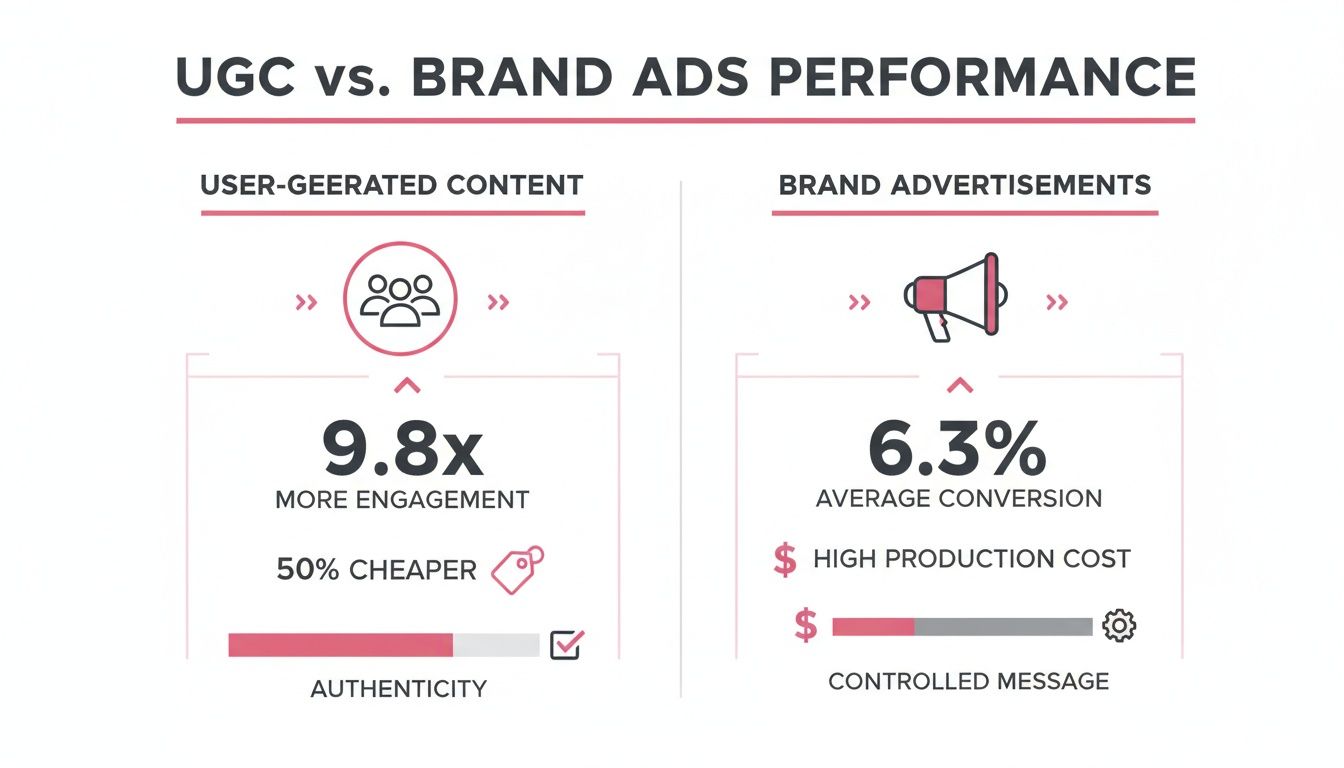
The numbers don't lie. Content from real users doesn't just perform a little better—it completely dominates brand-created content on engagement while costing a fraction of the price to create.
Amplify Audience Engagement
The psychology here is simple: we trust people who look like us far more than we trust a polished advertisement. A slick brand ad is supposed to say great things. But a real photo from a customer showing how they use a product in their daily life? That feels genuine and unbiased.
And that authenticity is the key to unlocking massive engagement.
The numbers back this up in a big way. Social campaigns that mix in user-generated content see a 50% lift in engagement over those that stick to brand-only assets. That’s a huge advantage, and some studies show UGC posts can rack up 6.9 times higher engagement than a brand’s standard content. If you want to dig deeper, you can explore more UGC performance metrics on archive.com to see just how wide the gap is.
Drive Conversions with Social Proof
High engagement is great, but the real goal is driving sales. This is where UGC truly shines, acting as powerful social proof that melts away purchase hesitation. Think about it: when a potential buyer sees dozens of other customers happily using and loving your product, it builds an incredible amount of trust.
Nearly 80% of consumers say that user-generated content directly shapes their purchasing habits. For many shoppers, seeing that real-world validation is the final nudge they need to click "buy."
This trust translates directly into higher conversion rates. By weaving customer photos, videos, and reviews into your product pages, emails, and paid ads, you create a seamless path to purchase built on genuine, real-world validation.
Maximize Your Marketing Budget
Finally, let's talk about the money. Traditional content production is expensive. It involves photographers, models, studio rentals, and endless editing—all for a handful of assets that can feel stale or inauthentic pretty quickly.
User-generated campaigns flip that model on its head, offering a scalable and incredibly cost-effective alternative.
Instead of a few high-cost assets, you get a continuous, ever-growing stream of authentic content from your community. This approach drastically cuts your content creation costs while delivering assets that are proven to be more effective.
Just consider the difference:
- Traditional Content: High upfront investment, a limited number of assets, and often lower engagement rates.
- User-Generated Content: Minimal to no production cost, a virtually endless supply of diverse assets, and proven higher performance.
By tapping into your audience's creativity, you don't just save a ton of money. You also build a richer, more diverse library of marketing materials that genuinely connects with new customers. This is what makes user-generated campaigns an essential strategy for any brand looking to maximize its marketing ROI and build sustainable growth.
How to Plan Your First UGC Campaign

Jumping into your first user-generated campaign can feel like a huge task, but it’s really about breaking the process down into manageable steps. Think of it less like launching a massive ad campaign and more like organizing a community event. Your goal is to inspire participation, not just demand content.
A well-planned campaign gives your community the structure they need to get creative. Without clear goals, a compelling prompt, and a dead-simple submission process, even your most enthusiastic audience can get stuck. This plan is your blueprint for turning genuine customer passion into a powerful marketing engine.
Define Your Campaign Goals
Before you even think about hashtags or prizes, you need to be crystal clear on what you want to achieve. A campaign without a clear goal is just noise. Your objective will shape every other decision you make, from the type of content you ask for to the platforms you focus on.
Are you aiming to boost brand awareness, generate social proof for a new product, or drive direct sales? Each of these goals requires a completely different playbook. For example, a campaign to collect testimonials for a product page will look very different from a viral TikTok challenge designed for maximum reach.
To make your goals actionable, tie them to specific business outcomes.
- For Brand Awareness: Your goal could be to increase your share of voice. A good metric would be tracking the number of posts using your campaign hashtag.
- For Social Proof: You might want to gather visual testimonials. Success would be measured by collecting a target number of high-quality photos or videos for your website.
- For Driving Sales: The objective is clear—increase conversions. You could measure this by tracking sales from a unique discount code shared with campaign participants.
Pinpoint Your Target Audience
Let’s be honest: not all customers are equally likely to jump into user generated campaigns. Your ideal participant is someone who is already engaged with your brand—they follow you on social media, they’ve purchased from you before, and they genuinely like what you do.
Don’t try to appeal to everyone. Instead, focus your energy on activating your most passionate fans. These are the people who will create the most authentic and compelling content. It can even help to build a specific persona for your ideal campaign participant to really nail your messaging and creative brief.
Think community over content. When you focus on what motivates your most loyal fans, you'll inspire them to create content that resonates deeply with a wider audience. The goal is to make participation feel like an exclusive, fun opportunity, not a marketing task.
Platforms like JoinBrands can simplify this process by connecting you with a network of creators who are already skilled at producing authentic content. This lets you supplement submissions from your core customer base with high-quality content from vetted creators, making sure you hit your campaign goals.
Write a Clear and Inspiring Creative Brief
Your creative brief is the single most important document in your campaign. It’s your instruction manual for participants, telling them exactly what you’re looking for and why they should get involved. A confusing or boring brief will lead to low-quality submissions or, even worse, no submissions at all.
Your brief should be simple, visual, and inspiring. Use clear, concise language and ditch the internal marketing jargon.
A strong creative brief must include:
- The Big Idea: A catchy, one-sentence summary of the campaign. What’s the core concept?
- The Ask: What specific type of content do you want? Be explicit. (e.g., "A 15-second video of you unboxing our new product," or "A photo of you using our hiking boots on your favorite trail.")
- Key Message: Is there a specific benefit or feature you want highlighted?
- Do’s and Don’ts: Provide clear visual guidelines. (e.g., "Do shoot in natural light," or "Don’t include competitor logos.")
- Submission Details: How and where do people submit their content? Include the official hashtag and any tagging requirements.
- The Incentive: What’s in it for them? Clearly state the prize, discount, or the chance to be featured.
Make your submission process as frictionless as possible. A simple hashtag on Instagram or TikTok is often all you need. The more steps you add, the more participants you’ll lose along the way. Your final step is amplification—have a plan ready to feature the best content across your channels to celebrate your community and maximize the campaign’s impact.
Navigating the Legal and Logistical Challenges
Great content comes with great responsibility. While it's awesome to see your audience creating and sharing, launching user generated campaigns without a solid legal and logistical plan is like building a house with no foundation. It might look good for a minute, but things can get shaky, fast.
Protecting your brand and respecting your creators are two sides of the same coin. This means you need to move past simple assumptions and get crystal clear on how content is used and managed. If you skip these steps, you're opening the door to legal headaches, a damaged brand reputation, and a breakdown of the very community trust you're working so hard to build.

Securing Your Content Rights
Here's one of the biggest mistakes brands make: assuming a campaign hashtag gives them a free pass to use submitted content however they want. It doesn't. A hashtag is just a sign of participation, not a legal transfer of ownership.
If you want to use someone's photo in your ads, on your website, or in any other marketing materials, you need their explicit permission. Period.
A quick DM asking for permission is a decent start, but a formal usage rights agreement is much, much better. This doesn't need to be some intimidating, multi-page legal document.
A straightforward agreement should cover:
- What content you can use: Be specific. Are you asking for rights to one photo, a particular video, or all the content they submitted?
- Where you can use it: Spell out the channels. Social media, your website, email newsletters, paid ads—list them out.
- How long you can use it: Is it forever? Or just for a specific timeframe? Make it clear.
Getting explicit consent is completely non-negotiable. It protects your brand from copyright claims and, just as importantly, shows creators that you actually value their work. This simple act of respect is crucial for keeping your community relationship positive and healthy.
Building a Scalable Moderation Workflow
Once the submissions start pouring in, you'll need a system to handle them all. Trying to do this manually without a clear process will get chaotic and totally unsustainable as your campaign gains momentum.
A scalable moderation workflow is your campaign's quality control center. It ensures every piece of content you decide to feature is on-brand, safe, and looks great. For a deeper dive into the legal specifics, it's worth learning what goes into a content creator contract template to formalize these relationships properly.
Here’s a practical framework to build out your moderation process:
- Establish Clear Guidelines: Create an internal document that defines what’s in and what’s out. This should cover things like image quality, brand voice, and forbidden content (like offensive material or competitor logos).
- Use a Centralized Hub: Don't let submissions scatter everywhere. Funnel them all into one place, whether that's dedicated software, a cloud folder, or a platform like JoinBrands that automates the whole collection process.
- Implement a Tagging System: As you review content, use simple tags like "Approved," "Rejected," or "Needs Review." This keeps your assets organized and makes it a breeze to find your best content later.
- Assign Roles: If you have a team, give people specific jobs. Someone can handle the initial review, and another can give the final sign-off. This creates accountability and keeps your selections consistent.
Putting these legal and logistical safeguards in place creates a professional, risk-free environment. This doesn't just protect your business—it builds a foundation of trust that will encourage even more amazing participation in all your future user generated campaigns.
How To Measure Campaign Success
Launching your user-generated campaign is an exciting first step, but it’s really just the beginning. Without a clear way to measure what’s working (and what isn’t), you’re essentially flying blind. To really prove the value of your user generated campaigns, you have to look past vanity metrics like 'likes' and dig into the Key Performance Indicators (KPIs) that actually mean something for your business.
Think of it this way: a doctor doesn’t run every test imaginable to check on a patient. They check specific vital signs to get a clear, accurate picture of their health. The same principle applies here. Effective measurement isn’t about tracking every single number; it’s about choosing the right numbers that connect back to your original campaign goals.
Aligning Metrics With Campaign Goals
What "success" looks like is completely different depending on what you set out to do. You wouldn't judge a campaign built for brand awareness with the same yardstick you'd use for one designed to drive immediate sales. When you tie your metrics directly to your goals, you can tell a clear, compelling story about your campaign's performance.
Let's break down the key metrics for three of the most common campaign objectives:
Brand Awareness: If your main goal is getting your brand in front of as many new people as possible, you’ll want to focus on metrics that measure visibility and reach.
- Impressions: This is the total number of times your campaign content was displayed on a screen.
- Reach: This tells you the number of unique individuals who saw your campaign content.
- Share of Voice: How much of the conversation around your industry is about your brand? You can track this by monitoring your campaign hashtag against your competitors'.
Community Engagement: When you're trying to build a more active and loyal community, your focus should be on how people are interacting with your campaign.
- Submissions: The total amount of UGC created specifically for your campaign is a direct measure of participation.
- Comments and Shares: These interactions show a much deeper level of engagement than a simple like.
- Hashtag Usage: Tracking how many times your official campaign hashtag was used tells you exactly how many people are joining the conversation.
Revenue Generation: For campaigns built to drive sales, your metrics need to connect directly to the bottom line. No fluff here.
- Conversion Rate: What percentage of users who engaged with UGC went on to make a purchase?
- Click-Through Rate (CTR): This is the percentage of people who clicked on a link within a piece of UGC, whether it was in an ad or on your site.
- UGC-Influenced Sales: Use unique discount codes or UTM parameters to track every sale that came directly from your campaign content. There's a whole world of content performance metrics you can explore to get an even more detailed view.
Proving The ROI of UGC
Don't underestimate the impact of UGC on your sales numbers. It's direct, and it's significant. Content from real customers doesn't just build trust; it actively drives people to click "buy." In fact, when brands incorporate UGC into their online purchase path, they see 10 percent more conversions on average. The effect is even more dramatic on websites, where brands using UGC see 29 percent more web conversions than those who don't. That’s a powerful, measurable lift.
This direct comparison really puts the power of UGC into perspective.
Comparing UGC Performance to Traditional Ads
| Performance Metric | UGC-Based Ads | Traditional Ads |
|---|---|---|
| Click-Through Rate (CTR) | 4x higher than brand-created ads | Lower engagement, often perceived as "just another ad" |
| Cost Per Click (CPC) | Often 50% lower, more efficient ad spend | Generally higher due to lower engagement rates |
| Conversion Rate | 10% higher on average when UGC is present | Lacks the social proof that drives immediate purchases |
| Ad Recall | Higher memorability due to authentic feel | Lower recall, blends in with other branded content |
As you can see, the authenticity of UGC isn't just a "nice-to-have"—it translates into real, bottom-line results that brand-created content often struggles to match.
Measuring your campaign’s success is all about translating that buzz and engagement into tangible business outcomes. This is the data that justifies your budget, proves your strategy works, and helps you make even smarter decisions for the next campaign.
Once you've launched, figuring out if your efforts are paying off is the most critical step. Learning more about measuring marketing campaign effectiveness is the key to truly proving your value. When you meticulously track the right KPIs, you can confidently show everyone the powerful return on investment that user generated campaigns deliver.
Streamlining Your Campaigns With Creator Platforms
While the results of user generated campaigns are powerful, the actual process of managing one can spiral into chaos. Fast. Juggling creator discovery, endless DMs, content approvals, usage rights, and payments across dozens of people is a massive operational headache.
Honestly, it's a full-time job in itself. This is often the very thing that holds brands back from really scaling their creator programs.
This is where creator marketing platforms come into the picture. Think of a platform as your campaign’s central nervous system. Instead of chasing down information scattered across spreadsheets, email threads, and social media messages, everything is organized in one clean dashboard. This layer of tech transforms a messy, time-consuming process into an efficient, scalable system.
These platforms are built specifically to solve the bottlenecks that plague manual campaigns, turning frustrating challenges into simple, automated workflows.
Eliminating Manual Campaign Headaches
Running user generated campaigns without the right tools means you're basically signing up to drown in administrative tasks. A creator marketing platform acts as a force multiplier for your team, automating the most repetitive (and error-prone) parts of the job so you can focus on strategy and creativity.
Here’s how they tackle the biggest pain points:
- Creator Discovery and Vetting: Instead of endlessly scrolling through hashtags hoping to find the right fit, these platforms use smart matching to connect you with creators who fit your exact criteria. You can filter by niche, audience demographics, engagement rates, and past work, saving you dozens of hours on recruitment alone.
- Centralized Communication: All conversations, brief distributions, and content submissions happen in one place. This completely eliminates the risk of missed messages or lost files, making sure every single person is on the same page.
- Automated Rights Management: Good platforms integrate content usage agreements directly into the creator onboarding process. This ensures you automatically secure the necessary permissions for every piece of content, protecting your brand from a legal standpoint.
A creator platform doesn’t just make your campaign easier to run—it makes it better. By systemizing your workflow, you free up the time and mental space to build stronger creator relationships and source higher-quality, on-brand content.
Achieving True Scalability and Control
The real game-changer of using a platform is the ability to scale. You can go from working with ten creators to one hundred without your entire process breaking down. A unified dashboard gives you a complete, real-time overview of your campaign’s health, from submission progress to budget tracking.
On top of that, these platforms offer serious cost-efficiency advantages that make your marketing budget work harder. The numbers show that when UGC is combined with paid advertising, it can lead to a 50% reduction in cost-per-click and achieve 4 times higher click-through rates compared to traditional ads.
This shift in advertising economics is a huge win for budget-conscious brands. You can explore more data on the cost-effectiveness of UGC on inbeat.agency to see the full picture.
This combination of efficiency and performance is what makes creator platforms an essential tool, not just a luxury. For brands serious about using UGC for measurable growth, they provide the control, insight, and automation needed to execute professional, high-impact user generated campaigns at any scale.
If you are just getting started, our guide on where to find UGC creators provides an excellent foundation.
Your Top UGC Questions Answered
When you're first dipping your toes into user-generated campaigns, a few practical questions always pop up. It's totally normal. Getting these sorted out is the key to moving forward with confidence and building a campaign that people are actually excited to join.
Let's walk through the three most common questions we hear from marketers. Think of this as your go-to guide for turning those "what if" moments into a solid action plan.
How Much Should You Pay for Content?
Ah, the money question. It's usually the first thing people ask, and honestly, there's no magic number. How you handle compensation really depends on what you're trying to achieve, who you're asking, and the kind of content you want. The good news? Cash isn't always king.
Here are the most common ways to pay creators:
- Product Seeding: For tons of creators, just getting a free product in exchange for some content is a fantastic deal. This is your best bet for getting authentic unboxing videos and genuine reviews. It's also super cost-effective for getting your product out there.
- Contests and Giveaways: Nothing gets people moving like the chance to win something big. This approach works wonders for big-picture awareness campaigns where you just want to get as many people involved as possible.
- Direct Payment: When you need top-tier, specific content—say, for a high-stakes ad campaign or your website's homepage—paying creators directly is the way to go. It makes the whole thing more professional and gives you a lot more say over the final product. Using a platform to handle the payments keeps everything clean and simple.
What if You Do Not Get Enough Submissions?
This is a huge fear for a lot of brands, but it’s almost always something you can avoid with a bit of planning. If the submissions are trickling in, it usually means something in your setup is off. Maybe the prize isn't exciting enough, the instructions are a pain to follow, or your creative brief is just plain boring.
A lack of submissions is rarely about a lack of interest. It's typically a sign of friction. Your job is to make participating as easy, fun, and rewarding as possible. Find and fix that friction point, and you'll see participation rise.
To get ahead of this, make sure your ask is dead simple and the reward is crystal clear. Then, shout about your campaign from the rooftops—all your social channels, your email list, everywhere. You might even consider running a small paid ad targeted at your most loyal followers to get the ball rolling.
How Can You Ensure High-Quality Content?
Are you having nightmares about getting a folder full of blurry, off-brand photos? I get it. But here’s the secret: the quality of the content you get is a direct reflection of the quality of your instructions. The single most powerful tool you have for getting amazing content is a detailed, easy-to-follow creative brief.
Don't just write it; make it visual. Include clear "do's and don'ts" and plenty of example images that show exactly what you're looking for. This takes all the guesswork out of it for creators. Plus, if you use a creator platform, you get a built-in quality control step. You can review and approve every single piece of content before it goes anywhere, making sure every asset is a perfect fit for your brand.
Ready to eliminate the guesswork and launch user generated campaigns that deliver results? JoinBrands connects you with over 250,000 vetted creators and provides the tools to manage your entire workflow, from briefing to content approval. Start your campaign today!