
 Your Guide to AI Generated Influencer Marketing
A user-generated content (UGC) campaign is all about using authentic content from your actual customers, fans, and creators to build real trust and get people talking. Forget the polished, brand-produced ads for a second. This approach leans on real-world social proof to connect with your audience, making your marketing feel way more genuine and relatable.
Table of Contents
Why UGC Is Your Brand’s Most Powerful Asset
Let’s be honest. Modern consumers are completely over traditional advertising. They scroll right past those glossy, impersonal ads, hunting for something real—a recommendation from a person they actually trust.
This is exactly where a user-generated content campaign changes the game for DTC and e-commerce brands. It’s not just another marketing buzzword; it’s a total shift in how you connect with the people you’re trying to reach.
The real magic of UGC is its authenticity. When a potential buyer sees someone just like them using and loving your product, it creates an instant layer of trust that no branded ad could ever hope to achieve. Think of it as the digital version of a friend’s recommendation, which is still the most powerful marketing tool on the planet.
The Psychology of Social Proof
When was the last time you bought something online without checking the reviews or looking for customer photos first? Probably never. We all do it. We’re searching for social proof—that little bit of reassurance that other people made the same choice and were happy with it.
A UGC campaign taps directly into this powerful psychological trigger. By putting real customers front and center in your marketing, you’re not just selling a product; you’re validating the purchase decision before it’s even made. This simple shift can turn hesitant window shoppers into confident buyers.
It works because of a few key drivers:
- Relatability: Consumers see themselves in the content, which makes your product feel more accessible and something they need.
- Trust: Content from a peer just feels more honest and unbiased than anything a brand can say about itself.
- Community: UGC helps build a sense of belonging, making customers feel like they're part of an exclusive club.
The Tangible Impact on Your Bottom Line
This move toward authenticity isn't just about creating good vibes; it delivers real, measurable results. The numbers don't lie. The UGC platform market, valued at $9.85 billion in 2025, is predicted to explode to $35.44 billion by 2030. That's a mind-blowing 29.20% compound annual growth rate.
This massive surge is exactly why platforms like JoinBrands are becoming so critical for brands that want to scale their campaigns effectively.
To put it in perspective, UGC posts get 6.9 times more engagement than brand-generated content. An uplift like that can completely reshape your entire social strategy.
Here's a quick look at how UGC stacks up against the old way of doing things.
UGC Campaign Performance vs Traditional Ads
This table gives a quick comparison, highlighting the key performance advantages of incorporating user-generated content into your marketing mix compared to standard branded advertising.
| Metric | User Generated Content (UGC) | Traditional Branded Ads |
|---|---|---|
| Authenticity & Trust | High; perceived as genuine peer recommendations. | Low; often viewed with skepticism. |
| Engagement Rate | Significantly higher (up to 6.9x more). | Lower; struggles to capture audience attention. |
| Conversion Rate | Higher; social proof drives purchase decisions. | Lower; lacks the element of trust. |
| Content Cost | More cost-effective; sourced from creators/customers. | Expensive; requires professional production. |
| Ad Fatigue | Lower; diverse content feels fresh and native. | High; repetitive ads are quickly ignored. |
| Community Building | Strong; fosters a sense of belonging and advocacy. | Minimal; a one-way communication channel. |
The takeaway is clear: UGC isn't just a "nice to have" anymore. It's a strategic imperative for brands that want to cut through the noise and build something that lasts.
The modern consumer’s path to purchase is paved with peer reviews, unboxing videos, and authentic testimonials. Ignoring UGC is like closing your doors to your most enthusiastic and convincing salespeople.
Ultimately, weaving UGC into your strategy is about more than just getting fresh creatives for your ad campaigns. It's about building a resilient, community-driven brand that thrives on genuine connection. When you empower your customers to tell your story, you kickstart a powerful cycle of advocacy that builds loyalty and drives sustainable growth. To dive deeper, check out our guide on the key benefits of user-generated content.
Building Your Campaign Blueprint for Success
A high-impact UGC campaign doesn't just happen by accident; it's meticulously planned. Without a solid game plan, even the most creative idea can fizzle out. Think of this blueprint as your framework for mapping out every detail, making sure your initiative is built to win from day one. And it all starts with figuring out what you actually want to achieve.
Jumping into a UGC campaign with a vague goal like "more engagement" is a recipe for burning through your budget with nothing to show for it. You need crystal-clear objectives tied directly to real business outcomes. What are your most pressing marketing challenges right now? Are your paid ads hitting a wall with creative fatigue? Do you need more authentic visuals for your product pages to build trust?
Your objectives will steer every other decision you make, from the kind of creators you work with to the specific call-to-action you use.
Defining Your Core Campaign Objectives
Before you even think about writing a creative brief, ask yourself: what does a home run look like for this campaign? Get specific. Move beyond fuzzy vanity metrics. Your goals need to be measurable and genuinely move the needle for your business.
Here are a few powerful objectives we see brands targeting with their user generated content campaigns:
- Generate High-Performing Ad Creatives: The goal here is to source a specific number of authentic, native-style videos (think 50-100 clips) that you can test in your paid social ads to slash your CPC and boost CTR.
- Build a Library of Social Proof: You might aim to gather enough high-quality images and testimonials to completely refresh key product pages, with the ultimate goal of increasing conversion rates by 10-15%.
- Amplify a Product Launch: For a new product, the focus could be on driving massive reach and conversation. This means partnering with creators to generate a high volume of content within the first week of launch to create that initial buzz.
- Increase On-Site Conversion Rates: This involves collecting authentic video reviews and testimonials from real customers to feature on your website, in email flows, and across social channels to build the trust that gets people to click "buy."
This visual really nails the direct line from building trust with authentic UGC to driving engagement and, ultimately, boosting sales.
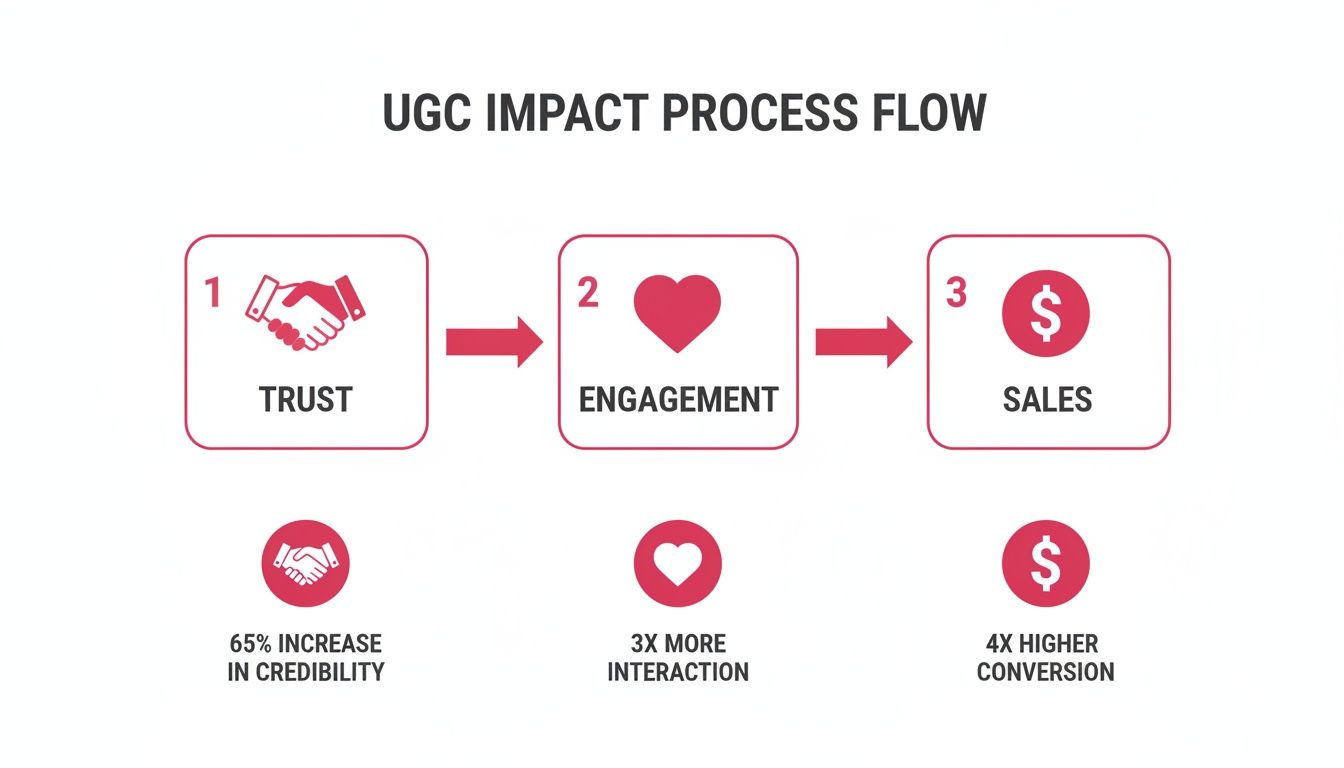
It’s a straightforward funnel: genuine content from real users establishes credibility. That credibility fuels audience interaction, which leads directly to purchasing decisions.
Crafting a Compelling Creative Brief
Your creative brief is easily the most important document in your entire campaign. It's not just a list of instructions; it's your key to empowering creators to produce content that feels authentic to them while being perfectly aligned with your brand. A weak, confusing brief leads to off-brand, unusable content, and that’s a waste of everyone's time.
A great brief gives clear direction without killing creativity. You want to clearly outline the non-negotiables while leaving plenty of room for the creator's unique personality and style to shine. Getting this balance right is the secret to getting content that feels genuine, not like a scripted ad.
Pro Tip: Think of your brief as guardrails, not a straitjacket. Give creators the destination (the campaign goal) and some key landmarks (messaging points), but let them choose the route. This is how you unlock that priceless authenticity.
At a minimum, your brief needs to include:
- Campaign Goal: Restate that primary objective you just defined. (e.g., "Create 5 authentic TikTok videos showing how easy it is to set up our new smart lamp.")
- Target Audience: Give a quick sketch of who this content needs to resonate with. (e.g., "Tech-savvy apartment dwellers aged 25-35 who care about aesthetics and convenience.")
- Key Messaging & Talking Points: Provide 2-3 core messages you need the creator to hit. Include specific features or benefits they absolutely have to mention.
- Content "Dos and Don'ts": This part is crucial. Be explicit. List things to include (e.g., "Show the product unboxing from start to finish") and things to avoid (e.g., "Please don't use filters that change the product's true color").
- Call to Action (CTA): Tell the creator exactly what you want the viewer to do next. Is it using a specific discount code? Clicking a link in their bio? Sharing their own experience in the comments? Be clear.
Budgeting for Maximum Impact
Finally, let's get real about the budget. Your investment level is going to directly impact the scale of your campaign and the types of creators you can afford to work with. A classic mistake is only thinking about the creator fees. A smart, realistic budget accounts for the entire campaign ecosystem.
Make sure you're considering these key line items:
- Product Seeding: This is the cost of actually getting your products into creators' hands. For many nano and micro-creators, the free product is the primary compensation.
- Creator Payments: For more established creators or for high-effort deliverables (like a polished YouTube deep-dive), you'll need to budget for paid collaborations.
- Platform Fees: Using a platform like JoinBrands is an operational cost, but it saves you a massive amount of time on discovery, management, payments, and content rights.
- Ad Spend: This one is huge. Don't forget to set aside a budget to put money behind your best-performing UGC. Amplifying top content through paid channels like Spark Ads or Instagram Reels ads is how you truly scale your results.
By planning for these elements upfront, you're not just hoping for success—you're building a comprehensive blueprint that turns your user generated content campaign from a simple idea into a measurable, high-impact driver for your business.
Finding and Partnering With Authentic Creators
Let's be honest: the success of your entire user-generated content campaign comes down to the creators you choose. It's the single most important decision you'll make. Finding people who genuinely vibe with your brand's mission and audience is part art, part science. It’s way too easy to get distracted by flashy follower counts, but the collaborations that truly move the needle come from creators whose authenticity just radiates through the screen.
This means you have to dig deeper than surface-level metrics. You're looking for a genuine fit, vetting potential partners on a mix of factors that signal a real connection. This careful selection process is what separates a campaign that feels forced and transactional from one that builds real excitement and, more importantly, drives real results.
Moving Beyond Follower Counts
Big follower numbers don't always mean big influence. I've seen creators with millions of followers who have an audience that's practically asleep, while a nano-influencer with just a few thousand can have a tight-knit community hanging on their every word.
So, instead of getting hung up on reach, make these criteria your North Star:
- Audience Demographics: Does their audience look like your ideal customer? You need to know their followers' age, location, and interests. A platform like JoinBrands can give you these analytics in seconds, saving you hours of guesswork.
- Content Quality and Style: Is their content visually appealing? Does it look and feel like your brand? If you sell minimalist home goods, a creator known for loud, chaotic content is probably not going to work, no matter how many followers they have.
- Engagement Rate: Don't just glance at likes. Read the comments. Are people just dropping emojis, or are they having real conversations? High-quality engagement is the ultimate sign of a connected community.
- Authentic Brand Affinity: Do a little digging. Have they ever talked about your brand or similar products before you even reached out? A creator who is already a fan will create content that's infinitely more believable than someone who's just collecting a paycheck.
For brands looking to create content at scale, understanding different operational models like the Print On Demand business model can also provide a framework for efficiently sourcing and using content from a wide range of creators.
Choosing the Right Creator Tier
The creator world isn't one-size-fits-all. Different types of creators are good for different things, and knowing who to partner with for a specific goal is crucial for getting the most out of your budget.
| Creator Tier | Follower Range | Best For |
|---|---|---|
| Nano-Influencers | 1k – 10k | Hyper-targeted niche engagement, high trust, and cost-effective content generation. |
| Micro-Influencers | 10k – 100k | Building strong community trust, driving conversions with a specific audience, and great ROI. |
| Macro-Influencers | 100k – 1M | Mass brand awareness campaigns, amplifying product launches, and driving significant reach. |
| Mega-Influencers | 1M+ | Celebrity-level endorsements for maximum visibility and broad-stroke brand association. |
For most DTC brands, the magic really happens with nano and micro-influencers. Their followers tend to be more loyal, and their recommendations feel more like advice from a trusted friend, which almost always leads to higher conversion rates. We've put together some more pro tips on our blog to help you figure out where to find UGC creators.
Streamlining Your Search and Outreach
Manually scrolling through social media trying to find the right creators is a massive time-drain. The UGC boom we're seeing in 2025 is happening for a reason. With 84% of consumers trusting UGC over branded content, the demand for authentic voices has exploded. Yet, 43% of marketers say they struggle to find creators manually. This is exactly why platforms like JoinBrands exist—to connect you with a pool of over 250,000 creators and use AI to find your perfect match, fast.
Once you’ve got a shortlist, your outreach has to cut through the noise. Generic, copy-and-paste DMs are a one-way ticket to being ignored.
A personalized outreach message that shows you’ve actually engaged with a creator's content is 10x more likely to get a positive response. Mention a specific post you enjoyed or how their personal story resonates with your brand’s mission.
Keep your first message short, personal, and to the point. Introduce your brand, tell them exactly why you think they are a great fit, and be clear about what you're offering (e.g., free product, a paid project). This kind of respectful, professional approach is the perfect way to kick off what could be a fantastic long-term partnership.
Nail Down Your Content Workflow and Legal Game Plan
Okay, so you’ve found your creators and they’re amped up to start making content. This is where the real work kicks in. The difference between a chaotic, time-sucking UGC campaign and a smooth, efficient one comes down to your operational workflow. This is how you’ll manage everything from the moment a product leaves your warehouse to the final, approved video landing in your content library.
Without a solid process, you're just asking for missed deadlines, off-brand content, and creators who feel completely lost. A streamlined workflow isn't about micromanaging; it's about giving everyone a clear road map. It makes the creator's job easier and pretty much guarantees you get the content you paid for.
Your operational rhythm should have a few key checkpoints:
- Product Shipment and Tracking: Get those tracking numbers to your creators the second you have them. It’s a small thing, but it builds immediate trust and cuts down on the endless "where's my package?" DMs.
- Keep the Conversation Going: Set up a central spot for communication. Whether it’s inside a platform like JoinBrands or a dedicated Slack channel, keep the check-ins regular but not annoying.
- Feedback That Actually Helps: Have a clear system for giving feedback. Be specific, be constructive, and always tie your comments back to the creative brief. This keeps things objective and actionable.
- The Final Handshake: Create a simple "final approval" step so the creator knows the job is officially done and they’ve delivered.

Don't Get Tripped Up by Content Rights and Licensing
This is the part where so many brands stumble, and it can be a costly mistake. You might get a jaw-droppingly good video from a creator, but if you don't have the legal right to use it everywhere you want, it’s basically useless. Let me be clear: paying a creator or sending them free product does not automatically give you unlimited usage rights.
Getting the licensing right is probably the single most important legal piece of your entire campaign. You need a rock-solid, written agreement that spells out exactly how, where, and for how long you can use the content. Skip this step, and you’re leaving your brand wide open to some serious legal and financial headaches later on.
A creator legally owns the copyright to their work unless they formally sign those rights over to you. Never assume usage rights are implied. A casual email confirmation won’t cut it and won't protect your brand.
A proper agreement protects everyone. It sets crystal-clear expectations and prevents any "he said, she said" drama down the road. This contract is the foundation that lets you confidently turn great UGC into ads, website content, and social posts without looking over your shoulder.
The Essential Legal Checklist for Creator Agreements
Your creator agreement has to be airtight. While getting a lawyer to look it over is always the smartest move, your contract absolutely must cover a few key areas to give you the marketing flexibility you need. We break this down even further in our guide to crafting a solid content creator contract template.
Before you get started, it’s crucial to have a checklist of the legal points your agreement must cover. This ensures you have full ownership and can use the content however you need to.
UGC Content Rights and Licensing Checklist
| Checklist Item | Why It's Important | Recommended Action |
|---|---|---|
| Clear Content Ownership | This defines who actually owns the final photos and videos. If it's not in writing, the creator keeps the full copyright. | Add a clause that transfers all ownership and intellectual property rights to your brand once the final payment is made. |
| Usage and Distribution Rights | This specifies exactly where you can use the content—think paid ads, social media, your website, email campaigns, etc. | You want to aim for perpetual, worldwide, royalty-free rights to use, copy, edit, and distribute the content across any and all media channels. |
| Exclusivity Period | This stops creators from turning around and making similar content for your direct competitors right after your campaign launches. | Define a reasonable exclusivity window. Something like 30-90 days after the campaign goes live is pretty standard. |
| Content Modification Clause | This gives you the right to edit the content—like cropping it for a different ad format or adding text overlays—to fit your needs. | Make sure the agreement explicitly states your brand can alter the content for marketing purposes without needing another round of approval. |
| Third-Party Rights | This ensures the creator has the legal right to use any music, stock photos, or even other people featured in their content. | Require creators to confirm they've secured all the necessary licenses and releases for any third-party elements they include. |
By sorting out these legal details upfront, you’re not just buying a piece of content. You’re securing a valuable brand asset that you can use to drive sales and growth for years to come.
Amplifying Your UGC for Maximum Reach and Impact
So, you’ve built up an incredible library of authentic, creator-made content. That's a huge win, but let’s be honest—that content doesn't do you any good just sitting in a folder. The final, and arguably most important, phase of your user generated content campaign is getting that content in front of as many eyes as possible.
This is where the magic really happens. By strategically distributing and amplifying your best assets, you turn a single piece of content into a multi-channel marketing engine that builds trust and drives sales long after the initial post.
From a Single Post to a Multi-Channel Powerhouse
It's time to think beyond the one-and-done social media post. Your top-tier UGC deserves to be everywhere your customers hang out online. The trick is to adapt the content to feel native to each platform, keeping it fresh and relevant no matter where it appears.
Think about a single 30-second vertical video from one of your creators. You can squeeze so much value out of it:
- Social Media Feeds: Post it as a TikTok, an Instagram Reel, and a YouTube Short. Right away, you're hitting audiences across the three biggest short-form video players.
- Static & Carousel Posts: Grab a few high-quality still frames from the video. Boom—you now have a compelling Instagram carousel or some eye-catching images for Facebook and Pinterest.
- Product Page Social Proof: Why not embed that video directly onto the product page? It acts as instant social proof, answers questions on the spot, and can seriously reduce hesitation before a customer clicks "buy."
- Email Marketing: Drop a GIF of the video's best moment into your next email campaign. Link it to the full video or the product page and watch your click-through rates climb.
This approach ensures you get the maximum ROI from every creator asset, creating a cohesive, trust-building experience across the board.
Turning Up the Volume With Paid Ads
Organic reach is fantastic for engaging your current followers, but paid amplification is how you scale your campaign and find thousands of new customers. One of the single most effective strategies for DTC brands right now is running your best-performing UGC as paid ads.
The numbers don't lie. When used in paid campaigns, UGC can pull in 4x higher click-through rates and slash cost-per-click by 50% compared to polished, studio-shot ads. It’s also 31% more memorable, which helps your brand stick. With 79% of shoppers saying UGC heavily influences their buying decisions, it’s clear this is no longer just a "nice to have." You can find even more stats on how UGC is shaping marketing in 2025 on creatorlabz.com.
Don't just post your UGC—promote it. The real ROI from your user generated content campaign is unlocked when you put ad spend behind your most authentic and engaging creator content.
Platforms like TikTok and Instagram have even built tools specifically for this purpose.
- TikTok Spark Ads: This is a game-changer. Spark Ads let you boost a creator's organic post directly from their own account. The ad runs natively with all the original likes, comments, and shares intact, making it feel incredibly authentic and driving much higher engagement.
- Instagram Whitelisted Ads: This works in a similar way, letting you run ads through a creator's handle. You tap into their engaged audience, and your ad shows up in the feed looking like just another piece of great content, neatly sidestepping the "ad blindness" so many of us have.
Using a platform like JoinBrands makes this whole process way simpler, letting you manage creator permissions and launch ads like these right from your dashboard. When you focus your ad budget on proven, high-engagement UGC, you create a powerful and efficient system for customer acquisition.
Measuring Performance and Optimizing for ROI
Getting your user generated content campaign out the door is just the first step. The real magic happens when you start connecting that content to actual business results.
It's time to look past vanity metrics like likes and views. We need to focus on the Key Performance Indicators (KPIs) that really show a return on your investment. This means digging into the data to see how your creators' content is actually influencing customer behavior. Are people clicking through to your site? And the million-dollar question: are they buying?
Attributing Sales to Specific UGC
The clearest way to prove your campaign's worth is to tie sales directly back to specific creators and their content. This isn't about guesswork; it's about having hard data to show your team exactly what's moving the needle. Without proper tracking, you're just flying blind.
Here are a couple of tried-and-true methods for direct attribution that we use all the time:
- Unique Promo Codes: This is the cleanest method. Give each creator a unique discount code, like "SARA15" or "DAVID10". Every time a code is used, that's a sale you can credit directly to that creator's influence.
- Trackable Links: Arm your creators with UTM-tagged URLs to share in their bios or stories. This lets you see in your own analytics exactly how much traffic and revenue each individual is driving.
This kind of tracking does more than just measure success. It gives you the ammunition to double down on what works and cut what doesn't.
Identifying Your Top-Performing Content
Once the data starts flowing in, the fun really begins. You can start spotting the winners. Don't just look at who drove the most sales; look at the engagement on the content itself. A video with an unusually high save rate? That's a huge signal that people find it valuable, and it's probably a fantastic candidate to put some ad spend behind.
Analyzing this performance data is how you get smarter with every campaign. It helps you answer critical questions:
- Which creator's content consistently gets the highest click-through rate (CTR) when we use it in ads?
- What video formats—unboxing, tutorials, testimonials—are leading to the best conversion rates on our product pages?
- Are there specific phrases or visual styles that just seem to hit different with our audience, no matter who the creator is?
The goal here is to create a feedback loop. Use the data to reinvest in your top creators, ask for more of the content styles that convert, and put your ad budget behind your proven assets.
This data-driven approach turns your user generated content campaign from a creative experiment into a predictable growth channel. And the ROI can be mind-blowing. One campaign we saw generated over 3,000 pieces of content, which led to a 250% jump in social engagement and a staggering 600% ROI.
While we're focused on digital content, it's always smart to have a broad perspective on marketing. Understanding how other brand-building efforts work, like using well-chosen promotional products that build brand loyalty and deliver real ROI, can provide valuable context for your overall strategy.
Common Questions About UGC Campaigns
Diving into your first user-generated content campaign? It's natural to have a few questions swirling around. Let's walk through some of the big ones so you can get started with total confidence.
How Much Is This Going to Cost?
One of the first things marketers ask is about the budget. How much does a UGC campaign actually cost? Honestly, it really depends on what you're trying to achieve.
You can actually kick off a campaign with a shoestring budget. A great starting point is product seeding with nano-creators, where you send out free products, and that's the main compensation. Of course, if you're aiming for a bigger splash with paid collaborations, your investment will scale up from there.
How Do I Make Sure the Content is Actually Good?
Another big worry is content quality. What happens if the photos and videos you get back are just… not usable? This is where your creative brief becomes your absolute best friend.
A detailed, well-thought-out brief is your secret weapon for quality control. It should clearly outline the "dos and don'ts," guiding creators to produce stuff that feels authentic but still hits all your brand's high notes.
The real trick is to give creators clear guardrails, not a restrictive script. Hand them your brand's vision, key messages, and visual vibe, and then step back and let their creativity shine. This is how you get content that connects instead of feeling like a forced ad.
What's the Deal with Usage Rights?
Finally, let's clear up the confusion around usage rights, because this is where things can get tricky. A lot of people mistakenly think that if you pay for content, you automatically own it and can use it however you want. That's not true.
You absolutely must have a signed agreement that formally transfers content ownership over to your brand. This contract needs to spell out that you have perpetual, worldwide rights to use, edit, and repurpose the content across any and all of your marketing channels. Getting this sorted out from day one will save you from massive legal headaches down the road.
Ready to launch a user generated content campaign without the guesswork? JoinBrands connects you with over 250,000 creators and streamlines the entire process—from finding the perfect match to managing content rights—all on one simple platform. Start your campaign today.