


 UGC Portfolio Examples: What Brands Actually Want to See
Think of User-Generated Content (UGC) marketing as word-of-mouth for the digital age. It’s all the authentic stuff – photos, videos, reviews – created by real people, not by the brand itself.
Essentially, it's the online version of getting a recommendation from a friend you trust. That personal touch is why a whopping 93% of consumers say UGC helps them decide what to buy. This isn't some fleeting trend; the market is set to explode to $32.6 billion by 2030, a massive leap from just a few years ago. Discover more insights about these UGC trends.
Table of Contents
Breaking Down UGC Marketing

Let's make this simple. Imagine you're trying to pick a new coffee shop. One has a slick billboard with a perfectly lit, flawless latte. The other has hundreds of tagged Instagram posts from actual customers – some showing messy but delicious-looking drinks, others capturing the cozy vibe of their favorite corner table.
Which one feels more real? You'd probably head to the one people are genuinely buzzing about. That's the magic of UGC. It slices right through the skepticism we all have for polished ads because it comes from a real experience, not a marketing script.
The Power of Raw Authenticity
Let's face it, today's shoppers are savvy. They can sniff out a sales pitch from a mile away and are frankly tired of picture-perfect ads that don't reflect real life. UGC flips the script by showing a brand through the eyes of the people who actually use it. The content is naturally relatable, raw, and unfiltered.
This approach builds instant trust. When potential buyers see people who look and sound just like them using and loving a product, it acts as powerful social proof. It’s a clear signal that says, "Hey, this isn't just a company telling you its product is good; this is a whole community of real people who agree."
UGC is the ultimate form of social proof. It's not about crafting the perfect message; it's about showcasing real, unscripted moments of brand love that resonate far more deeply than any traditional ad ever could.
To really drive the point home, let's look at how UGC stacks up against old-school advertising.
UGC Marketing vs Traditional Advertising at a Glance
This table breaks down the core differences, showing why so many brands are shifting their focus from talking at customers to letting customers talk for them.
| Attribute | UGC Marketing | Traditional Advertising |
|---|---|---|
| Creator | Real customers, fans, and creators | Professional marketers and ad agencies |
| Trust Level | High (seen as an authentic opinion) | Low (seen as a biased sales pitch) |
| Tone | Relatable, genuine, and often unpolished | Scripted, polished, and sales-focused |
| Cost | Often low-cost or even free to acquire | High production and media buying costs |
| Goal | Build an authentic community and deep trust | Drive direct sales and broad awareness |
This fundamental shift from a brand-centric monologue to a customer-led conversation is precisely why UGC is no longer optional. It's about empowering your happiest customers to become your most convincing marketers.
Why Authentic Content Is a Business Superpower

So, you know what User-Generated Content is. But the real question is, why does it work so incredibly well? It all comes down to a simple, powerful human truth: we trust other people way more than we trust advertisements.
That single principle is what turns everyday customer content into a strategic business asset that gets real, measurable results.
Think about it. When a potential buyer sees a real person – not some polished model in a studio – actually using and loving your product, it flips a switch in their brain. Psychologists call this social proof. It’s the same reason you’d pick a restaurant with a line out the door over an empty one next door. You just assume it must be good.
UGC creates that exact same feeling of validation online, cutting through the natural skepticism we all have toward traditional ads. While a slick, professional ad can feel distant and staged, a simple video from a happy customer feels like a recommendation from a friend. And that connection is where the magic happens.
Skyrocketing Trust and Credibility
In a world where we’re constantly bombarded with ads, authenticity has become the most valuable currency a brand can have. People are just plain tired of seeing flawless images and hearing scripted promises. They want something real.
By featuring content from your actual customers, you're doing more than just selling a product; you’re showing that it has a real place in people's lives. This kind of transparency builds a deep, lasting trust that a glossy marketing campaign can rarely achieve on its own. It proves you're so confident in your product that you're willing to let your customers do the talking.
By featuring real customer stories, you shift the narrative from "buy our product because we say it's great" to "buy our product because people like you already love it." This simple change in perspective is what builds an unshakeable foundation of brand loyalty.
This trust isn't just a warm, fuzzy feeling. It directly impacts your bottom line at every stage of the customer journey. You can dig deeper into the role of authenticity in modern marketing to see just how these genuine connections fuel sustainable growth.
Driving Conversions and Engagement
That hard-earned trust is what fuels action. When people see authentic content, they don't just believe your brand's claims more – they're far more likely to actually buy. The stats on UGC's impact are pretty staggering and show how it systematically boosts key performance metrics.
Across the board, UGC turns trust into sales. A massive 62% of consumers say they are more likely to buy something after seeing photos and videos from real customers. The results speak for themselves: UGC can outperform professional content by 8.7x in engagement, and social campaigns that mix in UGC see 28% better engagement.
But it gets even better. Brands see click-through rates jump 4x and can slash ad costs by 50%. On your website, adding UGC can lead to a 20% increase in return visitors and 90% more time spent on site, ultimately driving a 29% lift in conversions.
These numbers show just how much UGC impacts the bottom line:
- Higher Ad Performance: Ads with UGC feel more like native social posts and less like, well, ads. This leads to higher click-through rates (CTR) and lower costs.
- Increased Website Conversion: Displaying customer photos and reviews right on your product pages gives hesitant buyers that final nudge of social proof they need to click "buy now."
- Enhanced Community Engagement: When you share your customers' content, they feel seen and appreciated. This encourages more interaction and helps build a loyal community around your brand.
authentic content isn't just another marketing tactic. It's a business superpower that builds a reliable, high-return engine for growth.
Exploring the Different Forms of UGC
User-generated content isn't a one-size-fits-all kind of thing. It's more like a versatile toolkit, with each format designed to do a specific job for your brand. Once you understand the different types, you can move beyond just collecting customer posts and start using them strategically to build trust, create hype, and actually drive sales.
Think of it like building a house. You wouldn’t use drywall for the foundation or concrete for the windows, right? In the same way, the UGC you use to build initial trust (like a simple text review) is totally different from what you'd use to create viral buzz (like a trending TikTok).
Each format has its own superpower. Match the right content to your campaign goal, and you'll see a world of difference in your results.
Text-Based UGC: The Foundation of Trust
Before anyone even thinks about watching a video of your product, they’re looking for one thing: a good rating. Text-based UGC, like reviews and testimonials, is the absolute bedrock of social proof. It's the first hurdle to clear with any skeptical buyer.
- Customer Reviews: These are the most common and, honestly, the most crucial form of UGC. A steady flow of positive reviews on your product pages, Google, or Amazon directly boosts conversion rates because it signals that you're trustworthy.
- Testimonials and Case Studies: Think of these as supercharged reviews. They tell a deeper story about a customer's journey and their success with your product, which is perfect for higher-priced items where people need more detailed proof.
- Community Forum Posts: Unfiltered, honest-to-goodness feedback happens on places like Reddit or in private brand communities. Keeping an eye on these conversations gives you priceless insights and helps you build a real community around your brand.
This kind of content isn't flashy, but it's all about substance. It works quietly in the background, reassuring new visitors that they’re making a smart decision.
Visual UGC: Capturing Attention and Desire
Once you've built that foundation of trust, it’s time for visual UGC to step in and create an emotional connection. This is where your product comes to life through your customers' eyes, showing it in real-world situations a professional photoshoot could never truly capture.
Aesthetic photos and short videos are incredibly powerful on social media, where people scroll fast and visuals are everything. Seeing a product in a relatable setting helps potential customers immediately picture it in their own lives.
When a potential buyer sees someone just like them unboxing a product with genuine excitement, it creates a powerful sense of "I want that, too." This authentic enthusiasm is something branded content struggles to replicate.
Here are some of the most impactful visual formats out there:
- Aesthetic Photos: We're talking high-quality images of your product in a real-life setting. Think of a skincare product on an actual bathroom counter or a piece of outdoor gear on a muddy hiking trail. It just feels real.
- Unboxing Videos: This format is pure gold. It captures the raw excitement of someone opening your product for the first time, showing off your packaging and the entire customer experience from start to finish.
- How-To and Tutorial Videos: This content is double-dipping in value – it showcases the product and educates the viewer. A customer demonstrating how they use your espresso machine or style your jacket provides practical, believable proof.
Want to see how real brands are crushing it with these formats? You can check out a ton of awesome UGC content examples to get some inspiration.
Dynamic Video UGC: Driving Trends and Virality
Finally, we get to the most fast-paced and trend-driven form of UGC: short-form vertical videos. This is content made for platforms like TikTok, Instagram Reels, and YouTube Shorts. It’s less about a specific product feature and more about tapping into a cultural moment.
These videos are known for their raw, unpolished, and often funny style. They are ridiculously effective for reaching brand-new audiences and generating massive awareness in a very short amount of time. A single video that nails a popular sound or challenge can introduce your brand to millions of people overnight.
The goal here is not a polished ad. It’s to create something that feels like it belongs on the platform, something that makes other people want to join in. Whether it's a "day in the life" B-roll, a relatable skit, or a viral challenge, this format is all about authenticity and creativity.
Choosing the right format can feel overwhelming, so here’s a quick guide to help you match the perfect UGC type to your marketing goals.
Which UGC Format Is Right for Your Goal
| UGC Format | Primary Marketing Goal | Best Platforms |
|---|---|---|
| Reviews & Testimonials | Building trust & credibility | Your website, Google, Amazon |
| Aesthetic Photos | Increasing desire & showcasing lifestyle | Instagram, Pinterest, Facebook |
| Unboxing Videos | Generating excitement & showing the experience | YouTube, Instagram Reels, TikTok |
| How-To & Tutorials | Educating customers & proving value | YouTube, TikTok, Instagram |
| Reels, TikToks, Shorts | Driving mass awareness & going viral | TikTok, Instagram Reels, YouTube Shorts |
a strong UGC strategy uses a mix of these formats. Start with the foundational pieces like reviews, then layer in engaging visuals and trend-driven videos to create a powerful, well-rounded presence.
How to Launch Your First UGC Campaign
Alright, you get what UGC is and you’ve seen the different flavors it comes in. Now for the fun part: making it happen.
Transitioning from knowing what UGC is to actually getting it requires a solid, repeatable game plan. Launching your first campaign can feel like a huge task, but if you break it down into a logical flow, you take all the guesswork out of it. A winning UGC strategy isn't about getting lucky; it's about executing a smart plan.
This five-stage roadmap will give you the structure to go from a simple idea to a full library of authentic, high-impact content. Follow these steps, and you’ll be able to confidently run a UGC campaign from start to finish – from setting those initial goals to putting your best content to work.
Stage 1: Define Your Campaign Goals and Creator Brief
Before you even think about finding creators, you need to be crystal clear on what a "win" looks like for this campaign. Your goals will shape every other decision you make.
Are you trying to build trust for a new product launch? Do you need a constant stream of assets for your paid ads? Or are you looking to drive traffic to a specific landing page? Get specific. “More sales” isn’t a goal; “Generate 20 video assets for TikTok ads to lower CPA by 15%” is.
Once your objective is locked in, translate it into a compelling creator brief. Think of this document as your campaign's north star. It needs to clearly spell out:
- The Big Idea: A simple, one-sentence summary of what the campaign is all about.
- Content Requirements: The exact types and number of assets you need (e.g., three 15-second videos, five high-res photos).
- Key Talking Points: The must-mention messages or product features creators need to include.
- "Do's and Don'ts": Clear guardrails on tone, style, and things to steer clear of.
A detailed brief is your best defense against misunderstandings. It ensures you get content that actually aligns with your marketing goals right from the get-go.
Stage 2: Find and Vet the Right Creators
With your brief in hand, it’s time to find the people who will bring your campaign to life. The mission here isn't to find creators with the biggest follower counts. It's to find people who genuinely connect with your brand’s vibe and your target audience. Authenticity is everything.
A great place to start is your own backyard – your existing customer base. Who’s already tagging your brand or making awesome content just because they love your products? You can also explore creator marketplaces or platforms designed to connect brands with vetted talent. For a deeper dive, our guide on where to find UGC creators offers a ton of actionable strategies for discovering the perfect partners.
When you're thinking about content for different platforms, it pays to know the little details, like Instagram Stories length limitations, so you can make your requests super specific.
Once you have a shortlist, do your homework. Dig into each creator's portfolio. You're looking for content quality, solid engagement rates, and a style that just feels like a natural extension of your brand.
Stage 3: Establish a Seamless Content Approval Workflow
A messy approval process is a recipe for chaos. To keep your campaign running smoothly, you absolutely need a streamlined system for reviewing submissions, giving feedback, and approving the final cuts. This is all about ensuring consistency and quality control across every single asset.
Your workflow should be simple enough for anyone on your team to understand but robust enough to handle multiple creators and content pieces simultaneously. The goal is efficiency and clarity, not complexity.
A typical workflow might look something like this:
- Submission: Creators upload their draft content to one central spot (like a shared drive or a dedicated platform). No more hunting through email threads.
- Review: Your team checks the content against the creative brief, making sure all the boxes are ticked.
- Feedback: Give clear, consolidated feedback for any revisions. Be specific and constructive to make the changes easy.
- Approval: Once the content is spot-on, give it the final green light.
This structured approach cuts down on the endless back-and-forth, respects creators' time, and gets your content ready to use way faster.
Stage 4: Navigate Content Usage Rights
This step is absolutely critical. Seriously, don't skip it. Before you use a single piece of user-generated content, you must have explicit permission and clearly defined rights. Thinking you can just use any photo or video you're tagged in is a rookie mistake that can land you in serious legal trouble.
For organic UGC you find out in the wild, reach out directly via DM or email and ask for permission. For content you commission through platforms or direct partnerships, usage rights should be laid out in a formal agreement. This contract needs to specify:
- Duration: How long can you use the content? One year? Forever?
- Channels: Where are you allowed to use it? Organic social, paid ads, your website, emails?
- Exclusivity: Can the creator work with your competitors for a certain period?
Securing clear usage rights isn't just about protecting your brand – it’s about building a professional, respectful relationship with the creative community.
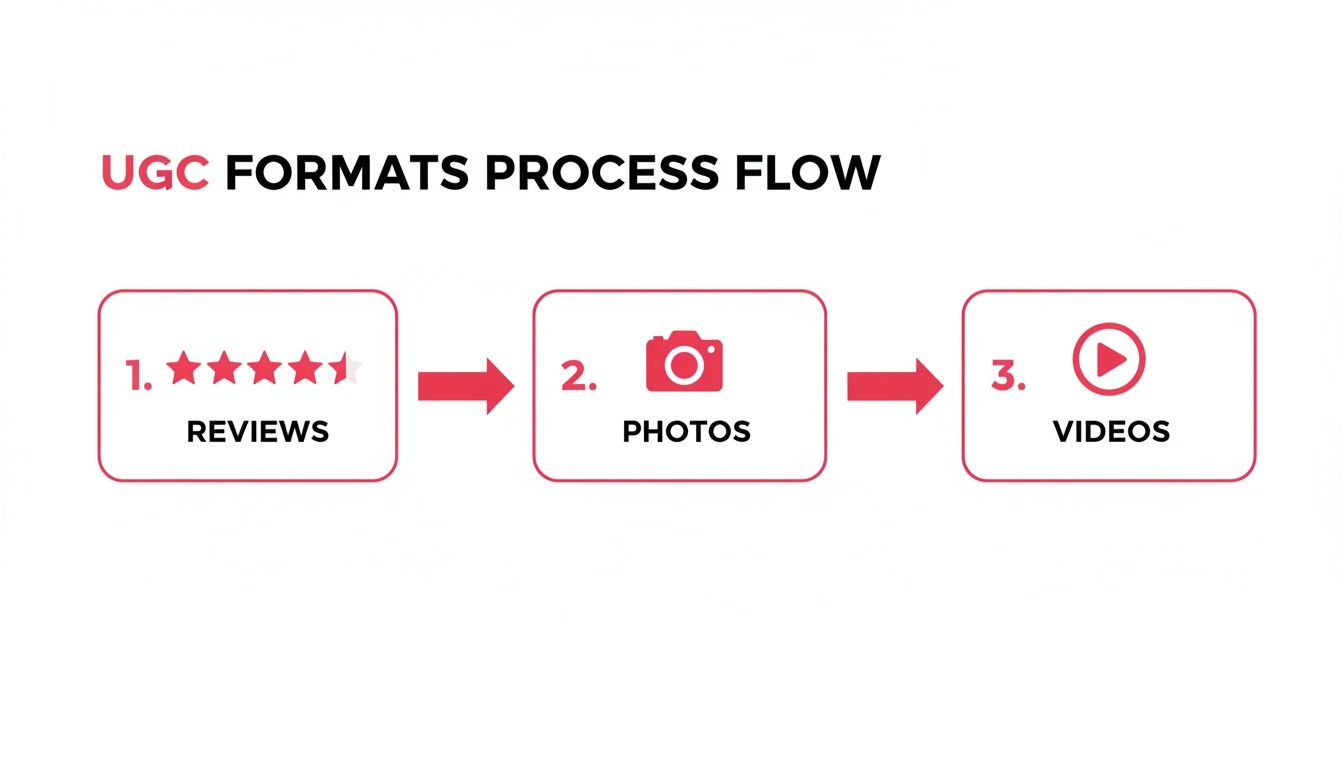
This diagram shows how different UGC formats can build on each other within a campaign, often starting with simple text reviews and evolving into more dynamic photos and videos.
Measuring What Matters in Your UGC Strategy
Launching a UGC campaign without a way to measure it is like driving with your eyes closed. You might be moving, but you have no idea where you're headed. If you want to prove your efforts are working and lock in that budget for next quarter, you need to track the right metrics – the ones tied directly to business growth, not just vanity numbers.
A smart UGC strategy is built on data. This means looking past simple "likes" and focusing on the Key Performance Indicators (KPIs) that actually tell the story of your return on investment. Let's break down the essential metrics into the three categories that matter most to your business.
Key Engagement Metrics
Engagement is your first sign that the content is actually hitting the mark. It shows people aren't just scrolling past your brand; they're stopping to interact with it.
Think about it: consumers spend an average of 5.4 hours every day with UGC. That deep connection is exactly why 93% of marketers agree that content from real customers beats polished brand ads any day of the week. Tracking these interactions is non-negotiable.
Here are the engagement KPIs you should be watching:
- Shares and Saves: These are huge. When someone shares or saves content, they're giving it their stamp of approval, either for themselves later or for their entire network to see. It’s a powerful endorsement.
- Comments: This is where you get the real flavor of audience sentiment. Are the comments glowing? Are people asking how to buy the product? This is your qualitative goldmine.
- Engagement Rate: Calculate this by taking (Likes + Comments + Shares) and dividing it by your follower count. It gives you a clear picture of how compelling your content is relative to your audience size.
Conversion and Revenue KPIs
marketing has to drive sales. This is where you connect the dots between your UGC activities and the bottom line, proving the real-world value of your campaigns. It’s no surprise that 86% of brands report that using UGC in their paid media boosts performance.
Keep a close eye on these bottom-line metrics:
- Click-Through Rate (CTR): This tells you how many people saw a UGC post or ad and were interested enough to click the link to your site or product page. A high CTR means your content did its job and sparked curiosity.
- Conversion Rate: This is the big one. It's the percentage of people who actually completed a desired action, like making a purchase, after seeing a piece of UGC.
- Cost-Per-Acquisition (CPA): When you're putting ad spend behind UGC, a lower CPA is a beautiful thing. It means you're getting new customers more efficiently. A/B testing UGC against your typical branded creative can often reveal some serious cost savings.
Measuring conversions isn't just about counting sales. It’s about understanding which pieces of authentic content are powerful enough to turn a passive scroller into an active customer.
Brand Reach and Awareness Metrics
While they might feel less direct than a sale, brand reach and awareness metrics show how UGC is growing your brand's footprint and shaping how people see you. These KPIs measure how far your message is traveling and how it's being received out in the wild.
- Brand Mentions: Keep track of how often your brand is being talked about online. A jump in untagged mentions is a fantastic sign that the organic conversation around your brand is growing.
- Sentiment Analysis: Use social listening tools to get a read on the tone of those conversations. Are people talking positively, negatively, or just neutrally about your brand?
- Share of Voice: This metric stacks up your brand's mentions against your direct competitors. To truly understand the impact of your campaigns, you need to know how UGC is contributing to your overall visibility and your slice of the market conversation. For a great breakdown on this, check out a modern guide to Share of Voice calculation.
Got Questions About UGC Marketing? We’ve Got Answers.
As you start digging into what UGC can do for your brand, it’s totally normal for questions to pop up. This whole approach feels different from traditional advertising, and that can lead to some confusion about everything from legal rights to dealing with a bad review.
Let's clear the air. We’ve pulled together the most common questions brands ask when they're just getting started with UGC. Each answer is designed to give you a straight, practical takeaway so you can move forward with confidence and build your strategy on solid ground.
What Is the Difference Between UGC and Influencer Marketing?
This is a big one. While both use creators to make content, they’re really playing different games with different goals. Think of it like a celebrity endorsement versus a recommendation from a trusted friend.
Influencer marketing usually means paying creators with big, established followings to produce polished, promotional content. The main value is tapping into that influencer's massive reach and getting their stamp of approval in front of their audience. The relationship is often transactional and built around a specific campaign.
UGC marketing, on the other hand, is all about the raw, relatable feel of the content itself – the creator's follower count doesn't really matter. This content often comes from everyday customers or micro-creators who have a real, unscripted connection to your product.
The real difference is what you're banking on: influencer marketing is about the creator's audience, while UGC marketing is about the content's authenticity. The whole point of UGC is to capture real experiences that feel genuine to other shoppers.
This means you can work with hundreds of UGC creators to build a massive library of authentic assets, while an influencer campaign might only involve a handful of high-profile people.
How Do I Legally Use My Customers' Content?
This is probably the most critical question, and the answer is simple: you absolutely must get explicit permission. Just because someone tagged your brand in a post doesn’t mean you have a free pass to use their content in your ads or on your website. Grabbing content without asking can seriously damage your reputation and land you in legal hot water.
The best way to handle this is with a transparent and respectful rights management process. Here are a few solid ways to do it:
- Just Ask Directly: The simplest method is often the best. Send a direct message or an email to the creator. Be polite, be clear, and tell them exactly how you want to use their content (e.g., "We love this photo! Would you mind if we featured it on our Instagram feed and in our next email newsletter?").
- Run a Branded Hashtag Campaign: You can encourage submissions with a specific campaign hashtag. But to do this right, you have to include clear terms and conditions in your social media bio or on a landing page, stating that using the hashtag grants you permission to share the content.
- Use a Platform: If you're looking to scale up, UGC platforms like JoinBrands have built-in tools that automate these permission requests. It makes managing rights from dozens or even hundreds of creators much easier.
Always be upfront about what you're doing. A little transparency builds a lot of goodwill with your community.
How Should I Handle Negative UGC About My Product?
First off, take a deep breath. A negative review isn't a disaster – it's actually an opportunity. Seeing a less-than-perfect review and how you respond can build more trust than a feed full of nothing but five-star praise. It proves you're a real business that's actually listening.
Unless the content is spammy, offensive, or violates community guidelines, do not delete it. Wiping away honest criticism makes it look like you have something to hide and can instantly kill the trust you’ve worked so hard to build.
Instead, use this simple framework:
- Respond Publicly and Professionally: Acknowledge their experience and offer a real apology. A simple, "We're so sorry to hear you had this issue," shows you're paying attention.
- Take the Conversation Private: Offer to fix the problem offline. Say something like, "Please send us a DM with your order number so our team can make this right for you."
- Learn from the Feedback: Treat this as valuable insight. Use it to identify and fix the root problem, whether it's with your product, your shipping, or your customer service.
This approach turns a potential negative into a public showcase of great customer service, which can be just as powerful as a glowing review.
How Can a New Brand Get UGC Without Many Customers?
Ah, the classic chicken-or-the-egg problem. Luckily, it’s easier to solve than you might think. You don't have to just sit around and wait for content to magically appear. New brands can be proactive and generate that first wave of UGC with a few smart moves.
One of the best ways to get started is to gift your product to a handpicked list of micro-creators who are a perfect fit for your target audience. These creators have smaller, super-engaged followings and are often excited to partner with cool new brands.
You can also kickstart content creation by:
- Running a Giveaway: Host a contest where one of the entry requirements is creating a post about a theme related to your brand or product.
- Working with UGC Platforms: This is a shortcut. You can partner with a platform to brief experienced creators who will produce high-quality, authentic-looking content on demand. This lets you build a whole library of assets before you even have a large customer base.
By "seeding" content like this, you create that all-important social proof that encourages your first real customers to start sharing their own experiences as they come on board.
Ready to build a powerful library of authentic content without the hassle? JoinBrands connects you with over 250,000 vetted creators to produce high-impact UGC at scale. Streamline your entire workflow and start your first campaign today.