



 Best Brand Ambassador Programs: Top Picks to Grow Reach
White label marketing is one of those powerhouse strategies you hear about but might not fully grasp. At its core, it's pretty simple: one company makes a fantastic product or service, and another company swoops in, puts its own brand on it, and sells it as theirs. It's like buying a ready-made solution, sticking your logo on the box, and instantly expanding what you can offer your customers.
Table of Contents
What Is White Label Marketing Explained
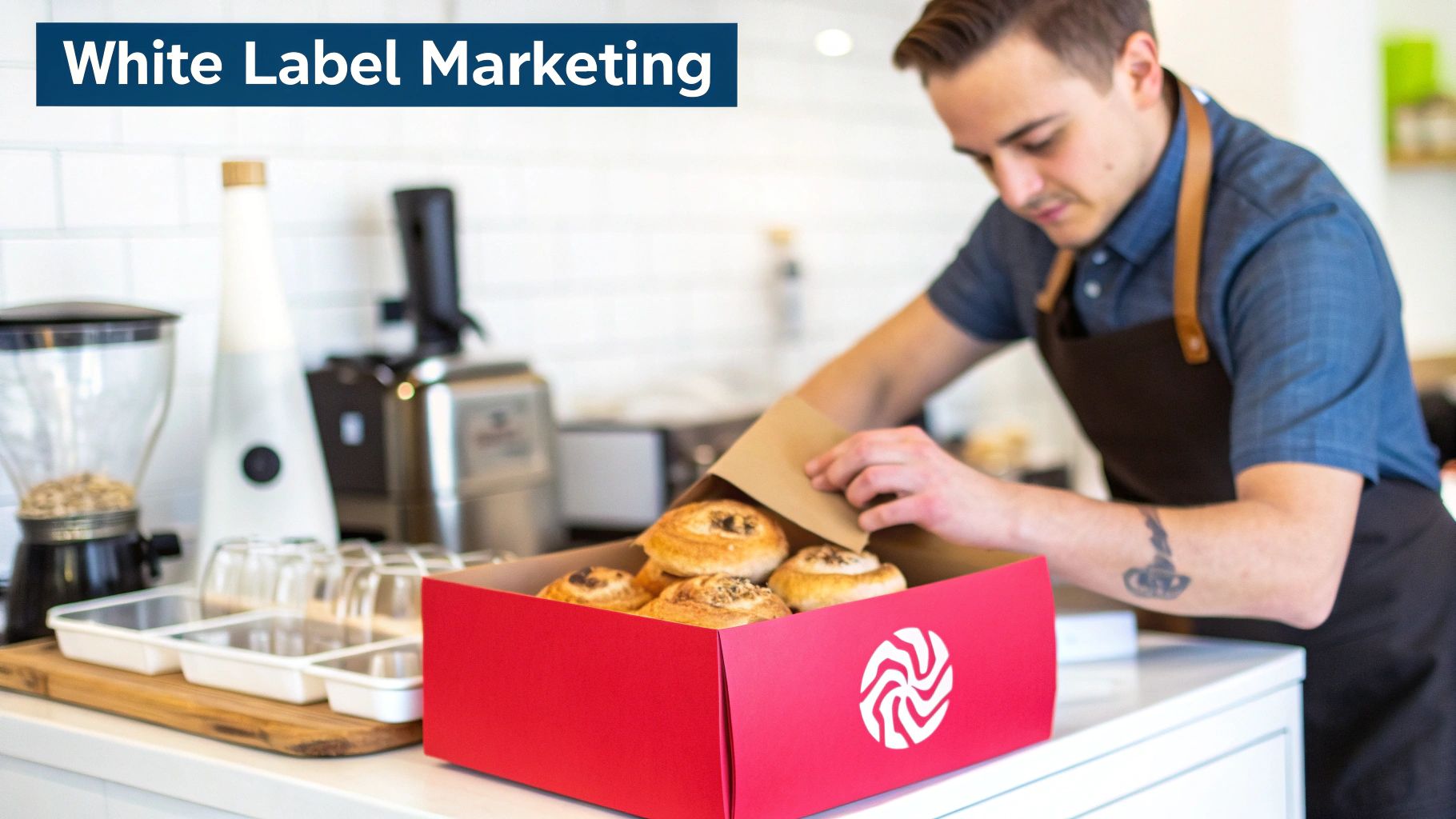
Think of it like this: a local coffee shop is famous for its incredible espresso, but their pastry game is non-existent. Instead of dropping a ton of cash on a full kitchen, fancy ovens, and a pastry chef, they team up with a top-notch local bakery. The bakery delivers amazing cakes and cookies every morning, and the coffee shop sells them from its own display case, under its own brand name.
That’s white label marketing in a nutshell.
It's a smart partnership where a producer creates a high-quality, unbranded "thing"—be it a product or a service—and a reseller slaps their branding on it. This lets e-commerce brands and marketing agencies add to their service list almost overnight, skipping all the heavy lifting of R&D, manufacturing, or development.
The Core Partnership Dynamic
This entire model is built on a straightforward idea: one company is a pro at production, while the other is a pro at marketing and sales. The producer (our bakery) gets to focus on what they do best—making an awesome product. Meanwhile, the reseller (our coffee shop) leans into their strengths—building customer relationships, creating a strong brand, and handling distribution.
This isn't just a shortcut; it's a smart strategy for scaling efficiently. It’s a proven way to accelerate growth, build up brand authority, and open up entirely new streams of revenue.
The white label market has been booming for a reason, proving its value across dozens of industries. It's a big part of why agencies offering white label services reported an average revenue jump of 24% within their first year. It just works.
To help break it down, here’s a quick overview of the key pieces involved.
White Label Marketing at a Glance
This table sums up the essential components, making it clear who does what and why this model is so effective.
| Component | Description |
|---|---|
| The Producer | The company that creates the original, unbranded product or service. They handle all the R&D, manufacturing, or development. |
| The Reseller | The company that buys the product/service, adds its own branding, and sells it directly to its customer base. |
| The Product/Service | A ready-to-sell, high-quality offering that can be anything from physical goods to digital marketing services or software. |
| The Branding | The reseller’s logo, packaging, marketing materials, and overall brand identity applied to the white label product. |
By letting each partner focus on their strengths, the entire process becomes incredibly efficient for everyone involved.
Why This Model Works So Well
The real magic of white label marketing is its efficiency. You get to skip the massive upfront investment and slash the time it takes to get a new product or service to market. A perfect example of this is white label software, which lets businesses offer complex digital services without writing a single line of code.
This approach gives companies a serious edge, allowing them to:
- Expand Service Offerings: Instantly add new services like SEO, content creation, or social media management without the headache of hiring and training new teams.
- Strengthen Brand Authority: Position your company as the complete, one-stop solution your clients have been looking for.
- Increase Revenue: Bolt on new, high-margin revenue streams with almost no extra operational work.
- Focus on Core Competencies: Concentrate on what you're best at—serving clients and growing your business—while a trusted partner handles the product side of things.
Once you get this fundamental concept, it’s easier to see how it stands apart from other partnership models. To dig deeper into the nuances, check out our guide on what is branded content. This foundation is key to figuring out how to build a white label strategy that truly works for you.
How a White Label Partnership Actually Works
So, how does this whole white-label thing work in the real world? It's way less complicated than you might think. Forget convoluted business models; this is a refreshingly straightforward workflow built for speed and efficiency, where everyone gets to play to their strengths.
It all starts with the producer. This is the company that builds a top-notch, unbranded product or service. Think of it as a "blank canvas"—it could be a slick piece of SEO software or a new line of organic skincare. The product is fully baked and ready to go, just without a brand name attached.
This is where the reseller comes in. Usually, this is a digital agency or a direct-to-consumer (DTC) brand that sees an opportunity. They buy the rights to this unbranded product, and this is where the transformation begins.
The Transformation Process
The reseller takes that generic product and makes it their own. We're talking more than just slapping a logo on it; they're fully weaving it into their brand's identity.
This stage involves a few key steps:
- Applying Branding: The reseller adds their company logo, color palette, and any unique packaging or user interface designs.
- Setting Market Positioning: They decide on the price, who they're selling it to, and what makes this newly branded product special.
- Integrating into Offerings: The product gets slotted perfectly into their existing lineup of services or products.
Finally, the reseller launches their shiny, new-to-them offering to their customer base. To the outside world, this product looks like it was developed in-house from day one. The original producer? They stay completely behind the scenes, working silently in the background. The entire process is built on getting things done quickly, and the right tools make it even smoother. If you want to nail down a structured system for creative assets, check out guides on building a content approval workflow.
The Core Idea: A white label partnership is a win-win. The producer handles all the heavy lifting of R&D and manufacturing, letting the reseller zero in on what they do best: building a brand, marketing, and taking care of customers.
A Real World Scenario
Let's imagine a digital marketing agency called "Growth Spark." They're absolute wizards at running killer ad campaigns for their e-commerce clients, but they don't have their own social media scheduling tool. Instead of burning a year and a ton of cash building one from scratch, they go the white-label route.
Here’s how that plays out:
- Purchase: Growth Spark licenses a powerful, unbranded social media tool from a SaaS developer.
- Rebrand: They customize it with their own logo, brand colors, and a unique domain, renaming it "SparkPost." Instantly, it looks and feels like it belongs to them.
- Launch: They start offering SparkPost to clients as a value-add in their premium social media packages. Clients love it, and it makes Growth Spark's services even stickier.
Meanwhile, the original developer quietly handles all the software updates and maintenance. Growth Spark gets to offer a fantastic service without any of the tech headaches. This kind of arrangement is super common across digital platforms and partnerships. To really get the mechanics, it helps to understand how a TikTok Shop Partner operates and see how platforms like that enable these third-party relationships.
This simple example shows just how powerful white labeling can be. It lets a business expand its offerings almost overnight, deliver more value to clients, and build a stronger brand—all without the massive risk and investment of starting from zero.
When you’re trying to figure out the best way to sell products, the jargon can get confusing fast. Terms like white label, private label, and reseller get tossed around a lot, sometimes even interchangeably. But they’re not the same thing—not by a long shot. Each one is a distinct business model with its own rules, benefits, and degree of control.
Picking the right one is crucial. It’s the difference between a strategy that fuels your growth and one that holds you back.
Let's break it down with a simple analogy. Imagine you’re selling t-shirts.
A white label approach is like buying a stack of high-quality, blank t-shirts from a manufacturer. They're generic, but they're good. You and a dozen other brands can buy these exact same shirts, slap your own logos on them, and sell them as part of your collection. The core product is identical for everyone.
Private label, on the other hand, is like Target hiring a factory to produce an exclusive clothing line just for them. The designs, the fabric, the fit—it’s all specified by Target. You won’t find that exact product with anyone else’s tag on it. It’s their unique creation.
And a reseller? That’s just a local boutique that buys Levi's jeans wholesale and sells them in their shop. They aren't changing the jeans, rebranding them, or pretending they made them. They're simply an authorized seller for an existing, big-name brand.
Key Differences At A Glance
It really all boils down to three things: exclusivity, customization, and control. White label gets you to market fast with a ready-made product, but it isn't exclusive. Private label gives you total exclusivity and deep customization, but it costs more time and money. Reselling is the easiest entry point, but you have almost no control over the brand or the price.
This diagram lays out the clean, straightforward path a white label product takes from the producer to your customer.
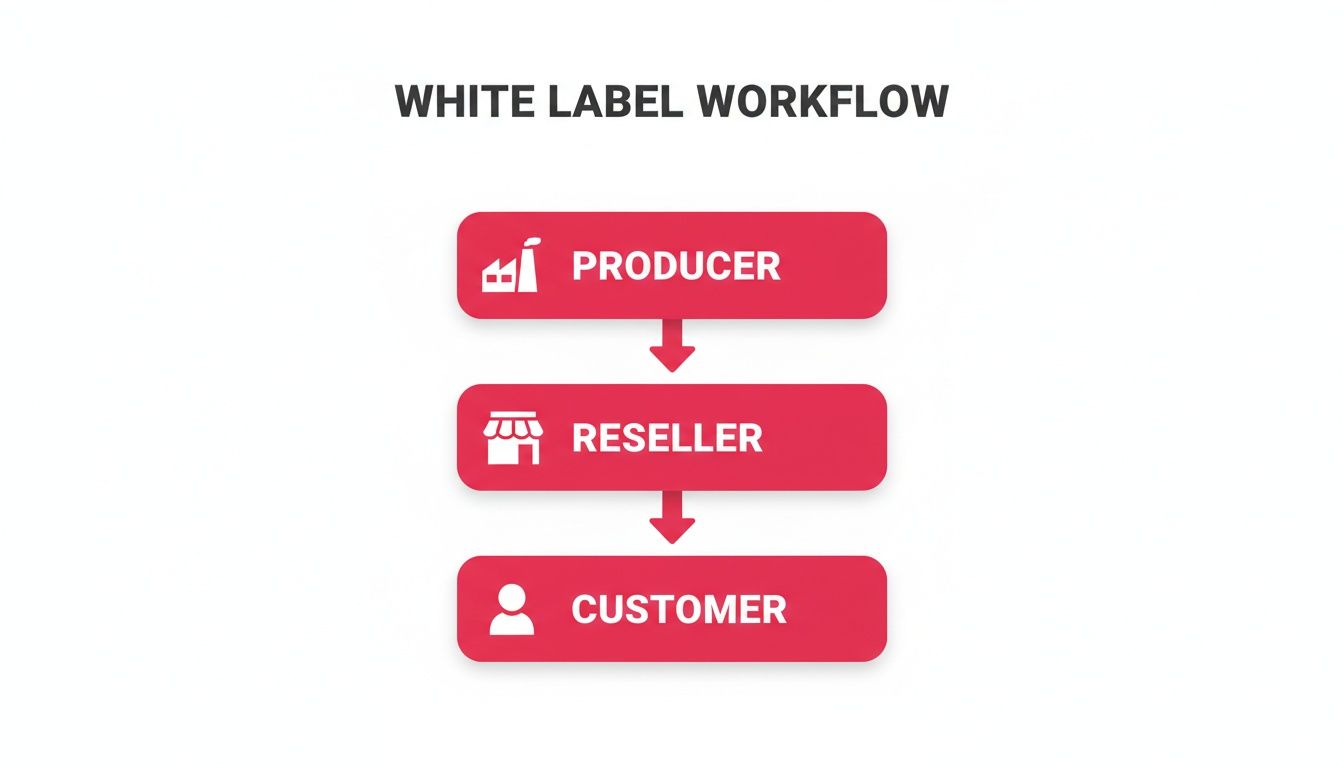
As you can see, it's a seamless handoff. The producer does the heavy lifting of creating the product, and the reseller steps in to handle the branding and marketing. To the end customer, it looks like it was your creation all along.
Comparing Business Models White Label vs Private Label vs Reseller
To really nail down the differences, a side-by-side comparison is the best way to see how these models stack up against each other. Each has its place, and the right choice depends entirely on your business goals, resources, and how much control you want to have.
| Attribute | White Label | Private Label | Reseller |
|---|---|---|---|
| Product Origin | Generic product made by a third party. | Unique product made exclusively for you. | Existing product from an established brand. |
| Branding | You add your own brand and logo. | You add your own brand and logo. | You sell under the original manufacturer's brand. |
| Exclusivity | None. Competitors can sell the same item. | High. The product is exclusively yours. | None. Other retailers sell the same product. |
| Customization | Little to none. You get what they make. | Full control over design and specifications. | Zero. The product cannot be altered. |
| Time to Market | Fast. The product is already developed. | Slow. Requires R&D and production time. | Fast. You just need to stock the product. |
| Cost & Investment | Low. No development costs. | High. Requires significant upfront investment. | Varies. Depends on wholesale/inventory costs. |
| Best For | Quickly adding new services or products. | Building a unique, defensible brand. | Selling popular, in-demand products easily. |
Ultimately, this table shows there's no single "best" model—just the best fit for your situation. White label is for speed, private label is for brand identity, and reselling is for simplicity.
Digging Deeper Into Each Model
Let’s get into the nitty-gritty of what makes each approach tick.
- White Label: This is all about speed and efficiency. A producer makes a fantastic, market-tested product or service and sells it to anyone who wants to rebrand it. Your main job is marketing. The big catch? Your direct competitor could be selling the exact same thing under their own label.
- Private Label: This model is built on exclusivity. You collaborate directly with a manufacturer to create a product from scratch, based on your exact specifications. This gives you complete control over the final result, but it comes with longer lead times, higher order minimums, and a much bigger upfront investment.
- Reseller: Think of yourself as a retail partner. You buy products from a well-known brand and sell them to your customers, usually with a markup. No rebranding is involved. Your success is directly tied to the reputation and marketing power of the brand you’re carrying.
The market for both private and white label goods is absolutely exploding as more and more shoppers embrace store and niche brands. The global private label market is on a trajectory to leap from $915.1 billion in 2024 to an incredible $1,623.4 billion by 2034.
This isn’t just a fluke. In 2024 alone, private label products saw a 3.9% jump in sales growth, which is nearly four times the rate of national brands. It’s a clear signal that consumer habits are shifting in a big way. You can discover more insights about this market shift and what it means for e-commerce.
The Strategic Benefits and Potential Risks

Going the white-label route can feel like you’ve found a cheat code for growing your business. It’s a way to instantly add new services, make your clients happier, and see a real impact on your bottom line. But like any big strategic move, it’s not a magic wand—it comes with its own set of challenges.
To make it work, you need a clear-eyed view of both the massive advantages and the potential traps. Getting this balance right is the difference between a partnership that fuels your growth and one that causes major headaches.
The Upside: A Wealth of Advantages
The biggest draw of white-label marketing is its raw efficiency. You get to completely sidestep the most time-consuming and expensive parts of building a new service from the ground up. This unlocks some serious benefits that can put you way ahead of the competition.
One of the most obvious wins is speed to market. Developing a new service in-house—whether it’s a sophisticated SEO tool or a custom line of e-commerce products—takes months, if not years, of R&D. A white-label solution is literally ready to sell from day one.
You also see a massive reduction in costs and resource strain. Think about it: you don't have to hire a new team of specialists, invest in new software, or set up a production line. This frees up your cash and lets your team stick to what they do best, like closing deals and managing client relationships.
The core advantage of white-label marketing is its ability to let you instantly broaden your expertise and become a comprehensive, one-stop shop for your clients.
When you offer more under your own brand, you naturally increase customer loyalty and lifetime value. Clients who can get everything they need from you have very few reasons to look somewhere else. This not only makes your business "stickier" but also positions you as a vital partner in their own success.
Navigating the Potential Downsides
While the benefits are pretty amazing, you have to be realistic. A white-label partnership means bringing in an outside element, and that introduces a few risks you’ll need to manage carefully to protect your brand.
The biggest one by far is your dependency on a third-party provider. Your reputation is on the line, but the actual quality of the product and the level of support are completely out of your hands. If your partner drops the ball, it's your brand that takes the hit with your clients.
Another thing to watch out for is the difficulty of differentiation. Since white-label products aren't exclusive, there's a good chance your competitors could be selling the exact same thing under their brand. This can make it tough to stand out and can quickly turn into a race to the bottom on price if you can't build value in other ways.
Finally, you're dealing with limited control and customization. You're pretty much locked into the features and design the provider offers. If a client needs a special feature or a small tweak, you’re completely at the mercy of your partner's development schedule and their willingness to help.
Mitigating Risks and Maximizing Success
The good news? All of these risks are manageable if you play it smart. A proactive approach to choosing and managing your white-label partner can turn these potential problems into non-issues.
Here are a few practical steps to keep your business protected:
- Conduct Rigorous Partner Vetting: Don't just look at the product; dig into the company behind it. Check reviews, ask for case studies, and talk to their other resellers. You need to be sure they have a solid reputation for reliability and fantastic support.
- Establish Ironclad Agreements: Your service-level agreement (SLA) is your best friend. It needs to clearly spell out everything: performance expectations, uptime guarantees, support response times, and how you'll communicate. This document is your safety net if things go sideways.
- Focus on Your Unique Value-Add: You can't change the core product, but you can control everything around it. Make your brand stand out with amazing customer service, expert strategic advice, and killer marketing. Your value is the entire experience, not just the product itself.
By carefully weighing the pros and cons, you can make a strategic call that lines up with your long-term vision. With the right partner and a focus on adding your unique value, a white-label strategy can become a powerful engine for scalable and sustainable growth.
Seeing White Label Marketing in Action

The theory behind white-label marketing is one thing, but seeing it work in the real world makes the strategy click. Smart brands and agencies are using these partnerships every day to achieve impressive growth, often in ways their customers never even notice. These examples show just how flexible and powerful this model can be.
Example 1: The Fast-Growing DTC Supplement Brand
Imagine a direct-to-consumer (DTC) wellness brand, "Vitality Now," known for its killer protein powders. They see a massive opportunity in the booming market for collagen supplements but don't have the specialized equipment or formulation expertise to make them in-house.
Instead of sinking millions into a new manufacturing facility and navigating a maze of regulations, they partner with a certified white-label supplement producer.
- The Partnership: The producer handles everything from sourcing high-quality collagen to creating the final, unbranded powder. It's a turnkey solution.
- The Rebranding: Vitality Now gets the finished product and packages it in their signature tubs, slapping on their logo and marketing copy.
- The Launch: They roll out "Vitality Glow Collagen" to their existing customer base, capturing a new market segment in a matter of months, not years.
This move lets them expand their product line with incredible speed and almost zero capital risk, cementing their position as a one-stop-shop wellness brand.
By leaning on a white label partner, Vitality Now focused on what it does best—brand building and marketing—while relying on an expert for production. This is the essence of a winning white label strategy.
The beauty and personal care industry is a hotbed for this model. The global white-label cosmetics market was valued at around $1.02 billion in 2024 and is projected to hit $1.66 billion by 2030. This growth is fueled by brands using white-label partners to quickly meet consumer demand for new and personalized products without massive upfront investment. You can learn more about trends in the white label cosmetics market and see how these partnerships are driving rapid expansion.
Example 2: The Digital Agency Offering Enterprise-Level Reporting
Now, let's look at a service-based business. A boutique digital marketing agency, "Pixel Perfect," is fantastic at creating high-performing ad campaigns. Their reporting, however, is pretty basic, and they just don't have the resources to build a sophisticated analytics platform that could compete with the big firms.
So, they decide to white-label a powerful analytics dashboard from a SaaS company.
Pixel Perfect rebrands the software with their logo and color scheme, presenting it to clients as the "Pixel Perfect Insights Dashboard." Suddenly, they're offering enterprise-level reporting with beautiful data visualizations and deep-dive metrics—all under their own trusted brand. This immediately elevates their perceived value and helps them land and retain bigger clients.
Example 3: White-Labeling Creator Content
The white-label concept isn't just for physical products and software; it's making huge waves in the creative world, too. Think about a brand that needs a constant stream of authentic user-generated content (UGC) for its ad campaigns.
Using a platform like JoinBrands, they can source high-quality videos and images from a huge network of creators. The content is delivered ready-to-use but totally unbranded. The brand then takes these authentic assets, adds its own branding, music, and calls-to-action, and pushes them out across its social media ads.
In this modern spin, the creator's content is the "white label" product. The brand simply rebrands it for its specific campaign needs, turning authentic creator work into a scalable and incredibly effective marketing asset.
How to Build Your White Label Strategy
Alright, so you're sold on the concept. But how do you actually put a white label model into practice? It's all about having a clear, step-by-step playbook. A solid strategy is what separates a seamless launch from a total headache, ensuring you pick the right partner and create something your customers will genuinely love.
It all starts by looking inward. The first move is to spot the right opportunity. Where are the gaps in your current product catalog or service list? Pay close attention to what your clients are constantly asking for that you just can't deliver right now. Nailing this down helps you find a white label solution that adds immediate, tangible value.
Let's say you run a marketing agency. You might notice a ton of your clients are struggling with online review management. Instead of spending a year and a fortune building your own tool, you could find a white label reputation management platform. Just like that, you've solved a major client pain point and opened up a brand-new revenue stream.
Vetting Your Potential Partners
Once you know what you need, it's time for the most critical step: finding and vetting the perfect partner. Make no mistake, your brand's reputation is about to be tied to their product. This isn't a decision you can afford to rush. Your evaluation has to go way deeper than just a feature comparison chart.
Here’s what you absolutely need to dig into during the vetting process:
- Product Quality and Reliability: Don't just watch a slick demo—get your hands on the product. Ask for a trial period and put it through its paces. Does it meet your standards? Is it dependable?
- Scalability: Think about the future. Can this partner grow with you? You need to know if they can handle a surge in users or orders as your business expands.
- Support and Communication: What happens when something goes wrong? (And something always goes wrong.) You need a partner who is responsive, helpful, and easy to get ahold of.
- Reputation: Do your homework. Hunt down reviews, testimonials, and case studies from other businesses using their service. A provider with a proven track record is a much safer bet.
A great white label partner acts as a true extension of your team, operating silently in the background. Their reliability should be so consistent that you and your customers forget they even exist.
Negotiating a Smart Agreement
After you've picked your partner, the next step is locking in a rock-solid agreement that protects your interests. This legal document needs to spell out the terms of your partnership in plain English, leaving zero room for interpretation. Think service level agreements (SLAs), pricing structures, and support commitments.
This is also where you'll define all the branding rights and responsibilities. Make sure the contract gives you the flexibility to present the product as your own. It should also be crystal clear about what happens if the partnership ever comes to an end. A well-written agreement prevents future drama and sets clear expectations from day one.
Launching and Integrating Your New Service
With a partner and a contract in place, it’s go-time. A successful launch is about more than just slapping the new service on your website. You have to weave it seamlessly into your existing operations.
Start with your team. Get your sales and support staff trained up so they know the new offering inside and out. They need to be able to sell it with confidence and help customers who have questions. If you're looking for ways to streamline this process, our guide on marketing campaign management software has some great insights.
Finally, put together a marketing plan to announce your new offering. Let your existing customers know and shout the benefits from the rooftops. A strong launch creates that initial buzz and makes sure your white label strategy starts paying off from the get-go.
Still Have Questions About White Label Marketing?
Jumping into a white-label strategy can feel like a big move, and it's natural to have a few questions swirling around. Let's tackle some of the most common ones I hear from brands and agencies to make sure you've got all the info you need to decide if it's right for you.
Is White Labeling Legal and Ethical?
Absolutely. White-label marketing is a completely legal and widely accepted business practice. The whole model is built on clear, upfront contractual agreements. One company (the producer) creates a product or service and then gives another company (the reseller) explicit permission to put their own brand on it.
Think of it this way: the agreement is the key. As long as both sides agree to the terms, the practice is standard and ethical across countless industries, from software and marketing services to coffee beans and t-shirts. It's a legitimate growth strategy, not some sneaky workaround.
How Do I Find a Reliable White Label Provider?
Finding the right partner is the most critical step, and it takes a bit of legwork. A great place to start is within your own industry. Check out online directories, read trade publications, and hang out in business forums where people are already talking about these kinds of services.
But don't forget your own network. Ask colleagues and peers you trust for referrals. A recommendation from someone who has already been through the process is worth its weight in gold—it can save you a ton of time and help you dodge partners who don't deliver on their promises.
The best white label partnerships are built on trust and a proven track record. Always lean toward providers who are transparent about how they work, can show you solid case studies, and have a reputation for great support.
Can Small Businesses Really Benefit from This Model?
Yes, and honestly, small businesses and startups often have the most to gain. White labeling levels the playing field, letting smaller companies go toe-to-toe with industry giants without needing a massive R&D budget.
Here’s where a small business can really get an edge:
- Expand Your Services Overnight: You can instantly add new, professional-grade services to what you offer. This makes your business a much more compelling one-stop-shop for clients.
- Skip the Heavy Lifting: Launching new products or services usually costs a fortune and takes forever. White labeling lets you bypass all that upfront investment and development time.
- Punch Above Your Weight: When you offer a wider range of high-quality solutions, your brand's authority and credibility shoot up. This helps you attract bigger and better clients down the road.
For a small agency, this could be offering top-tier SEO reports without hiring a whole new team. For a new DTC brand, it could be launching a complementary product in just a few weeks. It’s a strategy built for immediate scale.
Ready to apply these same principles to your creator marketing? With JoinBrands, you can source high-quality, authentic content from over 250,000 creators and seamlessly use it in your campaigns—all under your brand name. See for yourself how our platform makes it easy to find creators, manage projects, and grow your social presence. Start your first campaign on JoinBrands today!