
 Optimize Campaigns: Instagram View Insights
What makes a video catch fire and spread across the internet isn't just random luck – it's closer to a science. A video truly goes viral when it sparks a strong emotional response, perfectly plays into platform algorithms, and gets shared at lightning speed by an audience that can't get enough.
Think of it like a perfectly controlled chain reaction. It starts with compelling content and ends with strategic distribution.
Table of Contents
The Hidden Formula Behind Viral Videos

Figuring out what makes a video pop off is less about chasing some fleeting trend and more about mastering a repeatable formula. The real work begins long before you hit "publish." It's all about engineering your content with specific psychological triggers and technical signals baked right in.
To the viewer, a great viral video feels completely spontaneous. But behind the scenes, it’s often a masterclass in checking off a series of crucial boxes that compel people to watch, engage, and – most importantly – share.
This guide will break down the essential pieces that turn a regular video into a cultural moment. We're going beyond the surface-level tips to explore the fundamental pillars that hold up every viral success story. This isn't about crossing your fingers and hoping for a lucky break; it's about building a framework that massively stacks the odds in your favor.
The Four Pillars of Virality
Every viral video is really the result of four interconnected elements working in perfect harmony. Each one supports the others, creating a powerful flywheel that spins your content across social feeds and into the mainstream conversation. If you can get a handle on these concepts, you're well on your way to creating your own viral hits.
Let's break down the core components that give a video its viral potential.
The Four Pillars of Viral Video Success
| Pillar | Core Concept | Key Takeaway |
|---|---|---|
| Emotional Hooks | This is the heart of the video. It’s the punchline, the shocking reveal, the jaw-dropping moment, or the super-relatable situation that connects with a viewer on a deep, human level. | Your video must make people feel something strong enough to share. |
| Algorithm-Friendly Signals | Every platform has its digital gatekeeper. This pillar is all about creating content that sends the right signals – high watch time, rapid engagement, and shares – to convince the algorithm your video is a winner. | Feed the algorithm what it wants: high retention and immediate interaction. |
| Authentic Content Formats | People today are tired of polished ads; they crave genuine connection. This means leaning into raw, user-generated styles that feel more like a chat with a friend than a corporate broadcast. | Make it feel real. Authenticity builds trust and encourages sharing. |
| Smart Distribution | A brilliant video is useless if no one sees it. Strategic distribution gives your content an initial push through creator seeding, community sharing, and targeted promotion to get the ball rolling. | Don't just post and pray. Give your content the initial push it needs to gain momentum. |
By mastering these four pillars, you're not just creating content; you're building a system designed for virality.
Viral content is a shared emotional experience packaged for a specific platform. When you understand the emotion you want to evoke and the platform's rules, you unlock the formula.
By understanding how these four pieces fit together, you can start to see why some videos blow up while others just fizzle out. This guide will give you a detailed roadmap for each one, arming you with the tools to create content that doesn't just get views, but becomes part of the conversation.
Why We Share: Unlocking Emotional Triggers
Every viral video starts with one thing: a feeling. Long before the first share, like, or comment, there's an emotional spark. It’s the invisible bridge connecting the viewer to the screen, and it's the real engine behind virality. Without that connection, even the sharpest, most polished video is dead on arrival.
Think of it like a great conversation starter. The best videos don't just throw information at you; they hit you with a feeling so strong you feel an immediate urge to turn to someone and say, "You have to see this." Our job is to engineer that exact impulse.
And here's the kicker: you've only got about three seconds to make it happen. That's your entire window. In that tiny sliver of time, you need to hook them with something potent – whether it’s gut-busting laughter, jaw-dropping surprise, or a genuine sense of awe. That initial emotional punch isn't just a nice-to-have; it's everything.
The Core Emotions That Drive Sharing
While a ton of different feelings can make a video enjoyable, only a handful of "high-arousal" emotions consistently make people smash the share button. These are the feelings that practically demand a reaction.
- Intense Humor: Laughter is contagious, plain and simple. It's a communal experience. Videos that make people genuinely laugh out loud tap into our desire to spread a little joy.
- Awe and Wonder: When content shows us something extraordinary – an unbelievable view from a mountaintop, a stunning display of human talent, or a wild scientific fact – it makes us feel part of something bigger. We want to pass that feeling on.
- Surprise and Intrigue: Our brains are hardwired to lock onto the unexpected. A shocking twist, a clever reveal, or something that turns a common belief on its head makes a video stick. It gives people a perfect piece of "social currency" to share with their friends.
- Righteous Anger or Injustice: It's a negative emotion, sure, but it's incredibly powerful for building solidarity. When a video exposes something that feels fundamentally wrong, sharing it becomes an act of validation and a way to rally a community.
A video goes viral not just because it’s good, but because it gives the viewer a reason to share. It makes them look smart, funny, or in-the-know to their own social circles. It's a gift they can give to someone else.
Getting this dynamic is half the battle. You’re not just trying to entertain the viewer; you're trying to empower them to share.
Creating Powerful Share Triggers
Once you have that emotional hook, the best videos weave in share triggers – specific elements that give people a social reason to pass the video along. It's about making the act of sharing feel beneficial to the person doing it.
One of the most powerful triggers? Relatability. A video becomes insanely shareable when it taps into a universal human experience so perfectly that people feel seen. It’s that "This is so us!" feeling that makes someone immediately send it to their group chat.
This emotional foundation is precisely what the platform algorithms are looking for. Videos that spark strong feelings get reshared quickly, signaling to the algorithm that this is content worth pushing. The benchmarks don't lie: platforms like TikTok often require over 1 million views in 72 hours to be considered truly viral, while an Instagram Reel might need 50,000 shares. It all starts with that hook, where 80% of a video's potential is decided in the blink of an eye. You can find more viral benchmarks and insights on Bluehost.
This is where the art of storytelling becomes an absolute major advantage for brands. By crafting a narrative that hits on a personal level, you can turn passive viewers into passionate advocates. To dig deeper into building these kinds of connections, check out our guide on what is brand storytelling. that emotional core is what separates a forgettable clip from a viral sensation.
Making the Algorithm Your Biggest Fan
Think of social media algorithms less like gatekeepers and more like powerful amplifiers just waiting for the right signals. The secret to virality isn't about fighting them; it's about learning their language and turning them into your single most effective distribution partner.
At its core, an algorithm has one job: keep users on the platform as long as humanly possible. To pull this off, it's constantly hunting for content that proves it can grab and hold an audience's attention. From the second you hit "publish," your video's only mission is to send those positive signals loud and clear.
The make-or-break factor here is engagement velocity – how fast your video racks up likes, comments, shares, and watch time right after it goes live. Picture it like a rocket launch. You need a massive initial burst of power to break through the atmosphere and achieve orbit. A slow trickle of engagement just won't cut it. The algorithm needs to see an immediate, almost explosive reaction from the very first group of people it shows your content to.
The First Hour Is Everything
That initial tidal wave of activity is completely non-negotiable for going viral. One of the biggest things that makes a video go viral is securing lightning-fast engagement within the first few hours. In fact, some social media benchmarks suggest this first-hour performance can dictate up to 80% of a video's total viral potential. A rapid spike tells the algorithm it has a certified winner on its hands. This is especially true on a platform like TikTok, where your video has mere seconds to prove its worth.
This is often fueled by hitting the right emotional notes with viewers, which triggers them to react and share instantly.
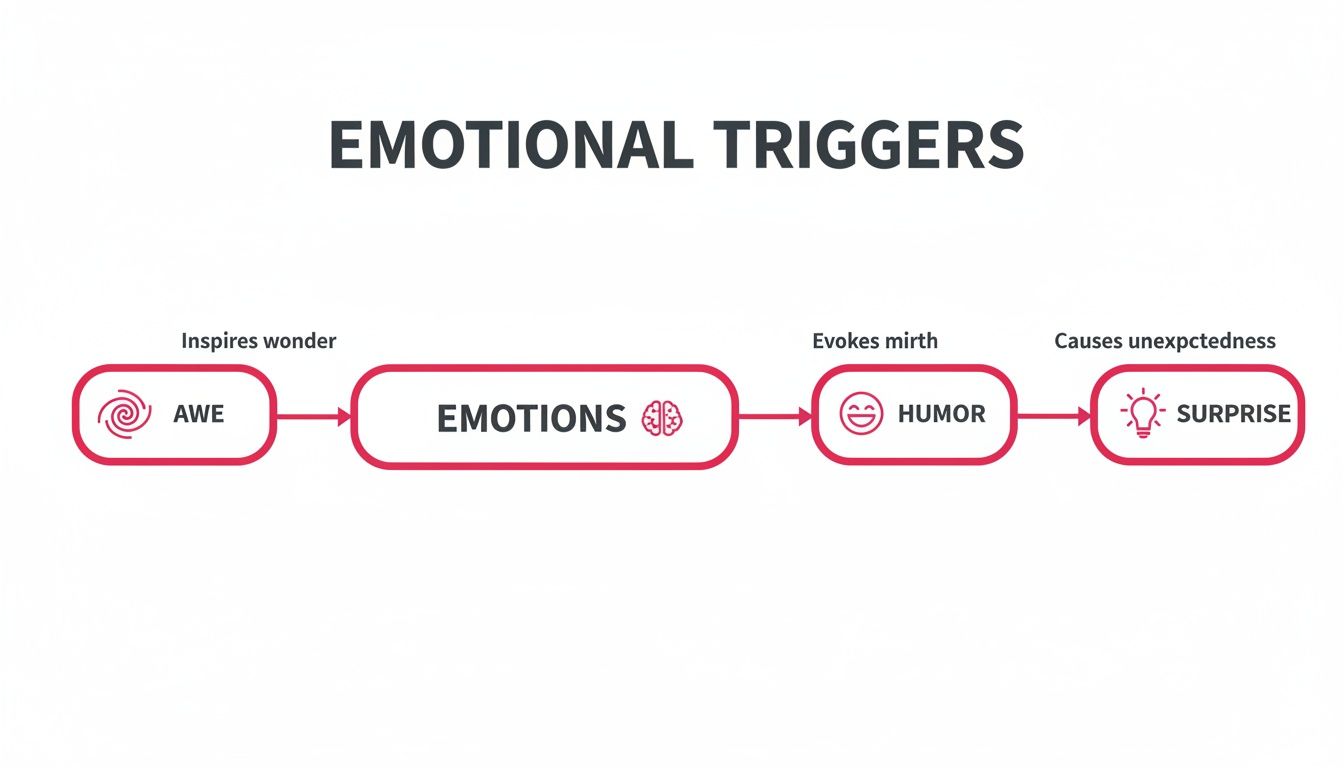
As you can see, these "high-arousal" emotions are direct on-ramps to the shares and comments that convince an algorithm to show your video to more and more people.
Speaking Each Platform’s Language
While the need for speed is universal, every platform has its own distinct dialect. The signals that scream "viral" to TikTok are different from what YouTube's algorithm is listening for. Winning this game means tailoring your approach to the specific metrics each algorithm values most.
Let's break down what truly matters on the biggest short-form video platforms. Each algorithm has its own hierarchy of signals it uses to decide whether a video is worth pushing to a massive audience. Understanding these nuances is key.
Platform Algorithm Signals for Virality
| Platform | Primary Signal | Secondary Signals | Content Tip |
|---|---|---|---|
| TikTok | Watch Time % & Completions | Shares, Saves, Comments | Hook viewers in the first 2 seconds. A high re-watch rate is a massive bonus. |
| Instagram Reels | Shares & Saves | Comments, Use of Trending Audio, Watch Time | Use native Instagram features and trending sounds to show you're part of the culture. |
| YouTube Shorts | Watch Time & Audience Retention | Session Time (do they watch more?), Likes, Channel Subscriptions | Focus on keeping viewers on YouTube. End your Short with a compelling reason to check out your channel. |
This table shows that while there's overlap, each platform has its own unique "tell." For TikTok, it's all about keeping eyeballs glued to the screen until the very end. For Instagram, it’s about inspiring users to share your content with others. And for YouTube, it’s about turning a casual viewer into a channel subscriber.
The algorithm doesn’t care if your video is "good" in an artistic sense. It only cares if it's effective at capturing and holding human attention. Your metrics are its only measure of quality.
This means a raw, unpolished video with a killer emotional hook that gets a 90% completion rate will almost always outperform a beautifully produced video that people swipe away from after three seconds. Mastering the technical side of engagement is just as crucial as the creative. For more deep-dive strategies, check out our guide on how to boost TikTok views.
How Authenticity Outperforms Polished Production
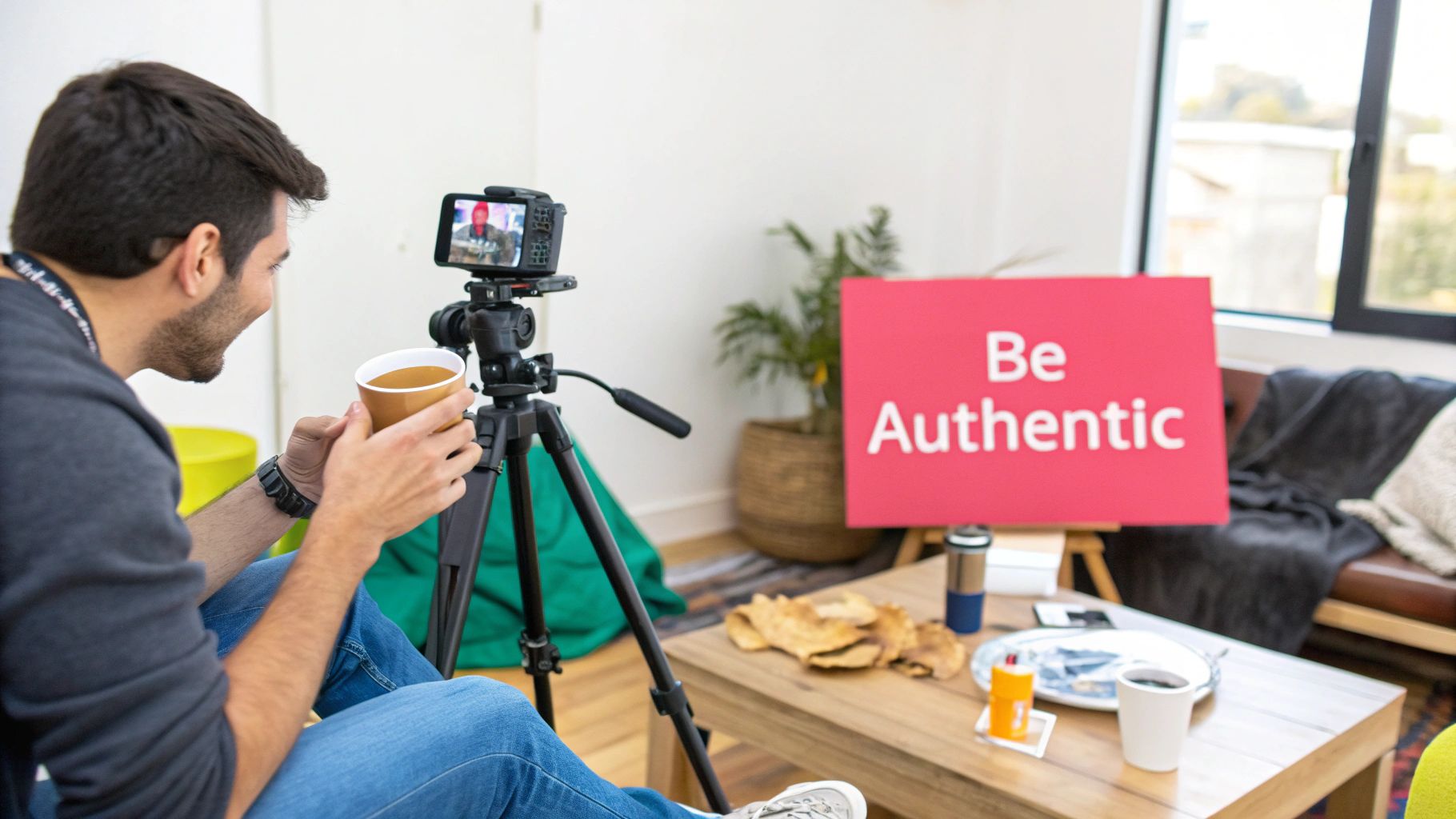
In a world drowning in glossy, high-budget commercials, a quiet revolution has taken place. Today’s audiences don’t just prefer authenticity – they demand it. They're looking for real connections and stories they can relate to, which they often find in raw, unpolished videos that feel more like a chat with a friend than a corporate broadcast.
This is exactly why a simple behind-the-scenes clip or a candid customer testimonial can build more loyalty than a flawless, studio-produced ad ever could. The slick veneer of perfection is out; the power of being real is in. This shift is at the very heart of what makes a video go viral today.
The Rise of Relatable Content
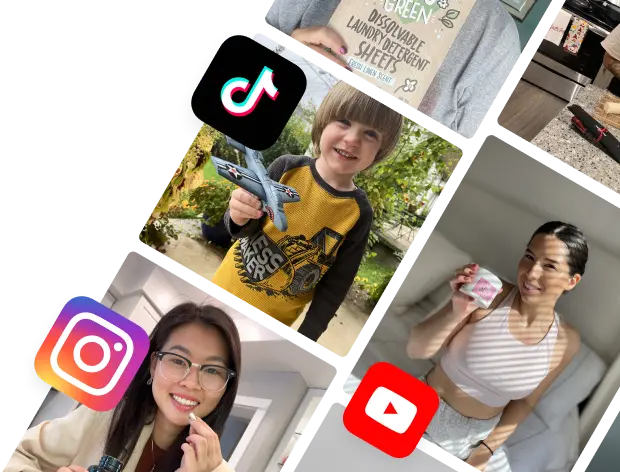
The era of the perfectly curated, flawless social media feed is on its way out. People are tired of seeing idealized versions of reality. Instead, they’re flocking to content that mirrors their own lives, struggles, and wins. This is where user-generated content (UGC) becomes a brand's secret weapon for building trust.
Authenticity is the new currency of the internet. When a brand drops the corporate mask and shows its human side, it doesn't just attract customers; it builds a loyal community that feels seen and understood.
Instead of telling people how great their product is, smart brands are showing them through the eyes of actual customers. It feels less like marketing and more like a trusted recommendation from a friend, which is infinitely more powerful.
Why Unpolished Wins
So, why does a shaky, handheld video sometimes crush a polished production that cost a fortune? It all comes down to trust and relatability. Polished content often triggers our internal "ad blocker," but authentic content slips right past that filter.
Here’s why raw content just works better:
- It Builds Instant Trust: It feels honest and unfiltered, breaking down the walls between a brand and its audience.
- It Inspires Participation: Relatable videos make others want to join in – through duets, stitches, or challenge submissions. This community-driven activity is a massive signal to the algorithms.
- It Lowers the Barrier to Entry: It shows people they don't need a professional studio to be part of the conversation, creating a more inclusive and active community.
The data doesn't lie. Authenticity and UGC are massive drivers of virality, and platforms are actively rewarding videos that spark community engagement. Research shows that independent creators are often seen as more credible, with 27% of audiences trusting influencers over brands. This trust translates into billions of viewing hours and is a key reason trends on TikTok can explode overnight through user participation. You can dive deeper into this shift in Deloitte’s Digital Media Trends report.
Putting Authenticity into Practice
For brands and campaign managers, this isn't just a trend; it's a strategic necessity. The key is to stop broadcasting and start participating. It’s about empowering creators and customers to become your storytellers, which creates a flywheel of genuine engagement.
Here are a few ways to make this happen:
- Launch a Branded Challenge: Kick off a simple, fun challenge with a unique hashtag that gets users creating and sharing their own videos.
- Showcase Real Customer Stories: Find your best customer reviews and turn them into compelling video testimonials. Let your customers be the heroes of your brand’s story.
- Partner with Micro-Influencers: These creators have smaller but hyper-engaged audiences that hang on their every word. Their endorsement feels less like a paid ad and more like a genuine tip from a trusted friend.
By embracing this shift, brands can tap into the power of their community to create content that connects on a much deeper level. For a closer look at how to leverage this strategy, check out our guide on user-generated videos. The goal is to make content that doesn't just sell, but builds a real connection that turns viewers into your biggest fans.
Giving Your Video an Unfair Advantage
So you've created a video with a killer emotional hook and all the right signals for the algorithm. That's a huge step, but it's only half the battle. A brilliant video with zero viewers is like a masterpiece locked away in a basement – no one knows it exists.
To really get what makes a video pop off, you have to understand that great content rarely catches fire all by itself. It almost always needs a strategic push to get that initial spark going. This is where smart distribution comes in, giving your video an "unfair" advantage right from the start. We're moving past the old "post and pray" method and actively creating the conditions for success, building just enough manufactured momentum to get the algorithm's attention.
Kickstarting Momentum with Seeding
One of the best ways to get the ball rolling is through seeding. Think of it literally, like planting a seed in the most fertile soil you can find. Instead of just throwing your video onto your own channels and hoping for the best, you strategically share it with influential accounts, niche online communities, and creators who can introduce it to a bigger, more passionate audience.
This isn't just about spamming links everywhere. It's a calculated move.
- Find Your People: Pinpoint the subreddits, Facebook groups, or Discord servers where your target audience hangs out and talks about this stuff all day.
- Identify the Tastemakers: Look for creators or community pages known for finding and sharing great content in your niche. They're the curators people trust.
- Share Like a Human: Don’t just drop a link and run. Frame your video with a good story or a question that sparks a real discussion and matches the vibe of the community.
A single, well-placed seed in the right community can easily trigger hundreds of initial shares, giving the algorithm the exact kind of velocity it loves to see.
Fueling the Fire with Paid Amplification
While organic seeding is powerful, mixing it with a small, laser-focused ad spend is like pouring gasoline on a flickering flame. Paid amplification isn’t about buying virality – you can't do that. It’s about buying crucial early data and exposure.
Even a modest budget can push your video into the algorithm's sweet spot, getting it in front of thousands of new viewers in those critical first few hours. This lets you quickly see which hooks and audiences are working, giving you the engagement data you need to prove your video’s worth to the platform.
Think of paid promotion as a launch ramp. It doesn't guarantee your rocket will reach orbit, but it provides the essential initial velocity needed to overcome gravity and give it a fighting chance.
For those creating truly next-level visuals, especially with AI, diving into advanced methods like Sora 2 prompting techniques can give you another massive edge, helping you make content that looks incredible from the get-go.
Developing a Multi-Channel Launch Plan
A truly successful launch needs a coordinated attack across multiple platforms, not just a one-off post. Your plan has to be built around the unique strengths and audience expectations of each channel.
- TikTok and Reels: Chop up your video into short, punchy clips that get straight to the most compelling moment. Grab attention fast.
- YouTube: This is a search game. Optimize your title and thumbnail to get clicks and then focus on keeping people watching for as long as possible.
- Instagram Stories: Use interactive features like polls and question stickers to drive that initial buzz and send people over to your full video.
By tailoring your content for each platform and scheduling your posts for when your audience is most active, you create a synchronized wave of activity. This multi-pronged approach maximizes your video's initial impact, sending a powerful, unified signal to the algorithms that something special has just landed.
Your Blueprint for Creating a Viral Video
Alright, we've covered the theory – the emotional triggers, the signals that algorithms love, and the smart ways to get your video in front of people. Now it’s time to put it all together. Let's transform that theory into a tangible, repeatable process.
Think of this as your checklist, guiding you from that first spark of an idea to the final push. This isn't about hoping for a lucky break; it’s a framework for engineering virality. Following these steps systematically will dramatically up your chances of making something that doesn’t just get seen, but gets shared.
Step 1: Ideation and The Emotional Hook
Before your camera even starts rolling, your single most important job is to land on an idea with a built-in emotional engine. This is the absolute, non-negotiable foundation of any viral video. You have to ask yourself: what strong, high-arousal emotion is this concept going to spark in someone?
- Brainstorm Core Feelings: Are you aiming for pure awe? Uncontrollable laughter? Genuine surprise? Righteous anger? A lukewarm "that's neat" concept is a dead end. The feeling has to be powerful enough to make someone stop what they're doing and hit "share."
- Identify the Share Trigger: Put yourself in the viewer's shoes. Why would they send this specific video to a friend? Does it make them look clever, hilarious, or in on an inside joke? You have to build this social currency right into the idea itself.
- Script the First Three Seconds: Your opening is everything. Meticulously plan a visual or verbal hook that snags attention instantly and gives a little taste of the emotional payoff to come.
Step 2: Creation for The Algorithm
Once you've got your emotionally-charged idea, every single production choice needs to be made with the platform's algorithm in mind. This is about more than just good content; it's about creating technically optimized content that feeds the algorithm all the right signals from the second you hit "post."
The best viral videos feel like spontaneous moments of genius, but they are often meticulously crafted to speak the algorithm’s native language – the language of watch time, engagement, and rapid sharing.
Your goal is to make the algorithm’s job easy. Give it content that’s perfectly formatted for its home turf and designed to glue eyeballs to the screen.
- Shoot for The Platform: This one’s simple but so many people get it wrong. Film vertically for TikTok, Reels, and Shorts. It creates a native, seamless mobile experience that immediately boosts how people interact with your video.
- Incorporate Trending Elements: Think of trending audio or popular formats as a Trojan horse. Using them signals to the algorithm that your content is culturally current and plugged into what people are already watching.
- Prioritize Authenticity Over Polish: Go for a raw, user-generated content (UGC) style. Slick, overproduced ads can feel jarring on these platforms. Audiences trust authenticity, and that trust translates directly into higher engagement and more shares. For a deeper explore planning and optimizing product videos for performance, there are fantastic guides that break down the whole process, ensuring every part of your video is built to connect.
Common Questions About Viral Videos
As you start chasing that viral moment, a few big questions always pop up. Getting a handle on the benchmarks, possibilities, and real-world costs is key to setting expectations that aren't just wishful thinking. Let's break down what brands and creators are always asking.
How Many Views Count as Viral?
Here’s the thing: “viral” doesn’t mean the same thing everywhere. The number is totally relative and shifts depending on the platform you're on. There isn't one magic number, but each app has its own unofficial benchmark that tells you a video has truly broken out.
It's not just about the final view count, either. It’s the velocity – how fast those views pile up – that really matters.
- TikTok: On TikTok, the viral conversation usually starts around 1 million views in a 3-day window. The videos that really take over culture are often clearing 5 million views in less than a week.
- Instagram Reels: A Reel is generally considered viral once it flies past 500,000 views and gets at least 50,000 shares. That share number is critical; it shows the content is hitting a nerve.
- YouTube Shorts: The bar is a bit higher here, just because of the sheer scale of YouTube. You’re typically looking at needing 1 to 2 million views, and you need them fast, for a Short to be in the viral category.
Can You Guarantee a Video Goes Viral?
Let's be direct: no. Anyone who promises a guaranteed viral hit is selling you snake oil. Audience behavior is just too unpredictable to ever make it a sure thing.
But that absolutely does not mean it's all just random luck. You can, and should, stack the deck in your favor.
Think of it like being a pro athlete. A star player can't guarantee they'll score every single game, but their relentless training, film study, and mastery of strategy make it a hell of a lot more likely. The frameworks in this guide – from nailing emotional hooks to decoding algorithms – are your training playbook.
Virality isn't a lottery ticket you hope to win. It's a calculated outcome that becomes more likely when you consistently apply the right principles of psychology, platform optimization, and strategic distribution.
What Does It Cost to Go Viral?
This is the classic "how long is a piece of string?" question. The cost can be anything from $0 to tens of thousands of dollars. It all comes down to your strategy and what you're trying to achieve.
The dream scenario? An incredible idea with a powerful emotional hook takes off organically with zero ad spend. The content is just so good that the audience becomes your distribution team, sharing it far and wide. This happens all the time.
On the other hand, you can take a more deliberate approach. A smart, strategic campaign might use paid promotion to give a video that initial boost it needs to catch the algorithm's attention. A little bit of targeted ad spend can be the spark that lights the fire, turning virality from a happy accident into a predictable part of your marketing machine.
Ready to create authentic video content that connects with your audience? JoinBrands provides the tools and creator network you need to launch impactful campaigns and drive real results. Find the perfect creators for your brand at https://joinbrands.com.