





 Your Essential Product Launch Timeline Template
Figuring out what a "good" click-through rate (CTR) is can feel like chasing a moving target. The truth is, there's no single magic number. It all comes down to your industry, the channel you're on, and what you're trying to achieve.
That said, a ballpark average for Google Ads floats around 6.11%, while a solid Facebook Ad CTR might be closer to 1%. But the real answer? A "good" CTR is one that consistently beats your own past performance and, most importantly, drives profitable growth for your business.
Table of Contents
What Is a Good Click Through Rate Really
Let's break it down with a simple analogy. Think of your ad or content as a storefront window display.
All the people who walk past your store are your impressions. But the people who actually stop, look, and decide to walk through the door because your display caught their eye? Those are your clicks.
CTR is just the percentage of people who saw your display and were intrigued enough to come inside. It’s the first, most direct measure of how well your creative and targeting are working together. A strong CTR basically shouts, "Yes! We're showing the right message to the right people at the right time."
A high CTR is a direct signal to ad platforms like Google and Meta that your content is relevant and engaging to the audience. This relevance is often rewarded with lower advertising costs and better ad placement, creating a powerful feedback loop for your campaigns.
Establishing Your Starting Point
To know what a good CTR looks like in the wild, you need some benchmarks. In the world of Google Ads, the average CTR across all industries was recently pegged around 6.11%, but that number swings wildly depending on the niche.
For e-commerce brands, the Apparel/Fashion & Jewelry category absolutely crushes it, pulling in an impressive 11.78% CTR on average. It's a perfect example of how compelling visuals and desirable products can make people click. Diving into industry-specific advertising benchmarks is a great way to see how you stack up.
A great first step is to see how your performance compares to these general industry averages.
Average CTR Benchmarks at a Glance
Think of the numbers below as a starting point – a compass, not a rigid map. They give you a general idea of what to expect across different marketing channels.
| Channel | Average CTR |
|---|---|
| Paid Search | 6.11% |
| Display Ads | 0.77% |
| 2.5% – 4.7% | |
| Facebook Ads | 1.11% |
| Instagram Ads | 0.60% |
| TikTok Ads | 1.00% |
Use these benchmarks to set realistic initial goals. Once you've gathered your own data, you can also learn more about how to calculate impressions to get a complete picture of the other half of the CTR equation.
Unpacking CTR Benchmarks Channel by Channel
Knowing the overall average for click-through rates is a decent starting point, but the real magic happens when you dig into how each channel performs. A “good” CTR on a Google search ad is worlds apart from a strong one on a social media campaign or even a display banner.
Each channel has its own vibe – its own audience, intent, and creative expectations – and all of that directly shapes what success looks like. For direct-to-consumer (DTC) brands, this nuance is everything. You’re not just chasing clicks; you’re hunting for the right clicks on the right platforms that actually turn into sales.
Let's break down the benchmarks for the channels that matter most to e-commerce brands.
CTR Benchmarks by Channel and Industry
To give you a clearer picture, here's a detailed breakdown of what to expect across different digital marketing channels, with a special focus on industries relevant to DTC and e-commerce founders.
| Channel | Industry (e.g., Apparel, CPG) | Average CTR Benchmark |
|---|---|---|
| Paid Search (Google Ads) | Apparel | 6.0% – 10.0%+ |
| Beauty & Cosmetics | 5.5% – 9.0% | |
| Consumer Packaged Goods (CPG) | 4.0% – 7.0% | |
| Social Media (Facebook) | E-commerce (General) | 1.11% |
| Apparel | 1.24% | |
| Beauty & Cosmetics | 1.02% | |
| Social Media (Instagram) | E-commerce (General) | 0.60% |
| Apparel | 0.58% | |
| Beauty & Cosmetics | 0.72% | |
| Social Media (TikTok) | E-commerce (General) | ~1.0% |
| Display Ads | E-commerce (General) | 0.51% |
Keep in mind that these are just benchmarks. Your own performance can swing wildly based on the quality of your creative, the precision of your targeting, and the strength of your offer.
Paid Search Ads: The High-Intent Arena
When someone types a search into Google, they have a mission. They have a problem to solve or a product to find, right now. This high-intent environment is precisely why paid search ads, especially on Google Ads, consistently deliver the highest click-through rates of any channel.
People are actively looking for a solution, and your ad is the answer they’ve been searching for.
A respectable CTR here can range anywhere from 4% to over 10%. For DTC categories that are highly visual and desirable, like apparel or beauty, seeing a CTR above 10% is a huge win. It’s a clear signal that your ad copy, keyword targeting, and product are all perfectly aligned with what the user wants.
This chart gives you a quick visual of how a specific, high-intent industry like apparel can really outperform the general averages on a platform like Google.
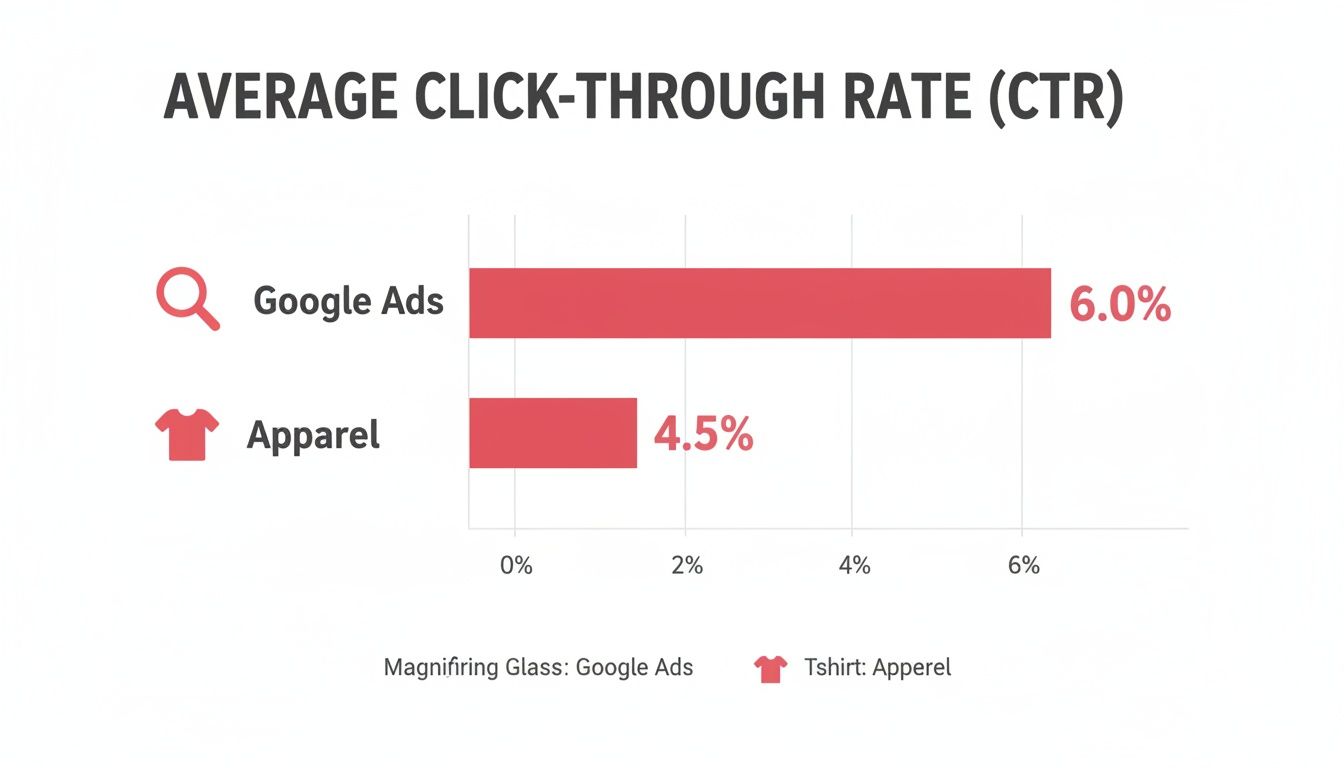
It’s a great reminder that when user intent is high, so is the potential for engagement.
Social Media Ads: Capturing Attention in the Feed
On platforms like Facebook, Instagram, and TikTok, the game is completely different. You’re not answering a direct question; you’re interrupting someone's social scroll. This means your creative has to work overtime to stop thumbs and earn that click.
- Facebook Ads: The average CTR usually sits around 1.11%. If you’re hitting anything above 2%, you’re doing something right with your feed ads.
- Instagram Ads: Because it’s so visual, the average is a bit lower at around 0.60%. The real wins here come from nailing your Reels and Stories creative.
- TikTok Ads: Benchmarks are still firming up, but a solid CTR is generally considered to be around 1%. The key is making your content feel native and creator-driven. Get the full scoop by checking out our guide on the latest TikTok ad specifications.
On social media, your secret weapon for a killer CTR is authenticity. User-generated content (UGC) sourced from real creators almost always outperforms polished, studio-shot creative because it feels like a genuine recommendation from a friend, not a disruptive ad.
Display Ads: Fighting Banner Blindness
Display ads – those visual banners you see scattered across websites – have the lowest CTR benchmarks by a long shot. People are usually there for the content on the page, and "banner blindness" is a real thing. We’ve all trained ourselves to subconsciously ignore those ads.
For display, a solid CTR is way down around 0.57% across most industries. That number is a stark reminder of just how challenging it is to get noticed. But for e-commerce brands, a benchmark of 0.51% for display can be supercharged by using creator-powered visuals that feel less like an ad and more like a recommendation.
This means that even hitting a 1% CTR on a display campaign can be a massive victory, especially if you’re using it for a smart remarketing strategy to target people who already know your brand.
Why Your CTR Is More Than Just a Number
While it's tempting to fixate on benchmarks, your click-through rate is so much more than a number to check against an industry average. Think of it as a health check for your marketing – a vital sign that tells you exactly how well your creative, messaging, and targeting are actually working together.
A high CTR is a direct signal to ad platforms that your ad is hitting the mark. On a platform like Google Ads, this relevance gets rewarded in a big way. A strong CTR boosts your Quality Score, which can unlock better ad placements and, more importantly, lower advertising costs. It’s a powerful feedback loop: great ads earn more clicks, and those clicks make the ads cheaper to run.
Reading the Story Your CTR Tells
To really get a handle on what a good click-through rate is, you have to look at it in the context of your entire marketing funnel. A CTR figure by itself can be seriously misleading. It confirms you earned a click, but it doesn't tell you if it was the right click.
For example, a sky-high CTR paired with a dismal conversion rate is a classic red flag. This usually points to a broken promise between your ad and your landing page. Your creative was catchy enough to get the click, but if the destination doesn’t deliver on that excitement, visitors will bounce immediately. You're basically paying for window shoppers with no intention of buying.
A high CTR with low conversions is a classic sign of misalignment. It tells you your ad is attractive, but your offer or landing page experience isn't sealing the deal. This is where you need to dig deeper into the user journey.
On the flip side, a low CTR isn’t always a disaster.
Imagine a campaign with a seemingly poor CTR of 1%, but the handful of people who do click are converting at an incredible 30% rate. This could mean your ad copy is acting as an highly effective filter, weeding out unqualified traffic and attracting only a small, hyper-relevant group of motivated buyers. In that scenario, the low CTR is a sign of extreme efficiency, not failure. To get a better handle on how different metrics influence each other, you can explore more about the different types of attribution modeling.
interpreting your CTR correctly means looking past the click itself. It’s about understanding the quality of the traffic it brings in and how that impacts your bottom line. Use it as a diagnostic tool to find weak spots in your funnel and start making smarter, more profitable decisions.
Key Factors That Influence Your Click Through Rate

Knowing the benchmarks is one thing, but actually hitting – and beating – them means getting under the hood of your campaigns. Your CTR isn’t just a random number; it’s the direct output of a few key ingredients working together.
Think of it like tuning an instrument. If one string is off, the whole chord sounds wrong. A high-performing campaign is no different – every single element needs to be in harmony to make the right kind of noise.
Audience Targeting and Relevance
If you take only one thing away from this guide, let it be this: relevance is the single biggest lever you can pull to improve your CTR. Are you actually showing your message to people who care? Even a Picasso of an ad will get ignored if it's shown to the wrong crowd.
This is where sharp audience targeting becomes your superpower. The goal isn't just to reach people, it's to match your ad so perfectly to their needs that clicking on it feels like the obvious next move. The tighter the alignment between your ad and your audience's intent, the higher your CTR will climb.
A tightly defined audience is your greatest asset. It’s far better to get a high CTR from a small, highly relevant group of 1,000 people than a low CTR from a generic, untargeted audience of one million. Precision beats scale every time.
The Power of Ad Creative and Your Offer
Your ad creative – the visuals, the copy, and the call-to-action (CTA) – is your first impression. In the world of endless scrolling, you have maybe two seconds to grab someone's attention and spark enough curiosity to earn that click.
- Visuals: High-quality, authentic, and eye-catching images or videos are table stakes now. For DTC brands, this is where user-generated content (UGC) from a diverse network of creators really shines. Content from real people feels more trustworthy and relatable than slick, polished ads, and that authenticity directly boosts engagement.
- Copy: Your headline and ad copy need to hit on a specific pain point or a deep-seated desire. It should be punchy, persuasive, and get straight to the point.
- Offer: What's in it for them? A weak offer gets a weak response. A strong, irresistible offer – like a limited-time discount or exclusive first look – creates urgency and gives people a compelling reason to click right now.
Ad Placement and User Device
Where your ad shows up is just as important as what it looks like. Think about it: an ad on Google Search, where someone is actively looking for a solution, is going to behave very differently than a display banner on a news site or a video ad in an Instagram Story.
The device they're using matters, too. Mobile users are often in a different mindset, more likely to click on quick, visual ads. Desktop users, on the other hand, might be more willing to engage with something that requires more reading or thought.
For example, organic search CTRs can be sky-high. Some top-ranked desktop sites in the News category can hit a 41% CTR. Yet, for e-commerce, we've seen first-position results for commercial queries like "buy" actually lose ground. This highlights why savvy e-commerce managers blend influencer content with strong on-page signals to win the click. You can explore more findings on organic CTR trends to see how these nuances play out across different devices and industries.
Practical Strategies to Dramatically Improve Your CTR

Alright, you get the theory behind CTR benchmarks and what moves the needle. Now comes the fun part: taking action.
Boosting your click-through rate isn't about finding one magic bullet. It's about a relentless process of testing, refining, and tweaking until you find the perfect combination that makes your audience have to click. Think of these strategies as your hands-on toolkit for turning passive impressions into active clicks.
Fine-Tune Your Ad Copy and CTAs
Your ad copy is your first impression. It has just a few seconds to stop a thumb from scrolling and earn that tap. The secret is to be specific, clear, and laser-focused on benefits.
The fastest path to a better CTR is rigorous A/B testing. Don't just pit one headline against another. Test completely different angles, play with emotional triggers, and experiment with your calls-to-action (CTAs).
- Create Urgency: Simple phrases like "Limited Stock," "Offer Ends Friday," or "Last Chance" create a sense of scarcity that nudges people to act now.
- Ask Engaging Questions: A headline like "Tired of Dull Skin?" hits a specific pain point and makes people want to click to find the answer.
- Focus on Benefits, Not Features: Nobody buys "hyaluronic acid." They buy what it does. Instead of listing ingredients, try "Get Visibly Plump, Hydrated Skin in 7 Days."
A strong CTA needs to tell someone exactly what to do next. Ditch the boring "Learn More." Get creative and test compelling alternatives like "Shop the Collection," "Get Your 20% Off," or "Claim Your Free Sample."
Refine Your Audience with Precision
A killer ad shown to the wrong people is a complete waste of money – it's like telling a great joke to an empty room. Precise audience targeting is everything. Dig deeper than broad demographics and start building audiences based on specific behaviors, interests, and past interactions with your brand.
Your most powerful targeting tool is often exclusion. Using negative keywords in search campaigns or excluding specific interests on social platforms ensures you stop wasting money on irrelevant impressions, which naturally improves your CTR among qualified viewers.
Seriously, think about who you don't want to see your ad. If you're selling premium leather shoes, you might exclude audiences interested in "vegan fashion." This one simple move makes your targeting sharper and your ad more relevant to the people who actually see it. For a deeper dive, explore these actionable strategies to improve click-through rates across your marketing channels.
Leverage Creator Content as Your Secret Weapon
In a world drowning in polished brand messages, raw authenticity is your biggest advantage. This is where creator-generated content absolutely crushes it, consistently outperforming slick, studio-shot creative. Why? It just feels real – like a genuine recommendation from a friend, not a hard sell from a corporation.
Sourcing a high volume of diverse creative from different creators is the key to rapid testing. It lets you quickly figure out what visuals and messages actually connect with your audience.
- Authentic Unboxings: There’s nothing like capturing the genuine excitement of a customer opening your product for the first time.
- Relatable Tutorials: Show your product solving a real-world problem in a way that feels natural and achievable.
- Before-and-After Shots: Visual proof is powerful. Let the results speak for themselves.
We saw one DTC skincare brand double its Instagram Story CTR overnight. All they did was swap their polished ads for a simple, authentic video from a creator showing her morning routine. It felt less like an ad and more like trusted advice, making the click feel earned, not forced.
Got Questions About Click-Through Rate?
Once you start digging into benchmarks and strategies, a few questions about click-through rate almost always come up. Let's run through the most common ones to clear up any confusion so you can move forward with confidence.
Think of this as your quick-reference guide for the tricky parts of CTR.
Is a High CTR Always a Good Thing?
Not always. It's a classic case of winning the battle but losing the war. While a high CTR feels great – it means your ad is relevant and grabbing attention – it only tells you half the story.
If all those clicks aren't leading to sales, sign-ups, or whatever your actual goal is, you might be attracting the wrong crowd. This usually happens when there's a disconnect between what your ad promises and what your landing page delivers. A high CTR with zero conversions just means you've gotten really good at paying for window shoppers.
Always look at your CTR next to your conversion rate and cost-per-acquisition (CPA). True success isn't just about getting a click; it's about getting the right click from someone who's actually going to convert.
How Do I Calculate CTR?
Calculating your click-through rate is refreshingly simple. You don't need to be a math whiz; the formula is super straightforward.
Here it is: (Total Clicks ÷ Total Impressions) x 100 = CTR (%)
So, if your ad was shown 10,000 times (impressions) and got 200 clicks, your CTR would be (200 ÷ 10,000) x 100, which comes out to 2%. The good news is you'll almost never have to do this math by hand. Every major ad platform like Google Ads or Meta Ads Manager tracks and reports this for you automatically.
How Much Data Do I Need to Judge My CTR?
This is a critical question because pulling the plug too early can be a huge mistake. You need enough data for the results to be what's called "statistically significant."
Making a call after just 100 impressions is basically just guessing. As a solid rule of thumb, wait until your ad or campaign has hit at least 1,000 impressions before you start making any firm decisions about its performance.
When you're A/B testing creative or copy, you have to be even more patient. You need to let the test run long enough for each version to get enough clicks or conversions for the platform to confidently tell you which one is the winner. Depending on your daily budget and audience size, this could take anywhere from a few days to a couple of weeks.
Ready to stop guessing what creative will work? With JoinBrands, you can access a network of over 250,000 creators to generate a steady stream of authentic, high-performing UGC to test and scale. https://joinbrands.com