



 AI Agents for Marketing: A Practical 2026 Guide
The creator and influencer marketing market grew from about $1.7 billion in 2016 to roughly $24 billion in 2024, then about $32.55 billion in 2025, a near-19x increase in less than a decade, according to creator marketing market statistics. That growth changes the operating question. Brands no longer need to ask whether creators belong in the media plan. They need to decide whether their process can control costs, verify authenticity, and turn each creator relationship into a reusable content asset.
A creator marketing platform is the infrastructure for that work. It connects discovery, briefs, communication, approvals, payments, rights, attribution, and reporting in one workflow. The value doesn't come from having another dashboard. It comes from helping a team make better decisions before money is committed, then proving what happened after the content goes live.
Table of Contents
What a Creator Marketing Platform Does
A creator marketing platform replaces disconnected outreach with a repeatable operating system. Instead of searching social networks, copying profile links into spreadsheets, sending individual messages, tracking delivery dates in separate documents, and building reports by hand, teams can manage the creator lifecycle from one place.
That lifecycle covers creator discovery, audience evaluation, campaign briefing, applications, contracting, product delivery, content review, payment, usage-rights management, and measurement. The exact feature mix varies, but the operational challenge stays consistent. Creator programs produce many dependencies, and manual coordination hides delays, weak fit, missing assets, and avoidable costs.
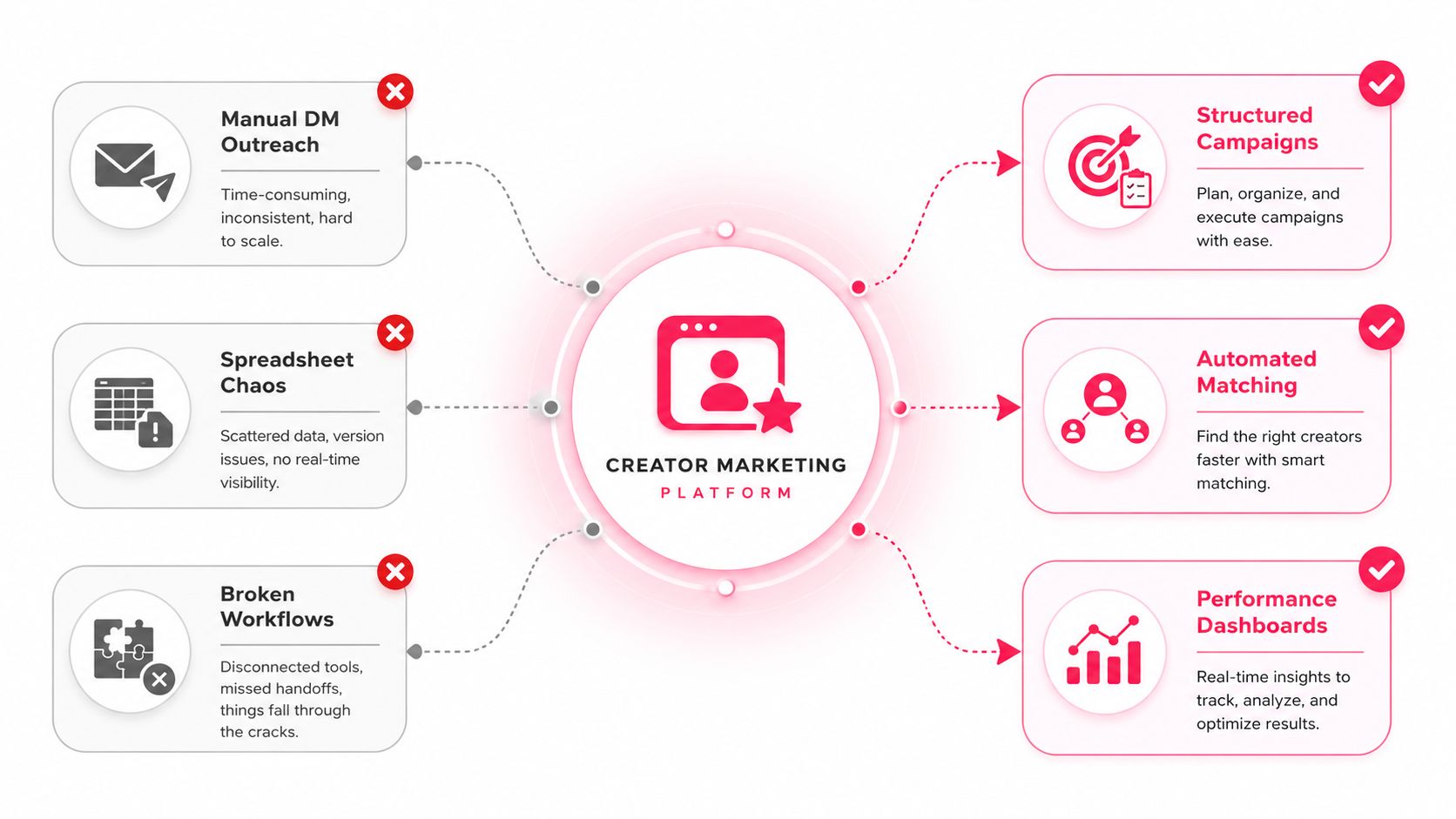
Creator marketing now spans Instagram, YouTube, TikTok, and other channels. U.S. influencer marketing spending was forecast at $7.1 billion in 2024, while the global Instagram influencer market was estimated to surpass $22 billion in 2025, according to Statista's influencer market data. A team can run a small test through email and spreadsheets, but that process becomes fragile as campaigns expand across markets, platforms, products, and creators. It also makes fraud checks, rights tracking, and content reuse harder to manage consistently.
The CRM analogy is useful
A CRM for influencer relationships is the clearest comparison. A CRM records conversations, stages, ownership, activity, and outcomes so sales teams can coordinate without relying on memory. A creator marketing platform applies that discipline to creator partnerships, while adding campaign-specific controls for briefs, assets, approvals, payments, and rights.
The platform should answer practical questions quickly:
- Who fits the brief: Which creators match the audience, category, format, geography, and brand-safety requirements?
- What has been promised: Which deliverables, deadlines, approval stages, usage rights, and fees apply to each collaboration?
- What has been delivered: Has the creator submitted the required format, included product details, and met the brief?
- What produced value: Which content generated reach, engagement, traffic, conversions, sales, or reusable paid-media assets?
A platform cannot repair weak strategy. It can expose weak process early. If a team selects creators only by follower count, writes vague briefs, skips audience-quality checks, or leaves usage rights undefined, software will not rescue the campaign. Its value comes from reducing administrative work while improving decisions that affect spend, authenticity, and asset value.
Practical rule: Buy the platform to control the workflow, not to collect more creator profiles.
The market projections show why repeatable operations matter. Estimates place the broader market at about $40.51 billion in 2026 and $152.56 billion by 2031, according to creator marketing market analysis. Those projections do not mean every brand needs enterprise software. They indicate that creator programs can become large enough to require systems that control costs, flag suspicious activity, and move approved content into additional channels without rebuilding the process each time.
Core Features That Drive Real Campaign Results
Feature lists often hide the core evaluation question: what failure does each capability prevent? A useful platform earns its cost by reducing wasted outreach, stalled approvals, poor creator fit, payment friction, or unverifiable results.
Matching should begin with fit, not reach
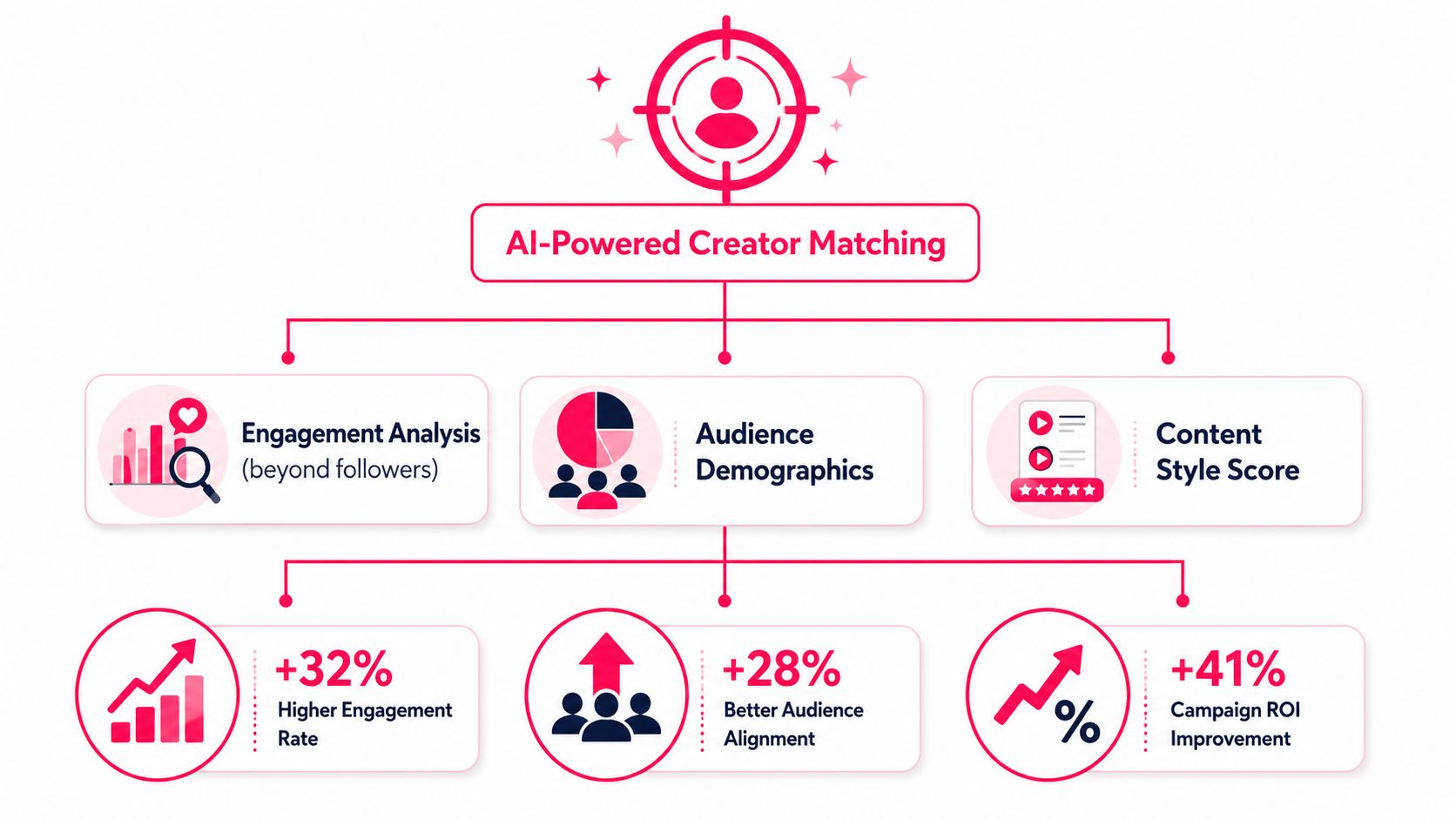
AI-powered matching is useful when it evaluates more than audience size. A practical matching layer should help a team inspect engagement quality, audience demographics, platform behavior, content style, category relevance, and past campaign signals. Follower count can provide context, but it can't tell you whether a creator can explain a technical product, demonstrate a beauty routine, or make a product feel native to a specific community.
Custom filters make that process actionable. A brand might filter for creators who publish short-form video, reach a defined market, produce product demonstrations, accept specific usage terms, and meet a minimum engagement-quality threshold. Without those controls, teams waste time contacting creators who look impressive in a directory but can't deliver the required asset.
Workflow features protect throughput
A structured brief should define the product, audience, message, deliverables, mandatory claims, deadlines, approval stages, and rights. Campaign tools should then connect that brief to creator applications, portfolio review, product dispatch, revisions, and payment.
Secure multi-brand tools matter especially to agencies. Client separation, permission controls, shared templates, and distinct reporting prevent one brand's assets or commercial terms from appearing in another account. The same principle applies to in-house teams managing multiple product lines. A shared workspace is useful only when ownership and access remain clear.
Analytics should change the next decision
Predictive analytics are valuable when they guide action rather than decorate a report. The system should help identify which creator attributes correlate with useful outcomes, which content formats deserve another test, and where a campaign is losing momentum.
Benchmarking provides the necessary context. CreatorIQ's benchmarking suite draws on data from over 1 million creators and 20,000 brands, covering 27 industries, 17 regions, 5 major social platforms, 4 follower tiers, and more than 9,000 unique data views, as described in its creator marketing benchmarks. The operational benefit is normalization. A brand can compare performance against a relevant peer group instead of treating one universal average as a decision rule.
A strong platform therefore connects discovery to measurement. If matching, approvals, rights, and attribution sit in separate tools, the team still carries the burden of joining the data and explaining discrepancies.
Who Needs a Creator Marketing Platform
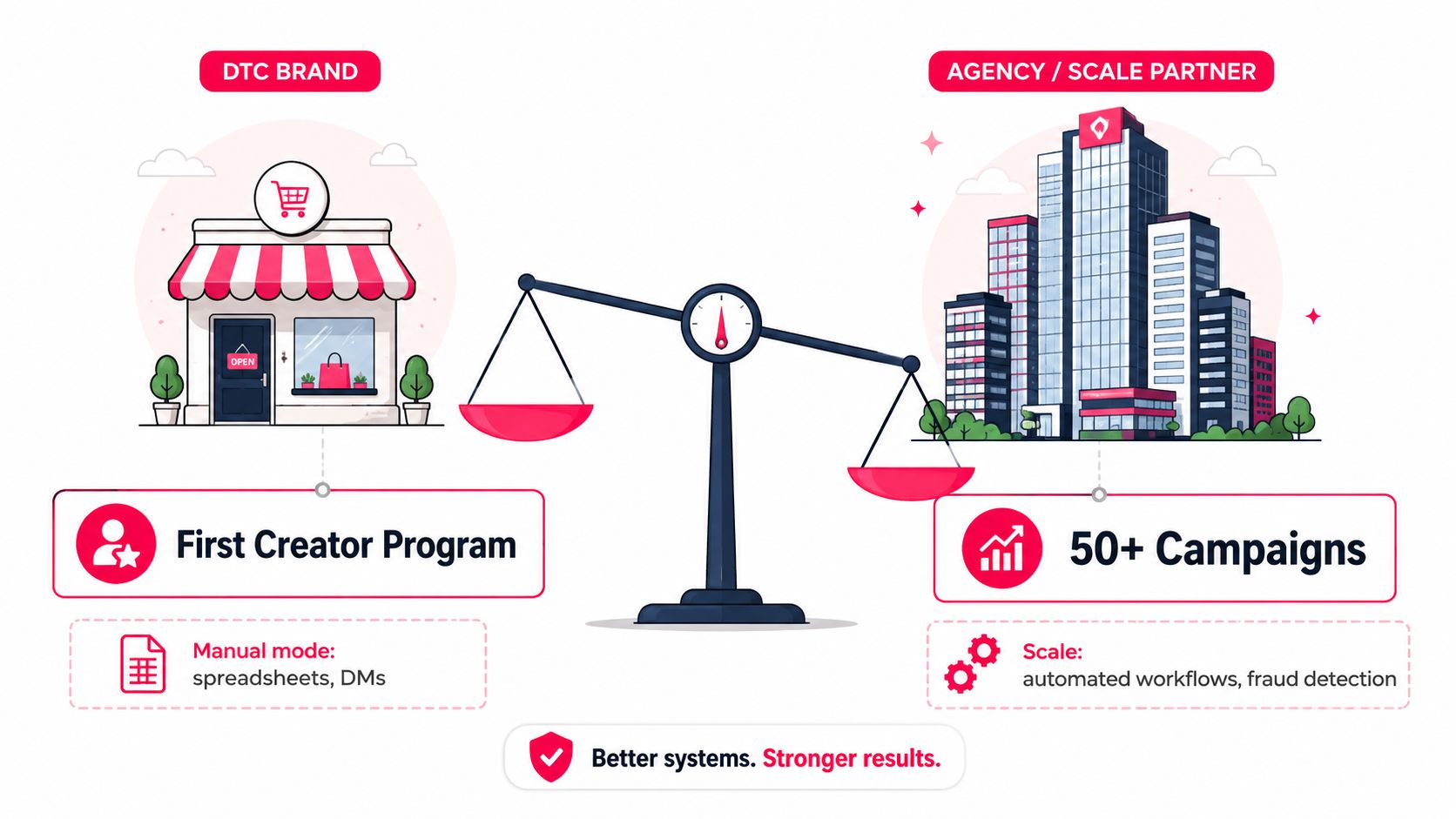
Not every creator program needs the same level of infrastructure. A DTC brand testing its first product-seeding campaign has a different problem from an agency coordinating dozens of client programs. The right buying decision depends less on company size than on workflow complexity, collaboration volume, compliance requirements, and measurement expectations.
Early-stage DTC teams
A startup or small ecommerce brand may only need discovery, a clear brief, messaging, content delivery, and secure payment. Manual tools can work while the team is learning which creator formats and audiences suit the product. The danger appears when spreadsheets become the memory of the program. Missed follow-ups, unclear rights, and inconsistent approvals usually arrive before the team recognizes that the process has outgrown its tools.
A marketplace or lightweight platform is often more appropriate at this stage than an enterprise suite. The buying criteria should be speed, transparent collaboration, creator relevance, and low commitment. Don't pay for complex forecasting before you have reliable campaign inputs.
In-house mid-market teams
An in-house team managing recurring campaigns needs more control. Product gifting, creator status, content approvals, affiliate links, usage rights, and performance reporting should connect in one operating flow. The team also needs a searchable history of past partnerships so strong creators can be reactivated instead of rediscovered.
A creator marketing platform begins replacing labor, not merely adding convenience. If several people touch the same campaign, a shared status view and defined approval ownership reduce internal delays.
Agencies and enterprise brands
Agencies prioritize client separation, white-label reporting, permissions, reusable workflows, and multi-brand security. Enterprise brands add global compliance, regional coordination, advanced analytics, contract governance, and integration requirements. Their platform must support local execution without destroying central visibility.
| Buyer | Primary need | Common mistake |
|---|---|---|
| Startup or small DTC brand | Fast testing and simple delivery | Overbuying enterprise functionality |
| Mid-market in-house team | Repeatable workflows and attribution | Keeping critical knowledge in personal inboxes |
| Agency | Client separation and scalable reporting | Treating every client campaign as a custom process |
| Enterprise brand | Governance, markets, rights, and analytics | Choosing network size over data quality |
A practical upgrade signal is operational friction. Move beyond spreadsheets when the team can't reliably answer who owns the next action, which assets are approved, what rights were purchased, or which creators drove meaningful outcomes. The platform should reduce those blind spots without forcing the team into a workflow that doesn't match its actual program.
How to Evaluate and Choose the Right Platform
A polished demo can make almost any platform look complete. The evaluation should happen against your own campaign, your own creators, and your own reporting requirements.
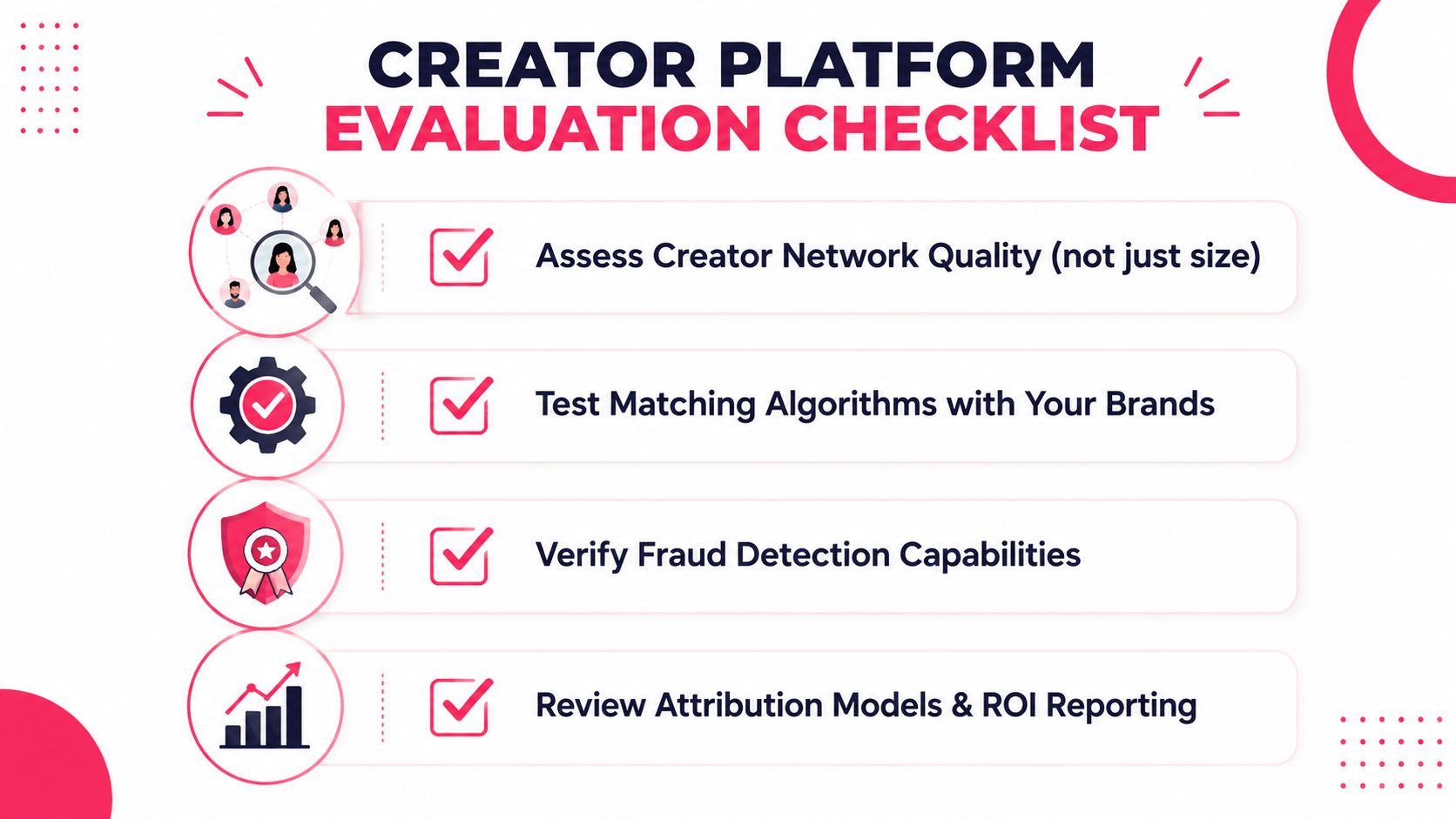
Start with the creator network. A large directory isn't automatically useful. Ask whether the platform has enough relevant creators in your category, target markets, formats, and audience segments. Review actual profiles and inspect audience quality, content consistency, recent activity, and commercial fit. If the vendor only shows network totals, request a search using your real brief.
Test the matching engine with live work
Give each shortlisted vendor the same campaign description. Include your category, target audience, required content format, geographic requirements, brand-safety exclusions, and usage needs. Compare the recommended creators, not just the interface. The useful question is whether the system finds creators your team would contact.
Then inspect the workflow from application to approval. Can you request revisions without losing the original submission? Can the team see deadlines, product status, rights, and payment status together? Can an agency keep client data separated while retaining an administrative view?
Make measurement a buying requirement
Ask the vendor to demonstrate attribution using a realistic scenario. You want to know how the platform handles creator links, discount codes, view-through influence, paid amplification, organic posts, and asset reuse. No single attribution model captures every creator effect, so the platform should make its assumptions visible rather than presenting one number as unquestionable truth.
Also check integrations with your store, advertising accounts, social channels, payment systems, and analytics stack. A platform that creates another isolated data store may add reporting work instead of removing it.
Use a pilot before an annual commitment. Select a representative campaign, define success criteria in advance, and include the people who will use the system daily. Measure practical outcomes such as time to shortlist, response management, approval turnaround, rights documentation, payment accuracy, and reporting effort.
Sales-demo question: “Show me the raw path from creator selection to attributed outcome, including what the system cannot measure.”
Pricing should match operating complexity. A pay-per-collaboration model can suit experimentation, while subscription software becomes more defensible when recurring volume makes automation valuable. Red flags include vague network claims, untestable matching promises, opaque data ownership, limited export options, unclear rights handling, and reports that show impressions without connecting them to a business objective.
End-to-End Campaign Workflow in Action
Consider a product launch managed through JoinBrands. The team begins by creating a brief that defines the product, audience, creative angle, required deliverables, deadlines, approval rules, and intended usage. A strong brief doesn't script every word. It gives creators enough context to produce content that meets commercial requirements while preserving their natural delivery.
The brand then reviews creator applications and portfolios against the brief. Instead of judging a profile in isolation, the team can assess whether the creator's existing work demonstrates the right pacing, storytelling, product handling, and platform-native style. That distinction matters. A creator can have a polished portfolio and still be a poor fit for a specific product or audience.
Where the work usually slows down
Product delivery and deadlines create the first operational test. Someone needs to confirm shipping details, track whether the creator received the product, monitor the production window, and follow up before a missed deadline becomes a launch problem. A centralized campaign view makes those responsibilities visible to the team.
Content approval creates the second test. The reviewer should be able to inspect the submitted asset, compare it with the brief, request a revision, and record approval without moving the file through disconnected email threads. The creator needs clear feedback, not a vague message that sends the project back into negotiation.
From approved asset to paid distribution
Once content is approved, the team can organize the next use rather than treating publication as the endpoint. A creator video may support an organic post, then move into paid distribution through Spark Ads, subject to the permissions and usage terms agreed in the campaign.
That workflow turns creator marketing into an operating loop. The brief informs selection, selection affects content quality, approval protects the asset, and rights determine where the brand can deploy it. Each step creates information for the next campaign, provided the platform preserves the record instead of leaving it scattered across chats and folders.
Solving the ROI and Fraud Measurement Challenge
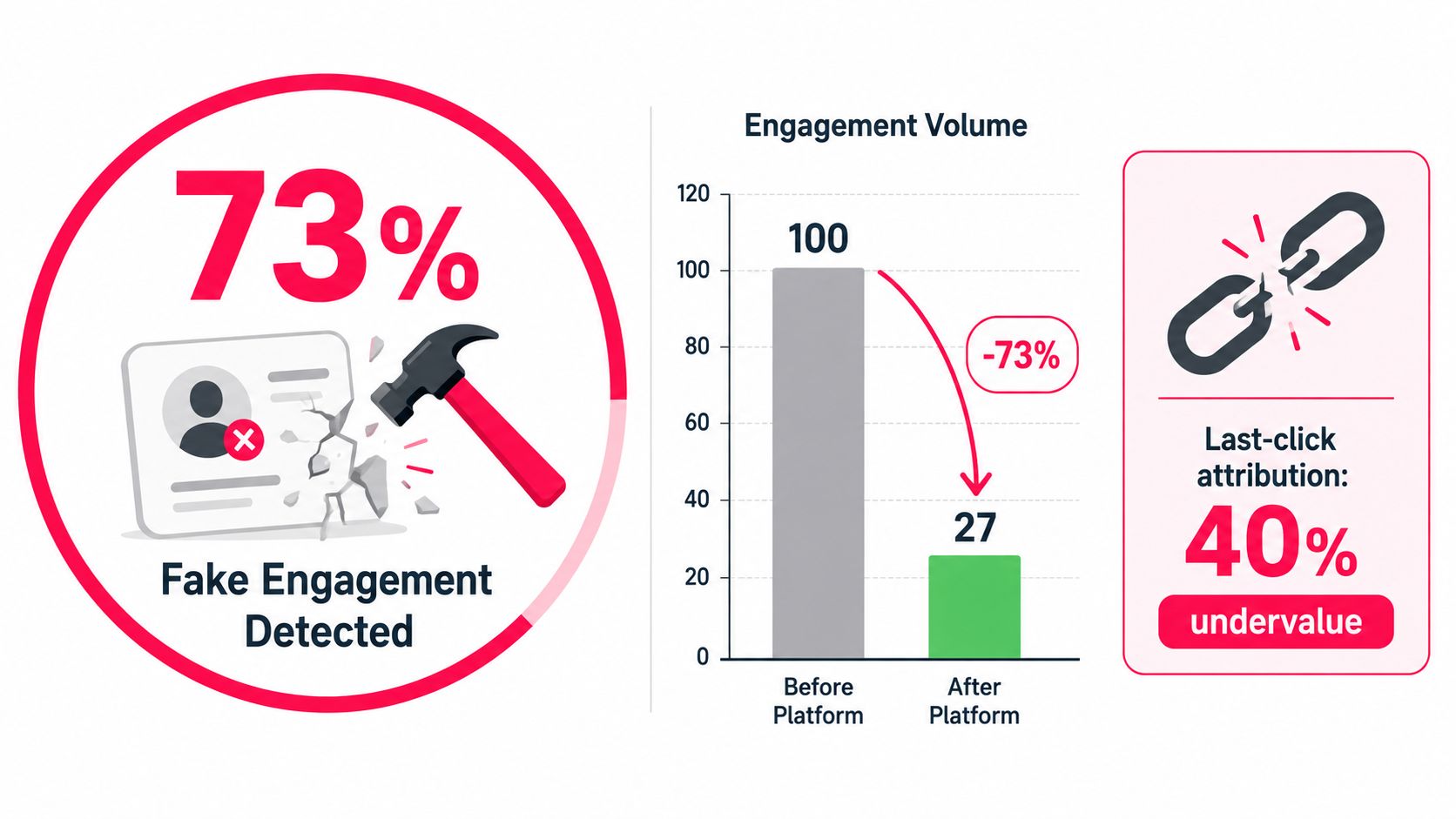
The most expensive creator mistake isn't always choosing the wrong creator. It's paying for activity that the team can't validate. Marketers report that finding influencers remains a challenge for 30%, while measuring ROI concerns 26.2% and fake engagement or authenticity issues account for 12.73% of concerns, according to the influencer marketing experts report.
Cost pressure makes that weakness harder to tolerate. A 2026 benchmark identified rising creator costs as the top marketer challenge at 35.4%, with budget constraints adding 5.28%, as reported in the influencer marketing benchmark report. Creator spend continues to expand, with U.S. creator spend projected at $37 billion in 2025 and $44 billion in 2026, so finance teams will expect a clearer explanation of what each dollar purchased.
Engagement isn't the same as impact
Follower count is a weak standalone selection criterion. A cited 2025 benchmark reports that 73% of brands prioritize engagement rate over follower count, with Instagram engagement ranging from about 0.47% for mega-influencers to 3.5% for nano-influencers, while TikTok overall engagement reached about 3.70%, compared with an Instagram average of 0.48%, according to this engagement-rate benchmark guide.
Those figures aren't a universal target. They show why teams must compare creators within the same platform and tier. A high rate can still be misleading if comments are generic, audience geography is irrelevant, or the content doesn't move people toward the intended action.
Use layered verification
Before committing budget, inspect the pattern behind the metric:
- Audience quality: Check whether the audience matches the market and customer profile you need.
- Interaction quality: Read comments and look for specific responses rather than repetitive or suspicious activity.
- Content consistency: Compare recent posts with older work to identify abrupt changes in topic, audience, or engagement behavior.
- Commercial evidence: Use trackable links, codes, landing pages, or platform commerce signals where appropriate.
- Benchmark context: Normalize results by platform, industry, region, and creator tier instead of judging raw averages.
Measure the campaign against a defined objective. Reach may be appropriate for awareness, while sales, qualified traffic, content production, or paid-media efficiency may matter more for an ecommerce launch. A creator marketing platform should expose the path between the chosen objective and the observed result, including limitations.
Treating Creator Content as Multi-Channel Media
A creator post shouldn't automatically be treated as a disposable placement. The more durable model is to commission content that can work across an ecosystem of video, newsletters, commerce, audio, retail media, connected TV, and display. Industry coverage expects U.S. brands to spend $13.7 billion on influencer marketing by 2027, while creator partnerships expand into retail media, connected TV, and display advertising, according to Digiday's 2026 creator marketing guide.
A single creator shoot can produce a TikTok video, an Instagram Reel, a YouTube Short, retail-media creative, and connected-TV cutdowns. That only works when the brief asks for versatile footage and the agreement clearly defines usage rights, editing permissions, channels, duration, territory, and paid amplification.
Rights are part of the asset value. A low-cost video with narrow permissions may be less useful than a more expensive asset the brand can legally adapt across its media plan.
Platforms help by keeping the brief, files, approvals, rights, and creator records connected. That gives the media team a searchable library instead of a folder full of clips with uncertain permissions. It also supports longer relationships, where a creator learns the product and brand standards over time while the brand builds a dependable source of fresh creative.
Average reported annual influencer marketing budgets grew 171% year over year, according to CreatorIQ's 2026 creator marketing trends report. That budget scrutiny favors proposals tied to cost per asset, conversion rate, sales contribution, or paid-usage value, rather than follower counts alone.
JoinBrands combines creator discovery and hiring across TikTok, Instagram, YouTube, and Amazon with campaign creation, applications, content approval, deliverable management, payments, AI-powered matching, customizable filters, and Spark Ads activation. Visit JoinBrands to evaluate whether its workflow fits your next creator campaign, then test it against a real brief and a clearly defined measurement plan.