


 Unlocking Gen Z Branding That Genuinely Connects
Monetizing your app is about way more than just slapping a “buy now” button on a feature and hoping for the best. It’s about building a sustainable business. To do that, you have to get deep into the weeds of your app's value and who you're building it for. The goal is to pick a strategy – whether that’s ads, subscriptions, or in-app purchases – that feels like a natural part of the experience, not a clunky interruption.
Table of Contents
Laying the Foundation for Monetization
Before you even think about writing a single line of code for a payment gateway, you need a rock-solid strategic foundation. The journey to a profitable app starts with a clear-eyed look at what your app does and for whom. This isn't about jumping on the latest trend; it's about building a revenue model that clicks perfectly with your app's core purpose and what your users actually expect from you.
The best monetization strategies feel like they belong. They’re baked into the app's DNA, not just bolted on at the end. For instance, a fast-paced mobile game can make a killing with in-app purchases for cool new gear or power-ups. On the other hand, a daily meditation app makes more sense with a subscription model that offers ongoing value. The secret is matching how you make money with the value you deliver.
Let's quickly review the most common monetization models to see the landscape of options available.
Core App Monetization Models at a Glance
This table gives you a quick rundown of the main ways apps make money. It helps to see everything in one place, matching the model to its ideal use case and how it actually generates revenue.
| Monetization Model | Best For | Revenue Driver |
|---|---|---|
| In-App Advertising | Casual games, social media, news, utility apps with high traffic. | Impressions (CPM), clicks (CPC), or views (CPV) on ads shown to users. |
| In-App Purchases (IAP) | Gaming apps (virtual currency, items), content apps (unlocking articles). | One-time purchases of digital goods, features, or content within the app. |
| Subscriptions | Content-heavy apps (streaming, news, fitness), SaaS, productivity tools. | Recurring payments (monthly/annually) for ongoing access to content or features. |
| Paid App (Pay-to-Download) | Niche utilities, professional tools, high-value indie games with a clear ROI. | A single, upfront fee to download and install the app from the app store. |
| E-commerce/Marketplace | Retail, DTC brands, service platforms connecting buyers and sellers. | Sales of physical goods, services, or taking a commission on transactions. |
| Affiliate/Sponsorships | Niche content apps, influencer-driven platforms, travel or lifestyle guides. | Commissions from referring users to other products/services or paid brand partnerships. |
Seeing these options side-by-side should spark some ideas. The right choice for your app often comes down to the fundamental value you're offering and the relationship you want to build with your users.
Aligning Your Model with User Expectations
First things first: what's your app's unique value proposition? What problem are you solving? A crisp answer to that question will naturally point you toward the most logical way to monetize.
Utility & Productivity Apps: If your app helps people save time or make money, they're usually open to paying for premium features that give them even more power. Freemium or subscription models are a great fit here.
Gaming & Entertainment Apps: These apps live and die by engagement. In-app purchases for things like virtual goods or extra lives feel native to the experience. Rewarded ads that offer in-game benefits also work incredibly well.
Content & Media Apps: When you’re providing a constant flow of great content – like news, music, or workout routines – a subscription is the most natural fit. It creates a predictable revenue stream and gives users unlimited access.
Your monetization strategy is a direct reflection of your app's promise to the user. If the value exchange is unclear or feels unfair, users will quickly churn. The goal is to make them want to pay because the benefit is obvious and compelling.
Integrating Monetization with Your Growth Strategy
Monetization and user acquisition are two sides of the same coin; you can't really separate them. If you get too aggressive with monetization too early, you risk scaring off new users before they even have a chance to fall in love with your app. But if you wait too long, you might devalue your app in their eyes – they’ll get used to it being completely free and resist any attempt to charge them later.
A smart move is to consider a hybrid approach right from the jump. Maybe your app is free to use with a few non-intrusive ads, but you offer a simple one-time purchase to remove them forever. This strategy caters to both casual users who don't mind the ads and your power users who are more than willing to pay for a premium, uninterrupted experience.
By planning for this from day one, you build an app that's not just valuable but also financially viable for the long haul. This kind of forward-thinking is essential for improving crucial metrics over time. For more on this, check out our guide on how to increase customer lifetime value. It’s all about setting your app up for lasting success.
Choosing Your Core Monetization Strategy
Figuring out how you're going to make money from your app is easily the most critical financial decision you'll make. It’s a choice that dictates everything that follows – your revenue, the user experience, and your path to growth. The trick is to pick a model that feels like a natural part of your app, not something clumsily tacked on.
This isn't about chasing trends. Just because a gaming app struck gold with in-app purchases doesn't mean that same playbook will work for your productivity tool. It's all about finding the perfect fit for your users and the unique value you provide.
To make this less of a guessing game, I like to use a simple three-step framework to guide the decision.
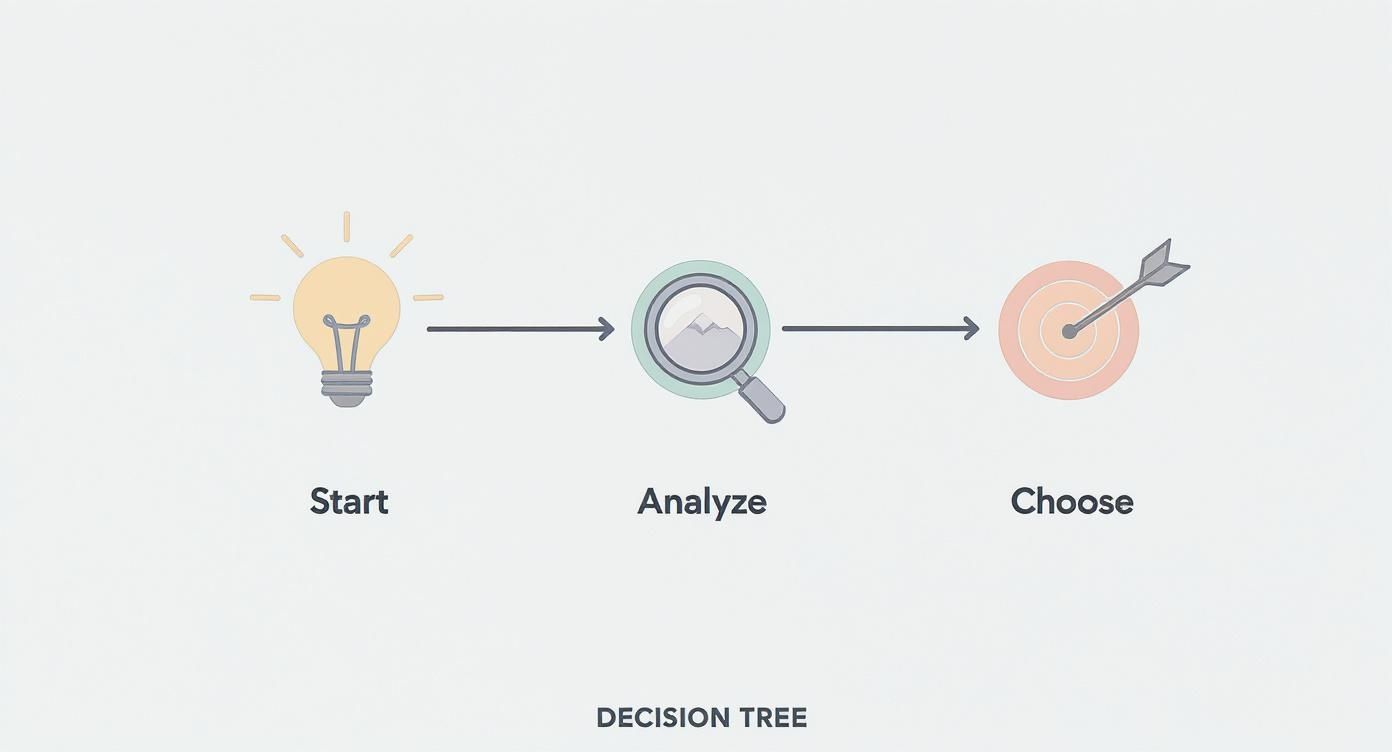
This process forces you to move from the initial idea, to a hard look at your app and its users, and finally to a specific monetization goal. It ensures your strategy is built on a solid foundation, not just a hunch.
Unpacking the In-App Purchase Model
The in-app purchase (IAP) model is an absolute giant. The concept is simple: you offer the app for free, then sell digital goods or features directly inside it. This model shines in apps where users can deepen their experience or get more value by making small purchases along the way.
The numbers are staggering. IAPs have become the industry's biggest money-maker, and they aren't slowing down. By 2025, in-app purchases are expected to pull in $514 billion, which is 55% of the entire $935 billion global mobile app revenue.
Here’s how IAPs usually break down:
- Consumables: Think one-time-use items. These are things users can buy over and over, like extra lives in a game or a pack of virtual currency.
- Non-Consumables: These are permanent unlocks. Buy it once, and you own it forever – like removing ads, unlocking a "pro" version, or getting a premium photo filter pack.
Gaming apps are the poster child for IAPs – think Clash of Clans players buying gems to speed things up. But it's not just for games. Productivity tools like Goodnotes use IAPs brilliantly, selling premium digital planners and sticker sets to their users.
Building Predictable Revenue with Subscriptions
Subscriptions have absolutely exploded in popularity, and for good reason: they generate predictable, recurring revenue. You know, the kind of revenue that lets you sleep at night. Users pay a regular fee, usually monthly or yearly, for continuous access to your content or premium features.
This model is a fantastic fit for any app that delivers ongoing value. The obvious examples are streaming services like Spotify and Netflix, but it’s just as powerful for fitness apps like Calm or Peloton that are constantly adding new meditations and workout classes.
A successful subscription model lives or dies by one thing: your ability to consistently deliver fresh, high-quality value. If your content gets stale, your revenue will too.
When you're thinking about subscriptions, consider offering different tiers. A "Basic" plan might give users a taste, while a "Premium" tier unlocks the whole buffet. This lets you appeal to different people with different budgets.
Leveraging In-App Advertising Intelligently
In-app advertising is one of the oldest and most common ways to make money, especially if your app has a big, active user base. You get paid when users see or interact with ads inside your app. Simple enough.
But here’s the catch: not all ads are created equal. The secret is to pick the right format and weave it into the experience so it doesn't feel disruptive.
- Rewarded Video Ads: These are genius. Users choose to watch a short video ad to get something in return, like in-game currency or a free article. Because it's opt-in, it feels fair and is highly effective.
- Native Ads: These are designed to look and feel like a natural part of your app. You see them all the time in social media feeds or news apps, where they blend right in with the other content.
- Banner Ads: These are the little ad strips you see at the top or bottom of the screen. They’re easy to implement, but they often have low engagement and can make an app feel cluttered. Use them sparingly.
Exploring Other Powerful Monetization Avenues
Beyond the big three, there are several other models that can work wonders for the right kind of app. For a more exhaustive look at your options, check out these proven mobile app monetization strategies.
Paid Apps (Pay-to-Download)
This is the most direct model out there: users pay once to download your app. It works best for apps that offer a very clear, high-value function right out of the box, like specialized professional tools or premium indie games. The biggest hurdle? Convincing people to pay upfront when "free" is the default.
Commerce and Marketplaces
If your app is built around transactions, taking a commission is a no-brainer. E-commerce brands like Nike use their app as a direct sales channel. Marketplace apps like Uber and Airbnb make their money by taking a small cut of every transaction they facilitate.
Affiliate and Sponsorships
This is all about getting paid to promote other companies’ products or services. A travel app could earn a commission every time a user books a hotel through an affiliate link. If you want to go deeper on this, our guide on what is affiliate marketing is a great place to start. Sponsorships are a bit different; a brand pays you directly for promotions, which is a great route for apps with a dedicated, niche audience.
Integrating Ads Without Hurting User Experience
Let's be real: nobody loves ads. But when you handle them the right way, they can be a powerful way to monetize your app without sending users running for the hills. The secret isn't just about slapping ads on the screen; it's about showing the right ads to the right users at the right time. Get this right, and ads feel less like an interruption and more like a fair trade for great, free content.
There's a reason in-app advertising has become a massive part of the mobile economy. Global spending is projected to blow past $390 billion by 2025, which accounts for a staggering 82.3% of all mobile ad spending. This isn't just about annoying pop-ups, either. The boom is fueled by smarter, more engaging formats like targeted and rewarded videos that users actually don't mind watching.
A clumsy, thoughtless ad strategy can tank your app's reputation in a heartbeat. The goal here is a delicate balance – one that respects your user's time while still hitting your revenue goals.
Choosing the Right Ad Formats
Not all ad formats are created equal, and your choice needs to sync up with your app's natural flow. Shoving a full-screen interstitial ad in the middle of a critical task is just asking for a one-star review.
Here’s a quick look at the most common formats and where they shine:
- Rewarded Video Ads: These are the gold standard for user-friendly ads. The concept is simple: a user chooses to watch a short video in exchange for something valuable in your app, like extra lives in a game or temporary access to a premium feature. It’s a clear value exchange, and users get it.
- Native Ads: These are the chameleons of the ad world, designed to blend right in with your app's content. Think of a sponsored post in a social feed or a product recommendation in an e-commerce app. When done well, they feel like they belong there.
- Banner Ads: These are the small, rectangular ads you usually see pinned to the top or bottom of the screen. They're easy to implement, but they also have the lowest engagement rates and can make your app look cluttered. Use them sparingly, and only where they won't get in the way of what the user is trying to do.
The best ad integrations are all about context. A rewarded ad lands perfectly just before a user needs a little boost, while a native ad feels right at home within a stream of content. Always ask yourself: "Does this ad help or hinder the user's journey right now?"
Leveraging Ad Mediation for Higher Revenue
Relying on a single ad network is like putting all your eggs in one basket. If their fill rates dip or their CPMs (cost per mille, or cost per thousand impressions) are in the gutter, your revenue takes a direct hit. This is exactly where ad mediation platforms save the day.
Think of a mediation platform as a smart auctioneer for your ad inventory. Instead of being locked into one network, it pings multiple ad networks at the same time. It then automatically serves the ad from whichever network is willing to pay the most for that specific impression. This simple switch boosts both your fill rate (the percentage of ad requests that actually get filled) and your overall revenue. You literally get the best price every single time.
Segmenting Users for a Smarter Ad Experience
This might be the most powerful tactic for integrating ads without annoying your users: segmentation. The idea is simple: not every user should see the same ads – or any ads at all.
Your most loyal customers – the ones who've made in-app purchases or are subscribed to your premium plan – have already voted with their wallets. Hitting them with ads is a quick way to devalue their purchase and push them toward the churn door.
Instead, use your analytics to create a couple of basic user segments:
- Non-Paying Users: This is your prime audience for ad-based monetization. They get the full, thoughtfully integrated ad experience.
- Paying Users/Subscribers: This group should get a completely ad-free or significantly ad-reduced experience. It reinforces the value of what they paid for and makes them feel like the VIPs they are.
This approach turns your ad strategy from a blunt object into a precision tool. You can generate revenue from your free user base without alienating the customers who are already paying you directly. This is a core principle of performance-based advertising, where the focus is on driving specific actions, not just showing ads to everyone. You can learn more about how this model works in our guide on what is performance-based advertising. By tailoring the ad experience, you create a better app for everyone involved.
Nailing Your Pricing and Payment Systems
Okay, so you've picked your monetization model – that's like deciding where you want to go. Now it’s time to actually build the car that’ll get you there. This is the fun part where technical nuts and bolts meet your financial strategy, turning a plan into a real, money-making machine.
Getting your in-app products and payments sorted out is way more than just plugging in a payment gateway. You'll be diving into the developer consoles for Apple and Google, creating product SKUs, figuring out subscription terms, and making sure your backend is rock-solid for handling transactions. It's a critical step, but we'll break it down.
Setting Up Your In-App Products
Both Apple’s App Store Connect and the Google Play Console have pretty robust systems for managing in-app purchases and subscriptions, but they do require a careful touch. Your first job is to define exactly what you're selling within their dashboards.
If you’re just offering a one-time purchase – say, an "ad-free" upgrade or a bundle of in-game coins – the setup is fairly straightforward. You’ll create a new product, give it a unique ID, set a price, and write a description that makes people want to click "buy."
Subscriptions, however, bring a bit more complexity to the table. You'll need to define a few key things:
- Subscription Groups: Think of these as families of related subscription options. For example, a "Pro Plan" group could contain both monthly and annual tiers.
- Duration: This is simply the length of each billing cycle, whether it’s weekly, monthly, or yearly.
- Pricing: The cost for each duration. Pro tip: always offer a nice discount for longer commitments to lock in that revenue.
- Free Trials or Introductory Offers: These are your secret weapons for converting curious users into paying customers, but you have to configure them correctly in the console.
Pro Tip: I can't stress this enough: make your product IDs consistent and descriptive across both platforms. Something like
com.yourapp.pro.monthlyandcom.yourapp.pro.annualwill save you from a world of hurt when you're coding the integration and digging through analytics later.
Mastering Pricing Psychology and Strategy
How you price your app is just as important as what it does. Just plucking a number from thin air is a guaranteed way to leave money on the table. Instead, let's lean on some proven pricing psychology to make your offers irresistible.
You’ve seen Charm Pricing everywhere – it’s the classic strategy of ending a price with a 9, like $9.99 instead of $10.00. It feels almost silly, but it works. That simple one-cent difference makes the price feel significantly lower in a customer's mind.
But don't stop there. Get a little more strategic with your approach:
- Tiered Pricing: This is a classic for a reason. Offer a few different packages (think Basic, Pro, Premium) with more features and value at each level. This lets you appeal to different types of users with different budgets, casting a much wider net.
- Usage-Based Billing: Perfect for certain types of SaaS apps, this model charges customers based on how much they actually use your service – like data storage or API calls. People see this as incredibly fair because the cost scales directly with the value they’re getting.
Managing the Subscription Lifecycle
For any app running on subscriptions, the first sale is just the beginning of the journey. Your long-term success hinges on managing the entire subscriber lifecycle, which really means one thing: preventing churn.
A huge part of that is handling billing issues with grace.
When a subscriber’s payment fails – and it will – don't just immediately cut off their access. That’s a terrible user experience. Instead, implement a grace period to give them a window to update their payment info. Use friendly in-app messages and gentle email reminders to let them know what's going on.
As you grow, you absolutely have to automate these processes. For any app built on recurring revenue, using advanced subscription management tools can drastically reduce involuntary churn and boost your LTV. These systems can automate dunning (the process of chasing down failed payments), handle smart payment retries, and give subscribers a portal to manage their own details. This is the technical backbone that allows a monetization strategy to really flourish over the long haul.
How to Optimize and Scale Your App Revenue
Getting your monetization strategy live isn't the finish line; it's the starting gun. The real work begins now, with relentless optimization. This is where you evolve your initial setup into a fine-tuned revenue engine, turning raw user data into smart, scalable growth.
This ongoing process of refinement is what separates the apps that just get by from the ones that truly dominate their category. It’s about becoming a scientist in your own ecosystem – constantly testing, measuring, and learning what makes your users tick, and more importantly, what makes them pull out their wallets.
Key Metrics That Drive Monetization Growth
You can't grow what you don't measure. Forget about vanity metrics like download numbers; they feel good, but they don’t pay the bills. To really scale your revenue, you need to live and breathe the KPIs that tell the true financial story of your app.
These are the numbers that matter:
- Average Revenue Per User (ARPU): This is your total revenue divided by your total number of users. Think of it as a high-level health check, telling you exactly how much each user is worth on average.
- Customer Lifetime Value (LTV): This metric goes deeper, predicting the total revenue you can expect from a single user over their entire time with your app. A high LTV means you're not just acquiring users, you're keeping the valuable ones around.
- Conversion Rate: Simply put, this is the percentage of users who take a specific monetary action – upgrading to a paid plan, buying an in-app item, or clicking a rewarded ad. Improving this is the fastest way to see a direct revenue lift.
- Churn Rate: The percentage of users who ditch your app or cancel their subscription in a given period. High churn is a monetization killer. Plugging this leak is just as critical as finding new customers.
As a rule of thumb, a sustainable business model should have an LTV that is at least three times its Customer Acquisition Cost (CAC). If you're spending more to get users than they're worth, something needs to change, fast.
Running A/B Tests to Find What Works
Your most powerful tool for optimization? A/B testing. It’s the simple but profound process of showing two different versions of something – a price point, an ad placement, a paywall design – to different user groups to see which one performs better.
Guesswork has no place here. You need to test everything.
Start with a clear hypothesis. For instance: "I believe changing our annual plan's button from 'Upgrade Now' to 'Save 40% Today' will increase conversions by 15%." Then, run the test and let the data prove you right or wrong.
Here are a few high-impact areas to start testing immediately:
- Pricing Points: Test $4.99/month versus $5.99/month. You might be shocked to find the higher price converts just as well, instantly boosting your ARPU.
- Trial Length: Is a 7-day trial better than a 3-day one? Or maybe 14 days? Shorter trials create urgency, while longer ones give users more time to see the value. Test it.
- Paywall Design: Experiment with the layout, copy, images, and even social proof on your paywall. Adding a few user testimonials could be the small tweak that makes a massive difference.
- Ad Frequency: For ad-supported apps, find the sweet spot. Try showing an ad every three levels in a game versus every five. The goal is maximum revenue with minimum user annoyance.
A/B testing isn't a one-and-done task. It's about building a culture of continuous improvement, where every decision is backed by real user behavior, not just gut feelings.
Creating Multiple Revenue Streams with Hybrid Models
Why put all your eggs in one basket? The smartest and most successful apps often use a hybrid monetization model, blending two or more strategies to appeal to different user segments.
Think about your user base. Some people will never pay for a subscription but don’t mind watching an ad to get a reward. Others despise ads and will gladly pay for a premium, clean experience. A hybrid model lets you serve both, maximizing your revenue potential.
Here are a few powerful combinations I’ve seen work wonders:
- Subscription + IAPs: A meditation app might offer its main library through a subscription but also sell one-off "course packs" for specific goals like "Better Sleep." This lets hardcore users spend more and gives non-subscribers a way to pay for just what they need.
- Ads + IAP to Remove Ads: A timeless classic for a reason. Offer the full app for free with ads, but include a simple one-time purchase to get rid of them forever. It's a crystal-clear value proposition that works.
- Freemium + Rewarded Ads: A productivity app could offer its core features for free, but let users unlock a premium feature for 24 hours by watching a rewarded video. This acts as a perfect "try before you buy" funnel into a full subscription.
By layering your monetization, you build a more resilient and profitable app. You're no longer reliant on a single income source and have created a flexible system that meets users where they are, setting you up for long-term, scalable growth.
Burning Questions About App Monetization
Diving into the world of app monetization can feel like navigating a minefield. Everyone's got questions, and getting straight, no-fluff answers is key to making the right calls for your app's future. Let's tackle some of the most common ones I hear from founders and developers.
What’s a Actually the Most Profitable Monetization Model?
This is the million-dollar question, isn't it? The honest answer is there’s no magic bullet. The "most profitable" model is the one that fits your app, your audience, and the value you're delivering like a glove. It’s all about alignment.
For instance, subscriptions are absolute gold for apps that offer continuous, evolving value. Think of a meditation app that adds new sessions weekly or a design tool that constantly updates its asset library. On the flip side, the gaming world practically runs on in-app purchases (IAPs), where selling digital goods or power-ups drives insane revenue. And for apps with massive, broad user bases – like a simple utility or a news aggregator – in-app advertising often ends up being the most lucrative route.
The best model never feels like a roadblock; it feels like a natural part of the user experience.
Can I Change My Monetization Model After I Launch?
Absolutely. You can definitely pivot your strategy after you've launched, but you have to tread very, very carefully. A sudden switch, especially going from totally free to a paid subscription, can feel like a bait-and-switch to your early, loyal users. That's a quick way to get hit with a storm of one-star reviews.
The key is managing the transition with transparency and respect. A proven strategy is to "grandfather" in your existing users. This means they get to keep the access they originally had, either for free or at their old price, while the new model only applies to new people signing up.
Always over-communicate any changes well in advance. Explain why you're making the shift – maybe it's to fund exciting new features or just to keep the lights on. Your community will be way more understanding if they feel like they're part of the journey.
How Long Until My App Actually Starts Making Money?
The timeline for profitability is all over the map. For paid apps that have a killer pre-launch marketing campaign, you could see revenue coming in from day one. But that upfront price tag can also be a huge barrier, slowing down your initial user growth.
For freemium models that depend on ads or IAPs, you need to play the long game. It often takes several months – sometimes even a year or more – to build up a user base that's big enough to generate real income. In the early days, your focus should be 100% on growth and engagement. Once you have a critical mass of active users who love your app, the money will follow. Don't sacrifice a great user experience by chasing revenue too early.
What Exactly Is a Hybrid Monetization Model?
Think of a hybrid model as a smarter, more flexible approach that mixes two or more monetization methods. It’s built on the simple truth that not all of your users are the same. A hybrid strategy lets you earn revenue from different types of users in different ways.
This approach makes your business more resilient and, frankly, often a lot more profitable.
- Ads + IAP: This is a classic in mobile gaming. The game is free to play with ads, but you can make a one-time purchase to get rid of them forever.
- Subscription + IAPs: A language-learning app might have a monthly subscription for its core lessons but also sell one-off "deep dive" course packs on specialized topics.
- Freemium + Rewarded Ads: A photo editing app could offer basic tools for free, but let users unlock a premium filter for 24 hours just by watching a quick video ad.
By giving users options, you create multiple revenue streams and cater to everyone from the casual user to the hardcore fan.
Ready to connect with creators who can showcase your app to the world? JoinBrands provides an all-in-one platform to find and collaborate with top-tier influencers and content creators, driving user acquisition and boosting your brand's visibility. Start your first campaign today at https://joinbrands.com.