





 TikTok Ad Price: Your Guide to Costs & ROI in 2026
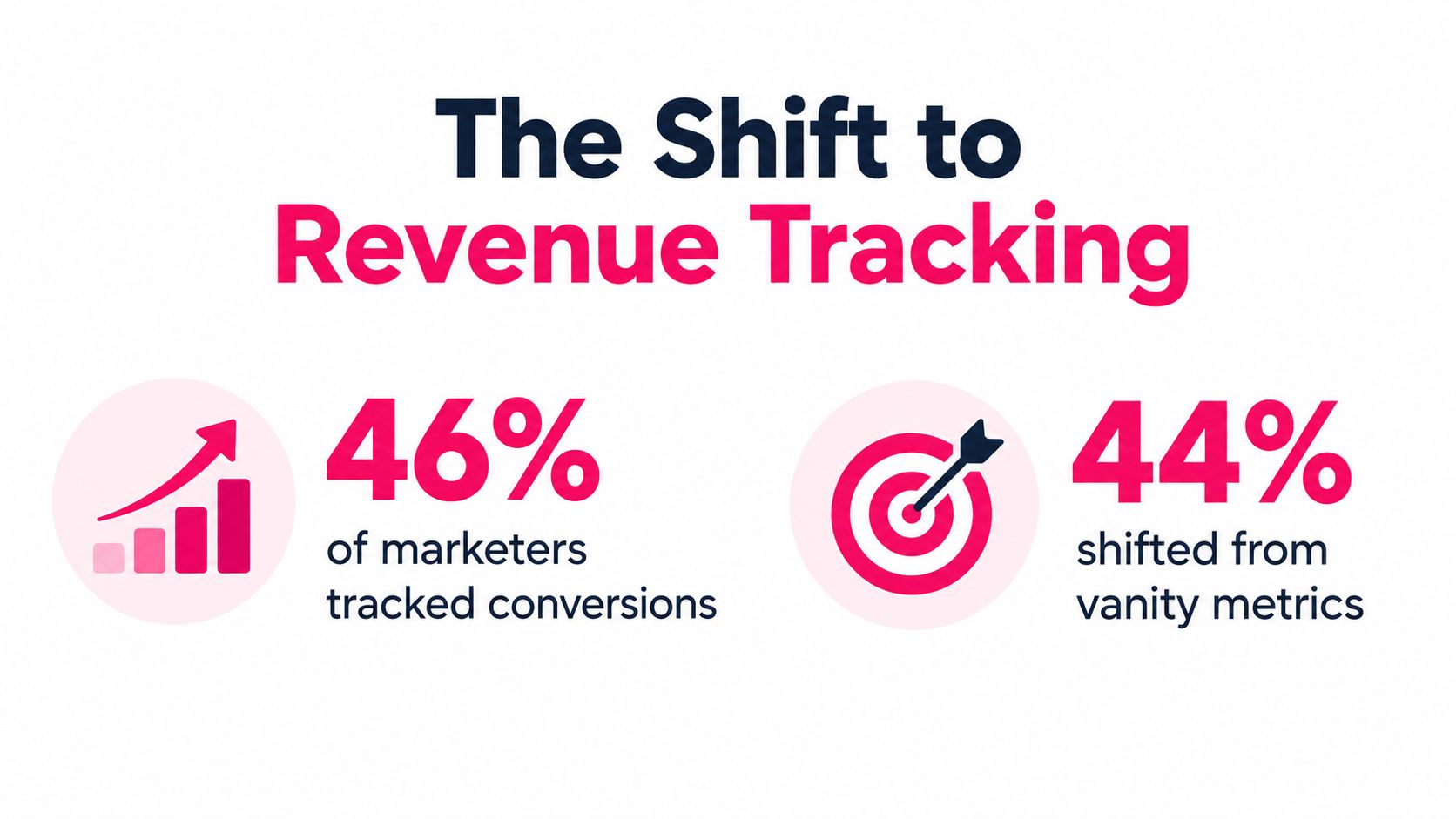
In 2024, 46% of marketers tracked conversions and 44% tracked sales as influencer-program success metrics. Effective influencer campaign tracking connects those outcomes to each creator, platform, content asset, and customer journey instead of stopping at reach or likes.
That shift changes the operating model. A campaign dashboard isn't just a post-campaign report for stakeholders. It should help a DTC team decide which creators to renew, which creative angles to amplify, and whether creator-generated demand is incremental or merely capturing buyers who would've converted through another channel.
Table of Contents
Why Influencer Campaign Tracking Has Shifted Toward Revenue
The 2024 movement toward revenue metrics is clear. Conversion tracking reached 46% and sales tracking reached 44%, increases of 11.6 and 13.7 percentage points from 2023, respectively, according to Archive's influencer campaign tracking statistics. The important change isn't the dashboard itself. It's that brands are connecting creator activity with events that affect budget allocation, optimization, and renewal decisions.
That doesn't make reach and engagement irrelevant. A 2026 benchmark found that 91% of brands track engagement rate, 84% track impressions or reach, 78% track click-through rate, and 72% track sales or revenue attribution in influencer campaigns, as reported by IQFluence's influencer marketing benchmark. The stack is layered because each metric answers a different question. Reach shows distribution, engagement shows audience response, clicks show intent, and revenue shows commercial output.
For ecommerce teams, the operational implication is straightforward. Social analytics, ecommerce events, affiliate links, promo codes, and CRM records need to describe the same campaign using shared creator and campaign identifiers. Otherwise, a TikTok view sits in one report, a Shopify order sits in another, and an email-assisted purchase has no reliable connection to the original creator touchpoint.
Why vanity reporting fails
Vanity metrics fail when teams use them as a proxy for business value without testing the relationship. A creator can produce strong interaction but weak product consideration, or drive clicks from an audience that doesn't purchase. The useful question isn't “Which post got the most likes?” It's “Which content generated qualified demand at an acceptable acquisition cost, and what evidence suggests the demand was incremental?”
Measurement remains difficult. A 2025 WFA report found that 63% of respondents identified proving ROI and tracking performance as their biggest barrier, while only 25% could confidently link influencer campaigns to sales and 23% used conversions or sales as a success metric. The same report says 94% prioritized views, reach, and impressions, while 89% prioritized engagement. Those figures, available in the WFA report on effective influencer marketing, expose the gap between what teams can easily report and what finance leaders need to understand.
Practical rule: Treat reach and engagement as diagnostic signals. Treat sales, revenue, CAC, and incrementality as decision signals.
Choosing the Right KPI Stack and Metric Definitions
Start with the campaign objective, then assign metrics to the stage where they provide useful evidence. A fixed KPI stack prevents teams from adding whichever metric looks favorable after content goes live.
| Funnel stage | Primary metrics | What the team should learn |
|---|---|---|
| Awareness | Reach, impressions, views | Did the content distribute effectively? |
| Engagement | Likes, comments, shares, saves, engagement rate | Did the audience respond to the creative? |
| Consideration | Click-through rate, landing-page sessions, sign-ups | Did the content create measurable intent? |
| Conversion | Purchases, revenue, conversion rate, CPA or CAC, ROAS | Did the activity produce efficient commercial results? |
The Influencer Strategists performance report describes this multi-stage approach and reports that 91% track engagement rate, 84% track impressions or reach, 78% track CTR, 72% track sales or revenue attribution, and 66% track ROAS. A separate benchmark cited in the same practical framework found that 71% track sales from influencer campaigns. Use those categories as a measurement architecture, not as a reason to copy every KPI into one crowded dashboard.
Lock the denominator before launch
Engagement rate is only meaningful when everyone agrees on the denominator. A common formula is:
Engagement rate = total engagements ÷ total followers × 100
Using the example documented in Superfiliate's field guide to influencer campaign success, a post with 800 engagements and 40,000 followers produces a 2% follower-based engagement rate. Some teams divide engagements by reach or views instead. Either choice can work, but mixing them invalidates comparisons.
Compare creators only within the same platform, niche, and deliverable type. A short TikTok video, an Instagram Story, and a YouTube integration have different distribution mechanics and different available denominators. Build a rolling benchmark sheet with separate fields for platform, format, audience segment, fee, reach, impressions, views, engagements, clicks, conversions, and revenue.
Standardize efficiency formulas
Use consistent formulas for commercial comparisons:
- CPM: cost ÷ impressions × 1,000
- CPV: cost ÷ views
- CPA or CAC: total campaign cost ÷ attributed conversions
- ROAS: attributed revenue ÷ total campaign cost
Don't let a high engagement rate overrule weak conversion economics when the campaign's stated objective is sales. Conversely, don't judge an awareness creator only by direct purchases if the brief was designed to build discovery. The KPI stack has to reflect the job assigned to the content.
Setting Up UTMs, Promo Codes, Pixels, and Affiliate Links
Instrumentation happens before the creator publishes. Give every creator and every relevant deliverable a distinct tracking identity, then test the full path from social post to landing page, checkout, order record, and CRM profile.

A practical UTM structure might include:
- utm_source: the platform, such as Instagram, TikTok, or YouTube
- utm_medium: influencer
- utm_campaign: the campaign identifier
- utm_content: the creator handle plus post or deliverable identifier
The exact naming matters less than consistency. Use lowercase values, document the convention, and keep the same creator ID across the link, affiliate record, promo code, content approval record, and ecommerce report.
Use several attribution signals
UTMs identify clicks that reach your site. They won't capture every purchase. A customer may see a creator video, search for the brand later, type the URL manually, and purchase on another device. Pair UTMs with a unique promo code and, where appropriate, an affiliate link. ReferralCandy's tracking guidance recommends combining unique links or discount codes with pixels and holdout or incrementality tests to connect creator activity with downstream actions.
Promo codes are particularly useful as a backup signal. Assign one code per creator, avoid reusing codes across simultaneous partners, and define whether redemption is attributed to the creator regardless of the click source. Affiliate links add more granular conversion tracking, especially when each post or platform receives its own link.
Install the relevant analytics and advertising pixels on the landing page and checkout journey, while respecting consent requirements and platform policies. Pass campaign and creator identifiers into ecommerce events, then preserve them in CRM fields for leads, subscriptions, or delayed purchases.
Pro tip: Test every link in a clean browser session, apply every code, complete a test order, and verify that the creator, campaign, revenue, and order status appear correctly in each downstream system.
The most common failures are operational rather than strategic. Teams mistype UTM parameters, omit campaign values, use one discount code for several creators, or change naming conventions halfway through a launch. Create a pre-launch checklist covering link validation, code collision checks, pixel events, affiliate attribution, landing-page redirects, CRM persistence, and refund handling.
Use a short implementation review before publication. A missing parameter discovered after the post goes live can't be reliably reconstructed later.
Choosing Between Last-Click and Multi-Touch Attribution
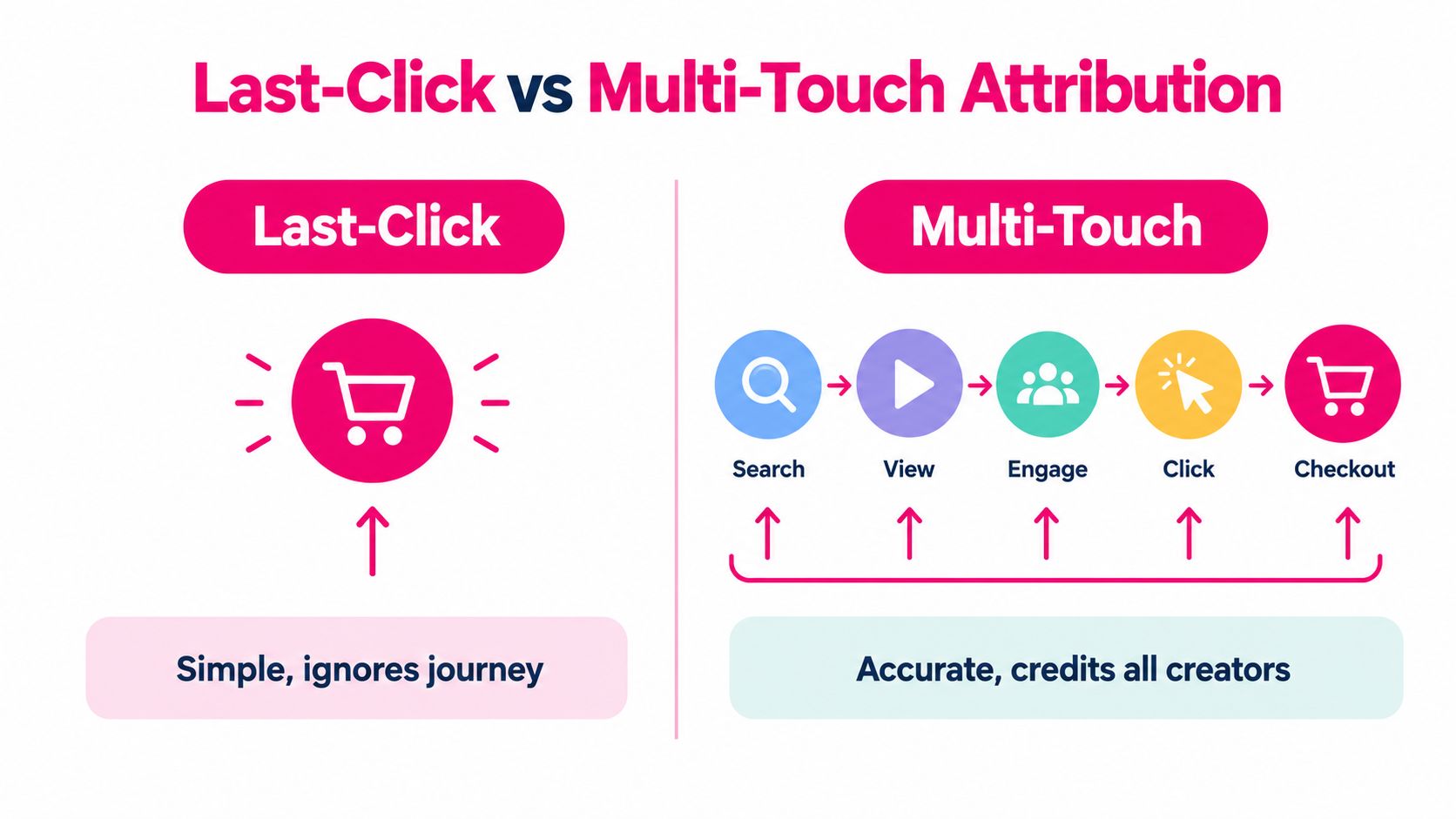
Last-click attribution is attractive because it's easy to explain. It assigns the conversion to the final measurable interaction before purchase, often an affiliate link, a retargeting ad, branded search, or an email click. That makes it useful for validating direct-response mechanics, but it systematically understates creators who introduced the brand or shaped consideration earlier.
A creator journey can move through Instagram, TikTok, YouTube, an affiliate link, a promo code, a landing page, a CRM sequence, and a retargeting ad. Manual spreadsheets tend to fragment that journey, especially when different systems use different customer IDs, timestamps, and attribution windows. Improvado's coverage of influencer marketing ROI describes this fragmentation and points toward unified commerce data, automation, and incrementality testing as responses to the problem.
Match the model to the decision
| Model | Useful for | Main limitation |
|---|---|---|
| Last click | Checking direct conversion capture and affiliate performance | Undervalues discovery and assisted influence |
| First touch | Understanding which creators introduce new audiences | Over-credits the first interaction |
| Linear multi-touch | Showing participation across several touchpoints | Assumes every touchpoint matters equally |
| Time decay | Giving more weight to interactions closer to purchase | Can still undervalue early awareness |
| Position based | Balancing first and last interactions | Uses a fixed rule rather than observed causal impact |
Use last click as one view, not the verdict. A conversion-focused product with a short decision path may rely heavily on direct links and codes. A considered purchase, recurring product, or broad launch needs assisted-conversion reporting and a longer window that reflects how customers actually research.
Test incrementality instead of assuming influence
Attribution identifies correlation. It doesn't prove that the creator caused the purchase. A holdout or control-group design can compare exposed audiences with a similar unexposed group, provided the audience definition, timing, and conversion event are sound. Geo-based tests, audience splits, and creator-level holdouts can work when the team has enough traffic and clean exposure data.
The right framework depends on data maturity. Start with last-click and code reporting if the data foundation is incomplete, add multi-touch paths as systems connect, then use controlled tests to challenge the assumptions in both models.
Integrating Tracking Data With E-Commerce and Reporting Cadences
A useful reporting system has one row per creator and deliverable, with enough detail to connect social performance to commercial outcomes. Pull platform metrics, affiliate activity, pixel events, ecommerce orders, refunds, and CRM outcomes into a shared structure. Preserve the original source data, then calculate normalized metrics in a reporting layer rather than editing exports manually.
Use different cadences for different decisions:
- During launch: monitor delivery, links, codes, spend, reach, engagement, clicks, and early conversion signals.
- During optimization: compare creators within their platform and format, identify weak calls to action, and shift amplification toward content that meets the objective.
- After the campaign: reconcile orders, cancellations, refunds, assisted conversions, and total cost before finalizing efficiency.
- For planning: review creator renewal, budget allocation, format performance, and testing priorities on a recurring planning cycle.
The team should assign owners. A social manager validates post metrics, the performance marketer checks UTMs and conversion events, ecommerce reconciles orders and refunds, and finance confirms the cost base. Without ownership, a dashboard can look complete while still containing duplicated conversions or missing revenue.
Where JoinBrands fits
JoinBrands is an all-in-one creator marketing platform that connects brands with a network of 500,000+ creators, including TikTok Shop Affiliates, Instagram and Amazon influencers, YouTube creators, AI and UGC producers. It supports campaign creation, creator matching, customizable filters, live chat, product delivery, content approval, project deadlines, and Spark Ads activation.
The platform belongs in the workflow layer, not as a substitute for ecommerce or CRM truth. Use it to organize creator briefs, deliverables, approvals, and campaign progress, then reconcile platform activity against orders and customer records in the reporting system that owns those outcomes.
Troubleshoot before decisions
Three checks catch many reporting errors. First, align timezone and date definitions so a post published late on one platform isn't compared with a full calendar day elsewhere. Second, deduplicate conversions when a pixel, affiliate system, and ecommerce platform all report the same order. Third, inspect CRM field persistence, because a UTM that disappears when a visitor returns later can't support reliable customer-level analysis.
Building a Practical Influencer Tracking Playbook
The strongest tracking programs are repeatable. They don't depend on one analyst remembering which spreadsheet contains the correct promo-code export or which denominator a creator used in a screenshot. Put the operating rules into the campaign brief, tracking sheet, dashboard definition, and post-campaign review.
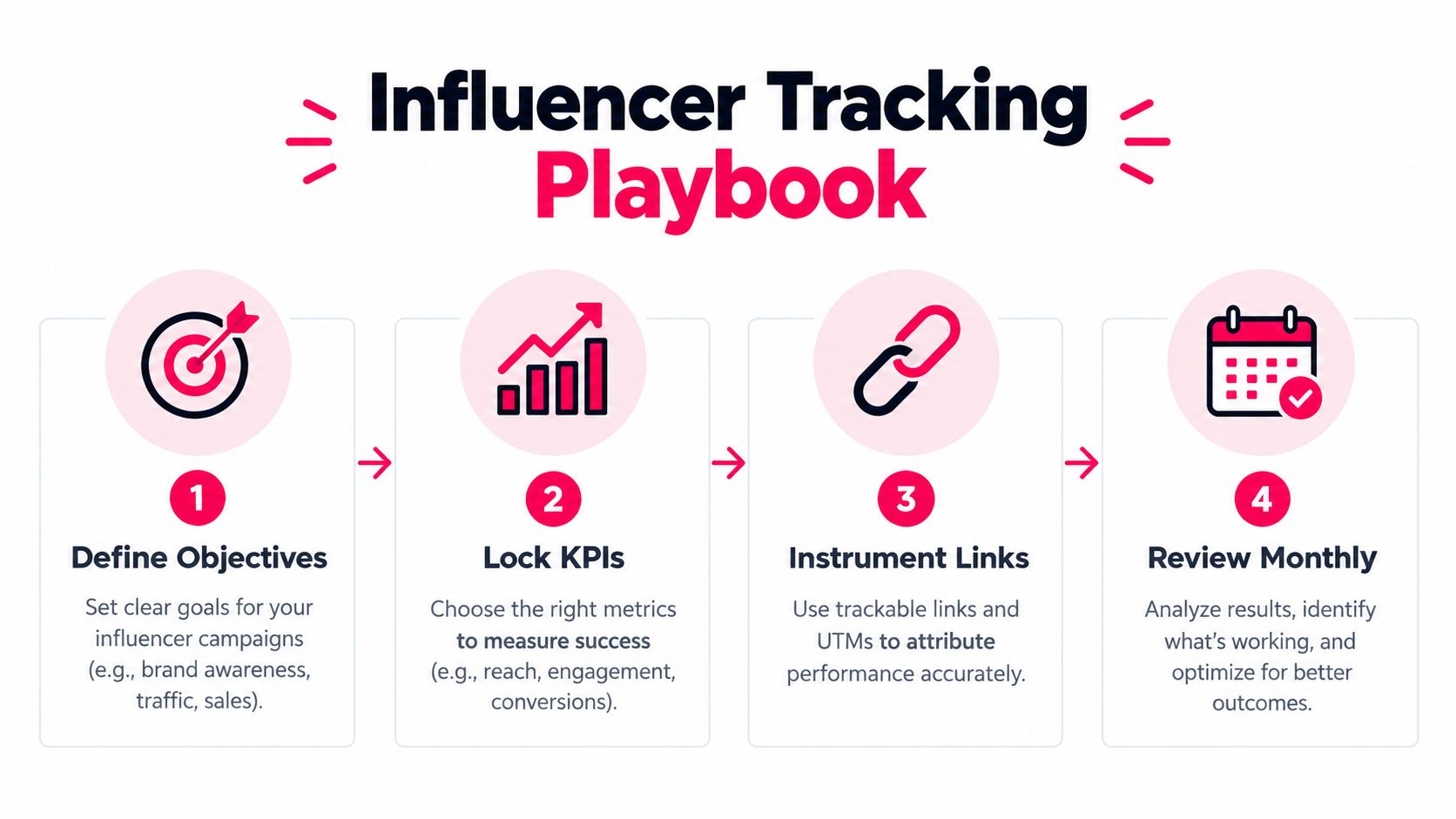
1. Define the commercial objective
Write the business decision first. If the campaign is designed to introduce a product, prioritize reach, impressions, views, engagement quality, sentiment, brand lift, and search volume uplift. If it exists to acquire customers, prioritize clicks, conversion rate, CPA or CAC, revenue, and ROAS.
Don't give every metric equal status. Assign one primary outcome, supporting indicators, and diagnostic metrics. A sales campaign may use revenue as the primary outcome, conversion rate and CAC as supporting measures, and engagement rate as a diagnostic for creative resonance.
2. Lock definitions and comparison rules
Document the formula for each KPI before creators publish. Specify whether engagement rate uses followers, reach, or views. Record whether revenue is gross or net of refunds, whether product seeding is included in cost, and which attribution window applies.
Build separate benchmarks by platform, niche, and format. Never rank an Instagram Reel, TikTok video, and YouTube integration using an unexplained blended engagement rate. Normalize cost and outcome metrics only after the underlying definitions match.
The most dangerous dashboard error isn't a missing metric. It's a precise-looking metric built from inconsistent inputs.
3. Instrument every path
Create a unique UTM link, affiliate parameter, and promo code where appropriate for each creator. Test the link through the landing page and checkout, confirm pixel events, and check that campaign data reaches ecommerce and CRM records.
Keep a launch register with:
- Creator identity: Handle, platform, audience segment, and internal creator ID.
- Deliverable identity: Format, post ID, publication date, and content usage rights.
- Tracking assets: UTM URL, affiliate link, promo code, and landing page.
- Commercial fields: Fee, product cost, shipping, paid amplification, commission, orders, revenue, refunds, and net cost.
- Quality notes: Content approval status, disclosure status, audience feedback, and optimization actions.
FTC rules require paid or otherwise material creator relationships to be disclosed clearly and conspicuously. Go Viral Global's summary of US influencer disclosure requirements gives examples including #ad, paid partnership labels, and platform disclosure tags, and recommends placing disclosure at the beginning rather than burying it in a description.
4. Choose attribution deliberately
Use direct tracking to answer “Which creator captured the conversion?” Use multi-touch reporting to answer “Which creators participated in the journey?” Use control groups or holdouts when the budget decision requires evidence of incremental lift.
Review both direct and assisted outcomes, but don't add assisted conversions to direct conversions without a defined allocation rule. That creates inflated totals. A clean report shows the model, window, eligible touchpoints, and whether revenue is attributed, influenced, or incrementally measured.
5. Run a fixed review rhythm
Monitor active campaigns frequently enough to catch broken links, missing disclosures, weak creative, and unexpected spend. During the review, compare actual performance with the objective, not with whichever creator has the largest audience.
At the close, reconcile the data before ranking creators. Check orders against refunds, remove duplicated conversions, verify fees and product costs, and separate paid amplification from organic creator delivery. Then record the decision:
| Decision | Evidence to review |
|---|---|
| Renew creator | Objective performance, efficiency, audience quality, content quality |
| Increase budget | Repeatable conversion economics and test results |
| Change creative brief | Strong engagement or views with weak clicks or conversion |
| Change platform mix | Consistent differences in qualified traffic or commercial output |
| Retest later | Inconclusive data, tracking failure, or insufficient exposure |
6. Turn results into operating knowledge
Store performance history by creator, format, platform, and campaign objective. Add qualitative notes about communication, content quality, compliance, audience fit, and asset reuse. That record protects the team from making decisions based only on the latest post.
Track efficiency and effectiveness together. A creator may produce the most revenue but require a high fee. Another may have lower volume but stronger CAC. A third may create reusable assets that perform in Spark Ads or product pages. These are different forms of value, and the reporting model should keep them visible without pretending they're interchangeable.
The final test is whether the report changes an action. If the team can't explain which creators to renew, which formats to adjust, which links or codes failed, and what experiment comes next, influencer campaign tracking has remained a reporting exercise rather than an operating discipline.
JoinBrands connects brands with 500,000+ creators and supports campaign creation, creator matching, content approvals, product delivery, deadline tracking, and Spark Ads activation. If you want a more organized way to manage creator workflows while tying campaign activity to performance review, explore JoinBrands and build your next tracking process around clean creator-level data.