

 User Generated Content for Ecommerce: A Growth Playbook
77% of marketers repurpose creator content into paid ads, and 8 in 10 extend creator content's reach through paid media. The practical answer is usually not influencer marketing or paid ads, but creator content for trust and paid distribution for targeting, scale, and conversion.
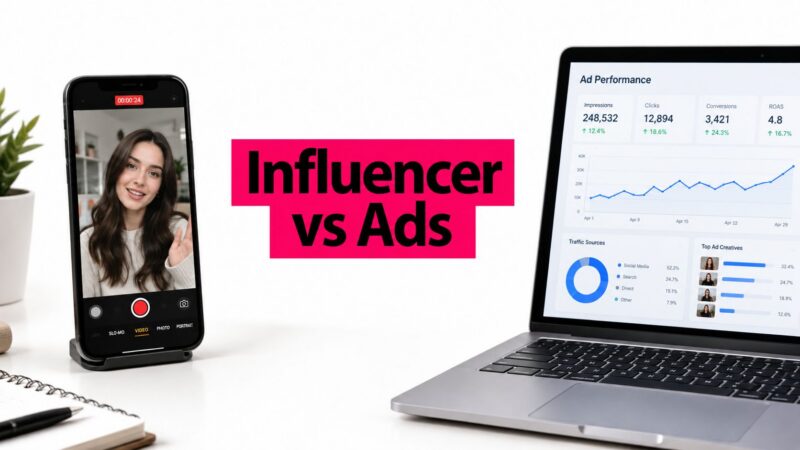
The popular advice says you need to choose a winner. That framing is increasingly unhelpful for DTC teams. Influencer marketing creates the asset, context, and social proof that make an ad feel credible. Paid media turns that asset into something you can target, test, and scale.
The right comparison is less “which channel is better?” and more “which job should each channel do?” Influencers can introduce a product in a way that feels native to a community. Meta, TikTok, and LinkedIn can then distribute the strongest creative to carefully selected audiences. Search ads can capture demand after creator content has created it.
| Decision factor | Influencer marketing | Paid ads |
|---|---|---|
| Primary strength | Trust, creator context, and authentic storytelling | Targeting, control, measurement, and scale |
| Buying model | Creator fee, product, commission, or a combination | Auction-based CPM or CPC media buying |
| Audience access | A creator's established community | Selected audiences, custom audiences, and retargeting pools |
| Creative control | Shared with the creator | Brand-controlled |
| Attribution | Promo codes, UTMs, landing pages, and branded-content tools | Pixel, CAPI, platform reporting, and conversion tracking |
| Best role in a hybrid system | Generate and validate persuasive creative | Amplify winning creative and capture demand |
Table of Contents
The False Choice Between Influencer Marketing and Paid Ads
A brand team launches a new product with two separate plans. The influencer team pays creators to demonstrate it, while the performance team produces polished ads from the same product brief. Each team reports its own metrics, protects its own budget, and rarely shares creative.
That setup creates an artificial competition. The influencer campaign may produce stronger comments and more believable demonstrations, while the paid team may deliver cleaner attribution and more predictable volume. Treating those outcomes as mutually exclusive wastes the advantage of both.
Creator media has become a scale channel
Influencer marketing has moved far beyond experimental brand activity. The global industry was about $1.7 billion in 2015, compared with estimates of about $35.1 billion in 2024 and around $40.5 billion in 2026, a rapid expansion over roughly a decade documented in this history of influencer marketing's evolution.
Those figures matter because they change the budget conversation. Creator-led media is no longer a niche alternative reserved for awareness campaigns. Brands increasingly use it alongside performance advertising, particularly when they need a steady supply of credible video assets.

The useful question is operational
Suppose a skincare creator films an unscripted routine that explains how a product fits into a real morning. The brand can publish the post organically, measure audience response, secure usage rights, and run the asset as a paid placement. The creator supplies the trust signal. The media buyer supplies the distribution system.
That workflow also changes creative production. Instead of asking a studio to guess which hook might work, the brand can source several creator interpretations, observe which messages attract qualified attention, and put paid budget behind the strongest candidates.
Practical rule: Buy influencer content for what creators do better than brands, then buy paid distribution for what ad platforms do better than creators.
The hybrid approach doesn't mean every creator post should become an ad. Some content works because it is intimate, spontaneous, or tightly connected to a creator's community. Other assets have a clear hook, product demonstration, and call to action that make them suitable for paid scaling. The job is to identify the difference before spending heavily.
Understanding Influencer Marketing and Paid Ads
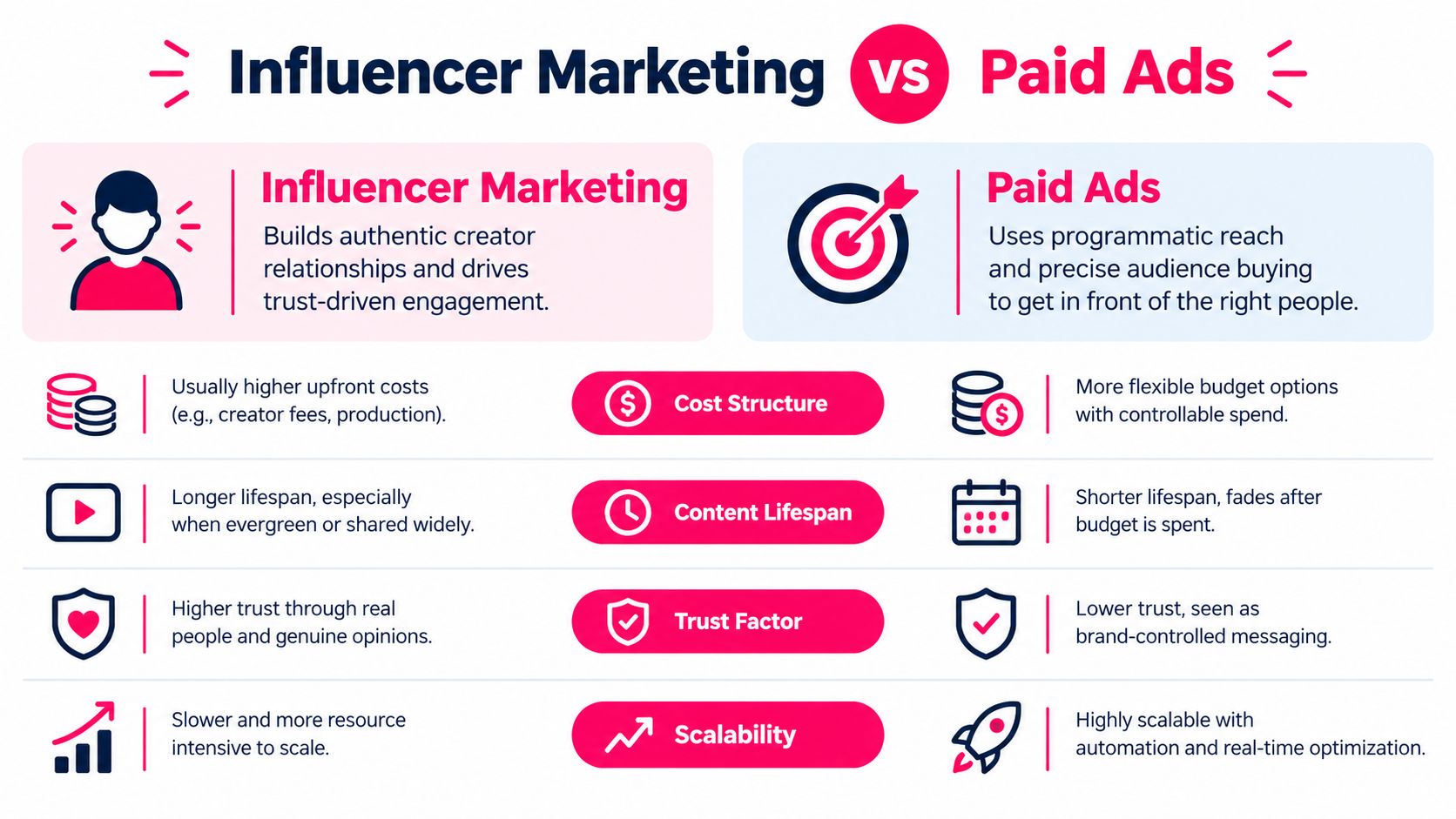
Influencer marketing and paid advertising are not competing replacements. They control different parts of acquisition. Influencer marketing supplies context, credibility, and creator-made content. Paid media supplies distribution, audience selection, and budget control. The strongest DTC programs connect those functions rather than forcing a choice between them.
Influencer marketing is a partnership with a person who has earned attention within a defined audience. Compensation may take the form of a fee, product, commission, or payment for content rights. The deliverable is more than exposure. It includes the creator's explanation of the product, visual style, proof of use, and relationship with the people watching.
Paid advertising buys controlled placement across a platform. A media buyer sets the audience, objective, budget, bid strategy, placement, and creative. The platform then distributes the ad to people it predicts will complete the selected action. That control supports testing and scaling, but the brand remains responsible for producing an asset that earns attention.
What each channel controls
Influencer campaigns inherit the creator's audience, tone, and publishing environment. Brands can assess subject expertise, community fit, previous work, and comment quality, yet they cannot fully control delivery or audience response.
Paid ads offer more direct control. Teams can build prospecting audiences, retarget site visitors, exclude existing customers, adjust budgets, and compare creative variations. Measurement can connect campaigns to sales through pixels, CAPI, promo codes, UTMs, dedicated landing pages, and branded-content tools, including the tracking methods used to connect influencer activity with outcomes.
The content boundary is disappearing
The practical distinction is no longer organic creator content versus brand-produced advertising. A creator asset can begin as a recommendation, then become a paid test, a retargeting creative, or a reusable product demonstration. Creator marketing benchmark data supports evaluating creator work as a content input that can serve more than one distribution channel.
The execution roles remain distinct:
- Influencer marketing works well when buyers need context, demonstration, identity, or reassurance from a person they chose to follow.
- Paid social works well for controlled reach, audience testing, retargeting, budget pacing, and direct-response measurement.
- Search advertising reaches buyers who have already expressed intent and are comparing solutions.
- Creator licensing connects the systems by allowing creator-made assets to run through paid placements.
A creator post can therefore serve community trust and performance testing. Judge it by the job it performs in the customer journey, then decide whether organic distribution, paid scaling, or both deserve the budget.
Cost Comparison and ROI Profiles
A low CPM can hide an expensive acquisition. Influencer marketing may show a higher media cost because the fee can cover creative production, access to a relevant community, and the creator's endorsement. Paid advertising separates those functions. The auction may deliver cheaper impressions, while the brand pays separately for creative that earns attention and converts.
Benchmark costs in context
Published benchmark guidance places influencer CPM at $10 to $25 for micro creators and $25 to $75 for macro creators, compared with roughly $4 to $14 for Instagram paid ads, according to this influencer marketing versus paid ads cost comparison. Platform economics vary by audience, placement, objective, and auction conditions. A recent comparison lists Meta CPM at roughly $6.60 to $14, TikTok CPM at $4 to $10, and LinkedIn CPM at $20 to $65. Its corresponding CPC ranges are $0.44 to $1.10, $0.30 to $1.20, and $2 to $6, respectively, as shown in this paid social platform comparison.
| Metric | Influencer marketing | Paid social ads |
|---|---|---|
| Typical CPM benchmark | $10 to $25 for micro creators and $25 to $75 for macro creators | Platform and placement dependent, with Instagram commonly benchmarked at roughly $4 to $14 |
| Cost structure | Creator fee, product, commission, and possible usage rights | Media auction, usually CPM or CPC |
| Main efficiency question | Did the creator generate trust, action, and reusable creative? | Did the audience, bid, and creative produce profitable conversions? |
| Scaling constraint | Creator availability, production capacity, and audience size | Budget, auction conditions, creative fatigue, and conversion economics |
| Best efficiency move | Reuse strong creator assets across organic, paid, email, and product-page placements | Test hooks, audiences, placements, and offers, then increase spend on profitable combinations |
The CPM table gives only the distribution cost. A creator fee can also produce an asset that supports organic social, paid social, email, a product page, and a landing page. A media impression buys reach. If the brand still needs credible demonstrations, testimonials, or product education, the total paid-social investment is higher than the CPM suggests.
That difference makes creator content valuable inside a paid acquisition system. A creator post can earn initial attention organically, then provide a concrete creative angle for paid testing. The winning asset can receive more budget, while weaker concepts remain limited to their initial distribution.
A blended campaign shows the trade-off
One published campaign example reported 840K organic influencer impressions, $2,800 in trackable revenue, and a $17.14 CPM. The campaign then generated 2.4 million paid-amplification impressions at a $6 CPM and 4.8x ROAS, producing a 4.2x blended ROAS across both channels, as documented in this Instagram influencer and paid ads campaign analysis.
Those results describe one campaign, not a guaranteed target. The practical lesson is the division of economic roles. Organic creator activity can carry a higher impression cost while supplying persuasive content and audience trust. Paid amplification can improve distribution efficiency while preserving the creator's voice.
Budgeting insight: Compare total contribution margin, not CPM alone. Include creator fees, production, usage rights, media spend, discounts, and the revenue or customer value each asset produces.
Targeting, Reach, and Measurement Differences
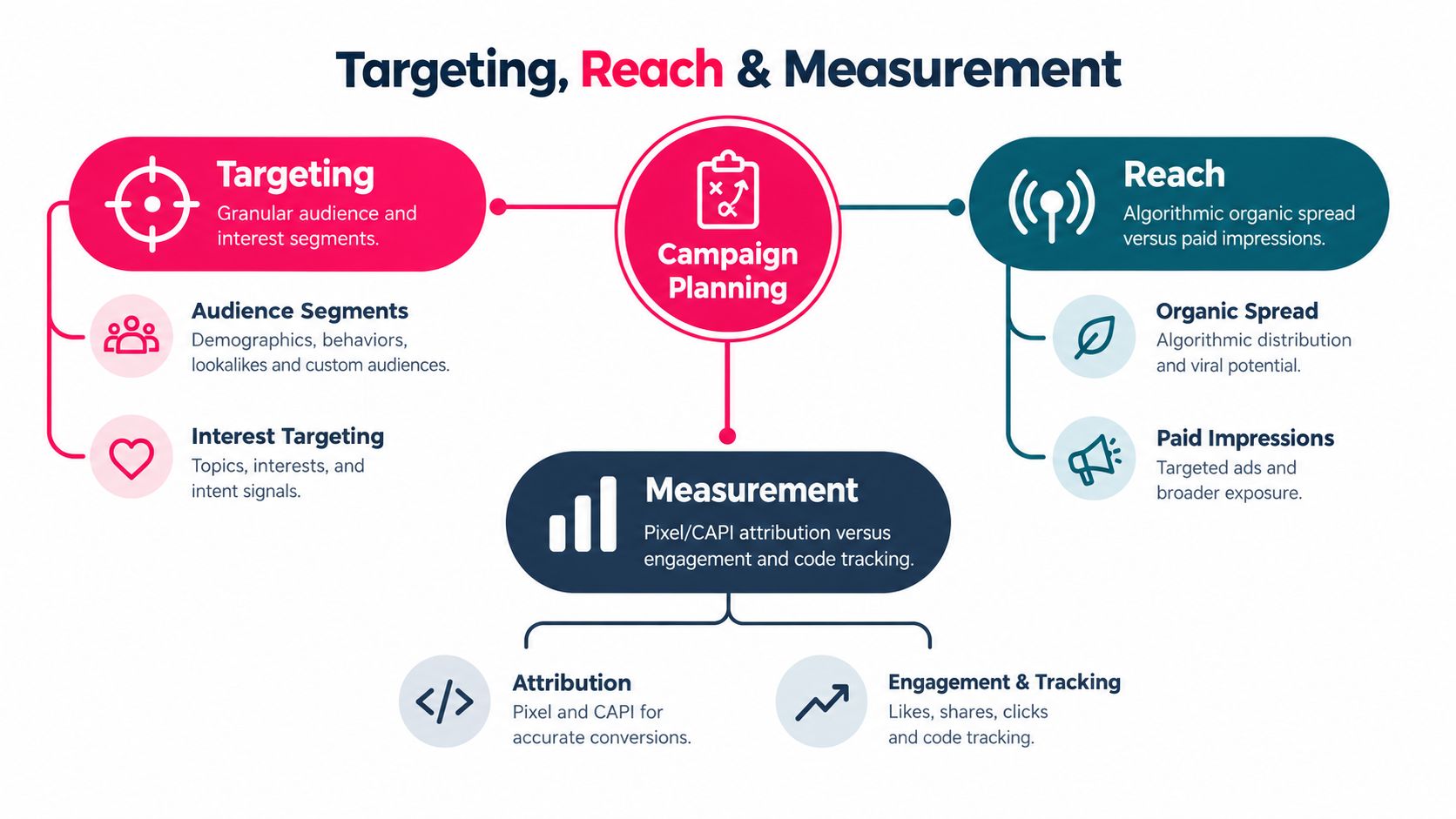
Paid ads and influencer marketing don't fail in the same way because they don't provide the same controls. A paid campaign can underperform because the audience is too broad, the creative is fatigued, or the bid strategy is misaligned with the conversion event. An influencer campaign can underperform because the creator lacks product fit, the message feels forced, or the audience doesn't take action after viewing the post.
Build the measurement layer before launch
Start with one primary business outcome. Awareness, qualified traffic, first purchase, repeat purchase, and contribution margin require different reporting. Don't judge a product education video only by immediate purchases, and don't call an ad successful because it received cheap impressions without producing qualified sessions.
Use a tracking stack that matches the channel:
- Assign creator-specific links. Give every creator a UTM-tagged destination and, where appropriate, a unique promo code. A dedicated landing page can help isolate the message and reduce confusion in the analytics.
- Secure platform permissions. Use the relevant branded-content or partnership tools when creator content will run through paid media. This keeps the asset connected to the creator identity and simplifies campaign management.
- Connect paid events. Confirm that the pixel, CAPI, analytics platform, and purchase event are working before launch. Paid ads need reliable conversion signals if the delivery system is expected to optimize.
- Separate reporting views. Keep organic creator reach, paid impressions, clicks, assisted conversions, and direct conversions visible as distinct fields. Combining them too early hides where the value came from.
- Review qualitative evidence. Read comments, saves, replies, and customer service questions. A creator may reveal an objection or use case that doesn't appear in last-click reporting.
Paid media usually offers faster feedback because the platform reports delivery and conversion events directly. Influencer measurement can take longer and may miss assisted demand if a buyer sees a post, remembers the product, and later converts through branded search or direct traffic.
Match the KPI to the decision
If the question is “which creative should receive more media?”, compare click-through rate, landing-page behavior, conversion rate, and contribution margin. If the question is “which creator reaches the right community?”, review audience fit, comment quality, saves, and qualified traffic.
A common mistake is to force influencers into the same reporting model as paid ads. The better approach is to use influencer activity to identify messages and audiences, then use paid campaigns to test and scale those insights under controlled conditions.
Ideal Use Cases by Funnel Stage and Budget
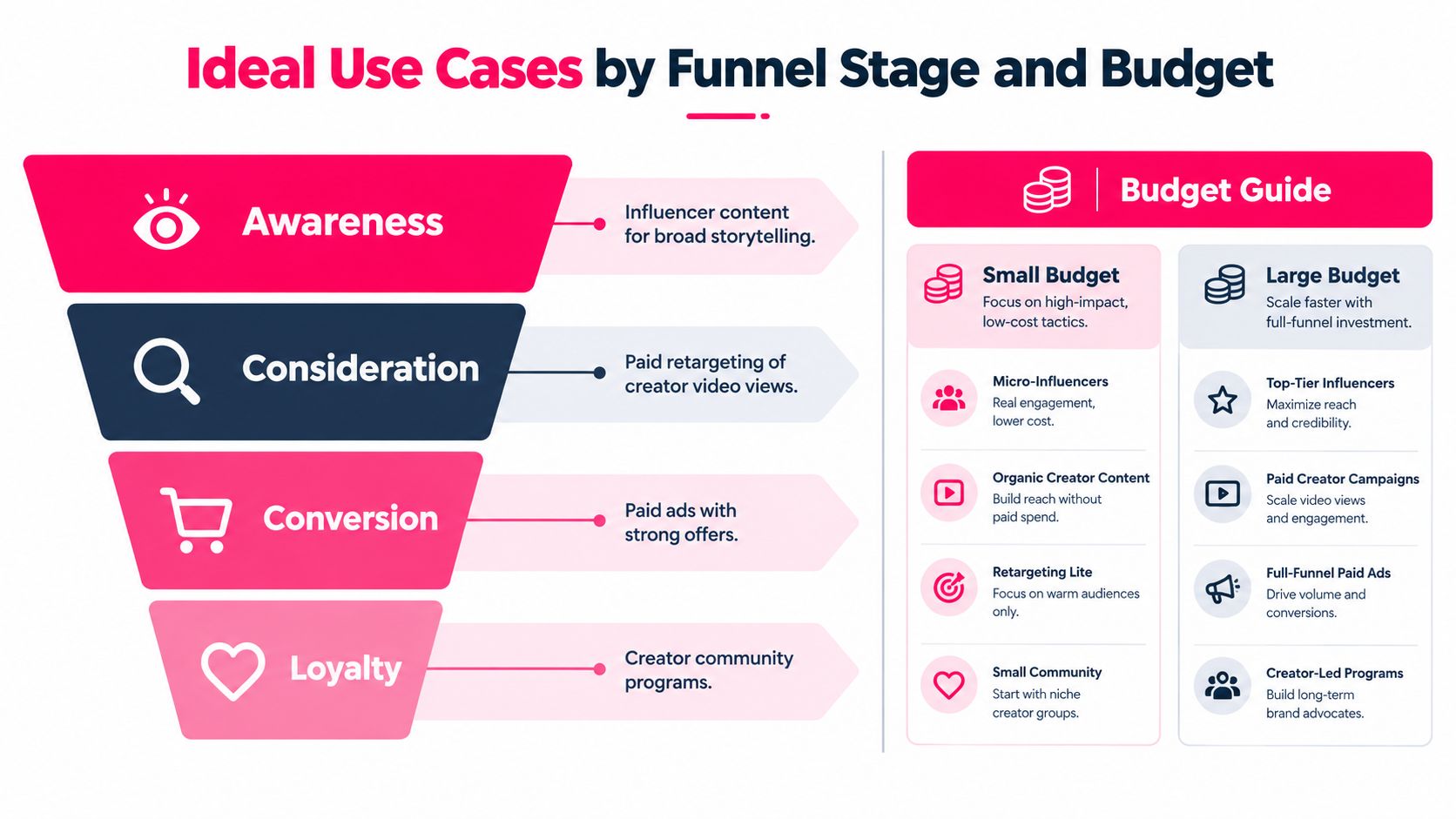
A product launch often needs credibility before it needs frequency. A retargeting campaign often needs the opposite. The strongest channel depends on the buyer's current level of awareness, the amount of creative available, and how quickly the brand needs dependable volume.
Awareness needs a believable introduction
Influencer marketing is useful when the audience doesn't yet understand the problem or doesn't trust the brand. A creator can show a product in a real setting, answer a common objection, and explain why it belongs in a routine. This is especially helpful for products where demonstration and personal experience carry more weight than a short product claim.
Paid ads still have a role at the top of the funnel. They can extend the reach of a strong creator asset beyond the creator's existing audience and help the brand test different audience definitions. The creative should retain the natural opening and product context instead of being edited into a generic brand commercial.
Consideration rewards useful proof
At the consideration stage, combine creator demonstrations with retargeting. Someone who watched a product explanation may now need a comparison, review, testimonial, or answer to a practical objection. Paid media can deliver that follow-up to an audience built from engagement or site behavior.
A DTC supplement brand, for example, might use creators to explain taste, routine, and use cases, then use paid ads to show an offer or direct interested visitors to a product page. The creator content establishes relevance. The paid layer gives the brand control over sequencing.
Conversion favors control
Bottom-of-funnel campaigns generally benefit from precise targeting, clear offers, and reliable event tracking. Paid ads can retarget product viewers, cart visitors, or prior purchasers while controlling exclusions and frequency. Creator content can still provide the conversion asset, but the media buyer decides who sees it and under what conditions.
For smaller budgets, start with a focused creator test and preserve the strongest assets for paid use. For larger budgets, run creator production and paid distribution as connected workstreams. The creator team should know which formats the media team needs, while the media team should return performance feedback that improves the next brief.
Decision test: If the main constraint is trust or creative quality, start with creators. If it's predictable volume or precise retargeting, start with paid media. If both constraints matter, design the handoff before either campaign launches.
The Hybrid Strategy, Combining Creator Content with Paid Scaling
The hybrid system works because it separates two decisions that brands often bundle together. First, find a message and presentation that a real person can deliver convincingly. Second, decide how much paid distribution that asset deserves.
Nearly 8 in 10 marketers extend creator content through paid media, and 41% say repurposing creator content in paid ads produces higher ROI than studio-produced creative, according to influencer marketing statistics on creator-content reuse. That doesn't mean creator content always wins. It means the format deserves a fair test against conventional brand creative.
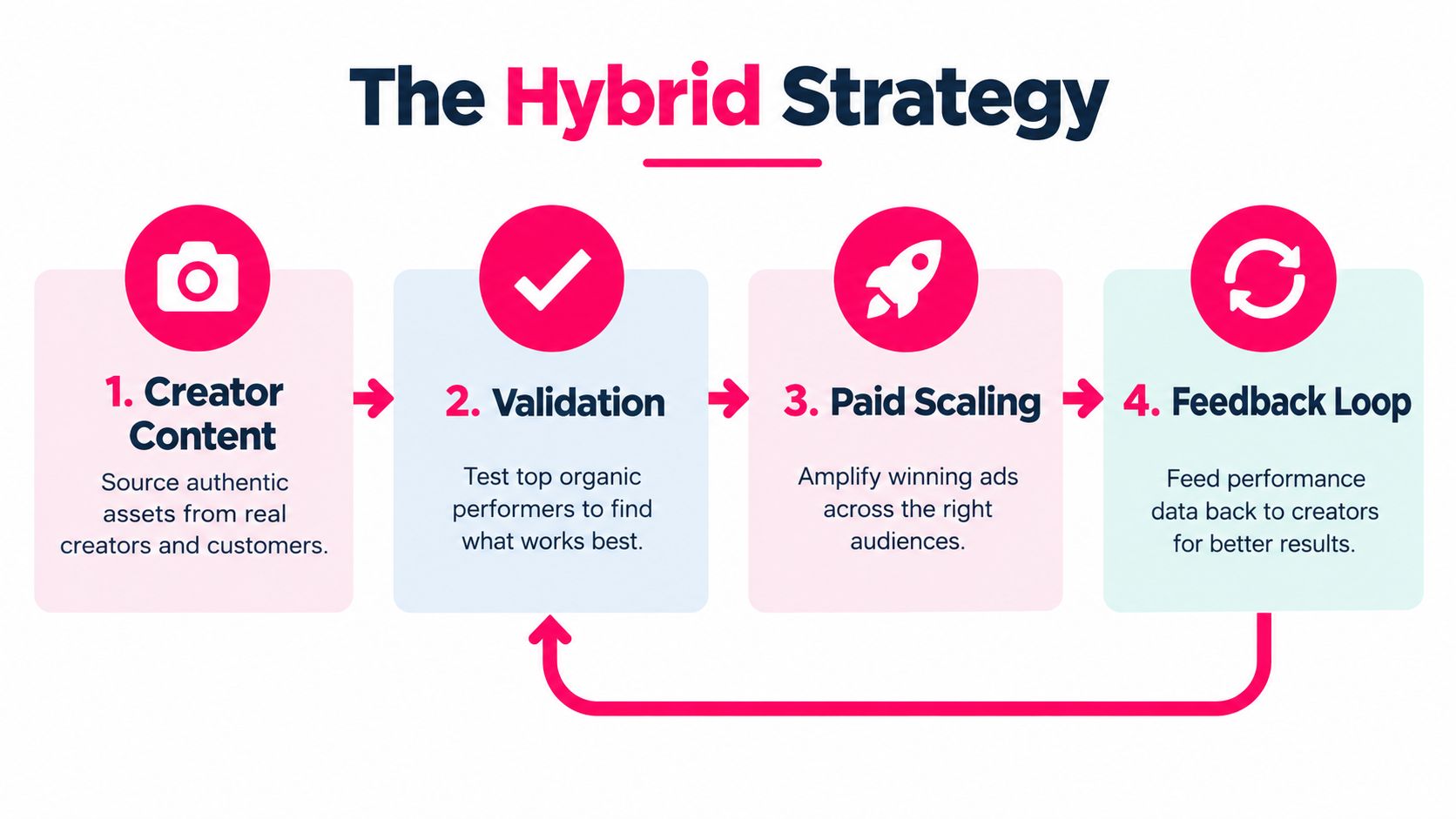
A practical four-step pipeline
1. Commission several distinct creator interpretations.
Give creators a clear problem, audience, mandatory product facts, and compliance requirements. Leave room for their own opening, language, setting, and demonstration. A creator who sounds like a brand spokesperson has already lost much of the advantage.
2. Validate the organic response.
Look beyond views. Review watch behavior where available, comments, saves, clicks, sentiment, and the questions people ask. A high-reach post may be entertaining but commercially weak. A smaller post may explain the product in a way that produces better qualified traffic.
3. Secure rights and amplify the winners.
Usage rights should be explicit before production begins. Once the brand has permission, run the strongest assets through the relevant paid format, such as Spark Ads on TikTok or Partnership Ads through Meta. Test the creator hook against the brand's existing ads, not against an imagined benchmark.
4. Feed results into the next brief.
Paid performance can show which opening, objection, product benefit, or format deserves another creator iteration. The feedback loop should improve both media buying and content production. Over time, the brand builds a library of proven angles rather than repeatedly starting from a blank page.
What the workflow looks like in practice
A home fitness brand might commission creators to demonstrate how a product fits into a short daily routine. One creator focuses on convenience, another on setup, and a third on the problem the product solves. The brand publishes the content organically, checks the response, then promotes the strongest demonstrations to prospecting and retargeting audiences.
The media team should preserve the creator's native framing where possible. Heavy edits, corporate overlays, and a long logo sequence can erase the reason the content worked. Add the conversion details the audience needs, but don't turn a believable review into a conventional commercial.
For teams managing creator discovery, briefs, content approvals, deadlines, and paid activation in one workflow, JoinBrands connects brands with creators and supports campaign management, content review, and Spark Ads activation. It's one operational option for keeping the creator-to-paid handoff visible instead of passing files and permissions between disconnected tools.
The most important safeguard is commercial clarity. Confirm who owns the asset, where it may run, how long usage lasts, whether the creator's handle will appear in the ad, and how revisions are handled. A cheap creator fee can become expensive if the brand has to renegotiate rights after the asset has already proved valuable.
The best hybrid programs don't ask influencers to replace paid media or ask paid media to manufacture authenticity. They use each channel for its comparative advantage. Creators make the message credible. Paid platforms make the message findable, repeatable, and measurable.
JoinBrands helps brands source creator content, manage briefs and approvals, and activate creator assets through formats such as Spark Ads and partnership advertising. Visit JoinBrands to connect creator production with the paid distribution workflow described above.