

 A Guide to Social Influence Marketing
Ever heard of influencer whitelisting? It's a game-changer for brands on Instagram, especially in the DTC and e-commerce space. In simple terms, it's a strategy where a creator gives your brand advertising permissions to their social media account. This lets you run paid ads directly through their profile, blending their authentic voice with the powerhouse targeting of Meta's ad platform.
The result is an ad that feels way more like a trusted recommendation and less like a straight-up promotion.
Table of Contents
What Is Influencer Whitelisting on Instagram?
At its heart, influencer whitelisting on Instagram is all about turning a creator's organic post into a scalable ad asset that you completely control. Instead of an ad popping up from your official brand account, it shows up in user feeds as if the influencer posted it themselves. It's a simple shift, but the impact on how people perceive the ad—and how it performs—is massive.
Let's say you're a skincare brand. A creator you've partnered with posts a genuine Reel of their morning routine, absolutely raving about your new serum. With whitelisting, you can take that exact Reel and push it to thousands of potential customers who fit your ideal demographic but have never even heard of that creator.
Why This Is Gold for E-commerce Brands
This isn't your standard influencer marketing campaign. Usually, you pay an influencer for a post, and its reach is stuck within their organic following. Whitelisting blows those walls down. You get direct control inside Meta Ads Manager, unlocking a whole new level of precision.
- Next-Level Targeting: Go way beyond the creator's organic reach. Target lookalike audiences, hyper-specific demographics, and niche interest groups that align with your ideal customer.
- Serious Performance Optimization: A/B test everything. Try out different captions, headlines, and calls-to-action on the same creative to figure out what actually drives conversions.
- Real, Direct Data: No more relying on fuzzy screenshots from creators. You get clean, reliable performance metrics straight from your Ads Manager dashboard.
- Built-in Authenticity: The ad keeps the creator's handle, making it feel like a genuine shout-out from a trusted source instead of just another brand ad people scroll past.
We've seen this strategy consistently crush traditional social ads. It's not uncommon to see a 20-50% improvement in key metrics like engagement and conversions. The algorithms on social platforms are already rewarding creator-native content; whitelisting lets you put paid muscle behind that trend. For a deeper dive, check out our overview of whitelisting in social media.
Whitelisting vs. The Other Guys
It's easy to get whitelisting mixed up with similar tactics, so let's clear the air.
A standard branded content ad—the kind with the "Paid Partnership" label—still relies on the creator to boost the post themselves. As a brand, you get very little control and even less data.
To quickly see how these methods stack up, here’s a simple breakdown.
Whitelisting vs Traditional Influencer Ads vs Brand Ads
| Attribute | Influencer Whitelisting | Traditional Influencer Post | Standard Brand Ad |
|---|---|---|---|
| Control | Full brand control over targeting, budget, and optimization. | Limited to creator's boosting options and organic reach. | Full brand control, but lacks creator authenticity. |
| Authenticity | High. Ad comes from a trusted creator's handle. | High. The post is organic to the creator's feed. | Low. Clearly a promotional message from the brand. |
| Reach | Scalable to millions via paid targeting. | Limited to the creator's organic follower base. | Scalable to millions, but can face ad fatigue. |
| Data & Tracking | Direct access to detailed metrics in Ads Manager. | Relies on creator-provided screenshots or limited data. | Direct access to detailed metrics in Ads Manager. |
As you can see, whitelisting offers a unique mix of benefits that you just can't get from other ad types.
Whitelisting is like being handed the keys to the creator's ad vehicle. You're in the driver's seat, controlling the budget, targeting, and optimization, all while benefiting from the credibility of their account.
In a nutshell, influencer whitelisting marries the trust of influencer marketing with the sharp precision of performance marketing. It lets you run ads that don't feel like ads, building deeper audience connections and driving much better results for your bottom line.
Why Whitelisting Is a Game-Changer for DTC Brands
If you're in the DTC world, you know the name of the game: turn clicks into customers as efficiently as possible. Instagram influencer whitelisting isn't just another marketing buzzword; it's a powerful engine built to do exactly that. It fuses the authentic voice of a creator with the sharp precision of paid advertising, directly impacting the metrics you care about most.
Right off the bat, brands usually see a serious drop in their Cost Per Acquisition (CPA). Why? Because an ad coming from a creator’s handle feels like a real recommendation from a trusted friend, not a cold pitch from a faceless company. That built-in social proof makes people far more likely to listen, leading to more conversions without spending an extra dime.
This efficiency naturally sends your Return on Ad Spend (ROAS) through the roof. You’re no longer gambling on polished brand ads that often get scrolled past. Instead, you're pouring gasoline on content that's already proven to connect with an audience.
Sidestep Ad Fatigue with Authentic Content
Let’s be honest, modern consumers have PhDs in ignoring ads. They fly past glossy product shots and corporate jargon without a second thought. This is precisely where a steady pipeline of whitelisted creator content gives you a massive strategic edge.
When you run ads from a diverse group of creator accounts, you keep your campaigns feeling fresh and dodge the dreaded ad fatigue that kills so many campaigns. Each piece of content offers a unique style and point of view, making your brand feel dynamic and constantly validated by real people.
The proof is in the data. This organic vibe holds attention way better. As ad fatigue climbs, whitelisting's authentic approach keeps people watching, with influencer ads clocking a 17.8-second average skip time compared to just 7.9 seconds for standard branded ads. You can dig into more stats on this ad strategy over at StackInfluence.
That extra viewing time is gold. It gives your message more room to breathe and dramatically boosts the chances of getting that all-important click.
Gain Unprecedented Access to Performance Data
One of the biggest headaches with old-school influencer marketing is the foggy data. You’re often stuck relying on creator-sent screenshots, which can be patchy, hard to verify, and leave you guessing about the real impact.
Whitelisting cuts right through that fog. Since the ads run through your own Meta Ads Manager, you get a direct, real-time firehose of every metric that matters.
- Impressions and Reach: See precisely how many people your ads are hitting, well beyond the creator's organic followers.
- Click-Through Rate (CTR): Instantly measure how well the creative is grabbing attention and driving traffic.
- Conversion Tracking: Your Meta Pixel tracks every purchase, lead, or sign-up, giving you concrete results.
- Cost Per Result: Know the exact dollar amount it costs to acquire each new customer.
This kind of clarity is a game-changer. You’re no longer making educated guesses about an influencer's ROI; you're measuring it with the same ruthless precision as the rest of your performance marketing.
A Real-World Scenario for an Apparel Brand
Let’s make this real. Imagine you run an apparel brand and just dropped a new line of sustainable activewear. You team up with a fitness influencer who posts an awesome Reel showing off the gear during a workout. Organically, it does great—tons of positive comments and shares.
Now, with influencer whitelisting for your Instagram campaign, you can pour jet fuel on that fire. After getting advertising permissions, you start running her Reel as a paid ad, directly from her account. This is where the magic happens. You immediately launch a series of structured A/B tests in Ads Manager:
- Audience Testing: You pit a lookalike audience of your best customers against a group of the influencer's engaged followers. The goal? Find out which one converts at a lower CPA.
- Copy Variation: You test two angles. One ad caption focuses on the high-performance features of the fabric, while the other talks about the sustainable, eco-friendly materials.
- Call-to-Action Optimization: It’s a simple test: "Shop Now" versus "Learn More." Which button gets more high-intent clicks?
Within just a few days, the data starts talking. It shows that the sustainability message connects deeply with your lookalike audience, driving a 25% lower CPA. Boom. You’ve not only made your ad spend smarter but also stumbled upon a powerful marketing angle for your entire brand—all thanks to the control and crystal-clear data that whitelisting delivers.
Getting Permissions and Agreements Locked Down
Before you even think about putting ad spend behind a creator's post, you need to lay a rock-solid foundation. This isn't just about good vibes; it's about clear communication, legal protection, and setting up the technical access needed to actually run the ads.
Think of it as setting the rules of the game before kickoff. Skipping this step is a surefire way to run into confusion, disputes, and headaches later on. Getting the permissions and the paperwork right from the start builds the trust you need for a partnership that actually drives results.
The Technical Handshake: Granting Ad Access
For whitelisting to even be possible, the creator has to give your business specific permissions through Meta. This is more than a verbal "okay"—it's a literal, technical process inside Meta Business Suite that links their account to yours.
Essentially, the creator needs to add your business as a partner and grant you advertising permissions for their Instagram handle and their connected Facebook Page. This is the crucial step that makes their profile and content pop up as an option when you're building a campaign in your own Ads Manager.
Key Takeaway: This permissions process is the digital handshake that makes the partnership official. Make sure your creators are comfortable with it, and be prepared to walk them through the steps if it’s their first time. A little guidance goes a long way here.
Crafting an Ironclad Whitelisting Agreement
Let's be clear: a verbal agreement or a DM conversation is not enough. You absolutely need a comprehensive influencer contract that spells out the terms of your whitelisting partnership. A well-written agreement prevents misunderstandings and makes sure everyone is on the same page.
To be effective, your contract needs to cover a few key bases:
- Usage Rights and Exclusivity: State clearly that you have the right to use their content in paid ads on Meta's platforms. You should also specify any exclusivity terms, like preventing them from working with your direct competitors while your campaign is live.
- Duration of Use: Be specific about how long you can run their content as an ad. Common terms are 30, 60, or 90 days, but whatever you agree on, define it precisely. Does the clock start when the contract is signed, or when the first ad goes live? Put it in writing.
- Content Ownership: Typically, the creator owns the original content, and your brand is just licensing it for advertising. Clarifying this upfront avoids any ownership battles down the road.
- Compensation Model: How is the creator getting paid? Beyond a simple flat fee, many brands are using variable compensation structures that might include performance bonuses based on clicks or conversions. Whether it's a fixed rate, a cut of the ad spend, or a hybrid model, get it all down on paper.
Creators are overwhelmingly on board with this. In fact, research shows that around 90% of influencers view whitelisting as a win-win. It gets their content in front of a bigger audience and helps them build more transparent, professional relationships with brands.
To make sure your contracts are buttoned up, check out our deep dive on what every influencer marketing agreement should include. Nailing the legal framework from day one is the single best way to build a healthy, long-term partnership that benefits everyone.
How to Set Up Your First Whitelisting Campaign
Alright, let's get into the nuts and bolts. Launching your first influencer whitelisting campaign might sound intimidating, but it's really just a digital handshake between your Meta Business Suite and the creator's account. Once you do it once, it'll be second nature.
Think of it like this: the creator owns a sweet ride (their authentic content and trusted handle), but you're getting a key. You're in the driver's seat, controlling the budget, picking the destination (your target audience), and hitting the gas. So, let's walk through how to get that key and start driving some serious results.
Requesting and Granting Advertising Access
First things first, you need to make the official connection within Meta's world. This is where the creator formally gives your brand permission to run ads from their account. To kick this off, you need to send them your Business Manager ID.
You can find this ID in your Meta Business Suite under "Business Info." It’s just a long string of numbers. Copy it, send it over to your creator, and they'll handle the next part on their end.
Here’s what your creator will need to do:
- Hop into their own Business Manager and find the "Partners" section.
- Click the option to "Give a partner access to your assets."
- Paste your Business Manager ID right into the box.
- Grant your business access to their Facebook Page and their Instagram account. These two are non-negotiable.
Once they hit "confirm," you'll see their Instagram handle and Facebook Page pop up as available assets inside your Business Suite. That's your green light—the connection is live, and you're ready to build your ad.
This whole process really starts before you even touch Business Manager. A solid agreement is foundational.
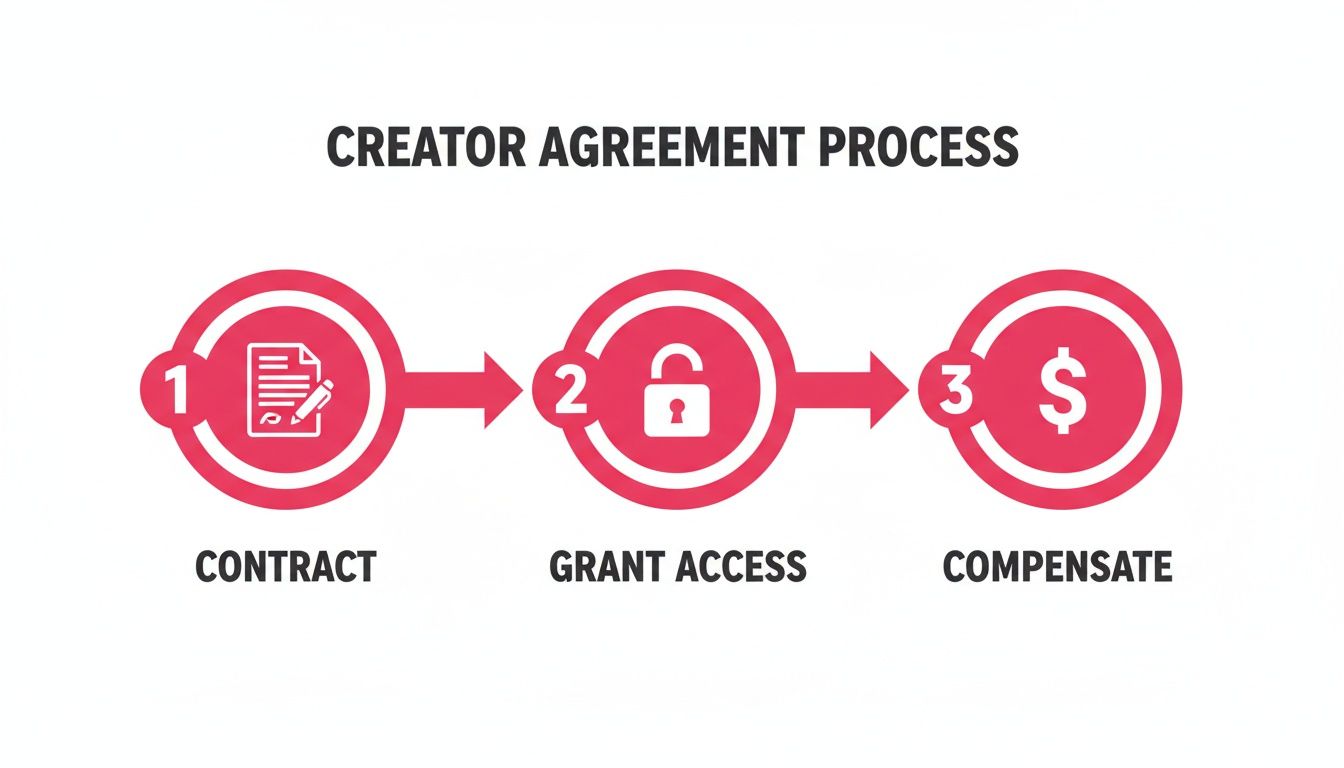
As you can see, a clear contract and compensation terms have to be locked in before any permissions are ever exchanged. Don't skip this step.
Navigating Ads Manager to Find Creator Content
With permissions squared away, it’s time to jump into Meta Ads Manager. This is your command center for building the ad using the creator's content. The setup is nearly identical to your regular brand ads, but with one critical tweak at the ad level.
You'll set your campaign objective and budget just like always. But when you get to the "Ad" level, you have to define the ad's identity—basically, telling Meta which account the ad should come from.
Pro Tip: By default, your brand's Instagram profile will be selected. Look for the "Identity" section. You'll see a dropdown menu where you can now select the creator's Instagram account. This is the magic button. Clicking this is what officially turns a standard ad into a whitelisted one.
Choosing Your Ad Creative: Existing Post or Unpublished Post?
Okay, you've set the ad's identity to the creator's handle. Now you have two main routes for your creative. The one you pick really depends on your campaign goals and what you've agreed on with the influencer.
1. Use an Existing Post
This is exactly what it sounds like. You get to pick a post that's already live and performing well on the creator’s organic feed. It’s the perfect way to pour gas on a fire that’s already burning. You're just amplifying what you know already works.
- How it works: In the "Ad setup" section, select "Use existing post." From there, you can browse their Instagram grid and pick the exact Reel, image, or carousel you want to run.
- Best for: Promoting authentic, high-performing content that already has social proof baked in with likes and comments.
2. Create an Unpublished (Dark) Post
Your other option is to create a brand-new ad that runs from the creator's handle but never shows up on their public feed. This is called an unpublished post (you might have heard the old term "dark post"). This approach gives you total freedom to test and optimize.
- How it works: Choose "Create ad" instead. You can then upload the creator's video or image file directly. This allows you to write entirely new ad copy, headlines, and CTAs tailored for specific audiences.
- Best for: A/B testing different hooks, calls-to-action, or copy without spamming the creator's feed. It's also the go-to for running surgical campaigns aimed at very specific customer segments.
Whether you're boosting an amazing Reel or crafting a stealthy unpublished ad, the tools in Ads Manager make it easy. If you're leaning into video, it’s worth digging into the specifics of Instagram Reels advertising to really squeeze every drop of performance out of your campaigns. By following these steps, you can confidently set up your first influencer whitelisting Instagram campaign and turn that great creator content into a powerhouse ad asset.
Optimizing and Scaling Your Whitelisted Ads
Hitting "publish" on your first whitelisted ad feels like the finish line, but it’s really just the start. This is where the real work—and the real growth—begins. You’re no longer treating the creator’s content as a one-off post. Instead, you're viewing it as a dynamic ad creative that you can tweak, test, and optimize to perfection.
The goal is to take a high-performing Reel or Story and turn it into a long-term asset that drives sales for weeks, or even months.
Your initial performance data is the roadmap. Keep a close eye on early metrics like Click-Through Rate (CTR) and Cost Per Click (CPC). These are your leading indicators, telling you whether the creative is hitting the mark long before the conversion data starts rolling in.
Smart Audience Targeting Strategies
The magic of influencer whitelisting on Instagram is combining a creator’s authentic voice with Meta's powerful targeting machine. Simply targeting the creator's existing followers is a rookie mistake—you're leaving a ton of money on the table.
This is your chance to get creative. Start by building high-value custom audiences. A great starting point is to create an audience of users who have engaged with the creator’s Instagram profile in the last 90 days.
From there, you can build an incredibly potent lookalike audience. A 1% lookalike based on those engaged followers almost always uncovers a highly receptive group of new customers who share similar traits and interests.
Another move I've seen work incredibly well is layering interest-based targeting that aligns with the creator’s niche. If you’ve partnered with a fitness influencer, don’t just target "fitness." Dig deeper. Target interests like "HIIT workouts," "vegan protein," or even competitor brands in the activewear space. Get specific.
Mastering the Art of the A/B Test
Never assume your first attempt is the best one. A/B testing is where you find the winning combination of elements that absolutely crushes your return on ad spend. And since you're using an unpublished post (or dark post), you can run all these tests without spamming the creator’s feed.
Here are a few high-impact A/B tests you should run right away:
- Headline vs. Headline: Test a benefit-driven headline ("Get Glowing Skin in 7 Days") against one that hits on a pain point ("Tired of Dull, Uneven Skin?").
- Caption Length: Does a short, punchy caption outperform a longer, more descriptive one that tells a story? Test it.
- Call-to-Action (CTA): Pit a direct "Shop Now" against a softer "Learn More." You might be surprised which one drives higher-quality traffic.
The point of A/B testing isn't just to find a single winner. It's about continuously learning what messages and angles resonate with your audience. These are insights you can apply across your entire marketing strategy.
The level of data you get back is a game-changer. Whitelisting gives you precise data on impressions, clicks, and purchases—a world away from the often vague, self-reported metrics from influencers. As explained by some industry experts, this detailed feedback loop is what allows you to make smarter decisions and optimize with real confidence.
Budget Optimization and Scaling Winners
Once you've identified a winning ad creative and audience pairing, it's time to scale. But scaling isn’t just about throwing more money at it. Smart budget management is what separates the pros from the amateurs.
A great way to manage this is with Meta's Campaign Budget Optimization (CBO). If you have multiple ad sets running under one campaign, CBO automatically pushes more of your budget to the top performers in real-time. It takes the guesswork out of manual adjustments and lets the algorithm do the heavy lifting for you.
When you see an ad that’s performing well—think low CPA and high ROAS—resist the urge to make drastic budget changes. A solid rule of thumb is to increase the budget by no more than 20-30% every 48 hours. This gradual increase prevents you from shocking the algorithm and resetting its learning phase, which can completely destabilize performance.
By methodically testing, optimizing, and scaling, you can transform a single piece of influencer content into a reliable, long-term sales engine for your brand.
Your Top Influencer Whitelisting Questions, Answered
Once you start exploring influencer whitelisting, a few practical questions always pop up. It's a game-changing strategy for sure, but the details can feel a little fuzzy at first. Let's cut through the noise and tackle the most common things brands wonder about.
This isn't about throwing jargon around; it's about giving you clear, direct answers so you can sidestep the common pitfalls and build your campaigns with confidence.
How Much Does Influencer Whitelisting Cost?
Think of your whitelisting budget in two separate buckets: what you pay the creator and what you pay Meta. You'll need to account for both.
First, there's the creator's fee. This is what you're paying for the license to use their content and run ads from their account. The price tag here can swing wildly depending on their audience size, engagement, and how specialized their niche is. Always, always get this negotiated and locked down in writing before anything else.
A couple of compensation models are pretty standard:
- Flat Fee: A straightforward, one-time payment for usage rights over a set period. For example, you might pay $500 for the right to run their content as an ad for 30 days. It’s the simplest way to get started.
- Percentage of Ad Spend: It's also common for creators to ask for a cut of your ad spend, usually somewhere between 10-20%. This model is great because it means they're invested in the campaign's success right alongside you.
The second piece of the puzzle is your ad budget. This is the money you'll load directly into Meta Ads Manager to get the whitelisted ad in front of your target audience. You have 100% control over this part.
Whitelisting Versus Dark Posting Explained
You'll hear these terms thrown around together all the time, and while they're related, they aren't the same thing. Nailing this distinction is crucial for mapping out your strategy.
Whitelisting is simply the act of getting advertising permissions to a creator's Instagram account. That's it. This is the handshake that lets you use their handle and profile picture as the face of your ad. It's the essential first step.
Dark posting—which Meta has rebranded to "unpublished posts"—is what you do after you have whitelisting access. It's the technique of creating an ad that lives only in the ad platform and never shows up on the creator's organic grid or feed. Only the specific audience you target will ever see it.
The real magic happens when you combine them. You whitelist to get access, then you dark post to run highly targeted, optimized ads that feel completely authentic but don't spam the creator's public profile.
Can I Edit a Creator's Post After Whitelisting?
This is a great question, and the answer is yes… and no. You can't touch the core media of an existing organic post. That means the image or the video file itself is set in stone. But you get a surprising amount of control over how that media is packaged as an ad.
When you pull a creator's post into Ads Manager to use as your creative, you can tweak almost everything else. This is where you get to work your magic, A/B testing different angles to see what performs best, all while keeping the creator's authentic content at the center.
You can usually change:
- The ad headline
- The primary text (the caption)
- The call-to-action (CTA) button, like "Shop Now" or "Learn More"
- The final destination URL the ad sends people to
This flexibility is huge. It lets you customize the ad for different audience segments without asking the creator to change their original, authentic post.
What Happens When a Whitelisting Agreement Ends?
Simple: when the clock runs out on your contract, your right to use the creator's handle and content in your ads is over. It is absolutely your responsibility to honor your agreement and turn those campaigns off.
Running ads past the agreed-upon end date is a major breach of contract. It's a quick way to burn bridges and get a bad reputation in the creator community. I always recommend setting a calendar reminder a week before the expiration date. That gives you plenty of time to either pause the campaigns or, if they're crushing it, reach out to the creator to negotiate an extension.
Working with verified creators this way is also just smart business. As the industry cracks down on fake accounts and engagement, you want to be sure you're partnering with credible people. Globally, as Instagram fraud drops from 49.2% in 2023 to 36.8% in 2024, whitelisting ensures your budget is going toward authentic partnerships. You can read the full analysis on StackInfluence to see where the industry is headed.
Ready to harness the power of authentic creator content? With JoinBrands, you can connect with over 250,000 creators to launch and scale your influencer marketing campaigns effortlessly. Find the perfect creators for your brand today!