
 Content Marketing Best Practices for E-commerce Success in 2025
So, what exactly is an Instagram brand partnership? It's a formal team-up where a business pays a creator to post content that features its products or services. This is all about leveraging the genuine connection a creator has with their audience to build brand awareness, get a stream of user-generated content (UGC), and—most importantly—drive sales and boost credibility. It’s a seriously effective way to tap into trusted communities and have a real person tell your brand's story.
Table of Contents
Building a Partnership Strategy That Actually Works

Diving into Instagram partnerships without a plan is like setting sail without a map. Sure, you might get some likes and comments, but you won’t hit any meaningful targets. A killer program starts long before you slide into anyone's DMs; it begins with a rock-solid strategy tied to real business objectives.
Forget chasing vanity metrics. You need to define what success actually looks like for your brand. Are you trying to drive sales for a new product launch? Or is your main goal to build up a library of authentic UGC for your ad campaigns? Maybe you just need to get your name out there with a whole new demographic. Each of these goals demands a totally different game plan and a unique way to measure success.
Defining Your Campaign Goals
Your campaign goals have to be specific, measurable, and hooked directly into your business's bottom line. Vague goals like "increase engagement" are a nightmare to track and rarely move the needle in a meaningful way.
Here are a few examples of what strong, concrete goals look like in the real world:
- Generate Sales: Hit a 3x return on ad spend (ROAS) from creator affiliate links within the first 60 days.
- Boost Brand Awareness: Grow branded hashtag usage by 25% and reach 500,000 unique accounts in our target audience.
- Acquire High-Quality UGC: Get our hands on 50 high-res images and 10 video Reels from creators to use in paid ads and on our product pages.
Establishing Key Performance Indicators
Once your goals are set, it's time to nail down the Key Performance Indicators (KPIs) you'll use to track progress. These are the hard numbers that prove whether your partnerships are actually delivering value. Think of KPIs as the lifeblood of your strategy—they turn those abstract goals into data you can actually use.
Some of the most common KPIs for Instagram collabs include:
- Conversion Rate: The percentage of people who buy something using a creator’s unique link or discount code.
- Cost Per Acquisition (CPA): How much it costs you to land one new customer through the campaign.
- Engagement Rate: The total likes, comments, shares, and saves, divided by the creator's follower count.
- Click-Through Rate (CTR): The percentage of people who clicked the link in a creator's bio or Story.
By focusing on these business-centric KPIs, you shift the conversation from "how many followers does this creator have?" to "how much value is this partnership generating?" This is the core mindset of a scalable, profitable program.
Creating a Realistic Budget
Finally, you absolutely need a well-defined budget. And it has to cover more than just what you pay the creator. A smart budget also accounts for the cost of your products, shipping expenses, and any ad spend you'll need to boost the best-performing content.
For brands looking to formalize their creator program, learning how to start an affiliate program can give you a solid framework for managing commissions and payments. This kind of strategic blueprint turns one-off campaigns into a predictable growth engine. You can also dive deeper into the overarching strategy in our guide to social influence marketing: https://joinbrands.com/blog/social-influence-marketing/
How To Find and Vet the Right Instagram Creators

Finding creators who actually connect with your brand goes way beyond just looking at follower counts. Get it right, and you've found a partner who can drive authentic engagement and sales. Get it wrong, and you’ve just wasted a chunk of your budget. Success in Instagram brand partnerships really boils down to your ability to look past the surface and spot true influence.
This all starts with understanding the current scene. The influencer marketing world has absolutely exploded, with the Instagram ecosystem alone valued at over $22 billion. Brands are piling in because, frankly, it works. But that means more noise and a bigger need for a sharp, no-nonsense vetting process.
It’s also interesting to see that 44% of brands now actually prefer working with nano-influencers (1k-10k followers). Why? Because their smaller, tight-knit communities often deliver much higher engagement.
Identifying Potential Partners
Your search needs to be a mix of smart discovery and strategic filtering. Don't just search for creators in your niche; find the ones whose audience looks, sounds, and thinks like your ideal customer.
Here are a few practical ways I find potential partners:
- Hashtag and Keyword Searches: You have to go deeper than broad terms like
#skincare. Try drilling down into community-focused tags like#sensitiveskinroutineor#acnepositivity. That’s where you’ll find the creators leading the real conversations. - Audience Overlap Analysis: Take a look at who your most engaged followers are also following. It's a goldmine. These creators are already hitting the mark with your target audience, making them perfect candidates for a partnership.
- Competitor Campaign Monitoring: See who your direct competitors are working with. This not only gives you a ready-made list of relevant influencers but also shows you what kind of content is already working in your space.
Of course, a more streamlined way to do this is with a dedicated platform. A tool like JoinBrands, for example, gives you instant access to a network of over 250,000 creators and uses smart matching to connect you with the right partners for your campaign, saving you dozens of hours of manual digging.
Vetting Creators for Authenticity and Fit
Once you’ve got a shortlist, the real work begins. The vetting stage is where you separate the creators with big followings from those who can actually influence someone to make a purchase. This is a critical step that protects your brand’s reputation and makes sure you see a positive return. If you want more tips on this, check out our full guide on how to find Instagram influencers.
Your vetting checklist should be a deep dive into a few key areas:
- Engagement Quality Analysis: Forget just the engagement rate. You need to actually read the comments. Are people having real conversations, or is it just a wall of fire emojis and "Great post!"? Authentic engagement is a clear sign that a creator has a genuine connection with their audience.
- Audience Health Check: Use a tool to check for fake followers or bots. A sudden, massive jump in followers followed by crickets in the comment section is a huge red flag. You want to see steady, organic growth over time.
- Past Partnership Review: Go through their previous sponsored posts. Do they weave products into their content naturally? Or is every other post an ad? A creator who promotes anything and everything likely has an audience that doesn't trust their recommendations.
- Content and Value Alignment: Does their content style, tone, and overall video quality match your brand's aesthetic? A mismatch here will feel jarring and inauthentic to both your audience and theirs.
The ultimate goal of vetting isn't just to find someone with good metrics; it's to find a partner whose values and voice align with your own, creating a collaboration that feels genuine to their followers.
Beyond the metrics, a thorough vetting process should also involve making sure the creator aligns with a modern trust and safety framework, which helps protect your brand from any potential backlash. This final check ensures the partnership is not only effective but also a safe bet for your brand's reputation.
Mastering Creator Outreach and Negotiation
Alright, you’ve got your shortlist of creators. Now comes the part that can make or break a potential partnership: the outreach. Firing off a generic, copy-pasted message is the fastest way to get ignored. The real secret to landing amazing Instagram brand partnerships is crafting a personalized message that actually connects with the creator and shows them what’s in it for them.
Your first pitch isn't just a request—it's the start of a relationship. It needs to prove you've done your homework. Mention a specific Reel or Story of theirs you loved and explain why it made you think of them for your brand. This simple act shows you respect their work and instantly separates you from the dozens of lazy offers flooding their DMs every single day.
Crafting a Pitch That Gets a Response
A great pitch is a mix of genuine appreciation, a clear proposal, and straightforward expectations (without being too demanding right off the bat). Your main job is to make it incredibly easy for them to say, "Yes!" or at the very least, "Tell me more."
Here’s what your outreach message absolutely needs to include:
- A Personalized Opener: Reference their recent content. Prove this isn't a mass email blast.
- Clear Introduction: Briefly say who you are and what your brand is all about. Keep it short and sweet.
- The "Why You": This is crucial. Explain exactly why their voice, style, and audience feel like a perfect match for what you’re trying to achieve.
- The Core Idea: Give them the high-level concept. Are you launching a new product? Kicking off a UGC campaign?
- A Clear Call to Action: End with a simple next step. Something like, "Let me know if you're interested, and I can send over a more detailed brief" works perfectly.
Whatever you do, don't attach a full creative brief or contract in the first email. The goal here is to spark their interest, not bury them in paperwork.
Navigating the Negotiation Process
Once a creator shows interest, it's time to talk business. This is where you’ll hash out the details on compensation, deliverables, and usage rights. Being transparent and fair here is non-negotiable if you want to build a solid, long-term partnership. Trying to lowball a creator is a guaranteed way to kill the trust before you even get started.
Creators need clear and fair payment structures. While some up-and-coming influencers might be open to gifted products, established creators expect to be paid for their time, effort, and the audience they've worked hard to build.
We've seen that while flat fees are common, a surprising four out of five creators actually prefer a hybrid model. They want a combination of a guaranteed flat fee plus a performance-based commission. This gives them security upfront while also motivating them to drive real results for you.
The right payment model really depends on your budget, campaign goals, and the creator you're working with. To help you figure it out, let’s break down the most common options.
Creator Compensation Models Compared
Choosing how to pay creators can feel tricky, but each model has its place. This table breaks down the pros, cons, and best-fit scenarios for the most popular compensation structures.
| Compensation Model | How It Works | Best For | Key Consideration |
|---|---|---|---|
| Flat Fee | A fixed payment per deliverable (e.g., per Reel, post). | Campaigns focused on brand awareness, content generation, and guaranteed deliverables. | Provides budget predictability but doesn't directly incentivize sales performance. |
| Product Gifting | Providing free products in exchange for content. | Brands with tight budgets working with nano-influencers or for authentic product seeding. | Often results in lower-quality content and offers no guarantee of posting. |
| Commission/Affiliate | Paying a percentage of sales generated through a unique link or code. | Performance-focused campaigns where driving direct sales is the primary goal. | Can be less attractive to creators without a guaranteed upfront payment. |
| Hybrid Model | A combination of a lower flat fee plus a commission on sales. | The ideal structure for aligning brand and creator goals for mutual success. | Offers the best of both worlds, securing content while motivating performance. |
Ultimately, the hybrid model often creates the best win-win scenario, but a simple flat fee is perfect when your main goal is getting great content.
Beyond just the payment, be ready to talk about content usage rights and exclusivity. Be crystal clear about where you plan to use their content (your organic social channels, paid ads, your website) and for how long. Being upfront about these terms from the get-go builds trust and saves you from major headaches down the road. For a deeper dive, check out our complete guide on perfecting your influencer marketing outreach strategy.
Creating a Brief That Inspires Great Content
A well-crafted creative brief is easily the most important document in any Instagram brand partnership. I’ve seen it firsthand—it’s the blueprint that guides creators, keeps everyone on the same page, and ultimately decides whether you get amazing content or something that completely misses the mark.
Think of it less as a set of rigid rules and more as a compass. You want to empower creators to do their best work inside your brand’s world.

The goal here is to provide guardrails, not handcuffs. An overly restrictive brief kills the exact creativity you’re paying for, leading to content that feels stiff and inauthentic. But a brief that’s too vague? That just leaves creators guessing, which means endless revisions and frustration for everyone. The sweet spot is a document that’s comprehensive yet flexible.
Getting this balance right ensures every piece of content, from a quick Story to an elaborate Reel, feels true to both the creator’s voice and your brand’s goals.
Core Components of an Effective Brief
Before a creator even thinks about hitting "record," they need a crystal-clear picture of the mission. A powerful brief is built on clarity. It gives them all the necessary info without bogging them down in corporate jargon or unnecessary details. It's about giving them the "what" and the "why," then trusting them with the "how."
Your brief should always nail down these essentials:
- Campaign Objective: What's the one thing this campaign has to achieve? Is it driving traffic to a new product page? Generating authentic user-generated content (UGC) for your ads? Or just boosting awareness for a flash sale? Be specific.
- Key Messaging Points: What are the 1-3 core messages you need the creator to hit? Focus on the benefits, not just the features. Instead of, "Our serum contains hyaluronic acid," go with, "This serum delivers deep hydration for a visibly plump, dewy glow." See the difference?
- Target Audience: Briefly describe who you're talking to. A simple persona like, "busy millennial moms looking for quick, healthy meal solutions" gives the creator enough context to nail the right language and style.
- Brand Voice and Tone: Are you playful and witty, or more aspirational and premium? Just a few adjectives can point them in the right direction.
Defining Deliverables and Creative Guidelines
This is where you get specific about what you need, but it's crucial to maintain that balance of direction and freedom. You need to clearly outline the required deliverables but still leave plenty of room for the creator's unique spin. This clarity is what turns a good partnership into a great one.
Here’s how I like to structure this part of the brief:
- Content Formats: Be precise about the assets you need (e.g., 1 Instagram Reel, 3 static Story frames). Don't forget to mention aspect ratios or other technical specs.
- Call to Action (CTA): Tell the creator exactly what you want their audience to do. Should they "Shop the link in bio," "Use code CREATOR20 for 20% off," or "Swipe up to learn more"?
- Mandatory Inclusions: List any absolute non-negotiables. This is where you put specific hashtags (
#YourBrandPartner), @mentions (@YourBrand), and proper FTC disclosure (e.g.,#ad,#sponsored). - The "Do's and Don'ts": This is a simple but incredibly powerful section. A "Do" might be, "Show the product in natural, everyday settings." A "Don't" could be, "Please avoid using filters that alter the product's true color."
A great brief is a conversation starter, not a final command. It should make the creator feel like a valued partner who is being trusted with a mission, not just a contractor being given a task list.
Trying to manage all of this—from sending the brief and product to reviewing drafts and giving final approval—can quickly become a nightmare of email chains and messy spreadsheets. This is where using a platform like JoinBrands really streamlines the workflow. You can upload your brief, track product shipments, and manage content reviews all in one spot. It keeps collaborations running smoothly and cuts down on the back-and-forth that kills creative momentum. Honestly, that kind of operational efficiency is the secret to scaling your partnerships without scaling your headaches.
Getting the Business Side of Your Partnerships Right
Great content is what everyone sees, but the real secret to successful Instagram brand partnerships is nailing the behind-the-scenes details. Getting the operational stuff right—contracts, payments, and all the legal bits—is what protects your brand, builds trust, and turns a one-off collaboration into a professional, long-term relationship.
This is where you graduate from casual collabs to a scalable business strategy. A clear, comprehensive influencer agreement isn’t just a formality. It’s a non-negotiable tool that stops misunderstandings before they start and ensures everyone knows exactly what’s expected.
Without this professional framework, you’re opening yourself up to content ownership arguments, missed deadlines, and payment headaches. Handling the business side with care builds the kind of trust that transforms a single campaign into a lasting brand ambassadorship.
Crafting a Clear Influencer Agreement
Your influencer contract is the single source of truth for the entire partnership. Make sure it's written in plain English, not confusing legal jargon, so every detail is crystal clear. Think of this document as your best defense against scope creep and misaligned expectations.
A solid agreement should always cover these bases:
- Specific Deliverables: Get granular. List every single piece of content required (e.g., one Instagram Reel, three static Stories) and their exact due dates.
- Content Ownership and Usage Rights: Define who owns the content and how your brand can use it. Can you use it on your website? In paid ads? On other social channels? And for how long? Spell it all out.
- Exclusivity Clause: This is a big one. Detail whether the creator is prevented from working with your direct competitors for a specific period before, during, or after the campaign.
- FTC Disclosure Requirements: Mandate the use of clear, upfront disclosures like
#ador#sponsored. This is crucial for complying with advertising regulations and maintaining transparency with the audience.
Your contract is basically a roadmap for success. It outlines the journey from start to finish, making sure both you and the creator arrive at the same destination without any unexpected detours.
Ensuring Timely and Transparent Payments
Paying creators on time, every single time, is one of the most fundamental ways to build a good reputation in this industry. Late or confusing payments are the fastest way to burn a bridge and guarantee a talented creator won't work with you again. A smooth payment process shows you respect their work and their business.
Keep it simple. Agree on the payment schedule in the contract. A common and fair structure is 50% upfront and 50% upon completion, or full payment within a set number of days after the final deliverable is approved.
Once you start managing multiple partnerships, manual invoicing and payments can quickly become a massive bottleneck. This is where using a platform that centralizes payments can be a total game-changer. It automates invoicing, tracks payment statuses, and makes sure everyone gets paid correctly and on schedule, freeing you up to focus on strategy instead of chasing paperwork.
Why Long-Term Relationships Are the Real Prize
Putting in the effort on the business side of partnerships pays off big time by fostering long-term collaborations, which are infinitely more valuable than one-off posts. The industry is already moving heavily in this direction.
A whopping 63.2% of brands now stick with the same Instagram creators across multiple campaigns, and over half are prioritizing long-term relationships over single shoutouts. Why the shift? Because repeat partnerships build deeper audience trust and allow for a much more natural, authentic integration of your product. You can dive deeper into the data and its impact on brand loyalty in these partnership preference statistics.
Measuring Success and Scaling Your Program
Getting your first Instagram brand partnerships live is a huge milestone, but it’s really just the starting line. The real magic happens when you start digging into the data to see what’s working, what's a flop, and how you can get smarter with your next move.
A program that runs on guesswork is bound to hit a wall. But one built on solid data? That’s how you build a predictable, scalable growth engine for your brand. It’s time to look past vanity metrics like likes and follower counts. Sure, they feel good, but they don't tell you if your investment is actually turning into dollars.
Moving Beyond Vanity Metrics
To get a real sense of your campaign’s health, you have to connect creator content directly to your business goals. This is what separates the pros from the amateurs. Setting up proper tracking from day one isn't just a good idea—it's non-negotiable.
The cleanest way to do this is by giving each creator their own unique, trackable assets. These are the tools that will give you crystal-clear data.
- Custom UTM Links: These are your best friend for seeing where your website traffic comes from. By adding a few simple parameters to a URL, you can see exactly how many clicks and visitors a specific creator is sending your way.
- Unique Discount Codes: Codes like "SARAH15" are super simple for customers to use and even easier for you to track. They draw a straight line from a creator’s post right to a sale.
Once you have those in place, you can start focusing on the numbers that actually matter. These are the KPIs you should be obsessed with.
Key Metrics for Measuring ROI
Your primary goal is to tell a clear story about your return on investment (ROI). Is the money you're spending on creators coming back to you in the form of new customers and revenue? These metrics will give you the answer.
- Conversion Rate: This is the percentage of people who actually made a purchase using a creator's link or code. It’s the ultimate report card on how persuasive their content was.
- Customer Acquisition Cost (CAC): This one's simple but powerful. Divide your total campaign spend (creator fees, product costs, etc.) by the number of new customers you got. This tells you exactly how much it costs to win a new buyer through your partnerships.
- Return on Ad Spend (ROAS): If you're putting money behind creator content with paid ads (like Spark Ads), ROAS is everything. It measures the gross revenue you're generating for every single dollar you spend on those ads.
Tracking these specific metrics is how you turn your influencer marketing from a creative "nice-to-have" into a quantifiable business channel. You'll be able to confidently report on what’s driving results and justify your budget for the next quarter.
This simple visual breaks down the flow of a healthy partnership. It all starts with getting the business side right to build a foundation of trust.
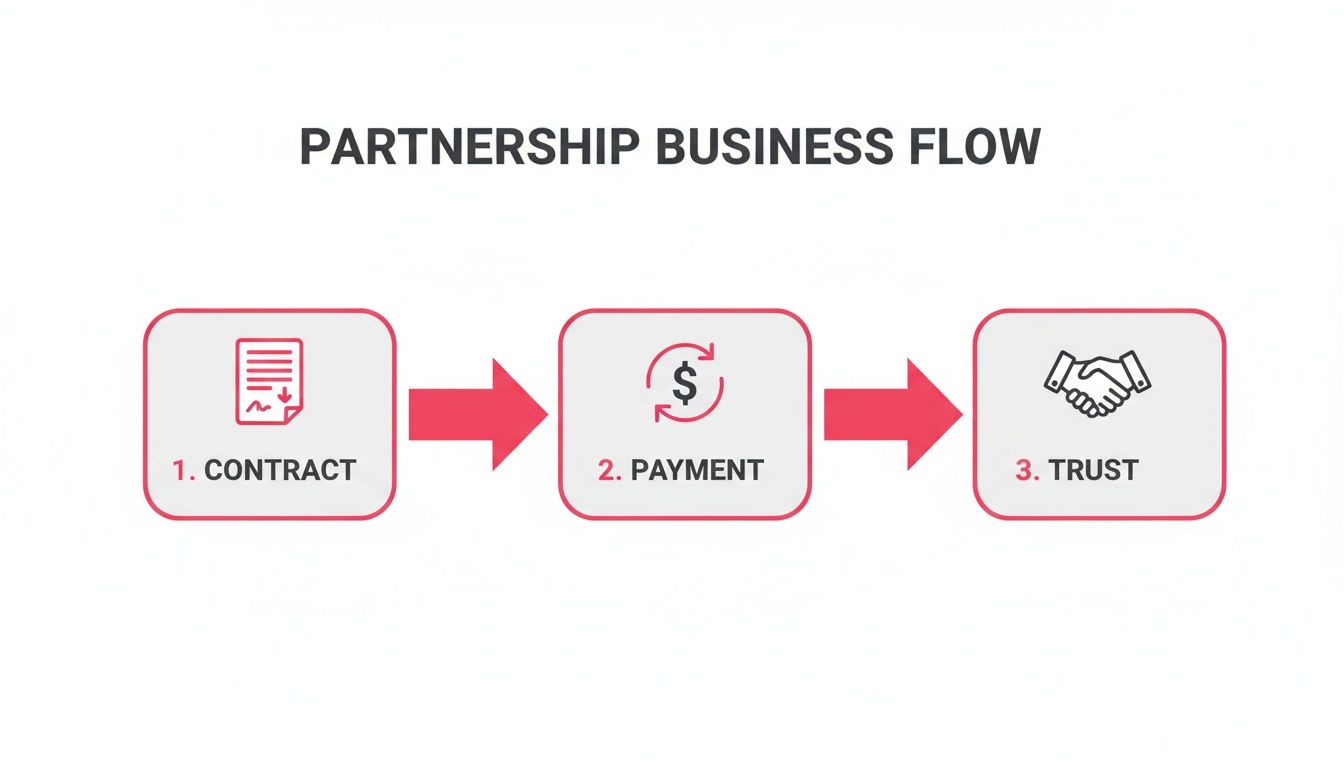
As you can see, a solid operational foundation—clear contracts and on-time payments—is what creates the trust needed for creators to produce their most authentic and high-impact work.
Using Data to Optimize and Scale
As soon as the campaign data starts to trickle in, it's time to optimize. This is where you double down on your winners and learn from your losses. Your reports will quickly show you which creators and content styles are hitting the mark.
Maybe you discover that Reels from your micro-influencers are bringing in a CAC that's way lower than static posts from bigger creators. That’s a game-changing insight. It tells you exactly where your next dollar should go for the best possible return.
Here’s how you can use that data to scale your program intelligently:
- Identify Top Performers: Find the 20% of creators driving 80% of your results. These are the people you want to build long-term relationships with, turning them into true brand ambassadors.
- Analyze Winning Content: Break down what made the best-performing posts so successful. Was it the format (Reel vs. Story)? The tone (funny vs. educational)? The call-to-action? Use these takeaways to make your future creative briefs even stronger.
- Test and Iterate: Your performance data is your new baseline. Now, start experimenting. Test new creator tiers, try different content formats, or play with new offers to see if you can beat your own benchmarks.
This data-driven feedback loop is what will transform your influencer program from a series of one-off campaigns into a consistent, scalable growth channel you can count on.
Ready to streamline your entire partnership workflow, from creator discovery to performance tracking? JoinBrands provides an all-in-one platform to manage every aspect of your campaigns, connecting you with over 250,000 creators and providing the tools you need to measure success and scale with confidence. Find your next top-performing partner at https://joinbrands.com.