



 Instagram Video Aspect Ratios: The 2026 Pro Guide
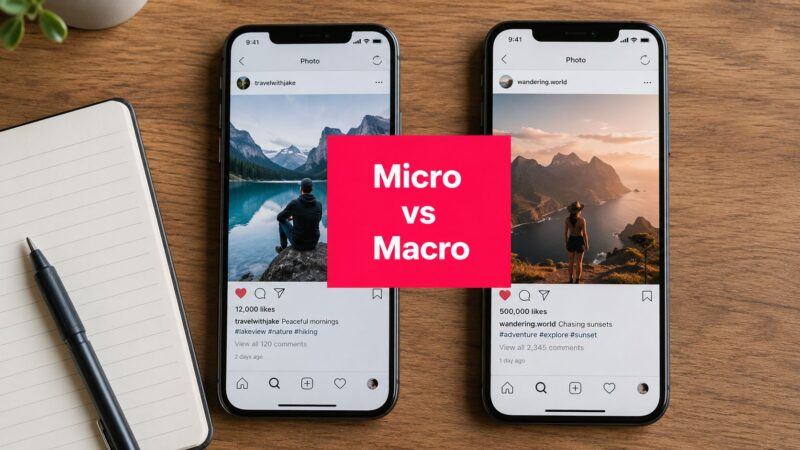
Big influencer budgets don't automatically buy better outcomes. In a micro influencer vs macro influencer decision, the question isn't who has the bigger audience, it's who matches the campaign job you need done right now.
The best brands I've seen don't treat creator size as a status contest. They treat it like channel planning, with micro creators used for trust, product education, and conversion, while macro creators handle broad visibility and fast awareness. That split matters because the performance gap is real. Multiple industry datasets put micro creators at 3.86% Instagram engagement versus 1.21% for macro creators, with another 2025 benchmark showing macro Instagram engagement at 2.15% and TikTok at 7.83% (micro vs macro influencer benchmarks).
| Metric | Micro-Influencer | Macro-Influencer |
|---|---|---|
| Typical follower band | 10,000 to 100,000 | 100,000 to 1,000,000 |
| Instagram engagement benchmark | 3.86% | 1.21% |
| Trust in recommendations | 82% | celebrity endorsements at 55% |
| Main strategic strength | Niche engagement | Broad visibility |
That doesn't make macro creators bad. It means the smartest brief in 2026 starts with the outcome, then picks the tier.
Table of Contents
Why the Micro vs Macro Debate Misses the Point
The common mistake is assuming a larger creator is automatically the safer bet. In practice, that thinking pushes brands toward impressive reach numbers and weak business results. A macro influencer can expose a message to a huge audience, but if the audience isn't in-market or the content isn't built for action, the campaign can feel busy without moving revenue.
The better way to think about it is simple. Micro creators are built for relevance, proof, and repetition inside smaller communities. Macro creators are built for scale, visibility, and fast cultural penetration. Those jobs are different, which is why the same creator tier doesn't fit every goal.
Practical rule: choose the creator tier that matches the funnel stage, not the one that looks strongest on a media plan.
A brand launching a new category needs attention first. A brand pushing a technical product needs explanation and trust first. A brand trying to get more people to click, sample, or buy usually gets more mileage from creators who can speak like insiders rather than broadcasters.
The strongest campaigns I've run didn't ask, “micro or macro?” They asked, “what has to happen next, awareness, consideration, or conversion?” That shift changes everything, from briefing to content format to how many creators you activate. It also explains why hybrid portfolios keep winning in serious teams, because one tier rarely solves the whole funnel on its own.
Defining Micro and Macro Influencers by the Numbers

The cleanest working definition is still follower range. Micro-influencers are typically creators with 10,000 to 100,000 followers, while macro-influencers usually sit between 100,000 and 1 million followers (tier definitions). In platform filters and agency workflows, those ranges are the most useful way to separate campaign logic.
What changes beyond follower count
Micro creators tend to be niche experts with tighter audience relationships. Their content often feels more direct, more specific, and less polished in a way that audiences read as authentic. Macro creators usually operate with broader audience mixes, more diversified content themes, and a more polished public-facing style.
That difference affects how people respond. A micro creator is often seen as an approachable expert in a specific lane, while a macro creator functions more like a digital heavyweight with wider reach. The same product can benefit from both, but not in the same role.
A skincare founder doesn't need the same creator profile for a dermatologist-led ingredient breakdown and a celebrity-style launch post.
Pro tip for campaign setup
Use the exact follower ranges above when building creator filters on platforms like JoinBrands or any similar marketplace. That makes it easier to separate creators by function instead of by vanity metrics, and it reduces the tendency to overpay for reach you may not need.
A practical example makes the distinction obvious. A skincare brand might treat a 42,000-follower dermatologist as a micro-influencer because the audience expects expertise and product guidance. The same brand might treat a 320,000-follower lifestyle creator as a macro-influencer because the audience is broader and the content is built for scale. Same category, different job, different role in the campaign mix.
Engagement Rates and Cost Efficiency Compared
Engagement is where the efficiency gap shows up fastest, but the better interpretation is not that one tier wins everywhere. Micro creators usually generate stronger interaction relative to audience size, while macro creators buy scale and awareness in a single placement. The distinction matters because a brand can get a cleaner response curve from a smaller creator while still needing a larger creator to put the message in front of more people.
The cost side is just as important. In the independent DTC comparison, micro creators showed lower cost per engagement, lower customer acquisition cost, and stronger conversion performance, while macro creators delivered far more reach per post (micro vs macro ROI comparison). That is the trade-off brands keep running into, micro creators are often more efficient, macro creators are better when the brief is scale.
| Metric | Micro-Influencer | Macro-Influencer |
|---|---|---|
| Cost per engagement | $0.08 | $0.09 |
| Conversion rate | 2.1% | 1.4% |
| Customer acquisition cost | $23 | $31 |
| Average reach per post | 12,400 | 180,000 |
Those ROI figures come from the independent DTC comparison above. The useful takeaway is straightforward. Micro partnerships tend to keep paid social teams closer to efficient testing, while macro partnerships are easier to justify when reach, visibility, or launch velocity matters more than tight response economics.
Why the math matters
If a campaign needs action, engagement is only part of the equation. A benchmark on creator trust shows 82% of followers trust micro-influencer recommendations, compared with 55% for celebrity endorsements (engagement benchmark). That trust gap helps explain why micro creators often do better on education, consideration, and lower-funnel conversion work.
Campaign summaries for Daniel Wellington, Glossier, HelloFresh, Dunkin' with Charli D'Amelio, and Kylie Cosmetics report micro-influencers at 5 to 20% engagement versus 1 to 6% for macro influencers, along with lower cost per engagement of about $0.20 versus $0.33 in macro partnerships (campaign case summary). The exact mix changes by category and creative brief, but the pattern stays consistent. Micros usually win on efficiency, macros usually win on scale.
Practical rule: if the brief is maximum reach from one post, macro still has a job to do. If the brief is response, clicks, saves, or purchases, micro usually does more with less.
For DTC teams, that is the decision point. Macro reach can look impressive on a report, but it does not automatically lower acquisition cost. Micro partnerships usually give media teams more room to test angles, rotate hooks, and keep CAC under control without giving up credibility.
Matching Influencer Tiers to Campaign Objectives

Different campaign goals need different creator roles. If the objective is brand awareness, a macro creator fits because the message needs to travel fast. If the goal is community building, niche authority, or authentic advocacy, micro creators usually perform better because their audiences expect depth and specificity.
Five common scenarios
Product launch with education needs. Choose micro creators first. They can explain ingredients, features, use cases, and objections in a way that feels like advice instead of an ad. That makes them strong for technical products, beauty, wellness, supplements, and anything else where buyers need context before they commit.
Category awareness. Use macro creators. They're useful when the brand needs broad visibility, press lift, or a fast spike in attention around a new offer. A macro post earns its keep here, especially for a new market entry or a tentpole moment.
Niche community penetration. Go micro. A running-shoe brand, for example, can activate local running creators, club leaders, and gear nerds who speak the community's language. That's usually stronger than paying one huge creator whose audience is too mixed to care.
Seasonal promotions. Use both tiers in sequence. Macro creators can announce the moment, then micro creators can reinforce the offer with product-specific content, demos, and reminders. The combination gives the campaign both reach and repetition.
Ongoing ambassador programs. Micro creators are usually the better fit. Their lower cost and stronger perceived authenticity make them easier to keep active over time without blowing up the budget.
Practical example: a running brand can use a macro creator to introduce a launch, then seed micro creators inside local running communities for detailed reviews and fit checks.
The underlying logic is straightforward. Macro creators are strongest when you need broad awareness or cultural-moment amplification. Micro creators are strongest when you need product education, community trust, or conversion-focused storytelling. Choosing the wrong tier for the objective is what wastes budget, not the tier itself.
Building a Hybrid Creator Portfolio for Maximum ROI

The highest-performing teams don't act like they have to choose a side. They build a hybrid creator portfolio that maps creator type to funnel stage. Macro creators sit at the top, where broad reach matters most. Micro creators do more of the middle and bottom-funnel work, where trust, education, and social proof carry more weight.
How the funnel sequence usually works
Top of funnel is about awareness. A macro creator gives the campaign immediate breadth and a recognizable face. That's useful when the brand needs attention fast, or when the launch itself has news value.
Mid-funnel is about consideration. A mixed tier of creators pays off here, because buyers start comparing options and looking for detail. Micro creators are especially useful because they answer the questions macro posts usually leave open.
Bottom-funnel is about conversion. Micro creators generally have the edge because they feel close to the audience, and their recommendations come across as firsthand experience rather than paid amplification. That's where product demos, reviews, before-and-after content, and creator-led FAQs can do real work.
Shopping-native and short-form ecosystems reward volume, authenticity, and iteration. A single polished post can still matter, but repeated creator proof across many voices often converts better than one oversized splash. That's why portfolio design matters more than ever.
For budget allocation, I usually think in terms of balance rather than fixed formulas. Put more weight on macro if the campaign is a brand launch, a media moment, or a visibility play. Put more weight on micro if the goal is CPA control, niche penetration, or creative testing. Many brands end up using both because the campaign needs both reach and believable proof.
If you're managing this at scale, the operational layer matters as much as the strategy. JoinBrands is one platform brands can use to organize creator filtering, campaign workflow, and asset handling across multiple tiers without turning the program into a spreadsheet mess. The point isn't to collect creators. It's to sequence them in a way that turns exposure into action.
Your Decision Framework for Choosing the Right Tier
Start with the campaign objective, not the creator tier. If awareness is the goal, lean macro. If trust, education, or conversion are the goal, lean micro. If the campaign needs all three, build a hybrid mix and assign each tier a job instead of asking every creator to do everything.
Score the campaign against five criteria
Campaign objective. Brand awareness points toward macro. Engagement and conversion point toward micro.
Target audience specificity. Niche audiences reward micro creators because their communities already care about the subject. Mass-market products can justify macro reach.
Budget constraints. Tighter budgets usually stretch further with micro creators because the spend can be distributed across more voices.
Content type. Storytelling, tutorials, and product education fit micro creators well. Broad announcements and launch visibility fit macro creators.
Measurement goal. If the metric is ROI or CAC, micro is usually the better starting point. If the metric is brand lift or reach, macro has a stronger case.
A simple decision matrix helps here. If three or more criteria point toward one tier, use that tier as the anchor. If the criteria split evenly, build a hybrid and assign the tiers by funnel stage. That keeps the strategy from drifting into “one big creator because it's easier” decision-making.
If the product is technical, niche, or expensive, start with creators who can explain it convincingly. Reach won't fix confusion.
The edge cases are where teams often get it wrong. Time-sensitive launches can justify macro for speed. Limited budgets usually belong with micro because the program can be distributed without losing focus. Highly specialized products often need micro creators with genuine subject-matter credibility, not just audience size.
Executing Multi-Tier Campaigns with JoinBrands
A practical hybrid campaign usually starts with filters. A DTC brand can set creator criteria by follower range, audience fit, content type, and channel, then separate the outreach pool into micro and macro buckets before anyone gets a brief. That matters because the work changes fast once 20 micro creators and 3 macro creators are in motion at the same time.

The operational win is consistency. Brands can manage creator matching, product delivery, content approval, and deadline tracking inside one workflow instead of chasing updates across email and DMs. That's especially useful when the macro creator needs a polished launch asset and the micro creators need slightly different product angles for niche audiences.
A video walkthrough helps show how the campaign pieces fit together.
A realistic campaign flow looks like this. The macro creator opens the campaign with broad reach content. The micro creators follow with reviews, usage demos, and community-specific angles. The brand then compares which messages drove the strongest response and adjusts the next wave accordingly.
That's the part many teams miss. The campaign isn't finished when the first post goes live. It becomes more valuable when the brand can review creator performance, keep the good assets, and reuse the strongest content in paid formats like Spark Ads. The more cleanly the workflow is managed, the easier it is to turn creator content into a repeatable system instead of a one-off launch burst.
If you're building a hybrid creator program and want a cleaner way to manage micro and macro campaigns together, visit JoinBrands. It's built to handle creator matching, campaign workflow, product delivery, and content approval in one place, which makes it easier to turn tier strategy into execution.