
 A Marketer’s Guide to Content Creation Websites
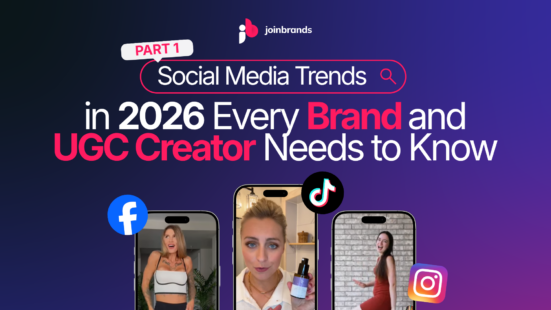
Social media in 2026 looks nothing like it did two years ago. Platforms are shopping destinations. Creators are full-time businesses. And brands still thinking in terms of follower counts and branded ads are falling behind fast.
The influencer marketing industry has grown past the $30 billion mark. Social commerce is projected to drive $1.3 trillion in global sales this year. UGC campaigns on creator platforms grew 133% year over year.
Here are the most important social media trends in 2026, what’s driving them and exactly how brands and UGC creators can act on them.
Table of Contents
UGC Beats Branded Content Every Time
This is no longer a hypothesis, it’s the data. UGC influences 79% of purchase decisions. 92% of consumers trust UGC and word-of-mouth recommendations more than any other form of advertising. Creator content consistently outperforms brand-first creative at a fraction of the cost and at significantly faster turnaround times.
As confirmed at JoinBrands Creator Masterclass Live #3, unpolished, authentic content outperformed every scripted and polished format tested across 2025. Brands are reallocating traditional production budgets into creator-made assets because the performance speaks for itself.
For brands building a UGC pipeline, start with how to find UGC creators, what to look for and how to evaluate fit beyond follower count.
💡 JoinBrands connects brands with 500,000+ UGC creators. Post a job and start receiving content in days, not weeks. Start for free
Social Commerce Goes Mainstream
US social commerce sales surpassed $100 billion in 2025. Global projections put the market at $1.3 trillion in 2026. The gap between discovery and purchase has collapsed, consumers are finding, evaluating, and buying products entirely within social platforms. Brands integrating shoppable UGC see 32% more click-throughs than non-shoppable formats.
TikTok Shop is the most aggressive example, but Instagram, YouTube, and Pinterest are all building native checkout experiences. For creators, your content is now a direct sales channel. Our guide on TikTok Shop affiliate marketing breaks down exactly how to get started.
Micro and Nano Influencers Are the Dominant Force
Brands are partnering with micro-influencers ten times more than mega-influencers in 2026. Smaller creators deliver 20% higher conversion rates. TikTok nano-influencers achieve 10.3% engagement rates while mega-influencers rarely break 2%. A recommendation from a micro-creator feels like a friend texting you about a product, audiences know the difference, and their purchase behavior reflects it.
For every $1 spent on influencer marketing, brands are seeing an average return of $6.50. When that spend is concentrated in micro and nano tiers, the return goes further. If you’re a creator wondering where you fit, our overview of what it means to be a content creator in 2026 is a good place to start.
Short-Form Video Is Still the Most Powerful Format
Short-form content saw 71% year-over-year growth in 2025. Meta reported showing 50% more Reels on the same day they were posted. The average TikTok watch time dropped to 3.75 seconds, making a strong hook in the first one to two seconds non-negotiable. Video ads deliver 48% higher engagement than static image ads across platforms.
The key shift in 2026 is that brands now need short-form video that converts, not just content that gets views. Watch time, saves, and shares are the metrics that matter. Learn the framework in our guide to making UGC that actually converts.
Social Is the New Search Engine
More than 60% of product discovery now happens on social platforms. Gen Z consumers use TikTok and Instagram to search for products, reviews, and recommendations more than they use Google. Brands briefing creators to answer high-intent questions “best protein powder for beginners,” “honest review of this skincare product”, see significantly better organic reach and conversion. This is social SEO, and it’s one of the most underused UGC creator strategies in the space.
🔍 JoinBrands lets you brief creators with specific angles and questions. Get content that answers what your customers are searching for. See how it works
Long-Term Creator Partnerships Replace One-Off Deals
54% of brands now use retainer or partnership models instead of one-off posts. When an influencer promotes the same brand across multiple pieces of content, their audience builds familiarity, trust, and buying intent. For creators, long-term deals mean predictable income and deeper brand integration, the creators earning the most in 2026 are converting single projects into monthly retainers.
Our guide on how to collaborate with influencers covers the full process from first contact to long-term partnership structure.
Performance-Based Influencer Marketing Is Standard
Vanity metrics are out. In 2026, brands expect conversion metrics, revenue insights, and direct attribution. Key metrics now include cost per click, cost per acquisition, ROAS, and revenue per creator. 74% of brands are actively moving budget into creator programs, ROI is the deciding factor. Performance bonuses tied to GMV are now standard in creator contracts, and JoinBrands has these built directly into the platform.
AI Tools Are Reshaping Creator Workflows
78% of marketers still prioritize human UGC over AI-generated content, with only 2% focused on AI-only content strategies. But AI tools for scripting, editing, captioning, and content planning are now part of every serious creator’s workflow. The creators growing fastest in 2026 use AI to remove friction from their process, not replace their voice.
Sub-Niche Content Outperforms Broad Content
A fitness creator who specializes in resistance training for women over 40 will outperform a general fitness creator every time. This applies to brands too, campaigns targeting a specific ICP with tailored messaging consistently outperform generic ones. Speaking to one person so specifically that they feel the content was made just for them is one of the most underused strategies in the space. As covered in our UGC content strategies guide, this is where most brands leave performance on the table.
The Creator Economy Is Professionalizing Fast
Content creator is now a legitimate career path. 50 million active creators are operating globally in 2026. Two-thirds of active creators acknowledge the professional nature of their roles, building portfolios, tracking results, and pitching proactively. Brands now expect creators who communicate clearly, deliver on time, and understand performance metrics.
Our guide on content creator jobs covers what brands are actually paying for and how to position yourself to earn more.
What’s Next
These first 10 trends set the foundation, but the second half of 2026’s creator landscape is where things get even more interesting. In Part 2, we cover TikTok Shop and creator affiliate programs, the rise of live shopping, how Gen Z and Gen Alpha are rewriting the rules, and the metrics that actually matter now that likes have lost their meaning.
🚀 Ready to put these trends to work? JoinBrands connects brands with 500,000+ UGC creators who are ready to make content that converts.
Start getting brand deals and UGC content on JoinBrands
If you are a creator looking to understand how brands are thinking about these trends and what they are looking for when they hire, our guide on how to collaborate with influencers covers the full picture from both sides.
And if you want to stay ahead of what is working for creators right now, catch up on the latest Creator Masterclass Live sessions where real creators break down their frameworks in real time.