
 How to Build an Omnichannel Content Strategy That Converts
You've found a creator, agreed on a video concept, and penciled in a launch date. Then someone asks who owns the new TikTok account, whose phone receives recovery codes, and whether the quoted fee includes running the winning video as an ad. Those aren't details to settle after filming. They determine whether you're buying usable content and a manageable distribution account, or inheriting a dispute.
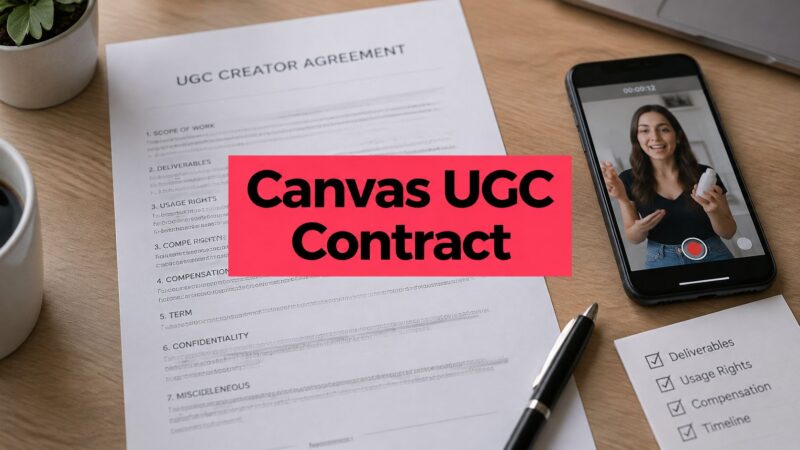
A Canvas UGC contract should govern both the creative work and the account the creator operates. Use the structure below as a drafting reference, then have counsel adapt the agreement to the governing law and the actual commercial arrangement.
Table of Contents
Canvas UGC Contract Template at a Glance
Canvas UGC contract clauses at a glance
| Clause | What to write | Example entry |
|---|---|---|
| Parties and accounts | Legal names, brand-owned account handles, who holds login and recovery access | Account [handle] owned by [Brand]; Brand holds recovery email and two-factor device |
| Deliverables | Asset list, count, format, length per cut | 3 videos, each with 1 script, 3–5 raw clips and 2 hook variants |
| Usage rights | Permitted channels, media, territory and duration | Organic posting plus paid use on Meta for 90 days, worldwide |
| Payment | Model, rate, trigger date and payment window | Flat fee of [amount] per video; paid within 14 days of posting |
| Revisions | Rounds included, scope of a revision, response window | Two rounds per deliverable; feedback within 2 business days |
| Deadlines | Dated milestones counted from the previous step | Script due day 3 after brief acceptance; final delivery day 10 |
| Account control and moderation | Who replies to comments and who may remove or edit posts | Creator replies to comments within 24 hours; Brand approves removals |
| Termination | Notice period, account handover, content removal rules | 7 days notice; creator removes logins and the brand retains posted videos |
These are illustrative negotiated entries, not standard rates, statutory deadlines, or automatic rights. Replace them with terms both parties can perform, and fill every bracketed field before circulating the draft.
Make the agreement operational
Identify the contracting entities, not just a brand name and a creator's social handle. Include each party's legal name, address for notices, authorized signatory, and billing contact. If an agency signs, state whether it contracts on its own behalf or as an authorized representative of the brand.
Give the account its own entry in a schedule. Record its platform, handle, account identifier, administrative owner, recovery email custodian, and authentication method. Don't put passwords or backup codes inside the agreement. Reference a restricted credential register instead.
For payment, separate the production charge from licensing, publishing, moderation, and performance compensation. A single bundled fee can work, but the contract should identify what that bundle buys. Otherwise, cancellation becomes an argument about how much work was already earned.
Establish which document controls
A signed contract, creative brief, email approval, and platform message can contradict one another. Add an order-of-precedence clause stating which document controls commercial terms and how the parties approve scope changes.
For example, the master agreement can govern ownership and liability, while a signed campaign schedule governs deliverable counts and dates. A later message requesting another hook shouldn't silently expand the production scope.
Practical rule: A bracket is a decision waiting for an owner. Assign that decision before asking the creator to sign.
Before sending the draft, resolve every blank, including fields marked “to be agreed.” Those unfinished clauses are often exactly where the parties later disagree.
What Sets a Canvas UGC Contract Apart
Canvas UGC is paid creator content published through brand-specific social accounts rather than the creator's established personal profile. The accounts typically start with zero followers and no posting history, with distribution driven by content relevance and viewer behavior rather than an existing audience, as described in The Viral App's Canvas UGC explainer.
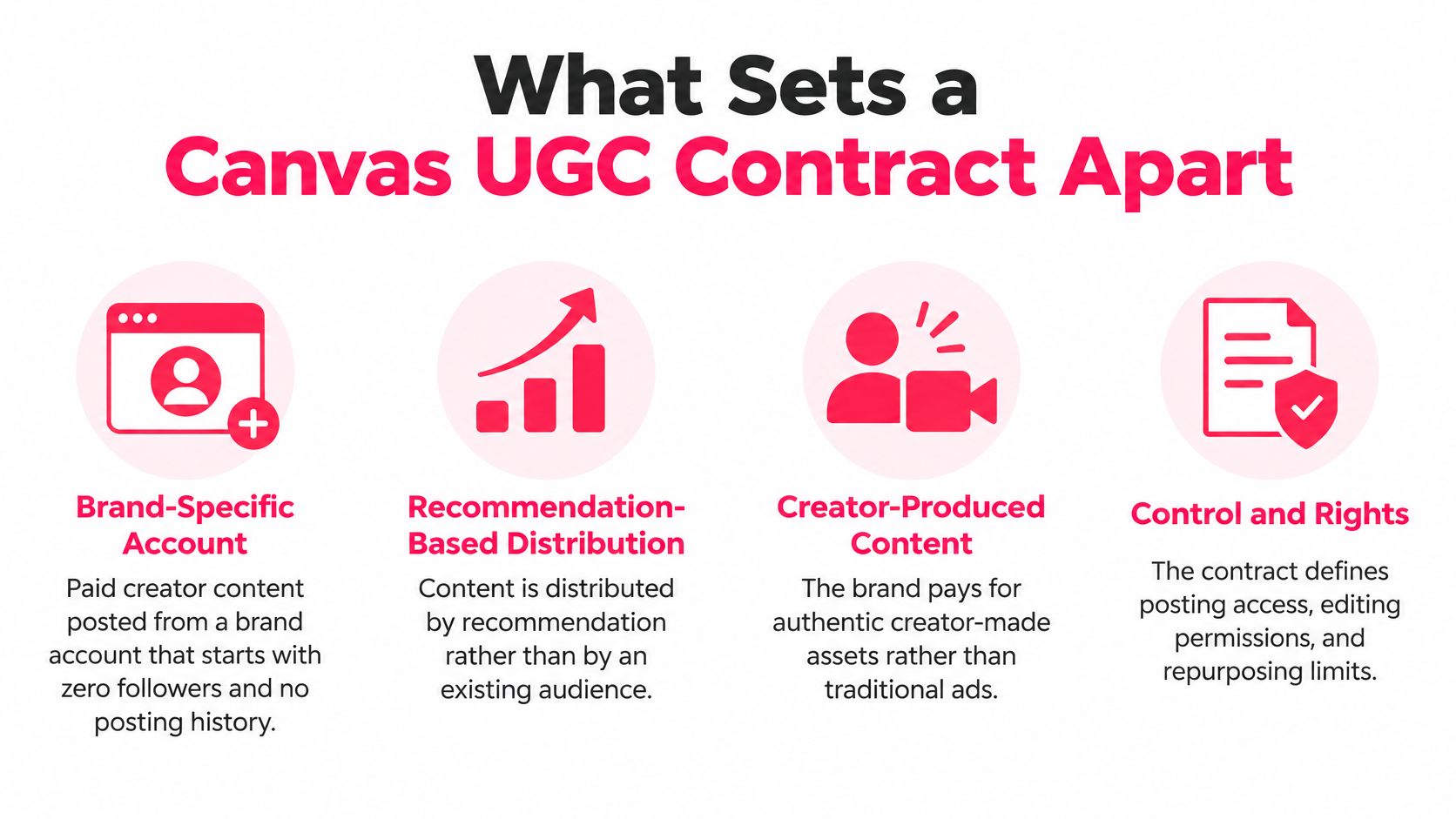
A conventional content-production agreement primarily governs a finished asset. A Canvas arrangement also governs a live publishing operation that someone may need to pause, recover, transfer, or close.
- What the creator delivers: Conventional UGC may end at file approval. Canvas work can include publishing, account upkeep, analytics reporting, and moderation.
- Who controls distribution: A file-delivery project doesn't necessarily involve account access. A Canvas engagement requires explicit administrative and recovery responsibilities.
- How compensation works: Production fees compensate completed work. Performance-based terms also require an agreed measurement process.
- What happens on exit: Delivering the final export isn't enough if the departing creator still controls authentication or scheduled posts.
Terminology isn't settled. TokPortal's explanation of Canvas UGC distinguishes dedicated-account programs from Canva-made assets and notes that the category isn't a single standardized service.
Define your arrangement in the opening recitals: “Creator will produce and publish brand-commissioned content through the dedicated accounts identified in Schedule [name].” Don't rely on the label alone.
For the broader planning work, PostSyncer's guide to how to launch a UGC campaign is a useful companion when turning campaign objectives into a working brief. The contract then assigns responsibility for executing that plan.
Creator reach isn't the main risk-control tool here. The signed operating terms are.
Deliverables and Revision Rounds to Define
Deliverables to define in the contract
| Deliverable | What the contract specifies | Example count |
|---|---|---|
| Script | Format, length, approval step and deadline | 1 per video, approved before filming |
| Raw footage | File type, resolution, minimum clips, delivery method | 3–5 clips per video |
| Edited video | Aspect ratio, length in seconds, number of cuts | 1 master plus 2 hook variants |
| Captions and text | File format, language, on-screen text rules | 1 caption file per video |
| Posted URL | Account, publish date window, pinned or unpinned | 1 URL per video, within 2 days of approval |
| Revision round | Scope, count per deliverable, response window | 2 rounds per deliverable |
| Placement | Feed, Reels or Shorts, paid use if any | 1 placement per video unless stated |
Treat these counts as sample scope, then replace them with the campaign's actual requirements. A UGC brief template can help organize the creative direction, but the signed deliverables schedule should settle what the creator owes.
Count files, not just concepts
Suppose you commission four videos with two hook variants each. If each concept includes a master and two alternative-opening exports, the creator owes twelve edited files. If you intended two exports total per concept, write that instead.
In this hypothetical package, each script receives two revision rounds before filming, and the raw footage accompanies each approved cut. Specify whether raw footage means all usable takes or only the clips appearing in the edit. Require original camera files without baked-in captions or music when the brand needs clean material for later editing.
The technical fields should be equally concrete: [file type], [minimum resolution], [aspect ratio], [duration in seconds], , and [delivery folder]. Include subtitle files and approved on-screen wording separately so localization doesn't require reconstructing the edit.
Define a revision boundary
A revision can change wording, framing, caption timing, or the selection of existing footage within the approved concept. A new product, replacement concept, or additional hook is new scope. A brand-requested reshoot after script approval should carry a separate fee, unless the creator failed to follow the agreed specifications.
Use a correction exception: fixing the creator's noncompliance with the approved script or technical requirements doesn't consume the brand's revision allowance. Conversely, changing an approved claim because the brand changed its positioning isn't a free correction.
Pro tip: Define a round as one consolidated feedback submission from the named approver. Separate messages from marketing, legal, and the founder shouldn't become an uncountable revision stream.
Attach a one-page deliverables sheet listing asset identifiers, versions, placements, approval owners, and acceptance criteria. Keep the scope readable without requiring either party to interpret the entire agreement.
Usage Rights and Brand Account Control
Usage rights levels and what each covers
| Usage level | What it covers | Creator profile use |
|---|---|---|
| Organic only | Posting from the brand's own account, no paid use; channels [list], territory [territory], duration [term], fee [amount] | Creator may keep the video on a personal profile only if the contract allows it |
| Paid whitelisting | Running the post as an ad through the creator's handle for a stated window; platforms [list], territory [territory], fee [amount] | Creator handle stays live; window and fee [amount] stated |
| Partnership ads | Ad access through the creator's account for a stated window; placements [list], territory [territory], fee [amount] | Brand gets ad access; the creator account stays under creator control |
| Full rights | Editing, repurposing and paid use across specified channels; territory [territory], perpetual or stated term, fee [amount] | Brand may repurpose and edit; personal profile use only if stated |
Account ownership and content ownership are separate decisions. Owning a dedicated account doesn't automatically establish permission to reuse a creator's likeness in unrelated advertising. Likewise, a broad content license doesn't grant control of the creator's personal profile.

Write permissions that survive the campaign
Use the UGC usage rights checklist to distinguish publishing permission from editing, paid distribution, and repurposing. State when the usage clock starts, such as first publication rather than file delivery, and what happens when it expires.
Paid whitelisting and partnership-ad terminology can overlap in practice. Name the platform permission being granted, the eligible advertiser, the authorized posts, and the expiration date rather than assuming the label is sufficient.
With our Content Only delivery, creators film and deliver the UGC asset directly to the brand, which owns it and can post it wherever it likes. Reflect that arrangement in plain ownership language rather than expecting the word “content” to establish an assignment.
Separate brand administration from creator operation
For a brand-owned Canvas account, use an operating clause such as:
Brand retains administrative control and custody of the recovery email, recovery phone or authentication device, and backup codes. Creator receives only the access necessary to perform the services and must not change recovery settings without written authorization.
Use platform roles where available instead of sharing the owner's credentials. Name who approves bio changes, replies to comments, handles complaints, edits captions, and authorizes deletion. Permit emergency hiding of an unsafe post under a defined escalation procedure, with notice to the brand.
On exit, require the creator to hand over scheduled content, unresolved moderation issues, and account records. The brand should revoke sessions, remove delegated access, and verify recovery before closing the engagement.
Make the contractual default explicit: any right not granted stays with the creator, subject to any separately agreed ownership assignment.
Rights Clearance and Canva Licensing
Require a rights warranty: the creator owns the original footage or has secured permission sufficient for every agreed use. Under Canva's Terms of Use, uploaders bear responsibility for having the necessary rights, so uploading a file isn't evidence that it's cleared.
Check the chain of permission
- People on camera: Obtain signed releases covering the intended media, territory, duration, and advertising use. Keep them with the agreement.
- Music and stock: Record the source and license for each third-party element. Organic availability doesn't establish paid-ad permission.
- Canva assets: The Canva Content License Agreement generally makes a Pro Content License specific to one Canva Design and non-transferable; free users normally need another license when reusing the Pro asset in a different design.
- Export versus source: Identify whether delivery includes only the flattened export or an editable design. Neither transfers ownership of underlying stock.
- Claims and takedowns: Allocate responsibility for third-party claims, defense costs, replacement work, and removal after notice. Have counsel review the indemnity's scope and limits.
AurenWell's photographer contract template offers a related reference when drafting image-delivery and permission terms.
Keep the edit close to customer-made. Approve edits that improve comprehension, not decoration that makes a genuine demonstration look staged.
Over-designed transitions and synthetic voices can undermine the intended human feel, a tension explored in TechRound's coverage of Canva's design predictions. Require creators to declare AI-generated voices, likenesses, and visuals before delivery so the brand can approve their use.
Payment Models and What Each Costs
Payment models compared
| Model | How the creator is paid | Best use | Main risk |
|---|---|---|---|
| Flat fee per video | Fixed amount on approval and posting | Predictable budgets and single launches | No reward for strong performance |
| Per-view (CPM) | Rate per 1,000 qualifying views in a set window | Testing many creative concepts | Disputes over view counts and removed posts |
| Hybrid | Base fee plus bonus above a view threshold | Balancing creator certainty with performance | More terms to draft and verify |
A flat fee buys defined work, not guaranteed reach. It's straightforward to budget, but specify whether posting and moderation sit inside the production fee. Use a UGC creator rates guide to structure the negotiation, then record the actual agreed amount rather than importing a generic rate.
The Canvas UGC industry benchmark described in The Viral App's explainer is approximately $2–$4 per 1,000 views, with rates varying by platform, geography, creative quality, and campaign terms. Treat that as context, not a guaranteed offer or a substitute for pricing production labor.
Make the view calculation reproducible
In a hypothetical agreement, 200,000 qualifying views at an agreed $3 CPM produces a $600 payment:
200,000 ÷ 1,000 × $3 = $600.
The hard part isn't the arithmetic. It's defining “qualifying.”
Record the counted platform, eligible post identifiers, measurement timezone, and observation window. For example, an illustrative contract might measure views during the first 30 days after publication using a dated native analytics export. State whether paid amplification, cross-posted views, suspected artificial traffic, and reposts are excluded.
For a hybrid, distinguish a threshold from a trigger. Does the bonus apply only to views above the threshold, or to all qualifying views once the threshold is reached? Put the formula in the agreement and test it with a sample calculation.
Allocate removal and budget risk
If the brand removes an approved post for convenience, the creator shouldn't automatically lose an earned production fee. State whether the performance amount freezes at the last verified count, whether an approved replacement continues measurement, and how creator-caused policy violations affect payment.
Add any cap, its application per post or campaign, and the maximum authorized liability. No cap should also be an express decision.
For a publishing engagement, define release as occurring after final approval and verified publication, not merely upload to a review folder. Keep already-earned fees separate from future performance settlements, with a deadline for each.
Deadlines, Milestones and Payment Timing
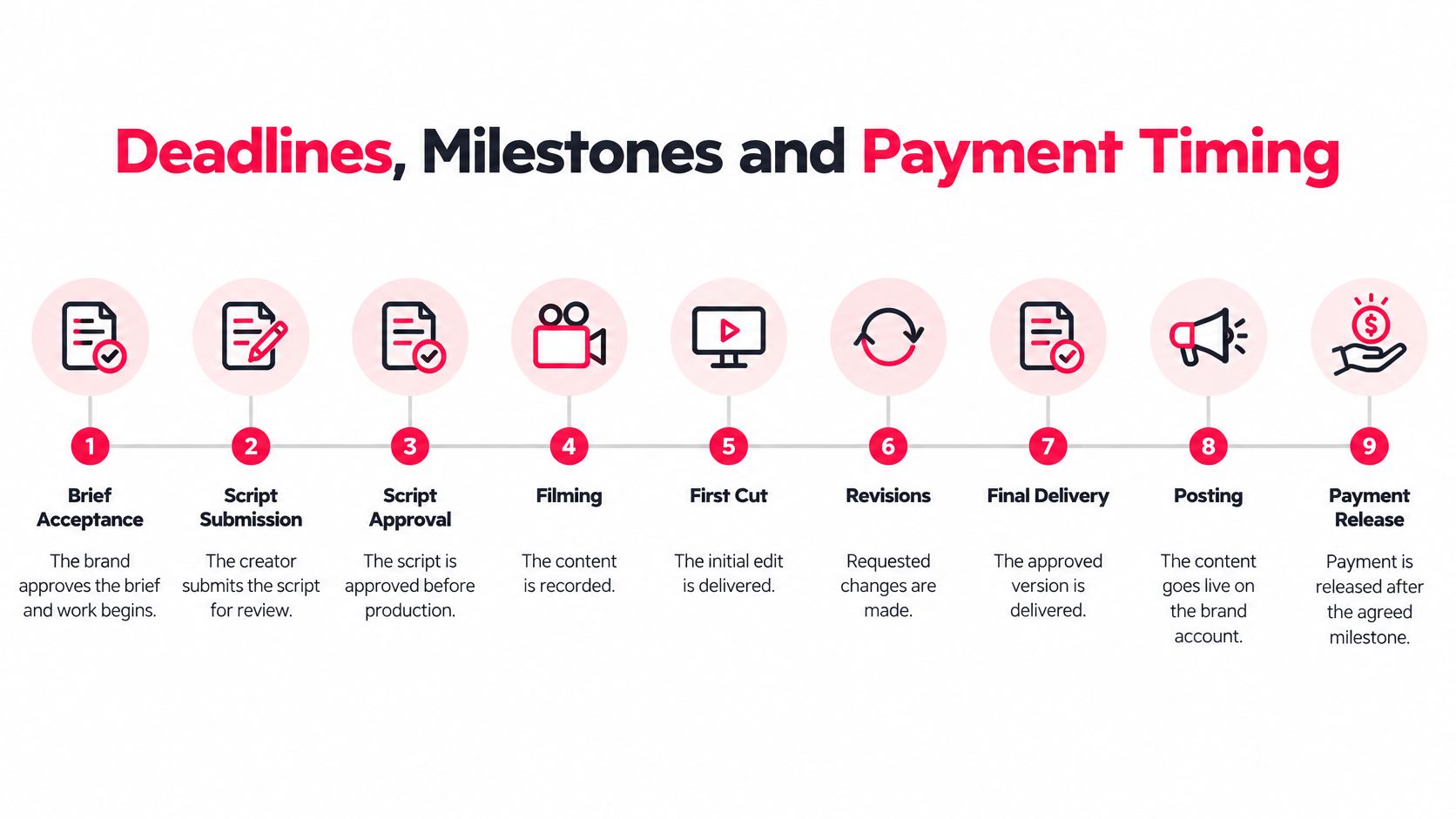
Use a relative schedule with a worked calendar, not a disconnected collection of due dates. Relative deadlines show dependencies; calendar dates help the team reserve production and launch time.
Copy an ordered milestone sequence
The following is an illustrative schedule, assuming approvals arrive on time:
- Brief acceptance: Day 0, after the parties confirm receipt of the product, access, and approved claims.
- Script submission: Due 3 days after acceptance.
- Script approval: Brand supplies consolidated feedback within 2 business days of submission.
- Filming: Begins after written script approval and receipt of any outstanding materials.
- First cut: Due within the agreed production interval after approval.
- Revisions: Creator resubmits within 2 business days of consolidated feedback; brand responds within 2 business days.
- Final delivery: Target day 10, subject to the dependency adjustments stated in the schedule.
- Posting: Target day 12, after written approval and confirmation of publishing access.
- Payment release: Due 14 days after posting, subject to the stated invoice and verification requirements.
Specify whether unqualified “days” means calendar days. Identify the applicable timezone and holiday calendar for business-day calculations.
State what a delay changes
Don't promise that every delay pushes the entire chain. A missed seasonal launch may make the deliverable unusable. Name any hard-stop launch date separately from movable production milestones.
A workable clause can say that a brand-caused approval delay extends dependent deadlines by the corresponding delay, provided the creator promptly supplies an updated schedule. A creator-caused delay should trigger notice, a proposed cure date, and an agreed escalation.
Use fill-in terms for the consequence: [cure period], [fee reduction or service credit], [cancellation threshold], and [amount payable for accepted work]. Avoid undefined late penalties or withholding the whole fee for an unrelated minor delay.
Put this sequence in Schedule [name], Production and Payment Timeline. Reference that schedule in the agreement, and require written approval for changes affecting the launch date or price.
Clause Mistakes That Cause Disputes and Fixes
Losing access to a functioning account can be more disruptive than rejecting a weak edit. The preventive clause isn't “Brand owns the account.” It's the operational language naming who controls recovery and how access is withdrawn.
Common drafting failures and their fixes
| Mistake | Likely result | Clause to add or edit |
|---|---|---|
| Vague deliverables | Scope creep and disputed completion | “Only assets listed in Schedule [name] are included; additions require written approval of price and timing.” |
| No usage period | Disagreement over whether use can continue indefinitely | “Usage is limited to [channels], [territory], and [term], beginning on [trigger].” |
| Per-view pay without tracking | Conflicting counts and invoices | “Qualifying views are measured through [method] during [window], subject to [removal rule].” |
| No recovery access clause | Brand lockout after departure | “Brand controls [recovery method]; Creator may not alter it without written authorization.” |
| Unlimited revisions | Stalled approval and unpriced work | “Included rounds are [count] per [deliverable], with consolidated feedback within [window].” |
| No termination mechanism | Uncertainty after a missed deadline | “After [notice and cure period], either party may terminate under [grounds], with [cancellation payment] and [handover steps].” |
An omitted usage term doesn't automatically create perpetual rights. It creates uncertainty about the parties' intent, which is exactly what a written agreement should remove.
Maintain the template like an operating document
Use a reusable template with controlled bracketed fields, but don't leave irrelevant clauses in place. A personal-account partnership-ad deal and a brand-owned Canvas account need different access provisions. The influencer agreement contract guide provides a useful comparison when the creator's own identity and account are part of the purchase.
For drafting discipline, Documind's guide to writing clear and enforceable agreements is a helpful reference for turning intentions into specific obligations. Counsel should still review enforceability in the relevant jurisdiction.
- Keep scope visible: Attach the deliverables sheet rather than burying asset counts in messages.
- Separate records: Store signed PDFs apart from the restricted credentials log.
- Capture exceptions: Record negotiated departures from the template.
- Set a review cadence: As an internal practice, review the template after every three campaigns and incorporate unresolved edge cases.
Send the Contract Before Your First Brief
Send the agreement before the first production brief, and don't authorize filming until it's signed. A preliminary scope discussion is useful, but it shouldn't become unpaid production or an implied agreement about rights.
Use the pre-signing review to confirm that both parties understand the same purchase. Ask the creator to flag terms they can't perform before anyone books filming time.
Confirm the essential decisions
- Deliverable list: Can both parties identify every required asset and the acceptance criteria?
- Usage window: Are the permitted channels, advertising permissions, start date, and end condition explicit?
- Payment trigger: Can the creator determine when an amount becomes earned and when it becomes payable?
- Revision count: Is the included allowance distinguishable from corrections and additional work?
- Account control: Can the brand recover and administer its dedicated account without depending on a departing creator?
Have counsel check governing law, dispute resolution, ownership language, releases, indemnities, and any proposed deductions or cancellation charges. Commercial clarity helps, but it doesn't replace jurisdiction-specific legal review.
Send the creator a versioned draft with a specific deadline for comments, naming the date, time, and timezone. Ask them to return proposed changes in the document rather than scattering approvals across messages. Once the parties agree, retain the signed agreement and its schedules together so the production team works from the same terms.
At JoinBrands, we connect brands with creators and provide a place to discuss briefs, product details, and revisions directly. Visit JoinBrands to find creators for your next UGC project, then establish the deliverables, usage permissions, and account responsibilities before production begins.