


 How to Sell on TikTok Shop: A Complete 2026 Playbook
A creator marketing strategy for ecommerce needs to do more than generate content — it needs to feed paid channels, convert browsers into buyers, and compound over time as your creator roster and content library grow. Most ecommerce brands start with ad-hoc campaigns and wonder why the results are inconsistent. A deliberate strategy changes that: it defines which content you need, where it runs, how performance is measured, and how the program scales. This is the 2026 playbook for building one.
If you are new to creator marketing, start with our guide on what a creator marketing platform is to understand the infrastructure before building your strategy.
Table of Contents
Foundations: What Your Strategy Needs to Answer
Before running any creator campaign, your creator marketing strategy needs to answer four questions: What is the primary objective — paid ad creative, organic social proof, product listing content, or affiliate revenue? Which platforms are you prioritising — TikTok, Meta, Amazon, or multiple? What is your monthly content volume target? And how will you measure whether the strategy is working? Without answers to these four questions, every campaign decision becomes a guess.
The Right Content Mix for Ecommerce
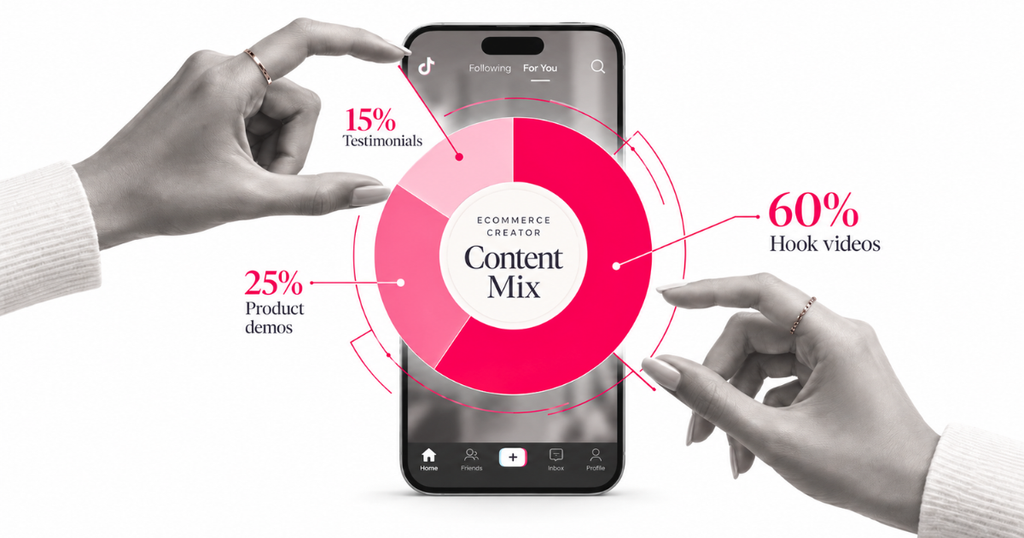
Ecommerce brands typically need three types of creator content running simultaneously:
| Content Type | Purpose | Recommended Volume |
| Short-form hook video (15-30s) | Paid ad creative — stop the scroll, drive clicks | 60% of monthly content |
| Product demo or review (45-60s) | Mid-funnel — show product in use, reduce hesitation | 25% of monthly content |
| Testimonial or transformation (30-45s) | Social proof — reinforce purchase decision | 15% of monthly content |
This split shifts depending on your funnel needs. If conversion rate on your product pages is low, increase demo and testimonial content. If CTR in paid ads is low, increase hook video production and test more creative variations.
Matching Creator Content to Your Channel Strategy
Different platforms require different content formats and serve different funnel stages:
- TikTok (Spark Ads): Short-form hooks 15-30s. Native content format. Strong for top-of-funnel awareness and direct response. See how TikTok Spark Ads amplify creator content.
- Meta (dark posts and feed): Short-form and mid-form video 20-60s. Strong for retargeting and conversion campaigns. Creator content as dark posts typically outperforms branded creative on CTR.
- Amazon (listing videos and posts): Product demos 30-60s. Directly impacts conversion rate on listing pages. Creator review videos lift conversion rates by 10-25% on average.
- TikTok Shop affiliates: Creator-posted content with direct shop link. Revenue attributable per creator. See our TikTok Shop affiliate guide.
How to Structure Your Creator Tier for Ecommerce
An ecommerce creator marketing strategy works best with a three-tier roster: a small group of retainer creators (three to five) delivering consistent monthly content, a mid-tier group of active creators (five to ten) briefed on specific campaigns, and a test pool of new creators rotated monthly to keep creative fresh. The retainer tier provides production consistency. The test pool provides creative variation and prevents audience fatigue.
Budget Allocation by Channel
A starting monthly budget of $2,000 to $5,000 covers: platform subscription, creator fees for eight to fifteen content pieces, and product fulfillment for seeding campaigns. Allocate sixty percent of creator budget to content that will run in paid channels, forty percent to organic and listing content. Scale paid channel creator budget proportionally to ad spend — as a general rule, allocate ten to fifteen percent of your paid social budget to creator content production.
Measuring and Iterating Your Creator Marketing Strategy
Review strategy performance monthly against three metrics: cost per content piece, average CTR of creator content in paid channels versus branded creative baseline, and ROAS of campaigns using creator content. If cost per piece is rising without quality improvement, review your briefing and creator selection process. If CTR is not improving over time, increase creative variation in your test pool. For the full measurement framework, see our creator marketing ROI guide.
JoinBrands supports ecommerce creator marketing strategies at every scale — from first campaigns to enterprise content programs. Start at joinbrands.com/brands
Frequently Asked Questions
How long does it take to see results from a creator marketing strategy?
First meaningful data typically comes in two to four weeks after content starts running in paid channels. A clear picture of which creator formats and messages perform best usually requires six to eight weeks and three to five creative variations per message. Strategy-level results — where the creator program is demonstrably improving blended ROAS — are typically visible after three to four months of consistent execution.
Should creator marketing replace paid advertising or supplement it?
Supplement, not replace. Creator marketing provides the content that runs in paid channels — it is an input to your paid strategy, not an alternative to it. Brands that see the best results use creator content as their primary paid ad creative rather than producing it in-house, while maintaining their media buying and targeting strategy independently.
How do I know if my creator marketing strategy is working?
The clearest signal is whether creator content is outperforming your existing branded creative in paid channels. Track CTR and CPA for creator content versus your baseline. If creator content CTR is at least 30 to 50% higher than your branded creative baseline, the strategy is producing performance-ready content. If not, the issue is usually brief quality or creator selection — not the channel or format.
Not sure where to start?
Build a creator marketing strategy that scales on JoinBrands. joinbrands.com/brands
Follow us on Instagram.