
 Short Form Video Strategy: A 2026 Playbook
You've spent three weeks building a polished influencer marketing campaign proposal. It has creator profiles, mood boards, platform screenshots, projected reach, and forty pages of rationale. Then the CFO asks one question: “What's the payback?” The room goes quiet because the document explains the activity, but not the commercial decision.
That is the most common failure. A proposal should make approval easy, not reward the reader for surviving a creative deck. The influencer marketing industry has grown from about $1.7 billion in 2016 to roughly $32.6 billion in 2026, a nearly 19-fold increase, according to 2026 influencer marketing data. The channel has matured, so your proposal needs to mature with it.
Table of Contents
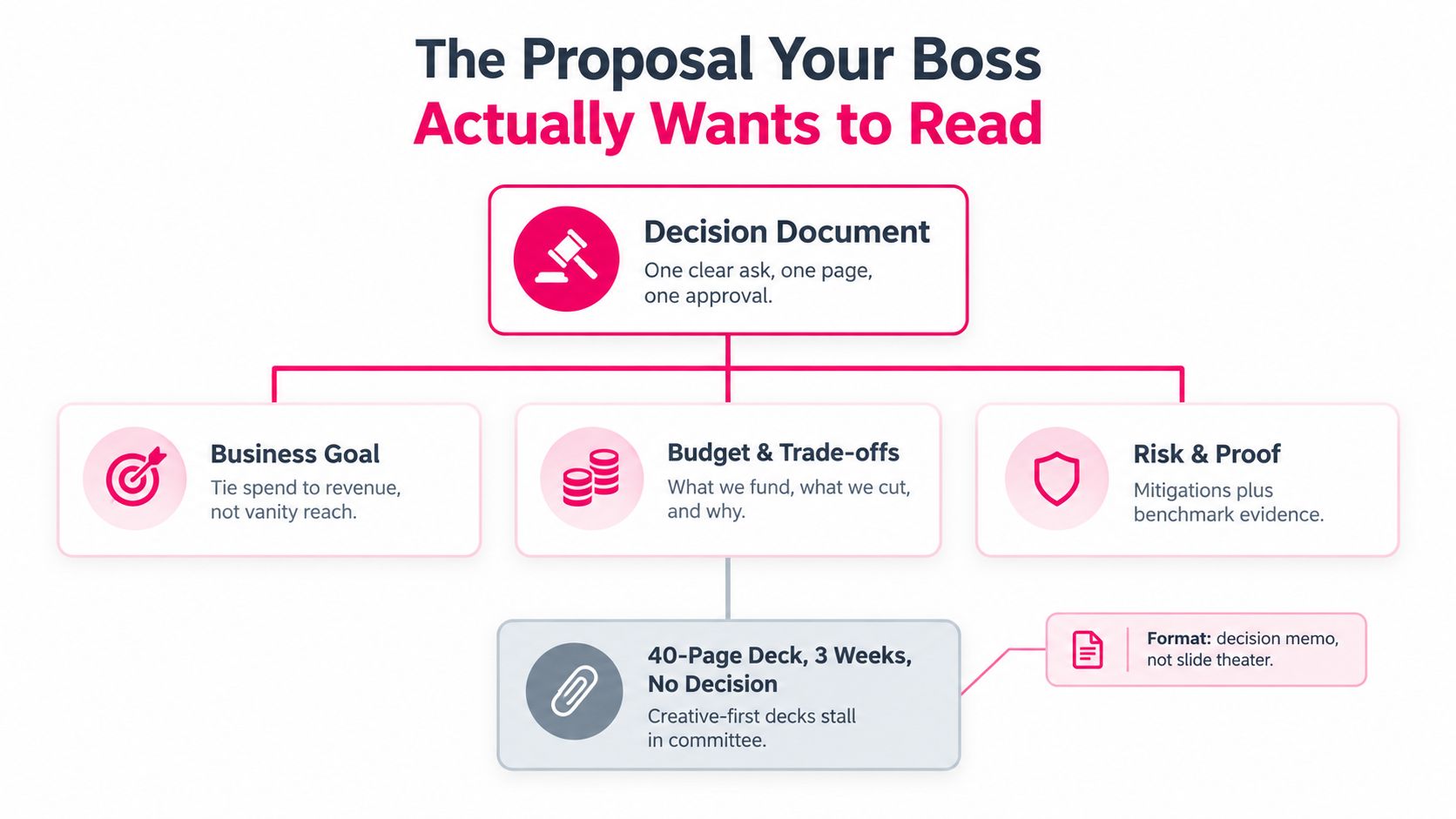
The Proposal Your Boss Actually Wants to Read
A strong proposal is a decision document, not a creative scrapbook. It gives leadership one clear investment thesis, shows how the spend connects to revenue or pipeline, explains the trade-offs, and gives the team enough operational detail to execute without creating approval friction.
A strong proposal has nine connected parts:
- Executive summary
- Objectives and KPIs
- Audience definition
- Channel and creator strategy
- Creative brief
- Deliverables and timeline
- Compensation and budget
- Measurement and reporting
- Legal terms, usage rights, and approval template
The executive summary and objectives should be written together. The summary makes the ask, while the objectives prove that the ask has a measurable business reason.
Start with one commercial thesis
Your opening page should answer four questions:
- What are we funding? A creator-led product launch, acquisition test, seasonal push, or retention program.
- Who is it for? The audience segment most likely to respond.
- What outcome matters? Revenue, customer acquisition, pipeline, or qualified demand.
- What decision is required? Approve the budget, creator mix, timeline, and test conditions.
Keep the thesis short. For example:
Approve a creator-led skincare launch focused on new-customer acquisition, using short-form product demonstrations and paid amplification to target a 2.5x ROAS within 45 days and generate a 12% new-customer rate from creator-attributed orders.
Those targets are useful because they tell the reader what success means before they see a creator name. They also create a basis for rejecting ideas that look attractive but don't support the outcome.
Pair each objective with a primary metric
Write one specific objective per campaign pillar. Then assign one primary KPI, a numeric target, a reason the target is achievable, a commercial connection, and a deadline.
For the skincare example:
- Acquisition: Generate a 2.5x ROAS within 45 days from creator-attributed purchases.
- New-customer growth: Reach a 12% new-customer rate among creator-attributed orders during the same period.
- Creative production: Produce a reusable bank of creator assets for organic publishing and paid amplification within the launch window.
The first two objectives are commercial. The third supports future efficiency, but it shouldn't replace revenue measurement.
Map the objective to the metric that can answer the business question:
- Awareness: CPM and branded search lift.
- Consideration: View-through rate and site visits.
- Conversion: ROAS and CAC.
- Retention: Repeat purchase rate.
Use supporting metrics to diagnose performance, not to create the appearance of progress. A campaign can have excellent engagement and still fail to acquire customers at an acceptable cost. The World Federation of Advertisers' recommendations highlight this measurement gap, with reach and engagement still dominating reported success metrics while conversions and sales are used less often.
Practical rule: If leadership can't tell which number determines whether you scale, pause, or stop, the proposal has too many KPIs.
Anchor the target to past channel performance, comparable creator activity, or a clearly stated category benchmark. Don't stack eight “primary” KPIs. One campaign can support several outcomes, but each pillar needs a clear owner and decision threshold.
Defining the Audience, Channels, and Creator Mix
Audience selection should start with evidence you already own, not a persona workshop. Pull customer data from Shopify, your CRM, subscription platform, or analytics stack, then document the traits that affect creator selection: age, gender skew, geography, content affinity, purchase frequency, and price sensitivity.
A creator-facing audience definition might read: “Existing skincare buyers in urban markets who watch ingredient explainers, compare routines, and respond to premium products when the benefit is demonstrated clearly.” That gives a creator something actionable. “Women aged 25 to 44 who like beauty” doesn't.
Channel choice follows viewing behavior and creative fit. TikTok suits product discovery among younger audiences, Instagram Reels can support mid-funnel consideration, YouTube gives reviewers room for long-form demonstrations, and Twitch or podcasts can work for niche gaming or B2B audiences. These are planning choices, not universal rules. Validate them against your first-party customer behavior and the creator's actual audience.
Build the roster around learning
A micro-first structure gives you more creative variation and makes audience fit easier to compare. A practical starting design is:
- 10 to 20 micro creators, using a working range of 10,000 to 100,000 followers.
- 3 to 5 mid-tier anchors to provide consistency and stronger production capacity.
- One hero partner whose content can support paid amplification.
The specific mix should change when the product requires authority, technical explanation, or broad reach. In 2026 benchmark data, 73% of brands run micro-influencer programs as their primary creator channel, and micro creators show a lower reported cost per engagement than macro creators, $0.20 compared with $0.33, according to Hubfluence's 2026 influencer marketing report. Treat those figures as directional evidence for testing, not a promise of campaign performance.
Writing the Creative Brief and Deliverables
A creative brief should function as a co-creation contract, not a script. Give creators the commercial job, the product truth, and the boundaries. Let them decide how to make the message believable to their audience.
Seven fields belong in the working brief:
- Objective: State the business outcome in one sentence.
- Positioning hook: Explain the product benefit or tension the creator should dramatize.
- Mandatory talking points: Limit these to two or three essential truths.
- Creative boundaries: List the approved do's and don'ts.
- Disclosure language: State the required sponsorship disclosure and placement.
- Asset specifications: Define format, duration, quantity, caption expectations, and hashtags.
- Deadline and submission format: Specify when and how drafts arrive.
Weak talking point: “Tell viewers our serum is effective.”
Stronger talking point: “Show the step you normally skip in your evening routine, then explain where this serum fits and why the texture matters.” The second version gives the creator a story angle without forcing ad copy into their voice.
| Tier | Reels/TikToks | Stories | Static Posts | Caption Length | Hashtags |
|---|---|---|---|---|---|
| Micro | 1 | 3 | 0 | Short, benefit-led caption | Brand and campaign tags |
| Mid-tier | 2 | 5 | 1 | Medium caption with product context | Brand, campaign, and category tags |
| Hero | 3 | 7 | 1 long-form asset | Longer caption or review description | Brand and campaign tags |
These quantities are proposal assumptions, so label them as such and adjust them to the creator's usual output. JoinBrands lets brands deliver structured briefs inside the platform, with requirements creators can acknowledge before pitching. That can reduce repeated clarification, preserve version history, and keep approvals connected to the original campaign terms.
Don't over-control the hook. Give creators room to remix the opening, pacing, and demonstration so the asset feels native to their audience. A rigid script may protect brand language, but it can flatten the first seconds of the video, which is where attention is won or lost.
Compensation Models and Budget Sizing
There isn't one correct way to pay creators. The right model depends on how predictable the deliverable must be, how much commercial risk the brand can carry, and whether attribution is reliable.
| Creator Tier | Per Deliverable | Follower Range | Recommended % of Budget |
|---|---|---|---|
| Micro | $150 to $500 | 10,000 to 100,000 | 25% for testing |
| Mid-tier | $1,000 to $5,000 | Defined by creator fit | 60% for proven partners |
| Hero | $10,000 to $50,000+ | Defined by reach and authority | 15% for amplification |
| Mega | $100,000+ | Broad-reach partner | Use selectively |
These are working budget benchmarks for proposal planning, not guaranteed market rates. Product complexity, exclusivity, production quality, audience quality, and usage rights can change the fee substantially.
- Flat fee per deliverable: Best when you need predictable output and a clear production commitment.
- Product-only gifting: Useful for seeding and relationship development, but weak when the brand needs guaranteed content or timing.
- Revenue share or affiliate commission: Strong for DTC when tracking is airtight. Forecasting becomes harder when creators have uneven traffic and conversion behavior.
- Hybrid flat fee plus bonus: A useful compromise. The creator receives a guaranteed payment and a performance kicker for exceeding agreed thresholds.
For a $25,000 quarterly program, a proposed allocation of 60% to proven mid-tier creators, 25% to 8 to 12 micro creators, and 15% to one hero partner produces:
- $15,000 for mid-tier creator fees.
- $6,250 for the micro-creator test cohort.
- $3,750 for the hero partner.
Reserve room for product seeding, shipping, editing, and paid amplification. A planning assumption of $25 to $75 in product value per creator can help estimate seeding costs, but shipping and product economics should be calculated separately. The proposal should state whether the budget includes whitelisting edits, paid media, platform fees, and usage-rights extensions.
CreatorIQ reports that nearly two-thirds of new creator spend is being reallocated from traditional paid and digital channels, while average annual influencer budgets grew 171% year over year, according to CreatorIQ's creator marketing report. That shift makes the payment model a strategic decision, not an administrative detail.
Measurement, Reporting, and Attribution Windows
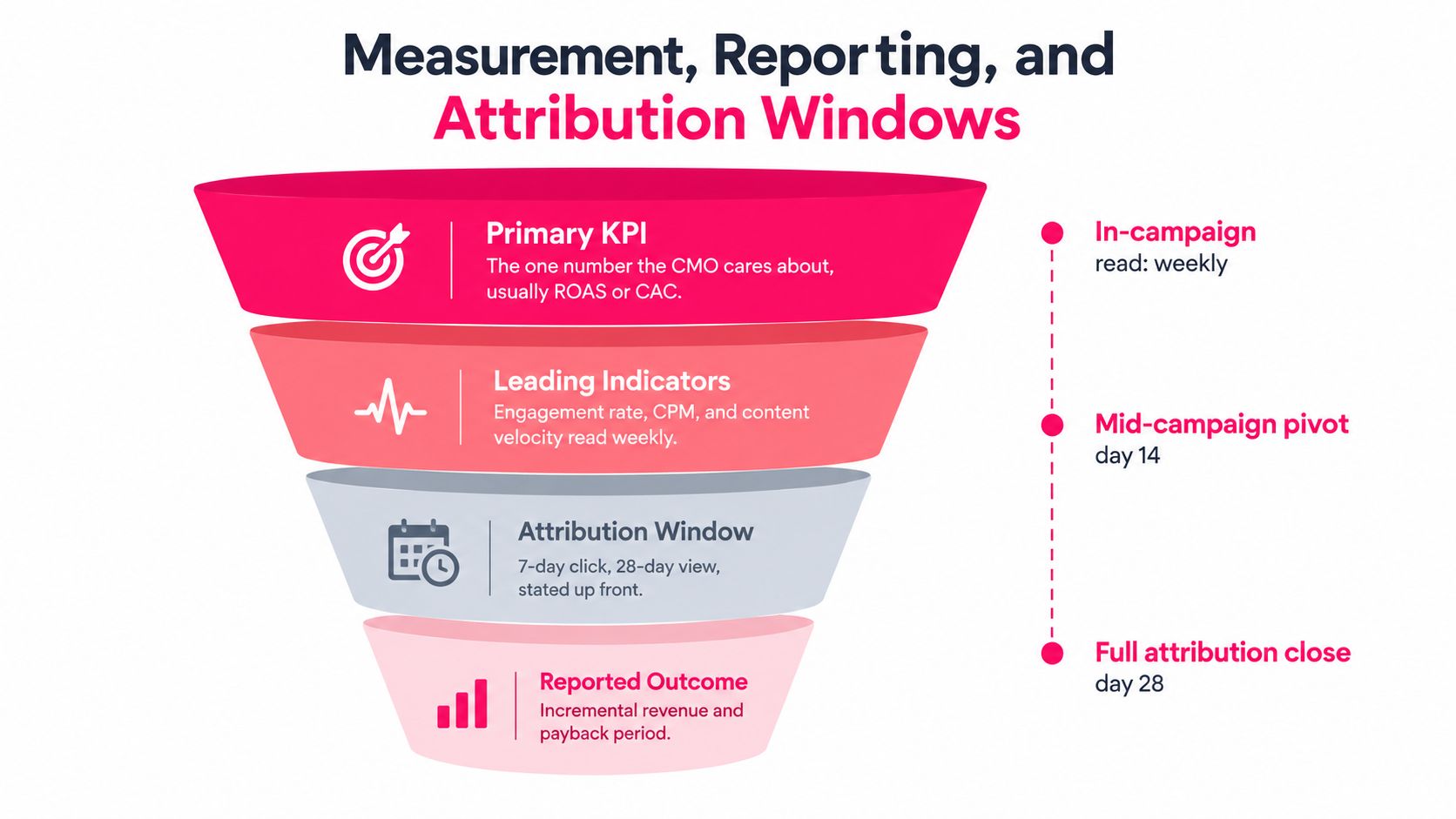
Measurement should surface problems while you can still change the campaign. Build a hierarchy before creators publish.
Primary KPI is the one number the CMO uses to judge the investment, usually ROAS or CAC from creator-attributed conversions. Secondary KPIs explain the customer journey, such as engagement rate, view-through rate, creator-attributed sessions, and new-customer count. Diagnostic metrics explain creative performance, including hook rate, save rate, share rate, and creator-level content retention.
Use a stated attribution model rather than changing the rules after results arrive. A practical default is a 7-day click window and 28-day view window, with a 1-day click view for last-click reporting. These are operating settings for the proposal and should be aligned with your analytics stack, sales cycle, and media buying method.
| Reporting Moment | What to Check | Decision |
|---|---|---|
| Daily pulse | Spend, approvals, missing assets, broken links | Fix execution issues |
| Day 14 read | Early clicks, content quality, creator variance | Revise or reallocate |
| Day 35 report | Closed attribution, revenue, CAC, ROAS | Scale, pause, or redesign |
Use UTM parameters on creator links, unique discount codes where appropriate, and platform-level conversion data. JoinBrands provides a workflow example through its analytics dashboard, which consolidates link clicks, conversions, and creator-level ROAS for campaign review. Reconcile those results against Shopify or your commerce platform before presenting final revenue.
The Influencer Strategists performance report identifies engagement rate, impressions and reach, click-throughs, conversions, revenue, CPA, and creator-level content performance as core reporting measures. Don't present every available metric. Show the primary KPI first, then the evidence that explains it.
A reporting dashboard still can't prove incrementality on its own. Where the budget allows, pair the campaign with a holdout geography or a comparable audience that wasn't exposed to creators. That comparison helps separate creator-driven lift from demand that would have arrived anyway.
Disclosures, Usage Rights, and Whitelisting Terms
Legal terms can determine whether a creator asset remains useful after the original post. Put them in the proposal early, because a low initial fee can become expensive if the brand later needs paid usage, editing rights, exclusivity, or platform access.
The FTC says influencers must disclose a material connection with a brand, including payment or free or discounted products. The disclosure should appear with the endorsement itself, not in a buried profile note, according to FTC disclosure guidance for social media influencers. The FTC's clear and conspicuous disclosure guidance also places responsibility on marketers to educate creators and monitor published content.
Your proposal should specify approved disclosure language, platform partnership tags, review responsibility, and the process for correcting a non-compliant post. Include relevant local advertising rules, such as ASA requirements where the campaign reaches the United Kingdom.
| Term | Standard Default | Negotiated Upgrade | Cost Impact |
|---|---|---|---|
| Paid usage | Organic publication only | 30, 90, or 180 days of paid usage | Fee increases with duration |
| Whitelisting | No ad-account access | Creator approval for Spark Ads or Branded Content Ads | Fee plus media-management terms |
| Editing rights | Brand may repost as published | Brand may crop, subtitle, resize, or cut variants | Additional rights fee may apply |
| Exclusivity | No category restriction | Defined competitor block for a stated period | Higher creator fee |
| Amplification | Creator publishes only | Brand funds paid media behind approved content | Separate media budget |
Define whether the brand receives organic reposting rights, paid amplification rights, raw footage, and derivative-editing rights. State who controls ad copy, targeting, comments, spend caps, and creator approval. “Whitelisting included” is not specific enough.
Before signature, redline these items:
- Exact platforms and asset formats.
- Disclosure wording and approval responsibility.
- Usage territory and rights duration.
- Competitor category definition.
- Revision limits and reshoot conditions.
- Payment timing and cancellation terms.
- Paid media access and spend ownership.
- Data access, tracking links, and reporting responsibilities.
Sample One-Page Template and Pitch Tips
A one-page proposal works because it forces prioritization. It gives a CMO enough information to approve the test without scheduling a meeting to decode the strategy.
Use this layout:
- Campaign name: A memorable phrase that explains the initiative.
- Objective and primary KPI: The business outcome and the decision metric.
- Audience and creator tier: Who the campaign reaches and why the roster fits.
- Channel mix: The platforms and role each one plays.
- Deliverables: Asset quantities, specifications, and approval dates.
- Timeline: Briefing, pitching, product delivery, drafts, publishing, and reporting.
- Budget total: Creator fees, product, shipping, editing, usage, and paid amplification.
- Projected ROAS range: A scenario estimate labeled clearly as a projection.
- Measurement plan: Attribution method, reporting cadence, and close date.
- Creative concept: One sentence that makes the campaign tangible.
The persuasion mechanics matter as much as the layout. Lead with the revenue number, then anchor the ask against your existing customer acquisition cost benchmark. Name the test budget and the scale trigger, such as “increase spend if creator-attributed CAC remains below the approved threshold after the mid-campaign read.”
Attach one creator example with a short fit rationale. Show the audience match, content style, proposed hook, and expected role in the mix. One concrete example gives leadership something to evaluate without turning the proposal into a roster catalogue.
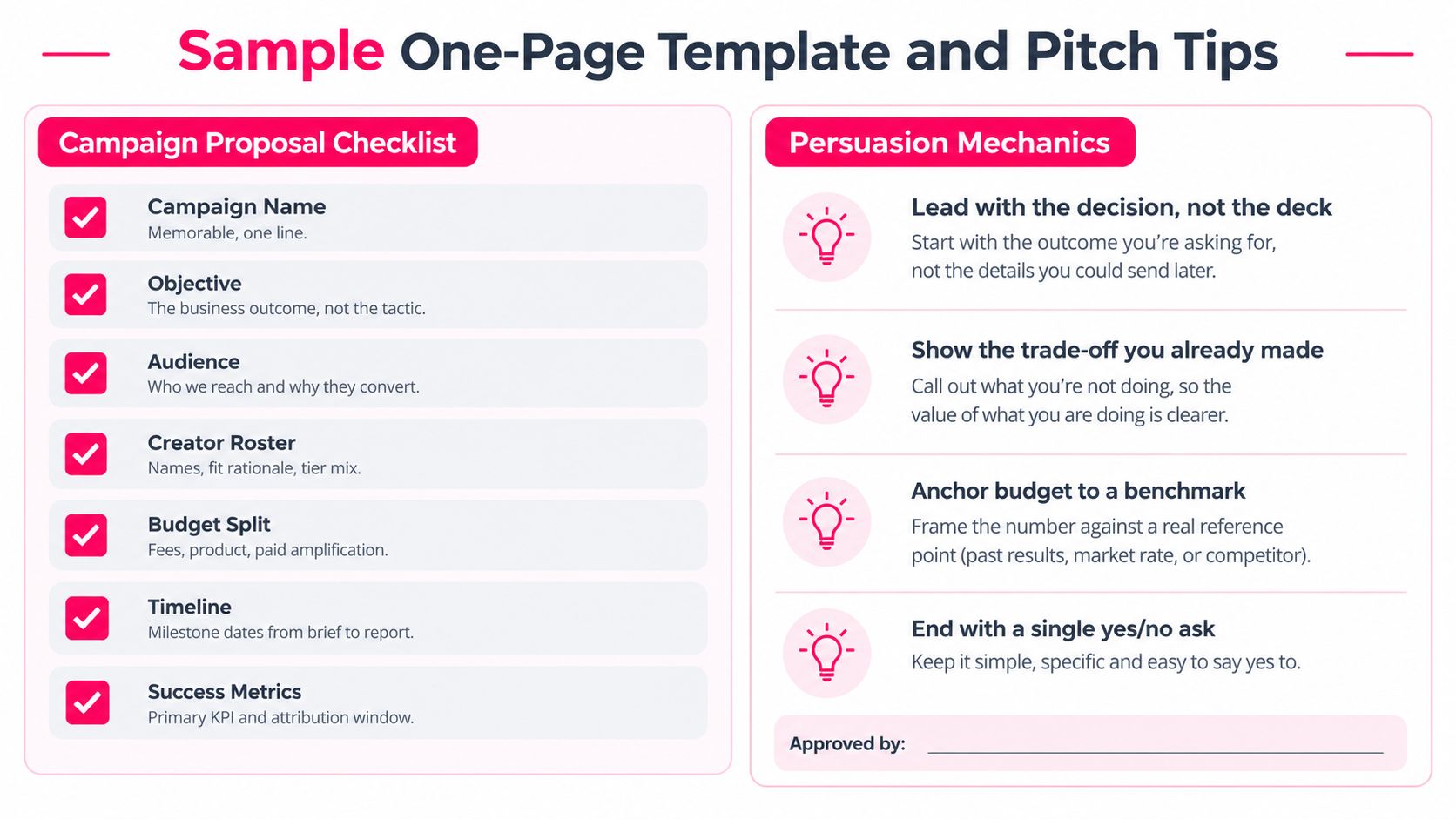
Close with a single decision request: approve the budget, creator structure, and launch date by a named deadline. Don't ask stakeholders to approve “the strategy” in general. Ask for a yes or no on a defined test with a defined stop or scale condition.
The case for acting now isn't that the plan is perfect. It's that a controlled test creates evidence your next proposal can use, while waiting for perfect certainty leaves the budget decision unresolved.
JoinBrands offers creator sourcing, structured briefs, content approvals, product delivery workflows, and analytics in one platform, making it practical for turning an influencer marketing campaign proposal into an executable test. Visit JoinBrands to build a measurable creator workflow around your next campaign.