




 Collaboration Social Media: The DTC Creator Playbook
The most popular advice about influencer marketing pricing is also the least reliable: multiply followers by a standard rate and call the result fair. That approach treats a static post, a polished Reel, a TikTok Shop video, and a dedicated YouTube production as interchangeable units. They aren't.
A creator fee pays for several things at once, including creative production, audience trust, distribution, and sometimes a reusable advertising asset. The right question isn't “What does this influencer charge per post?” It's “What combination of content, reach, rights, and performance can this campaign buy at an acceptable blended cost?”
Table of Contents
The Reality of Modern Influencer Marketing Pricing
Follower count still helps establish a rough starting tier, but it doesn't create a universal rate card. A micro creator might quote one price for a feed post, another for a Reel, and a different structure for a TikTok Shop integration that requires a product demonstration, sales link, and permission to amplify the content through paid media.
The market itself has become larger and more professional while remaining fragmented at the campaign level. The global influencer marketing market reached US$32.55 billion in 2025, a scale that has encouraged more transparent pricing, standardized rate cards, and greater professionalism across creator tiers, according to this industry summary of influencer marketing rate cards. Yet 47.4% of brands spent under $10,000 per campaign in 2024, compared with 43% in 2023, while the share spending more than that rose to 14.5% from 11%. Those figures describe a market with expanding total value but very different buyer budgets.
A post is no longer the whole product
A brand buying one Instagram post may be purchasing a short-lived placement. A brand buying a Reel with raw files, paid usage, creator-handle advertising access, and category exclusivity is buying a small media and production package. Those agreements should never share the same price logic.
Format changes the work involved. Static content may require a simple shoot and caption, while short-form video adds scripting, filming, editing, hooks, revisions, and platform-specific creative decisions. YouTube dedicated videos involve a different production commitment again, with the creator carrying the entire episode rather than inserting a brief mention.
Usage changes the value too. Organic publication on a creator's account is not equivalent to licensing the same asset for a brand's website, email, paid social campaigns, or multiple platforms. The creator's audience and identity may also become part of the media buy when a brand activates whitelisting or Spark Ads.
Practical rule: Start every brief with four separate lines, base deliverable, distribution, usage rights, and performance incentive. If those items are bundled into one number, you won't know what you're actually paying for.
The modern pricing model therefore has three layers. First comes the base creator fee, which covers the agreed content and organic publication. Next come optional commercial rights, such as paid usage, raw asset access, whitelisting, and exclusivity. Finally, performance bonuses or affiliate compensation can reward outcomes without forcing the brand to overpay upfront.
That structure gives DTC teams better control. It also gives creators a clearer way to charge for their work without pretending that every deliverable has the same production burden or commercial value.
Influencer Rate Benchmarks by Tier and Platform
A useful benchmark should narrow the starting point, not replace negotiation. The following 2026 ranges show why platform and format must sit beside creator tier in every budget model. The published benchmark places Instagram posts or Reels, TikTok videos, and YouTube dedicated videos in sharply different bands across nano, micro, macro, and mega creators, as detailed in these 2026 platform and tier pricing benchmarks.
| Creator Tier | Instagram (Reels/Posts) | TikTok (Videos) | YouTube (Dedicated) |
|---|---|---|---|
| Nano | $50–$250 | $50–$300 | $100–$500 |
| Micro | $250–$1,000 | $300–$1,200 | $500–$5,000 |
| Macro | $1,000–$10,000 | $1,200–$12,000 | $5,000–$50,000 |
| Mega | $10,000–$100,000+ | $12,000–$150,000+ | $50,000–$300,000+ |
These ranges cover broad deliverable categories, so they shouldn't be read as a promise that every creator in a tier will quote within the same band. A niche specialist with a responsive audience can justify a stronger fee than a larger account with weak recent performance. Audience geography, content complexity, approval requirements, and intended usage all move the final quote.
Instagram rewards format separation
Instagram Stories and Reels shouldn't appear as one blended “Instagram rate.” Stories are commonly priced around $500–$30,000+, while Reels are often around $750–$50,000+, depending on reach and niche, according to this Instagram influencer pricing guide. A short Story sequence has a different shelf life and production burden from a high-production Reel designed to perform organically and later run as an ad.
The same creator may therefore be inexpensive for a simple Story mention but expensive for a Reel with multiple cuts, product demonstrations, and raw-file delivery. Quote each format independently before asking for a package discount.
TikTok is more volatile, not automatically cheaper
TikTok videos begin at accessible levels for smaller creators, but the upper range rises rapidly when creators deliver reliable views, strong commerce content, or paid amplification access. The benchmark places TikTok videos from $50–$300 for nano creators through $150,000+ for mega creators, which reflects the distance between testing content and large-scale distribution.
TikTok's engagement economics also have a broad spread. That volatility can create upside, but it makes historical average views, view consistency, and prior commerce performance more useful than follower count alone. A lower fee isn't a bargain if the content repeatedly fails to earn attention.
YouTube charges for production and permanence
Dedicated YouTube videos command the highest ceiling in the table because the creator produces an entire piece of long-form content around the brand. The production may include research, scripting, filming, editing, thumbnail work, and a stronger editorial commitment than a short sponsored placement.
The practical mistake is comparing a YouTube dedicated video directly with one TikTok video because both are “one deliverable.” They aren't equivalent units. Compare them by expected qualified reach, content value, shelf life, and the role each asset plays in the campaign.
A separate 2026 benchmark found that 50% of influencers charged between $250 and $1,000 per post, reinforcing that the median creator deal generally sits below celebrity-level pricing and clusters in smaller and mid-sized creator tiers, as reported in this creator marketing statistics benchmark. That makes micro and mid-tier portfolios practical starting points for many brands, but only when the team budgets for management and rights separately.
Hidden Costs and Add-Ons That Inflate Campaign Budgets
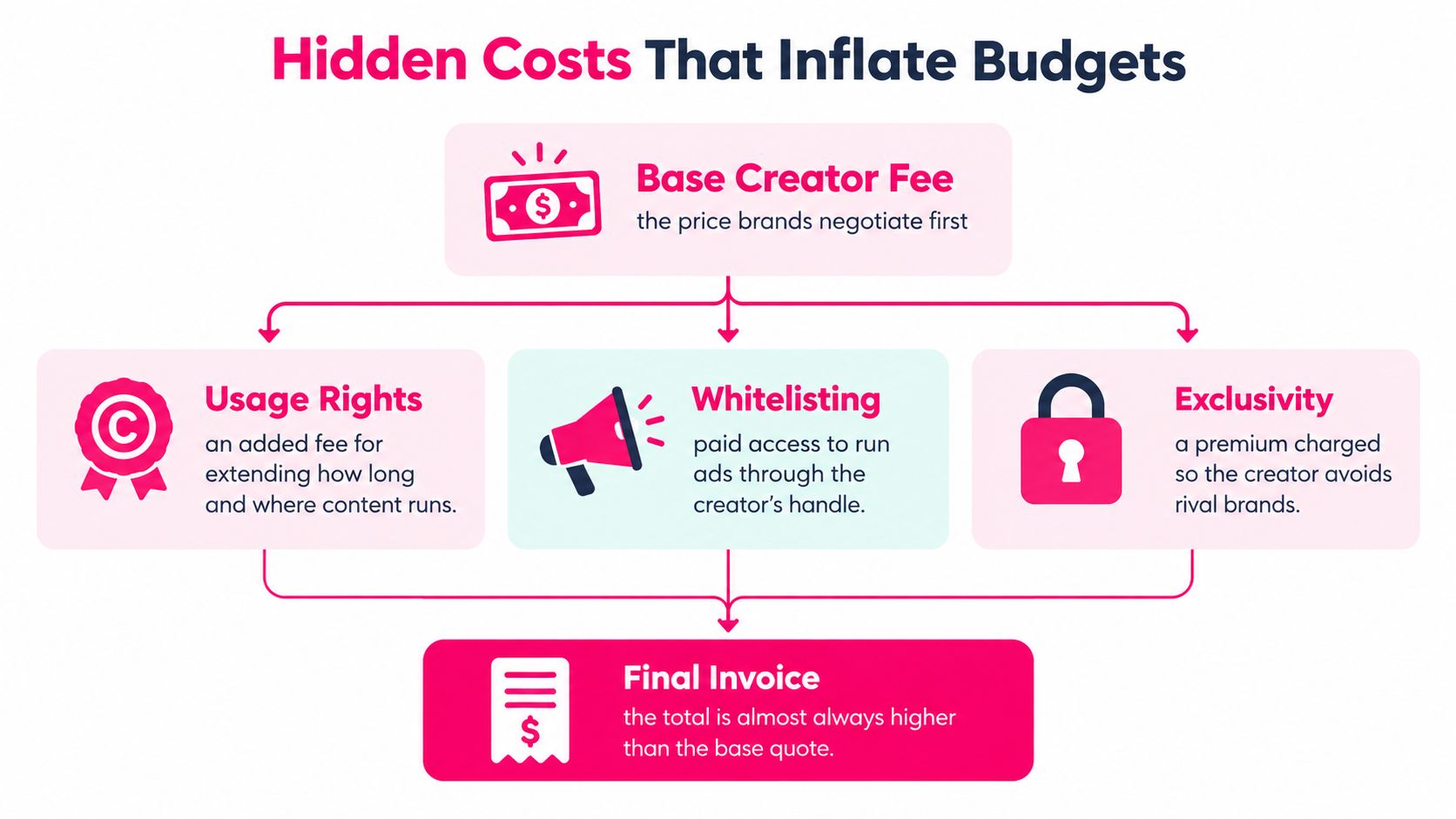
The base quote is the number brands negotiate first, not necessarily the number they pay. A creator may agree to produce one video for a modest fee, then charge separately when the brand asks to run that video as an ad, publish it on another channel, retain the raw files, block competitor work, or keep the content available indefinitely.
Separate production from commercial rights
The contract should identify the base production fee before it lists add-ons. That base might cover one edited TikTok video, one round of revisions, organic posting, and delivery by an agreed deadline. It should not include every possible future use without saying so.
Use a separate line for each expansion:
- Usage rights: Define the platforms, geography, duration, and whether the brand can edit or resize the asset.
- Whitelisting: State whether the brand may run ads through the creator's handle, including Spark Ads activation on TikTok.
- Raw assets: Specify whether unedited clips, alternate hooks, project files, or still images are included.
- Exclusivity: Name the competing categories and the exact period during which the creator can't work with them.
- Revisions and reshoots: Set a review limit and explain what happens when the brand changes the brief after filming.
Pricing scales faster than follower growth once a creator crosses from producing an asset into providing meaningful distribution influence. Mid-tier creator pricing commonly clusters in the $2,000–$10,000 bands, and usage rights and whitelisting should be priced separately from the base fee, as explained in this creator pricing guide.
Consider a hypothetical UGC-first arrangement. A creator may quote $500 for the content production, but the final agreement can become a $2,500 project when the brand adds paid advertising usage and cross-platform syndication rights. Those amounts are an illustration of contract structure, not a market average. The lesson is simple: the brand isn't only buying filming time. It's buying the right to place the creator's work into additional distribution systems.
Watch the operational invoice
Product shipping, reshipping, packaging, agency management, payment processing, editing requests, and rush coordination can all sit outside the creator's headline fee. They matter most in volume programs, where a small overlooked cost multiplied across many creators can change the economics of the entire portfolio.
The most reliable budget sheet has separate columns for creator fees, products and logistics, content rights, paid media activation, management, and incentives. Finance teams can then see whether a campaign is expensive because creators are costly or because the brand expanded the scope after contracting.
The cheapest base fee can become the most expensive campaign when the rights are vague.
Calculating ROI and Cost Per Engagement
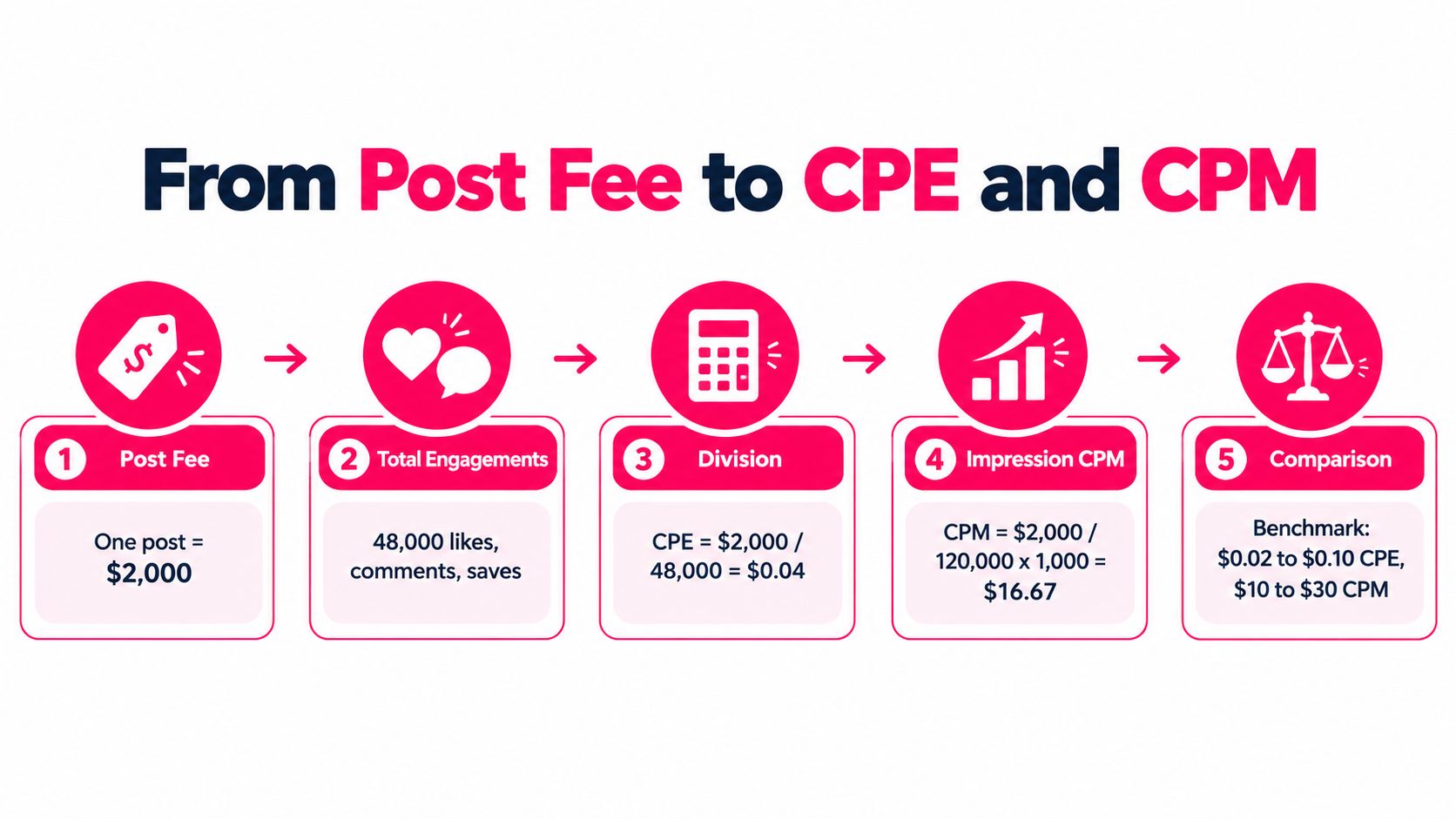
Flat fees make approvals easy, but they don't make creators comparable. To normalize a campaign, calculate cost per engagement, or CPE, and cost per thousand impressions, or CPM, using expected results rather than follower totals.
The basic formulas are straightforward:
- CPE: Total creator cost divided by expected engagements.
- CPM: Total creator cost divided by expected impressions, multiplied by 1,000.
- Blended campaign CPE: Total campaign cost, including rights and management, divided by total engagements across the portfolio.
- Blended campaign CPM: Total campaign cost divided by total impressions, multiplied by 1,000.
Build the calculator around evidence
Start with the creator's recent average views, impressions, likes, comments, saves, and shares. If the creator can't provide useful performance evidence, model a conservative range and avoid paying a premium for unverified reach. Separate organic performance from paid performance, because an asset's results after amplification don't prove what the creator's account would have delivered alone.
Then add the full cost, not just the post fee. If a $2,000 creator fee comes with rights, shipping, management, and paid activation costs, those additions belong in the numerator. Otherwise, the spreadsheet reports an attractive CPE that the finance team can't reproduce.
CreatorIQ's benchmark reports Instagram creators at roughly $0.59–$0.95 per engagement, TikTok at $0.06–$2, and YouTube at $0.11–$0.25, as detailed in this cost-per-engagement pricing benchmark. TikTok's wider range signals more volatility in realized efficiency, while YouTube's narrower range can make planning easier when view history is stable.
Use platform benchmarks as guardrails
CPM estimates can also support early screening. One pricing guide places YouTube at roughly $5–$12 CPM, Instagram at about $0.75–$4 CPM, TikTok at about $0.25–$2 CPM, and emerging platforms at about $0.10–$1 CPM, according to this platform rate and CPM guide. These are directional benchmarks, not automatic bid prices.
A creator with a higher upfront fee can still win if their audience generates more engaged views. Conversely, a low quote can lose after weak delivery, expensive rights, and heavy management time are included.
Measurement rule: Keep creator content, paid media, and affiliate revenue in separate reporting layers before calculating the blended result. Otherwise, you'll credit one channel for outcomes created by another.
For DTC teams, add conversion data where tracking is reliable. Use affiliate links, creator-specific codes, platform reporting, and post-purchase surveys together rather than treating one attribution source as complete. The objective isn't to force every creator into the same model. It's to identify which combinations of format, audience, rights, and distribution produce a margin the business can repeat.
Negotiation Tactics and Budgeting Strategies for Brands
The strongest negotiations don't begin by demanding a lower rate. They begin by defining the inventory. A creator can protect their price while giving a brand better value if both sides adjust scope, timing, rights, deliverable bundles, or incentive structure.
Negotiate the portfolio, not the isolated post
Micro creators can charge anywhere from $200 to $5,000 per post, so a single quote tells a scaling brand very little. The actual challenge is negotiating portfolio pricing and blended rates across dozens of creators, as described in this 2026 influencer benchmark.
For an agency or e-commerce team, build a campaign-level target before outreach. Decide how much of the budget belongs to production, organic distribution, paid usage, and incentives. Then compare the blended cost across a group of creators rather than celebrating one unusually cheap deal.
A practical negotiation sequence looks like this:
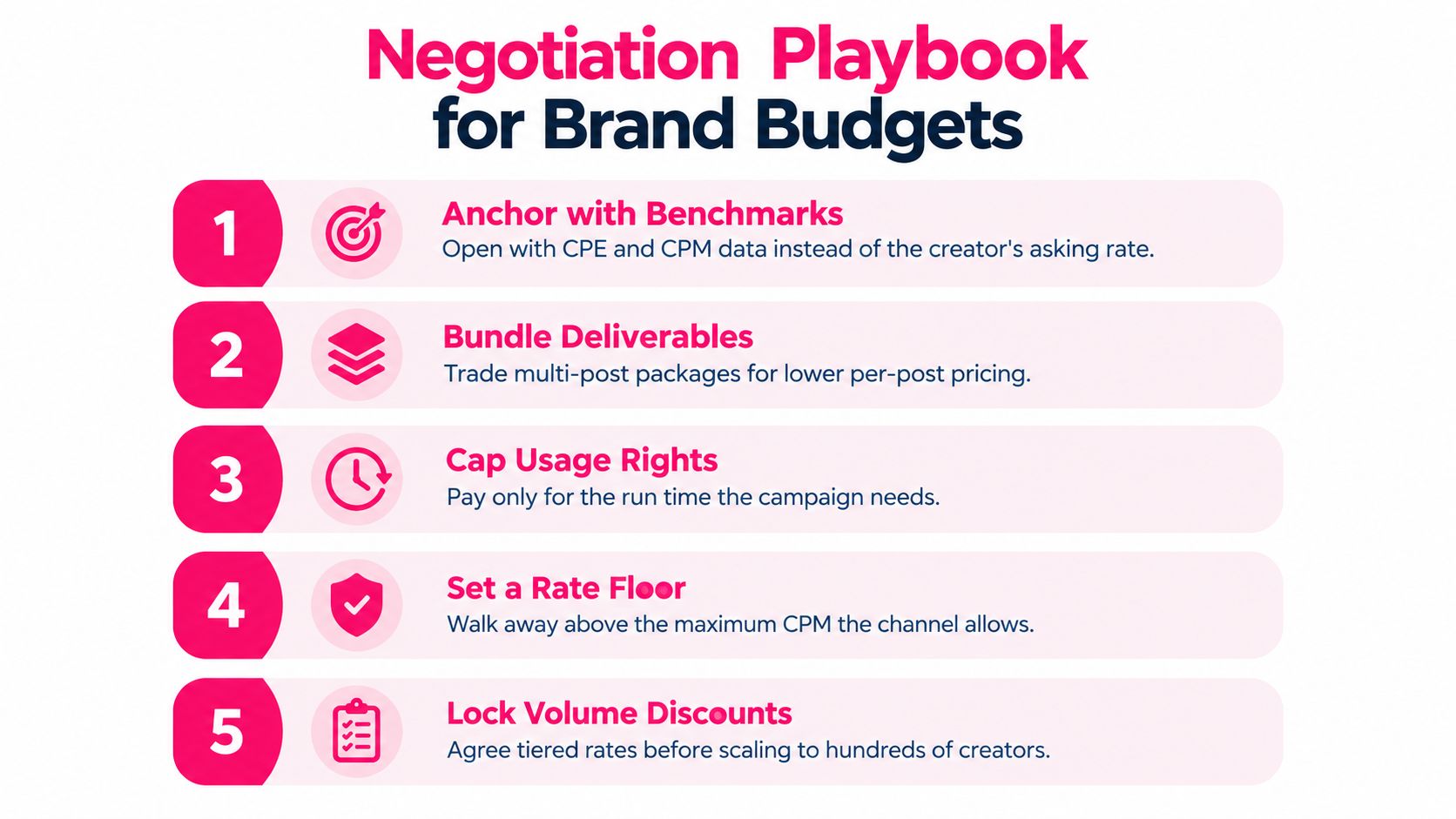
- Anchor with performance data. Present expected CPE or CPM and recent view evidence instead of arguing from the creator's follower total.
- Bundle related deliverables. A Reel, supporting Stories, or a TikTok variation may share creative work, which gives the creator a reason to reduce the unit price.
- Cap the rights. Pay for the period and platforms the campaign needs. Don't accept perpetual, unrestricted usage by default.
- Trade price for scope. If the creator won't reduce the base fee, remove unnecessary exclusivity, reduce revisions, or choose a simpler format.
- Add a performance layer. Use a fixed fee for production and an agreed bonus for tracked sales, qualified actions, or TikTok Shop performance.
Make volume valuable to both sides
A multi-market campaign should have a blended rate model, but not a vague promise of future volume. Define the creator count, deliverable mix, approval process, and payment milestones before asking for a discount. If the brand expects to scale later, write tiered pricing into the agreement so the next wave doesn't restart negotiations from zero.
Long-term partnerships can also reduce friction. Creators learn the product, the brand spends less time on education, and the content becomes more consistent. Don't lock a poor performer into a long retainer, though. Use an initial test period, then expand only when delivery quality and efficiency meet the campaign's thresholds.
Performance bonuses need equally careful design. Tie them to outcomes the creator can influence, define the attribution window, and distinguish organic sales from sales created by paid amplification. A vague “bonus for strong performance” creates conflict after launch.
A rate floor protects the budget. Set the maximum blended CPM or CPE the channel can support, then walk away when the package exceeds it unless the creator brings a strategic asset that the model hasn't captured, such as exceptional creative quality or valuable reusable footage.
Scaling Creator Campaigns with JoinBrands
High-volume creator work breaks down in the handoffs. Someone has to translate the brief, filter creators, approve applications, ship products, track deadlines, collect files, handle revisions, and confirm rights before paid activation. Spreadsheets can track a few partnerships, but they become difficult to audit when several formats and markets run at once.

Turn the pricing model into an operating workflow
JoinBrands is one platform option for centralizing creator campaign operations. Its workflow supports AI-powered creator matching, customizable filters, live chat, campaign briefs, product delivery, content approvals, deadline tracking, and Spark Ads activation. That matters for pricing because the team can filter for the audience, platform, format, and budget requirements before negotiating individual agreements.
A workable process starts with a brief that separates deliverables from rights. The brand can specify whether it needs raw UGC, an organic post, a Reel, a TikTok video, or content intended for paid media. Creators can then be evaluated against the actual job rather than a broad follower tier.
Protect asset ownership and delivery visibility
The operating team should record who owes what, when the product shipped, which revision is pending, and what usage permission has been granted. Centralized approvals reduce the risk of paying for content that can't legally be repurposed, while predictive analytics can help teams compare performance and decide which creators deserve additional budget.
The value isn't limited to discovery. For an agency, a shared workflow can make client reporting cleaner. For an e-commerce brand, it can connect production planning with paid activation and affiliate activity, which helps the team calculate a genuine blended cost instead of relying on the original creator quote.
The key discipline remains contractual clarity. No platform removes the need to define rights, deadlines, revisions, disclosure responsibilities, or bonus terms. Infrastructure makes the model manageable, but the brand still has to decide what each asset is worth and which results justify expansion.
Frequently Asked Questions About Influencer Rates
How should a brand price a UGC-first campaign?
Start with the content-production fee, then list raw asset delivery, editing, usage duration, paid media rights, and any creator-handle activation separately. A UGC asset intended for paid ads is both creative inventory and a media input, so the brand should compare it with other ad creative costs as well as organic creator placements.
What is a sensible testing budget for a new product?
There isn't one universal number. Set a test budget from the number of creative concepts and audience segments you need to evaluate, then reserve enough budget for rights and measurement rather than spending everything on creator fees. A portfolio approach usually gives better learning than putting the entire test behind one expensive endorsement.
What if a creator's media kit is far above the benchmark?
Ask for recent average views, engagement evidence, audience geography, prior sponsored performance, and a precise breakdown of rights. If the premium reflects scarce creative quality or proven distribution, model it through CPE, CPM, and conversion scenarios. If the creator can't explain the premium, offer a narrower package or decline.
Should performance bonuses replace fixed fees?
Usually, no. A base fee compensates production, while a bonus or affiliate component shares upside. That hybrid keeps creators invested without shifting every variable, including landing-page quality, offer strength, tracking, and inventory, onto the creator.
What should contracts clarify first?
Define the deliverable, platform, publication date, revisions, approval process, usage territory, usage duration, paid amplification, exclusivity, ownership, disclosure, payment schedule, and cancellation terms. If a term changes the creator's future earning ability or gives the brand more distribution power, price it explicitly.
JoinBrands gives DTC teams and agencies a centralized way to match creators, manage briefs and product delivery, review content, track deadlines, and activate Spark Ads while keeping the pricing model organized by deliverable and usage. Visit JoinBrands to build a creator portfolio that separates production fees from rights and performance incentives before your next campaign goes live.